M E T H O D O L O G Y
Open Access
Grip and load force coordination in cyclical
isometric manipulation task is not affected by the
feedback type
Sabrina Tiago Pedão
1, José Angelo Barela
1,2, Kauê Carvalho de Almeida Lima
1and Paulo Barbosa de Freitas
1*Abstract
Background:The relationship between normal and tangential force components (grip force–GF and load force–LF, respectively) acting on the digits-object interface during object manipulation reveals neural mechanisms involved in movement control. Here, we examined whether the feedback type provided to the participants during exertion of LF would influence GF-LF coordination and task performance.
Methods:Sixteen young (24.7 ±3.8 years-old) volunteers isometrically exerted continuously sinusoidal FZ(vertical component of LF) by pulling a fixed instrumented handle up and relaxing under two feedback conditions: targeting and tracking. In targeting condition, FZexertion range was determined by horizontal lines representing the upper (10 N) and lower (1 N) targets, with frequency (0.77 or 1.53 Hz) dictated by a metronome. In tracking condition, a sinusoidal template set at similar frequencies and range was presented and should be superposed by the participants’exerted FZ. Task performance was assessed by absolute errors at peaks (AEPeak) and valleys (AEValley) and GF-LF coordination by GF-LF ratios, maximum cross-correlation coefficients (rmax), and time lags.
Results:The results revealed no effect of feedback and no feedback by frequency interaction on any variable. AEPeakand GF-LF ratio were higher and rmaxlower at 1.53 Hz than at 0.77 Hz.
Conclusion:These findings indicate that the type of feedback does not influence task performance and GF-LF
coordination. Therefore, we recommend the use of tracking tasks when assessing GF-LF coordination during isometric LF exertion in externally fixed instrumented handles because they are easier to understand and provide additional indices (e.g., RMSE) of voluntary force control.
Keywords:Visual, Auditory, Hand function, Motor control
Background
The ability to use one or both hands to grasp and ma-nipulate objects is essential for performing innumerous daily living activities and, consequently, is important for maintaining an independent lifestyle. Therefore, several studies have explored different aspects of hand function. Specifically, a largely used and elegant experimental para-digm has been applied to investigate the relationship between force components acting on the digits and object surface interface during object manipulation. The force component acting tangentially on the digits-object
interface, referred to as load force (LF), tends to cause slippage of the handheld object, which is prevented by the exertion of force perpendicularly to the object surface, which has been termed grip force (GF) [1-3].
The close relationship established between GF and LF during object manipulation is a striking evidence of the central nervous system’s (CNS) ability to predict the effects of individuals’ own actions [2,4-6]. This coupling has been widely investigated during manipulation tasks that involve lifting a grasped object [1], moving a handheld object upward and downward discretely [7] or continu-ously [5,8], and isometrically applying sinusoidal LF pro-files on an externally fixed object [4,6,9]. This highly coupled relationship is characterized by a parallel change of GF and LF with virtually no time delay. During tasks in * Correspondence:[email protected]
1Institute of Physical Activity and Sport Sciences and Graduate Program in
Human Movement Sciences, Cruzeiro do Sul University, Rua Galvão Bueno 868, 13° andar, Bloco B, São Paulo 01506-000, SP, Brazil
Full list of author information is available at the end of the article
which LF changes (e.g., lifting, transporting, and shaking a handheld object) this parallel change of GF and LF ensure an economical exertion of GF [1,4,5,7,9].
Investigations of GF-LF coupling using continuous changes in LF during manipulation of free moving and fixed objects have provided consistent support for the use of predictive strategies by CNS in healthy [4,5] and neurological individuals [10-12]. However, the use of an externally fixed object could be advantageous when compared with the use of a free moving one because researchers could easily regulate LF magnitude and fre-quency. Also, additional information about the CNS current condition and about the adopted control strategies related to visuomotor coordination could be obtained by assessing the individual’s ability to control LF (i.e., task performance) over the task time course. Hence, a com-mon methodological feature of this type of experiment is to provide both the real time visual feedback of the exerted LF and any type of information regarding the prescribed LF magnitude and frequency to guide partici-pants in the task execution. For example, in two studies performed in fixed (or quasi-fixed) objects, visual informa-tion about the prescribed LF magnitude and frequency and about the currently exerted LF was presented in oscil-loscopes and computer screens [4,10,13]. Moreover, in other studies [6,9], visual information about the prescribed LF magnitude was shown in a computer screen (i.e., visual feedback) while information about LF frequency was given by a metronome (auditory feedback).
To our knowledge, no one compared the effects of exerting cyclical isometric LF using different types of feed-back on task performance as well as on GF scaling and GF-LF coupling. The comparison between two different types of feedback (visual vs. visual plus auditory) is a rele-vant methodological aspect when designing studies aiming to investigate the relationship between GF and LF and to assess hand function in healthy and hand-impaired indi-viduals. Regarding task performance, we could expect differences between feedback conditions because any motor task that requires simultaneous processing of vis-ual and auditory feedback could be considered more complex than a task that requires processing of a single source of feedback because individuals need to deal with two different sources of information, which increases, for example, attentional demands. Thus, looking from this perspective, individuals with attention deficits (e.g., old adults, Parkinson and cerebellar patients, and spe-cific group of children) would benefit from a simplified experimental approach as the proposed by this study. Conversely, regarding GF scaling and GF-LF coupling, the need for accuracy throughout the whole task imposed by a visual task could be a burden on the CNS and it would make the system to change the adopted control strategy, that is, increase GF magnitude and reduce GF-LF coupling.
Thus, before recommending one experimental approach in detriment of another we need to investigate whether they produce different outcomes in variables related to GF-LF coordination as well as task performance. There-fore, we examine in this study whether the type of feedback received by the individuals during exertion of oscillatory isometric LF profile would influence task performance and GF scaling, as well as GF-LF coord-ination. If we find differences in task performance and, mainly, in GF-LF coordination we would have to take into consideration this fact before selecting one type of feedback that interfere less with GF-LF coordination. Alternatively, if we find no differences in those variable we could claim that the type of feedback received by the participants is not influential in GF-LF coordination and could recommend the use of either one based upon the advantages that one type of feedback has comparing to the other.
Methods Participants
Sixteen healthy and right-handed individuals (eight males), ranging from 19 to 33 years of age (mean ± S.D.: 24.7 ±3.8 years-old) participated in the study. Their participation was conditioned to the signature of an informed consent form. All experimental procedures and the informed consent form given to and signed by the participants were approved by the research ethics committee of the Cruzeiro do Sul University. This study was conducted in accordance with the Declaration of Helsinki.
Instrumentation
Experimental procedure
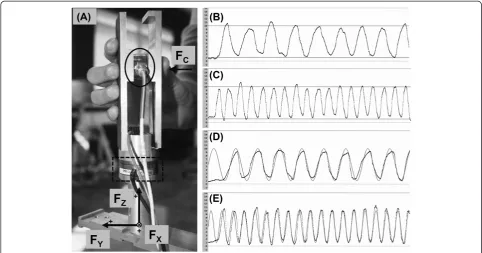
Before starting the experiment, all participants cleaned the tip of their digits with alcohol swabs. Then, they stood upright, kept their upper arm vertically and fore-arm horizontally oriented, and were asked to grasp the fixed handle using the tip of their digits as shown in Figure 1A. The vertically oriented handle was rotated 45° with respect to the participants’frontal plane to as-sure a comfortable wrist position. Next, the participants were asked to exert a sinusoidal pattern of the vertical component of LF (FZ), by isometrically pulling the han-dle up and relaxing up to a certain point. They were requested to do it within a prescribed range (i.e., 9 N, ranging from 1 to 10 N) at two different frequencies [46 bpm (≈0.77 Hz) and 92 bpm (≈1.53 Hz)].
The participants performed the task receiving two distinct types of feedback:targeting and tracking. In the
targeting condition, they received information of the prescribed FZmagnitude by two horizontal lines presented in a 19-in. widescreen computer monitor placed in front of them (Figure 1B-C) and information of the prescribed frequency by a metronome set at the above mentioned frequencies. They also received information about the current real-time FZ exerted by them shown as a con-tinuous left to right running black line. The partici-pants were instructed to continuously exert sinusoidal
FZ reaching the upper and lower targets (red lines) as accurate as possible following the rhythm dictated by the metronome. In the tracking condition, sinusoidal templates set at similar frequencies (either 0.77 Hz or 1.53 Hz) and range (9 N, from 1 to 10 N) were individu-ally shown in the screen (Figure 1D-E). In this condition, the participants were asked to exert oscillatory FZin order to match (i.e., superpose) the sinusoidal template, also as accurate as possible. The force range was selected based upon the fact that healthy young individuals, in the most of the daily situations in which they manipu-late objects with a precision grip, do not generate high levels of tangential force due to the limitation of GF muscles to generate high magnitudes of grip to prevent slippage. Regarding the chosen frequencies, we selected a slow and a fast rate of FZchange, which allowed for a
condition of feedback and frequency were recorded at 200 Hz and stored for further analysis. Individual trials lasted 12 s and were performed in a balanced sequence, with half of the participants starting with the targeting condition and half starting with the tracking one. The same was done for frequency. Note that participants were only instructed to exert FZby isometrically pulling up the han-dle and GF was not mentioned whatsoever.
Data processing and analyses
Two customized LabView (Version 2010, National Instru-ments, Austin, TX, USA) routines were used for data acquisition and processing. The raw force data were low-pass filtered at 20 Hz with a fourth-order (zero-phase lag) Butterworth filter. Data from the first 4 s (phase for FZ fre-quency and magnitude adjusts) and the last 2 s (end of trial) of each trial were not considered and removed after filtering processing. Therefore, only the data between the 4th and 10th s were analyzed. Next, dependent variables related to task performance, GF scaling, and GF-LF coup-ling were calculated. Task performance was assessed by absolute errors (AE) [15] of FZ peaks and valleys with respect to the upper (AEPeak) and lower (AEValley) tar-gets, respectively. GF-LF coordination was evaluated by measures of GF scaling and GF-LF coupling. GF scaling, which represents the CNS ability to scale GF with re-spect to LF, was assessed by GF-LF ratio (GF/LF), calcu-lated as the averaged GF divided by the averaged absolute LF. Also, the maximum cross-correlation coefficient (rmax) between GF and LF and its respective time lag (positive values indicating that GF lags LF) were computed from a linear cross-correlation analysis to assess, respectively, the directional and temporal coupling between LF and GF.
Statistical analyses
Five two-way, repeated measures, analyses of variance (ANOVA) were employed to test the effects of feedback (targeting vs. tracking) and frequency of FZ exertion (0.77 vs. 1.53 Hz) and the interaction between these factors
on AEPeak, AEValley, (GF/LF), Fisher’s z transformed of the rmax, and time lag. The significance level was set at .05.
Results
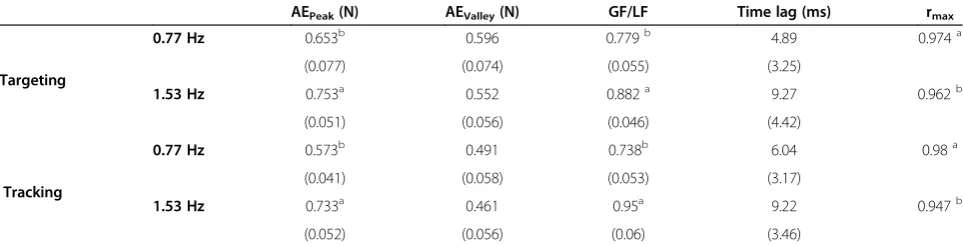
Overall, the results showed that the participants were able to exert sinusoidal FZ profiles reaching the lower and upper targets accurately (AEs in average less than 1 N) at the requested frequencies independently of the type of feedback presented. Also, very high rmaxvalues (>.87) with most of time lags ranging within ± 20 ms interval were observed regardless of feedback type and FZfrequency. The averaged values of the dependent variables related to task performance (AEPeak and AEValley), GF scaling (GF/LF) and directional and temporal GF-LF coupling (rmaxand time lag) are presented in Table 1.
Task performance
Regarding the effect of feedback and frequency on AEPeak, ANOVA revealed no main effect of feedback [F(1,15) = 1.5, p > .05,η2= .09] and no feedback by frequency inter-action [F(1,15) = 0.15, p > .05, η2= .03], but revealed that AEPeak was larger at 1.53 Hz than at 0.77 Hz [F(1,15) = 10.68, p < .01, η2= .42]. For AEValley, however, ANOVA revealed neither main effect of feedback [F(1,15) = 2.5, p > .05, η2= .14], nor of frequency [F(1,15) = 0.56, p > .05,
η2
= .04], and no feedback by frequency interaction [F(1,15) = 0.04, p > .05, η2= .01].
GF scaling
ANOVA for GF/LF revealed neither effect of feedback [F(1,15) = 0.15, p > .05, η2= .01] nor feedback by fre-quency interaction [F(1,15) = 2.83, p > .05, η2= .16], but revealed that GF-LF ratio was higher at 1.53 Hz than at 0.77 Hz [F(1,15) = 18.04, p < .005,η2= .55].
Directional and temporal GF-LF coupling
ANOVA for rmax Fisher’s z transformed values revealed no main effect of feedback [F(1,15) = 0.4, p > .05,η2= .03] and no feedback by frequency interaction [F(1,15) = 0.005, p > .05, η2= .01], but revealed that rmax values were the
Table 1 Values representing task performance (AEPeakand AEValley), GF scaling (GF/LF), and GF-LF coupling (rmaxand time lag) in targeting and tracking feedback conditions performed at 0.77 Hz and 1.53 Hz
AEPeak(N) AEValley(N) GF/LF Time lag (ms) rmax
Targeting
0.77 Hz 0.653b 0.596 0.779b 4.89 0.974a
(0.077) (0.074) (0.055) (3.25)
1.53 Hz 0.753a 0.552 0.882a 9.27 0.962b
(0.051) (0.056) (0.046) (4.42)
Tracking
0.77 Hz 0.573b 0.491 0.738b 6.04 0.98a
(0.041) (0.058) (0.053) (3.17)
1.53 Hz 0.733a 0.461 0.95a 9.22 0.947b
(0.052) (0.056) (0.06) (3.46)
highest at the lower frequency (i.e., 0.77 Hz) [F(1,15) = 14.3, p < .005, η2= .49]. Regarding the time lag, ANOVA revealed no main effect of feedback [F(1,15) = 0.71, p > .05,
η2
= .05] and frequency [F(1,15) = 1.04, p > .05, η2= .09], and no feedback by frequency interaction [F(1,15) = 0.86, p > .05,η2= .05].
Discussion
The aim of the study was to examine whether the type of feedback received by the participants while exerting oscillatory isometric LF profile would influence task per-formance and GF-LF coordination. The results showed that the type of feedback received did not impact any of the variables and that it is not frequency dependent. Moreover, the results revealed the already known effect of frequency on GF-LF coordination and task perform-ance (lower rmax and higher GF-LF ratio, and higher AEPeakat the higher frequencies) [6,14].
Based upon these findings, someone would have no restrictions when selecting any of the feedback types tested in this study. However, the use of a tracking task could be advantageous when compared to the targeting one. Firstly, while in the targeting condition individuals need to deal with two sources of information (visual and auditory), in the tracking condition information about the prescribed LF magnitude and about LF frequency is presented simultaneously as a single entity (i.e., a sinus-oidal template). Therefore, tracking would make the task easier because attention resources would be focused on a single source and not diverged in two as in a targeting task. Moreover, the tracking task would provide better guidance for task performance because, intuitively, it would be easier for children, older adults, and persons with mild neurological and orthopedic impairment to follow the instructions of tracking (i.e., superposing) a sinusoidal template than to reach the upper and lower targets during exerting LF in a sinusoidal manner following the beats of a metronome. Likewise, individuals who undergo hearing problems (e.g., old adults) could also be able to be tested when performing a tracking task. Secondly, a tracking task could provide additional and more complete estimation of task performance (i.e., force control) than a targeting one. Dependent variables such as absolute, variable and constant errors [15], related to LF peaks and valleys, could be calculated from both tasks. However, the ability to control force throughout the task execution could only be assessed in the tracking task by using, for instance, the root mean square error (RMSE) as a dependent variable.
Alternatively, someone could suggest the use of simple vertically moving horizontal bar that would oscillate up-ward and downup-ward as the source of feedback about the prescribed frequency and amplitude [10] or the use of a task that involve pursuit of a sinusoidal moving target [16]. However, while those two feedback strategies could
be as effective as the tracking task to provide visual guid-ance, they do not provide information about the continu-ing force path what could be useful for force magnitude and frequency corrections during task execution [17]. Also, information about force magnitude provided by a relatively rapid moving bar does not allow individual to give priority to a high level of accuracy.
There are limitations in this study that deserve to be mentioned and could be addressed in future investiga-tions. For instance, participants exerted sinusoidal LF profile in only one force range (1–10 N). Despite Uygur and colleagues [14] having found no effect of LF magni-tude in GF-LF coordination in LF ranging from 6 to 15 N during a task identical to the performed in targeting con-dition, the tracking task was not tested in different load conditions and the GF-LF coordination and task perform-ance could be affected in higher and even lower LF ampli-tudes. In addition, we tested the participants in only two frequencies (0.77 and 1.53 Hz). During isometric LF exer-tion in targeting condiexer-tion, Jaric and colleagues [6] found that GF-LF coupling and GF scaling is affected in relatively very high frequency (above 3 Hz). In frequencies lower than 2.5 Hz, the indices of GF-LF coordination are kept relatively stable. However, those findings could not be applied to tracking conditions. Despite we observed no difference between feedback condition at 0.77 Hz and 1.53 Hz in GF scaling and GF-LF coupling, we could not affirm that feedback condition would not affect those parameters in frequencies higher than 1.53 Hz. Neverthe-less, the amplitude and frequencies selected by this study are within the range utilized by virtually all the studies that used isometric LF exertion to investigate GF-LF coordin-ation in individuals with neurological deficits e.g., [10-12].
Conclusion
In conclusion, due to the fact that our findings did not indicate any effect of feedback type on GF scaling and GF-LF coupling as well as on the ability to reach the prescribed upper and lower targets, we could claim that the type of feedback presented (i.e., visual and visual plus auditory) does not affect the coordination between GF and LF. However, because tracking tasks are easier to understand and provides additional indices of voluntary force control (e.g., RMSE), we recommend from now on the use of tracking tasks such the one performed in this study during experiments involving isometric LF exertion in externally fixed instrumented objects.
Abbreviations
Competing interests
The authors declare that they have no competing interests.
Authors’contributions
STP and KCAL were responsible for data collection, processing, and analysis as well as data interpretation and drafting the article. JAB was responsible for drafting the article and revising it critically for scientific method and content. PBF was responsible for conception and design of the study. Also, he was responsible for programing the LabView routines for data acquisition and processing, for data interpretation, and for drafting the article. All authors read and approved the final version of the manuscript.
Acknowledgements
Authors are thankful to the São Paulo State Research Foundation (FAPESP) for the financial support (FAPESP #2010/02939-4).
Author details 1
Institute of Physical Activity and Sport Sciences and Graduate Program in Human Movement Sciences, Cruzeiro do Sul University, Rua Galvão Bueno 868, 13° andar, Bloco B, São Paulo 01506-000, SP, Brazil.2Departament of Physical Education, Bioscience Institute, São Paulo State University at Rio Claro, Av. 24-A, 1515, Bela Vista, Rio Claro, São Paulo, SP 13506-900, Brazil.
Received: 27 March 2012 Accepted: 26 March 2013 Published: 4 April 2013
References
1. Johansson RS, Westling G:Roles of glabrous skin receptors and sensorimotor memory in automatic control of precision grip when lifting rougher or more slippery objects.Exp Brain Res1984,56:550–564. 2. Johansson RS, Westling G:Programmed and triggered actions to rapid
load changes during precision grip.Exp Brain Res1988,71:72–86. 3. Westling G, Johansson RS:Factors influencing the force control during
precision grip.Exp Brain Res1984,53:277–284.
4. Blakemore SJ, Goodbody SJ, Wolpert DM:Predicting the consequences of our own actions: the role of sensorimotor context estimation.J Neurosci
1998,18:7511–7518.
5. Flanagan JR, Wing AM:The stability of precision grip forces during cyclic arm movements with a hand-held load.Exp Brain Res1995,105:455–464. 6. Jaric S, Collins JJ, Marwaha R, Russell E:Interlimb and within limb force
coordination in static bimanual manipulation task.Exp Brain Res2006,
168:88–97.
7. Flanagan JR, Wing AM:Modulation of grip force with load force during point-to-point arm movements.Exp Brain Res1993,95:131–143. 8. Zatsiorsky VM, Gao F, Latash ML:Motor control goes beyond physics:
differential effects of gravity and inertia on finger forces during manipulation of hand-held objects.Exp Brain Res2005,162:300–308. 9. De Freitas PB, Jaric S:Force coordination in static manipulation tasks
performed using standard and non-standard grasping techniques.
Exp Brain Res2009,194:605–618.
10. Brandauer B, Timmann D, Hausler A, Hermsdorfer J:Influences of load characteristics on impaired control of grip forces in patients with cerebellar damage.J Neurophysiol2010,103:698–708.
11. Krishnan V, De Freitas PB, Jaric S:Impaired object manipulation in mildly involved individuals with multiple sclerosis.Motor Control2008,12:3–20. 12. Rost K, Nowak DA, Timmann D, Hermsdorfer J:Preserved and impaired
aspects of predictive grip force control in cerebellar patients.Clin Neurophysiol2005,116:1405–1414.
13. Hermsdorfer J, Blankenfeld H:Grip force control of predictable external loads.Exp Brain Res2008,185:719–728.
14. Uygur M, De Freitas PB, Jaric S:Effects of varying the load force range and frequency on force coordination in static manipulation.Neurosci Letters
2010,475:115–119.
15. Schmidt RA, Lee TD:Motor control and learning: A behavioral emphasis.4th edition. Champaign: Human Kinetics; 2005.
16. Sarlegna FR, Baud-Bovy G, Danion F:Delayed visual feedback affects both manual tracking and grip force control when transporting a handheld object.J Neurophysiol2010,104:641–653.
17. Miall RC, Jackson JK:Adaptation to visual feedback delays in manual tracking: evidence against the Smith Predictor model of human visually guided action.Exp Brain Res2006,172:77–84.
doi:10.1186/1743-0003-10-34
Cite this article as:Pedãoet al.:Grip and load force coordination in cyclical isometric manipulation task is not affected by the feedback type.Journal of NeuroEngineering and Rehabilitation201310:34.
Submit your next manuscript to BioMed Central and take full advantage of:
• Convenient online submission
• Thorough peer review
• No space constraints or color figure charges
• Immediate publication on acceptance
• Inclusion in PubMed, CAS, Scopus and Google Scholar
• Research which is freely available for redistribution