Iranian Biomedical Journal 15 (3): 73-78 (July 2011)
Association of Arg194Trp, Arg280His and Arg399Gln
Polymorphisms in X-ray Repair Cross-Complementing Group 1
Gene and Risk of Differentiated Thyroid Carcinoma in Iran
Pezhman Fard-Esfahani
*1, Armaghan Fard-Esfahani
2, Shima Fayaz
1, Bahareh
Ghanbarzadeh
3, Parinaz Saidi
1, Reyhaneh Mohabati
1, Seyed Kazem Bidoki
3and Mina Majdi
21
Dept. of Biochemistry, Pasteur Institute of Iran, Tehran; 2Research Institute for Nuclear Medicine, Tehran University of Medical Sciences, Tehran; 3Dept. of Biochemistry and Genetics,
Payam-e-Noor University of Tehran, Tehran, Iran
Received 9 May 2011; revised 23 August 2011; accepted 3 September 2011
ABSTRACT
Background: X-ray repair cross-complementing group 1 (XRCC1) gene is a DNA repair gene and its
non-synonymous single nucleotide polymorphisms (SNP) may influence DNA repair capacity which has been considered as a modifying risk factor for cancer development. Methods: A case-control study was conducted to
investigate impact of three frequently studied polymorphisms (Arg194Trp, Arg280His and Arg399Gln) on
developing differentiated thyroid carcinoma (DTC). Results:Increased risks for DTC were shown in homozygous
(odds ratio [OR]: 3.66, 95% confidence interval [CI]: 0.38-35.60) and in dominant trait (OR: 1.22, 95% CI: 1.64-2.32) of Arg194Trpgenotype. Also, for Arg280Hisgenotype, an increased risk for DTC was shown in dominant
trait (OR: 1.42, 95% confidence interval [CI]: 0.76-2.68), while a mildly reduction of risk for DTC (OR: 0.77, 95% [CI]: 0.50-1.17) was estimated in dominant Gln genotype of Arg399Gln. Considering combinatory effects of Arg194Trpand Arg280Hisgenotypes on DTC, the calculated OR and 95% CI for being heterozygous for one of Arg194Trp or Arg280His genotypes were 1.57 and 0.90-2.74, respectively. Conclusion: Genotyping of codons
194, 280 and 399 in XRCC1gene may use in risk assessment of DTC. Iran. Biomed. J. 15 (3): 73-78, 2011
Keywords: Endocrine related cancer, DNA repair gene, X-ray repair cross-complementing group 1 (XRCC1) gene, Differentiated thyroid carcinoma (DTC)
INTRODUCTION
xogenous and endogenous mutagens damage DNA, which may result in uncontrolled cell proliferation or programmed cell death. To protect the integrity of genome, some DNA repair systems have been developed in variety of organisms from bacteria to mammals. A few pathways of DNA repair operate on specific types of damaged DNA. Among them, base excision repair (BER) operates on nil lesions [1] and more than 20 gene products are related to BER [2]. The X-ray repair cross-complementation group 1 (XRCC1) protein plays an important role in BER [3]. The XRCC1 is a multi-domain protein, and is required for the efficient repair of single strand breaks and damaged bases in DNA [3, 4]. This protein is essential for mammalian viability because XRCC1 deficiency in mice results in
embryonic lethality. As DNA damage may result in somatic mutations and subsequent stimulation of DNA repair processes, it can be considered that polymorphisms of DNA repair genes may alter cell repair function capacity and lead to carcinogenesis [5]. The XRCC1 gene is located on chromosome 19q13.2
and 17 exons of this gene encode a protein with 633 amino acids [6]. A number of single nucleotide polymorphisms (SNP) have been reported in the
Ensembl database. Among them, Arg194Trp
(rs1799782), Arg280His (rs25489) and Arg399Gln
(rs25487) are highly studied and caused non-conservative changes [7]. Some studies have shown a significant association between these variants and risk of different types of human cancer [8, 9]. These findings suggest that non-conservative changes may result in DNA repair capacity, although there are inconsistent reports in favor of cancer types and
E
74 Fard-Esfahani et al. Iran. Biomed. J., July 2011
different populations [10, 11]. Rationally, it seems non-conservative that Arg194Trp, Arg280His and Arg399Gln substitutions may attribute to cancer
susceptibility.
Thyroid carcinomas are the most frequent endocrine malignancies which among these thyroid carcinomas, more than 90 percent are differentiated thyroid carcinomas (DTC). Pathologically, DTC include papillary, follicular, and Hürthle cell carcinoma [12]. To date, exposure to ionizing radiation is the only known risk factor for thyroid cancer [13]. However, there are evidences that some gene variants including DNA repair genes influence on DTC susceptibility.
XRCC1is one of the candidate genes which its variant
relationship with thyroid cancer has not been extensively studied [14].
In the present case-control study, the genotype frequency distributions of three common XRCC1SNP
(Arg194Trp, Arg280Hisand Arg399Gln) are compared
in DTC patients and thyroid cancer-free controls using usual statistical methods.
MATERIALS AND METHODS
Cases and controls. The cases were thyroid cancer
patients with DTC pathologic diagnosis after surgical excision. The controls were individuals who were thyroid cancer free. The sample volumes are indicated in Table 1. Both cases and control groups were admitted to Research Institute for Nuclear Medicine of Shariati Hospital during the period of September 2008-2009 and signed a consent form for genetic tests. Individuals with cervical lymph node involvement, any other cancer history, heavy smokers, radiation exposure history and alcohol users were excluded from the research. Controls were frequency matched to cases based on age and sex.
Genotype analysis. Peripheral blood was collected in
tubes containing EDTA and genomic DNA was extracted from leukocytes by previously described method in literature. XRCC1codons 194 and 399 were
determined using PCR-RFLP as described previously [11, 15]. Briefly, the primers used for XRCC1 codon
194 were GCCAGGGCCCCTCCTTCAA and TACC CTCAGACCCACGAG; and for codon 399 were TCCTCCACCTTGTGCTTTCT and AGTAGTCTGC TGGCTCTGGG. The PCR reactions for two polymorphisms were the same. Each 25 μl reaction contained 10 pmol of each primer, 2.0 mM MgCl2, 200
mM each dNTP, 1 unit of Taq DNA polymerase
(CinnaGen Smart Taq, Iran) and 50-250 ng of genomic
DNA. The PCR conditions for codon 194 were 95oC
Table 1.Arg194Trp (A), Arg280His (B)and Arg399Gln (C):
demographic and genotype frequencies of case and control subjects.
(A)
Variable
DTC (n = 157)
Controls (n = 187)
n % Pa
n %
Sex 0.596
Male 34 21.7 45 24.1
Female 123 78.3 142 75.9
Age 0.137
<= 50 131 83.4 144 77.0
> 50 26 16.6 43 23.0
Arg194Trp 0.477
Arg/Arg 136 86.6 166 88.8
Arg/Trp 18 11.5 20 10.7
Trp/Trp 3 01.9 1 00.5
Trp allele frequency 07.6 0.357 05.9
(B)
Variable
DTC (n = 170)
Controls (n = 193)
n % Pa
n %
Sex 0.826
Male 38 22.4 45 23.3
Female 132 77.6 148 76.7
Age 0.173
<= 50 141 82.9 149 77.2
> 50 29 17.1 44 22.8
Arg280His 0.411
Arg/Arg 146 85.88 173 89.64
Arg/His 23 13.53 18 09.33
His/His 1 0.59 2 01.04
His allele frequency 30.3 0.366 033.4
(C)
Variable
DTC (n = 155)
Controls (n = 190)
n % Pa
n %
Sex 0.700
Male 34 22 45 23.7
Female 121 78 145 76.3
Age 0.131
<= 50 130 83.9 147 77.4
> 50 25 16.1 43 22.6
Arg280His 0.401
Arg/Arg 78 50.3 83 43.7
Arg/Gln 60 38.7 87 45.8
Gln/Gln 17 11 20 10.5
Gln allele frequency 30.3 0.385 033.4
a
P<0.05 is significant
Iran. Biomed. J., July 2011 XRCC1 Gene Polymorphisms and Risk of DTC in Iran
75
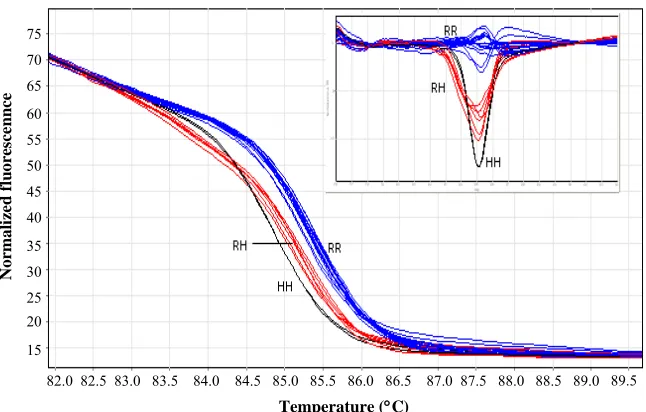
Fig. 1.High resolution meltingof XRCC1gene in 25 samples. RR-, RH- and HH-type curves are shown as RR, RH and HH, respectively. Small box shows difference graphs.
for 2 min; 35× (95oC for 30 s, 57oC for 30 s and 72oC
for 45 s); 72oC for 7 min and for codon 399 were 95oC
for 2 min; 35× (95oC for 30 s, 61oC for 30 s and 72oC
for 45 s); 72oC for 7 min . PCR products of codon 194
(485 bp) and codon 399 (517 bp) were digested by
PvuII and BcnI restriction enzymes (Fermentas,
Switzerland), respectively. Using submarine electro-phoresis, the DNA fragments were separated in 2% agarose gel and visualized by ethidium bromide. The expected fragments for codon 194 were 485 bp (194Arg) and 396 plus 89 bp (194Trp) as well as for
codon 399 were 384 and 133 bp (399Arg) and 517 bp
(399Gln).
For Arg280His genotyping, we developed a high
resolution melting (HRM) technique and confirmed the 280His alleles by RLFP. A 125-bp fragment of XRCC1
gene containing codon 280 was proliferated using CCC CAG TGG TGC TAA CCT AAT and CTT CTC CTC GGG GTT TGC C primers. The PCR-HRM reactions carried out in 10-μl reactions using Type-it HRM PCR Kit (Qiagen, Germany) contained 10 pmol of each primers and 20-50 ng genomic DNA. The thermocycling program was 95oC for 5 min; 45× (95oC for 30 s, 60oC for 30 s and 72oC for 10 s); 72oC for 4 min, followed by Pre-HRM heteroduplex enrichment (95oC for 10 s; 65oC for 5 min) and HRM protocol was
ramp from 75oC to 95oC, rising by 0.05oC each step and waiting for 2 s in each step. As it was the first time that PCR-HRM used for genotyping of Arg280His
change in XRCC1 gene, for confirmation, all samples showed 280Hisallele were subjected to RsaI restriction
enzyme treatment.
Statistical analysis. The relationship between the
XRCC1codons 194, 280 and 399 genotypes and DTC
risk was analyzed by two-sided Chi-squared tests. In each codon we calculated the relative risk of the homozygous patients (Trp/Trp for codon 194, His/His
for codon 280 and Gln/Gln for codon 399),
heterozygous patients (Arg/Trp for codon 194, Arg/His
for codon 280 and Arg/Gln for codon 399) compared
with the wild type Arg/Arg genotypes (all three
codons) for amino acid substitutions. Moreover, the recessive and dominant effects of the mentioned substitutions were estimated (codon 194: Trp/Trp
versus Arg/Trp + Arg/Arg and Trp/Trp + Arg/Trp
versus Arg/Arg, respectively; codon 280: His/His
versus Arg/His + Arg/Arg and His/His + Arg/His
versus Arg/Arg, respectively; codon 399: Gln/Gln
versus Arg/Gln + Arg/Arg and Gln/Gln + Arg/Gln
versus Arg/Arg, respectively). In addition, relative risks
of having combinatory heterozygous form of three codons were calculated. The relative risk was expressed as odds ratio (OR) with 95% CI using logistic regression analyses.
Based on observed genotypes, the haplotype analysis was performed using PHASE program [16] for reconstruction of haplotypes. The frequencies of haplotypes were compared by chi-squared tests and the relative risks were estimated.
RESULTS
Sex distributions of case and control subjects in addition to detailed genotype analysis results for the
194Trp, 280Hisand 399Glnare demonstrated in Table
1.
75 70 65 60 55 50 45 40 35 30 25 20
15
82.0 82.5 83.0 83.5 84.0 84.5 85.0 85.5 86.0 86.5 87.0 87.5 88.0 88.5 89.0 89.5
N
o
rm
a
li
ze
d
f
lu
o
re
sc
e
n
n
ce
Temperature (C)
76 Fard-Esfahani et al. Iran. Biomed. J., July 2011
Fig. 2.RFLP of samples treated by RsaI restriction enzyme. Lane 1, untreated; lanes 2, 3, 5, 6, 9 and 10, 280RH; lanes 4, 7, 8, 11, 12 and 13, 280RR; M, 100 bp DNA ladder. Gel: agarose 3.5%.
Genotyping of 194Trp and 399Glnwas done by
RFLP method (Fig. 1), while HRM and PCR-RFLP was used for 280Hiscodon (Fig. 2).
According to the Hardy-Weinberg equilibrium model, the frequencies of observed genotypes of the controls did not deviate significantly from those expected (194Trp: χ2= 0.217, df = 1, P>0.05; 280His: χ2= 3.382, df = 1, P>0.05; 399Gln: χ2= 0.159, df = 1, P>0.05).
In Arg194Trp, Arg280Hisand Arg399Glngenotypes,
the differences in genotype frequency distributions between DTC cases and controls were not significant (P = 0.477,P =0.411 andP= 0.401, respectively).
Calculated OR are presented in Table 2. For the
Arg194Trpchange, a 3.6-fold increase in risk for DTC
was estimated in homozygous Trp genotype. Also,
when considering Trpas recessive trait, the risk was in
concordance with it (3.62 fold). By separating
Arg194Trpgenotypes into groups with and without the Trpallele, the OR was calculated as 1.32 in favor of
having DTC. In case of Arg280His change, the
dominant Hisgenotype was associated with increased
DTC (OR: 1.42, 95% [CI] 0.76-2.68). Finally, in
Arg399Gln change, the dominant Gln genotype was
borderline associated with reduction of DTC. Sex and age adjusted OR showed the same trend as the crude OR for all alleles.
Association between carrying different combinatory forms of heterozygous alleles and DTC were estimated and stated as OR. Considering combination of
Arg194Trp and Arg280His heterozygous genotypes,
the association between "being heterozygous in only one site" was borderline significant (OR 1.57, 95% [CI] 0.90-2.74, P = 0.111). The other data were not
significant and not shown.
The retrieved haplotype frequencies and OR are shown in Table 3. The OR were calculated by comparison of each haplotype with the most frequent one (CGG) in controls. No significant risk association between XRCC1 haplotypes and DTC cases was found.
DISCUSSION
For the first time in Iran, the role of XRCC1 gene
polymorphisms in relation with DTC was examined in a case-control study.
The impact of changes in DNA repair genes including XRCC1 gene has been studying in growing
studies to elucidate possible susceptibility to various types of cancers [17, 18]. There are significant heterogeneities among studies due to cancer type, population and site of SNP [19-21]. There are only few studies which assessed XRCC1 gene polymorphism
relations with thyroid carcinomas. In a case-control study [22], a significant increased risk of DTC for the
Arg194Trp homozygous polymorphic genotype was
calculated ([OR: 10.4, 95% CI: (1.0-105.5), while for
Arg194Trp heterozygous polymorphic genotype, the
OR was estimated as: 1.4, 95% [CI] (0.9-2.1). These results are in concordance with those of our survey
Table 2.Crude and adjusted odd ratio (OR) and confidence interval (CI) of case and control subjects for Arg194Trp, Arg280Hisand Arg399Glnalleles.
Variable Crude OR
(95% CI), P valuea
Sex-adjusted OR (95% CI), P valuea
Age-adjusted OR (95% CI), P valuea
Arg194Trp
Trp/Trp vsArg/Arg 3.66 (0.38-35.60), 0.226 3.52 (0.37-34.46), 0.437 3.34 (0.34-32.54), 0.137 Trp/Trp + Arg/Trp vsArg/Argb 1.22 (0.64-2.33), 0.545 1.21 (0.64-2.31), 0.732 1.21 (0.64-2.33), 0.276
Trp/Trp vs(Arg/Arg + Arg/Trp)c 3.62 (0.37-35.19), 0.229 3.53 (0.36-34.28), 0.416 3.35 (0.34-32.58), 0.131 Arg280His
His/His vsArg/Arg 0.59 (0.05-6.60), 0.12 0.58 (0.05-6.43), 0.82 0.55 (0.05-6.18), 0.44 His/His + Arg/His vsArg/Argb 1.42 (0.76-2.68),0.275 1.42 (0.75-2.68), 0.547 1.42 (0.76-2.69), 0.214 His/His vs(Arg/Arg + Arg/His)c 0.57 (0.05-6.29), 0.634 0.56 (0.05-6.22), 0.87 0.53 (0.05-5.85), 0.34 Arg399Gln
Gln/GlnvsArg/Arg 0.90 (0.44-1.85), 0.784 0.90 (0.44-1.85), 0.951 0.89 (0.43-1.83), 0.270 (Gln/Gln + Arg/Gln) vsArg/Argb 0.77 (0.50-1.17), 0.219 0.76 (0.50-1.17), 0.419 0.77 (0.50-1.18), 0.154
Gln/Gln vs(Arg/Arg + Arg/Gln)c 1.05 (0.53-2.08), 0.895 1.05 (0.53-2.08), 0.920 1.03 (0.52-2.09), 0.314 a
P<0.05 is significant, bdominant T allele , crecessive T allele
Iran. Biomed. J., July 2011 XRCC1 Gene Polymorphisms and Risk of DTC in Iran 77
Table 3. XRCC1haplotype frequency and risk association.
Haplotypea Frequency (%) DTC
DTC Control OR (95% CI) P value
CGG 43.6 38.4 1.0 (Ref)
CAG 19.9 22.3 0.79 (0.37-1.65) 0.526
CAA 15.5 20.7 0.66 (0.30-1.45) 0.308
CGA 13.1 12.4 0.93 (0.38-2.26) 0.874
TGG 5.6 04.7 1.05 (0.29-3.85) 0.942
TGA + TAG + TAA 2.3 01.5 1.35 (0.17-11.05) 0.779
aHaplotypes follow the SNP: XRCC1 Arg194Trp, Arg280His and Arg399Gln
(Table 4). In the same research, the calculated OR for
Arg399Gln homozygous and heterozygous were 0.5,
95% [CI] (0.3-0.8) and 0.8, 95% [CI] (0.6-1.0), respectively, demonstrating a decreased risk of DTC for Arg399Gln genotypes. Again, the data is in the
same direction with our results. Increased risk for DTC is also shown with Arg194Trp [23] and Arg399Gln
genotypes in another case-control study [24]. For
Arg280Hisgenotype, we found a trend toward having
DTC in dominant trait (OR: 1.42, 95% [CI] (0.76-2.68) which is in opposite side of the results from both mentioned studies.
Although the haplotype analysis showed no significant results, the combined relative genetic risk of dominant trait of SNP showed some trends toward having DTC: OR Arg194TrpX OR Arg280HisX OR Arg399Gln
= 1.22 X 1.42 X 0.77 = 1.33.
All mentioned SNP studied here were missense mutations and we expected impaired function of protein. Although we found an increased risk effect of
Arg194Trpand Arg280Hisalleles for developing DTC,
a minor protective effect of Arg399Glngenotype was
found for this type of carcinoma. The latter result is in contrast with our hypothesis.
The results are not significant, s are not conclusive, probably because of small sample size or other
unknown phenomena in developing thyroid
carcinomas. Clearly, larger population samples from different populations and following meta-analysis assays will give better estimation of above SNP' association with DTC.
ACKNOWLEDGEMENTS
This project was supported by the Pasteur Institute of Iran. The authors do not have any conflicts of interest to report with for this manuscript.
REFERENCES
1. Kiyohara, C. and Yoshimasu, K. (2007) Genetic polymorphisms in the nucleotide excision repair pathway and lung cancer risk: a meta-analysis. Int. J. Med. Sci. 4:59-71.
2. Hu, Z., Ma, H., Chen, F., Wei, Q. and Shen, H. (2005) XRCC1 polymorphisms and cancer risk: a meta-analysis of 38 case-control studies. Cancer Epidemiol. Bio-markers Prev. 14:1810-1818.
3. Hung, R.J., Hall, J., Brennan, P. and Boffetta, P. (2005) Genetic polymorphisms in the base excision repair pathway and cancer risk: a HuGE review. Am. J. Epidemiol. 162:925-942.
4. Masson, M., Niedergang, C., Schreiber, V., Muller, S., Menissier-de Murcia, J. and de Murcia, G. (1998) XRCC1 is specifically associated with poly(ADP-ribose) polymerase and negatively regulates its activity following DNA damage. Mol. Cell Biol. 18:3563-3571.
5. Arizono, K., Osada, Y. and Kuroda, Y. (2008) DNA repair gene hOGG1 codon 326 and XRCC1 codon 399 polymorphisms and bladder cancer risk in a Japanese population. Jpn. J. Clin. Oncol. 38:186-191.
6. Lindahl, T. and Wood, R.D. (1999) Quality control by DNA repair. Science 286:1897-1905.
7. Shen, M.R., Jones, I.M. and Mohrenweiser, H. (1998) Nonconservative amino acid substitution variants exist at polymorphic frequency in DNA repair genes in healthy humans. Cancer Res. 58:604-608.
8. Chacko, P., Rajan, B., Joseph, T., Mathew, B.S. and Pillai, M.R. (2005) Polymorphisms in DNA repair gene XRCC1 and increased genetic susceptibility to breast cancer. Breast Cancer Res. Treat 89:15-21.
9. Olshan, A.F., Watson, M.A., Weissler, M.C. and Bell, D.A. (2002) XRCC1 polymorphisms and head and neck cancer. Cancer Lett. 178:181-186.
10. Duell, E.J., Holly, E.A., Bracci, P.M., Wiencke, J.K. and Kelsey, K.T. (2002) A population-based study of the Arg399Gln polymorphism in X-ray repair cross-complementing group 1 (XRCC1) and risk of pancreatic adenocarcinoma. Cancer Res. 62:4630-4636.
11. Xing, D., Qi, J., Miao, X., Lu, W., Tan, W. and Lin, D. (2002) Polymorphisms of DNA repair genes XRCC1 and XPD and their associations with risk of esophageal squamous cell carcinoma in a Chinese population. Int. J. Cancer 100:600-605.
12. Wein, R.O. and Weber, R.S. (2005) Contemporary management of differentiated thyroid carcinoma.
Otolaryngol. Clin. North Am. 38:161-178.
13. Preston-Martin, S., Franceschi, S., Ron, E. and Negri, E. (2003) Thyroid cancer pooled analysis from 14 case-control studies: what have we learned? Cancer Causes Control 14:787-789.
14. Akulevich, N.M., Saenko, V.A., Rogounovitch, T.I., Drozd, V.M., Lushnikov, E.F., Ivanov, V.K., Mitsutake, N., Kominami, R. and Yamashita, S. (2009)
78 Fard-Esfahani et al. Iran. Biomed. J., July 2011
Polymorphisms of DNA damage response genes in radiation-related and sporadic papillary thyroid carcinoma. Endocr. Relat. Cancer 16:491-503.
15. Cao, Y., Miao, X.P., Huang, M.Y., Deng, L., Hu, L.F., Ernberg, I., Zeng, Y.X., Lin, D.X. and Shao, J.Y. (2006) Polymorphisms of XRCC1 genes and risk of nasopharyngeal carcinoma in the Cantonese population.
BMC Cancer 6:167.
16. Scheet, P. and Stephens, M. (2006) A fast and flexible statistical model for large-scale population genotype data: applications to inferring missing genotypes and haplotypic phase. Am. J. Hum. Genet. 78:629-644. 17. Wang, B., Wang, D., Huang, G., Zhang, C., Xu, D.H.
and Zhou, W. (2010) XRCC1 polymorphisms and risk of colorectal cancer: a meta-analysis. Int. J. Colorectal. Dis. 25:313-321.
18. Zhou, C., Zhou, Y., Li, J., Zhang, Y., Jiang, L., Zeng, X., Feng, X. and Wang, Z. (2009) The Arg194Trp polymorphism in the X-ray repair cross-complementing group 1 gene as a potential risk factor of oral cancer: a meta-analysis. Tohoku J. Exp. Med. 219:43-51.
19. Kowalski, M., Przybylowska, K., Rusin, P., Olszewski, J., Morawiec-Sztandera, A., Bielecka-Kowalska, A., Pietruszewska, W., Mlynarski, W., Janusz, S. and Majsterek, I. (2009) Genetic polymorphisms in DNA base excision repair gene XRCC1 and the risk of
squamous cell carcinoma of the head and neck. J. Exp. Clin. Cancer Res. 28:37.
20. Saadat, M. and Ansari-Lari, M. (2009) Polymorphism of XRCC1 (at codon 399) and susceptibility to breast cancer, a meta-analysis of the literatures. Breast Cancer Res. Treat 115:137-144.
21. Skjelbred, C.F., Svendsen, M., Haugan, V., Eek, A.K., Clausen, K.O., Svendsen, M.V. and Hansteen, I.L. (2006) Influence of DNA repair gene polymorphisms of hOGG1, XRCC1, XRCC3, ERCC2 and the folate metabolism gene MTHFR on chromosomal aberration frequencies. Mutat Res. 602:151-162.
22. Ho, T., Li, G., Lu, J., Zhao, C., Wei, Q. and Sturgis, E.M. (2009) Association of XRCC1 polymorphisms and risk of differentiated thyroid carcinoma: a case-control analysis. Thyroid 19:129-135.
23. Chiang, F.Y., Wu, C.W., Hsiao, P.J., Kuo, W.R., Lee, K.W., Lin, J.C., Liao, Y.C. and Juo, S.H. (2008) Association between polymorphisms in DNA base excision repair genes XRCC1, APE1, and ADPRT and differentiated thyroid carcinoma. Clin. Cancer Res. 14: 5919-5924.
24. Zhu, Q.X., Bian, J.C., Shen, Q., Jiang, F., Tang, H.W., Zhang, H.W. and Wu, Y. (2004) Genetic poly-morphisms in X-ray repair cross-complementing gene 1 and susceptibility to papillary thyroid carcinoma.
Zhonghua Liu Xing Bing Xue Za Zhi 25:702-705.