pp. 115-140
IMPACT OF SYNCHRONOUS COMPUTER-MEDIATED
COMMUNICATION ON EFL LEARNERS’
COLLABORATION: A QUANTITATIVE ANALYSIS
Azadeh Mozafarian Pour ∗∗∗∗ MA, TEFL University of Guilan [email protected]
Abdorreza Tahriri Assistant Professor University of Guilan [email protected]
Abstract
For the last two decades, computers have entered people’s lives in an unprecedented manner in a way that almost everybody considers life without them rather impossible. In recent years, researchers and educators have been trying to discover how computers and the Internet technology can maximize the quality of language instruction. As such, the present experimental study sought to investigate the impact of Synchronous Computer-Mediated Communication (SCMC) on Iranian EFL learners’ collaboration. To this end, 26 upper-intermediate female students were randomly chosen from a language institute and then they were randomly assigned to one control (Face-to-Face) and two experimental groups (Internet Relay Chat and 2 Dimensional modes). Then, they were taught how to write for ten sessions. The two experimental groups were instructed over the net with two different SCMC modes while the control group was given instruction in a conventional classroom context. Quantitative data regarding the students’ collaboration were collected via Haythornthwaite’s (2000) three-part Likert-scale questionnaire after being tested for its reliability and validity for the present context. The results of one-way ANOVA showed no statistically significant differences between the experimental and control groups in terms of collaborative learning, class interaction, and students’ impression. The results also suggested that mode of instruction might not be a determining factor as far as the amount of students’ collaboration, interaction and impressions are concerned.
Received: 15/08/2015 Accepted: 06/03/2016
∗ ∗ ∗
Keywords: Synchronous Computer-Mediated Communication (SCMC), Internet Relay Chat (IRC), 2 Dimensional (2D), Face to Face (F2F) context, collaboration
1. Introduction
Early work with microcomputers began to increase in 1980s that involved teams of language teachers, designers, and programmers. Hubbard (2009) names MIT’s Athena Language Learning Project as one of the most ambitious undertakings in the history of language teaching with its attempt to bring together interactive videodisc and Artificial Intelligence applications in order to revolutionize language learning.
According to Goda and Yamada (2013), “Computer-Supported Collaborative Learning (CSCL) has been used to help learners acquire higher-level cognitive thinking skills and adopt the constructivism, social-cognitive, and situated-leaning theories” (p. 1). They also believe that in the EFL context, there has been an increase in the use of CSCL because it enables the students to apply and practice the materials they have learned. In addition, Jeong (2011) has stated that due to a shift in the focus of second language learning and teaching to enhance communicative ability and creativity in self-expression in a social context, there has been a growing interest in the interaction and negotiation of meaning, which are considered among the most important factors in successful second language acquisition. Additionally, she defines the concept of interaction as meaning negotiation and believes that "its context has been expanded from face to face classroom interaction to possibly more feasible computer-supported interaction and network-based communication" (p. 51).
anxiety that is usually part of oral conversations, d) rendering honest and candid expression of emotions, e) providing personalized identification of TL errors, f) creating substantial communication among L2 learners, and g) demonstrating a significant decrease in specific grammatical errors over time (cited in Darhower, 2002). Some other researchers also reported advantages for the use of SCMC (Abe, 2005; Chun, 1995; Colon, 2011; Darhower, 2002; Kern, 1994; La Pointe, 2003; Rezai & Zafari, 2010; Warschauer, 1996). On the other hand, a small number of researchers referred to some potential disadvantages to chatting, among which are the problems of limited skills in using the keyboard, slow speed, and less amount of coherence (Bump, 1999; as cited in Darhower, 2002).
Conventional F2F oral classes are the reason for some problems for both teachers and learners. For example, Rezai and Zafari (2010) refer to learner problems as being hesitant, cautious and passive, avoiding taking part in classroom discussions, which result in creating a main concern in the teacher as how to activate such students in the classroom. They also refer to some teacher problems, such as a large number of students in the classes, a limited time available for the teacher to pay enough attention to all the students and cover the syllabus efficiently, which may lead to a chaos in the class as well as the teacher's inability to control group work discussions. Colon (2011) also mentioned other F2F classroom's deficiencies including little exposure to the target language, few opportunities for using the new language, and limited opportunities for communicating authentically using the target language in various physical and sociolinguistic settings. He believes that having access to computers in the classroom provides language learners with opportunities that are beyond the traditional classroom environment.
2. Literature Review
There has been an increasing trend in research on educational communication and information technology in using a variety of forms of CMC for interpersonal communication (Harstinski, 2006). Numerous studies have been conducted with regard to the effect of different forms of CMC on the learners’ collaboration (Abe, 2005; Fjermestad, 2003; Hoven, 2006; Ziegler, 2013, among many others). Chou (2002), for example, made a comparative content analysis of students' interaction in synchronous and asynchronous learning networks. He used the content analysis method to analyze transcripts from both synchronous and asynchronous conference modes of discussion. The data were collected from computer conferences that were held weekly on WebCT bulletin boards and chat rooms. The findings of the study showed that the synchronous mode of interaction generated a higher percentage of social-emotional interactions in comparison to the asynchronous mode. Furthermore, the results showed that “constructivist-based instructional activities, such as student-moderated discussion and small group cooperative learning, are conducive to interaction” (p. 1).
In another study, Abe (2005) examined the Japanese EFL learners’ patterns of interaction in two synchronous modes of discussion, F2F and text-based SCMC. The study was conducted on 77 undergraduate EFL learners performing group tasks in one of the two modes of discussion. The purpose of the study was to reveal the patterns of group work. The results of this investigation showed that the collaborative pattern was more predominant in both modes. The findings has also suggested that the SCMC mode can be a tool for facilitating meaning negotiation in the target language as well as facilitating the process of language acquisition through encouraging interaction and collaborative writing construction among participants.
out a questionnaire on their experience of F2F and online classroom discussions. In addition, four 9-grade students (2 active and 2 silent) were chosen based on the teacher’s evaluation of the most active and the most silent students in F2F classroom discussions; they participated in short, individual structured interviews on this subject. The results of their study indicated that blending online discussion tools in co-located settings could affect practices in the classroom in a positive way.
Because turn-taking is not necessary and a lot of non-verbal signals are not conveyed, it may result in promoting more democratic participation on the part of students, free expression of ideas, and increased peer interaction. It also avoids some of the undesirable phenomena of distant, anonymous CMC, such as social and learning disturbances. Furthermore, silent and active students were reported to act differently in the CMC environment; students that were known as silent seemed to have begun to develop discussion practices as active participants and identified the advantages of online peer discussions, while the active ones, though acknowledging the advantages for their silent classmates, received the new communication format with reservations due to having well-founded discussion practices.
In another study, Colon (2011) looked into a highly popular Web 2.0 tool as a means for enhancing students’ motivation as well as practicing what had been learned in class in a more natural environment. He investigated the introduction of a social network site in an FL classroom in order to see if the virtual social interaction that the students experienced could help them to improve their L2 reading comprehension and writing skills. The study followed a mixed method approach including both qualitative and quantitative data collected through a pre-test, a post-test, and, after the post-test, a survey and an interview. In addition, the instructor and teacher assistant were also interviewed in order to gain an insight into the quantitative data. Participants were forty 100-level cadets divided randomly into an experimental and a control group. The experimental group attended classes and completed assignments as scheduled; however, they had to maintain a virtual conversation through a social network site called Orkut. The control group also had to attend the regular classes and complete the assignments as scheduled, without the need to attend virtual conversations. The results of the study showed no significant difference between the two groups in terms of reading comprehension and writing skills, as well as their motivation to continue their foreign language education as a group.
The theoretical support for SCMC in language learning is provided by Krashen’s (1970) Input Hypothesis. According to Krashen (1985), “the Input Hypothesis claims that humans acquire language in only one way— by understanding messages or by receiving ‘comprehensible input’ (p. 80). It puts primary importance on the 'input' that the learner receives, that is, one step above his/her current level of linguistic competence. Therefore, the input that the learners receive, whether it includes a new piece of information or a task to complete, it should be at one level above the learner’s current linguistic competence in order for acquisition to take place. Numerous studies have investigated the impact of comprehensible input on language learning (Chapman Parr & Krashen, 1986; Krashen, 1991, 1996; Lantolf, 2009; Little, 1995; Mangubhai, 2001; Rodrigo, Krashen & Gribbons, 2004).
•Is SCMC more effective in generating more collaboration in learning
than the conventional face-to-face (F2F) environment? Subsequently, the following null hypothesis was formulated:
• H0. SCMC is not more effective than the traditional F2F environment
in generating more collaboration in learning.
3. Method
A quantitative method of data collection and analysis was followed in the present study. Two different SCMC modes of interaction, Internet Relay Chat (IRC) and 2 Dimensional (2D), formed the experimental groups and one conventional oral classroom (F2F) formed the control group in this study.
3.1 Participants
Twenty-six upper-intermediate female students from a private language institute in Ahwaz, Khuzestan province participated in the present study. The institute was chosen based on convenience sampling. The participants were randomly selected and they were randomly assigned to two experimental (IRC: n= 8; 2D: n = 8) and one control (F2F: n = 10) groups. The sampling procedure was of simple random sampling type. That is to say, each member of the selected level had an equal chance of being selected. The participants’ average age was 20.73 and all of them had already taken at least three years of English instruction in the same institute, with an average grade of 75, which was the pass score at the aforementioned institute. All of the participants' first language was Persian.
3.2 Instruments
The instruments utilized in the present study included a background questionnaire, a placement test, a collaboration questionnaire, and two kinds of SCMC programs (IRC and 2D).
they are at the required level of English proficiency. It is a 70-minute hand-written essay exam in which the students are given a set of data and are asked to respond to a question relevant to the data in the form of a 4-5 paragraph essay. Then, the students’ essays are scored based on a number of components including essay organization, clarity of argument, paragraph and sentence structure, and grammar and mechanics.
The exam markers use ELPE Rubric to evaluate the essays and there are multiple checks to ensure ongoing consistency. Based on the Rubric, each piece of writing is evaluated on the basis of four main criteria (content, organization, style, and application of conventions) with some details according to which the writings are graded. Each of the four main criteria has 2, 3 or 4 explanatory details for scoring. For example, with regard to the content of the writing, one of the explaining details for scoring is that if the student mostly supports his/her arguments using facts, evidence and/or data rather than simply copying or transferring data, the writing should be scored as meeting expectations (65). The topic of the essay was chosen from a
sample test from the site of University of Waterloo
(http://www.ford.com/compare/). To ensure that the scoring is reliable, the essays were graded by three raters and the grades were then analyzed by Kohen's Kappa Coefficient. The inter-rater correlation coefficient was reported at .90. Furthermore, the reliability of this test was measured by Cronbach’s Alpha and the results showed an alpha coefficient of .83 indicating a good index of reliability (Clark & Watson, 1995).
A background questionnaire, adopted from Yilmaz (2007) and appropriated in a pilot study for the context of this study, was administered to get information about the participants’ familiarity with computers (Appendix B). The reliability of the questionnaire was measured via Cronbach’s Alpha, the results of which showed an alpha coefficient of .78.
weekly, and monthly) the students were engaged in the following exchanges with each member of the class:
“1) Collaboration on class work,
2) Giving or receiving information or advice about class work, 3) Socializing, and
4) Giving or receiving emotional support (described as help in a major or minor upset)” (p. 202).
Part B1 is also a five-point Likert-scale that was used to examine students’ class interaction. It is a short questionnaire with three questions asking the students about their impressions of the class:
1) Whether they felt the class worked together.
2) Whether they felt the class included social interaction. 3) Whether they felt they were part of the class
(Haythornthwaite, 2000).
Part B2 is another short questionnaire with only two questions that ask the students “whether they would like to: 1) work and 2) socialize with each other member of the class less or more in the future” (p. 203).
In order to ensure that the questionnaire is reliable, the collaboration questionnaire was piloted on 25 upper-intermediate students with the same characteristics as the target sample before being used for the experiment.
Table 1. Item-total statistics of collaboration on class work (Part A)
Scale Mean if Item Deleted
Scale Variance if Item Deleted
Corrected Item-Total Correlation
Squared Multiple Correlation
Cronbach's Alpha if Item
Deleted
q1 4.8846 2.506 .380 .406 .759
q2 5.3077 1.902 .679 .557 .568
q3 5.5769 2.654 .461 .588 .706
q4 5.5769 2.414 .616 .668 .627
Table 2. Item-total statistics of students’ impressions (Part B1)
Scale Mean if Item Deleted
Scale Variance if Item Deleted
Corrected Item-Total Correlation
Squared Multiple Correlation
Cronbach's Alpha if Item
Deleted
qq1 7.8846 1.866 .442 .197 .600
qq2 8.5000 1.460 .492 .248 .548
qq3 8.3846 1.926 .499 .250 .540
In fact, all items should correlate with the total in a reliable questionnaire. A value less than .30 means that the item is weak and it does not correlate well with the overall scale (Clark & Watson, 1995). In Table 1 and Table 2, the correlations values are all above .30.
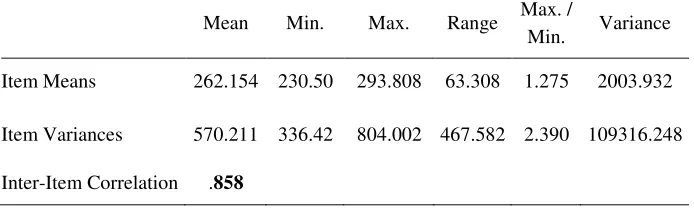
Inter-item correlation for the future interactions part which consisted of two items was found to be .858, suggesting a scale of high reliability (Clark & Watson, 1995). See Table 3.
Table 3. Summary-item statistics of future interactions questionnaire (Part B2) Mean Min. Max. Range Max. /
Min. Variance
Item Means 262.154 230.50 293.808 63.308 1.275 2003.932
Item Variances 570.211 336.42 804.002 467.582 2.390 109316.248
The two SCMC programs that were used in the present study were IRC and 2D. Internet Relay Chat (IRC), an older type of SCMC services, enables the users to chat in pairs or groups by means of written texts on screens visible to all the participants. A common IRC software is Yahoo Messenger, which was chosen for the present study because it is convenient and common among almost all of the participants, and also because it does not require a high internet bandwidth.
2 Dimensional (2D) is a rudimentary form of virtual reality and a more recent type of SCMC. In this environment, the users are able to use more sophisticated than text-only facilities to communicate with each other. The background can be a conference room, a hall, a classroom, a tavern or any other virtual place where the students can convey a real-like discussion or conversation. Moreover, this virtual world usually has more than one room and the students can navigate from room to room, and “if it has been structured well, the navigation becomes part of the educational experience along with the visual backgrounds and the conversations” (Ingram, Hathorn & Evans, 2000, p. 22). The 2D program utilized in this study was Palace Chat (http://www.palacechat.org). It is a palace with a large number of rooms, a hall, an office, a laboratory, a club, etc. Users can also add their own room, assign a name to it and even lock it to enjoy more privacy. This program also doesn’t require a high internet bandwidth and it is hence useful even in low internet speeds.
3.3 Procedure
would benefit from the car which they were promoting. Finally, they had to finish the essay with a conclusion. When the writings were evaluated based on the ELPE Rubrics, all the scores fell between 60-65 which indicated that all the participants were at the same level of proficiency.
To control the possibility of low internet skills, the participants in the two experimental groups spent four one-hour practice sessions before the experiment. In the first session, they were given information about computer and typing. In the second session, Dropbox was introduced to them along with its application. In the third session, installation and use of Yahoo Messenger (for IRC group) and Palace Chat (for 2D group) and their facilities were introduced and practiced. Finally, in the fourth session, the whole materials that had been taught in the three previous sessions were reviewed.
3.3.1 Treatment
connectives, etc. They were also taught how to use some essential structures for writing their post-test letter, for example, the types and uses of different patterns of development, such as classification, exemplification, and comparison and contrast. The tenth session was a review session of all the materials discussed, problem shooting, further feedback from the students and also the instructor, and finally, a complete explanation about the post-test essay which they had to write and submit in line with the materials they had learned.
With regard to collaboration, the students of each group were divided into pairs (IRC: n = 4; 2D: n = 4; F2F: n = 5) at the beginning of the course and remained intact until the end of the course in order for the instructor to follow closely any changes in each pair. During the course, they were given three tasks in sessions 3 (a short composition), 6 (sentence completion) and 9 (editing), and were asked to complete them in pairs through discussion and cooperative work. Then, they reported their results to the class and exchanged feedback with each other and also with the instructor. The experimental groups did their pair work in private rooms and after they finished their work, they returned to the main room. On the other hand, the control group did their pair work in the classroom at separate desks and then joined each other and shared ideas with the whole class.
At the end of the experiment, the collaboration questionnaire was distributed among the participants of all three groups to. Then, they were collected and compared statistically to see which group had a more collaborative learning experience.
3.4 Data analysis
Data from the first part of the questionnaire (Part A) were analyzed via one-way ANOVA to examine the differences in the amount of collaboration among the three groups throughout the experiment, and also to see which medium of instruction had more influence on the students’ collaboration. The second and third parts of the questionnaire’s data (parts B1 & B2) were also analyzed in order to examine the students’ amount of interaction and their perceptions towards future interactions with each other in each group. As such, the results were compared statistically through one-way ANOVA with the degree of significance measured at p<.05.
4. Results
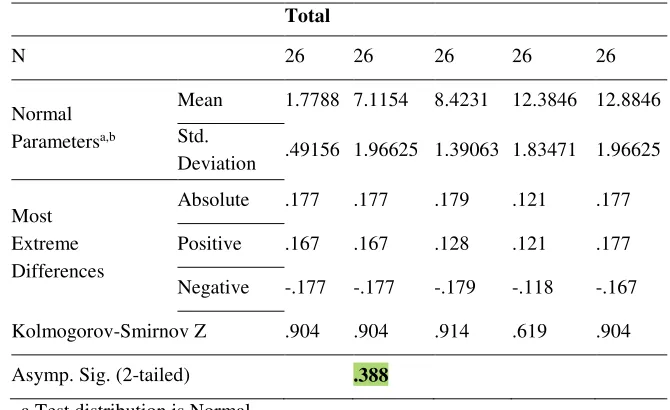
The data were first analyzed for their normality of distribution (Table 4).
Table 4. Kolmogorov-Smirnov test for collaboration (pre-intervention)
Total
N 26 26 26 26 26
Normal Parametersa,b
Mean 1.7788 7.1154 8.4231 12.3846 12.8846
Std.
Deviation .49156 1.96625 1.39063 1.83471 1.96625
Most Extreme Differences
Absolute .177 .177 .179 .121 .177
Positive .167 .167 .128 .121 .177
Negative -.177 -.177 -.179 -.118 -.167
Kolmogorov-Smirnov Z .904 .904 .914 .619 .904
Asymp. Sig. (2-tailed) .388
a.Test distribution is Normal. b.Calculated from data
As Table 4 shows, according to Kolmogorov-Smirnov Z-test statistics, the p-value was not statistically significant (p>.05); hence, the sample can be argued to be normally distributed.
collaboration before the intervention. Table 5 shows the results of one-way ANOVA before the experiment:
Table 5. One-way ANOVA analysis of collaboration of the three groups (pre-intervention)
Sum of
Squares
Df Mean Square F Sig.
Between Groups .324 2 .162 .651 .531
Within Groups 5.717 23 .249
Total 6.041 25
As table 5 shows, there were no statistically significant differences among the three groups before the experiment, F (2, 23) = .651, p = .53.
4.1 Collaboration on class work (Part A)
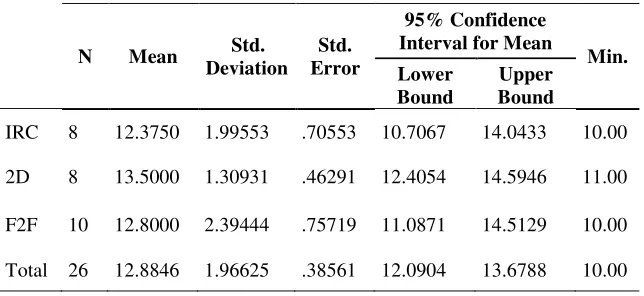
To analyze collaboration on class work, first, the descriptive statistics of the data from the first part of the questionnaire (Part A) are given in Table 6.
Table 6. Descriptive statistics of the groups’ collaboration on class work (Part A, post-experiment)
N Mean Std. Deviation
Std. Error
95% Confidence Interval for Mean
Min. Lower
Bound
Upper Bound
IRC 8 12.3750 1.99553 .70553 10.7067 14.0433 10.00
2D 8 13.5000 1.30931 .46291 12.4054 14.5946 11.00
F2F 10 12.8000 2.39444 .75719 11.0871 14.5129 10.00
Total 26 12.8846 1.96625 .38561 12.0904 13.6788 10.00
Table 7. One-way ANOVA for collaboration on class work (Part A, post-experiment)
Sum of
Squares Df
Mean
Square F Sig.
Between
Groups 5.179 2 2.589 .651 .531
Within Groups 91.475 23 3.977
Total 96.654 25
As Table 7 shows, the results of the one-way ANOVA, F (2, 23) = .651, p = .53, for the first part of the questionnaire (Part A) showed no significant difference among the three groups in terms of collaborative learning after the experiment.
4.2 Class interaction (Part B1)
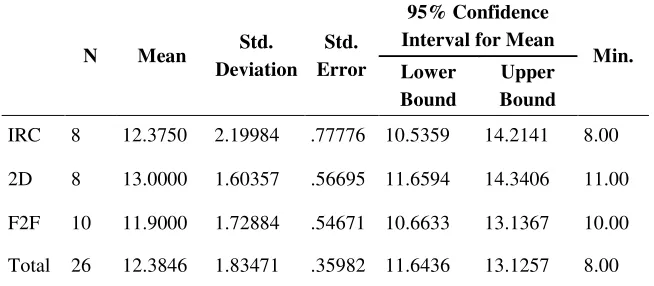
Descriptive statistics of the three groups’ post-test results from the second part of the questionnaire are given below (Table 8):
Table 8. Descriptive statistics of the groups’ class interaction (Part B1, post-experiment)
N Mean Std. Deviation
Std. Error
95% Confidence Interval for Mean
Min. Lower
Bound
Upper Bound
IRC 8 12.3750 2.19984 .77776 10.5359 14.2141 8.00
2D 8 13.0000 1.60357 .56695 11.6594 14.3406 11.00
F2F 10 11.9000 1.72884 .54671 10.6633 13.1367 10.00
Total 26 12.3846 1.83471 .35982 11.6436 13.1257 8.00
Table 9. One-way ANOVA for class interaction (Part B1, post-experiment)
Sum
of Squares Df
Mean
Square F Sig.
Between Groups 5.379 2 2.689 .785 .468
Within Groups 78.775 23 3.425
Total 84.154 25
The results of the one-way ANOVA of the second part (part B1), Table 10, also showed no significant difference among the three groups in terms of class interaction, F (2, 23) = .78, p = .46.
4.3 Student impressions (Part B2)
The data from the third part were also analyzed descriptively (Table 10) and then were analyzed through one-way ANOVA for the significance of the differences in terms of student impressions.
Table 10. Descriptive statistics of the three groups’ impressions (Part B2, post-experiment)
N Mean Std. Deviation
Std. Error
95% Confidence Interval for Mean
Min. Lower
Bound
Upper Bound
IRC 8 8.3750 1.40789 .49776 7.1980 9.5520 6.00
2D 8 8.1250 1.55265 .54894 6.8270 9.4230 6.00
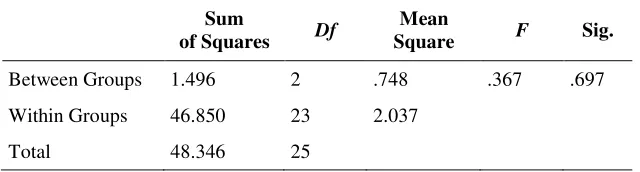
Table 11 shows the results of one-way ANOVA for students’ impressions in the three groups (Part B2) after the experiment.
Table 11.One-way ANOVA for three groups’ impressions (Part B2, post-experiment)
Sum
of Squares Df
Mean
Square F Sig.
Between Groups 1.496 2 .748 .367 .697
Within Groups 46.850 23 2.037
Total 48.346 25
According to Table 11, no significant differences were found among the three groups in terms of students’ impressions after the experiment, F (2, 23) = .36, p = .69.
All in all, statistical analyses of the data indicated no statistically significant difference between the experimental groups and the control group in terms of collaborative learning, class interaction and student impression. The results suggest that mode of instruction does not affect the amount of student collaboration and interaction or impressions in the English classroom.
5. Discussion
On the other hand, some other studies suggested that other factors, such as the task type or the nature of activity, had more effect on the learners' collaboration than the mode of instruction (Fjermestad, 2004; Pellettieri, 2010). For instance, Fjermestad (2004) conducted an analysis of communication mode in group support system (GSS) research. He summarized and analyzed the results of 145 experiments that used communication mode as an independent variable. In depth analysis of the data suggested that the type of task, GSS type, and the interaction of both had a moderating effect on 'adaptation and outcome factors'.
The findings of the present study are in line with those of Pellettieri (2010) who examined whether SCMC or the oral mode would engage learners (native speakers of English learning Spanish) in a more ‘acquisition-rich’ discourse. The participants were divided into four pairs who stayed unchanged throughout the course and were required to complete the same information-gap tasks once orally and once through SCMC. The results of the study showed that in both environments the students were likely to spend the same amount of interaction, suggesting that the nature of communicative activity had more effect on the discourse quality of L2 acquisition than the mode of interaction.
The results of the present study are also in line with Ziegler's (2013) research that evolved a synthesis and meta-analysis of the relative effectiveness of interaction in SCMC and F2F contexts. The findings of the study suggested a positive impact for both contexts on L2 development, and a small, though non-significant, effect for interaction in SCMC with regard to the measures of the L2 learning outcomes.
6. Conclusions
Long’s (1996) Interaction Hypothesis places special importance on the role of peer interaction in learning a second language. This is also the case with Vygotsky’s (1978) sociocultural theory which "provides a basic foundation for understanding learning as a process of social negotiation or collaborative sense making, mentoring and joint knowledge construction” (Zhu, 1998; as cited in Pui-Shan, 2003, p. 29).
collaboration, this does not mean that SCMC is not beneficial for EFL learners (Pellettieri, 2010). Unlike F2F mode of interaction, one salient advantage of SCMC is that “it does not require that students be physically co-present to interact with each other, so FL learners can engage in L2 interaction outside of class time with classmates, with other learners across the globe, or even with native speakers” (p. 53).
From the results of the present study it can also be concluded that students' familiarity with the computer and internet technology is highly effective on the students' willingness to interact and cooperate with each other. Prior to the experiment, the students showed hesitation towards taking part in the SCMC classes due to their unconventional nature. They were not certain of being able to keep up with the demands of the online classes and the unfamiliar way of learning languages. However, after receiving instruction on how to use the required SCMC and computer programs, little by little, all their fears disappeared and even changed to eagerness and enthusiasm to take part in the SCMC classes and activities throughout the course.
On the institutional level, stakeholders and policy-makers are urged to pay due attention to the role of technology in designing the macro-level policies in a way that boosts learning opportunities through merging modern-day technology into the language teaching materials. Training instructors to have a better understanding of how technology can be implemented in language classes is also crucial. A last implication is that the findings indicated the students' willingness to use technology in their learning process due to its convenience and timeliness of communication, and most importantly for being less confrontational and stressful.
7. Suggestions for Further Research
comprehensive insight of the role of SCMC in the learning and teaching EFL/ESL.
One suggestion for further research is that the study be conducted on a larger sample size and for a longer period of time. Another suggestion is that, since the study was conducted only on upper-intermediate female students, it should also be conducted on male students or a mixed-gender group in other proficiency levels to have a clearer picture of the impact of SCMC on language learners. Another suggestion is that the effect of task type and communication nature be examined in addition to the CMC mode of instruction. And finally, the last suggestion is that the effect of SCMC in its various forms be investigated on other language skills, i.e., speaking, listening, and reading, and their sub-components.
References
Abe, Y. (2005). Japanese EFL learners’ patterns of interaction in two synchronous discussion modes. TCC 2011 Proceedings, Hiroshima,
Japan, 169-185.
Asterhan, C. S. C., & Eisenmann, T. (2009). Online and face-to-face discussions in the classroom: A study on the experiences of 'active'
and 'silent' students. Paper presented at the 8th International
Conference on Computer Supported Collaborative Learning, CSCL'09, Rhodes, Greece. Retrieved June 5, 2014, from ltee.org/uploads/cscl2009/paper203.pdf
Becker-Beck, U., Wintermantel, M., & Borg, A. (2005). Principles of regulating interaction teams practicing face-to-face communication versus teams practicing Computer-Mediated Communication. Small
Group Research, 36(4), 499-536.
Chapman Parr, P., & Krashen, S. D. (1986). Involuntary rehearsal of second language in beginning and advanced performers. System, 14(3), 275-278.
Cho, H. J. (2011). Negotiation of meaning in synchronous
computer-mediated communication in relation to task types. Doctoral
Chou, C. C. (2002). A comparative content analysis of student interaction in
Synchronous and Asynchronous learning networks. Paper presented at
the 35th Hawaii International Conference on System Sciences: IEEE Computer Society, Hawaii. Retrieved June 15, 2014, from http://www.computer.org/csdl/proceedings/hicss/2002/1435/05/14350 134b.pdf
Clark, L. A., & Watson, D. (1995). Constructing validity: Basic issues in objective scale development. Psychological Assessment, 7(3), 309-319.
Colon, V. A. (2011). Using web 2.0 tools in a foreign language classroom: Motivating students through virtual social interaction to improve
reading and writing skills (Doctoral Dissertation, University of
Georgia). Retrieved June 7, 2014, from
http://purl.galileo.usg.edu/uga%5Fetd/colon%5Fvictor%5Fa%5F2011 05%5Fphd
Darhower, M. (2002). Interactional features of synchronous computer-mediated communication in the intermediate L2 class: A sociocultural case study. CALICO Journal, 19(2), 249-277.
Fjermestad, J. (2004). An analysis of communication mode in group support systems research. Decision Support Systems, 37, 239-263.
Goda, Y., & Yamada, M. (2013). Application of CoI to design CSCL for EFL online asynchronous discussion. In Akyol, Z., & Garrison, D., R. (Eds.) Educational Communities of Inquiry: Theoretical Framework,
Research and Practice (pp. 295-311). Canada: IGI Global.
Harstinski, S. (2006). Introducing an informal synchronous medium in a distance learning course: How is participation affected? Internet and
Higher Education, 9, 117-131.
Harstinski, S. (2007). Participating in synchronous online education. Lund, Sweden: Lund University. Retrieved June 18, 2014, from http://lup.lub.lu.se/luur/download?func=downloadFile&recordOId=59 9311&fileOId=600490
Hoven, D. L. (2006). Communicating and interacting: An exploration of the
changing roles of media in CALL/CMC. Computer Assisted Language
Instruction Consortium Journal, 23(2), 233-256.
Hubbard, P. (2009). Computer Assisted Language Learning: Critical
Concepts in Linguistics. London: Rutledge.
Ingram, A. L., Hathorn, L. G., & Evans, A. (2000). Beyond chat on the internet. Computers & Education, 35, 21-35.
Jeong, E. (2010). Comparison between the effects of SCMC and SCMC with peer feedback on EFL writing. Multimedia-Assisted Language Learning, 13(2), 81-103.
Jeong, N. (2011, October). The effects of task type and group structure on meaning negotiation in synchronous computer-mediated
communication. Proceedings of the 2009 Second Language Research
Forum: Diverse Contributions to SLA (pp. 51-69). MA, USA.
Retrieved June 5, 2014, from
http://www.lingref.com/cpp/slrf/2009/index.html
Krashen, S. D. (1985). The input hypothesis. London: Longman.
Krashen, S. D. (1991). How much comprehensible input did Heinrich Schliemann get? System, 19(3), 189-190.
Krashen, S. D. (1996). The case for narrow listening. System, 24(1), 97-100. Lantolf, J. P. (2009). Knowledge of language in foreign language teacher
education. The Modern Language Journal, 93(2), 270-274.
La Pointe, D. K. (2005). Effects of peer interaction facilitated by computer-mediated conferencing on learning outcomes: A story of developing, testing, and refining a model to understand the relationship between
peer interaction and learning outcomes. Paper presented at 19th
Annual Conference on Distance Teaching and Learning, Madison,
Wisconsin, USA. Retrieved July 5, 2014, from
http//www.uwex.edu/disted/conference/
Little, D. (1995). Learning as dialogue: The dependence of learner autonomy on teacher autonomy. System, 23(2), 175-181.
Mahmoud, A. B., & Auter, P. J. (2009). The interactive nature of Computer-Mediated Communication. American Communication Journal, 11(4).
https://www.academia.edu/847408/The_interactive_nature_of_comput er-mediated_communication
Mangubhai, F. (2001). Book floods and comprehensible input floods: Providing ideal conditions for second language acquisition.
International Journal of Educational Research, 35(2), 147-156.
Pellettieri, J. (2010). Online chat in the foreign language classroom: From research to pedagogy. MEXTESOL Journal, 34(1), 41-57.
Puri, G. (2012). Critical success factors in E-learning – An empirical study.
International Journal of Multidisciplinary Research, 2(1), 149-161.
Pui-Shan, C. S. (2003). Using computer-mediated communication (CMC) to
enhance student participation in group discussion, Postgraduate
Thesis, the University of Hong Kong. Retrieved June 10, 2014, from http://hub.hku.hk/handle/10722/31153
Rezai, A. A., & Zafari, N. (2010). The impact of Synchronous Computer-Mediated Communication (SCMC) on the oral proficiency of Iranian EFL learners. IJAL, 13(2), 101-119.
Rodrigo, V., Krashen, S. D., & Gribbons, B. (2004). The effectiveness of two approaches to foreign language instruction at the intermediate level. System, 32(1), 53-60.
Smith, B., Alvarez-Torres, M. J., & Zhao, Y. (2003). Features of CMC technologies and their impact on language learners’ online interaction.
Computers in Human Behavior, 19, 703-729.
Storch, N. (2002). Patterns of interaction in ESL pair work. Language
Learning, 52(1), 119-158.
Yilmaz, Y. (2008). Collaborative dialogue during tasks in Synchronous
Computer-Mediated Communication (Doctoral Dissertation, Florida
State University). Retrieved June 10, 2014, from https://www.lib.fsu.edu/find/etds.html
Ziegler, M. (2013). Synchronous Computer-Mediated Communication and
interaction: A research synthesis and meta-analysis, Doctoral
Appendices
Appendix A: English Language Proficiency Examination
In training to be a part-time car salesperson for Ford, the company has provided you with a table of information and you have been asked to write a short essay. Use the following essay question to write your essay:
Explain which vehicle would be best for a young family. Start with an introduction and thesis statement. In the body of your essay, explain why members of a young family would benefit from the car you are promoting. Finish your essay with a conclusion.
C o st N u m b er o f F ea tu re s F u el E co n o m y K il o m et er s p er li te r in th e ci ty a n d o n E n g in e si ze i n li te rs (L ) T o w in g ca p a ci ty in k il o g ra C u st o m e r R ev ie w s Ford Fiesta
$18,80 5 4-door Front -whee l Driv e 11.6 city 16.2 highway
1.6L 0 kg
“I love this small car. It’s affordabl e and good on gas. It doesn’t have a ton of power, but it don’t need power anyways. ” Ford Musta ng
$26,61 4 2-door 6 spee ds 7.7 city 12.5 highway
3.7L 0 kg
“Great vehicle. Looks great on the road, and it’s fun to drive. It consumes
a lot of gas though,
(http://www.ford.com/compare/)
Appendix B: Background Questionnaire 1. Sex: female ___ male ___
2. Age: _____
3. Years of High School English__________.
4. What was your average grade in English in previous courses? __________
5. Have you ever studied in another country? __________If yes, which country___________.
6. Have you ever studied another foreign language? ________If yes, which language, when and for how long_______________?
7. Do you have a computer at home? ______ 8. Do you use a computer? _____
9. How often do you use a computer? ___________ 10. Do you feel comfortable using a computer? _______
11. How would you rate your typing skills? Circle one number. 1 2 3 4 5 12. Do you prepare your homework at computer? _________If yes, how
often?___________
13.Do you use instant messaging (chat) programs, such ICQ, MSN Messenger or others? _____
If yes, how often? (a) every day (b) several times a week (c) rarely (d) never
Name the programs you use___________________
15. Have you ever used a collaborative editing program such as Moon Edit? _________
Ford Explor
er
$41,67 5
7 4-door
All-whee
l Driv
e
6.8 city 9.0 highway
3.5L 2267 kg
“This is the toughest
vehicle on the road. All