DOI: 10.30954/0974-1712.03.2019.1
©2019New Delhi Publishers. All rights reserved
GENETICS AND PLANT BREEDING
G × E interaction and Stability Analysis of Maize Hybrids Using
Eberhart and Russell Model
R Nirmal Raj*, C.P. Renuka Devi and J. Gokulakrishnan
Department of Genetics and Plant Breeding, Faculty of Agriculture, Annamalai University, Chidambaram, Tamil Nadu, India
*Corresponding author: [email protected] (ORCID ID: 0000-0002-6444-7106)
Paper No. 757 Received: 15-10-2018 Accepted: 22-01-2019
ABSTRACT
The present study was carried out to identify stable Maize hybrids across various environments as the performance of each hybrid tends to vary when grown in different seasons or locations. Twenty one Maize hybrids and two commercial checks were tested over three locations in India viz., Viluppuram, Trivandrum and Nagercoil. Eberhart and Russell model of stability analysis was carried out which revealed a significant effect of each environment on the hybrids taken, for all the ten morphological traits except the number of leaves. The hybrid AU-101 was identified as a stable hybrid with high mean under less favourable conditions and the hybrid AU-114 was recognized as a stable hybrid under favourable conditions. None of the check hybrids viz., CP-818 and Bioseed-TX369 showed stability in any of the environment. Thus, it emphasized the need for the development of location specific hybrids or a hybrid that is, stable across environments.
Highlights
mEberhart and Russell model of stability analysis is used in this research and assessed the performance of hybrids across the environments.
Keywords: Stability, maize hybrids, environments
In India, Maize is the third most important cereal
crop after Rice and Wheat. It contributes a lion
share to the total food production globally. The
Maize production is estimated at 26.2 million tonnes
(FAOSTAT, 2017) in India and the projected demand
for Maize is expected to be 42 million tonnes by
the year 2025 (Sain Dass
et al.
2009). Corn which
literarily means “that which sustains life” (Akinyele
and Adigun, 2006) has been cultivated throughout
India. The significance of the crop has grown due to
its multipurpose nature and the high yielding maize
hybrids met the quest for higher yield by farmers.
Even with these highly productive hybrids, farmers
experience the distress of inconsistent yield across
different environments.
There is a growing need to identify maize hybrids
that perform uniformly and consistently for yield
regardless of environments. Eberhart and Russell
(1966) stated that a desirable cultivar should have
an average yield performance that is higher under
favourable conditions and less fluctuating under
unfavourable conditions than that of the group of
cultivars when tested in many environments. There
is an ever growing demand for environment specific
hybrids, hence the present study was carried out to
identify stable and environment specific hybrids
and to test the hybrid performance in environment
other than conventional maize growing areas.
MATERIALS AND METHODS
The materials for stability analysis consisted of
twenty one maize hybrids of single cross origin were
received from Department of Genetics and Plant
environments during June, 2017 in a one row trial.
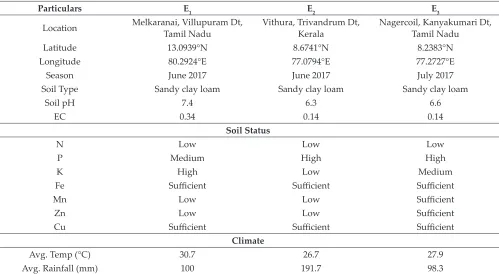
The particulars of three environments are given in
Table 1. Experiments were laid out in randomized
block design with three replications. Fifteen plants
per replication were maintained for each hybrid.
Ten morphological traits
viz.,
days to 50% tasseling,
number of leaves, days to maturity, plant height
(cm), cob placement height (cm), ear length (cm),
number of kernels per row, number of kernels per
ear, hundred seed weight (g) and yield per plant (g)
were recorded from five randomly selected plants
for each hybrid per replication. Linear regression
model of stability suggested by Eberhart and Russell
(1966) was employed and the data was analyzed
using TNAUSTAT software.
RESULTS AND DISCUSSION
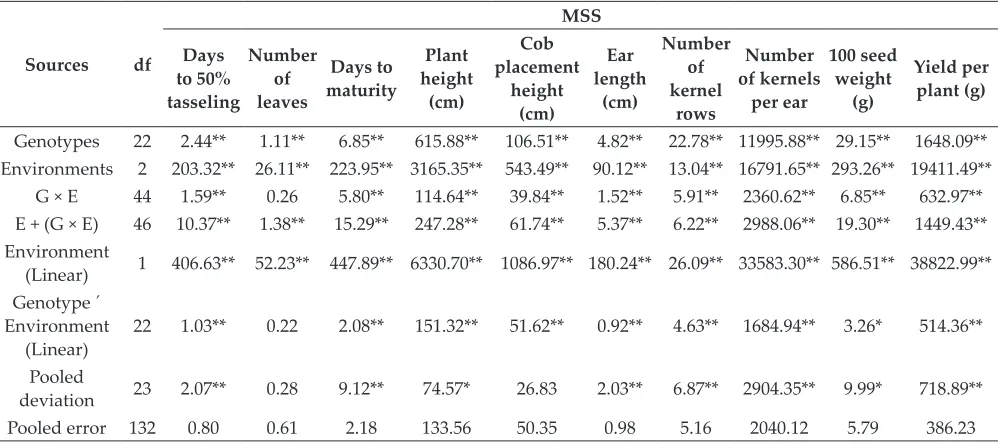
The combined analysis of variance revealed
significant differences among the hybrids for all
the traits thus indicated the existence of inherent
genetic variability and suggest the possibility
of selecting a stable hybrid from the lot. Similar
results were reported by Usharani (2012) and
Lata
et al.
(2010). Highly significant genotype х
environment interaction was observed for almost all
the characters except number of leaves indicating
that all the hybrids interacted considerably well
with the environmental conditions (Table 2). Similar
interaction for various traits was also reported by
Admassu
et al.
(2008).
Analysis of variance for Eberhart and Russell
model revealed highly significant E+ (G×E) for all
the characters against pooled error and indicated
distinct nature of seasons and GхE interactions
in the phenotypic expression. Highly significant
values for environment (linear) variance indicated
considerable additive environmental variance for
all the traits. Pooled deviations were also highly
significant for most of the characters except for
number of leaves (Bharathiveeramani
et al.
2016)
and cob placement height which indicated that
unpredictable portion formed the major part of
the GхE interactions. The contribution of linear
portion to GхE interactions was revealed by highly
significant GхE (Linear) variance for nine traits
except number of leaves (Table 3). Similar works
were done by Gami
et al.
(2017) and Matin
et al.
(2017).
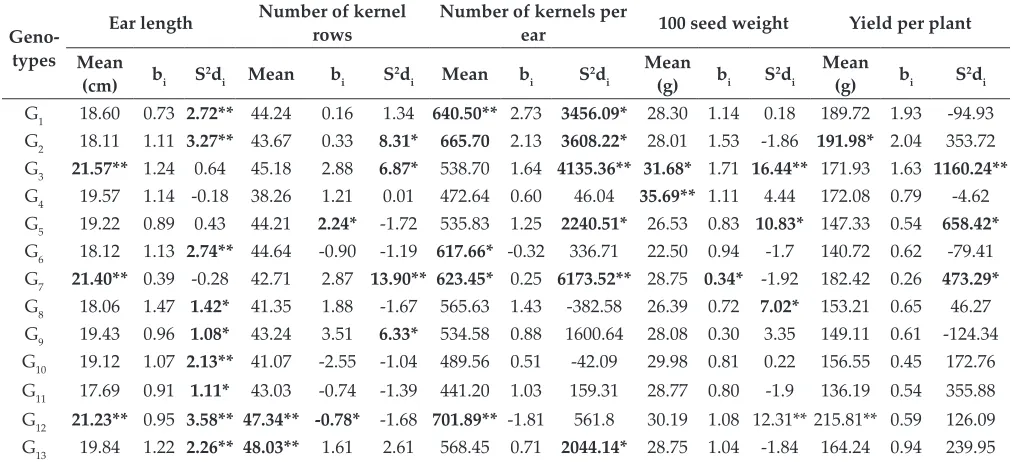
The mean performance, regression (b
i) and squared
deviation (s
2d
i
) for ten morphological traits are
presented in Table 4a and 4b. It is interesting to
note that no one hybrid was stable for all the
Table 1:
Particulars of three environments
Particulars E1 E2 E3
Location Melkaranai, Villupuram Dt, Tamil Nadu Vithura, Trivandrum Dt, Kerala Nagercoil, Kanyakumari Dt, Tamil Nadu
Latitude 13.0939°N 8.6741°N 8.2383°N
Longitude 80.2924°E 77.0794°E 77.2727°E
Season June 2017 June 2017 July 2017
Soil Type Sandy clay loam Sandy clay loam Sandy clay loam
Soil pH 7.4 6.3 6.6
EC 0.34 0.14 0.14
Soil Status
N Low Low Low
P Medium High High
K High Low Medium
Fe Sufficient Sufficient Sufficient
Mn Low Low Sufficient
Zn Low Low Sufficient
Cu Sufficient Sufficient Sufficient
Climate
Avg. Temp (°C) 30.7 26.7 27.9
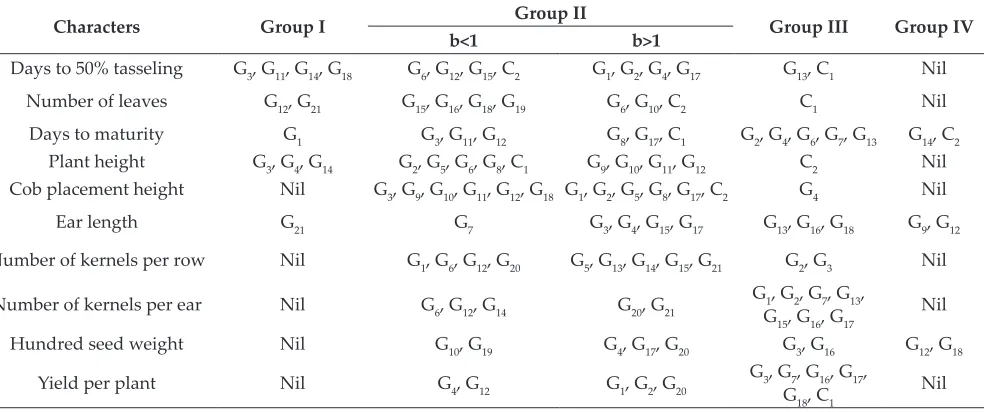
characters. Twenty one hybrids and two checks with
higher/lower mean values than grand mean were
grouped into four based on stability parameters
viz.,
regression coefficient and squared deviation,
according to the methodology followed by Mehra
and Ramanujam (1979) and Singh and Singh (1980)
(Table 5). The hybrids falling in group I have
desirable mean, regression coefficient value around
one with non significant squared deviation. Under
group II, hybrids with less than unity regression
value and non significant squared deviation are
taken, indicating suitability towards unfavourable
environments. Again, the hybrids with more than
unity regression is also classified under group II
indicating the hybrid’s suitability towards favourable
environments. Behaviour of hybrids falling in group
III and group IV cannot be predicted as they exhibit
significant squared deviation, irrespective of the
regression coefficient values.
According to the grouping, the hybrid G14 is stable
for two traits
viz.,
days to 50% tasseling and plant
height, as it was placed under group I. Under
group II (b<1), the hybrid G12 is stable for six
traits
viz.,
days to 50% tasseling, days to maturity,
cob placement height, number of kernels per row,
number of kernels per ear and yield per plant in
unfavourable conditions. The hybrid G20 is placed
under group II (b>1) and is stable in favourable
conditions for three traits
viz.,
number of kernels
per ear, hundred seed weight and yield per plant.
These results are in line with the reports of Kaundal
Table 2:
Combined analysis of variance for ten morphological characters
Sources df MSS Days to 50% tasseling Number of leaves Days to maturity Plant height (cm) Cob placement height (cm) Ear length (cm) Number of kernel rows Number of kernels per ear 100 seed weight (g) Yield per plant
Replication 2 1.30 2.81 2.03 334.25 37.25 1.94 5.58 3040.91 13.49 968.42 Genotype 22 2.44** 1.11** 6.93** 615.78** 106.51** 4.81** 22.77** 11995.67** 29.13** 1648.08** Environment 2 203.32** 26.11** 223.95** 3165.35** 543.49** 90.12** 13.04** 16791.65** 293.26** 19411.49**
G × E 44 1.59** 0.26 5.80** 114.64** 39.84** 1.52** 5.91** 2360.62** 6.85** 632.97**
Pooled error 132 0.80 0.61 2.18 133.56 50.35 0.98 5.16 2040.12 5.79 386.23
*: Significant at 5% level; **: Significant at 1% level.
Table 3:
Analysis of variance for Eberhart and Russell model
Sources df MSS Days to 50% tasseling Number of leaves Days to maturity Plant height (cm) Cob placement height (cm) Ear length (cm) Number of kernel rows Number of kernels per ear 100 seed weight (g) Yield per plant (g)
Genotypes 22 2.44** 1.11** 6.85** 615.88** 106.51** 4.82** 22.78** 11995.88** 29.15** 1648.09** Environments 2 203.32** 26.11** 223.95** 3165.35** 543.49** 90.12** 13.04** 16791.65** 293.26** 19411.49**
G × E 44 1.59** 0.26 5.80** 114.64** 39.84** 1.52** 5.91** 2360.62** 6.85** 632.97** E + (G × E) 46 10.37** 1.38** 15.29** 247.28** 61.74** 5.37** 6.22** 2988.06** 19.30** 1449.43** Environment
(Linear) 1 406.63** 52.23** 447.89** 6330.70** 1086.97** 180.24** 26.09** 33583.30** 586.51** 38822.99** Genotype ´
Environment
(Linear) 22 1.03** 0.22 2.08** 151.32** 51.62** 0.92** 4.63** 1684.94** 3.26* 514.36** Pooled
deviation 23 2.07** 0.28 9.12** 74.57* 26.83 2.03** 6.87** 2904.35** 9.99* 718.89**
Pooled error 132 0.80 0.61 2.18 133.56 50.35 0.98 5.16 2040.12 5.79 386.23
Table 4a:
Stability parameters for morphological traits across environments
Geno-types
Days to 50%
Tasseling Number of leaves Days to maturity Plant height
Cob placement height
Mean bi S2d
i Mean bi S2di Mean bi S2di
Mean
(cm) bi S2di
Mean
(cm) bi S2di
G1 50.80** 1.25 -0.21 13.56 1.11 0.62* 103.00** 1.09 1.96 215.85 0.88 0.36 67.76 1.76 32.24 G2 51.95 1.21 0.56 12.75 1.40 -0.17 104.64 1.20 3.08* 194.29** 0.25 -8.45 66.35 2.82 23.03 G3 51.94 0.96 0.31 13.57 1.25 -0.1 103.85 0.83 2.08 209.77 0.93 -25.44 69.41 0.82 -13.38 G4 51.05* 1.39 -0.14 13.45 1.26 -0.16 103.19* 1.41 2.37* 208.23 0.90 39.57 70.19 0.62 66.26* G5 53.26 1.01 0.95* 13.52 1.41 -0.2 106.46 1.01 8.95** 198.71** 0.67 -11.42 67.99 1.57 6.70 G6 52.06 0.76 -0.14 14.39 1.41 -0.08 104.76 0.65 7.68** 213.68 0.35 93.83 77.77 1.61 76.07* G7 52.78 0.98 1.07* 13.83 0.93 -0.11 104.80 0.82 3.06* 220.86 0.48 -40.88 84.85 1.66 -12.65 G8 52.20 1.26 0.02 13.51 0.93 0.14 104.31 1.21 0.57 197.87** 0.32 113.08 67.85 2.06 1.06 G9 53.15 1.11 5.13** 13.51 1.10 -0.2 105.93 1.07 8.24** 195.53** 1.49 114.57 66.65 0.35 31.30 G10 52.50 1.03 -0.18 14.32 1.24 0.15 106.13 0.93 15.44** 206.81 1.50 -27.6 66.77 0.02 -13.61 G11 52.02 1.09 -0.02 13.89 0.63 -0.14 104.06 0.83 2.08 202.49* 1.11 -16.02 67.17 0.50 -13.24 G12 51.96 0.68 -0.24 14.11 0.94 -0.15 102.96** 0.47 0.01 214.31 1.32 102.34 68.21 0.27 -14.06 G13 49.91** 1.13 5.31** 13.70 0.78 -0.18 101.76** 0.84 11.23** 223.19 1.61 -17.57 72.81 0.09 -12.37 G14 51.89 0.97 -0.2 13.82 0.78 -0.18 103.52 0.98 3.86* 210.07 0.92 -39.15 78.61 1.02 -8.49 G15 52.06 0.87 0.72 14.94* 0.64 0.06 105.07 1.13 6.08** 229.84 1.62 53.82 78.28 0.66 42.99 G16 52.57 0.76 1.11* 14.30 0.31 -0.12 105.28 0.75 5.98** 248.34 2.82 -33.57 75.21 -1.35 61.54* G17 51.77 1.13 -0.26 13.86 1.25 -0.2 103.94 1.11 -0.04 229.48 0.88 37.05 61.73** 1.51 7.46 G18 51.41 0.98 -0.26 14.97* 0.46 -0.02 106.22 0.90 24.17** 219.09 1.86 6.45 68.90 0.08 8.07 G19 53.30 0.26 0.67 15.50** 0.63 -0.14 106.83 0.25 21.24** 220.88 1.98 -32.2 75.47 -0.06 -1.41 G20 54.16 1.27 10.85** 13.92 1.08 0.79* 108.41 1.81 22.20** 219.08 0.16 -2.48 72.78 2.59* -16.28 G21 52.82 0.90 14.00** 14.07 1.08 0.32 106.45 1.35 37.55** 247.68 1.39 220.80* 84.71 0.02 4.17
C1 51.67 1.11 2.51** 14.74 1.28 1.51** 104.33 1.34 -0.69 210.84 0.39 19.76 75.24 1.70 -7.75 C2 52.00 0.89 -0.19 14.16 1.11 0.2 104.67 1.02 5.87** 209.63 0.14 144.28* 70.65 2.69* -16.47
52.14 14.02 104.81 215.06 71.97
Table 4b:
Stability parameters for morphological traits across environments
Geno-types
Ear length Number of kernel rows Number of kernels per ear 100 seed weight Yield per plant Mean
(cm) bi S2di Mean bi S2di Mean bi S2di
Mean
(g) bi S2di
Mean
(g) bi S2di
G14 19.24 0.57 -0.24 47.28** 1.90 -1.03 576.10 0.45 78.35 26.12 1.15 42.83** 149.28 1.17 378.93* G15 19.83 1.19 0.16 45.51 2.01 2.08 603.35 1.12 4222.23** 25.39 1.05 21.48** 154.70 1.04 1469.61** G16 20.47* 0.44 4.61** 43.50 4.55 2.65 601.43 1.84 5908.86** 31.84* 1.18 8.20* 196.73** 1.41 1936.71** G17 20.53** 1.91 0.02 43.17 -2.82 4.15 597.48 0.24 3751.46* 33.06** 1.19 4.29 203.94** 1.24 1926.48** G18 19.82 0.63 1.27 43.17 0.75 2.75 549.99 0.00 -487.07 31.89* 1.08 18.82** 176.22 0.75 435.85* G19 18.36 0.64 -0.32 40.07 0.00 -0.01 480.47 -0.03 -242.32 30.22 0.40* -1.88 143.95 0.09 -125.14 G20 18.24 1.00 4.27** 44.96 0.22 -0.78 607.06 2.73* -675.35 31.06 1.35 -1.07 194.60* 1.70 -52.91 G21 19.91 0.95 0.05 48.55** 4.77 -1.17 587.26 2.60 502.5 28.44 0.91 1.3 170.28 1.43 121.09 C1 18.52 1.31 6.27** 42.22 0.66 25.74** 541.47 1.32 56.62 35.18** 1.52 44.49** 205.59** 1.79 1759.74** C2 16.52 1.14 2.09** 38.17 0.22 53.32** 529.58 1.71 14106.26** 26.72 0.84 1.39 150.27 0.79 1595.66**
19.28 43.63 568.26 29.28 170.30
Table 5:
Grouping of hybrids based on stability parameters
Characters Group I Group II Group III Group IV
b<1 b>1
Days to 50% tasseling G3, G11, G14, G18 G6, G12, G15, C2 G1, G2, G4, G17 G13, C1 Nil
Number of leaves G12, G21 G15, G16, G18, G19 G6, G10, C2 C1 Nil
Days to maturity G1 G3, G11, G12 G8, G17, C1 G2, G4, G6, G7, G13 G14, C2 Plant height G3, G4, G14 G2, G5, G6, G8, C1 G9, G10, G11, G12 C2 Nil Cob placement height Nil G3, G9, G10, G11, G12, G18 G1, G2, G5, G8, G17, C2 G4 Nil
Ear length G21 G7 G3, G4, G15, G17 G13, G16, G18 G9, G12
Number of kernels per row Nil G1, G6, G12, G20 G5, G13, G14, G15, G21 G2, G3 Nil
Number of kernels per ear Nil G6, G12, G14 G20, G21 G1, G2, G7, G13,
G15, G16, G17 Nil Hundred seed weight Nil G10, G19 G4, G17, G20 G3, G16 G12, G18
Yield per plant Nil G4, G12 G1, G2, G20 G3, G7, G16, G17,
G18, C1 Nil
and Sharma (2006), Jha
et al.
(1986) and Arun and
Singh (2004).
Considering the overall performance, G12
(AU-101) was found promising with stable performance
(group II) and may be used for general cultivation
in unfavourable environments. G20 (AU-114) was
found to be stable in favourable environment. None
of the hybrids were stable across environments,
hence emphasises the need for environment specific
hybrids.
REFERENCES
Admassu, S., Nigussie, M. and Zelleke, H. 2008. Genotype- environment interaction and stability analysis for grain yield of maize (Zea mays L.) in Ethiopia. Asian J. Plant Sci., 7(2): 163-169.
Akinyele, B.O. and Adigun, A.B. 2006. Soil texture and the phenotypic expression of Maize (Zea mays). Res, J. Botany, 3: 136-143.
Arun Kumar and Singh, N.N. 2004. Stability studies of inbred and single crosses in maize. Ann. Agric. Res., 25: 142-148. Bharathiveeramani, B., Prakash, M., Seetharam, A. and
Sunilkumar, B. 2016. Evaluating tropical single cross hybrids for adaptability and commercial value. Maydica, 61-2016.
Eberhart, S.A. and Russell, W.A. 1966. Stability parameters for comparing varieties. Crop Sci., 6: 36-40.
FAOSTAT, 2017. Food and Agricultural Organization of the United Nations (FAO), FAO Statistical Database. From http: //faostat.fao.org
Gami, R.A., Patel, J.M., Chaudhar, S.M. and Chaudhary, G.K. 2017. Genotype-environment relations and stability analysis in different land races of maize (Zea mays L.). Int. J. Curr. Microbiol. App. Sci., 6(8): 418-424. Jha, P.B., Khehra, A.S. and Akhter, S.A. 1986. Stability analysis for
grain development and yield in maize. Crop Res., 13: 16-19. Kaundal, R. and Sharma, B.K. 2006. Genotype × environment
Lata, S., Guleria, S., Dev, J., Kanta, G., Sood, B.C., Kalia, V. and Singh, A. 2010. Stability analysis in maize hybrids across locations. Electronic Journal of Plant Breeding, 1: 239-243. Matin, M.Q.I., Golam Rasul, M.D., Aminul Islam, A.K.M.,
Khaleque Mian, M.A., Ahmed, J.U. and Amiruzzaman, M. 2017. Stability analysis for yield and yield contributing characters in hybrid maize (Zea mays L.). Afr. J. Agric. Res., 12(37): 2795-2806.
Mehra, R.B. and Ramanujam, S. 1979. Adaptation in segregating populations of Bengal gram. Indian J. Genet. PI. Sr., 39: 492-500.
Sain Dass, Mohinder Singh, K. Ashok, Sarial and Aneja, D.R. 1987. Stability analysis in maize. Crop Res., 14: 185-187. Singh, R.B. and Singh, S.V. 1980. Phenotypic stability and
adaptability of durum and bread wheat for grain yield. Indian J. Genet., 40: 86-92.