The Effects of Local Fetal Brain Extract Administration on the
Electromyogram of Crushed Sciatic Nerve in Rat
Morteza Behnam-Rasouli
*1, Mohammadreza Nikravesh
2, Nasser Mahdavi-Shahri
1and
Alireza Fazel
21Dept. of Biology, School of Sciences, Ferdowsi University of Mashhad;2Dept. of Anatomy, School of Medicine,
Mashhad University of Medical Sciences, Mashhad, Iran
ABSTRACT
To evaluate the effects of local administration of the fetal brain extract (FBE) on the crushed peripheral nerve, 15 male Wistar rats were used. The right sciatic nerve of 10 rats was locally underwent the tense compression for 30 seconds and then randomly divided into experimental and control (sham) groups. The remained rats were considered as intact animals. Treatment was commenced weekly, by intramuscular injection of FBE around the injured site of experimental rats, started from the 1stweek post-operation to the 5thweek. The control (sham) rats were injected normal saline in the same manner. The delay time of the electromyographical records in different groups was measured from stimulation-response curves. This delay time was obtained by stimulating of the distal part of the sciatic nerve and recording the electrical response in the plantar muscles, using a computerized oscilloscope. The results indicating that the administration of FBE may improve dramatically the regeneration rate of the sciatic nerve in the early stage of the recovery period. Iran. Biomed. J. 5 (2 & 3): 73-77, 2001
Keywords: Electromyography, Sciatic nerve, Nerve crush, Regeneration, Fetal brain extract
INTRODUCTION
hile considerable emphasis has been placed on the importance of the technical aspects of the surgical nerve repair, it has been suggested that the rate of neuronal regeneration is influenced by neurotrophic factors such as Nerve Growth Factor (NGF) [1, 2], Brain Derived Neurotrophic Factor (BDNF) and Neurotrophin3 (NT3) [3, 4]. This neurotrophic hypothesis was originally in 1898 [5]. A series of recent studies have supported this hypothesis and the concept that with a crush, the peripheral nerve under the influence of neurobiological factors is capable of regeneration with significant specificity [6]. In this subject, recent experimental studies in adult rodents indicate that neurons of many regions of the brain and spinal cord are capable of extensive axonal growth when implanted into the fetal Central Nervous System (CNS) [7, 8]. Also, it has been shown that survival of motoneurons, particularly in immature animals, depends on peripheral connections providing trophic support [9]. After peripheral axotomy, some motoneurons in rodents survive and undergo typical reactive changes classic for chromatolysis, while others undergo changes
that lead to cell death [10]. This motoneuronal death is characteristic of apoptosis, similar to that of neurons after trophic factor withdrawal [11]. The discovery and characterization of NGF led to the neurotrophic theory [12]. To support this theory, it has been demonstrated that neuronal death after sciatic nerve transection could be prevented in postnatal rats with systemic administration of nerve growth factor [13] and in adult rats with locally supplied NGF at the site of nerve section [14]. Multiple growth factors have shown similar effects on neuronal protection of facial motoneurons [15]. Similar observations have been obtained by application of BDNF and NT3, which indicate the improvement of motoneuronal survival from 14% to 49% and from 14% to 29%, respectively, 1 week after facial axotomy in newborn rats [16]. The most dramatic protectional effects of neurotrophics are reported by local application of glial-cell-line-derived factor and growth factor replacement that provides 100% protection of facial motoneurons after axotomy [17].
Although transplantation of adult neurons into fetal CNS has exhibited putative effects of fetal CNS for extensive axonal growth [7, 8], the current research examines, electromyographically, the
W
effects of fetal brain extract (FBE) on the regeneration of prepheral nervous system (PNS).
MATERIALS AND METHODS
Animal model and experimental design. Fifteen
adult male Wistar rats from our stock were maintained under conditions of controlled lighting (lights on: 6 a.m. to 6 p.m.) with free access to standard laboratory food (JavanehKhorassan, Iran) and tap water.
Five rats were kept as intact animals and 10 underwent sciatic nerve compression and then randomly assigned as control and experimental animals (n = 5 in each group). Each animal was coded by ear marked. All assessments were made in a blinded fashion and decoded at the end of study.
Surgical procedure.The animals of experimental
and control groups were anesthetized with intraperitoneal injection of 0.2 ml of a mixture (1:2) of 10% ketamine (Bayer, Germany) and 2% xylazine (Boxtel, Holland). For axotomy, the right sciatic nerve (SN) was exposed through a gluteal muscle splitting incision. At this location, the nerve trunk was crushed for 30 seconds between prongs of #5 clamp forceps. The muscle and skin were then closed with 14-mm stainless steel sutures.
Preparation of FBE. Twenty virgin Wistar rats
were mated. On the 17th day of pregnancy, the pregnant rats were sacrificed and their fetuses were removed immediately from uterine horns. The whole brain of each fetus was removed from the skull and homogenized. The volume of homo-genized brain was reached to 1 ml by adding saline, and then centrifuged for 10 min. The extract was pulled and stored in Eppendorf tubes at -20C.
FBE application. The weekly injections of FBE
were applied around the injured site of sciatic nerve of experimental rats. Injection was started at 7thday and ended at 35thday post-operation. At the time of injection, the Eppendorf tubes containing FBE were warmed to room temperature. Then, 0.2 ml of FBE was injected intramuscularly around the injured site. Control rats received an equal volume of normal saline in the same manner.
nerve fibers, the delay time of compound muscular action potentials (CMAP), during a period of 72 days, was measured in experimental, control and intact rats, as an index of regeneration.
The electromyographical assessment of regeneration, using a comprehensive electro-physiological teaching unit (CEPTU) oscilloscope-linked computer, was started from the 5th week post-operation (no record was available during the earlier weeks). To measure the regeneration rate in distal part of sciatic nerve, the CMAP were recorded from plantar muscles, via a bipolar recording needle electrode which was inserted into the plantar muscles. To evoke action potentials, the sciatic nerve was precutaneously stimulated by a bipolar plotted stimulating electrode, with a square pulse of 0.1 ms duration and 20 volt in magnitude. The stimulating electrode was adjusted until a saturated response was recorded. At this location, the recorded CMAP were saved. Then, the recorded CMAP from animals, in each group and at each stage, were averaged and a printout of each was taken. Finally, the delay time (latency) of averaged records of experimental and control rats were measured and compared with each other and with intact animals.
The latency was determined by measuring the distance between electrical pulse artifacts and the onset of CMAP.
Statistical analyses. Results are expressed as
mean SEM. Statistical analyses were performed
using one way ANOVA with Student’s t-test in
order to assess the significance of differences between individual means.
RESULTS AND DISCUSSION
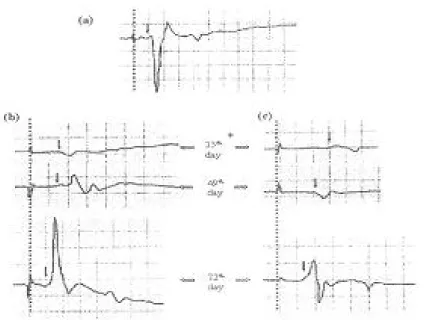
The averaged delay time of CMAP of control and experimental animals, during experimental period (72 days) are presented in Table 1. In Figure 1, the averaged CMAP of intact (a), experimental (b) and control (c) animals are plotted in different stages (35, 49 and 72 days post-operation). The averaged delay times show a shorter latency in records of experimental animals than controls during the experimental period (Table 1).
However, by passing time, the latency of control group became closer to experimental group.Data
Table 1. The comparison of averaged delay time (latency, msec) during the
experimental period in control and experimental animals.
Record no. Recording time (day)
Control group Experimental group
1 28 No record available No record available
2 35 5.15 (± 0.13) 2.86 (± 0.08) ***
3 42 4.55 (± 0.09) 2.64 (± 0.08) ***
4 49 3.60 (± 0.11) 2.40 (± 0.05) **
5 56 3.35 (± 0.1) 2.37 (± 0.04) **
6 72 3.50 (± 0.08) 2.34 (± 0.08) **
**P<0.01, ***P<0.001 compare with the control group (Student’st-test) . The averaged delay time in intact animals was measured 1.78 (± 0.1) msec. The values are presented as Mean + SEM.post-operation days
Fig. 1. (a) An averaged CAMP recorded from an intact animal. Averaged CAMP at different stages (days) of
experimental period, recorded from experimental (b) and control animals (c). The time scale is 2 msec. The stippled lines show the stimulus time. *The days are post-operation. The onset of CAMP.
experimental group (2.35 msec) is very close to the intact animals (1.8 msec) than control group (3.5 msec). Although the principal mechanisms underlying cell death following peripheral nerve injury are currently unknown, a major contributing factor is likely to be deprivation of target-derived neurotrophic factors such as the neurotrophins [18]. Neuronal death after sciatic nerve transection can be prevented in postnatal rats with systemic administration of NGF [13] and in adult rats with locally supplied NGF at the site of nerve section [14]. There have been numerous reports that neurotrophins and NGF rescue motoneurons subjected to transection or crush of peripheral nerves [2, 15-17, 19]. Also, it has been shown that motoneurons respond to neurotrophinsin vitro [18, 20] as well as retrogradely transport neurotrophins [21, 22]. It seems that the occurrence of neuronal loss following axotomy in an age-related fashion, parallels also the age-related loss of trophic factors [23].
The goal of this research was to examine the effects of FBE on recuperation of motor function in the early phase of regeneration. On the base of electromyographical records, the delay time (conduction velocity) was measured on different post-operation days (Table 1). This parameter was used to evaluate the recovery of injured nerve which may include the regeneration of nerve fibers and formation of the new myelin sheet. The results obtained show that during the early phase of the recovery, the application of FBE has a beneficial effect on the functional recovery and appearance of electrical activity of plantar muscles; the shorter the delay time the higher the conduction velocity. As are shown in Figure 1 and Table 1 the latencies, especially in earlier stages, are shorter in the experimental than in control group.
By appearing of different peaks in CMAP of experimental group (stage 49 days) it could be concluded that FBE application may enhance the regeneration of nerve fibers with different diameters and/or myelin sheet formation.
These results demonstrate that application of FBE may have dual effects; firstly, with retrograde transportation of FBE, the neuronal cell bodies rescue of cell death and therefore could regenerate the damaged fibers (neurotrophic effect) [7, 8] and secondly, with regional and anterograde effects of FBE, the Schwann cells may keep their activities
results suggest that the beneficial effects of FBE is more evident in the early phase of peripheral nerve recovery; the period which is critical for re-establishment of end organ innervation.
In conclusion it may be concluded, similar to the effects of fetal brain transplantation on the adult CNS regeneration, FBE may also enhance the PNS regenration.
ACKNOWLEDGMENTS
This work was supported by the grant #3-2/858 from Office of Research Affairs of Ferdowsi University of Mashhad. The authors wish to thank Mr. M. Khaksar and M. Sabzehbin for their technical assistance and animal care.
REFERENCES
1. Gage, F.H., Buzsaki, G. and Armestrong, D.M. (1990) NGF-dependent sprouting and regeneration in the hippocampus. Prog. Brain Res. 83: 357-370. 2. Drby, A., Englemand, V.W., Fredrich, G.E., Neises,
G., Rapp, S.R. and Roufa, D.G. (1993) Nerve growth factor facilitates regeneration across nerve gaps: morphological and behavioral studies in rat sciatic nerve. Exp. Neurol. 119: 176-191.
3. Clatterbuck, R.E., Price, D.L. and Koliatsos, V.E. (1994) Further characterization of effects of brain derived neurotrophic factor and ciliaryneurotrophic factor on axotomized neonatal and adult mammalian motor neurons. J. Comp. Neurol. 342: 45-56. 4. Eriksson, N.P., Lindsay, R.M. and Aldskogius, H.
(1994) BDNF and NT-3 rescue sensory but not motoneurons following axotomy in the neonate. Neuroreport 5: 1445-1448.
5. Evans, P.J., Bain, J.R., Mackinnon, S.E., Makino, A.P. and Hunter, D.A. (1991) Selective reinnervation: a comparison of recovery following microsuture and conduit nerve repair. Brain Res. 559: 315-321.
6. Brushart, T.M. and Seiler, W.A. (1987) Selective reinnervation of distal motor stumps by peripheral motor axons. Exp. Neurol. 97: 289-300.
7. Khrenov, A.P., Novikov, L.N. and Novikova, L.N. (2000) Effects of embryonal nerve tissue transplantation on regeneration of dorsal roots of the rat spinal nerves. Morphologiia 118: 40-44.
8. Bamber, N.I., Li, H., Lu, X., Oudega, M., Aebischer, P. and Xu, X.M. (2001) Neurotrophins BDNF and NT-3 promote host spinal cord through Schwann
10. Crews, L.L. and Wigeston, D.J. (1990) The dependence of motoneurons on their target muscle during postnatal development of the mouse. J. Neurosci. 10: 1643-1650.
11. Broude, E., McAtee, M., Kelley, M.S. and Bregman, B.S. (1999) Fetal spinal cord transplants and exogenous neurotrophic support enhance c-Jun expression in mature axotomized neurons after spinal cord injury. Exp. Neurol. 155: 65-78.
12. Levi-Montalcini, R. (1987) Nerve growth factor: thirty five years later. EMBO J. 6: 1145-1154. 13. Yip, H.K., Rich, K.M., Lampe, P.A. and Johnson,
E.M. (1984) The effects of nerve growth factor or and its antiserum on the postnatal development and survival after injury of sensory neurons in the rat dorsal root ganglia. Neurosci. 4: 2986-2992.
14. Rich, K.M., Luszczynski, J.R., Osborne, P.A. and Johnson, E.M. (1987) Nerve growth factor protects adult sensory neurons from cell death and atrophy caused by nerve injury. J. Neurocytol. 16: 261-268. 15. Oppenheim, R.W. (1996) Neurotrophic survival
molecules for motoneurons: an embarrassment of riches. Neuron 17: 195-197.
16. Sendtner, M., Holtmann, B., Kolbeck, R., Thonen, H. and Barde, Y.A. (1992) Brain-derived neurotrophic factor prevents the death of motoneurons in newborn rats after nerve section. Nature 360: 757-759.
17. Yan, O., Elliot, J. and Snider, W.D. (1992) Brain-derived neurotrophic factor rescues spinal motor
neurons from axotomy-induced cell death. Nature 360: 753-755.
18. Wong, V., Arriaga, R., Ip, N.Y. and Lindsav, R.M. (1993) Theneurotrophins BDNF, NT-3, and NT-4/5, but not NGF, up regulate the cholinergic phenotype of developing motoneurons. Eur. J. Neurosci. 4: 466-474.
19. Fawceti, J.P., Bamji, S.X., Causing, V.G., Alvoz, R., Ase, A.R., Reader, T.A., McLean, J.H. and Miller, F.D. (1998) Functional evidence that BDNF is an anterograde neuronal tropic factor in the VNS. J. Neurosci. 18: 2808-2821.
20. Maisonpierre, P.C., Belluscio, L., Friedman, B., Alderson, R.F., Wiegand, S.J., Furth, M.E., Lindsav, R.M. and Yancopoulos, G.D. (1990) NT-3, BDNF and NGF in the developing rat nervous system: parallel as well as reciprocal patterns of expression. Neuron 5: 501-509.
21. Gimenez, Y.R.M., Revah, F., Pradier, L., Loquet, I., Mallet, J. and Privat, A. (1997) Preventation of motoneuron death by adenovirus-mediated neurotrophic factors. J. Neurosci. Res. 48: 281-285. 22. Yan, Q., Matheson, C., Lopez, O.T. and Miller, J.A.
(1994) The biological responses of axotomized adult motoneurons to brain-derived neurotrophic factor. J. Neurosci. 14: 5281-5291.
23. Eichler, M. and Rich, K.M. (1989) Death of sensory ganglion neurons after acute withdrawal of nerve growth factor in dissociated cell cultures. Brain Res. 42: 340-346.