Design and Fabrication of Compressed air powered Six Stroke
Engine
Lovin Varghese
1*, T. Savio Jojo
2Eldhose Paul
3, Ajo Issac John
4, Arun Raphel
51,3,4,5
Asst. Professor, Department of Mechanical engineering Viswajyothi College of engineering, Kerala, India
I. INTRODUCTION
Presently a days we are in a time where individuals need more mileage in their vehicles. People need vehicles that have more power and increased performance. We know that increasing power leads to the decrease in the mileage of the vehicle ie: the fuel consumption of the vehicle increases with increase in power. Also pollution has become a major factor during the design of engines because more power in vehicles means bigger engines. Engines with least emissions are being developed for a better tomorrow. Many engines which have reduced emissions have been developed out of which compressed air engines being the most successful. These engines run on pure compressed air and thus produce zero emissions. But thus air engine has many drawbacks. Hence an engine has to be developed which has more power and mileage with reduced pollution, thus a six stroke engine is developed which is a fusion of six stroke engine and compressed air engine. Six stroke engine with compressed air is a engine which gives better performance and reduced pollution. The other advantages of this engine is the elimination of cooling system and also reduction in weight.
II.METHODOLOGY
Components
1. Secondary inlet valve
2. Secondary inlet manifold
3. Primary inlet manifold
4. Primary inlet valve
5. Spark plug
6. Exhaust valves
7. Exhaust manifold
8. Piston
9. Connecting rod
Fig 1. Components of six stroke engine
FIRST STROKE:
During the first stroke or the suction stroke the piston moves from the top dead centre to the bottom dead centre, during this period fuel air mixture is sucked from the carburettor and injected into cylinder through the primary inlet valve(4). At this time the secondary valve(1) and the exhaust valves(6) are closed. The first stroke ends with the piston reaching the bottom dead centre.
SECOND STROKE:
During the second stroke or the compression stroke the piston moves from the bottom dead centre to the top dead centre thereby compressing the fuel air mixture. During this stroke all the valves (primary(4), secondary(1) and the exhaust valves(6)) remain closed.
THIRD STROKE:
This is the first power stroke, due to the ignition from the spark plug(5) the charge burns and the force produced during burning pushes the piston downwards. All the valves are kept closed. The piston moves from the top dead centre to the bottom dead centre.
FOURTH STROKE:
This is the exhaust stroke. During this stroke both the inlet valves remain closed and the exhaust valve(6) opens. The piston moves from the bottom to the top dead centre thereby pushing the burnt gas out through the exhaust port.
FIFTH STROKE:
This is the second power stroke. During this stroke the secondary inlet valve(1) opens and compressed air is allowed to enter the engine cylinder. During this period the primary inlet valve(4) and the exhaust valve(6) remains closed. The compressed air expands inside the cylinder pushing the piston downwards producing the second power stroke and the compressed air expands by absorbing the heat from the engine thereby reducing the engine temperature. Thus the engine moves from the top to the bottom dead centre.
SIXTH STROKE:
During this stroke both the inlet valves remain closed and the exhaust port(6) opens. The piston moves from the bottom to the top dead centre thus pushing out the expanded air through the exhaust valve.
III. RESULTS & DISCUSSIONS SEGMENTS CHANGED
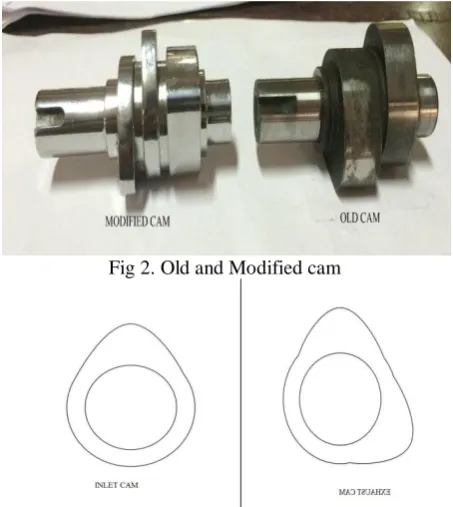
1. CAM
initially outlined in CAD programming and later planned in CATIA programming for the CNC code. The CAM was fabricated utilizing the material EN28, at Don Bosco ITI by Mr. Gorbin.
Fig 2. Old and Modified cam
Fig 3. Cad drawing of cam
2. CAMSHAFT SPROCKET
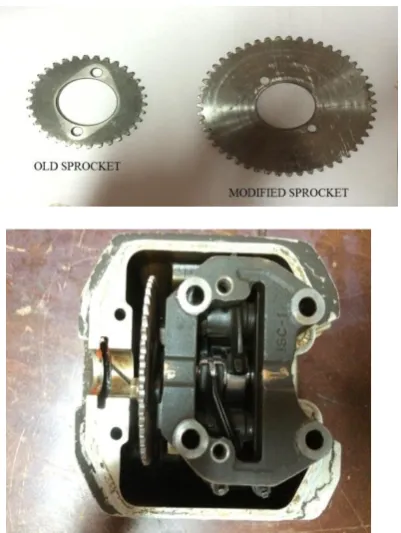
In the six stroke motor for three upset of the wrench shaft there is one upheaval of the camshaft. Subsequently the sprocket of the crankshaft and the camshaft require a teeth proportion of 3:1, while in the four stroke motor the teeth proportion is 2:1. So the sprocket of the four stroke motor camshaft with 34 teeth was supplanted utilizing 51 teeth sprocket.
As the sprocket in the six stroke motor was a specially designed one, every tooth was sliced autonomously to coordinate with the planning chain. The sprockets were cut in Don Bosco ITI, Pachalam utilizing EN28 material.
SEGMENT MODIFIED
1. ROCKER ARM
The motor utilized as a part of this anticipate was a LML 4 stroke petrol motor with 3 valves, two bay valves and a fumes valve. The two channel valves were worked utilizing one rocker arm. In four stroke LML motor fuel is supplied through the two gulfs. For six stroke motor essential fuel(petrol) is infused through the essential delta and optional fuel(compressed air) is infused through the auxiliary channel. In order to partitioned the supply of fuel through the channel valves the rocker arm is sliced into two to work freely. The rocker arm was divided by utilizing point cutter and surface is done utilizing processor.
Fig 5. Modified rocker arm
2. TIMING CHAIN
The length of the planning chain was expanded to remunerate the expansion in width of the camshaft sprocket. Timing chain of another LML motor was purchased and joined with the current chain to expand the length.
3. SECONDARY COMPRESSED AIR INDUCTION SYSTEM
The auxiliary air prompting framework, supplies the packed air which is utilized amid the fifth and 6th stroke. Amid the fifth stroke packed air from the compacted air tank is sucked into the chamber through the auxiliary compacted air incitement line. The optional gulf valve opens to allow the packed wind current. Amid the 6th stroke, the air is expelled through the ventilation system. The gulf valve stays shut amid these strokes.
Fig 7. Auxiliary compacted air incitement line
4. PARTIONING OF INLET MANIFOLD
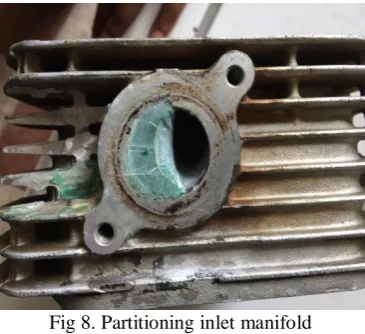
The channel complex is isolated into two keeping in mind the end goal to independent the stream of essential fuel(petrol) and auxiliary fuel(compressed air). The bay is isolated by putting metal glue in the auxiliary complex. Keeping in mind the end goal to keep the reverse of packed air a metal piece is screwed with the carburettor.
Fig 8. Partitioning inlet manifold
supply the two fuels, the primary fuel(petrol) supply to the engine is cut short into half so the chock should be applied so as to provide rich mixture for keeping the engine running.
IV. CONCLUSION
The six stroke engine modification promises dramatic reduction of pollution and fuel consumption of an internal combustion engine. The fuel efficiency of the engine can be increased and also the valve timing can be effectively arranged to extract more work per cycle. Better scavenging is possible as compressed air intake occurs during the fifth stroke and the exhaust during the sixth stroke. Due to more air intake, the cooling system is improved. It enables lower engine temperature and therefore increases in the overall efficiency.
REFERENCES
[1]. Kapil N. Kariya, Mayur M. Raje. “VELOZETA SIX STROKE ENGINE” International journal of pure
an applied research in engineering and technology, volume 2, Published Date: 01/05/2014.
[2]. Yuan-Wei Wang, Jhih-Jie You, Cheng-Kuo Sung, and Chih-Yung Huang. “The Applications of Piston
Type Compressed Air Engines on Motor Vehicles”.37th National Conference on Theoretical and
Applied Mechanics (37th NCTAM 2013) & The 1st International Conference on Mechanics (1st ICM) ,
Published date: June 2014
[3]. AkashAlkhaniya, Aakashkotiyal, “Concept of Six Stroke Engine”, International Journal of Mechanical
and Industrial Technology, Vol. 2, Month: October 2014 - March 2015.
[4]. ChinmayeeKarmalkar, VivekRaut, “Analysing the implementation of six stroke engine in a hybrid
car”International Journal of Mechanical Engineering and Applications 2014, 2(1): 1-4 Published: January 10, 2014.
[5]. B. Ramya, “Study and Analysis of Six Stroke Engine”,B.Ramya Int. Journal of Engineering Research
and Applications, Vol. 4, Issue 9, September 2014.
[6]. Mistry Manish K., Dr.PravinP.Rathod,Prof. SorathiyaArvind S. “STUDY AND DEVELOPMENT OF
COMPRESSED AIR ENGINE- SINGLE CYLINDER: A REVIEW STUDY”, International Journal of
Advanced Engineering Technology, Vol.III, January-March, 2012 .
[7]. PrashantHaridasPande, “Velozeta Six Stroke Engine”, International Journal of Research in Advent
Technology Special Issue 1st International Conference on Advent Trends in Engineering, Science and