ISSN 2319-8133 (Online (An International Research Journal), IF = 4.715, www.physics-journal.org
A Theoretical Evaluation of Eigen Values as a Function of
Applied Bias Voltage of Two QDs When They are Tuned
into Exact Resonance with One Another
Puran Shaw1 and L. K. Mishra2
1Department of Physics,
J. J. College Jhumri-Telaiya, Koderma-825409 (Jharkhand), INDIA. 2Department of Physics,
Magadh University, Bodh-Gaya-824234 (Bihar), INDIA.
(Received on: June 4, Accepted: June 7, 2017)
ABSTRACT
Using the theoretical formalism of A. Lauchet et al. (Phys. Rev 82B, 075305 (2010), we have theoretically studied a system consisting of two spatially separated self-assembled InGaAs quantum dots coupled to optical nano cavity mode. We observe that due to their different size and compositional profiles, the two quantum dots exhibit markedly different DC Stark effects. We have theoretically evaluated the eigenvalues of two QDs as a function of applied bias voltage when they are tuned into exact resonance with one another. We have presented the evaluated results of eigenvalues of (three branches of the double anticrossing of the two QDs) when they
are detuned from the mode,
0 (upper panel)
1 (middle panel)
2 (bottom panel). The evaluation has been performed with the help of equation (5). These results indicate the exact evolution of three branches as a function of Vapp. Our theoretical results indicate that eigenvalue is lowest in
0 panel and largest in
2 panel as a function of Vapp. Our theoretically evaluated results are in good agreement with the experimental data and also with other theoretical workers.Keywords: Two semiconductor Quantum dots, Optical nano cavity, Cavity Quantum electrodynamics (CQED), Quantum optical non-linearties, Double anti-crossing, Exciton-photon coupling strength.
INTRODUCTION
quantum dots unprecedented tenability. These dots are semiconductor nanocrystals embedded in another semiconductor which presents a wide energy band gap between its valance and conduction states. This results in a three dimensional potential well that confine the carriers (electrons and holes) in the nano crystal. Here, the electron and hole motion is quantized in all the three spatial directions. This gives rise to discrete energy levels, each one accommodating up to two electrons and holes of opposite sign as in the case of single atoms. For this reason semiconductor quantum dots are often referred to as ‘artificial atoms’ that is a semiconductor analogue of a single atoms1,2. Quantum information science aims to explore the distinctive features of quantum physics especially superposition and entanglement, to enhance the functionality and power of information and communication technologies. It has been a progressing inter disciplinary field of research for last thirty years. It extends from the fundamental investigation of quantum phenomena to the experimental implementation of disruptive quantum-enabled technologies. In quantum information science, the information is encoded on a quantum bits consisting of any two level quantum system, its two states representing the digits 0 and 1. Among quantum system, photons constitute a neutral choice for communications and metrology. This is a promising route for quantum simulation and computing. All these applications require ideally deterministic light source that can deliver on demand single photon, indistinguisble single photons or entangled photon pairs produced at high repetition rate. Several schemes have been established to produce such quantum states of light for example are attenuated lasers or non-linear optics. Presently, most experiments in quantum optics or photonic quantum information processing rely on non-linear optical sources. These sources allowing the preparation of time-beis3 or polarization4 entangled photons as well as heralded single photons5. Although down-conservation sources are still primarily employed due to high purity of the emitted quantum states of light, such sources suffer in particular from the probabilistic generation of photons combined with a trade-off between the repetition rate and the probability of emitting multiple photon pairs simultaneously.
In an earlier paper27, we have theoretically evaluated the spectral function S(
) of a system where two QDs are coherently coupled via an optical cavity mode. S(
) were evaluated both as a function of applied bias voltage Vapp(V) and as a function of QDs energy(meV). Our theoretically evaluated results are in good agreement with the other theoretical workers and also with the experimental data. We have also evaluated the temperature (K) for two mutually coupled QDs when they are resonance with the cavity mode as a function of wavelength (nm) for three values of magnetic field namely 5.5T, 5.75T and 5.9T. We observed that as the strength of magnetic field is reduced, each QD is coupled individually with cavity mode.In this paper, we have evaluated the eigenvalues (probabilities) of three panels
0 (upper panel)
1 (middle panel)
2 (bottom panel) as a function of applied bias voltage Vapp. We have also studied spectra in two cases (a) when obtained spectral signature could be due to two different single exciton transitions of the same quantum dot (b) by two different QDs one weakly and one strongly coupled to the cavity. Our obtained theoretical results are in good agreement with the other theoretical workers28,29.MATHEMATICAL FORMULA USED IN THE EVALUATION
One extends the model for single QD exciton30 which includes two independently excitons coupled two independently excitons coupled to a common cavity mode
The Hamiltonian is written as 2
1
[ ( )]
2
n n n
n
z n c
n
H
g a
a
a a
(1)Where
n, nand
nz are the pseudo spin operators for the two level system consisting of ground state0
and a single exciton stateX
n of the nth QD (n=1,2).
n is exciton frequency, a+ and a are the creation and annihilation operators of photons in the cavity mode with frequency
c and gn describes the strength of the dipole coupling between cavity mode and exciton of the nth-QD. The incoherent loss and gain (pumping) of the dot cavity system is included in the master equation of the Lindblad form[ , ]
( )
d
i
H
dt
(2)
Where 2
1
( ) [ (2 )
2
n n n n n n
n
n
(2
)
(
)
2
2
n n n n n n n n
n n
z z
P
(2
)
(2
)
2
2
c
P
ca a
a a
a a
a
a aa
aa
Here
n is the exciton decay rate, Pn is the rate at which excitons are created by a continuous wave pump laser,
nis the pure dephasing rate of exciton in the nth-QD which accounts for effects originating from high exciton powers or high temperatures,
c is cavity loss, Pc is the incoherent pumping of the cavity31 and
is the density matrix of the systemAssuming that most of the light escapes the system through the radiation pattern of the cavity and using the Wiener-Khintchine theorem, the spectral function is given by32
0
( ) lim Re exp[ ( r ) ] ( ) ( )
S
t d
i
t a t a t
(4)Where
r is the half width added to take into account of the finite spectral resolution of double-monochromater33. The emission eigen frequency is obtainedby solving the Liouvillian equation for the single time expectation value34i
t
(a
1
= 1 2 1 12 2
0
0
c
g
g
g
g
(a
2
)
12
) (5) Wherec c
i
c
6(a)n n
i
n
6(b)(
)
2
c c c
P
6(c)(
)
2
c c n nP
6(d)The exciton-phonon coupling strength g is calculated using the formula 1 2 2 2 2
(
)
[
]
4
16
c nE
g
(7)obtains the degree of mixtures of each peaks in the spectrum i.e the strength of the contributions of cavity mode, QD1 exciton and QD2 exciton to each individual eigen states. In this calculation, one puts the following data
1
44
g
eV
2
51
g
eV
1
0.1
QD
eV
2 0.8
QD
eV
1 1.5 QD
P
eV2
1.9
QDP
eV
1
20
QD
eV
2
9.8
QD
eV
147
c
eV
5.7
c
P
eV
(8) Now in the case of study of optical properties of Quantum dot, the coupling strength between exciton-photon g is also calculated directly from the minimum energy splitting by similar type of formula as in equation (7)1 2 2
2 2
(
)
[
]
4
16
c s
E
g
(9)Where
cand
sare the cavity and exciton decay rate respectively. Now from the cavity Q, one can determine the cavity mode decay rate as36.4
2
c
c
GH
zQ
0.16
s
GH
z
One obtains the value of g1 and g2 as 1
13.8
zg
GH
2
14.8
zg
GH
(10) where g1 and g2are the exciton-photon coupling strength of the state.
of the same QD i.e exciton and charged exciton. In this case the spectral function is the sum of the spectra of two independent quantum states
S(
)=S1(
) + S2 (
) (11) This gives double peak close to the resonance.DISCUSSION OF THE RESULTS
Table T1: An evaluated result of eigenvalue of the three branches of the double anticrossing of the two QDs when they are detuned from the mode,
0 (upper panel)
1 (middle panel)
2(bottom panel)
Applied Voltage Vapp (V) <---- Eigenvalue (Energy, meV)---
0
1
20.10 1217.27 1217.40 1217.58
0.20 1217.45 1217.55 1217.70
0.25 1217.56 1217.67 1217.75
0.30 1217.65 1217.75 1217.80
0.35 1217.72 1217.80 1217.85
0.40 1217.80 1217.90 1217.96
0.45 1217.85 1218.20 1218.37
0.50 1217.88 1218.32 1218.48
0.55 1217.90 1218.43 1218.62
0.60 1217.95 1218.54 1218.70
Table T2: An evaluated result of probability (eigenvalue) of normalized admixture of QD1, QD2 and cavity mode to the quantum state of the coupled system for upper panel
0 as a function ofapplied bias voltage Vapp(V). This is the individual states for different detuning as a function of Vapp
Applied bias voltage Vapp <----
0(upper panel)(eigenvalue)----
QD1 QD2 Cavity mode
0.20 0.955 0.052 0.002
0.25 0.927 0.158 0.006
0.30 0.908 0.267 0.010
0.35 0.835 0.343 0.030
0.40 0.746 0.468 0.046
0.42 0.629 0.589 0.086
0.45 0.546 0.662 0.128
0.50 0.502 0.785 0.182
0.55 0.438 0.862 0.105
0.60 0.326 0.935 0.074
Table T3: An evaluated result of probability (eigenvalue) of normalized admixture of QD1, QD2 and cavity mode to the quantum state of the coupled system for middle panel
1 as a function ofapplied bias voltage Vapp(V). This is the individual states for different detuning as a function of Vapp
Applied bias voltage Vapp <----
1(middle panel)(eigenvalue)----
QD1 QD2 Cavity mode
0.20 0.056 0.987 0.095
0.25 0.082 0.906 0.186
0.30 0.126 0.835 0.202
0.35 0.238 0.675 0.265
0.40 0.456 0.436 0.386
0.42 0.589 0.358 0.302
0.45 0.635 0.487 0.255
0.50 0.428 0.598 0.215
0.55 0.237 0.678 0.186
Table T4: An evaluated result of probability (eigenvalue) of normalized admixture of QD1, QD2 and cavity mode to the quantum state of the coupled system for bottom panel
2 as a function ofapplied bias voltage Vapp(V). This is the individual states for different detuning as a function of Vapp
Applied bias voltage Vapp <----
2 (bottom panel)(eigenvalue)----QD1 QD2 Cavity mode
0.20 0.056 0.126 0.958
0.25 0.082 0.208 0.903
0.30 0.125 0.305 0.875
0.35 0.186 0.396 0.786
0.40 0.209 0.458 0.654
0.42 0.246 0.532 0.585
0.45 0.489 0.436 0.495
0.50 0.686 0.297 0.335
0.55 0.855 0.185 0.274
0.60 0.952 0.102 0.186
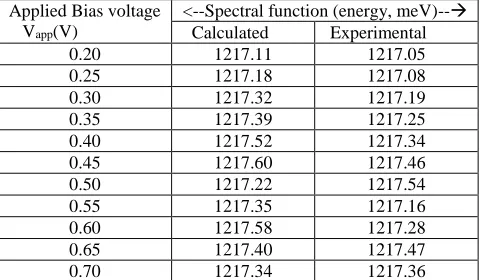
Table T5 :An evaluated result of Spectral function (energy, meV) as a function of applied bias voltage Vapp (v) assuming that QD1 and QD2 cannot coexist at the same time We have compared
our theoretical results of spectral function with the experimental data36
Applied Bias voltage Vapp(V)
<--Spectral function (energy, meV)-- Calculated Experimental
0.20 1217.11 1217.05
0.25 1217.18 1217.08
0.30 1217.32 1217.19
0.35 1217.39 1217.25
0.40 1217.52 1217.34
0.45 1217.60 1217.46
0.50 1217.22 1217.54
0.55 1217.35 1217.16
0.60 1217.58 1217.28
0.65 1217.40 1217.47
0.70 1217.34 1217.36
Table T6: An evaluated result of spectral function (energy, meV) as a function of applied bias voltage Vapp (V) assuming that QD2 is only weakly coupled to the cavity mode with fixed
g
2=32e
V. We have compared our theoretical results of spectral function with the experimental data36
Applied Bias voltage Vapp(V)
<--Spectral function (energy, meV)-- Calculated Experimental
0.20 1217.22 1217.17
0.25 1217.31 1217.25
0.30 1217.36 1217.29
0.35 1217.42 1217.38
0.40 1217.56 1217.53
0.45 1217.68 1217.62
0.50 1217.47 1217.43
0.55 1217.35 1217.30
0.60 1217.58 1217.54
0.65 1217.46 1217.41
CONCLUSION
From the above theoretical analysis and investigations, we have come across the following conclusion
(1) In case of QDs tuning there is resonance with cavity mode the system is in state of coherent superposition for longer time. It has external very high mode Q-factors.
(2) In the investigation of observed spectral function two possibilities arise (a) two different single exciton transition to the same quantum dot. (b) two different QDs, one is weakly and other is strongly coupled to the cavity mode.
(3) In the case of QD2 weakly coupled to the cavity mode, no exciton- polaritons are found. Spectral functions are not affected by the cavity mode.
REFERENCES
1. Lounis B. Bechtal H. A., Gerion D., Alivisatos P., and Moerner W.E., ,’Single QD: fundamentals Application and New concept, Chem. Phys. Lett. 329, 399 (2000).
2. Michler P., Kiraz A., Becher C., Schoenfeld. W. V., Hu E., and A. Imamoglu A., “A Quantum Dot Single Photon-Turnstile Device, Science 290, 2282 (2000).
3. Brendel,, J., Tittle W., Zbinden H. and Gisin N.,’Pulsed energy-time entangled twin-photon source for Quantum Dot, Phys. Rev. Lett.(PRL) 82, 2594 (1994).
4. Kwiat P.G., Mattle K., Weinfurther H., Zeillinger A. and Shi, Y.,’ New High-intensity source of polarization-entangled Photon pair, Phys. Rev. Lett.(PRL) 75, 4337 (1995). 5. Fasel S., Alibart O., Tanzilli S., Baldi P., and Zbinden H.,” High quality asynchromous
heralded single photon source --, New J. Phys. 6,163 (2004).
6. Kimble H., Dagenais M. and L. Mandel L., ‘Photon-Antibunching in resonance fluorescence, Phys. Rev. Lett.(PRL) 39, 691 (1997).
7. Grangier P., Roger G. and Aspec A., ’Experimental evidence for photon anticorrelation effect, Europhys. Lett. 1, 173 (1986).
8. Dietrich F. and Walter H., ‘Non classical radiation of single stored ion, Phys. Rev. Lett. (PRL) 58, 203 (1987).
9. Keller M., Lange B., Hayasaka K. and H. Walter H., ‘Continuous generation of single photon with controlled----, Nature 431, 1075 (2004).
10. Bashe T., Moerner W. E., Orrit M. and Talon H., ‘Photon antiboding in the fluorescence of single dye molecule, Phys. Rev. Lett.(PRL) 69, 1516 (1992).
11. Lounis B. and Moerner W. E, ‘Single photon on dimand from a single molecule at room temperature, Nature 407, 491 (2000).
12. Kurtsiefer C., Mayer S., Zorda P. and Weinfurther H., ‘Stable solid-state source of single photon, Phys. Rev. Lett.(PRL) 85,290 (2000).
13. Bereretos A., Brouri R., Gacoin T. and Grangier P.,’Non-classical radiation from diamond nanocrystals, Phys. Rev. A64, 061802 (2001).
15. A. Shields A., ‘Semiconductors quantum light sources, Nature Photonics 1,215 (2007). 16. Santori C., Fattel D., Vuckovic J., Soloman G. S. and Y. Yamamoto Y.,
‘Indistinguishable photon from a single photon device, Nature 419, 594 (2002).
17. Reithmaier J. P., Sek G., Loffier A. and Forchel A., ‘Strong coupling in a single quantum dot semiconductor, Nature 432, 197 (2004).
18. Yoshie T., Schirer A., Hendrickson J., Shehekin O. B. and Deppl D. G., ‘Vacuum Rabi splitting with a single quantum dot in a photonic crystal, Nature 432, 200 (2004). 19. Peer E., Senellart P., Martroce D., Hown J. and J. Bloch J., ‘Exciton-photon strong
coupling regime for a single quantum dot, Phys. Rev. Lett.(PRL) 95, 067401 (2005). 20. Reitzenetein S., Loeffier A., Hofman C. and Forchel A., ‘Coherent photon coupling of
semiconductor quantum dots, Opt. Lett. 31, 1738 (2006).
21. Laucht A., Hauke N., Vills-Boas J. M. and Finley J. J., ‘Dephasing of exciton-polaritons in photoexcited InGaAs quantum dot, Phys. Rev. Lett.(PRL) 103, 087405(2009).
22. Laucht A., Kaniber M., Mohtashami A., Hauke N. and Finley J. J., ‘Temporal monitoring of photons, Phys. Rev. B81,241302(R) (2010).
23. Englund D., Faraon A., Fushman I., Stoltz N. and Vuckovic J.,‘Controlling cavity reflectivity with single quantum dot, Nature 450, 857 (2007).
24. Gerace D., Tureci H. E., Imamoglu A. and Fazio R., “ The quantum-optical Josephson-interferometer, Nature Physics 5, 281(2009).
25. Imamoglu A., Awschalon D. D., Burkard G., Lose D., Shirwin M. and A. Smal A., ‘Quantum information processing using quantum dot spins---, Phys. Rev. Lett.(PRL) 83, 4204 (1999).
26. Flagy E. B., Muller A., Polyakov S. V., Ling A. and Solomon G. S., ‘Interference of single photons emitted by two separate semiconductor quantum dot states, Phys. Rev. Lett. (PRL) 104, 137401(2010).
27. Sachidanandan Singh and L. K. Mishra, “Coupling of two semiconductor quantum dots via Nanocavity, J of Pure appl. And Industrial phys. Vol 7(5) 211 (2017).
28. Winger M., Volz T., Tarel G., Portolan S., Badolato A. and V. Savona et al., ‘Nonequlibrium steady state of photoexcited controlled electrons----, Phys. Rev. Lett.(PRL) 103, 207403 (2009)
29. M. O. Scully and M. S. Zubairy, Quantum Optics (Cambridge University Press, Cambridge, 1977).
30. Carmichael H. J., Brecha R. J., Raizen M. G., Kimble H. J. and Rice P. R., ‘The time-dependent physical spectrum of light, Phys. Rev. A40 5516 (1989).
31. Laucht A., Villas-Boas J. M., Stobbe S., Kaniber M. and Finley J.J., ‘ Mutual coupling of two semiconductor quantum dots via an optical nanocavity, Phys. Rev. B82, 075305 (2010).
32. Kim Hyochul, Sridharan Deepak , Shen T.C. , Soloman G. S. and Waks E., ‘ Sub-natural line width averaging for coupled atomic and cavity-mode, Optics Express 19, 2589 (2011). 33. Baier M. H., Malko A., Pelucchi E., Oberli D. Y. and Kapon E., ‘ Strong coupling
34. Fain B., Robert-Philip I., Beveratos A. and Giard J. C., ‘Quantum-dot exciton dynamics probed by photo-correlation---, Phys. Rev. Lett. (PRL) 108, 126808 (2012).
35. Barker J. A. and O’Reilly E. P., ‘Discretization of electronic states in large InAsP/InP,
Phys. Rev. B61, 13840 (2000).
36. U. Hohenester, A. Laucht, M. Kaniber, N. Hauke and J. J. Finley, ‘Theoretical analysis of electron-hole alignment in InAs-GaAs quantum dot’ Phys. Rev. B80, 201311(R) (2009). 37. A. Reinhard, T. Volz, M. Winger, A. Bodolato and A. Imamoglu, “Propagation of
contrained based single photon” Nat. Photon 6, 93 (2012).
38. M. Munsch, N. S. Malik, E. Dupuy, A. Delga, J. Bleuse and J. Moerk, “Optical emission from single semiconductor quantum dot” Phys. Rev. Lett.(PRL) 111, 239902(E) (2013). 39. Y-M He, Y. He, Y-J Wei, D. Wu and J-W Pan,”Exciton-spin states mediated
photon-photon interaction in a systems—“ Nat. Nanotechnol. 8,213(2013).
40. G. Juska, L. O. Mereni, A. Gocalinska and E. Pelucehi,” Strongly correlated photons on a chip” Nat. Photon 7, 527 (2013).
41. H. Jayakumar, A. Predojevic, T. Kauten, T. Huber and G. Weihs,”Dielectric-GaAs antenna ensuring an efficient broadband coupling” Nat. Commun. 5, 4255 (2014).
42. M. Muller, S. Bounonar, K. D. Jomes, M. Glan and P. Michler,” On diamond semiconductor single photon sources” Nat. Photon 8, 224 (2014).
43. L. Monniello, A. Reigue, R. Hostein, R. Grousson and V. Voliots, “ Towards quantum-dot arrays of entangled photon emitters” Phys. Rev. B90, 041303(R) (2014).
44. A. K. Nowak, S. L. Portalupi, V. Giesz, I. Sagnen and P. Senellart, “ Exotic properties of Carbon Nanoemitters” Nat. Commun. 5,3240 (2014).
45. G. Bulgarini, M. E.Reimer, M. B. Bavinck, K. D. Jones, D. Dalack and V. Zwiller,” A theoretical spin-transfer torque and electronic current in helical edge states” Nano Lett. 14, 4102 (2014).
46. A. V. Tsukanov and I. Yu Kateiv,” Nanowine waveguides launching single photons in a Gaussian modes” Rassian Microelectronics 44, 61(2015).
47. J. T. Mahonen, A. Laucht, S. Simmon et al., “Quantum calculations on quantum dots in semiconductor microcavities” J. Phys. Condens. Matter 27, 154205 (2015).
48. Gersimes Angelatots, ‘Theory and application of light matter interactions in quantum dots, Thesis submitted to Queen’s University Kingston, Ontarto, Canada (August 2015). 49. T-Hyuns Kuan et al., “Two photons interference from the far-field emission of chip
integrated cavity-coupled emitters, Nano Lett. 16, 7061 (2016).
50. Dam Thuy Trang Nguya et al., “Coupling of single atom nanoparticle to a polymer-based
photonic structure, Journal of Science: Advanced Materials and Devices, Vol 1, page 18-30 (2016).
51. M. Florian et al., “Scattering –induced dephasing of many-particles transitions in