Available Online At www.ijpret.com
INTERNATIONAL JOURNAL OF PURE AND
APPLIED RESEARCH IN ENGINEERING AND
TECHNOLOGY
A PATH FOR HORIZING YOUR INNOVATIVE WORK
LEARNING OBJECTS MANAGEMENT SYSTEM FOR E-LEARNING
SHACHI KHODKE1, PROF. A. V. DEORANKAR2, DR. P. N. CHATUR3
1. M. Tech 2nd year, Department of Computer Science and Engineering, Government College
of Engineering, Amravati (Maharashtra), India.
2. Asst. Professor, Department of Computer Science and Engineering, Government College of
Engineering, Amravati (Maharashtra), India.
3. Head of Department, Department of Computer Science and Engineering, Government
College of Engineering, Amravati (Maharashtra), India.
Accepted Date:
27/02/2013
Publish Date:
01/04/2013
Keywords
Learning Object, Learning Object Metadata, Loms,
Xml Binding Elearning, Elearning Standards, Xml-Native Database.
Corresponding Author
Ms. Shachi Khodke
Abstract
Available Online At www.ijpret.com INTRODUCTION
As web-based Learning being widely used in
educating and training, the amount of
digital learning resources begin to
accumulate. Reusability and interoperability
of digital learning resources become one of
the major challenges. The proposal to
structure learning contents according to the
model of the Learning Object (LO) has
evolved out of this context. The
characteristics of durability, interoperability
and reusability and the related
standardization process needed to achieve
these goals, have played an important role
in the diffusion of the Learning object
model. Thus the cost of courseware
development can be lowered through
reusing of learning objects.
A learning object, as defined by the
Institute of Electrical and Electronics
Engineers (IEEE) Learning Technology
Standards Committee, “is any entity, digital
or non-digital that can be used, re-used or
referenced during technology supported
learning” (IEEE, 2002). This definition is
intended to include any form of
instructional material that can be used
during “technology supported learning.”
Learning objects should be stored in a
database and organized by a management
system for easy retrieval and search. For
this purpose a small amount of additional
information must be provided to describe
each learning object. These information are
called metadata. In common sense
metadata is a label placed on any object,
similar to the labels on cans of vegetables
and library cards. In e-learning context
metadata is the term to describe a package
of information about an electronic
resource, providing information such as
author, title, subject matter, copyright
information, and location.
The core of a learning object system is a
central repository (database) containing
hundreds to thousands of individual
learning objects. The information stored in
these repositories would be accessed by an
array of applications and end users,
including learners and the instructional
designers. Attached to each learning object
Available Online At www.ijpret.com
includes subject-specific information by
conforming to the open standards.
Figure1. Learning Object Repository
Centralized Metadata
The basic LMS performs two major
functions: it provides instructional
designers with a means of locating learning
objects, and it assembles them into
standard compliant learning units. Although
many types of LMSs are available, the
enhanced LMS will contain four essential
features: an authoring application similar to
the computer assisted software
environment , a collection of learning
objects described above, a means of
sending the completed course to a delivery
system (called a delivery interface), and
administration tools. The LMS systems have
been enhanced to include additional
features, such as intelligent tutoring or
adaptive learning components for learners.
In particular the standardization process
has focused on two main aspects: the
description of LOs to provide efficient
search and retrieve mechanisms; the model
of LO to guarantee the reusability and
interoperability of educational resources in
the hundreds of learning platforms and
learning systems available worldwide.
Standard organizations such as ACM
(Association for Computing Machinery), DLF
(Digital Library Federation) and IEEE
(Institute of Electrical and Electronics
Engineers), IMS (Global Learning
Consortium, Inc.) and ADL (the Advance
Distributed Learning Initiative, sponsored
by the OSD (Office of the Secretary of
Defense of USA)) have published several
well known specifications for e-learning
either independently or co-operatively
XML-based specifications supporting
learning technologies have been developed
by the SCORM initiative and distributed
through the ADL (Advanced Distributed
Learning) initiative’s network [5]. There are
Available Online At www.ijpret.com
content aggregation model and the other is
run-time environment. SCORM provides
specifications for building a unified content
model and a run-time environment, enable
courseware sharing and multi-platform
(cross-platform) learning.
Our basic design goal is to develop a
general-purpose, user-friendly digital
reference room with a simple but effective
architecture. So we adopted native XML
database technology and open source
offering Xindice after thorough
investigation. This paper describes the
architecture and implementation for
Learning object management system using
native xml database Xindice.[7]
SYSTEM ARCHITECTURE
The architecture is based on the B/S
(Browser/Server) architecture. Contrast to
other Client/Server architectures, B/S is
convenient for user, for only a browser is
required. In addition, the change of the
system doesn’t affect the user either. The
LOMS consists of two sub-systems:
application server and the database servers.
The system is distributed on three layers:
the presentation layer, the function/control
layer and the data layer. The browser on
the presentation layer is the entry to the
system. Application server focuses on the
implementing of the functions of the
system, such as the metadata’s generating.
It is the function/control layer. All the data,
including the metadata and the learning
objects themselves are stored in different
databases, which form the data layer. The
metadata is stored in Xindice and the
learning objects in file systems. Three
components reside in the application
server: Learning Objects Upload Module
allows a user upload his/her learning
resources to the system and stores them
into the learning objects database.
Metadata Generate Module generates the
metadata for a learning object. Learning
Objects Search/Retrieve Module accepts
the user’s request, finds the appropriate
objects and then returns them.[5]
Available Online At www.ijpret.com XML Binding for the Metadata
XML binding for a metadata defines the
structure of the XML document, the
elements appeared, including the elements’
names, attributes and contents and the
number of a specific element and order of
some elements. For instance, the name of
the root element of the XML document for
LOM must be “lom”. It also defines the
value’s ranges for some attributes and more
for the organization of the XML document.
The Management of Metadata
The XML presentation of metadata
should be stored for the management of
learning objects. Most work of the LOMS is
to generate metadata and store them for
the adding of new learning objects, to
search the appropriate learning object
through searching the metadata. A
sub-system called repository serves this
purpose. Xindice is used as the repository in
our system, which is a so-called XML-native
database. XML-native means that when the
XML documents are stored into the
database the conversion of the structure of
the document into the table-structure used
in Relational database is not required and
the retrieval of the documents don’t need
the reverse conversion. Xindice uses the
XPath as the query language. It is quite
suitable where just the XML binding is used
for metadata.
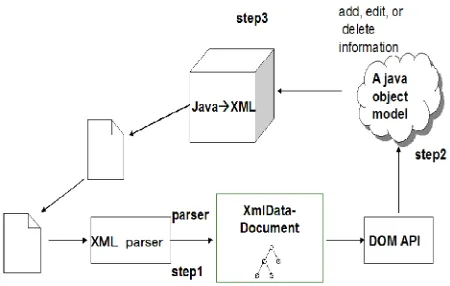
Steps to manage the XML contents
Fig.3 shows a procedure for managing the
XML contents. Considering the case when
an instructor or an administrator wants to
update/modify an available content in XML,
for instance, logic puzzles, he or she can do
in following steps:
Figure 3. Steps to manage the XML contents
Convert the XML document to a Java object
Available Online At www.ijpret.com
(Document Object Model). Using the DOM
API, we will create our own a Java object
model. An XML LRDB (logic reference
database) document, for example, is
converted to a Java object model for logic
reference database. The DOM API is used to
read in information from an XML document.
DOM can also be used to change this
information, and can be used to generate
an XML document. There is an easier way of
getting around using DOM for modifying
and saving the XML data; working with the
Java object model. The contents of the logic
reference database are stored in the object
model and this model is used to add, edit or
delete information. Generate an XML
document from a Java object model. The
Java object model for the logic reference
database is saved as an XML document [8].
CONCLUSION
This paper will serve as an e-learning portal
in which new objects will be allowed to
create and old objects to be reused. For the
reusability and interoperability of learning
objects, the development of a LOMS should
be based on the concept of metadata and
compatible to various metadata standards.
The XML technology makes the
multi-standards support feasible.
REFERENCES
1. Albert D. Ritzhaupt ,” Learning Object
Systems and Strategy: A Description and
Discussion”, Interdisciplinary Journal of
E-Learning and E-Learning Objects Volume 6,
2010.
2. Y. Vovides , S. Sanchez-Alonso,” The use
of e-learning course management systems
to support learning strategies and to
improve self-regulated learning” ,Science
Direct Educational Research Review 2 ,64–
74 ,2007.
3. Alex Koohang, “Creating Learning Objects
in Collaborative E-learning Settings”, Issues
in Information Systems, Volume V, No
2,2004.
4. Wang Xuan, Zheng Li, and Yang Fang,”An
Implementation of Learning Objects
Management System”, Springer-Verlag
Berlin Heidelberg 2004
5. Olivier Motelet, Nelson A. Baloian ,José
Available Online At www.ijpret.com
Learning Object Metadata”, JOURNAL OF
COMPUTERS, VOL. 2, NO. 3, MAY 2007
6. Apache Software Foundation, The
Apache Xindice Project.