Available Online at www.ijpret.com 411
INTERNATIONAL JOURNAL OF PURE AND
APPLIED RESEARCH IN ENGINEERING AND
TECHNOLOGY
A PATH FOR HORIZING YOUR INNOVATIVE WORK
AN OVERVIEW OF ZONE ROUTING PROTOCOL USING NS2 SIMULATOR
MEENA H. GADGE1, PROF. K. B. BIJWE 2
1. P. G. Student, Department of Computer Science & Engineering, P. R .Pote (Patil) Welfare & Education Trust’s college of Engineering & Management, Amravati.
2. Professor, Department of Computer Science & Engineering, P. R .Pote (Patil) Welfare & Education Trust’s college of Engineering & Management, Amravati.
Accepted Date: 15/03/2016; Published Date: 01/05/2016
\
Abstract: The behavior of purely proactive and reactive schemes suggests that what is needed is a protocol that initiates the route determination procedure on demand, but at limited search cost. Zone Routing Protocol (ZRP) is a hybrid protocol which combines the advantages of both proactive and reactive approaches. For route discovery reactive routing protocols involves long route request delays and inefficient flooding, while proactive routing protocols uses excess bandwidth to maintain routing information. ZRP solves these problems by combining the best properties of both approaches. It takes advantage of proactive discovery within a node's local Neighbourhood and using a reactive protocol for communication between these Neighbourhoods. In Ad-Hoc mobile network, it can be supposed that the most communication takes place between nodes closer to each other. Therefore, ZRP decreases the proactive scope to a zone centered on each node. In a limited zone, the routing information can be maintained easily and the amount of routing information that is never used is also minimized. Since all nodes proactively store local routing information, nodes farther away can be reached with reactive routing.
Keywords: ZRP, IARP, IERP, BRP, NS2, Algorithm.
. Corresponding Author: MS. MEENA H. GADGE
Access Online On:
www.ijpret.com
How to Cite This Article:
Available Online at www.ijpret.com 412 INTRODUCTION
In wireless networking, Zone Routing Protocol or ZRP was the first hybrid routing protocol with both a proactive and a reactive routing component. ZRP was introduced to reduce the control overhead of proactive routing protocols and decrease the latency caused by route discovery in reactive routing protocols. The Zone Routing Protocol (ZRP) as described in aims at addressing these limitations by combining the best properties of both proactive and reactive approaches and hence it can be classed as a hybrid proactive/reactive routing protocol. [5],[6]
In a MANET it can be safely assumed that most communication takes place between nodes close to one other. Therefore, ZRP decreases the proactive scope to a zone centred on each node and reactive approach outside the zone. When a node has to send a data packet to a particular destination, first it checks whether the destination is within the zone of the node or not. If it is within the zone, the packet is routed proactively. If the destination is outside the zone then reactive routing is used. A proactive routing protocol, Intra-zone Routing Protocol (IARP), is used inside routing zones, and a reactive routing protocol, Inter-zone Routing Protocol (IERP), is used between routing zones [11].
A route to a destination of packet within the local zone of a node can be established from proactively cached routing table of the source by IARP. Thus, if the source and destination of a packet to be sent are in the same zone, the packet might be delivered immediately. For routes outside the local zone, route discovery is done reactively. A route request is sent by the source node to the border nodes of its zone, having its own address, the destination address and a unique sequence number. If the destination node is not a member of this local zone of the source, the border node adds its own address to the route request packet sent by the source node and forwards the packet to its own border nodes. If the destination is a member of the local zone of the source, it sends a route reply packet on the reverse path back to the source. The source node uses this path saved in the route reply packet to send data packets to the destination.[11]
Available Online at www.ijpret.com 413 II . LITERETURE REVIEW
Natasha Dhiman, Mr. Jagtar Singh conclude that Routing is very essential component in the study of MANETs. These are networks where topology is changing very rapidly. Every time the topology changes the source to destination path also change, so our routing protocol must able to overcome the all challenges of routing. We have discussed the hybrid Zone Routing Protocol in this paper, which is the combination of reactive and proactive routing protocols and have advantages of both type of protocols. The ZRP protocol is suitable for large networks and is not an independent protocol but rather a routing framework. It is especially well adapted to large networks and diverse mobility patterns. Often it is more appropriate to apply a hybrid protocol rather than a strictly proactive or reactive protocol as hybrid protocols often possess the advantages of both types of protocols. Further, architecture and components of ZRP were discussed in detail comprising IARP, IERP, NDP, and BRP. The functionality of different components is mentioned then routing process is discussed through which we understand the ZRP routing properly. [1]
Vinay Kumar, Prof. (Dr.) C. Ram. Singla shown that network Coding-based AOMDV (NC-AOMDV) routing in MANET proposed by Yang, et al., suggested a routing algorithm to increase data transmission reliability or provide load balancing. In simulation, NC-AOMDV routing protocol is compared to AODVM routing protocol, regarding packet delivery ratio, packet overhead and average end-to-end delay during packet transmission. Simulation results reveal that NC-AOMDV routing protocol provides accurate and efficient estimates and evaluates route stability in dynamic MANETs. An improved AOMDV to increase path stability by using node mobility information in MANET was proposed by Park, et al., where authors suggest an algorithm that excludes high mobility nodes from constructing a path by collecting and managing mobility information. Hence, the proposed algorithm ensures more stable paths. In this algorithm, MRecord Field and Relieve Field are appended in the routing table to collect and manage mobility information by extending current AOMDV. Additionally, Mbl Field is added to RREP message to adapt collected information for path configuration. The proposed protocol’s performance is analysed, and compared to existing AOMDV using ns-2 simulator.[2]
Available Online at www.ijpret.com 414
probability, but have greater overheads. Multipath routing protocols have been implemented for mobile adhoc networks from many years. Multipath routing can yield load balancing and minimize the occurrence of route discovery mechanism effectively as compared to single path counterparts. Researchers have made rapid progress in ad hoc networks. Many multi path extensions of AODV have been suggested.[8]
Keshav Nayak, Neelesh Gupta shown that optimizes the power depletion and maintains a more or less uniform power usage among all the nodes in the network while maintaining effective throughput. In the simulation, it is observe that a sharp performance and power usage gains using the considered AODV, DSR and ZRP protocol performances. If the battery of a node is drained out, then it cannot communicate with other nodes and the number of nodes that more participating in routing their energy is depleted early in network. The energy based routing is done with AODV, DSR and ZRP performance has been studied via simulations. Simulation results have indicated that the DSR routing technique provides robustness to mobility and enhances protocol performance. However, this routing performance may perform well under different pause time, energy consumption, Node mobility, random mobility and different node density. Its performance has been found much better than other existing protocols in dense medium as probability of finding active routes increases. The energy consumption per packet in DSR protocol is less. The comparison analysis will be carrying out about these protocols and in the last the conclusion is that the DSR is the more energy efficient protocol for routing and for energy based routing DSR routing protocol is the best one for mobile ad hoc networks. In future this concept can be apply with all different MANET protocol like MPDSR, MAODV and OLSR. In future various energy depletion parameters can be used and simulate the work so in future rectified result get from the proposed module.[17]
Available Online at www.ijpret.com 415
than other routing algorithms. Thus, clustering conserves the limited energy resources of the sensor nodes. The proposed system is very scalable in that it has linear complexity in the number of neighbors and constant complexity in the total number of nodes. To get the better result with several protocols, analysis can be done with the protocols like DSR and DSDV. Further, the system can implement security based wireless sensor network by routing the packets in a more secured way.[18]
III. ARCHITECTURE
Zone Routing Protocol consists of several components, which only together yield the full routing benefit to ZRP. Each component of ZRP works independently of the other and they may use different technologies in order to maximize efficiency in their particular area. Fig. 1 illustrates the different protocols and their interactions.
Fig.1: ZRP Architecture
Available Online at www.ijpret.com 416
(NDP) provided by the MAC layer. NDP transmits “HELLO” beacons at regular intervals. After receiving a beacon, the neighbour table is updated. Neighbours, for which no beacon has been received within a specified time, are removed from the table. [3],[12]
The IARP allows for local route optimization through the removal of redundant routes and the shortening of routes if a route with fewer hops has been recognized, as well as bypassing link-failures through multiple (local) hops, thus leveraging global propagation. Due to its pro-active nature, local route discovery is very efficient and routes to local destinations are immediately available. In order to not over use the available bandwidth resources, the IARP, as the name indicates is restricted to routing within the zone that is why it is referred to as a “limited scope pro-active routing protocol”.
As the global reactive routing component of the Zone Routing Protocol, the Inter zone Routing Protocol, or IERP, takes benefit of the known local topology of a node’s zone and, using a reactive approach which enables communication with the nodes in other zones. IERP is a family of reactive routing protocols like DSR or AODV that offer enhanced route discovery and route maintenance services based on local connectivity monitored by IARP. For route discovery by IERP, the notion border casting [4] is introduced. Border casting utilizes the topology information provided by IARP to direct query request to the border of the zone. The border cast packet delivery service is provided by the Border cast Resolution Protocol (BRP). BRP uses a map of an extended routing zone to construct border cast trees for the query packets. BRP employs query control mechanisms, to direct route requests away from areas of the network. Route queries within the IERP are issued on demand that is only when a request for a route is formed. The delay caused by the route discovery (in reverse to IARP, where the route is immediately available) is minimized through the use of border casting, an approach in which the node does not subscribe the query to all local nodes, but only to its peripheral nodes. Moreover, a node does not send a query back to the nodes from where the request came, even if they are peripheral nodes.[4]
Available Online at www.ijpret.com 417
The BRP keeps track of which nodes a query has been delivered to, so that it can shorten the bordercast tree of nodes that have already received the query . When a node receives a query packet for a node that does not lie within its local routing zone, it creates a bordercast tree so that it can forward the packet to its neighbors. These nodes, after receiving the packet, recreate the bordercast tree so that they can determine whether or not it belongs to the tree of the sending node. If it does not belong to that tree, it continues to process the request and determines if the destination lies within its routing zone and taking the relevant action, upon which the nodes within this zone are marked as covered. In order to further eliminate unnecessary broadcasting, the BRP may invoke Selective Bordercasting . In this approach, a node has to know network topology information for an extended zone. Given this knowledge, a node can also eliminate peripheral nodes from its list of bordercast recipients, if the outer peripheral nodes overlap. In the context of ZRP, the BRP can be seen as the glue which ties together the IARP and the IERP in order to take full advantage of the pro-active and reactive components where they are best used.[11],[16]
Latest advances in processing, storage, and communication technologies have advanced the capabilities of small scale and cost effective sensor systems to support numerous applications. A sensor network is defined as an autonomous, multihop, wireless network with non deterministic routes over a set of possibly heterogeneous physical layers. The NS-2 simulation environment offers great flexibility in investigating the characteristics of sensor networks because it already contains flexible models for energy-constrained wireless ad hoc networks. In this environment a sensor network can be built with many of the same set of protocols and characteristics as those available in the real world. The mobile networking environment in NS-2 includes support for each of the paradigms and protocols. The wireless model also includes support for node movement and energy constraints.
NS-2 has many and expanding uses including:
To evaluate the performance of existing network protocols.
To evaluate new network protocols before use.
To run large scale experiments not possible in real experiments.
Available Online at www.ijpret.com 418
NS is an object-oriented, discrete event driven network simulator that simulates a variety of IP networks, written in C++ and OTcl . It is primarily useful for simulating local and wide area networks. It implements network protocols such as TCP and UDP, traffic behavior such as FTP, Telnet, Web, CBR and VBR, router queue management mechanism such as Drop Tail, RED and CBR, routing algorithms such as Dijkstra, and more. NS also implements multicasting and some of the MAC layer protocols for LAN simulations. NS develops tools for simulation results display, analysis and converters that convert network topologies to NS formats.
IV. ROUTING
ZRP is suitable for many types of MANETs, specifically for the networks with large span and diverse mobility patterns. In ZRP, each node proactively maintains routes within a local region, which is called as routing zone. Route formation is done using a query-reply mechanism . For making different zones in the network, a node first has to know who its neighbors are. A neighbor is determined as a node with whom direct communication may be encountered, and that is; within one hop transmission range of a node. A node that has a packet to send first checks whether the destination is within its local zone or not using information provided by IARP routing table. If the destination is within the zone, then the IARP routing table should have a valid route to the destination. So in this case, the packet is routed proactively to the intrazone destination. Reactive routing is used if the destination is present outside the zone. [9],[12]
The reactive routing process of this protocol is divided into two phases: the route request phase and the route reply phase. In the route request phase, the source sends a route request packet to its peripheral nodes using BRP component of ZRP. If the receiver of a route request packet knows the destination, it acknowledges by sending a route reply back to the source of the route request phase. Otherwise, it continues the process by bordercasting the packet.
Available Online at www.ijpret.com 419
forwarding nodes records routing information as next-hop addresses, which addresses are used when the reply is sent to the source. This type of approach can save transmission resources, as the request and reply packets for communication are smaller .[15]
V. NS2 SIMULATOR
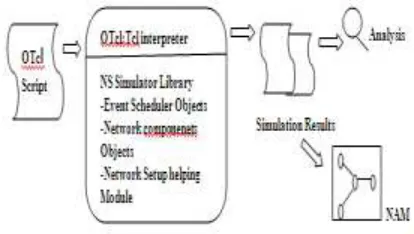
There are many simulators such as Network Simulator 2 (NS-2), OPNET Modeler, GloMoSim, OMNeT++ and etc. In this implementation we choices network simulation tool NS2. Fig. 3 shows the basic architecture of NS2. NS2 provides users with executable command ns which take on input argument, which is the the name of a Tcl simulation scripting file. Users write the name of a Tcl simulation script in the terminal window (which sets up a simulation) as an input argument of an NS2 executable command ns. In most of the cases, a simulation trace file is created when Tcl file executes, and is used to plot graph and/or to create animation.
NS2 consists of two key languages: C++ and Object-oriented Tool Command Language (OTcl).[17] While the C++ defines the internal mechanism (i.e., a backend) of the simulation objects, the OTcl sets up simulation by collecting and configuring the objects as well as scheduling discrete events (i.e., a frontend). The C++ and the OTcl are linked together using TclCL. Mapped to a C++ object, variables in the OTcl domains are sometimes referred to as handles. Conceptually, a handle (e.g., n as a Node handle) is just a string in the OTcl domain of NS2, and does not contain any functionality. Instead, the functionality (e.g., receiving a packet) is defined in the mapped C++ object (e.g., of class Connector). In the OTcl domain [18], a handle behaves as a frontend which interacts with users and other OTcl objects. It may define its own procedures and variables to facilitate the interaction. The member procedures and variables in the OTcl domain are called instance procedures (instprocs) and instance variables (instvars), respectively [14].
Available Online at www.ijpret.com 420
NS2 provides a large number of built-in C++ objects. It is advisable to use these C++ objects to set up a simulation using a Tcl simulation script. Though, advance users may find these objects insufficient. They need to develop their own C++ objects, and use an OTcl configuration interface to put together these objects. After simulation, NS2 outputs either text-based or animation-based simulation results. To illustrate these results graphically and interactively, tools such as NAM (Network AniMator) and XGraph are used. To evaluate a particular behaviour of the network, users can obtain a relevant subset of text-based data and transform it to a more conceivable presentation [13] [14].
Fig. 3: Architectural Views of NS
Figure 3 shows the general architecture of NS. In this figure a general user can be thought of standing at the left bottom corner, designing and running simulation in the
TCL using the simulator object in the OTcl library. The event schedulers and the most of the network components are implemented in the C++ and available to OTcl through an OTcl linkage that is implemented using tclcl. The whole thing together makes NS, which is a OO extended TCL interpreter with network simulator libraries.
Advantages and Disadvantages of NS2
1) Advantages:
Cheap- It does not require costly equipment for simulation.
Available Online at www.ijpret.com 421
More ideas can be tested in a smaller time frame and thus results can be obtained quickly.
Different versions of NS2 supported all types of protocols of MANET.
It supports various platforms.
It find bugs (in design) in advance.
Generality: It is over analytic and has numerical techniques.
Detail: NS2 can simulate system in details at arbitrary level.
2) Disadvantages:
Real system is too complex to model. i.e. has a complicated structure.
Bugs are unreliable.
In NS2, there is traffic Scenario for wired and wireless network.
Large scale systems: NS2 require lots of resources to simulate (especially accurately
simulate).
May be slow (computationally expensive – 1 min real time could be hours of simulated
time).
It shows statistical uncertainty in results.
VI. CONCLUSION
Available Online at www.ijpret.com 422
suitable for large networks and is not an independent protocol but rather a routing framework. It is especially well adapted to large networks and diverse mobility patterns. Often it is more appropriate to apply a hybrid protocol rather than a strictly proactive or reactive protocol as hybrid protocols often possess the advantages of both types of protocols.
ACKNOWLEDGMENT
The author would like to present their sincere gratitude towards the, Prof. K. B. Bijwe ( Guide ) and also special thanks to Prof. Vijay B. Gadicha ( H.O.D - Department of Computer Science & Engineering ) for their extreme support to complete this assignment.
REFERENCES
1. Natasha Dhiman* , Mr. Jagtar Singh, Implementation of Zone Routing Protocol using NS2
Simulator, International Journal of Advanced Research in Computer Science and Software Engineering , Volume 3, Issue 10, October 2013 ISSN: 2277 128X
2. Vinay Kumar, Prof.(Dr.) C.Ram.Singla, ENHANCED AD HOC ON DEMAND MULTIPATH
DISTANCE VECTOR FOR MANETS, Journal of Theoretical and Applied Information Technology 20th August 2014. Vol. 66 No.2
3. Haas, Zygmunt J., Pearlman, Marc R., Samar, P.: Intrazone Routing Protocol (IARP), June
2001, IETF Internet Draft, draft-ietf-manet-iarp-01.txt.
4. Haas, Zygmunt J., Pearlman, Marc R., Samar, P.: The Bordercast Resolution Protocol (BRP) for
Ad Hoc Networks, June 2001, IETF Internet Draft, draft-ietf-manet-brp-01.txt.
5. http://en.wikipedia.org/wiki/Zone_Routing_Protocol.
6. Haas Z. J., Pearlman M. R., and Samar P., “The Zone Routing Protocol (ZRP)”, IETF Internet
Draft, draft-ietf-manet-zone-zrp-04.txt, July 2002.
7. sites.google.com/site/securezrp/zrp.
8. Vijay Chhari , Enhanced and more secure AODV routing protocol to avoid black hole attack in
MANET , IJCSNT Vol.3, No.1, 2014
9. D.B. Johnson, D.A. Maltz, “Dynamic source routing in adhoc wireless networks”, in: T.
Imielinski, H. Korth (Eds.), Mobile Computing, Kluwer Academic Publishers, Dordrecht, 1996, pp. 153–181. P.O. Box 3000, FIN-02015 HUT, Finland [email protected]
10. Niroj Kumar Pani “A SECURE ZONE-BASED ROUTING PROTOCOL FOR MOBILE AD HOC
NETWORKS” Department of Computer Science and Engineering National Institute of Technology, Rourkela, Orissa 769008, India May 2009.
11. Nicklas Beijar “Zone Routing Protocol (ZRP)” Networking Laboratory, Helsinki University of
Available Online at www.ijpret.com 423
12. Anil Kumar Verma, Dr. Harsh Sadawarti, Performance analysis of AODV, DSR and TORA
routing protocols, IACSIT,Vol.2, No.2, ISSN :1793-8236, pp.226-231, April 2010.
13. NS-2, The ns Manual (formally known as NS Documentation) available at http: //www.
isi.edu/nsnam/ ns/doc.
14. Jatin Gupta, Student, CSE, Punjabi University Ishu Gupta, A.P. CSE, P.T.U., Jalandhar India
“A review of evaluation of the Routing Protocols in MANETs” International Journal of Advanced Research in Computer Science and Software Engineering Volume 3, Issue 5, May 2013 ISSN: 2277 128X.
15. M.Joa-Ng and I. T. Lu, “A Peer-to-Peer Zone-Based Two-Level Link State Routing for Mobile
Ad Hoc Networks,” IEEE journal on Selected areas in Communications, vol. 17, no. 8, pp. 1415- 1425, August 1999.
16. Mr. Kamaljit I. Lakhtaria, Mr. Paresh Patel “Analyzing Zone Routing Protocol in MANET
Applying Authentic Parameter” Global Journal of Computer Science and Technology Vol. 10 Issue 4 Ver. 1.0 June 2010.
17. Keshav Nayak, Neelesh Gupta, Energy Efficient Consumption based Performance of AODV,
DSR and ZRP Routing Protocol in MANET, International Journal of Engineering and Innovative Technology (IJEIT) Volume 4, Issue 11, May 2015
18. Santhi G, Soundararajan N, Yasar Arafath T, Manibalan T, An Energy Efficient Cluster Based