Available Online At www.ijpret.com
INTERNATIONAL JOURNAL OF PURE AND
APPLIED RESEARCH IN ENGINEERING AND
TECHNOLOGY
A PATH FOR HORIZING YOUR INNOVATIVE WORK
ROBOT AND HOME APPLIANCES CONTROL USING GESTURE AND SPEECH
RECOGNITION
ASHWINI PARATE, PRIYANKA CHANDORE, KRISHNA KANT, GAURAV RAUT
UG Scholar, Department of Information Technology, SITRC, Sandip Foundation, Nasik (M.S.)
Accepted Date:
27/02/2013
Publish Date:
01/04/2013
Keywords
Hand gestures,
Microsoft’s SAPI,
XML.
Corresponding Author Ms. Ashwini Parate
Abstract
Human computer interaction has greatly evolved through a
number of technologies like gesture recognition, speech
Available Online At www.ijpret.com I. INTRODUCTION
In section 1, a brief is being told about the
two technologies namely, Gesture
Recognition and Speech Recognition, and a
brief introduction of the proposed system.
In section 2, the related work done in these
fields in early period is mentioned. In
section 3, the actual methodology by which
it can be implemented is mentioned.
Section 4 gives us the analysis of the results
that are obtained.
Gesture Recognition is a technology used
for Human Computer Interaction. Gesture
recognition includes human being making
gestures are recognized by the system.
Communication with the system through
gestures is quite easy as compared to the
traditional and obsolete interaction
methods such as keyboard and mouse.
Hand gestures has a natural ability to
represent ideas and actions very easily, thus
using these different hand shapes, being
identified by gesture recognition system
and interpreted to generate corresponding
event, has the potential to provide a more
natural interface to the computer system
[1].
For controlling the home appliances and the
operating system we are using speech
recognition technology. Speech recognition
is actually a technology in which the user
gives some command to the system and the
system performs some specific action
according to the grammar files. A database
is maintained in which a mapping of
command to action is prepared. In our
work, user command is used to activate the
home appliances as well as to manage
operating system. SAPI (Microsoft’s Speech
Application Programming Interface) is used
for this purpose. SAPI is a middleware that
provides an API and a Device Driver
Interface (DDI) for speech engines to
implement. A person may find it difficult to
handle a system by traditional means such
as mouse or keyboard. And in such
situations Speech Recognition technology
can be very much easier.
II. LITERATURE SURVEY
Since past decades there are many
techniques by which gesture recognition
has been implemented. One of them is the
Available Online At www.ijpret.com user is tied up to a wire. The wire acts as
the interface between the human and the
user. A major drawback of the system is
that there is a physical medium between
the user and the system hence the user will
not be able to move freely in the room.
Instrumented gloves or data gloves are
used for wired communication. Some type
of electrical sensors is fitted /mounted
into/upon the gloves. These sensors provide
us the information regarding the position,
length of the hand. Data gloves also provide
great amount of efficiency but a major
drawback is that they are expensive to be
used in a wide range of applications. Data
gloves have been replaced by optical
markers. These optical markers project
Infra-Red light and reflect this light on
screen to provide the information about the
location of hand or tips of fingers wherever
the markers are wear on hand, the
corresponding portion will display on the
screen. These systems also provide the
good result but require very complex
configuration [2]. There were even some
advanced techniques that were introduced
which were based on image processing. Like
processing the image based on its color,
texture, etc. But this technique did not
come out to be as efficient because the
color or texture of skin may vary from
person to person. Results may also vary
based on certain illumination conditions.
There is another technique in which the
K-means clustering algorithm is used. In this,
the input sequence of RGB images gets
converted to YCbCr images. Image
segmentation is typically performed to
locate the hand object in a particular image.
The image is segmented into K clusters by
means of the K clustering algorithm. The
cluster is mainly divided into two clusters
where Cluster1 represents the hand object
in which all pixel values are set to 1,
whereas the second cluster represents the
background portion where all the pixel
values are set to 0.And then apply filling of
holes on binary image. After hand
segmentation is done we need to calculate
the boundary contours of the image so as to
locate the hand region in image. For this
purpose the image is scanned from left to
right and top to bottom. While scanning left
to right the first white pixel that is
encountered is considered as the left
Available Online At www.ijpret.com first white pixel encountered is considered
as the right boundary. And same is followed
while scanning from top to bottom and
bottom to top.
Another algorithm called Fuzzy-C-means
clustering algorithm for classifying both
dynamic and static gestures is present. A
static hand gesture recognition algorithm
for robot control was proposed by Juan P.
Wachs et al [4] [5]. Jae-Ho Shin [6] used
entropy analysis to extract hand region in
complex background for hand gesture
recognition system. In [7], a vision-based
hand pose recognition technique using
skeleton images is proposed, in which a
multi-system camera is used to pick the
centre of gravity of the hand and points
with farthest distances from the centre,
providing the locations of the finger tips,
which are then used to obtain a skeleton
image, and finally for gesture recognition.
VoiceXML is used as one of the recent
approaches to use voice recognition as the
technique to implement human computer
interaction. The origins of VoiceXML began
in 1995 as an XML-based dialog design
language intended to simplify the speech
recognition application development
process within an AT&T project called
Phone Markup Language (PML) [3].As AT&T
reorganized teams at AT&T, Lucent and
Motorola continued working on their own
PML-like languages [3].In 1998, W3C hosted
a conference on voice browsers. By this
time, AT&T and Lucent had different
variants of their original PML, while
Motorola had developed VoiceXML, and
IBM was developing its own SpeechML.
Many other attendees at the conference
were also developing similar languages for
dialog design; for example, such as HP's
TalkML and PipeBeach's VoiceHTML [3].The
VoiceXML Forum was then formed by AT&T,
IBM, Lucent, and Motorola to pool their
efforts. The mission of the VoiceXML Forum
was to define a standard dialog design
language that developers could use to build
conversational applications [3]. They chose
XML as the basis for this effort because it
was clear to them that this was the
direction technology was going [3].In 2000,
the VoiceXML Forum released VoiceXML 1.0
to the public. Shortly thereafter, VoiceXML
1.0 was submitted to the W3C as the basis
Available Online At www.ijpret.com standard [3]. VoiceXML 2.0 is the result of
this work based on input from W3C
Member companies, other W3C Working
Groups, and the public [3].The only
limitation of VoiceXML is it works only with
websites. Hence SAPI is the best choice for
it.
III. METHODOLOGY
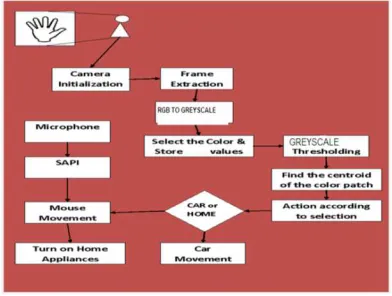
Integration of two technologies namely
gesture recognition and speech recognition
is proposed, block diagram of system is as
shown in the figure 1.
Fig 1- Block Diagram of proposed system
Fig 1 describes that a single camera or a
webcam has been used in the system; the
webcam can be of any type. But the main
problem with the webcams is that they
come with different resolutions. This may
create some complexions. Hence it has
been decided to convert every image into a
fixed resolution. Any resolution of the
webcam has to be converted into this fixed
resolution. We convert the RGB color space
to HSV color space. RGB color space is
mostly used by many of the computing
devices. But HSV is the color space which
corresponds more to the human
perceptions. The formulas used to convert
RGB to HSV depend on which of the RGB
components is largest and which is smallest,
and are described at Transformation from
RGB to HSV. The HSV color space is
user-friendlier [1]. After the conversion from
RGB to HSV select a single color from the
image which is used to track the hand
movement. A color threshold is performed
on the image.
User gives the input through a microphone.
Microphone processes the audio stream
given by the user and converts it into the
some form of digital data. This digital data is
converted into phonemes and then we get
a text command. Phonemes are linguistic
units. They are the sounds that group
together to form our words, although how a
phoneme converts into sound depends on
Available Online At www.ijpret.com phonemes, speaker’s accent and
age[8][9].These phonemes are extracted by
Microsoft speech SDK[8]. Hidden Markov
Model (HMM) is used to convert the
phonemes into commands. Phonemes are
extracted from the given input. A Markov
Model (in a speech recognition context) is
basically a chain of phonemes that
represent a word [8]. A Markov Model can
be shown in Figure 2. The command which
is generated from speech recognition is
synthesized further for context searching.
The command is compared to the context
database and then the action is performed
accordingly.
Fig2- A Markov Model
IV. RESULT AND ANALYSIS
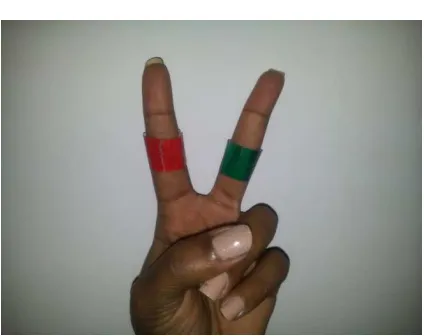
Here with two colors for tracking the
movement of hand i.e. Red and Green. Red
for the up-down motion and green for
left-right motion. Our results have been shown
in the following figure 2, figure 3 and figure
4.
Fig- 2: Position 1(position of hand)
Available Online At www.ijpret.com
Fig 4- Colors used from tracking
For Representation purpose, we have used
an orange spot in our GUI to track the
motions of our hand. And as shown in
Figure 4, two colors namely red and green
are used.
V. CONCLUSION
To overcome many drawbacks of the
traditional systems proposed system can be
of great use for disabled people by
successful implementation of gesture and
speech recognition with control the mouse
pointer and robot movement by gesture
recognition. Operating system and the
home appliances are managed using speech
recognition.
VI. REFERENCES
1. Prof. Yuvraj V. Parkal “Gesture Based
Operating System Control” ,Electronics and
Telecommunication department ,College of
Engineering, Malegaon (Bk),Maharashtra,
India
2. Meenakshi Panwar “Hand Gesture
Recognition based on Shape Parameters”,
Centre for Development of Advanced
Computing, Noida, Uttar Pradesh, India
3. Voice Extensible Markup Language
(VoiceXML) Version, 16 March 2004.
4. Juan P. Wachs, Helman Stern and Yael
Edan, "Cluster Labeling and Parameter
Estimation for the automated setup of a
Hand gesture Recognition System," IEEE
Trans. Systems and Humans, vol. 35, no. 6,
pp. 932-944, Nov. 2005.
5. J. Wachs, H. Stern and Y Eden,
"Parameter search for an image Processing
Fuzzy c-Means hand gesture recognition
system," Proc.IEEE Int.Conf.Image
Processing, Barcelona, Spain, vol. 3, pp.
Available Online At www.ijpret.com 6. Didier Coquin, Eric Benoit, Hideyuki
Sawada, and Bogdan Ionescu, “Gestures
Recognition Based on the Fusion of Hand
Positioning and Arm Gestures”, Journal of
Robotics and Mechatronics Vol.18 No.6,
2006. pp. 751-759.
7. A. Utsumi, T. Miyasato and F. Kishino,
“Multi-Camera Hand Pose Recognition
System processing Skeleton Image", IEEE
International Workshop on Robot and
Human Communication, pp. 219-224, 1995.
8. Anil J Kadam, Pallavi Deshmukh, Amita
Kamat, Neelam Joshi, Ritika Doshi,” Speech
Oriented Computer System Handling”,
International Conference on Intelligent
Computational Systems (ICICS'2012) Jan.
7-8, 2012 Dubai
9. Md. Abdul Kader, et al “Speech Enabled
Operating System Control” (ICCIT 2008),