Available Online at www.ijpret.com
441
INTERNATIONAL JOURNAL OF PURE AND
APPLIED RESEARCH IN ENGINEERING AND
TECHNOLOGY
A PATH FOR HORIZING YOUR INNOVATIVE WORKRECOGNITION AND VISUALIZATION OF INTERACTION IN MEETING USING TREE
BASED MINING
PUJA R. KOSE1, PROF. PANKAJ K. BHARNE2
1. M.E-Student, Dept. of Computer Science and Engg, SSGMCE, Shegaon, Maha., India. 2. Asst. Professor, Dept. of Computer Science and Engg, SSGMCE, Shegaon, Maha., India.
Accepted Date: 27/02/2014 ; Published Date: 01/05/2014
\
Abstract: Meetings are an important communication and coordination activity of teams where status is discussed, new decisions are made, alternatives are considered, details are explained, information is presented, and new ideas are generated. As such, meetings contain a large amount of rich information which is not often formally documented. Capturing all of this informal meeting information has been a topic of research in several communities over the past decade. In this work, data mining techniques are used to detect and analyze the frequent interaction patterns to discover various types of knowledge on human interactions. Tree is used for representing a human interaction flow in a discussion session. Tree-based interaction mining are studied to analyze the structures of the trees and to extract interaction flow patterns. It can successfully extract several interesting patterns which is useful for the interpretation of human behavior in meeting discussions, such as determining frequent interactions, typical interaction flows, and relationships between different types of interactions.
Keywords: Human interaction, Interaction flow, Interaction Pattern, Meeting, Tree based mining.
Corresponding Author: MS. PUJA R. KOSE
Access Online On:
www.ijpret.com
How to Cite This Article:
Puja Kose, IJPRET, 2014; Volume 2 (9): 441-447
Available Online at www.ijpret.com
442
INTRODUCTION
In the social dynamics, human interaction is the one of the important for understanding how a human’s reactions or human activities under the meetings. And determining whether the meeting was well organized or not efficient. Because it is the one of the main issue in the meetings. Several methods have been used to found the interaction of the flow in the meeting at each human. The human interaction flow or the human interaction is the sequence of communications, such as proposing an idea, giving comments, expressing an opinion, etc., between the participants of the meeting. It is used to know the user role, attitude, or intention toward a topic and their suggestion about the meeting, requesting information. To understand the human interactions and interference of the human interactions in meetings, first we need to discover higher level semantic knowledge called interactions flow often occur in a discussion. It encompasses what interaction flow discussion usually follows, and relationships between the exist among interactions. This knowledge will help to describes important patterns of interaction. Meetings constitutes the natural and essential cases in the people interaction, becomes challenging problem for several conditions and a relatively well-defined dictionary of relevant actions. The previous work of the paper the most common way to capture meeting information is through notes-taking. However, fully writing down the content of a meeting is a difficult one. And it can result in an inability to both take notes at the same time participate in the meeting. Many data mining problems can be represented with nonlinear data structures like trees. We will develop several applications based on the discovered patterns in human meetings. So we propose our work with the various categories of the meetings. We extend our previous work in two ways. First, we propose the mining methods that extract frequent patterns of human interaction forvarious categories of meetings and second with the embedded sub tree mining.
A. Data Mining
Available Online at www.ijpret.com
443
B. Data Mining in the Human Interaction
In this paper, we study data mining techniques to detect and analyze frequent interaction patterns. And hope to discover various types of new knowledge on interactions. Human communication flow in a discussion session is represented as a tree. Tree-based mining, designed interaction tree pattern mining algorithms for constructed tree datasets. It is used to analyze tree structures and extract interaction flow patterns from the tree dataset. An interaction flow that appears frequently reveals relationships between different types of interactions. The tree-based interaction pattern mining method is used to mine the frequent interactions. A tree is used to represent an interaction flow in a session. It is an acyclic connected graph, also rooted, directed, and labeled. There would be some differences in the frequent interaction patterns for different meeting styles. We survey embedded tree mining for hidden interaction pattern discovery.
C. Tree-Based Mining
Finding frequent item sets in databases are the fundamental operation of association rule mining. Mining frequent tree patterns have many useful applications in XML mining, marketing, banking, network routing. We propose a mining method to extract frequent items of human interaction based mining on the captured content of meetings.
I. RELATED WORKS
The collaborative based systems [2] mainly focus on detecting physical interactions between participants without any relations with topics. TREEMINER [3] is a novel algorithm to discover all frequent sub trees in a tree-plant, using a new data structure called scope-list. Chopper [4] and XSpanner systematically develop the two algorithm pattern growth methods for mining frequent tree patterns. Modeling and tracking a person’s focal point of interest is useful for many applications.a key aspect of interactive meetings is the present speaker, who is, by definition, changing frequently [5].
A successful smart meeting system presents a survey of existing research and technologies, including meeting capture,semantic processing, meeting recognition, and evaluation methods [6]. An omni directional camera [7] is used to capture the scene around a meeting table.
The head gestures including shaking and tilt, nodding are recognized with a Wavelet-based technique from magnetic sensor signals [8].
Available Online at www.ijpret.com
444
II. INTERACTION CAPTURING
3.1 Human Interaction Definition and Recognition:
Human interactions in a meeting discussion are defined as social behaviors or communicative actions taken by meeting participants corresponding to the current topic. In meeting discussion human interaction are categorized as; propose, comment, acknowledgement, request Info, askOpinion, posOpinion, and negOpinion. The detailed meanings are as follows: propose— a user proposes an idea with respect to a topic; comment—auser comments on a proposal, or answers a question; acknowledgement—a user confirms someone else’s comment or explanation, e.g., “yeah,” “uh huh,” and “OK;” requestInfo— a user requests unknown information about a topic; askOpinion-a user asks someone else’s opinion about a proposal; posOpinion—a user expresses a positive opinion, i.e., supports a proposal; and negOpinion—a user expresses a negative opinion, i.e., disagrees with a proposal.
3.2 Interaction flow:
Based on the interaction defined and recognized, we now describe the notion of interaction flow and its construction. An interaction flow is a list of all interactions in a discussion session with triggering relationship between them.Interaction flow helps to assume the probability of another type of interaction. We first give
the definition of a session in a meeting discussion.
Definition 1 (Session) A session is a unit of a meeting that begins with a spontaneous interaction and concludes with an interaction that is not followed by any reactive interactions.
Available Online at www.ijpret.com
445
3.3Pattern Discovery:
Patterns are frequent trees or sub trees in the tree database. TD denotes of Interaction trees.ITD denotes the full set of isomorphic trees to TD. t denotes a tree.tk denotes a sub tree
with k nodes, Ck denotes a set of candidates with k nodes. Fk denotes a set of frequent k-sub
trees.
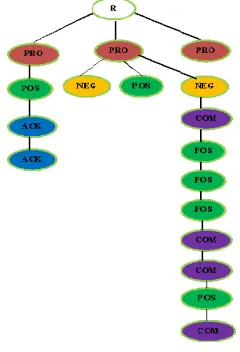
Definition 2 (Interaction Tree) :A tree is used to represent an interaction flow in a session. It is an acyclic connected graph. In which trees are also rooted, directed, and labeled. And they are represented as,
L={PRO,COM,ACK,REQ,ASK,POS,NEG}.
Definition 3 (Tree String Code):
A tree is represented as a string. We represent a tree T by its string encoding, denoted by tsc. It starts with the root, using “-” and “ * ” to denote parent child and sibling relationships, respectively. If a child has a descendant of its own, a parenthesis is used to separate it and its descendant from the others. According to this definition, trees in Fig.2 are represented as PRO-(COM-ACK)*ACK, respectively.
Definition 4 (Tree Preorder Sequence):
This is a depth-first preorder traversal label sequence of a tree (T), denoted by tps. We use “-” to connect node labels in the sequence.
In accordance with Definition 4, the trees in Fig. 2 are represented as PRO-ACK, PRO-COM-ACK -ACK, respectively.
Definition 5 (Isomorphic Tree):
Given two trees, T1 = (V1, E1) and T2 = ( V2, E2), if tps(T1) ≠ tps(T2) and through exchanging the
Available Online at www.ijpret.com
446
Fig 3. Isomorphic Tree
For the Pattern Discovery, we should have to find the support value.Where, σ denotes a
support threshold of minimum support. Support is with given a tree or sub tree T and a data set of trees TD.
If the value of supp(t) is more than a threshold value Minimum support T is called a frequent tree or frequent sub tree. We have a data set of interaction trees TD. Given a minimum support
σ, we would like to find all trees and sub trees that appear at least σ × | TD | times in the data
set.
III. CONCLUSION
We proposed a tree-based mining method for discovering frequent patterns of human interaction in meeting discussions. It determines frequent interactions, typical interaction flows, and relationships between different types of interactions.The mining results would be useful for summarization, indexing, and comparison of meeting records. They also can be used for interpretation of human interaction in meetings.Cognitive science researchers could use them as domain knowledge for further analysis of human interaction. Moreover, the discovered patterns can be utilized to evaluate whether a meeting discussion is efficient and to compare twomeeting discussions using interaction flow as a key feature.
REFERENCES
1. Zhiwen Yu, Zhiyong Yu, Xingshe Zhou, Christian Becker, and Yuichi Nakamura, “Tree-Based
Available Online at www.ijpret.com
447
2. Z.W. Yu, Z.Y. Yu, H. Aoyama, M. Ozeki, and Y. Nakamura, “Capture, Recognition, and
Visualization of Human Semantic Interactions in Meetings,” Proc. Eighth IEEE Int’l Conf. Pervasive Computing and Comm. (PerCom ’10), pp. 107-115, Mar.-Apr. 2010.
3. M.J. Zaki, “Efficiently Mining Frequent Trees in a Forest: Algorithms and Applications,” IEEE
Trans. Knowledge and Data Eng., vol. 17, no. 8, pp. 1021-1035, Aug. 2005.
4. C. Wang, M. Hong, J. Pei, H. Zhou, W. Wang, and B. Shi, “Efficient Pattern Growth Methods
for Frequent Tree Pattern Mining,” Proc. PacificAsia Conf. Knowledge Discovery and Data Mining (PAKDD ’04), pp. 441- 451, 2004.
5. S. Junuzovic, R. Hegde, Z. Zhang, P. Chou, Z. Liu, and C. Zhang, “Requirements and
Recommendations for an Enhanced Meeting Viewing Experience,” Proc. ACM Int’l Conf. Multimedia, pp. 539- 548, 2008.
6. Z. Yu and Y. Nakamura, “Smart Meeting Systems: A Survey of State-ofthe-Art and Open
Issues,” ACM Computing Surveys, vol. 42, no. 2, article 8, Feb. 2010.
7. R. Stiefelhagen, J. Yang, and A. Waibel, “Modeling Focus of Attention for Meeting Indexing
Based on Multiple Cues,” IEEE Trans. Neural Networks, vol. 13, no. 4, pp. 928-938, July 2002.
8. K. Otsuka, H. Sawada, and J. Yamato, “Automatic Inference of Cross- Modal Nonverbal
Interactions in Multiparty Conversations,” Proc. Int’l Conf. Multimodal Interfaces (ICMI ’07), pp. 255- 262, 2007.
9. M.S. Magnusson, “Discovering Hidden Time Patterns in Behavior: TPatterns and Their