A STUDY ON JOB STRESS LEVEL OF WOMEN TEACHERS
WORKING UNDER WOMEN PRINCIPALS AT HIGHER
SECONDARY SCHOOL LEVEL
D. Johns Vaseekaran,
Ph.D., Research Scholar,Bharathiyar University,
D.Vinoth Kumar,
Assistant Professor,School of Education,Tamilnadu Open University
The present study is an attempt to explore the phenomenon of women teachers stress.
Principal’s behavior has an important role in the teachers stress development. This study is
to analyze the job stress of women teachers on accordance with their women principals. A standardized tool was given to the women teachers to identify their job stress. In that tool there will be 20 items. Among them 5 items deal with the stress, given by the institution, 5 by their finance, 5 by their working conditions and 5 by their women principals. The investigator analyze the total stress of the women teachers working in high schools with their type of school, age, educational qualification, experience, type of family and marital status. From that the stress given by the institution, finance, working condition, and women principals can be identified separately. If the stress level is low, then it is considered to be a stress less women teachers working in higher secondary schools. If it is high, there will be a need of some modification towards women teachers.
INTRODUCTION
Education is the ability to meet life’s situation, it is a character building process,
enhancing one’s personality and making him/ her rationale, capable, responsive and
industrialization, urbanization, globalization and disintegration in the family system. It is
described as the century of stress and strain. Since, education is viewed as an instrument to
develop the cognitive qualities, tolerance and understanding of people, it should prepare the
younger generation to understand and face the realities of globalization. In this context, the
schools and the teachers have more responsibilities in molding the character of the students.
Thus, the role of the teacher in the society is vital for its improvement.
Professionalism demands teachers to be innovative in their attitudes, flexible in their
approach, always refreshing themselves with day-to-day developments in their respective
subject area. At the same time, they should be capable of recognizing the value of human
potentials, understanding the diverse needs of learners and enrich the environment for their
growth. In essence, the dream of learning society in this information age becomes real only
when the teachers are able to collaborate with each other to accomplish the task, and, towards
this end, their ability to communicate effectively becomes more critical than their technical
skills and capabilities.
In the lives of the individuals, most of the problems, especially, occupational in nature
are the result of misinterpretation of the involved sentiments, feelings and emotions of the
concerned individuals, groups, society and nations. A teacher has to face innumerable
challenges and play different roles in his/her institution. He/she not only plan lessons but also
organize activities, maintainnecessary records, make purchases, administer time-table, oral
and aural teaching aids, adopt new techniques of communication and motivate the students by
words and deeds.
Review of Related Literature
The study focused on the factors causing stress among teachers. At one point or other
everybody suffers from stress, relationship demands, physical and mental problems, pressure
at workplace, traffic, meeting deadlines, growing-up tension-all of these conditions and
situations are valid cause of stress.
Antoniou and Polychroni (2006) reported that female teachers experienced
significantly higher level of occupational stress, specifically with regard to interaction with
students and colleagues, workload, students’ progress and emotional exhaustion. Increased
Brutes and Brower’s (2006)conducted a study on emotional stress and symptoms of
burn out in teachers. Through random sampling, 365 mathematics teachers from Betherland
were selected. Emotional stress scale and work related stress inventory was used for
collecting data. The result revealed that there is no significant relationship between emotional
stress and work related stress.
Deepa Silkandkauts, Minakshivig Aggarwal (2008) investigated the teacher stress,
an emerging area of research in teacher educations. A sample of 250 was randomly selected.
The findings indicate that members of the teaching profession are vulnerable to stress
because of the often times demanding nature of the work and the stressors involves.
Relatively speaking teachers need help and hurt. They are not as satisfied as they want to be
with the role of teaching, unless they are able to reduce or eliminate their problems or attain
their goals. They will feel considerable stress and burnout.
Objectives of the study
The following are the main objectives of the study,
To assess the level of job stress among higher secondary school women teachers.
To find the level of stress given by the institution, finance, working condition, and with principals.
To find the level of stress with type of school, age, educational qualification, experience, type of family and marital status.
Hypotheses of the study
1. Women teachers working in higher secondary school do not differ job stress level
according to their
Type of school
Age
Educational qualification
Experience
Type of family
Methodology
Stratified random sampling technique was used to gather data from the women
teachers.
Sample
In this study, 60 women teachers working under women Principal at Higher
secondary school level are taken as samples in Chennai district.
Tool Used for the Study
The investigator developed the Job Stress Questionnaire. The tool consists of 20 items
out of which 5 items are for institution and 5 items are for finance, 5 items for working
condition and 5 items are for principal. The tool was standardized by conducting pilot study
by following the test and retest method. The calculated ‘t’ value is higher than the table value,
so the tool was reliable for the sample. Content validity was done for validation of the tool.
[image:4.595.71.523.274.575.2]Analysis and Interpretation
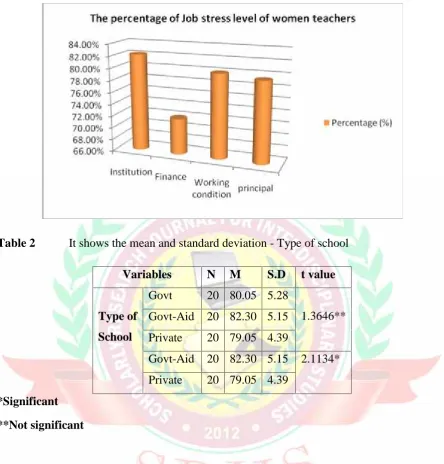
Table 1-Shows the percentage of job stress level of women teachers in criteria
S. No Stress Percentage (%)
1 Institution 82.2%
2 Finance 72%
3 Working condition 80%
4 principal 79.46%
The women teachers have maximum level of job stress in their institution when compared
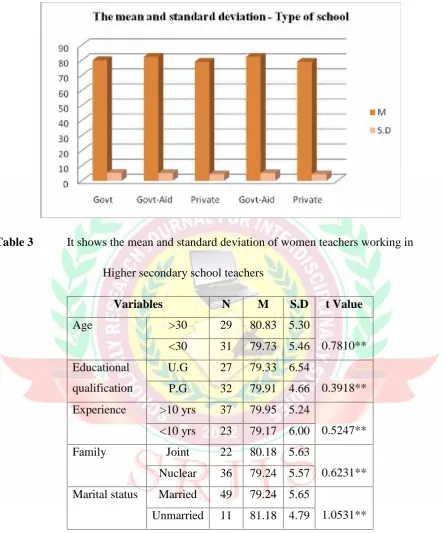
Table 2 It shows the mean and standard deviation - Type of school
Variables N M S.D t value
Type of
School
Govt 20 80.05 5.28
1.3646** Govt-Aid 20 82.30 5.15
Private 20 79.05 4.39
Govt-Aid 20 82.30 5.15 2.1134*
Private 20 79.05 4.39
*Significant
**Not significant
When compared to the type of schools the mean score is high in government-aided
than the government school. The mean score is high in government school than the private
Table 3 It shows the mean and standard deviation of women teachers working in
Higher secondary school teachers
Variables N M S.D t Value
Age >30 29 80.83 5.30
0.7810** <30 31 79.73 5.46
Educational
qualification
U.G 27 79.33 6.54
0.3918**
P.G 32 79.91 4.66
Experience >10 yrs 37 79.95 5.24
0.5247** <10 yrs 23 79.17 6.00
Family Joint 22 80.18 5.63
0.6231** Nuclear 36 79.24 5.57
Marital status Married 49 79.24 5.65
1.0531** Unmarried 11 81.18 4.79
*Significant
**Not significant
When compared to the women teachers’ age, the mean score is high in below 40 years
than above 40 years. When compared to the educational qualification the mean score is high
10 years experienced women teachers than above 10 years experienced women teachers.
When compared to the type of family than the nuclear family. When compared to the marital
status the mean score is high in unmarried women teachers than the married women teachers.
Findings of the Study
1. Women teachers working in high school do not differ job stress level according to
their
Type of school
Age
Educational qualification
Experience
Type of family
Marital status
2. Women teachers working in Government aided school differ in their job stress level
when compared to the private school teachers.
3. There is no significant difference between the government and government Aided
school women teachers
4. There is no significant difference between the Government and Private school women
5. There is significant difference between the Government-Aided and Private school
women teachers
6. There is no significant difference between the age of below 40 and above 40 women
teachers
7. There is no significant difference between the educational qualification of U.G with
B.Ed., and P.G with B.Ed., women teachers
8. There is no significant difference between the experience of below 10 years and
above 10 years women teachers
9. There is no significant difference between the joint and nuclear family women
teachers
10. There is no significant difference between the married and unmarried women teachers
Educational Implication
Teacher is expected to possess a multifaceted personality. Under these circumstances,
it is but natural that teachers will remain under stress which is sure to affect their
effectiveness while teaching. Therefore the teaching environment should be made so
conducive and favorable such that their work behavior can be enhanced.
Conclusion
The purpose of the present study was to study the level of Job stress prevailing among
higher secondary school teacher. The atmosphere existing in the school premises should be
peaceful and democratic which can enhance their teaching skills and implementing the
strategies required for the effective teaching in the class rooms.
Bibliography
Kyriacou, C and Sutcliffe,J (1979)”Teacher Stress and Satisfaction”, Educational
Research, 21,89-96.
Raju.DVVK, A study of Teachers Stress in Relation to Teachers Effectiveness and
Teacher Attitude.
Sabu S. and Jangiah C.(2005),”Adjustment and Teachers Stress”, Edutracks, Vol.5(1),
Selye, (1974) “Stress without distress”. Lippincott, New York Varma Ramesh:
Psychology of Teachers, Anmol publications Pvt.Ltd, New Delhi