doi:10.5681/jcs.2013.022
http:// journals.tbzmed.ac.ir/ JCS
* Corresponding Author: Toktam Etezadi (MSc), E- mail:[email protected]
A Standardized Shift Handover Protocol: Improving Nurses’ Safe Practice
in Intensive Care Units
Javad Malekzadeh1, Seyed Reza Mazluom1, Toktam Etezadi1*, AlirezaTasseri2
1
Department of Nursing, Faculty of Nursing and Midwifery, Mashhad University of Medical Sciences, Mashhad, Iran. 2
Department of Nursing, Javad-Al- Aemeh Hospital, Mashhad, Iran.
ARTICLE INFO ABSTRACT
Article type: Original Article
Introduction: For maintaining the continuity of care and improving the quality of care, effective inter-shift information communication is necessary. Any handover error can endanger patient safety. Despite the importance of shift handover, there is no standard handover protocol in our healthcare settings.
Methods: In this one-group pretest-posttest quasi-experimental study conducted in spring and summer of 2011, we recruited a convenience sample of 56 ICU nurses. The Nurses’ Safe Practice Evaluation Checklist was used for data collection. The Content Validity Index and the inter-rater correlation coefficient of the checklist was 0.92 and 89, respectively. We employed the SPSS 11.5 software and the Mc Nemar and paired-samples t test for data analysis.
Results: Study findings revealed that nurses’ mean score on the Safe Practice Evaluation Checklist increased significantly from 11.6 (2.7) to 17.0 (1.8) (P < 0.001).
Conclusion: using a standard handover protocol for communicating patient’s needs
and information improves nurses’ safe practice in the area of basic nursing care.
Article History: Received: 1 Oct. 2012 Accepted: 29 Nov. 2012 ePublished: 27 Agu. 2013
Keywords: Shift handover Patient safety Intensive care unit Nursing care
Introduction
Delivery of safe and proper health care is extremely important to patients’ health. Currently, a wide range of safety issues has challenged the healthcare delivery and therefore, many personal and organizational
strategies have been developed for
promoting patient safety.1
Previously, people believed that hospitals are
safe places for receiving medical treatments.2
Early in the 1990s, the results of a study conducted by Harvard University in UK aroused the first concerns about patient safety. The results of this study showed that during the course of the study, 98000 patients experienced serious injuries as a result of medical errors. Fifty seven percent of these patients recovered from the injuries one month later, seven percent experienced long-
term complications, and fourteen percent died. The important fact was that 69% of these errors were potentially preventable.3 Following this study, a report of the Institute of Medicine in 1999 surprised healthcare providers and costumers greatly. In this report—entitled ‘To err is human: building a safer health system’—it has been estimated that medical errors cause 44000–98000 cases of in-hospital death in the United States each year.4 These statistics changed the public’s attitude towards the safety of medical treatments and triggered many political endeavors in the United States to find the risk factors for medical errors and to improve patient safety.2
The studies conducted by the Joint
Commission International (the WHO
Solutions) revealed that poor information communication is the main risk factor for 65% and the contextual risk factor for 90% of sentinel events.1 Information communication happens repeatedly among healthcare providers. One of the instances of information communication in healthcare settings is during the nursing shift handovers. Effective handover facilitates the continuity of care and enhances patient safety.5
Shift handover is a common tradition among nurses; however, standard and effective handover and information communication skills are not taught formally during nursing academic education; rather, nurses learn such skills during their daily practice and form
more experienced nurses.6-7 The primary goal
of shift handover is to communicate the patients’ clinical information and to provide a safe and high-quality care; however, poor
information communication during
nonstandard and ineffective shift handover
may endanger patient safety.8 Evidence
shows that ineffective shift handover increases the risk of medication error and sentinel events, delays the course of treatment, decreases patient satisfaction, and prolongs the length of hospital stay. The results of a study on pregnant women showed a significant correlation between the number of shift handovers and unplanned cesarean deliveries.7 Hansten found that a low-quality change-of-shift report can lead to a one- to two-hour delay in the delivery of nursing care.9 On the other hand, Reader et al. reported that ineffective intra-shift and
inter-shift verbal and written
communications are responsible for respect- tively 57% and 37% of all the healthcare
errors.10 Consequently, effective commun-
ication of the patients’ clinical information is a key factor in the delivery of a safe and high-quality care. Effective information commun- ication is so much important that in 2005 the American Committee of Safety referred to the standardization of information commun- ication process in health care system as the
second national goal of safety. This goal emphasized the communication of up-to-date and credible information that minimally
disrupts the shift handover process.6To
achieve this goal, numerous shift handover formats such as ‘I PASS THE BATON’ (Introduction, Patient, Assessment, Situation, Safety, THE, Background, Action, Timing, Ownership, Next), ‘SHARQ’ (Situation, History, Assessment, Recommendations, Questions), ‘5 Ps’ (Patients, Precaution, Plan, Problems, Purpose), and ‘SBAR’ (Situation, Background, Assessment, Recommendation)
were developed and used worldwide.11 These
formats improved the quality of inter-shift information communication in different hospital units worldwide.
In our country, Iran, the shift handover reports are usually given verbally using the patient Kardex and not based on an integrated protocol. However, the contents of Kardexes do not necessarily reflect the patient’s caring priorities.11 The lack of an integrated handover protocol in our country in addition to the inappropriateness of the international shift handover formats for our
healthcare settings have made the
standardization of the shift handover difficult. Currently, there are two types of
accreditation standards for hospitals
worldwide including the JCAHO (Joint
Commission Accreditation of Health
Organization) and JCI (Joint Commission International). The JACHO and JCI standards have been developed for the accreditation of healthcare settings in the developed and developing countries, respectively.12 On the other hand, available handover formats such as SBAR have been designed based on the specifications of the developed country and therefore are not applicable to the Iranian healthcare settings.
1. In ICUs, nurses are the chief healthcare providers and hence spend a great deal of time and energy on the collection, integration, and utilization of patients’ data for caring purposes.13
2. ICU patients usually are not able to
participate in their self-care activities and therefore are very vulnerable to the medical errors.14
To prevent the occurrence of preventable errors and improve patient safety through effective handover information communi-cation, we designed a comprehensive and practical handover protocol based on the JCI standards. The aim of this study was to investigate the effects of this protocol on the nurses’ safe practice in intensive care units.
Materials and methods
This was a one-group pretest-posttest quasi-experimental study conducted in spring and summer of 2011. The study population consisted of all the ICU nurses affiliated to a large-scale teaching hospital located in Mashad, Iran. Including criteria were having a Master or Baccalaureate degree in nursing, having at least a six-month work experience in ICUs, and participating in at least 90% of theoretical education classes and all the practical education classes held by the researchers to educate the participants the designed handover protocol.
We recruited a convenience sample of 56 nurses for the study. For calculating the study sample size, we conducted a pilot study with participating ten eligible nurses and used the findings in the following sample size calculation formula:
N=((Z1– α /2 + Z1– β) 2×(S12+S22))/(Mean1–Mean2)
Finally, with a confidence level of 95% and a power of 80%, the sample size was determined to be 55.
For data collection, we used a demographic questionnaire, the Shift Handover Evaluation Checklist (hereinafter briefly referred to as SHEC), and the Nurses’ Safe Practice Evaluation Checklist (hereinafter briefly referred to as NSPEC). All the instruments
were developed by the study researchers. The demographic questionnaire consisted of eight questions regarding participants’ age, gender, overall work experience in nursing, work experience in ICUs, main working shift and working unit, academic degree, and satisfaction in monthly working shift pattern measured on a dichotomous Yes/No scale. The SHEC was designed based on the JCI standards and physical examination of all the body systems. The handover skills of each individual nurse were observed for three times in different day or evening working shifts. Accordingly, 168 episodes of shift handover were observed.
For designing the NSPEC, we needed to use caring standards and protocols to determine nursing interventions that their omission
resulted in adverse consequences.
Accordingly, we collected all the routine nursing standards and protocols affiliated to our study setting. Thereafter, we defined the probable deviations from these standards and protocols. Finally, we selected all the
deviations harmful to the patients.
Consequently, the 20-item NSPEC was developed. NSPEC was consisted of 20 nursing interventions that, as mentioned previously, their omission resulted in adverse consequences. The possible responses to each item of NSPEC were ‘Performed’, ‘Not performed’, and ‘Not indicated. Items were scored on a dichotomous scale in which score 1 stood for ‘Performed’ and score 0 stood for ‘Not performed’ responses. ‘Not indicated’ items were deleted and their scores were added to other items. Consequently, the possible range of the total score of NSPEC was 0–20.
and safe practice of 12 nurses. Accordingly, we calculated the correlation between the two series of scores for each checklist. The inter-rater correlation coefficient for SHEC and NSPEC was 0.95 and 0.89, respectively. The main purpose of the study intervention was to change the nurses’ shift handover behavior; therefore, we used the Kurt Lewin’s
Change Theory.15 Lewin believed that a
successful change project consists of three stages:
1. Unfreezing: Lewin believed that some
disequilibrium in the status qua is the pre-requisite for behavior change. In this stage, factors and forces that maintain the status qua
should be unfrozen and removed. In the current study we established face-to-face contacts with the ICU head-nurses, issued formal announcements, and employed hospital trustworthy workers and authorities to attain the goal of unfreezing. These activities initiated informal discussions between nurses and generated some degree of uncertainty among them. Accordingly, the nurses started to seek new information regarding shift handover. They also started to think and discuss about the new handover
protocol and its advantages and
disadvantages as well as probable restraining forces of change. Consequently, they reached a state of disequilibrium and their resistance to change was broken down.
2. Change: in this stage, the change agent
develops and implements the most effective change strategies. In this study, we theoretically educated nurses the developed handover protocol in two 90-minute sessions held in two successive days. Accordingly, we practically educated each individual nurse the handover protocol in three half-hour sessions held in three successive days. The practical education sessions held at the time of inter-shift handover. One week after these educations, we observed and evaluated the nurses’ shift handover skills using the SHEC. Nurses who obtained at least 80% of the total SHEC score were subjected to safe practice evaluation using the NSPEC. To evaluate
nurses’ practice regarding patient safety, we observed their caring behavior for a whole working shift. On the other hand, other nurses whose SHEC scores were below 80% were subjected to additional three half-an-hour practical education sessions.
3. Refreezing: in this stage the change agent
attempts to fix the after-the-change state of equilibrium. Accordingly, he encourages the group members to follow the learned behaviors and prevents them from the re-adopting the old ones. In this study to attain the goal of refreezing, we strictly supervised the nurses’ adherence to the protocol, asked the head-nurses to encourage and support the nurses in the implementation of the protocol, and asked the nurse-managers to reward those nurses who were in compliance with it.15
Data analysis
We employed the version 11.5 of the Statistical Package for Social Sciences, SPSS 11.5, for data management and analysis. Initially, we checked the normality of the study variables using the Kolmogrov-Smirnov and Shapiro-Wilk tests. The results of these tests showed that all the study variables, except for the total score of NSPEC, had a non-normal distribution. Subsequently, to facilitate the data analysis process, we transformed the non-normally distributed
variables using the square root
transformation. Accordingly, we described the data using descriptive measures such as frequency, percentage, mean, and standard deviation. On the other hand, for comparing the nurses’ before- and after-the-intervention NSPEC scores, we employed the McNemar and paired-samples t tests.
Results
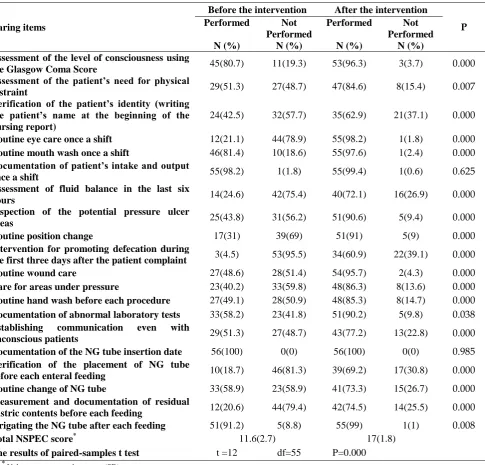
51.8% of them worked in rotational working shifts. Moreover, 59% of nurses were satisfied with their monthly working shift pattern. The results of the paired-samples t test revealed that secondary to the study intervention, nurses’ mean score on the NSPEC increased significantly from 11.6 (2.7) to 17.0 (1.8) (P < 0.001). In other words, compared to the before-the-intervention mean NSPEC score, the nurses’
after-the-intervention mean score had increased by 46.5%.
Moreover, the results of the McNemar test revealed that except for the item 6 (Documentation Intake/Output in each working shift) and 16 (Documenting the date of naso-gastric tube insertion), the number of nurses who performed the remaining 18 caring items of NSPEC increased significantly after the intervention. (P< 0.05); (Table 1).
Table 1. Nurses’ safe practice before and after the study intervention
Caring items
Before the intervention After the intervention
P
Performed
N (%)
Not Performed
N (%)
Performed
N (%)
Not Performed
N (%) Assessment of the level of consciousness using
the Glasgow Coma Score 45(80.7) 11(19.3) 53(96.3) 3(3.7) 0.000 Assessment of the patient’s need for physical
restraint 29(51.3) 27(48.7) 47(84.6) 8(15.4) 0.007 Verification of the patient’s identity (writing
the patient’s name at the beginning of the nursing report)
24(42.5) 32(57.7) 35(62.9) 21(37.1) 0.000
Routine eye care once a shift 12(21.1) 44(78.9) 55(98.2) 1(1.8) 0.000
Routine mouth wash once a shift 46(81.4) 10(18.6) 55(97.6) 1(2.4) 0.000
Documentation of patient’s intake and output
once a shift 55(98.2) 1(1.8) 55(99.4) 1(0.6) 0.625 Assessment of fluid balance in the last six
hours 14(24.6) 42(75.4) 40(72.1) 16(26.9) 0.000
Inspection of the potential pressure ulcer
areas 25(43.8) 31(56.2) 51(90.6) 5(9.4) 0.000
Routine position change 17(31) 39(69) 51(91) 5(9) 0.000
Intervention for promoting defecation during
the first three days after the patient complaint 3(4.5) 53(95.5) 34(60.9) 22(39.1) 0.000 Routine wound care 27(48.6) 28(51.4) 54(95.7) 2(4.3) 0.000
Care for areas under pressure 23(40.2) 33(59.8) 48(86.3) 8(13.6) 0.000
Routine hand wash before each procedure 27(49.1) 28(50.9) 48(85.3) 8(14.7) 0.000
Documentation of abnormal laboratory tests 33(58.2) 23(41.8) 51(90.2) 5(9.8) 0.038
Establishing communication even with
unconscious patients 29(51.3) 27(48.7) 43(77.2) 13(22.8) 0.000 Documentation of the NG tube insertion date 56(100) 0(0) 56(100) 0(0) 0.985
Verification of the placement of NG tube
before each enteral feeding 10(18.7) 46(81.3) 39(69.2) 17(30.8) 0.000 Routine change of NG tube 33(58.9) 23(58.9) 41(73.3) 15(26.7) 0.000
Measurement and documentation of residual
gastric contents before each feeding 12(20.6) 44(79.4) 42(74.5) 14(25.5) 0.000 Irrigating the NG tube after each feeding 51(91.2) 5(8.8) 55(99) 1(1) 0.008
Total NSPEC score* 11.6(2.7) 17(1.8)
The results of paired-samples t test t =12 df=55 P=0.000
*
Discussion
The results of this study showed that nurses’
NSPEC scores increased significantly after the study intervention. In other words, the implementation of the designed shift handover protocol improved the nurses’ performance in terms of patient safety through updating their caring program, maintaining the continuity of care, and
improving the quality of inter-shift
information communication.
Because of the strong emphasis of the designed protocol on the inter-shift communication of information regarding the skin, urinary and gastrointestinal systems health, the improvement in nurses’ skin, urinary, and gastrointestinal care (items number 2, 4, 6, 7, 8, 9, 11, 12, 14, 17, and 19) was remarkable. Intake and output monitoring for preventing fluid loss or overload is a rather simple nursing task in ICUs; however, error of omission and nurses’ malpractice in this area have been cited in
many studies.16 According to the Nursing
and Midwifery Association in 2007, intake and output record is a key component of routine nursing care and therefore, it should not be omitted because of insufficiencies such as staff shortage or nurses’ time limit. This Association proposed that nurses have to control the patients’ intake and output strictly and document and report any intake
and output imbalances.17 On the other hand,
Perren questioned the accuracy of fluid balance charts used in many ICUs. He reported that fluid imbalance is more prevalent in unconscious patients and
patients unable to communicate verbally.18In
the current study, careful system-by-system physical examination of patients helped nurses recognize fluid imbalance signs and symptoms. Moreover, the implemented
protocol increased their ability to
communicate these signs and symptoms correctly during change-of-shift reports. We found that only 24.6% of nurses documented the intake and output of fluids. After the
intervention, this value increased to 73.1%. This increase highlights the important role of effective information communication skills in increasing patient safety during nursing interventions.
On the other hand, we found that only 11.5% of nurses measured and documented the residual gastric contents before each feeding. After the study intervention, this value also increased to 95.4%. Studies showed that enteral feeding is the most common route of nutritional support in hospitalized patients. On the other hand, aspiration is the most common and most serious complication of
enteral feeding.19 Careful assessment and use
Otherwise, the patient may experience fluid and electrolyte imbalance. We found that before the study intervention, most of our nurses missed this point. On the other hand, prokinetic agents like Metoclopramide and Erythromycin increase the rate of gastric emptying and improve enteral feeding tolerance while digestive disorders like constipation may result in enteral feeding
intolerance 20. We included all these
considerations in our handover protocol. The study findings revealed that nurses’ per-formance in areas such as residual gastric content measurement, abdominal auscul-tation, and assessment of abdominal distension and bowel evacuation increased significantly (from 11.5% to 94.5%) after the intervention
The effects of errors of commission (such as
rapid administration of intravenous
potassium chloride) are like the effects of errors of omission (such as taking no action
for hypokalemia).23Errors of commissions are
more prevalent in healthcare settings; however, errors of omission in ICUs are
potentially more detrimental.24 In ICUs,
many decisions are momentous and if not made timely, may result in serious injuries. Kumar et al. found that during the first six hours of septic shock-induced hypotension, every one hour delay in the initiation of antimicrobial therapy decreases the survival rate by 7.6%.25
As, in ICUs, nurses bear most of the responsibilities for patient care, they are the chief agents for both initiating and detecting
life-threatening events. Accordingly,
documentation and early report of abnormal laboratory findings is an effective strategy for the prevention of healthcare errors and promotion of patient safety.
Verifying the proper placement of NG tube in stomach before each entreat feeding is an important aspiration prevention strategy. In patients having normal peristalsis, the tip of the feeding tube may displace or dislodge easily and enter the esophagus. The tube length and proper placement of the tube
should be checked at least once a
shift.21Although the routine auscultation
method is not a reliable method for verifying the placement of NG tube, our nurses did not use even this simple method before the study. However, after the study, inter-shift information communication regarding the patient’s normal peristalsis, persuaded the incoming nurses to think about the displacement of the tube and to verify its proper placement. The results of the study revealed that the after-the-study number of nurses who checked the placement of NG tube before feeding increased significantly by 50.5%.
Inappropriate use of physical restraints may result in many complications including new pressure ulcers, nosocomical infections, fall and injury, joint contracture, orthostatic
hypotension, death wish, urinary
information regarding physical restraints and
its rationales improves the nurses’
performance in terms of safe physical restraining.
Kalisch found that in ICUs a large number of caring measures are missed. He reported that basic nursing interventions (such as position change, mouth wash, feeding patients with warm food, skin care, bath, etc.) are missed by 73% of ICU nurse.27 We also found that eye care and position change were missed by 78.9% and 60% of nurses, respectively. In our study, implementing the shift handover protocol and increasing nurses’ knowledge about patients’ needs improved the quality of nursing care; however, more studies are needed to determine the root causes of errors of omissions in ICUs.
Conclusion
Implementing standardized and structured shift handover protocols can improve nurses’ safe practice. In other words, using shift handover protocols result in effective and regular inter-shift information communic- ation which in tern, promotes the continuity of care.
This study was conducted on ICU nurses affiliated to only one caring setting; therefore, conduction of more studies to investigate the effects of standardized shift handover protocols on nurses’ satisfaction and nursing error incidence rate in other caring units is
recommended. Development of short
protocols for intra-shift handover is also recommended. Moreover, investigating the predictors of omitting the developed handover protocols also deserves more studies.
Ethical issues
Our university-affiliated Institutional Review Board and Ethics Committee approved the study. We explained the aim of the study to the participants and asked them to read and sign the study informed consent form.
Conflict of interest
The authors declare no conflict of interest in this study.
Acknowledgments
We would like to gratefully thank the managers and lecturers of Mashhad Faculty of Nursing and Midwifery as well as head-nurses and staff head-nurses who helped us conducting this study. We also appreciate the
Research Administration of Mashhad
University of Medical Sciences which supported this study.
References
1. World Health Organization. Nine Patient Safety Solutions 2009 [cited 2012 Apr 05]. Available from: http://www.who.int/ patientsafety /solutions/ patientsafety/Preamble.pdf
2. Maamoun J. An introduction to patient safety. Journal of Medical Imaging and Radiation Sciences 2009; 40(3):123-33.
3. Cullen DJ, Bates D.W, Leape LL. Prevention of adverse drug events: a decade of progress in patient safety. Arthroscopy: The Journal of Arthroscopic and Related Surgery 2000; 12(8): 600-614.
4. Solomita J. An analysis of variance in nursing-sensitive patient safety indicators related to magnet status, nurse staffing, and other hospital characteristics fairfax. Virginia: George Mason University; 2009.
5. Riesenberg L, Leisch J, Cunningham J. Nursing handoffs: A Systematic Review of the Literature. American Journal of Nursing 2010; 110(4):24-34.
6. Hardey M, Payne S, Coleman P. ‘Scraps’: hidden nursing information and its influence on the delivery of care. J Adv Nurs 2000; 32(1): 208-14.
7. Lally S. An investigation into the functions of nurses' communication at the inter-shift handover. J Nurs Manag 1999; 7(1): 29-36. 8. Hansten R. Streamline change-of-shift report.
Nurs Manage 2003; 34(8): 58-9.
9. Reader TW, Flin R, Cuthbertson BH.
Communication skills and error in the intensive care unit. Curr Opin Crit Care 2007; 13(6): 732-6.
11.Sandlin D. Improving patient safety by implementing a standardized and consistent approach to hand-off communication. J Perianesth Nurs 2007; 22(4): 289-92.
12.Donahue K, vanOstenberg P. Joint Commission International accreditation: relationship to four models of evaluation. Int J Qual Health Care 2000; 12(3): 243-6.
13.Strople B, Ottani P. Can technology improve intershift report? What the research reveals. J Prof Nurs 2006; 22(3): 197-204.
14.Camiré E, Moyen E, Stelfox HT. Medication errors in critical care: risk factors, prevention and disclosure. CMAJ 2009; 180(9): 936-43.
15.Burnes B. Kurt Lewin and complexity theories: back to the future. Journal of Change Management 2004; 4(4): 309-25.
16. Bennet C. ‘At A Glance’ Fluid Balance Bar Chart. London: NHS Institute for Innovation and Improvement; 2010.
17.Scales K, Pilsworth J. The importance of fluid balance in clinical practice. Nurs Stand 2008; 22(47): 50-7.
18.Perren A, Markmann M, Merlani G, Marone C, Merlani P. Fluid balance in critically ill patients. Should we really rely on it? Minerva Anestesiol 2011; 77(8): 802-11.
19.Opilla M. Aspiration risks and enteral feeding: A Clinical Approach. Pract Gastroenterol 2003; 27(4): 89-96.
20.Ministry of health. MOH Nursing Clinical
Practice Guideline 1 /2010: Nursing
Management of Nasogastric Tube Feeding in Adult Patients. Singapore: MOH; 2010.
Available from: http://160.96.2.237/ content/ dam/moh_web/HPP/Nurses/MOH%20Nursing% 20NG%20CPG%20card%20(final).pdf
21.McClave SA, Snider HL. Clinical use of gastric residual volumes as a monitor for patients on enteral tube feeding. JPEN J Parenter Enteral Nutr 2002; 26(6 suppl): S43-8.
22.Williams TA, Leslie GD. A review of the nursing care of enteral feeding tubes in critically ill adults: part I. Intensive Crit Care Nurs 2004; 20(6): 330-43.
23.Preventable adverse drugevents in hospitalized patients: A comparative study of intensive care and general care units. Preventable adverse drug events in hospitalized patients: a comparative study of intensive care and general care units. Crit Care Med 1997; 25(8): 1289-97.
24.Rodriguez-Paz JM, Dorman T. Patient safety in the intensive care unit. Clinical Pulmonary Medicine 2008; 15(1): 24.
25.Kumar A, Roberts D, Wood KE, Light B, Parrillo JE, Sharma S, et al. Duration of hypotension before initiation of effective antimicrobial therapy is the critical determinant of survival in human septic shock*. Critical Care Medicine 2006; 34(6):1589-96.
26.San Diego Patient Safety Council. ICU Sedation Guidelines of Care.2009.