Abstract— In textile industry, marker planning is one of the main operations in the cutting fabric stage. Marker packing is usually used to maximize cloth exploitation and minimize its waste. In this research, a method is used based on new found meta-heuristic imperialist competitive algorithm (ICA) and Bottom-Left-Fill Algorithm (BLF) to achieve optimal marker packing. Function of the proposed method was compared with other evolutionary algorithm based marker packing methods. The results indicate that the performance of presented method is 6.5% higher than other evolutionary marker packing methods.
Keywords: Imperialist competitive algorithm, marker packing, packing algorithms, optimization.
I. INTRODUCTION
lways for cutting pieces of garment pattern from fabric layers, empty spaces arise between them due to the irregular shape of the pattern pieces. These useless spaces are considered as wastes. Reducing these wastes is factor affecting the cost of production which is highly regarded by clothing and textile industry. Marker planning is classed as cutting and packing issues which includes finding layout with highest efficiency of no overlap packing of different garment pattern pieces on a sheet of paper (marker).
Generally due to the geometry of the pieces, variety of packing issues can be categorized into two groups one is packing of pieces with regular shapes in the glass, ceramics and paper industry, and the other is packing of pieces with irregular shapes in the textile, iron leather industry. This study focuses on solving packing problems by pattern pieces with irregular shapes which is known as marker planning in clothing industry [1-2].
Over the years, two main methods have been presented to solve packing problems: heuristic method and approximations based on linear programming [3]. Use of linear programming in packing problems are mostly limited to the problems with one or two dimensional with small pieces and more attention is directed to the meta-heuristic methods which are able to search the space searching intelligently [4].
M. Kargar and P. Payvandy are with the Department of Textile Engineering of Yazd University, Yazd, Iran. Correspondence should be addressed to P. Payvandy (e-mail: [email protected]).
Genetic algorithm is one of the heuristic algorithms that has repeatedly been used in solving packing problems [5-17].Fischer and Dagli [18] and Junior et al. [19] were attempted to solve packing problems of pieces with irregular shape by combining genetic algorithm and Bottom-Left-Algorithm. Yeung and Tang [20] and Wong and Lang [21] presented hybrid methods based on genetic algorithm to solve packing problems of pattern pieces in textile industry. Liu and He [22] introduced a hybrid method used genetic algorithm to solve packing problems of shoes pattern pieces in leather industry.
Simulated annealing is one of those meta-heuristic algorithms which has been used to solve packing problems [23-25]. Gomes and Oliveira [26] presented a method by combining simulated annealing with linear programming models to solve packing problems of pieces with irregular shapes. Martinez and Sozuki [27] used meta-heuristic simulated annealing algorithm to find the best position and angle for pieces placement to solve packing problems. The other meta-heuristic algorithm which was considered to solve packing problems is Tabu Search algorithm. Other researchers who used this algorithm for solving packing problems of pieces with irregular shapes are Blazewicz at el [28], Bennell and Dowsland [29-30]. Shalaby and Kashkoush [31] applied particle swarm optimization algorithm to find the best arrangement of pieces with irregular shapes for replacement.
It can be observed by examining the packing problems methods that the type of used meta-heuristic algorithm has a significant role in achieving the optimal solution.
Imperialist competitive algorithm (ICA) [32] is a new evolutionary algorithm for optimization that has recently been introduced for dealing with different optimization tasks [32]. This evolutionary optimization strategy has shown great performance in both convergence rate and better global optima achievement [33-34]. But imperialistic competitive algorithm has not been applied to packing problems of pieces with irregular shape until now. This research investigates the performance of (ICA) to solve this kind of packing problems.
The performance of ICA was tested through eight set of patterns [21] that used in the latest researches of planning markers. Since the shapes of pieces has direct impact on the complexity of the problem, so we used pieces of
Optimization of Fabric Layout by Using Imperialist
Competitive Algorithm
Motahareh Kargar and Pedram Payvandy
reference 21 that deals specifically with the packing of clothes patterns on the marker. The obtained results were compared with results gained by Wong and Lang [21]. The present study firstly describes the packing problems and pieces placement and then introduces ICA. In the fourth section the results of ICA will be presented. Finally, the performance of the proposed algorithm will be discussed for solving packing problems of irregular shapes in comparison with Wong and Lang [21] method.
II. METHODS
Different kind of packing problems including placement of limited set of items into one or larger rectangular objects, in such a manner that items do not overlap each other and are completely contained with the object. The main and common purpose of this process is to maximize utilization and minimize wasted of raw materials at the minimum possible time [3]. In the step of cut pieces of clothing pattern on fabric, the clothing industry is engaged with the type of packing problems of two-dimensional strip packing of irregular shapes. This type of packing problems is also known as “marker-making”. Marker is a fixed-width and unlimited length paper used as a cutting guide on fabric [35-36].
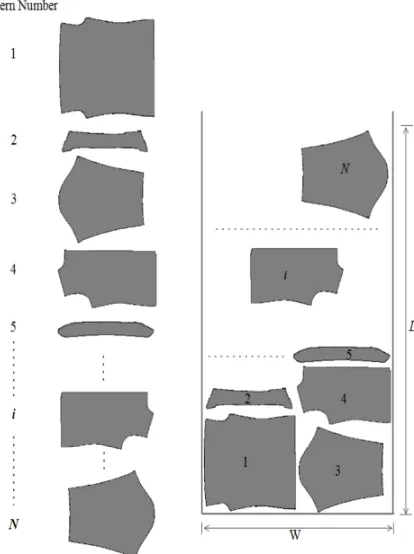
Figure 1 illustrates the layout of the marker packing. The arrangement of packing of pattern pieces on marker should be found with the minimum length of the marker.
Fig. 1. Illustrates the layout of the marker packing.
The characteristics of the marker packing problems are expressed as below in brief:
a) a paper with a width W and unlimited length (marker)
b) N pattern of pieces (i=1, 2, 3, 4,5,KN)with an area of Pi
c) Pattern of pieces are not able to rotate.
d) Pattern of pieces should be arranged on marker without overlapping.
As shown in Figure 1, packing efficiency is inversely related to its length and if the marker occupied longitudinal equals L, then the efficiency is calculated by Equation 1.
But when the optimization met-heuristic algorithms are used, Equation 1 is not appropriate. Because in some cases it may be several packing with a different arrangement have the same length and thus equal fitness function (efficiency). This state causes algorithm confusion in finding the right direction toward the absolute optimum.
The proper way to solve this problem is to influence the parameter of the space between pieces to fitness function. Because it is possible that some different packing with the same length have different empty spaces between the pieces and the packing that has fewer space between their pieces leads algorithm towards more favorable packing [30]. For example, both packing in Figure 2 have the same length. But there are fewer spaces between pieces in Figure 2.a.
The blue spaces are considered as empty spaces between the pieces.
Fig. 2. Both packing by the same length and: a) less spaces between the pieces. b) More spaces between the pieces.
Therefore the parameters of length and size of empty space between the pieces is used in fitness function calculation. Both parameters have been included in the fitness function in the form of a weighted sum. If A is the size of space between pieces then the rate fitness function F is calculated as below [30]:
(1)
The weights of the two terms have been determined in a series of trials setting ‘a’ to 0.7 and ‘b’ to 0.3 [35]. A. Purposed Solution
In this study the goal is minimizing the length of marker by using the best sequence of pattern pieces for placement on marker. For this purpose, ICA which is a new and powerful search algorithm is used. In this method assumed the searching space include different sequence of pattern pieces. During several past decade ICA implementation converges toward a sequence that produce more efficiently marker.
To calculate fitness function during ICA implementation, it is necessary to placement the set of pattern pieces on marker according to the finding sequence by ICA. In this stage fitness function is calculated with Equation 2. There are two methods to implement the shape of pattern pieces in packing problems: vector and pixel method. In using vector method for packing pieces with irregular shaped, although operation speed is high, but examining the overlap of pieces needs complicated computations. The operation speed is low in using raster method but it is possible to examine the overlap of pieces with irregular shaped by easier computations [37]. Therefore pixel method has been used in this study.
B. Pixel Method
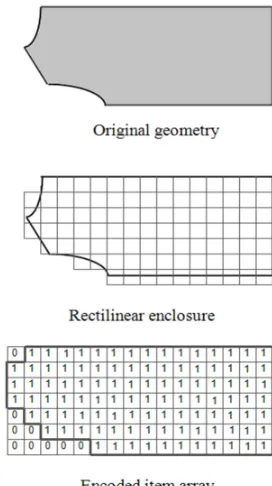
Pixel method is an approximate geometry handling technique. The geometry of an item through this method is first approximated by a set of square pixels that form a rectilinear enclosure. Such an approximated form is then encoded by a 2-D array (item array). An item array
involves two types of pixels: interior and exterior pixels. An interior pixel is the one corresponding to one of the rectilinear enclosure pixels; while other remaining pixels within the item array are exterior pixels [38] (see Figure 3).
Fig. 3. Approximation of a piece by pixel method [38].
In the same manner, the marker is encoded by a 2-D array (sheet array). This array also involves two types of pixels; occupied and unoccupied pixels. Occupied pixels are those pixels utilized via former placement operations, while unoccupied pixels are the remaining free pixels. Assigning a certain location inside the sheet to a given item is done by adding the corresponding item array, to the sheet array at that place. Hence, for a feasible placement (overlap-free placement), any of the interior pixels of the item array should not be added to an occupied pixel within the sheet array. Figure 4 illustrates the overlap of the pixel method.
1
(2)
C. Packing Algorithms
Many studies have been conducted in various types of placement techniques and various packing algorithms have been proposed to solve the packing problems. Among those following can be cited: BLLT-Algorithm, Bottom-Left-Algorithm, Bottom-Left-Fill-Algorithm, TOPOS and Best fit algorithm [39]. Complicated packing algorithms produced packing with higher efficiency. However they require more time to complete the pieces packing process. During this time, simpler algorithms can perform several packing and determine the efficiency of some different packing arrangement of pieces. Hence, the weakness of simple algorithms was compensated by multiplicity of packing at the same time [30].
In the present study the Bottom-Left-Fill-Algorithm is used at placement phase, which can produce an acceptable response with appropriate speed [40]. Placement with Bottom-Left-Fill-Algorithm method has two steps: at the first step a piece is placed at the lowest position of the object that has a sufficient space for placing. The next step the pieces will be moved to the leftmost possible position of the object. Figure 5 illustrates this type of packing. This method produces a more dense packing in comparison with the Bottom left and BLLT-Algorithm methods.
D. Imperialistic Competitive Algorithm
Imperialist Competitive Algorithm is a new evolutionary optimization method which is inspired by imperialistic competition [32]. Like other evolutionary algorithms, it starts with an initial population which is called country and is divided into two types of colonies and imperialists which together form empires. Imperialistic competition among these empires forms the proposed evolutionary algorithm. During this competition, weak empires collapse and powerful one stake possession of their colonies. Imperialistic competition converges to a state in which there exists only one empire and colonies have the same cost function value as the imperialist. The pseudo code of Imperialist competitive algorithm is as follows:
1) Select some random points on the function and initialize the empires.
2) Move the colonies toward their relevant imperialist (Assimilation).
3) Randomly change the position of some colonies (Revolution).
4) If there is a colony in an empire which has lower cost than the imperialist, exchange the positions of that colony and the imperialist.
5) Unite the similar empires.
6) Compute the total cost of all empires.
7) Pick the weakest colony (colonies) from the weakest empires and give it (them) to one of the empires (Imperialistic competition).
8) Eliminate the powerless empires.
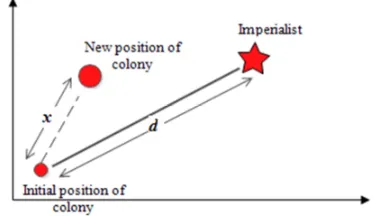
9) If stop conditions satisfied, stop, if not go to 2. After dividing all colonies among imperialists and creating the initial empires, these colonies start moving toward their relevant imperialist state which is based on assimilation policy. Figure 6 shows the movement of a colony towards the imperialist. In this movement, θ and x are random numbers with uniform distribution as illustrated in formulas (3&4) and d is the distance between colony and the imperialist.
x~U(0, β×d) (3)
θ~U(-γ, γ) (4) where β and γ are parameters that modify the area that colonies randomly search around the imperialist.
Fig. 6. Motion of colonies toward their relevant imperialist [34]
In ICA, revolution causes a country to suddenly change its socio-political characteristics. That is, instead of being assimilated by an imperialist, the colony randomly changes its position in the socio-political axis. The revolution increases the exploration of the algorithm and prevents the early convergence of countries to local minimums. The total power of an empire depends on both the power of the imperialist country and the power of its colonies which is shown in formula (5).
Tn= cost( nth imperialist)+
+ (ξmean cost (colonies of nth empire)
(5)
In imperialistic competition, all empires try to take possession of colonies of other empires and control them. This competition gradually brings about a decrease in the power of weaker empires and an increase in the power of more powerful ones. This is modeled by just picking some of the weakest colonies of the weakest empires and making a competition among all empires to possess these colonies. Figure 7 shows a big picture of the modeled imperialistic competition. Based on their total power, in this competition, each of the empires will have a likelihood of taking possession of the mentioned colonies. The more powerful an empire, the more likely it will possess the colonies. In other words these colonies will not be certainly possessed by the most powerful empires, but these empires will be more likely to possess them. Any
Fig. 7. Imperialistic competition [34]
empire that is not able to succeed in imperialist competition and cannot increase its power (or at least prevent decreasing its power) will be eliminated.
E. The Discrete Imperialistic Competitive Algorithm The primary algorithm proposed by Atashpaz [32] is designed for continuous optimization problems. This algorithm doesn’t possessed the ability to run on discrete problems such as permutation problem or packing problem. But the optimization variable can be discrete only in the time of calculation fitness function.With making changes in fitness function definition; the Imperialistic competition algorithm can be used to solve discrete problems.
In this case, the goal is to optimize a continuous problem and the algorithm runs for a continuous problem as well, but one interface function is used before calculation stage of fitness function during ICA running. This interface function discrets the variable continuous in the time of calculation fitness function and send it to fitness function of ICA. Then, the amount of fitness function returns to the ICA for continuing operation. In order to solve packing optimization problems by using ICA operates as follows:
- Generate random real numbers in the range of zero to one in number of N-var.
- Country formation and its repetition to produce required number of countries
- Using produced countries for using in ICA.
- Using sorted place (from low to high or vice versa) of each country instead of its amount to assess the strength of each country.
In fact, by using this method, ICA is applied on real numbers. But sorted place of real numbers is used in the time of calculation fitness function. Because sorted place of real numbers possess essential characteristics of the discrete problems such as been natural numbers and not repeatability.
Figure 8 illustrates the conversion process of sequence of real numbers to sequences pieces.
III. RESULTSANDDISCUSSION
In this section, eight sets of sample pieces presented for solving packing problems by using proposed method. Then, the results have been compared with obtained results of Wong and Lang [21]. They used a hybrid method which is based on evolutionary algorithm and a heuristic packing algorithm. Table I illustrates data of eight sets of sample pieces [21].
TABLEI
DATAOFEIGHTSETSOFSAMPLEPIECES Marker Width
(inch) Number of Patterns
Problem Name 48 16 SHIRT1 48 48 SHIRT2 48 64 SHIRT3 48 80 SHIRT4 60 12 SWIM1 60 60 SWIM2 60 78 SWIM3 60 108 SWIM4
The optimization was performed with Matlab 2013. Table II shows the ICA parameters which is used for initializing of optimization process. In which parameter
d
states the current decade index.TABLEII THEICAPARAMETERS
Parameter Value
Number of decades (Ndecade) 50
Number of imperials (Nimp) 20
Number of countries (Ncountry) 150
Assimilation coefficient (β) 2
Deviation coefficient (γ) 0.1
Colonies share coefficient(ξ) 0.5
Objective function ( )f Eq. (2)
Revolution rate
0.5 d D e−
In order to create required diversity in searching space of ICA, the floated revolution was used. In this method the initial rate (percent) of revolution was high, that guarantees the diversity of searching space. Increasing decades decreases the rate of revolution; in fact the algorithm mostly searches among the population’s neighborhood. One of the most effective parameters on the algorithm performance is the number of initial country. The low number of initial population leads, further speed in algorithm implementation. But even if the optimal solution is found by the algorithm, the answer is no repeatability. Although the high initial population causes low algorithm performance and wasting time but it generalizes the repeatability of desired response. Despite the importance of this parameter, there is no accurate way to determine the amount. Number of decades should be selected in such a way to avoid algorithm saturation. Saturation occurs when the mean fitness function of countries is equal with the best available value. In fact, the entire population has the same amount of fitness function. In this case, the algorithm must be stopped .
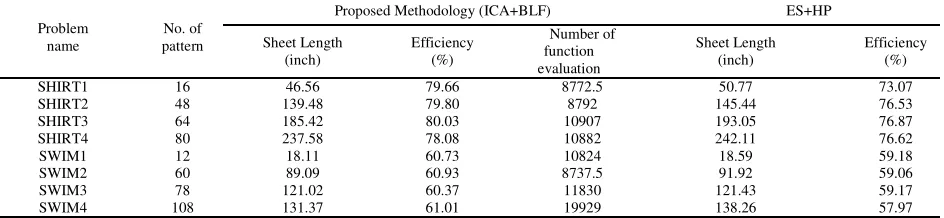
ICA-BLF algorithm was performed 15 times for each set of sample. The maximum run time was 20 minutes. Best results are obtained by using ICA-BLF reported in Table III. Also the results reported by Wong and Lang [21] are illustrated in Table III.
Since the type of software and coding programs have a significant influence on the mean time of algorithm implementation. Therefore the number of function evaluation (NFE) is used in order to have a deeper examination of proposed algorithm. Evaluation of fitness function value is the most time- consuming part of each algorithm. The time required for algorithm performance can be approximated by using the amount of NFE. However, each time of function evaluation, the solution found by the algorithm is evaluated. The useful algorithm is the one that provides proper results with less Number of Function Evaluations (NFE).
TABLEIII
ASUMMARY OF THE BEST RESULTS FOR THE EIGHT ILLUSTRATIVE EXAMPLES Problem
name
No. of pattern
Proposed Methodology (ICA+BLF) ES+HP
Sheet Length (inch) Efficiency (%) Number of function evaluation Sheet Length (inch) Efficiency (%)
SHIRT1 16 46.56 79.66 8772.5 50.77 73.07
SHIRT2 48 139.48 79.80 8792 145.44 76.53
SHIRT3 64 185.42 80.03 10907 193.05 76.87
SHIRT4 80 237.58 78.08 10882 242.11 76.62
SWIM1 12 18.11 60.73 10824 18.59 59.18
SWIM2 60 89.09 60.93 8737.5 91.92 59.06
SWIM3 78 121.02 60.37 11830 121.43 59.17
As is observed from Table III, in each of the 8 samples, the ICA-BLF method has produced markers with the lower length and higher efficiency in compared with the ES-HP method. Table IV shows the details of the percentage of improvement for each example.
On average the markers of pattern categories (SHIRT) have improved by about 3.62 percentage and the makers of pattern categories (swim) have improved by about 2.3. It can be said that the (ICA) is a useful algorithm for solving packing problems.
Figure 9 illustrates the graphs of average and the best performance of fitness function in decades of ICA implementation for the best results of SWIM2 and SHIRT2 set-pieces.
According to the Figure 10 it is obvious that the ICA has successfully increased the markers’ performance from 5 to 8 during five decades. The best packing patterns generated for each example by using the proposed method
are presented in Figure 10.
IV. CONCLUSIONS
In this study in order to solve packing problems a new meta-heuristic method is developed based on Imperialist Competitive newfound Algorithm. Also packing BLF algorithm is a proper algorithm in producing high qualified packing. In comparison with previous researches that only used the length of the marker to calculate fitness function, this study employed the empty space between pieces of pattern placement alongside with the length of the marker. This novelty in calculating fitness function affords effective guidance for searching process. The usefulness of the proposed method was tested through implementation on the eight sets of samples.
The results have been compared to the results obtained by researchers who used hybrid method to solve these problems. This hybrid method based on evolutionary algorithm (ES) and a type of heuristic packing algorithm (HP). The results show that markers efficiency of eight sets of samples are improved 1.2 to 6.56 percent. Therefore, it can be said that the search method based on ICA is an effective way to solve marker packing problems. The performance of ICA to solve these problems greatly depends on packing algorithms combined with it. Because in some cases it is possible that a particular sequence of pieces generates markers with different efficiency according to its packing algorithms. Therefore in case of using better packing algorithms than BLF algorithm, then there is a possibility of producing higher efficiency marker using Imperialist Competitive algorithm.
TABLE IV METHOD COMPARISONS
Improvement
(Proposed Methodology vs. ES+HP) (%)
Problem name
6.59 SHIRT1
3.27 SHIRT2
3.16 SHIRT3
1.46 SHIRT4
1.55 SWIM1
1.87 SWIM2
1.20 SWIM3
3.04 SWIM4
Fig. 9. The graphs of the average and best performance of fitness function for the decades of implementation of the Imperialist Competitive algorithm (ICA) for the best results of: a) SWIM2 set-pieces. b) SHIRT2 set-pieces.
(a) (b)
(c)
(d)
(f)
(g)
(h)
(e)
REFERENCES
[1] P. Peivandi and M. Latifi, “An ILP-GA Based Approach for Nesting Scheduling in Carpet Weaving Industries”, The 10th
Asian Textile conference and modern sciences Ueda Japan 7-9 September 2009. [2] P. Peivandi, M. Amani-Tehran and M. Latifi, “Optimization of
Pattern Layout Considering Multi- Set Pattern & Pieces Rotation”,
5th national Conference on Textile Engineering, Amir Kabir
University of Technology, Tehran Iran, April 2005. (In Persian) [3] H. Liu and Y. Hu, “Algorithm for 2d irregular-shaped nesting
problem based on the NFP algorithm and lowest-gravity-center principle”, J. Zhejiang. Univ. Sci. vol. 7, no. 4, pp. 570-576, 2005. [4] E. Hopper and B. C. H. Turton, “An empirical investigation of
meta-heuristic and heuristic algorithms for a 2D packing problem”, Eur. J. Oper. Res., vol. 128, no.1, pp. 34-57, 2001.
[5] S. Jakobs, “One genetic algorithms for the packing of polygons”, Eur. J. Oper. Res., vol. 88, no.1, pp. 165-181,1996.
[6] T. C. Martins, “Two-dimensional packing utilizing evolutionary algorithms and other meta-heuristic methods”, PhD. dissertation, Dept. Text. Eng., University of wales, 2000.
[7] F. E. H. Tay, T. Y. Chong and F. C. Lee, “Pattern nesting on irregular-shaped stock using genetic algorithms”, J. Eng. Appl. Artif. intel, vol. 15, no. 6, pp. 551-558, 2002.
[8] K. Fujita, S. Akagji and N. Kirokawa, “Hybrid approach for optimal nesting using a genetic algorithm and a local minimization algorithm”, J Des. Eng-Division., vol. 65, no. 1, pp. 477-484, 1993. [9] H. S. Ismail and K. K. B. Hon, “New approaches for the nesting of two-dimensional shapes for press tool design”, Int. J. Prod. Res., vol. 30, no. 4, pp. 825-837, 1992.
[10] H. S. Ismail and K. K. B. Hon, “Nesting of two-dimensional shapes using genetic algorithms”, J. Eng. Manuf., vol. 209, pp. 115-124, 1995.
[11] E. K. Burk and G. Kendall, “Applying ant algorithms and the no fit polygon to the nesting problem”, 12th Australian Joint Conference on Artificial Intelligence, Sydney, Australia, pp. 453-464, 1999,. [12] S. K. Cheng and K. P. Rao, “large-scale nesting of irregular patterns
using compact neighborhood algorithm”, J. Mater. Process. Tech., vol. 103, pp. 135–140, 2000.
[13] A. R. Babu and N. R. A. Babu, “A generic approach for nesting of 2-d pieces in 2-D sheets using genetic and heuristic algorithms”, J. Comput. Aided. Design. vol. 33, no.12, pp.879-891, 2001. [14] M. Hifi and R. M. Hallah, “Hybrid algorithm for the two
dimensional layout problem: the cases of regular and irregular shapes”, J. Int. Trans. Oper. Res., vol. 10, no. 3, pp. 195-216, 2003. [15] A. D. Fischer and C. H. Dagli, “Employing subgroup evolution for irregular-shape nesting”, J. Intell. Manuf., vol. 15, pp. 187-199, 2004.
[16] A. Crispin, P. Clay, G. Taylor, T. Bayes and D. Reedman, “Genetic algorithm coding methods for leather nesting”, J. Appl. Intell., vol. 23, no. 1, pp. 9-20, 2005.
[17] R. Selow and S. L. Heitor, “Genetic algorithms for the nesting problem in the packing industry”, International Conference of
Engineers and Computer Scientists, Hong Kong; pp. 15-20, 2008.
[18] A. D. Fischer and C. H. Dagli, “Employing subgroup evolution for irregular-shape nesting”, J. Intell. Manuf. vol. 15, pp. 187-199, 2004.
[19] B. Junior, P. Pinheiro and R. Saraiva, “A hybrid methodology for nesting irregular shapes: case study on a textile industry”, 6th IFAC Conference on Management and Control of Production and Logistics, Fortaleza, 2013.
[20] L. H. W. Yeung and W. K. S. Tang, “A hybrid genetic approach for garment cutting in the clothing industry”, J. IEEE. T. Ind. Elecron., vol. 50, no. 3, pp. 449-455, 2003.
[21] W. K. Wong and S. Y. S. Leung, “A Hybrid Planning Process for Improving Fabric Utilization”, Text. Res. J., vol. 79, no. 18, pp. 1680-1695, 2009.
[22] H. Liu and Y. He, “One genetic algorithms for shoe making nesting – a taiwan case”, J. Expert. Syst. Appl., vol. 36, no. 2, pp.1134-1141, 2009.
[23] S. Takahara, Y. Kusumoto and S. Miyamoto, “Solution for textile nesting problems using adaptive met heuristics and grouping”, Int. J. Soft. Computing., vol. 7, no. 3, pp. 154-159, 2003.
[24] V. Marques, C. Bispo and G. Sentieiro, “A system for the compaction of two dimensional irregular shapes based on simulated annealing”, international conference on industrial electronics, control and instrumentation, 1991.
[25] J. F. Oliveira and J. S. Ferreira, “Algorithms for nesting problems”, J. Intell. Manuf., vol. 39, no. 6, pp. 255-276, 1993.
[26] A. M. Gomes and J. F. Oliveira, “Solving irregular strip packing problems by hybridizing simulated annealing and linear programming”, J. Oper. Res., vol. 171, no. 3, pp. 811-829, 2006. [27] T. C. Martins and M. Tsuzuki, “Simulated annealing applied to the
irregular rotational placement of shapes over containers with fixed dimensions”, J. Expert. Syst. Appl., vol. 37, pp. 1955-1972, 2010. [28] J. Blazewicz, P. Hawryluk and P. Walkowiak, “Using a tabu search
approach for solving the two-dimensional irregular cutting problem”, J. Ann. Oper. Res., vol. 41, no.4, pp. 313-325, 1993. [29] J. A. Bennell and K. A. Dowsland, “Hybridizing tabu search with
optimization techniques for irregular stock cutting”, J. Manage. Sci., vol. 47, no. 8, pp. 1160-1172, 2001.
[30] E. Hopper, “Two-dimensional packing utilizing evolutionary algorithms and other meta-heuristic methods”, Ph.D dissertation, Dept.Text. Eng., University of Wales, Cardi, 2000.
[31] M. Shalaby and M. kashkoush, “particle swarm optimization algorithm for a 2-d irregular strip packing problem”, Am. J. Oper. Res., vol. 3, no. 1, pp. 268-278, 2013.
[32] E. Atashpaz-Gargari and C. Lucas, “Imperialist Competitive Algorithm: An algorithm for optimization inspired by imperialistic competition”, IEEE Congress on Evolutionary Computation, pp. 4661-466, 2007.
[33] E. Atashpaz-Gargari, F. Hashemzadeh, R. Rajabioun and C. Lucas, “Colonial competitive algorithm: A novel approach for PID controller design in MIMO distillation column process”, International Journal of Intelligent Computing and Cybernetics, vol. 1, no. 3, pp. 337-355, 2008.
[34] S. Ebrahimi and P. Payvandy, “Optimization of the Link Drive Mechanism in a Sewing Machine Using Imperialist Competitive Algorithm”, Int. J. Cloth. Sci. Tech., Vol. 26, No, 3, pp. 247-260, 2014.
[35] A. Catastini, C. Cavagna, U. Cugini and P. Moro, “A computer-aided design system for pattern grading and marker making in the garment industry”, Second International Conference on Computers in Engineering and Building Design, Imperial College London, 1976.
[36] M. D. Valle, D. Queiroz, F. Miyazawa and E. Xavier, “Heuristics for two-dimensional knapsack and cutting stock problems with items of irregular shape”, Expert Syst Appl, vol. 39, no. 16, pp. 12589-12598, 2012.
[37] M. Shalaby and M. Kashkoush, “A Particle Swarm Optimization Algorithm for a 2-D Irregular Strip Packing Problem”, Am. J. Oper. Res., vol. 3, No. 2, 2013, pp. 268-278, 2013.
[38] J. F. Oliveira and J. S. Ferreira, “Algorithms for Nesting Problems”, J. Intell. Manuf., vol. 39, no. 6, pp.255-276, 1993