A Dynamic Rescheduling Model with Multi-Agent System and Its
Solution Method
Zhao, F. – Wang, J. – Wang, J. – Jonrinaldi, J.
Fuqing Zhao1,2,* ‒ Jizhe Wang1 ‒ Junbiao Wang2 ‒ Jonrinaldi Jonrinaldi3
1 School of Computer and Communication, Lanzhou University of Technology, China 2 Key Laboratory of Contemporary Design & Integrated Manufacturing Technology,
Ministry of Education, Northwestern Polytechnical University, China
3 School of Engineering, Computer Science and Mathematics, University of Exeter, United Kingdom
Dynamic rescheduling problem is an important issue in modern manufacturing system with the feature of combinatorial computation complexity. A dynamic rescheduling model, which is based on Multi-Agent System (MAS), was proposed. The communication and negotiation mechanism between agents were addressed to support the autonomic decision for each individual agent and the multi-agent system. Furthermore, the simulation results in dynamic scheduling accompanying with its perturbation show that the proposed model and the algorithm are effective to the dynamic scheduling problem in manufacturing system.
Keywords: MAS, agent, dynamic scheduling, Contract Net Protocol, negotiation mechanism, perturbation
0 INTRODUCTION
Today’s manufacturing businesses are facing immense pressures to react rapidly and robustly to dynamic fluctuations in demand distributions across products and changing product mix. Traditional manufacturing systems and approaches to production, involving sequential stages from manufacturing systems design, construct, and setup in the preparation phase to production planning, scheduling, and control in the operational phase, can be challenging in satisfying the requirement of the variation. Efficient and practical methods for scheduling and optimization technology are the key to improve the productivity and efficiency of a manufacturing plant [1]. The traditional scheduling and optimization process, which always deals with a clear schedule and a fixed processing time, while for the actual processing problem, there are many uncertain factors, for example, changes in processing time, product demand, delivery, equipment failure, resources and production variations. The dynamic interference of these factors causes that the original dynamic scheduling can not be implemented successfully. Therefore, the rescheduling model and its solution method are of significant importance for the dynamic scheduling problem [2].
Job shop scheduling is to schedule a set of jobs on a set of machines, which is subject to the constraint that each machine can process one job at most at a given time and the fact that each job has a specified processing order through the machines. It is not only a NP-hard problems, it also has the well-earned reputation of being one of the strong combinatorial problems in manufacturing systems. Recently, two single-machine rescheduling problems
modeling approach. Goncalves [12] proposed a hybrid genetic algorithm for the job shop scheduling problem with reactive scheduling method. Wong et al. [13] introduced multi-agent system as a platform for the dynamic shop floor scheduling problem.
With the aim of enhancing the flexibility of manufacturing systems and achieving optimization of solutions to constantly respond to increasing rates of change in demand patterns and product mixes, rescheduling approaches and production scheduling options should be taken into consideration simultaneously, and evaluated and optimized dynamically. In this way, constrains from both functions can also be fulfilled concurrently and an optimum integrated plan and schedule can then be produced. Mes et al. [14] proposed a distributed agent-based solution to real-time, dynamic transport scheduling problems, which has the advantages of less sensitive to fluctuations in demand or available vehicles than more traditional transportation planning heuristics (Local Control, Serial Scheduling) and provides a lot of flexibility by solving local problems locally. Shen et al. [15] review the research literature on manufacturing process planning, scheduling as well as their integration, particularly on agent-based approaches to the integration of the difficult problems. A class of dynamic scheduling problems characterized by a just-in-time objective was addressed in literature [16], an on-line scheduling heuristic based on a multi-agent architecture was also presented. Kemppainen [17] presented the method of the coordinating power of priority scheduling when customers request different response times and suppliers do their best to fulfill the customer expectations, especially if enforced with different pricing. Pfeiffer et al. [18] presented a simulation-based evaluation technique for the testing, validation and benchmarking of rescheduling methods. Certain stability-oriented evaluations of periodic and hybrid rescheduling methods are described for both single- and multi-machine (job-shop) cases. Cauvin et al. [19] proposed an approach to minimize the impact of disrupting events on the manufacturing scheduling and control system, which is based on a cooperative distributed problem solving approach supported by a multi-agent system framework.
However, few attempts have been done on the universal communication and negotiation mechanism for the dynamic rescheduling problem and corresponding solution approach. We aim to construct a universal dynamic rescheduling model, which is based on Multi-Agent System (MAS), for the job shop scheduling problem in manufacturing systems.
This paper is organized as follows. In Section 1, the rescheduling model which is based on MAS is given. Section 2 describes the detailed functions of agent. The communication and negotiation processes and steps are introduced in Section 3. In Section 4, the proposed model and approach are validated using the popular benchmark functions. Finally, Section 5 concludes the paper with an outlook on future work.
1 MAS-BASED RESCHEDULING MODEL
In dynamic shop scheduling environment, the job shop problem can be described as: in a processing unit or system, n jobs need to be processed on m machines, every job Ji (1 ≤ i ≤ n) has ni process Oij (1 ≤ i ≤ n,
1 ≤ j ≤ n) which is needed to processing. Set machine tool with a collection of M, then each process Oij can
either be processed by the concentration of machine tools Mij or can be processed in one machine, where
Mij ⊆M . If Mij = M, the scheduling problem is a
completely flexible scheduling problem; if Mij ⊂M, it is a local scheduling problem with flexible strategy [20].
In scheduling operation, when one machine failure occurs, all machines need to execute the operation of rescheduling of the operation on the predetermined operation processes. As rescheduling model is the corresponding evolution process to the initial scheduling model, the initial problem modeling is as follows.
min max
{
c i Iis ∈}
,S.t.
sij+1 ≥ sij+1+ pij , i ∈ I, J ∈{1, ... s−1}, (1)
(mi j1 ≠mi j2 ) (∨ si j1 ≥ci j1 ∨si j2 ≥ci j2 ), (2) i1, i2 ∈I, i1 ≠ i2, j ∈ J, (3)
cij = sij + pij , i ∈ I, j ∈ J, (4) si1≥0,sij≥
∑
kj=−11p i I jik, ∈ , ∈{
2,...,s}
, (5)mij∈Rj =
{
rjl,...,rjlj j J i I∈}
, ∈ , (6)where i is the workpiece number and
i ∈ I = {1, ..., n}, j is the level number and j ∈ J = {1, ..., s}, rjl is the machine number, sij is the
start time of initial scheduling, mij is the start machine,
pij is the processing time of the workpiece.
Eq. (2) shows the operation of the timing constraints. Eq. (3) shows that if two jobs are processed on the same machine, then they can not be processed at the same time. Eq. (4) shows that once the processing for the workpiece starts, it can not be interrupted until it will be finished. Eqs. (5) and (6) show operation started with variable time window and the variable interval of processing machinery, respectively.
It is supposed that the machine rj ld d disruptions at the time interval [tb, te], the initial scheduling begins
to adjust in tb, and the initial scheduling will alter to
the dynamic rescheduling:
max f w w v v ij ij j J i I ij j J i I ij ij j J i I ij j J i I = ∈ ∈ + ∈ ∈ ∈ ∈ ∈ ∈
∑
∑
∑
∑
∑
∑
∑
∑
δ1 δ2
,, (7)
S.t.
(mi j1 ≠mi j2 ) (∨ si j1 ≥ci j1 ∨si j2 ≥ci j2 ), i1, i2 ∈I, i1 ≠ i2, j ∈ J,
cij = sij + pij , i ∈ I, j ∈ J, (8) mij∈Rj =
{
rj rjll j J∈}
∈I1, ..., , i ,
(mij' ≠rj ld d) (∨ sij' ≥t i I j Je), ∈ , ∈ ,
(sij' ≥t i I j Jb), ∈ , ∈ . (9) Eq. (7) shows that the objective of the rescheduling is to maximize the time for the adjustment arrangement.
δ1ij is the rescheduling operation time of the
corresponding alternative scheduling operation for workpiece oij :
δ1ij ij ij ij ij 0
ij
c c s s p
=max min
{
{ }
−max{ }
}
' , ' , ,
,
where δ2ij is the dynamic rescheduling decision
varible when selecting the alternative for workpiece oij :
δ2 1
0
ij mij Mij
other = ∈ , , . '
Eq. (8) shows the new constraints when mechanical failures occur. Eq. (9) shows the beginning of the operation of the new interval for the start time of process oij·oij means the process step j of workpiece
i, wij , vij are operating weight of the workpiece and
the machine time consistency of weight, respectively.
sij' means the starting time of the operating parts in rescheduling, mij' is the operating machine for workpiece in rescheduling.
For the rescheduling problem, the
structure of the agent can be expressed as: agent = def <Id, Goal, Act, Rule, L>.
Agent Id is the identifier in multi-agent system. Different agent has different agent Id.
Goal is the objective of the agent. The goal is keeping the optimization objective of job sequence as optimum or near optimum after inserting a new job to the agent when rescheduling occurs. The goal can be expressed as:
Goali =(Cmaxi ,J1i →J2i...→Jnii ), where
{
J J J1i, ...2i nii}
is the union of the current operating jobs and the current order queue Ji Ji J
nii
1 → 2...→ for machine Mi.
Ji Ji J
nii
1 → 2...→ is the optimum priority sequence
or near optimum order of machine Mi. Cmaxi is the
optimal objecive of the machine Mi or near optimal
objective value.
Act is the action set of agent in the form of Act = {act1, act2, ..., actn} , which represents the operation
it can be accomplished. Each agent has capabilities of communication and collaboration.
Rule represents the cooperation criterion for the communication between agent and its corresponding agent.
L is the Agent communication language. Different agents communicate with each other with L. ACL (Agent communication language) with FIPA rules and modified contract net protocol, which are used in this paper.
Basically, each of these agent platforms provides a user with a library of JAVA classes (since all of them are programmed in JAVA) that allow to create agents with application-specific attributes and behaviors and with the capabilities to send and receive messages following different FIPA interaction protocols. The vital part for agent platform is the runtime environment. which provides a space for agents to live. The running environment consists of white pages services registering existing agents and their contact addresses, yellow pages services used to register and locate services offered by agents and finally the message dispatching mechanism ensuring the inter-agent communication within the platform as well as among agents hosted at different platforms.
2.1 Function Design of Agent
Traditional rescheduling is generally obtained manually and/or is computer aided in accordance with certain reallocation algorithm [23]. We use the MAS-based intelligent scheduling systems, which collaborate with each other to guarantee the intelligence of machines that utlized MAS as the software of control unit. Therefore, jobs for rescheduling in manufacturing shops can achieve the automation and optimization. The basic structure of improved contract net model consists of Management Agent (MA), Resource Agent, Supervision Agent (SA) and Workpiece Agent.
MA is the core of the scheduling system. İt is mainly responsible for evaluating and scheduling the task entered into the rescheduling system. The information of the task is composed of the host information and the degree of emergency for the concrete task. MA transmits the information to the Resource Agent for processing. Communication between MA and other Agents is shown in Fig. 1.
Fig. 1. Description of Management Agent
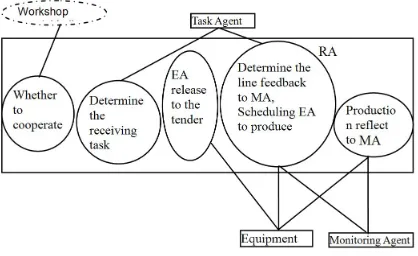
Resource Agent (RA) is responsible for receiving and processing production tasks entering into the shops. And in accordance with the current processing capacity, RA determines whether to perform the task or not. After the decomposition of tasks, the
tender will be distributed to Equipment Agent (EA). According to the rules of the agreement, RA lays out a concrete processing planning, then submits it to the SA. In addition, guides the production for EA after obtaining the feedback from SA. The internal schematic for Resource Agent is shown in Fig. 2.
Fig. 2. Resource Agent internal schematic
SA is responsible for the simulation for the candidate production planning, which is returned back from the MA. Moreover, SA selects processing route and forwards it to the MA to be performed. Furthermore, SA is responsible for the supervision of Agent equipment failure, the entering of new equipments and the arrival of other emergency tasks. Fig. 3 shows the internal schematic of SA.
Fig. 3. Supervision Agent internal schematic
itself to RA. Internal schematic of EA is shown in Fig. 4.
Fig. 4. Equipment Agent Internal Schematic
Afterwards, the MA sends a message to Workpiece Agent with the accepted information. Communication primitives in the process can be expressed as:
:Sender(managerAgent@abc:1099/jade) :Receiver(Equipment@abc:1099/jade) :Ontology AMS-ontology
:Protocol FIPA-contract-net :Language FIFA-KQML
:Content “((Issue (taskid(01),surface
Type(plane),machining Type(drilling),number(8),tolerance (geometic Tol:02dimensional tol:01roughness:02), deadline(2010.12.01/21:10)))”
RA selects processing tasks in sequence from the waiting tasks to be processed. RA sends the process information as a proposition to EA. The communication primitives can be expressed as: (CFP
:Sender(Agent-identifier:name resource@abc:abc:1099/jade) :Receiver(Agent-identifier:name equipment@abc:abc:1099/jade) :Content(action issues:issuebook:taskli\task01:working
procedure\01\)
:task ready time”2010-12-01 21:20” :surface roughness 4:dimensional tolerance time\”60”\:deadline\”2010-12-01 21:20”\) :Reply-with CFP1
:in Reply-with PROPOSE1 :Language FIPA-KQML :Ontology scheduling ontology :Protocol fipa-contract-net )
Workpiece Agent analyzes the tender received according to the capacity of itself and status of the
request, then replies with proposed tender in given deadline. Tender request primitives for Workpiece Agent can be expressed as:
(PROPOSE
:Sender(Agent-identifier:name equipment@abc:1099/jade) :Receiver(Agent-identifier:name resource@abc:1099/jade) :Content”((action(bidbook(bidbook
:finishtime\2010-12-01\21:30\)):cost:10:equipment (Agent-identifier:name equipment@abc:1099/jade)))” :Reply-with CFP1
:in Reply-with PROPOSE1 :Language FIPA-KQML :Ontology scheduling ontology :Protocol fipa-contract-net )
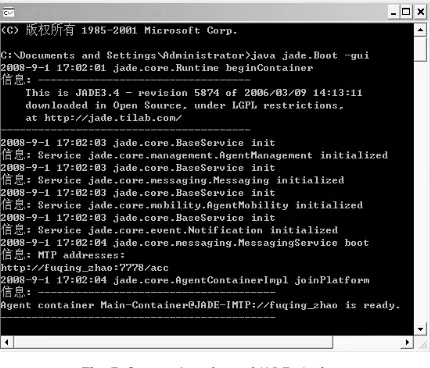
The proposed communication and the interaction process are implemented on the Java Agent Development Environment (JADE) platform. JADE is a multi-agent system platforms, which conforms strictly to FIPA criteria. The JADE programmer can use JAVA to exploit the system when the agent is built (Administrator Guide, Programmer Guide). Meanwhile, because JADE simplifies the communication process between agents by delivering messages which abide by FIPA criteria (FIPA), the message can also be inserted into the sequenced object to realize the standardization parameter delivery. Furthermore, the yellow function can be directly used because of DF function provided by JADE to guarantee the register for customer system. With AMS and Sniffer tools provided by JADE, users can debug the implementation platform and easily achieve the total functioning of the system. The startup interface is shown in Figs. 5 and 6.
2.2 The Rescheduling Process Based on Contract Net Protocol
MA generates the appropriate contract according to the task order in the task allocation model. The final task allocation is determined by the bidding mechanism through the contract net protocol [24].
Fig. 6. GUI Startup interface of JADE platform
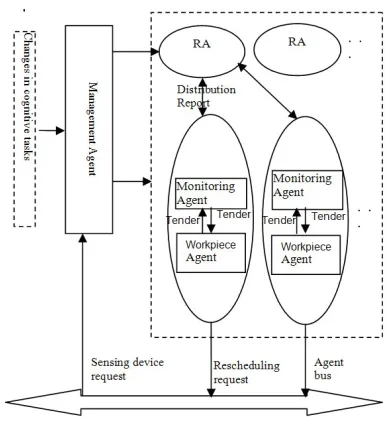
However, given the consultation efficiency and frequent dynamic scheduling in the workshop, in order to improve efficiency, a two-way consultation mechanism for global scheduling is utilized. By introducing the two-way consultation mechanism, the workshop no longer needs to accept bidding information from MA passively. It can take the initiative to inform the MA of rescheduling information for RA and EA in free time to shorten the scheduling time needed. Meanwhile, RA no longer needs to send bidding information to the workshop with broadcast mode unconditionally. In contrast, RA inspects whether there are request submitted from other agent, afterwards, invites bidding from the workshops which have submitted the bid previously. Therefore, the communication between the agent system decreases obviously, along with the improvement of negotiation by the two-way consultation mechanism. Fig. 7 shows the multi agent based dynamic scheduling model with the two-way consultation mechanism.
In multi-agent dynamic scheduling system, any agent in the agent society may be involved in more than one cluster. With on-going clustering and agents becoming involved in multiple compositions, a multi-dimensional cluster negotiation process is illustrated in Fig. 8. Four kinds of agents, such as scheduling agent, RA and SA, etc. are involved in the agent cluster. The interaction can be traced in the JADE platform.
Fig. 7. Multi Agent Based Dynamic Scheduling Model
Autonomous negotiation strategy is used in the local Scheduling, which focuses primarily on the negotiation process for one single operating. When the task administration agent obtains the process needed to be perform, it selects a certain agent in the machine queues with specific status to forward notice according to the time of task obtaining.
And it authorizes it to appropriate work piece agent by negotiation. If MA obtains a task at the same time, it starts negotiation randomly. When the machine and the authorized work piece agent accomplish the task which was assigned, RA informs the MA, which is responsible for the current task, of the finished status. In addition, RA updates status of itself, and, transfers to the queues which are waiting for the tasks in the next time intervals. EA alter to idle status at the same time.
2.3 Rescheduling for Emergency Orders
2.4 Failure of the Machine
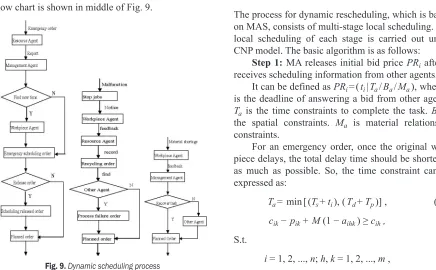
For the machine in breakdown, the agents system terminate its running operation immediately, and then issue a notice of repairment. Equipment Agent sends the current processing status to RA. RA records the current status, takes the processing task back and examines the alternative EA available. If there is an alternative EA, RA dispatches the process to continue the task. Whereas, if there are no altenatives available, the recalled task is to be bid and reschedule again. The flow chart is shown in middle of Fig. 9.
Fig. 9. Dynamic scheduling process
For other exceptions: such as the shortage of raw materials, the task can not be completed before deadline. MA is to recall the corresponding tasks in order to bring the rest rear scheduling task in production planning ahead. The unfinished task is to be scheduled until the process constraints satisfy the scheduling request. The flow chart is shown on the right of Fig. 9.
3 SCHEDULING ALGORITHMS FOR DYNAMIC RESCHEDULING MODEL
The process for dynamic rescheduling, which is based on MAS, consists of multi-stage local scheduling. The local scheduling of each stage is carried out under CNP model. The basic algorithm is as follows:
Step 1: MA releases initial bid price PRi after it
receives scheduling information from other agents. It can be defined as PRi = ( ti | Ta / Ba / Ma ), where ti
is the deadline of answering a bid from other agents. Ta is the time constraints to complete the task. Ba is
the spatial constraints. Ma is material relationship
constraints.
For an emergency order, once the original work piece delays, the total delay time should be shortened as much as possible. So, the time constraint can be expressed as:
Ta = min [ (Ts +ti ), ( Td+Tp )] , (10)
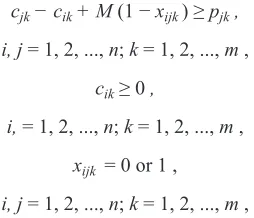
cik− pik + M (1 − aihk ) ≥ cih , S.t.
i = 1, 2, ..., n; h, k = 1, 2, ..., m ,
cjk− cik + M (1 − xijk ) ≥ pjk ,
i, j = 1, 2, ..., n; k = 1, 2, ..., m , cik ≥ 0 ,
i, = 1, 2, ..., n; k = 1, 2, ..., m , xijk = 0 or 1 ,
i, j = 1, 2, ..., n; k = 1, 2, ..., m ,
where Eq. (10) indicates time constraints. Ts is the
time that MA offers the initial bid. Td is the latest time
that all the jobs have been accomplished. Tp is the
average expectant operating time. cik is the finished
time for the work piece i processed by machine k. pik
is the machining time for workpiece i processed by machine k. aihk and xijk are coefficient and the decision
variable, respectively.
Step 2: EA answers a bid from another agent and a bid for the tender. EA evaluates whether it can first satisfy the resource constraint or not. Then, give evaluated bid price˝ PRj = ( aj | Tc , Mc ), where aj is
the wait time committed by itself. Tc is the earliest
beginning time which is produced by the EA after assessment. If the EA can not satisfy Ta and Ba, or
occupied by one process constraints, then EA gives up bidding. If Tc is being the idle status, then EA answers
the tender to RA actively and schedules in idle time to save scheduling time.
Step 3: RA assesses the bid from EA and then authorize to the EA outperformed. MA evaluates all bids returned from all the bids with min [ (Tc +Tp ), Mc].
Select the best EA to authorize, namely, considering the earliest start time, the workpiece capacity and efficiency of the EA.
Step 4: Perform the operation process. The EA which was authorized is to perform job tasks. During the process, certain failures are possible to occur. However, if the system works well, MA calculates the total process time, and then sends the information collected by it to EA. If there are certain failure occurs, EA reports the status to SA, terminates the operation, and transfers the task needed to be rescheduled to the fault repairment negotiation process.
4 SIMULATION RESULTS AND DISCUSSION
In this paper, the actual production line simulation model was used to testify the efficiency of the method which is proposed in our paper. The system is running on Intel Pentium (R) 4 CPU 2.93 GHz processor, 512 MB of memory, the operating system was Windows 2003 server, JADE version is 3.9.
In order to testify the efficiency of the rescheduling model and the scheduling algorithms, one machine shop is utilized as a test case. The workshop we selected is composed of 5 parts, 4 processes and 8 machines. The parts and machines were mapped as resource agent and workpiece agent in MAS model as Fig. 2. The UML functional structure of Resource Agent in the model is shown as Fig. 10. The model and the communication process of SA, EA, MA and Workpiece Agent (WA) were modeled as in section 2.
Fig. 10. Resource Agent
The workshop has the capacity for planing, milling, turning, drilling and other processes. In addition, there are multi-functional machines, two different specification planers, two different specifications lathes, one milling machine and one function machine in the workshop. A multi-function machine can accomplish processes for drilling, planing operations. The relationship between a process for machines is shown in Table 1 (in the table, 1 indicates that the machine can complete the process, otherwise value is 0). Process sets of the workpiece are shown in Table 2. The processing time for each process is shown in Table 3. Two cases were simulated: one case is the deadline for all parts which have no strict requirement. The other case is that all the parts ordered have tense deadline. In the experiment, for the first case, a deadline is set as the average processing cycle under FIFO scheduling rules. For the second case, the set deadline scale as 1:1.2.
The obtained results by our MAS based model and algorithm were compared with those obtained under the rules of FIFO and EDD. The performance comparison results are shown in Table 4.
the job in Table 2. The corresponding figures signify the process time in corresponding machines. The simulation results in the normal production line and emergency production line are shown in Table 4.
Fig. 11. Time delivery comparison in normal state
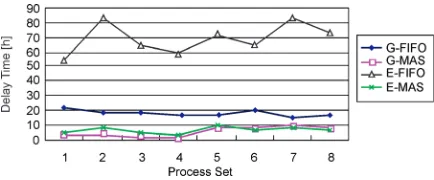
In Figs. 11 to 14, FIFO means first input first output. EDD means earliest due date. G-FIFO is FIFO in General status; G-EDD is EDD in General status; G-MAS means in General MAS status; E-FIFO means in Emergency FIFO status; E-MAS means in Emergency MAS status; G-F-FIFO means in General Failure FIFO status; G-F-MAS means in General Failure MAS status; E-F-FIFO means in Emergency and Failure FIFO status; E-F-MAS means in Emergency and Failure MAS status.
Fig. 12. Delay time comparison in normal state
As can be seen from Table 4, Figs. 11 and 12, the proposed consultation mechanism can reduce the weighted average delay in delivery of products. Moreover, it can shorten product delivery time. Hence, the model and the algorithms utilized are effective to the rescheduling problem.
For the problem of equipment failure, it is assumed that there is one machine with a daily failure of 12 h and simulation time is one month. Other test conditions are the same with previously tested cases. FIFO rules is not be used to process equipment failure, while MAS based consultation and negotiation mechanism is to reschedule the rest processes. Simulation and performance results are shown in Table 5, Figs. 13 and 14.
Fig. 13. Time delivery comparison in failure model
Under the circumstance of equipment failure, results indicate that local autonomic negotiation mechanism we utilized can alleviate the effection of equipment failure for the production line in manufacturing shops.
The case-study utilized is a real industrial problem aiming at evaluating reschedules in a large job-shop environment with MAS simulation platform. The simulation architecture presented in the previous sections constituted the stochastic evaluation environment in which absolute evaluation of static schedules was performed. The case study elaborated concerned a factory that produces mechanical products by using machining and welding resources, assembly and inspection stations and some highly specialized machines. Production is performed in a make-to-order manner where deadline is an absolute must, even regarding unpredicted orders. Since quality assurance is a key issue, tests may result in extra adjustment operations. The process for dynamic rescheduling, which is based on MAS, consists of multi-stage local scheduling. The local scheduling of each stage is carried out under the CNP model. And the Multi-agent negotiation and interaction process based on CNP is in full-duplex communication manner, which is a distinct difference between our approach and the methods in [25].
Fig. 14. Average weighted delay in failure model
Table 1. Relationship between the machine and process
Process A Machine
(Planer1) (Planer2)B (Milling)C (Lathe1)D (Lathe2)E function)F (Multi- (Lathe)G function)H
(Multi-P1 1 1 0 1 0 1 1 0
P2 0 0 1 0 0 0 0 1
P3 0 0 0 1 1 0 1 0
P4 0 0 1 0 0 1 1 0
Table 2. Equipment and process
Piece ID number 1 procedure 2 procedure 3 procedure 4 procedure j1 Plane(id:1) Milling (id:2) Diamond (id:4) Car (id:3) j2 Car (id:3) Diamond (id:4) Milling (id:2) Plane (id:1) j3 Milling (id:2) Plane (id:1) Car (id:3) Diamond (id:4) j4 Diamond (id:4) Plane (id:1) Milling (id:2) Car (id:3) j5 Milling (id:2) Diamond (id:4) Plane (id:1) Car (id:3)
Table 3. Procedure processing time
ID
Machine
Plane Milling Car Diamond
A B C C G D E F H
j1 3 4 6 10 8 2 3 5 9
j2 7 8 8 5 6 6 7 6 4
j3 2 3 3 3 5 4 5 3 3
j4 8 9 9 2 7 11 12 7 7
j5 3 5 6 5 3 5 6 8 6
Table 4. Simulation results under emergency by MAS model
Production
Line Status Scheduling rules A B CTime delivery [%]D E F G H A B Weighted average delay [h]C D E F G H
General
FIFO 49 48 51 57 50 50 50 51 21 18 18 16 16 20 15 16
EDD 46 54 55 61 65 50 52 68
MAS 85 91 94 88 90 84 93 80 3 3 1 1 8 7 9 8
Emergency FIFOMAS 100 940 0 850 890 980 890 920 940 555 847 655 593 1071 656 848 746
Table 5. Simulation results under equipment failure by MAS model
Production
Line Status Scheduling rules A B CTime delivery [%]D E F G H A B Weighted average delay [h]C D E F G H General
Failure
FIFO 55 58 51 55 54 59 50 49 41 20 15 17 19 21 19 20
MAS 96 92 92 95 90 95 99 94 6 8 3 3 7 6 4 5
Emergency
Failure FIFOMAS 990 940 880 890 980 890 920 940 358 336 246 1132 2911 168 31 1217 8
The Simulation results under equipment failure by MAS model was shown in Table 5. In Figs. 13 and 14, it is seen that the MAS method we proposed in this paper shows a high efficiency in adjusting the jobs to
5 CONCLUSION
Dynamic rescheduling method is widely used in the modern production plant. In this paper, the Contract Net Protocol, which is based on MAS, is introduced to the rescheduling of the workshop environment. It is a new way of solving the communication and negotiation problem in this field. After fully considering the effection of the equipment failure and repairment in the process of production, the complex dynamic rescheduling process is to be divided into the communication and negotiation processes of multi-agents. Therefore, the capability of autonomic decision for tackling the unexpected events, which occur in the production, is extended. By simulation in the actual production workshop, the model and algorithm, which are based on MAS, were identified as effective to the rescheduling problem in the manufacturing system.
It is worth pointing out that the test cases studied in this work are not very many. We will explore the efficiency of our model and approach on those problems with a larger number of decision variables in the future. The future work should also includes studies on the process specific interaction between agents in multi agent area and how to extend our model and algorithm based on MAS to solve constrained or discrete multiobjective optimization problems.
6 ACKNOWLEDGEMENT
This work is financially supported by the National Natural Science Foundation of China under Grant No. 61064011. And it was also supported by Scientific research funds in Gansu Universities,Science Foundation for the Excellent Youth Scholars of Lanzhou University of Technology, Educational Commission of Gansu Province of China, Natural Science Foundation of Gansu Province, and Returned Overseas Scholars Fund under Grant No. 1114ZTC139, 1014ZCX017, 1014ZTC090, 1114ZSB091, and 1014ZSB115, respectively.
7 REFERENCES
[1] Ayton, H., Lawley, M., Mckay, K. (2005). Executing production schedules in the face of uncertainties: a review and some future direction. European Journal of Operation Research, vol. 161, no. 1, p. 86-110, DOI:10.1016/j.ejor.2003.08.027.
[2] Rossi, A., Boschi, E. (2009). A hybrid heuristic to solve the parallel machines job-shop scheduling problem. International Journal of Production Research, vol. 40, no. 2, p. 118-127.
[3] Zhao, C.L., Tang, H.Y. (2010). Rescheduling problems with deteriorating jobs under disruptions. Applied Mathematical Modeling, vol. 34, no. 1, p. 238-243, DOI:10.1016/j.apm.2009.03.037.
[4] Novas, J.M., Henning, G.P. (2010). Reactive scheduling framework based on domain knowledge and constraint programming. Computers & Chemical Engineering, vol. 34, no. 12, p. 2129-2148, DOI:10.1016/j. compchemeng.2010.07.011.
[5] Gomes, M.C., Barbosa-Povoa, A.P., Novais, A.Q. (2010). A discrete time reactive scheduling model for new order insertion in job shop, make-to-order industries. International Journal of Production Research, vol. 48, no. 24, p. 7395-7422, DOI:10.1080/00207540903433858.
[6] Kuster, J., Jannach, D., Friedrich, G. (2010). Applying local rescheduling in response to schedule disruptions. Annals of Operations Research, vol. 180, no. 1, p. 265-282, DOI:10.1007/s10479-008-0488-x.
[7] Mehta, S.V., Uzsoy, R.M. (1998). Predictable scheduling of a job shop subject to breakdowns. IEEE Transactions on Robotics and Automation, vol. 14, no. 3, p. 365-378, DOI:10.1109/70.678447.
[8] Kim, Y.K., Park, K., Ko, J. (2003). A symbiotic evolutionary algorithm for the integration of process planning and job shop scheduling. Computers and Operations Research, vol. 30, no. 8, p. 1151-1171, DOI:10.1016/S0305-0548(02)00063-1.
[9] Petrovic, D., Duenas, A. (2006). A fuzzy logic based production scheduling/rescheduling in the presence of uncertain disruptions. Fuzzy Sets and Systems, vol. 157, no. 16, p. 2273-2285, DOI:10.1016/j.fss.2006.04.009. [10] Cheng, S.C., Shiau, D.F., Huang, Y.M. (2009). Dynamic
hard-real-time scheduling using genetic algorithm for multiprocessor task with resource and timing constraints. Expert System with Application, vol. 36, no. 1, p. 852-860, DOI:10.1016/j.eswa.2007.10.037. [11] Wang, H., Xiang, D., Duan, G.H. (2009). Assembly
planning based on semantic modeling appoach. Computer in Industry, vol. 58, no. 3, p. 227-239. [12] Goncalves, J.F., Mendes, J.J., Resende, M.G.
(2005). A hybrid genetic algorithm for the job shop scheduling problem. European Journal of Operational Research, vol. 167, no. 1, p. 77-95, DOI:10.1016/j. ejor.2004.03.012.
[13] Wong, T.N. Leung, C.W., Mak, K.L., Fung, R.Y.K. (2006). Dynamic shop floor scheduling in multi-agent manufacturing system. Expert System with Applications, vol. 31, no. 3, p. 486-494, DOI:10.1016/j. eswa.2005.09.073.
[14] Mes, M., van der Heijden, M., van Harten, A. (2007). Comparison of agent-based scheduling to look-ahead heuristics for real-time transportation problems. European Journal of Operational Research, vol. 181, p. 59-75, DOI:10.1016/j.ejor.2006.02.051.
man, and cybernetics-part C: Applications and
reviews, vol. 36, no. 4.
[16] Boccalatte, A., Gozzi, A., Paolucci, M., Queirolo, V., Tamoglia, M. (2004). A multi-agent system for dynamic just-in-time manufacturing production scheduling. Systems, Man and Cybernetics, IEEE International Conference, vol. 6, p. 5548-5553.
[17] Kemppainen, K. (2007). Priority scheduling
revisited-dominant rules, open protocols, and integrated order management. Katariina kemppainen and Helsinki school of Economics. A-264, p. 18-28.
[18] Pfeiffer, A., Kadar, B., Monostori, L. (2007). Stability-oriented evaluation of rescheduling strategies, by using simulation. Computers in Industry, vol. 58, p. 630-643, DOI:10.1016/j.compind.2007.05.009.
[19] Cauvin, A.C.A., Ferrarini, A.F.A., Tranvouez, E.T.E. (2009). Disruption management in distributed enterprises: A multi-agent modelling and simulation of cooperative recovery behaviours. International Journal Production Economics, vol. 122, p. 429-439, DOI:10.1016/j.ijpe.2009.06.014.
[20] Kacem, I., Hammadi, S., Borne, P. (2002). Pareto-optimality approach for flexible job-shop scheduling problems: Hybridization of evolutionary algorithms and fuzzy logic. Mathematics and Computer in
Simulation, vol. 60, no. 3-5, p. 245-276, DOI:10.1016/ S0378-4754(02)00019-8.
[21] Vrba, P. (2003). MAST: Manufacturing Agent Simulation Tool. Proceedings of IEEE Conference on Emerging Technologies and Factory Automation, vol. 1, p. 282-287.
[22] Merdan, M. Moser, T., Wahyudin, D., Biffl, S., Vrba, P. (2008). Simulation of workflow scheduling strategies using the MAST test management system. Control, Automation, Robotics and Vision, ICARCV 10th
International Conference, vol. 17-20, p. 1172-1177. [23] Jiaa, H.Z., Fuh, J.Y.H., Neea, A.Y.C., Zhang, Y.F.
(2007). Integration of genetic algorithm and Gantt chart for job shop scheduling in distributed manufacturing systems. Computer and Industrial Engineering, vol. 53, no. 2, p. 313-320, DOI:10.1016/j.cie.2007.06.024. [24] Lim, M.K., Zhang, Z. (2003). A multi-agent based
manufacturing control strategy for responsive manufacturing. Journal of Materials Processing Technology, vol. 139, no. 1-3, p. 379-38, DOI:10.1016/ S0924-0136(03)00535-1.