Summary
Objective
The links between parenting and mental health are a major topic of research in psychiatry. Research on the correlates of dysfunc-tional or inadequate parenting relies on the availability of valid and reliable measures of parental style. Our main aim was to de-velop and validate the Italian version of the Measure Of Parental Style (MOPS). A secondary aim was to test the reliability of an Italian version of the Parental Bonding Instrument (PBI) that was specifically designed for this study.
Methods
An Italian version of the MOPS and PBI was produced using multiple independent bilingual translators. The questionnaires were administered to a non-clinical sample of adults (N = 154). A sub-sample (N = 73) completed the instruments again one month later.
Results
As expected, MOPS maternal and paternal Indifference were moderately to highly negatively correlated with PBI maternal and paternal Care, respectively. Also, MOPS Overcontrol was mod-erately to highly correlated with PBI maternal and paternal Over-protection, respectively. Moreover, MOPS maternal and paternal Abuse displayed a moderate negative correlation with PBI mater-nal and patermater-nal Care, and a small though significant correlation with PBI maternal and paternal Overprotection. Furthermore, the MOPS and the PBI subscales were found to be reliable in terms of internal consistency and absolute as well as relative stability.
Conclusions
Given their satisfactory psychometric properties, the MOPS and PBI hold promise for clinicians and researchers interested in the links between quality of parenting and mental health.
Key words
Attachment • Parenting • Validity • Reliability
Validity and reliability of the Italian version of the Measure Of Parental Style
(MOPS)
Validità e affidabilità della versione italiana della Measure Of Parental Style (MOPS)
A. Picardi1, L. Tarsitani2, A. Toni3, A. Maraone2, V. Roselli2, E. Fabi2, F. De Michele2, I. Gaviano2, M. Biondi2
1 Italian National Institute of Health, Center of Epidemiology, Surveillance and Health Promotion, Mental Health Unit; 2 Department of Neurology
and Psychiatry, Policlinico Umberto I, Sapienza University of Rome; 3 Department of Social Sciences, Sapienza University of Rome
Correspondence
Angelo Picardi, Italian National Institute of Health, Centre of Epidemiology, Surveillance and Health Promotion, Mental Health Unit, viale Regina Elena 299, 00161 Rome, Italy • Tel. +39 06 49904200 • Fax +39 06 49904182 • E-mail: [email protected]
Introduction
Parenting and its relationships with mental health, per-sonality, and emotion regulation is a major topic of re-search in several disciplines, including psychiatry and clinical and developmental psychology. For instance, sev-eral cross-sectional studies have suggested that relation-ships during childhood are associated with mental health outcomes in later life including depression, anxiety and self-harm 1-3. Longitudinal studies also provided evidence
that rejecting attitudes, emotional unavailability, parent– child discord and affectionless control increase the risk of depression, anxiety and suicidality 4. Additionally,
at-tachment research has focused on the effects of parent-ing on children’s development over time, as attachment is postulated to be a function of the nature and quality of the interactions between parents and children. Research has been particularly concerned with the implications
for attachment security of the emotional availability and accessibility of parents to their children 5 6, and with the
links between children’s social competence and the qual-ity of parent-child relationships 7. Furthermore, research
on alexithymia has highlighted an association between alexithymia and dysfunctional parenting. Some studies suggested that alexithymia is negatively associated with the degree to which positive feelings are expressed in the family of origin 8 9, while other studies reported an
asso-ciation between mothers’ perceived low care and alexi-thymia in adulthood 10.
protection scores, are related to a variety of psychiatric disorders in adulthood 14 15.
Two decades later, a modified version of the PBI, named Measure Of Parental Style (MOPS), which includes a scale assessing parental abuse, was introduced 16. While
the PBI has been used in many studies, there has been rel-atively less research experience with the MOPS, although it can be regarded as a refined form of the PBI. Addition-ally, whereas several Italian translations of the PBI are available, including validated ones 17, to our knowledge
there is no validated Italian version of the MOPS.
This paper describes the development and validation of the Italian version of the MOPS and also reports reliability data for an Italian version of the PBI specifically designed for this study. We assessed the MOPS criterion-related validity against the PBI, and evaluated the reliability of the two instruments in terms of both internal consistency and absolute and relative stability.
Methods
Participants
The study sample was recruited among friends and rela-tives of a group of students and graduate students attend-ing the Department of Neurology and Psychiatry, Poli-clinico Umberto I, Sapienza University of Rome, Italy. All participants gave their written informed consent to take part in the study and met the following criteria: 1) age 18-only in longitudinal studies, whereas cross-sectional
studies have to rely on retrospective measures of parent-ing, such as detailed interviews or self-report question-naires. Although interview measures are usually more reliable than self-report questionnaires, they are time consuming and require administration and scoring by trained investigators. As a consequence they are quite expensive and less often feasible with large samples in comparison to self-reports.
A self-report measure that has gained wide acceptance over the last two decades is the Parental Bonding Instru-ment (PBI), which was introduced in the late 1970s by Parker, Tupling and Brown 11 as a measure of perceived
parental rearing characteristics that contribute to the quality of the parent-child bond. The instrument probes adult recollections of parental behaviours and attitudes during the subject’s childhood, and it yields scores on two dimensions, named “care” and “overprotection”. Optimal parenting is considered to result from the com-bination of high care and low overprotection. Several studies have assessed the psychometric properties of this instrument and suggested satisfactory reliability and va-lidity 12. For instance, in a recent study the maternal care
scale of the PBI was found to compare reasonably well as an index of overall neglect in childhood to that pro-vided by a detailed standardized interview, the Child-hood Experiences of Care and Abuse (CECA) 13. In
ad-dition, numerous studies have shown that dysfunctional interactive patterns, defined by low care and high
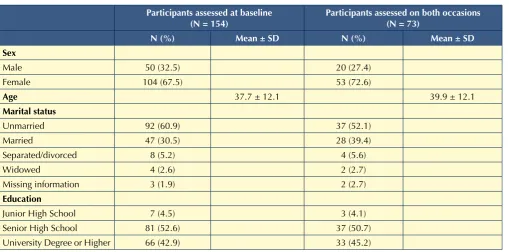
over-Table I.
Characteristics of participants. Caratteristiche dei partecipanti.
Participants assessed at baseline
(N = 154) Participants assessed on both occasions (N = 73)
N (%) Mean ± SD N (%) Mean ± SD
Sex
Male 50 (32.5) 20 (27.4)
Female 104 (67.5) 53 (72.6)
age 37.7 ± 12.1 39.9 ± 12.1
Marital status
Unmarried 92 (60.9) 37 (52.1)
Married 47 (30.5) 28 (39.4)
Separated/divorced 8 (5.2) 4 (5.6)
Widowed 4 (2.6) 2 (2.7)
Missing information 3 (1.9) 2 (2.7)
education
Junior High School 7 (4.5) 3 (4.1)
Senior High School 81 (52.6) 37 (50.7)
Table II. MOPS and PBI scores by sociodemographic variables.
Punteggi MOPS e PBI in relazione alle variabili demografiche
. MOPS Pb I M ot he r’ s In di ff er en ce M ot he r’ s a bu se M ot he r’ s O ve rc on tr ol Fa th er ’s In di ff er en ce Fa th er ’s a bu se Fa th er ’s O ve rc on tr ol M ot he r’ s C ar e M ot he r’ s O ve rp ro te ct io n Fa th er ’s C ar e Fa th er ’s O ve rp ro te ct io n Se x Fe m al e 1. 3 ± 3 .0 1. 2 ± 2 .2 4. 3 ± 3 .2 1. 6 ± 2 .5 1. 1 ± 1 .9 2. 7 ± 2 .3 25 .7 ± 7 .8 16 .4 ± 8 .2 23 .8 ± 7 .4 15 .4 ± 7 .9 M al e 1. 3 ± 2 .2 1. 1 ± 1 .9 3. 9 ± 2 .4 2. 5 ± 3 .5 1. 4 ± 2 .9 2. 7 ± 2 .1 26 .2 ± 6 .7 13 .7 ± 5 .9 * 23 .0 ± 8 .2 11 .6 ± 6 .8 ** a ge 18 -3 9 0. 7 ± 1 .4 0. 7 ± 1 .2 3. 4 ± 2 .6 1. 5 ± 2 .3 0. 9 ± 1 .8 2. 2 ± 1 .9 28 .1 ± 5 .5 14 .0 ± 6 .6 24 .8 ± 6 .9 11 .8 ± 6 .9 40 -6 5 2. 2 ± 4 .0 ** * 1. 9 ± 2 .9 ** * 5. 3 ± 3 .2 ** * 2. 4 ± 3 .6 1. 7 ± 2 .8 * 3. 5 ± 2 .4 ** * 22 .4 8 .7 ** * 17 .7 ± 8 .5 ** 21 .3 ± 6 .3 ** 17 .9 ± 7 .8 ** * M ar ita l s ta tu s U nm ar rie d 1. 1 ± 2 .6 0. 9 ± 1 .8 3. 6 ± 2 .7 1. 9 ± 2 .8 1. 1 ± 2 .2 2. 3 ± 2 .0 26 .8 ± 6 .9 14 .2 ± 7 .2 23 .9 ± 7 .2 12 .6 ± 7 .4 M ar rie d 1. 6 ± 3 .2 1. 3 ± 2 .2 4. 8 ± 2 .9 1. 5 ± 2 .5 1. 3 ± 2 .2 3. 4 ± 2 .2 25 .4 ± 7 .6 15 .9 ± 6 .9 23 .4 ± 8 .7 16 .4 ± 7 .3 Se pa ra te d/ di vo rc ed / w id ow ed 1. 2 ± 2 .3 2. 5 ± 3 .5 6. 6 ± 3 .8 ** * 2. 6 ± 4 .2 1. 6 ± 3 .0 3. 9 ± 2 .9 ** 20 .2 ± 9 .1 ** 25 .1 ± 7 .1 ** * 20 .3 ± 6 .9 20 .1 ± 7 .7 ** ed uc at io n Ju ni or o r S en io r H ig h Sc ho ol 1. 4 ± 3 .2 1. 4 ± 2 .4 4. 1 ± 2 .8 1. 8 ± 2 .9 1. 2 ± 2 .1 2. 9 ± 2 .3 25 .3 ± 7 .8 15 .9 ± 7 .7 23 .1 ± 7 .7 15 .3 ± 8 .0 U ni ve rs ity D eg re e or H ig he r 1. 3 ± 2 .2 1. 0 ± 1 .7 4. 3 ± 3 .2 1. 9 ± 3 .0 1. 2 ± 2 .5 2. 5 ± 2 .0 26 .7 ± 6 .8 15 .1 ± 7 .6 24 .2 ± 7 .6 12 .7 ± 7 .2 *
* p < 0.05; ** p < 0.01; *** p < 0.001.
65 years; 2) absence of severe medi-cal or psychiatric illness; 3) absence of cognitive impairment.
A total of 154 participants were en-rolled in the study and completed the MOPS and the PBI. Of these, 73 completed the instruments for a sec-ond time after about 4 weeks. They did not significantly differ on any sociodemographic variable from the 81 participants who completed the questionnaires only at baseline. The sociodemographic characteris-tics of participants are summarized in Table I.
Assessment
The PBI is a self-completed question-naire consisting of 25 items, scored on a 4-point Likert scale indicating the degree of agreement with the item statement. Twelve items refer to empathy and care (“Care”) and 13 to excessive control and protection (“Overprotection”) that subjects re-call to have received from either their mother (maternal form) or father (pa-ternal form) during their first 16 years of life. Therefore, the Care scale mea-sures the degree to which the parent was empathic and caring or cold and indifferent, while the Overprotection scale measures the extent to which the parent was intrusive and infan-tilizing or, in contrast, fostered inde-pendence in the subject.
To obtain a valid Italian version of the instrument, we followed commonly accepted steps in the cross-cultural adaptation of psychosocial measures 18. We concentrated
our efforts on producing a good translation and abstained from performing iterative back-translation as several au-thors 19 have argued persuasively against back-translation
for both theoretical and practical reasons, characterizing it as a sub-optimal procedure for checking translations which merely achieves linguistic and conceptual equiva-lence without paying attention to clarity and understand-ability, and without taking due account of context and milieu 20. An initial translation was produced by the first
author and then reviewed independently by two other translators, both fluent in English, who then proposed their own version. Next, each translator independently reviewed the other two versions and provided comments and suggestions. Each translator included those sugges-tions deemed to be relevant in a second version. This process was repeated one more time, until consensus was reached. The clarity and the acceptability of the re-sulting version were tested in a pilot administration until a final Italian version of the MOPS was produced. The Italian version of the PBI used in this study was produced following the same steps.
Statistical analysis
All analyses were performed with SPSS for Windows, ver-sion 17.0. All statistical tests were two-tailed, with alpha set at 0.05.
A descriptive analysis was used to study the frequency distribution of all variables of interest. Differences in MOPS scores between sociodemographic subgroups were tested with analysis of variance. Then, we deter-mined the reliability of the MOPS and the PBI in terms of internal consistency, absolute stability (i.e., the extent to which the scores remain the same across time or situ-ations), and relative stability (i.e., the degree to which the relative differences in scores among individuals
re-main the same over time). The internal consistency of the MOPS and PBI scales was expressed by means of coef-ficient alpha. To assess absolute stability, the magnitude of the differences between scores on the MOPS and PBI at baseline and follow-up was determined by calculat-ing Cohen’s d effect size for within-subjects comparisons, taking into account the dependence between means. To examine the relative stability of MOPS and PBI scores, the intraclass correlation coefficient (ICC) between the scores on the first administration and those on the second administration was computed.
Results
MOPS and PBI scores by sociodemographic variables are summarized in Table II. Mean MOPS subscale scores did not differ by gender and education, while they were higher, except for Father’s Indifference, in the age group of 40-64 as compared with the younger age group. A couple of subscale scores were also higher in separated/ divorced/widowed participants; this finding, too, is like-ly to ascribe to the influence of age. A similar profile of findings was observed for PBI subscales. Additionally, PBI Overprotection was found to be higher in females (from both the mother and father) and in participants with lower education (only from the father).
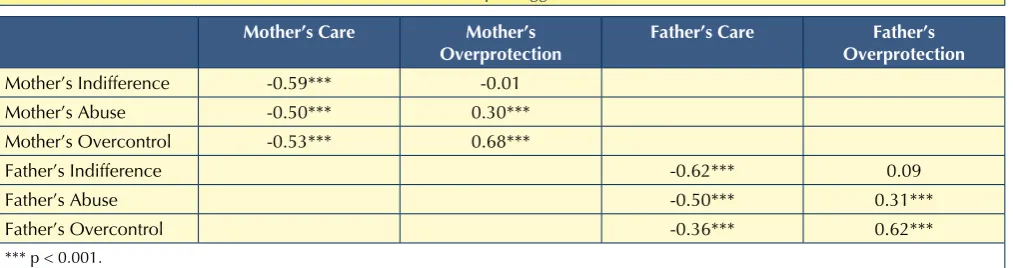
Table III summarizes the correlations between MOPS and PBI subscale scores. As expected, MOPS maternal and paternal Indifference were moderately to highly nega-tively correlated with PBI maternal and paternal Care, respectively (p < 0.001). Moreover, MOPS Overcontrol was moderately to highly correlated with PBI maternal and paternal Overprotection, respectively (p < 0.001). Moreover, MOPS maternal and paternal Abuse displayed a moderate negative correlation with PBI maternal and paternal Care, and a small though significant correlation with PBI maternal and paternal Overprotection.
Both the MOPS and the PBI subscales were found to
Table III.
Correlations between MOPS and PBI scores. Correlazioni tra i punteggi MOPS e PBI.
Mother’s Care Mother’s
Overprotection
Father’s Care Father’s Overprotection
Mother’s Indifference -0.59*** -0.01
Mother’s Abuse -0.50*** 0.30***
Mother’s Overcontrol -0.53*** 0.68***
Father’s Indifference -0.62*** 0.09
Father’s Abuse -0.50*** 0.31***
Father’s Overcontrol -0.36*** 0.62***
Table IV. Reliability of MOPS and PBI subscales.
Affidabilità delle sottoscale MOPS e PBI
.
MOPS
Pb
I
Mother’s
Indifference
Mother’s a
buse
Mother’s
Overcontrol
Father’s
Indifference
Father’s abuse
Father’s
Overcontrol
Mother’s Care
Mother’s
Overprotection
Father’s Care
Father’s
Overprotection
Internal consistency (N = 154)
C
oe
ffi
ci
en
t
Alpha
0.87
0.73
0.76
0.83
0.78
0.59
0.75
0.84
0.83
0.88
Relative stability (N = 73) ICC (95% CI)
0.95***
(0.91 – 0.97)
0.95*** (0.92 – 0.97)
0.90***
(0.85 – 0.94)
0.93***
(0.88
–
0.95)
0.92***
(0.87 – 0.95)
0.87***
(0.80 – 0.92)
0.90***
(0.84 – 0.94)
0.88***
(0.82 – 0.92)
0.93***
(0.84 – 0.96)
0.90***
(0.85 – 0.94)
Absolute stability (N = 73) Mean (SD) score at baseline
1.5 (2.9)
1.2 (2.2)
4.0 (2.9)
2.2 (3.4)
1.5 (2.7)
2.9 (2.5)
25.0 (7.5)
15.9 (8.0)
23.3 (8.5)
15.0 (8.6)
Mean (SD) score at follow-up
1.2 (2.6)
1.1 (2.1)
3.7 (2.8)
2.0 (3.4)
1.3 (2.6)
2.9 (2.6)
25.8 (7.9)
16.2 (8.7)
23.2 (8.8)
14.5 (8.9)
Cohen’s d
0.34
0.15
0.25
0.16
0.19
0.01
0.23
0.08
0.03
0.13
CI = Confidence Intervals; *** p < .001.
be reliable in terms of internal consistency and stability (Tab. IV). The ICC between scores on the first and sec-ond administration was very high for all MOPS and PBI subscales, which attests to a high level of relative stabil-ity. In addition, the changes in MOPS and PBI subscale scores over time were slight, with effect sizes ranging from trivial to small, which indicates a good level of ab-solute stability.
Discussion
This study supports the validity and the reliability of the Italian version of the MOPS and also provided evidence of the absolute and relative stability of the Italian version of the PBI used in this study.
The moderate to high correlations observed between the MOPS “Overcontrol” and “Indifference” subscales and the PBI “Overprotection” and “Care” subscales, respec-tively, corroborate the criterion-related validity of the MOPS, that was designed as a refined version of the PBI that also includes a subscale covering parental abuse. Furthermore, the study findings support the reliability of the MOPS and the PBI. Firstly, all subscales displayed good temporal stability, as only small changes in scores were observed over a 4-week period. The relative stabil-ity of subscales was also satisfactory, as the correlation between scores on the first and second administration was very high for all MOPS and PBI subscales. Moreover, the internal consistency of all MOPS and PBI subscales met the recommended standard (alpha ≥ 0.70) 21 for all
subscales, except for MOPS Paternal Overcontrol. Some limitations of this study should be acknowledged. First, to increase the study feasibility, only a subsample of participants were involved in the follow-up assessment. Nevertheless, the statistical power of the longitudinal analyses was adequate. Also, the participants were re-cruited in the community and had average to high edu-cation. Therefore, caution should be applied in general-izing our results to clinical populations and individuals with lower education.
The quality of relationships in the home is related to emotional and social development in childhood 22. The
such as further elucidation of risk and protective factors for child abuse and neglect at the individual, family, and social domains 23, and further inquiry into the association
between abusive parenting and a wide range of negative outcomes in adulthood 24-27, including low educational
attainment, being a victim of interpersonal violence, health-compromising behaviours, and a number of phys-ical and mental health problems.
References
1 Parker G, Hadzi-Pavlovic, Greenwald S, et al. Low parental care as a risk factor to lifetime depression in a community sample. J Affect Disord 1995;33:173-80.
2 Rodgers B. Reported parental behaviour and adult affective
symptoms. 1. Associations and moderating factors. Psychol Med 1996;26:51-61.
3 Hill J, Pickles A, Burnside E, et al. Child sexual abuse, poor parental care and adult depression: evidence for different mechanisms. Br J Psychiatry 2001;179:104-9.
4 Weich S, Patterson J, Shaw R, et al. Family relationships in childhood and common psychiatric disorders in later life: systematic review of prospective studies. Br J Psychiatry 2009;194:392-8.
5 Bowlby J. Attachment and loss. Vol. 1: Attachment. New York: Basic Books 1969.
6 De Wolff MS, van Ijzendoorn MH. Sensitivity and attach-ment: a meta-analysis on parental antecedents of infant at-tachment. Child Dev 1997;68:571-91.
7 Attili G, Vermigli P, Roazzi A. Children’s social competence, peer status and the quality of father-child and mother-child relationships, a multidimensional scaling approach. Eur Psy-chol 2010;15:23-33.
8 Kench S, Irwin HJ. Alexithymia and childhood family
envi-ronment. J Clin Psychol 2000;56:737-45.
9 Yelsma P, Hovestadt AJ, Anderson WT, et al.
Family-of-origin expressiveness: measurement, meaning, and relation-ship to alexithymia. J Marital Fam Ther 2000;26:353-63. 10 Fukunishi I, Kawamura N, Ishikawa T, et al. Mothers’ low
care in the development of alexithymia: a preliminary study in Japanese college students. Psychol Rep 1997;80:143-6. 11 Parker G, Tupling H, Brown LB. A Parental Bonding
Instru-ment. Br J Med Psychol 1979;52:1-10.
12 Parker G. The Parental Bonding Instrument: psychometric properties reviewed. Psychiatr Dev 1989;7:317-35.
13 Lancaster G, Rollinson L, Hill J. The measurement of a ma-jor childhood risk for depression: comparison of the Parental Bonding Instrument (PBI) ‘Parental Care’ and the Childhood Experience of Care and Abuse (CECA) ‘Parental Neglect’. J Affect Dis 2007;101:263-7.
14 Faravelli C, Panichi C, Pallanti S, et al. Perception of early parenting in panic and agoraphobia. Acta Psychiat Scand 1991;84:6-8.
15 Parker G, Hazdi-Pavlovic D, Greenwald S, et al. Low paren-tal care as a risk factor to lifetime depression in a community sample. J Affect Dis 1995;33:173-80.
16 Parker G, Roussos J, Hadzi-Pavlovic K, et al. The develop-ment of a refined measure of dysfunctional parenting and assessment of its relevance in patients with affective disor-ders. Psychol Med 1997;27:1193-203.
17 Scinto A, Mariangeli MG, Kalyvoka A, et al. Studio di val-idazione della versione Italiana del Parental Bonding Instru-ment (PBI). Epidemiol Psichiatria Soc 1999;8:276-83. 18 Guillemin F, Bombardier C, Beaton D. Cross-cultural
adaptation of health-related quality of life measures: lit-erature review and proposed guidelines. J Clin Epidemiol 1993;46:1417-32.
19 Harkness J. In pursuit of quality: issues for cross-national sur-vey research. Int J Soc Res Meth 1999;2:125-140.
20 Bulmer M. The problem of exporting social survey research. Am Behav Sci 1998;42;153-67.
21 Nunnally JC. Psychometric theory. New York: McGraw-Hill 1978.
22 Rutter M. How the environment affects mental health. Br J Psychiatry 2005;186:4-6.
23 Cicchetti D, Lynch M. Toward an ecological/transactional model of community violence and child maltreatment: Consequences for children’s development. Psychiatry 1993;56:96-118.
24 Gilbert R, Spatz-Widom C, Browne K, et al. Burden and consequences of child maltreatment in high-income coun-tries. Lancet 2009;373:68-81.
25 Tyler KA. Social and emotional outcomes of childhood sex-ual abuse: a review of the literature. Aggress Violent Behav 2002;7:567-89.
26 Felitti VJ, Anda RF, Nordenberg D, et al. The relationship of adult health status to childhood abuse and household dys-function. Am J Prev Med 1998;14:245-58.