in the population sciences published by the Max Planck Institute for Demographic Research Konrad-Zuse Str. 1, D-18057 Rostock · GERMANY www.demographic-research.org
DEMOGRAPHIC RESEARCH
VOLUME 24, ARTICLE 13, PAGES 293-312
PUBLISHED 15 FEBRUARY 2011
http://www.demographic-research.org/Volumes/Vol24/13/ DOI: 10.4054/DemRes.2011.24.13
Descriptive Findings
A note on race, ethnicity and nativity
differentials in remarriage in the
United States
Catherine B. McNamee
R. Kelly Raley
© 2011 Catherine B. McNamee & R. Kelly Raley.
This open-access work is published under the terms of the Creative Commons Attribution NonCommercial License 2.0 Germany, which permits use, reproduction & distribution in any medium for non-commercial purposes, provided the original author(s) and source are given credit.
1 Introduction 294
2 Background 295
2.1 R-E-N differentials in marriage and divorce 295
2.2 What do we know about remarriage patterns? 296
2.3 Did cohabitation render remarriage irrelevant? 297
3 Data and methods 298
4 Results 300
5 Discussion and conclusion 307
6 Acknowledgement 308
A note on race, ethnicity and nativity differentials in remarriage
in the United States
Catherine B. McNamee1
R. Kelly Raley2
Abstract
The objectives of this study are to produce up-to-date estimates of race/ethnic/nativity differentials for remarriage and repartnership among women in the United States and to see if these differences are due to across-group differences in demographic characteristics. First, we produce lifetable estimates of remarriage and repartnering for white, black, U.S. born Latina and foreign born Latina women. Next, we estimate race/ethnic/nativity differentials for remarriage and repartnership using event-history analysis with and without controls for demographic characteristics. The results suggest a continued overall decline in remarriage rates, while many women repartner by cohabitating. Whites are more likely than blacks or Latinas to remarry and they are also more likely to repartner. Race/ethnic/nativity differentials remain even after accounting for variations in demographic characteristics. This suggests that race/ethnic/nativity differentials in remarriage and repartnering rates, rather than ameliorating disadvantages associated with divorce, reinforce these differentials.
1. Introduction
Remarriage is important for evaluating theories of social change in the family and it also has practical importance for the lives of parents and children. Ongoingresearch has documented the continued retreat from marriage in the United States as well as in much of Europe and Asia. Most of this research has focused on the timing of first marriage; however, research on remarriage has also provided some insights, especially in the United States where rates of divorce remain high. For example, when high rates of divorce are accompanied by high rates of remarriage, it suggests that people are not rejecting marriage as an institution, but are simply dissatisfied with their particular marriage (Spanier and Glick 1980; Thornton 1977).
Additionally, remarriage can be an important life event for adults and their children. Divorce is associated with substantial declines in economic well being, especially for women and their children (Holden and Smock 1991; Smock, Manning, and Gupta 1999). Remarriage, however, can provide an additional income earner in the household and is the “surest path to economic recovery” after a divorce (Smock, Manning, and Gupta 1999: 807). Remarriage is associated with increases in income-to-needs ratios and household income, as well as decreases in poverty and welfare use (Smock, Manning, and Gupta 1999; Morrison and Ritualo 2000). Although remarriage can increase economic well-being especially if the marriage lasts, it can also contribute to family instability, which is associated with poorer child outcomes.
Many women repartner through cohabitation and this might also have implications for their well-being as well as their children’s. For example, previous research has found that, unlike remarriage, repartnering through cohabitation does not bring substantial economic benefits (Morrison and Ritualo 2000). Furthermore, given the instability of nonmarital unions, cohabitation may contribute even more to family instability than remarriage (Raley and Wildsmith 2004). Families still are the primary location for childrearing and as such the core location for social investments in children (e.g., managing children’s educational experiences, providing access to health care). Consequently differentials in family experiences can ameliorate or reinforce the intergenerational transmission of inopportunity.
account for variability in the pace of remarriage. To achieve this, we combine data from the 2006-2008 National Study of Family Growth (NSFG) and the 2004 Survey of Income Program Participation (SIPP) to produce lifetable estimates of remarriage and repartnering for U.S. born non Hispanic white, U.S. born non Hispanic black, U.S. born Latina and foreign born Latina women. We use event-history analysis to explore the extent to which R-E-N differentials in remarriage and repartnering arise from differences in other demographic characteristics such as age and the presence of children.
2. Background
2.1 R-E-N differentials in marriage and divorce
Compared to whites, blacks experience a later age at a first marriage as well as higher rates of divorce (Udry 1966; South and Spitze 1986; Ruggles 1997; Raley and Bumpass 2003; Goldstein and Kenney 2001). Moreover, the black-white differential in divorce may have been increasing over time (Sweeney and Phillips 2004, although see Teachman 2002 for contrary evidence). Generally, the family patterns of Latinos fall somewhere between those of whites and blacks, but whether they more closely resemble those of blacks or whites depends on immigrant generation and whether one focuses on marriage or divorce. Latino marriage patterns more closely resemble those of whites whereas patterns of divorce fall closer to the experience of blacks. Moreover, Latinos born in the United States are more similar in marriage and divorce patterns to blacks than are foreign born Latinos. Specifically foreign born Mexican Americans marry younger than whites, but U.S. born Mexicans marry later than whites once one accounts for Mexicans’ early age at school leaving (Raley, Durden, and Wildsmith 2004). Likewise the foreign born Latino population has lower rates of divorce than whites, but U.S. born Latinos have higher rates of divorce. In fact among third and later generation Latinos, rate of divorce are similar to rates for African Americans (Bean, Berg, and Van Hook 1996).
1992; Raley and Bumpass 2003). Thus controlling for this factor actually widens the black-white gap in the risk of marital disruption.
2.2 What we know about remarriage patterns?
Considering the group variations in the patterns of marriage and divorce, it is surprising that few studies have investigated the association between race/ethnicity (as well as other sociodemographic factors) and remarriage. Notable exceptions are Bumpass, Sweet and Castro Martin (1990), and Smock (1990). These studies indicate that in the 1980s, non Hispanic whites had the highest remarriage probabilities, followed by Latinos. Non Hispanic blacks have lower remarriage rates than both non Hispanic whites and Latinos (Bumpass, Sweet, and Castro Martin 1990). However patterns of variation in remarriage have not been re-examined in recent years despite the fact that trends and differentials in marriage and divorce have likely altered the sociodemographic characteristics of women “at risk” of remarriage. Further, we do not know how remarriage rates differ among U.S. born and foreign born Latina women. As mentioned above, previous research indicates that patterns of marriage and divorce among Latinas differ substantially by nativity, with the foreign born having an earlier age at first marriage and lower rates of divorce, partly because of the selective nature of the migration process and perhaps also partly because of cultural differences between those born in Mexico and those who grew up in the United States (Raley, Durden, and Wildsmith 2004; Phillips and Sweeney 2005). Research on remarriage has been scarce in recent decades, which parallels the time period when nativity differences for Latinos started appearing in demographic research. As a result, our study adds a unique piece to the remarriage literature by providing information on remarriage probabilities for Latinas by nativity.
Presence of children is also associated with a lower rate of remarriage (Koo, Suchindran, and Griffith 1984; Teachman and Heckert 1985; Bumpass, Sweet, and Castro Martin 1990; Smock 1990). The negative association between number of children and remarriage has been found to be greater for black women than white women, especially at higher parities (Koo, Suchindran, and Griffith 1984; Smock 1990).
Early research on remarriage indicated that education was negatively associated with the chance of remarriage, at least among whites. At that time researchers hypothesized that this might arise because more highly educated women had more resources to support themselves (Koo, Suchindran, and Griffith 1984; Thornton 1977). Yet, an analysis of remarriage using data from the 1987-88 NSFG indicated that education was not (any longer) associated with remarriage for white women and was positively associated with remarriage for black women (Smock 1990). Sweeney’s (2002) analysis of an even more recent period shows a positive association between women’s education and the pace of remarriage, but no association between educational attainment and the timing of repartnering. Altogether these results suggest that the association between educational attainment and remarriage has become more positive over time.
2.3 Did cohabitation render remarriage irrelevant?
blacks, whereas cohabitation occurs frequently across all race-ethnicities. Yet importantly these estimates largely reflect experiences prior to first marriage and we know very little about variation in cohabitation following the dissolution of first marriage. Consequently, a study of R-E-N differentials in remarriage would not be complete without a companion analysis of repartnering. Unfortunately, the SIPP does not include information on the timing of transitions into cohabiting unions. Consequently our analysis of repartnering uses only the recently released 2006-2008 NSFG, which does have information on the formation of cohabiting unions following separation or divorce.
3. Data and methods
In this study, we combine data from the 2006-2008 National Survey of Family Growth (NSFG) and the 2004 Survey of Income and Program Participation (SIPP). The SIPP is a nationally representative continuing panel survey conducted by U.S. Census Bureau. The sample consists of 62,000 households in the U.S. interviewed every four months in eight waves starting in February 2004. Our analysis employs data from topical modules on marital and fertility histories conducted during wave two of the 2004 SIPP. The Cycle 7 NSFG is a nationally representative continuous cross-sectional survey conducted by the National Center for Health Statistics for the U.S. Department of Health and Human Services. The sample design included men and women in the U.S. between the ages of 15 to 44. We are using data collected from women in 2006-2008, totaling 7,356 female respondents.
Our analysis focuses on women, because we found in preliminary analysis that, because the NSFG sample of men is smaller than that of women, there were not enough men to produce lifetable estimates of remarriage by R-E-N even with the NSFG and SIPP combined. Moreover, the cohabitation histories were collected differently for men than for women, with interviews of men focusing only on previous spouses and the three most recent sexual partners. Prior research also suggests women tend to more accurately report dates of separation and remarriage than men (Martin 2006). Furthermore focusing on women better enables us to compare our findings to past research, which also typically describes patterns of remarriage using samples of women.
repartnership avoids some of the sample size concerns associated with the remarriage analysis. Additionally, because the NSFG sample is restricted to women less than age 45 in 2006-2008, we limit both NSFG and SIPP to women who separated before age 36 since 1996. (Women age 44 at the start of the NSFG interview period were up to age 35 in 1996. Consequently we can not use these data to describe remarriage patterns of women who separate after age 35). We exclude first separations prior to 1996 to provide a recent account of demographic patterns and to prevent having to make a more severe age restriction. In total, our analyses employ data on 1,599 women who separated from or divorced their first husband (600 from NSFG and 999 from SIPP.) We censor marital events post 2002 in the SIPP and twelve months prior to the interview date in the NSFG data, because we want to exclude women with separations that occur less than one year prior to the survey as they may reconcile with their partners (Binstock and Thornton 2003). Lengths of separations can vary with some couples never formally divorcing; for example, prior research suggests long-term separations are more common among black couples (McCarthy 1978; Morgan 1988). Thus we define the dissolution of marriage at the separation date, rather than the date of formal divorce. We focus our analysis on marriages and cohabitations that occur after the separation from the first marriage.
We construct a variable indicating race-ethnicity-nativity (R-E-N) by combining information from separate questions on race, Hispanic/Latino origin, and place of birth. Respondents are coded as black and white if they were coded as such on the recoded race variable and not coded Hispanic on a separate ethnicity variable. Anyone identified as Hispanic is coded either as U.S. born Latino or foreign born Latino, depending on their response to a question about whether they were born in the United States. This constructed variable has four categories, non Hispanic white (white), non Hispanic black (black), U.S. born Latino, and foreign born Latino. We exclude foreign born white women, foreign born black women, Asian non Hispanic women and other race non Hispanic women because of small sample sizes. In the combined SIPP and NSFG remarriage analysis there are 1,095 white women, 209 black women, 163 U.S. born Latina women, and 132 foreign born Latina women. For the NSFG repartnering analysis there are 352whitewomen, 94 blackwomen, 78 U.S. born Latina women, and 76 foreign born Latina women. For brevity, we switch to using “white women” and “black women” to refer to U.S. born non Hispanic white women and U.S. born non Hispanic black women for the remainder of this paper.
depending on the analysis. The construction of the premarital birth variable differs by dataset. The SIPP has women identify births as premarital, while the NSFG constructs a recoded variable based on a child’s date of birth and the mother’s marriage dates. Education refers to level at time of interview due to substantial missing data on degree dates in the NSFG. Preliminary analysis showed little change in educational attainment after first marriage; therefore we do not believe using current education over education at first marriage affects our findings.
To estimate discrete-time hazard models of remarriage and repartnership we reconstruct the data into person-years starting from year at separation to year of remarriage or interview and year at separation to year of repartnership or interview. Our analysis begins by providing lifetable estimates of the duration until 25 percent of women have remarried or repartnered by R-E-N, age at separation, and education. To get a sense of trends in remarriage, we compare our estimates to Bumpass, Sweet, and Castro Martin (1990).
Next we describe the sociodemographic characteristics of divorced women in the SIPP and NSFG as they vary by R-E-N, including age at separation, age at first marriage, education, whether the woman had a premarital birth, and whether she has had a child. Lastly, we estimate discrete-time hazard models to examine R-E-N differentials in remarriage and repartnering, as well as the potential influence of compositional factors on R-E-N differentials in remarriage and repartnering. These models are estimated using logistic regression and we present exponentiated coefficients, representing the relative risk of remarriage (or repartnering.) To identify which compositional factors are most strongly associated with R-E-N differences in remarriage and repartnering, we estimate six models. The first model includes only R-E-N, data source (in the remarriage analysis) and duration of separation as the predictors (Model 1). Models 2 – 5 add each demographic composition factor separately. The final model (Model 6) includes all variables. All models are weighted to adjust for the non proportional sampling designs.
4. Results
different from the research on remarriage in the 1970s and 1980s, we find women with less than a high school degree have the slowest pace of remarriage, taking 5.4 years until 25% remarried. Women with high school degrees and those with advanced degrees have a similar pace of remarriage, taking 3.7 and 3.6 years respectively. Women with some college fall in between with 4.3 years.
Table 1: Number of years until 25% remarried or repartnered by sex, age at separation, and education by R-E-N, women
Remarriage Estimates from
Bumpass, Sweet, and Castro Martin
U.S. Born Non Hispanic White 3.8 U.S. Born Non Hispanic Black never reached U.S. Born Latina 5.1 Foreign Born Latina 5.2
Age at Separation Age at Separation
< 25 3.2 < 25 2.3
25-29 3.7 25-29 2.8
30-35 4.3 30-39 4.0
Total 4.0
Education
< High School Diploma 5.4 High School Diploma 3.7
Some College+ 4.3
College Degree Plus 3.6
Repartnering
U.S. Born Non Hispanic White 1.7 U.S. Born Non Hispanic Black 2.8 U.S. Born Latina 2.2 Foreign Born Latina 2.4
Age at Separation
< 25 1.5
25-29 1.9 30-35 1.9 Total 1.9
Education
< High School Diploma 1.2 High School Diploma 1.8
Some College+ 2.3
College Degree Plus 2.6
Note: Remarriage uses NSFG & SIPP. Repartnering uses NSFG. All data is weighted. + Some college includes those who earned an Associates degree.
Whereas in 1982 it took 2.3 years for a woman separated before age 25 to remarry, our estimate for the late 1990s and early 2000s is 3.2 years, and our estimates are longer for the other groups as well.
The bottom of Table 1 presents estimates of the pace of repartnering. The results indicate that the pace of repartnering is substantially quicker than is the case for remarriage, yet the general pattern of R-E-N differentials for repartnering mirrors that for remarriage. White women repartner more quickly than black women or Latinas. Additionally the differences in marriage or repartnering by nativity among Latinas are small.
The bottom of Table 1 also indicates that women who separate at early ages have the quickest reentry into a coresidential union with 25% repartnered in a year and a half; however, women separated between 25-29 have the same pace into repartnership as women separated between 30-35 with 25% repartnered at about 2 years. Finally, in contrast to the patterns for remarriage, education is negatively associated with the pace of repartnering. The difference is most dramatic for women with less than a high school education. For women with less than a high school education, 25% enter a repartnership in a little over a year, over 4 years faster than it takes to reach 25% remarried. In comparison, 25% of women with a Bachelor’s degree or more have repartnered after 2 and half years, only one year faster than remarriage. The results suggest that in the United States, women with lower education levels are turning to repartnership in place of remarriage far more than women with higher levels of education.
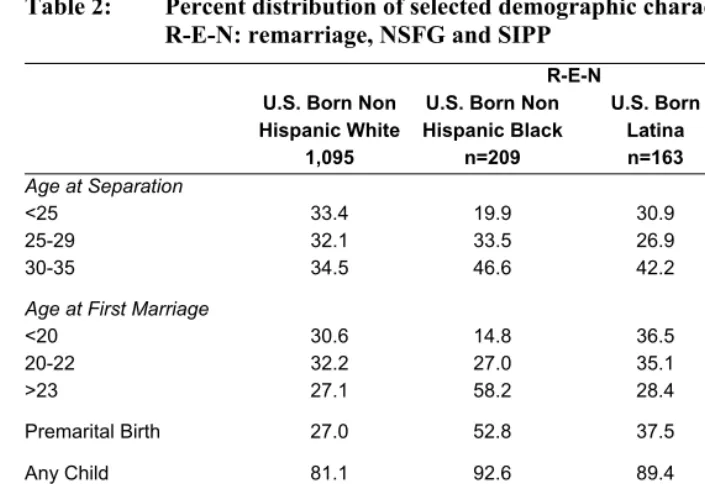
Table 2: Percent distribution of selected demographic characteristics by R-E-N: remarriage, NSFG and SIPP
R-E-N U.S. Born Non
Hispanic White
U.S. Born Non Hispanic Black
U.S. Born Latina
Foreign Born Latina
1,095 n=209 n=163 n=132
Age at Separation
<25 33.4 19.9 30.9 41.3
25-29 32.1 33.5 26.9 27.1
30-35 34.5 46.6 42.2 31.6
Age at First Marriage
<20 30.6 14.8 36.5 46.8
20-22 32.2 27.0 35.1 22.3
>23 27.1 58.2 28.4 30.9
Premarital Birth 27.0 52.8 37.5 29.7
Any Child 81.1 92.6 89.4 88.6
Education
< High School Diploma 10.0 14.9 14.4 43.6
High School Diploma 33.9 23.3 35.0 26.8
Some College 40.1 45.6 42.9 22.0
College Degree 16.1 16.3 7.7 7.6
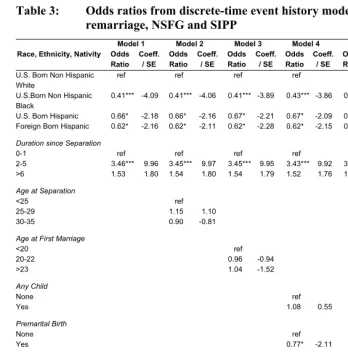
Table 3: Odds ratios from discrete-time event history model predicting remarriage, NSFG and SIPP
Model 1 Model 2 Model 3 Model 4 Model 5 Model 6
Race, Ethnicity, Nativity Odds Ratio Coeff. / SE Odds Ratio Coeff. / SE Odds Ratio Coeff. / SE Odds Ratio Coeff. / SE Odds Ratio Coeff. / SE Odds Ratio Coeff. / SE U.S. Born Non Hispanic
White
ref ref ref ref ref ref
U.S.Born Non Hispanic Black
0.41*** -4.09 0.41*** -4.06 0.41*** -3.89 0.43*** -3.86 0.41*** -4.06 0.42*** -1.54
U.S. Born Hispanic 0.66* -2.18 0.66* -2.16 0.67* -2.21 0.67* -2.09 0.68* -2.00 0.70 -1.54 Foreign Born Hispanic 0.62* -2.16 0.62* -2.11 0.62* -2.28 0.62* -2.15 0.71 -1.48 0.71 -1.14
Duration since Separation
0-1 ref ref ref ref ref ref
2-5 3.46*** 9.96 3.45*** 9.97 3.45*** 9.95 3.43*** 9.92 3.44*** 9.95 3.43*** 7.75 >6 1.53 1.80 1.54 1.80 1.54 1.79 1.52 1.76 1.55 1.83 1.53 1.42
Age at Separation
<25 ref ref
25-29 1.15 1.10 1.07 0.34
30-35 0.90 -0.81 0.80 -1.07
Age at First Marriage
<20 ref ref
20-22 0.96 -0.94 0.94 -3.21
>23 1.04 -1.52 1.11 0.49
Any Child
None ref ref
Yes 1.08 0.55 1.20 -1.37
Premarital Birth
None ref ref
Yes 0.77* -2.11 0.77 -0.74
Education
<High School Diploma ref ref High School Diploma 1.44 1.88 1.43 1.18 Some College* 1.43 1.82 1.44 1.27 College Degree 1.79** 2.71 1.79* 1.84
NSFG 0.84 -1.66 0.84 -0.17 0.84 -1.87 0.83 -1.70 0.88 -1.12 0.88 -9.78 Wald Model Fit Test ref 1.75(ns) .25(ns) 1.90(ns) 4.02(ns) 8.45(ns)
Number of Person-Years 6707
Notes: +some college includes those who earned an associates degree.
(ns) Not Significant at the p< .05; * Significant at the p< .05; ** Significant at the p<.01; *** Significant at the p<.001.
at least some of the reason why foreign born Latina women have lower remarriage rates is because they have lower levels of education and education is positively associated with the chance of remarriage. In Model 6, after adding all of the sociodemographic characteristics the black-white difference remains significant but neither Latina group is significantly different from whites. Importantly from Model 1 to Model 6, only the relative odds for foreign born Latina women changes substantially, from .62 to .71. As we just discussed, this change in the relative odds was due to controlling for educational differences, but the decline in statistical significance for Latina women, particularly U.S. born Latina women, is due to increasing standard errors. This is not surprising given our fairly small sample size, only 34 remarriages for foreign born Latina women and 24 for U.S. born Latinas. Given that the odds ratios continue to be substantially different from one, we are reluctant to conclude that controlling for sociodemographic characteristics explains U.S. born Latina women’s lower remarriage rates. As an aside, in all models, we included a variable to identify data origin as NSFG or SIPP. At no point does NSFG have significantly different odds of remarriage compared to SIPP, which validates combining the datasets.
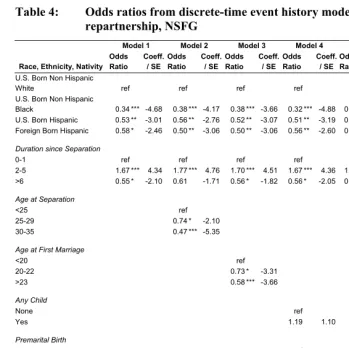
Table 4 presents the odds ratios for repartnership. Model 1 shows that repartnership differentials resemble remarriage differentials; black, U.S. born Latina and foreign born Latina women all have significantly lower odds of repartnership compared to the odds for white women. Black women again have the largest differential with 66% lower odds of repartnership. U.S. born Latina women have the second largest differential with 47% lower odds of repartnership. Resembling the patterns in remarriage, Foreign born Latina women have odds similar to U.S. born Latinas, with 42% lower odds of repartnership compared to white women. Models 2 – 6 add the demographic characteristics seen in the previous remarriage analysis. The results in Model 6 reveal continued significant lower odds of repartnership for black and Latina women compared to white women. The differentials, however, become slightly smaller for black women (62% lower odds) and for U.S. born Latina women (45% lower odds) but larger for foreign born Latina women (65% lower odds).
interaction terms because they are based on a small sample and can sometimes change direction when other covariates are included in the models.
Table 4: Odds ratios from discrete-time event history model predicting repartnership, NSFG
Model 1 Model 2 Model 3 Model 4 Model 5 Model 6
Race, Ethnicity, Nativity Odds Ratio Coeff. / SE Odds Ratio Coeff. / SE Odds Ratio Coeff. / SE Odds Ratio Coeff. / SE Odds Ratio Coeff. / SE Odds Ratio Coeff. / SE U.S. Born Non Hispanic
White ref ref ref ref ref ref U.S. Born Non Hispanic
Black 0.34 *** -4.68 0.38 *** -4.17 0.38 *** -3.66 0.32 *** -4.88 0.36 *** -4.43 0.38 *** -3.78 U.S. Born Hispanic 0.53 ** -3.01 0.56 ** -2.76 0.52 ** -3.07 0.51 ** -3.19 0.53 ** -3.07 0.55 ** -2.28 Foreign Born Hispanic 0.58 * -2.46 0.50 ** -3.06 0.50 ** -3.06 0.56 ** -2.60 0.41 *** -3.75 0.35 *** -3.11
Duration since Separation
0-1 ref ref ref ref ref ref 2-5 1.67 *** 4.34 1.77 *** 4.76 1.70 *** 4.51 1.67 *** 4.36 1.77 *** 4.78 1.88 *** 3.21 >6 0.55 * -2.10 0.61 -1.71 0.56 * -1.82 0.56 * -2.05 0.63 -1.61 0.69 -1.14
Age at Separation
<25 ref ref
25-29 0.74 * -2.10 0.79 -0.77
30-35 0.47 *** -5.35 0.48 *** -2.76
Age at First Marriage
<20 ref ref
20-22 0.73 * -3.31 0.93 -0.29
>23 0.58 *** -3.66 0.97 -0.12
Any Child
None ref ref Yes 1.19 1.10 1.11 0.43
Premarital Birth
None ref ref Yes 1.15 1.09 1.13 0.55
Education
<High School Diploma ref ref High School Diploma 0.71 * -2.06 0.75 -0.91 Some College* 0.49 *** -4.05 0.51 *** -2.42 College Degree 0.37 *** -4.44 0.46 ** -2.23
Wald Model Fit Test ref 10.22** 4.88(ns) 1.50(ns) 11.56** 24.65** Number of Person-Years 2290
Notes: some college includes those who earned an associates degree+.
5. Discussion and conclusion
The main objective of this study is to describe differences in the pace of remarriage and repartnering by race, ethnic, and nativity groups, while considering the group variations in demographic characteristics. Our results point to a continued decline in remarriage rates. Repartnering makes up for some of the slower pace in remarriage, particularly for women with less than a high school degree. Our analysis also demonstrates that the black and Latina women have lower rates of remarriage than whites. Black women have the largest differentials compared to white women even controlling for compositional differences in other demographic factors. But Latina women, both U.S. born and foreign born, also have lower remarriage rates. Our analyses also suggest that R-E-N differentials in repartnering (marriage and cohabitation) echo patterns of remarriage. Whites are more likely than blacks or Latinas to remarry and they are also more likely to repartner. Moreover we find that while for most groups education is negatively associated with the pace of repartnering, it is positively associated with remarriage. The finding that education is positively associated with remarriage echoes research of remarriage in the early 1990s (Sweeney 2002). The positive association between education and remarriage may indicate that women’s resources are important in facilitating remarriage, yet is it less clear why women with less education would form cohabiting unions at a relatively quick pace. This may reflect the difficulty less educated women have maintaining a household by themselves. Future research should explore this pattern more deeply.
among the U.S. born. SIPP also does not provide information on country of origin; therefore we can not specify the country of origin for Latina respondents. Grouping Latinas into one panethnic category underplays possible variations within this group. A potentially fruitful line of future research would be to investigate remarriage variations across generational status and country of origin.
Despite these weaknesses, this research fills an important gap in knowledge by updating estimates of remarriage and describing differences in remarriage and repartnering by race, ethnicity, and nativity. Interestingly remarriage rates continue to decline. Once we could point to the high rates of remarriage as an indicator that people were not disillusioned with the institution of marriage, just unhappy with their particular marriage. Does the decline in remarriage suggest a shift in the status of marriage? We do not think so. Most youth today still want to marry and most will marry, suggesting that we are still strongly attached to marriage (see also for example Cherlin 2009). It is notable that women with the most resources, as measured by educational attainment, are the most likely to remarry quickly after a separation. This suggests that declines in remarriage may have more to do with constraints than preferences.
Additionally our results describing patterns in remarriage mirror recent patterns in divorce. Blacks and U.S. born Latinas as well as women with lower levels of education have higher rates of divorce and lower rates of remarriage compared to white women and those with a college degree. This suggests that differentials in remarriage rates, rather than ameliorating disadvantages associated with divorce, reinforce these differentials. Importantly, we have not shown that divorce causes economic hardship or that this effect is similar across race-ethnic differentials. So, we can not say for certain that divorce and remarriage patterns contribute to race-ethnic (or nativity) differentials in economic well being. Yet prior research strongly suggests that divorce actually does cause declines in economic well being (Smock, Manning, and Gupta 1999). Future research could also investigate whether these estimated effects vary across different racial, ethnic, and other sociodemographic groups.
6. Acknowledgement
References
Bean, F.D., Berg, R.R., and Van Hook, J.V.W. (1996). Socioeconomic and cultural incorporation and marital disruption among Mexican Americans. Social Forces
75(2): 593-617. doi:10.2307/2580415.
Binstock, G. and Thornton, A. (2003). Separations, reconciliations, and living apart in cohabiting and marital unions. Journal of Marriage and Family 65(2): 432-443.
doi:10.1111/j.1741-3737.2003.00432.x.
Bumpass, L., Raley, R.K., and Sweet, J.A. (1995). The changing character of stepfamilies: Implications of cohabitation and nonmarital childbearing.
Demography 32(3): 425-436. doi:10.2307/2061689.
Bumpass, L. and Sweet, J. (1989). National estimates of cohabitation. Demography
26(4): 615-625. doi:10.2307/2061261.
Bumpass, L., Sweet, J., and Castro Martin, T. (1990). Changing patterns of remarriage.
Journal of Marriage and the Family 52(3): 747-756. doi:10.2307/352939. Cherlin, A.J. (1992). Marriage, divorce, remarriage. Cambridge: Harvard University
Press.
Cherlin, A.J. (2009). The Marriage-Go-Round. New York: Knopf.
Gierveld, J.D. (2004). Remarriage, Unmarried Cohabitation, Living Apart Together: Partner Relationships Following Bereavement or Divorce. Journal of Marriage and Family 66(1): 236-243. doi:10.1111/j.0022-2445.2004.00015.x.
Goldstein, J.R. and Kenney, C.T. (2001). Marriage delayed or marriage forgone? New cohort forecast of first marriage for US women. American Sociological Review
66(4): 506-519. doi:10.2307/3088920.
Holden, K.C. and Smock, P.J. (1991). The economic costs of marital dissolution: Why do women bear a disproportionate cost? Annual Review of Sociology 17: 51-78.
doi:10.1146/annurev.so.17.080191.000411.
Koo, H.P., Suchindran, C.M., and Griffith, J.D. (1984). The effects of children on divorce and re-marriage: A multivariate analysis of life table probabilities.
Population Studies 38(3): 451-471. doi:10.2307/2174134.
Manning, W.D. and Landale, N.S. (1996). Racial and ethnic differences in the role of cohabitation in premarital childbearing. Journal of Marriage and the Family
Martin, S.P. (2006). Trends in marital dissolution by women’s education in the United States. Demographic Research 15(20): 537-560. doi:10.4054/DemRes.2006.
15.20.
McCarthy, J. (1978). A comparison of the probability of the dissolution of first and second marriages. Demography 15(3): 345-359. doi:10.2307/2060655.
Morgan, L.A. (1988). Outcomes of marital separation: A longitudinal test of predictors.
Journal of Marriage and the Family 50(2): 493-498. doi:10.2307/352014. Morrison, D.R. and Ritualo, A. (2000). Routes to children’s economic recovery after
divorce: Are cohabitation and remarriage equivalent? American Sociological Review 65(4): 560-580. doi:10.2307/2657383.
Oppenheimer, V.K. (2003). Cohabitating and marriage during young men’s career-development process. Demography 40(1): 127-149. doi:10.1353/dem.2003.
0006.
Oropesa, R.S. and Landale, N.S. (2004). The future of marriage and Hispanics. Journal of Marriage and Family 66(4): 901-920. doi:10.1111/j.0022-2445.2004.00061.x. Phillips, J.A. and Sweeney, M.M. (2005). Premarital cohabitation and marital
disruption among White, Black, and Mexican American women. Journal of Marriage and Family 67(2): 296-314. doi:10.1111/j.0022-2445.2005.00117.x. Phillips, J.A. and Sweeney, M.M. (2006). Can differential exposure to risk factors
explain recent racial and ethnic variation in marital disruption? Social Science Research 35(2): 409-434. doi:10.1016/j.ssresearch.2005.04.002.
Raley, R.K. (1996). A shortage of marriageable men? A note on the role of cohabitation in Black-White differences in marriage rate. American Sociological Review
61(6): 973-983. doi:10.2307/2096303.
Raley, R.K. and Bumpass, L. (2003). The topography of the divorce plateau: Level and trends in union stability in the United States after 1980. Demographic Research
8(8): 245-260. doi:10.4054/DemRes.2003.8.8.
Raley, R.K., Durden, E.T., and Wildsmith, E. (2004). Understanding Mexican American marriage patterns using a life course approach. Social Science Quarterly 85(4): 872-890. doi:10.1111/j.0038-4941.2004.00249.x.
Raley, R.K. and Wildsmith, E. (2004). Cohabitation and children’s family instability.
Journal of Marriage and Family 66(1): 210-219.
Ruggles, S. (1997). The rise of divorce and separation in the United States, 1880-1990.
Demography 34(4): 455-466. doi:10.2307/3038300.
Smock, P.J. (1990). Remarriage patterns of Black and White women: Reassessing the role of educational attainment. Demography 27(3): 467-473.
doi:10.2307/2061380.
Smock, P.J. (2000). Cohabitation in the United States: An appraisal of research themes, findings, and implications. Annual Review of Sociology 26(1): 1-20.
doi:10.1146/annurev.soc.26.1.1.
Smock, P.J., Manning, W.D., and Gupta, S. (1999). The effect of marriage and divorce on women’s economic well-being. American Sociological Review 64(6): 794-812. doi:10.2307/2657403.
South, S. and Spitze, G. (1986). Determinants of divorce over the marital life course.
American Sociological Review 51(4): 583-590. doi:10.2307/2095590.
Spanier, G.B. and Glick, P.C. (1980). Mate selection differentials between whites and blacks in the United States. Social Forces 58(3): 707-725. doi:10.2307/2577180. Sweeney, M.M. (2002). Two decades of family change: The shifting economic
foundations of marriage. American Sociological Review 67(1): 132-147.
doi:10.2307/3088937.
Sweeney, M.M. (2010). Remarriage and stepfamilies: Strategic sites for family scholarship in the 21st century. Journal of Marriage and Family 72(3): 667-684.
doi:10.1111/j.1741-3737.2010.00724.x.
Sweeney, M.M. and Phillips, J.A. (2004). Understanding racial differences in marital disruption: Recent trends and explanations. Journal of Marriage and Family
66(3): 639-650. doi:10.1111/j.0022-2445.2004.00043.x.
Teachman, J.D. (1986). First and second marital dissolution: A decomposition exercise for Whites and Blacks. The Sociological Quarterly 27(4): 571-590.
doi:10.1111/j.1533-8525.1986.tb00279.x.
Teachman, J.D. and Heakert, A. (1985). The impact of age and children on remarriage.
Journal of Family Issues 6(2): 185-203. doi:10.1177/019251385006002003. Teachman, J.S. (2002). Stability across cohorts in divorce risk factors. Demography
39(2): 331-351. doi:10.1353/dem.2002.0019.
Udry, R.J. (1966). Marital instability by race, sex, education, and occupation using 1960 census data. The American Journal of Sociology 72(2): 203-209.
doi:10.1086/224279.