Paper received: 10.5.2007 Paper accepted: 19.12.2007
Application of Neural Networks in Evaluation of Technological
Time
Goran Šimunović* - Tomislav Šarić - Roberto Lujić
University o f Osijek, Mechanical Engineering Faculty in Slavonski Brod, Croatia
The traditional approach to the process planning mostly based on experience o f technologists, requires a lot o f accumulated knowledge, is inflexible and time consuming. The application o f artificial intelligence methods can support and greatly improve this approach. This paper describes the results obtained by investigating the application o f neural networks in evaluating the manufacturing parameters and, indirectly, technological time o f the seam tube polishing. Various structures o f a back-propagation neural network have been analysed and the optimum one with the minimum RMS (Root Mean Square) error selected. The obtained model was integrated into the ERP system (Enterprise Resource Planning system) o f a manufacturing company. The more precise evaluations o f technological time obtained by the ERP system model complete the previously defined manufacturing operations and form the basis fo r production planning and times o f delivery control. The work o f technologists is thus made easier and the production preparation technological time made shorter.
© 2008 Journal o f Mechanical Engineering. All rights reserved.
Keywords: process planning, artificial intelligence, neural networks
0 INTRODUCTION
The fulfilm ent o f the basic requirements modem enterprises are faced with, such as a product optimum quality, low production costs, holding to the agreed times o f delivery and a more rational m a te ria l and in fo rm a tio n m a n ag em en t in a production system, cannot be imagined without n ew s c ie n tific a p p ro a c h e s in p ro d u c tio n p re p a ra tio n . T he le v e l o f k n o w led g e and organisation in production preparation sectors has a considerable impact upon the final characteristics o f a product and an indirect effect on production costs and the tim es o f delivery. Integration o f c o m p u te rs i.e. c o m p u te r sy stem s into the preparation, manufacturing and managing process has exerted a great influence on increasing the level o f au to m atio n , p ro d u ctiv ity and flexibility in m anufacturing companies. In this way the human involvem ent in production has been significantly reduced while at the same time the human factor’s importance in production preparation has remained ex cep tio n ally great. By the application o f the systems based on artificial intelligence attempts are made to integrate and make commonly accessible th e a c c u m u la te d in d iv id u a l k n o w le d g e and experience o f the people working in the production preparation sectors. Some authors today deal with
the way o f collecting the technological knowledge, its presentation and application to intelligent systems. They use the acquired expert knowledge in the Computer Aided Process Planning (CAPP) system for the identification (classification) o f work pieces, selection o f a m anufacturing process, machines and machining parameters in order to shorten the time and minimize the errors in the process planning o f the machining process [1] to [3] and some other processes like forging [4],
The technological knowledge is necessary for determination o f the basic material, sequence o f manufacturing operations, selection o f tools etc. The problem o f optim ization in the mentioned activities is quite im portant in m anufacturing industries. One o f the up-to-date techniques in the optimization procedure is the application of genetic algorithms (GA). This optim ization technique, which is more efficient than the traditional ones (geometric programming, dynamic programming, etc.) is described and implemented in the works of many authors [5] to [8]. The authors [5] and [6] use genetic algorithms in the optimization o f cutting parameters in turning processes. They consider a great number o f constraints such as cutting force, m achine power, tool reliability, cutting zone temperature etc. in order to shorten the time and reduce the operating costs. Attempts are made to
a c h ie v e th e sam e g o als b y a c o n tin u o u s im provem ent o f cutting conditions i.e. by the d e v e lo p m e n t an d a p p lic a tio n o f an o n -lin e in te llig e n t sy ste m fo r th e m o n ito rin g and optimization o f cutting conditions based on genetic algorithms [7] to [9]. The authors [10] and [11] also deal w ith the optim ization o f m achining parameters but by the application o f the modified GA w ith the self-organizing adaptive penalty (SOAP) strategy i.e. by the application o f parallel GA and simulated annealing (SA). Besides the GA the neural networks (NN) [12] to [15] are also often com bined in the procedures o f the m achining parameters optimization. Thus for the selection o f o p tim al m a c h in in g p a ra m e te rs , b a se d on e x p e rim e n ta l d a ta , w h en the a n a ly tic a l and empirical mathematical models are not available, G enetically O ptim ized N eural N etw ork System (GONNS) [13] is proposed. In this paper the NN represents the relationship betw een the cutting conditions and m achining-related variables, and G enetic A lgorithm (GA) obtains the optim um operational condition. The paper [14] presents the use o f neural network and genetic algorithm for m o d e llin g an d o p tim a l s e le c tio n o f in p u t parameters o f abrasive flow machining process. For a m u lti-c rite ria o p tim iz a tio n o f th e c u ttin g p a ra m e te rs in a tu rn in g p ro c e ss th e h y b rid analytical-neural network approach [15] and [16] is also proposed. Neural networks are also used for evaluation o f the machined surface roughness [17] i.e. o f the tool wear in the machining process [18] , The authors [17] and [18] compare the results obtained by the application of neural networks with the results obtained by analytical models. It is also possible to use neural networks for intelligent tool path generation for the milling o f free surfaces [ 19] and [20]. In their work the authors take the required su rfa c e q u a lity as a p rim a ry te c h n o lo g ic a l requirement for free surface milling programming. Therefore the application o f artificial intelligence for the solution o f specific manufacturing problems is in most cases justified in the conclusions o f all th e m e n tio n e d w o rk s. In m u lti-d im e n s io n a l problems in w hich the mathematical dependence o f input and output variables is difficult or almost im possible to set up, the application o f neural networks is certainly significant. Nevertheless, no matter what the main objective o f the application o f neural networks, there are few authors only who speak about improvement in terms o f the previously
trained network integration into a corresponding data base within which the results the network gives might be repeatedly used. It is exactly the problem o f predicting technological time by the application o f neural networks and integration o f a trained network into the ERP system that the present paper deals with.
1 THE PROBLEM AND INVESTIGATING GOAL DEFINITION
There are two phases in the production o f stain less steel seam tubes: ro llin g phase and grinding and polishing phase. In the initial phase a stainless steel band o f diverse width and thickness, depending on the required external diameter o f the tube, is rolled over a num ber o f vertical and horizontal rollers and formed into a tube. Then the edges o f the rolled tube are heated and prepared for the TIG welding in a protective chamber. This is followed by the grinding o f the raised edges of the weld and calibrating o f the tube according to the required tolerance o f external diameter and the required oval shaping. After the weld is tested by a
n o n -d e s tru c tiv e m e th o d an d o c c a sio n a l
technological trials, the tube is rough ground, marked, cut to the specified length and taken to a store fo r the sem i-m an u factu red products. A planned minimum quantity o f the tubes o f various dimensions is kept in the store.
It is alm o st im p o ssib le to esta b lish a mathematical model of the polishing rate due to a num ber o f influential parameters, which will be described later. Therefore, one o f the goals o f this p a p e r, w h ich d eals w ith th e e v a lu a tio n o f te c h n o lo g ic a l p a ra m e te rs an d in d ire c tly o f technological time o f the seam tube polishing, is to dev elo p a p ro cessin g m odel based on the application o f neural networks. The developed m odel w ill be integrated into the existing ERP system o f the company Đuro Đ aković Welded Vessels Ltd. The values o f input variables in the model will be based on the ERP system real data and the results the model gives should form the basis for a more precise assessment o f delivery times and production planning. The integration of the model into the ERP system should upgrade the a c tiv itie s in the technological p reparation o f production and the jobs connected with production p la n n in g and m ake the data the model gives generally accessible and useful for the company as a whole.
N e u ra l n e tw o rk s are se le c te d for establishing the model because the knowledge about the problem is available in the form o f a set o f discrete values o f the state vector element and the process output values. Real data for setting up the model have been collected over a longer period o f tim e in the company Đuro Đaković Welded Vessels Ltd. in the production o f stainless steel seam tubes.
2 EVALUATION OF THE MACHINING
PARAMETERS BY THE APPLICATION OF THE BACK-PROPAGATION NETWORK
2.1 Selection of the Type of Neural Network -General Model
The observed re se a rc h b elongs to the problems dealing with continuous input and output values i.e. problems connected with prediction, thus the back-propagation network is applied. Figure 2 shows the structure o f a back-propagation network with one hidden layer (there can be more hidden layers), while the structure o f an artificial neuron is shown in Figure 3.
During the process o f learning the aim is to enable fast convergence and reduce global error given by:
£ = 0 , 5 - X K - * * ) 2 (1).
In this type o f n e tw o rk glo b al erro r propagates backwards through the network all the way to the input layer. During the backward pass all weighted connections are adjusted in accordance w ith the desired neural netw ork output values. Increase or decrease o f the actual values o f the
weights affects the decrease o f global error.
By the application o f the gradient descent ru le s the in c re a se in the n e tw o rk w eig h ted connections Aw*’1 can be given as:
( l) - Loader
- Inlet roller conveyor - Compressed air inlet - Control desk - Filter fabric cleaner
(6) - Dust collector (7) - Unloader
(8) - Outlet roller conveyor £ - Panelling
A <M. -a f })E '
äwf1 (2),
where a is the learning coefficient.
Derivations given above can be calculated as:
ÓE f dE ) f dll11 )
V 7 V J /
= — e , ■ X )M (3).
The value o f the w eighted connections increase in the network A w y is now:
AhW =q-4sM H (4)’
where a is the learning coefficient, x1- represents
output state o f the j -th o f this neuron in the s-th
layer, and the param eter e y that represents the error and propagates backwards through all the layers o f the network is defined as:
J A - -d E
a / 1:
(5).
The learning coefficient should be kept law to avoid divergence although this could result in a very slow learning. This situation is solved by including a momentum term into expression (4):
A w ^ = a • • x |s ^ + momentum ■ A w ^ (^)
-The weights in the network can be updated fo r each le a rn in g v e c to r s e p a ra te ly o r else cumulatively, which considerably speeds up the rate o f learning (convergence).
T herefore the objective o f the learning process in a neural network is to achieve the lowest possible level o f error between the outputs obtained by training the network and the actual (desired)
results. This is realized by adjusting the weights o f th e n eu ro n s, and by a c cep tin g the ob jectiv e function, defined below through the minimization o f the mean square error.
General form vector o f the model applicable for a neural network input is as follows:
(7),
X , = { x n ,x ,2, x n ,... , * „ } = >
= ^ F0 = { T 01>T02>>;03 > -,To„}
w here vector X l = {xn,xa ,xa ,...,xirt} represents
input variables, and vector Y0 = {yol,yo2,y0i,-,yor,}
output variables.
2.2 A p plication o f the B ack-Propagation N etw ork in E valuations of M achining Parameters
In the given problem the model vector has one output variable - the rate o f polishing. The technological time is calculated from the rate o f polishing. Input variables are: kind o f material, tube external diameter, wall thickness, oval shaping o f the tu b e a fte r th e first p h ase o f p ro d u ctio n , gradation o f the belts used for grinding or polishing adjusted on machine (conveyor), condition o f belts (tim e o f usage), pressure o f belts, required and performed roughness o f the surface, length o f tubes and polishing phase (Table 1).
The RMS error (Root Mean Square error) is taken as a criterion for network validation. It is
defined as: ____________
N
RMS = y[MS = ,
N
where:
M S Mean Square error,
N Number o f pairs o f the training set input-output
(8) ,
Fig. 2. Structure o f a back-propagation network
Inputs
Axons Weights (Synapse)
values,
Vn Neural network n-th output,
d Desired value o f a neural network n-th output.
The D elta rule is ap p lied for netw ork training. This rule is also called Widrow/Hoff rule o r the m inim um m ean square rule w hich has become one of the basic rules in the training process o f most neural networks.
In expression (9) the formula for the Delta rule is given:
A w j j = a ■ y cj ■ £ j (9),
where is the value o f the difference in the weights
o f neuron j and neuron i realized in two steps (k-th
and k-l), mathematically described by:
AW j j = Aw*. - A w j f 1 ( 10),
a is the rate (coefficient) o f learning,^, is the output
value o f neuron j calculated according to transfer
function, e is the error given as:
£i=yci~ydi
(11),where y is the actual (desired) output. The error
given by the expression (11) returns to the network only rarely, other forms o f error are used instead depending on the kind o f network.
For most actual problems various rates o f learning are used for various layers with a low rate o f learning for the output layer. It is usual for the rate o f learning to be set at a value anywhere in the interval between 0.05 and 0.5, the value decreasing during the learning process. While using the Delta rule algorithm the used data are to be selected from the train in g set at a random basis. O therw ise frequent oscillations and errors in the convergence o f results can be expected.
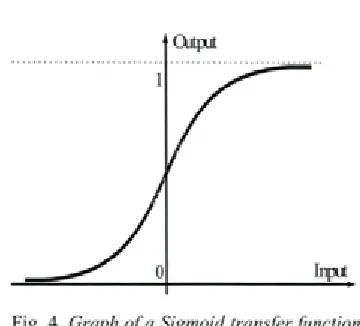
The transfer function used in this paper is the S ig m o id fu n c tio n c a lc u la te d acco rd in g to expression:
Output, = - - J-C~ puli (12),
where G - is the function increment. It is calculated
as G=l/T. Tis the function threshold. This function is often used when neural networks are created or in v e stig a te d . T he g ra p h o f th e fu n ctio n is continuously monotonous and is shown in Figure 4. As it can be seen the values o f this transfer function are in the [0,1] interval range.
2.3 O btained Results
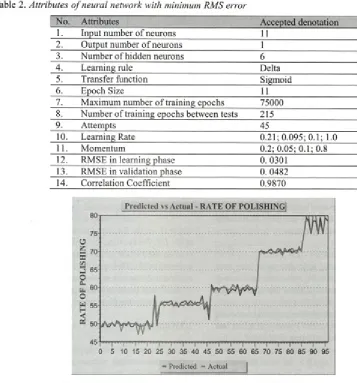
The study o f the application o f the back- propagation network was carried out for a defined data model. By alternating the attributes diverse architectures o f neural networks were studied. The attributes of the network that gives minimum RMS e rro r are show n in T able 2. T his n etw o rk architecture generated the netw ork output with
Table 1. Variables with a value range fo r the proposed model
No Variable Minimum value Maximum value
1. Kind of material i 4
2. Tube external diameter [mm] 10 50
3. Wall thickness [mm] 0.5 2.5
4. Tube oval shaping after first phase of production [pm] 0.04 0.1
5. Gradation o f belts for grinding or polishing 80 700
6. Condition o f belts (time of usage) [min] 0 1200
7. Pressure o f belts 0.8 2.5
8. Required roughness [pm] 8 12
9. Performed roughness [pm] 10 14
10. Length o f tube [mm] 1000 6000
Table 2. Attributes o f neural network with minimum RMS error
No. Attributes Accepted denotation
1. Input number o f neurons 11
2. Output number of neurons 1
3. Number o f hidden neurons 6
4. Learning rule Delta
5. Transfer function Sigmoid
6. Epoch Size 11
7. Maximum number o f training epochs 75000
8. Number of training epochs between tests 215
9. Attempts 45
10. Learning Rate 0.21; 0.095; 0.1; 1.0
11. Momentum 0.2; 0.05; 0.1; 0.8
12. RMSE in learning phase 0. 0301
13. RMSE in validation phase 0. 0482
14. Correlation Coefficient 0.9870
Predicted vs Actual - RATE OF POLISHING]
O z
a.
fa
O H 50 5 10 15 20 25 30 35 40 45 50 55 60 65 70 75 80 85 90 95
- Predicted “ Actual
Fig. 5. Presentation o f actual and predicted values given by N N for the rate ofpolishing
3.01% rate o f RMS error in the training phase and 4.82 % in the validation phase.
T h e re fo re th e n e u ra l n e tw o rk w hose attributes are given in Table 2 approximates best to experim ental results. The graph in Figure 5 shows the results obtained by this network structure with regard to experimental results.
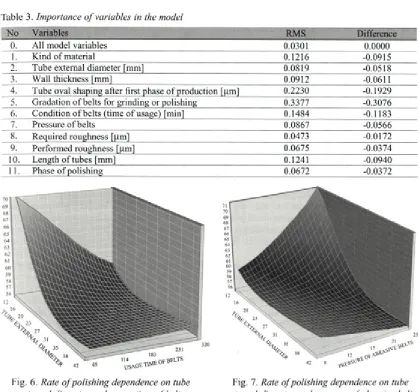
S u b seq u en tly an in v e stig a tio n into the im portance o f particular variables for a neural network model was also performed aimed at the possibility o f reducing their number. As compared to the d e fin e d n eu ral n etw o rk stru ctu re w ith m inim um rate o f error (Table 2) a process was d e v e lo p e d in w h ic h a re d u c e d d a ta m o d el containing 10 input variables and 1 output one was observed. The network was trained with the reduced data model and the given results were analyzed
subsequently. The results, shown in Table 3, point to a higher RMS error for each step (with the model reduced by one variable) compared with the initial model.
Therefore the conclusion is that leaving any o f the variables out o f the model would lead to an increase in error. In an extended model reduction process the dependence o f polishing rate on two variables was also studied (Figs. 6 and 7).
3 INTEGRATION OF A PREDICTION MODEL BASED ON NEURAL NETWORKS INTO A
TECHNOLOGICAL SUBSYSTEM
Table 3. Importance o f variables in the model
No Variables RMS Difference
0. All model variables 0.0301 0.0000
1. Kind of material 0.1216 -0.0915
2. Tube external diameter [mm] 0.0819 -0.0518
3. Wall thickness [mm] 0.0912 -0.0611
4. Tube oval shaping after first phase o f production [|rm[ 0.2230 -0.1929
5. Gradation o f belts for grinding or polishing 0.3377 -0.3076
6. Condition o f belts (time of usage) [mini 0.1484 -0.1183
7. Pressure of belts 0.0867 -0.0566
8. Required roughness [|4m[ 0.0473 -0.0172
9. Performed roughness [pm] 0.0675 -0.0374
10. Length of tubes [mm] 0.1241 -0.0940
11. Phase of polishing 0.0672 -0.0372
Fig. 6. Rate o f polishing dependence on tube
external diameter and usage time o f belts
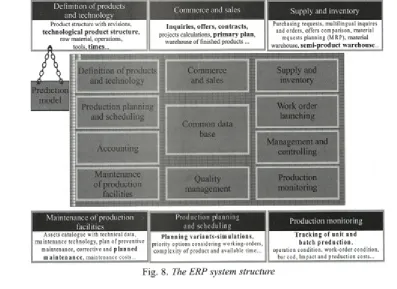
components o f the ERP system are shown in Figure
8.
B y im p lem en tin g the ERP system the
o rg a n iz a tio n lev el o f th e p re p a ra tio n ,
manufacturing and service jobs has raised, quality o f m anagement has improved and control o f the p ro c e sse s o f p rep aratio n and p ro d u ctio n has becom e easier. Stocks o f m aterials, production costs, costs of quality deviation (scrap, refinish), costs o f customer complaints, costs o f penalties due to d e la y s in d eliv ery have all been reduced. Production cycle time and production preparation time have been cut, number of required documents and am o u n t o f m anual w ork needed for data entering and copying has become smaller. The time n e c e s s a ry to re p a ir d a m ag es and m ach in e breakdow ns has been reduced. The ERP system
Fig. 7. Rate o f polishing dependence on tube
external diameter and pressure o f abrasive belts
technological subsystem DEPTO makes it possible to enter and define materials, raw materials, work- pieces, assembly blocks and products, product com ponents with standards for raw m aterials, materials and finished parts. It also enables the definition o f manufacturing processes, material ratings, technological times per operation resulting from experience, connection and inspection of drawings o f parts, assembly blocks and products and print-out o f technological documentation.
manufacturing process can be calculated from the ERP technological subsystem previously defined technological param eters, including the rate o f polishing. H ow ever, this theoretical, em pirical value of the polishing rate based on the condition o f the tubes, machine and equipment, changes. That is why the obtained model based on the application o f neural networks has been integrated into the existing ERP system o f the company Đuro Đaković W elded V essels L td. T he m o d el is d ire c tly integrated into the DEPTO subsystem.
Therefore, one o f the goals o f the prediction model integration into the ERP system is to more precisely predict the rate o f polishing, thus the time o f machining and feasible times o f delivery, on the basis o f the system obtained model actual data. Such precise predictions o f the rate and time of polishing that the previously obtained model gives, are essential in the planning and scheduling o f production and particularly o f the production plan revision.
Based on the system data and application o f the prediction model it is also possible to make a correction o f the empirical (theoretical) rate of polishing at the m om ent o f the preparation o f te c h n o lo g ic a l d o c u m e n ta tio n an d p e rfo rm launching w ith the real technological times.
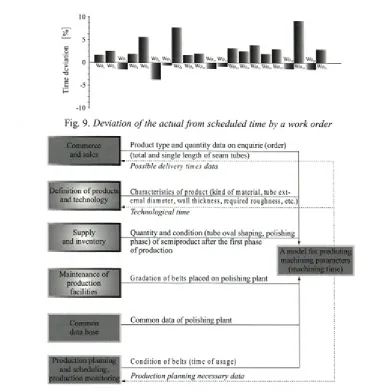
A month long application o f the integrated model has proven efficient as it gives the actually needed times of polishing (Fig. 9). The necessary data that represent the input into the obtained model are collected from the following subsystems and modules (Fig. 10): Commerce and Sales, Definition o f Products and Technology, Supply and Inventory, M aintenance o f Production Facilities, Common Data Base, Production Monitoring, and Production Planning and Scheduling.
4 CONCLUSION
T h is p a p e r o u tlin e s th e re su lts o f the application o f neural networks in evaluating the technological parameters and technological time o f seam tube polishing. The prediction model based on neural networks gives the results with a less than 10% error. Although high, this is a limit to the model acceptability. Namely, the research showed that the young and less experienced engineers com m it a 10% error in process planning when d e te rm in in g th e ra te o f m a c h in in g and technological time.
B y integrating the m odel into the ERP system the process planning o f the seam tube polishing has become easier and the time needed
Definition of products
and technology Commerce and sales Supply and inventory Product structure with revisions,
t e c h n o l o g i c a l p r o d u c t s t r u c t u r e , j raw material, operations, A tools, t i m e s . ..
I n q u i r i e s , o f f e r s , c o n t r a c t s , ! projects calculations, p r i m a r y p l a n ,
warehouse of finished products ...
Purchasing requests, multilingual inquires and orders, offers comparison, material
requests planning (M R P), material warehouse, s e m i - p r o d u c t w a r e h o u s e . . .
d b Ml IHIIII...limi... It
1 Maintenance o f production facilities
Production planning
and scheduling 1 Production monitoring
A s s e t s c a t a l o g u e w i t h t e c h n i c a l d a t a , m a i n t e n a n c e t e c h n o l o g y , p l a n o f p r e v e n t i v e
m a i n t e n a n c e , c o r r e c t i v e a n d p l a n n e d m a i n t e n a n c e , m a i n t e n a n c e c o s t s . . .
P l a n n i n g v a r i a n t s - s i m u l a t i o n s ,
I p r i o r i t y o p t i o n s c o n s i d e r i n g w o r k i n g - o r d e r s ,
I c o m p l e x i t y o f p r o d u c t a n d a v a i l a b l e t i m e . . .
T r a c k i n g o f u n i t a n d b a t c h p r o d u c t i o n , o p e r a t i o n c o n d i t i o n , w o r k - o r d e r c o n d i t i o n ,
b a r c o d , I m p a c t a n d p r o d u c t i o n c o s t s . . .
Fig. 9. Deviation o f the actual from scheduled time by a work order
Fig. 10. Neural network model integration into the ERP system
for technological preparation o f production has been reduced.
Monitoring o f the application of the model within the ERP system showed that with the more precise predictions o f the rate o f polishing and of the v a lu e s o f te c h n o lo g ical tim es the m odel facilitates the activities o f production planning and scheduling and o f defining the times o f delivery.
The research will continue and its aim will be to proceed with the collecting o f real data in the production o f polished seam tubes and to enlarge the amount o f sample data. It is to be expected that after learning and training the network will give better results i.e. smaller error and that the time deviation of actual versus planned time by a working order will be reduced. The aim is also to perform optimization o f machining parameters after proposing the rate of
polishing. The optim ization procedure w ill incorporate genetic algorithms (GA) so that the combined application of NN and GA should result in obtaining optimum machining parameters considering the ERP system data and condition o f the semi products and equipment in the plant.
A cknow ledgem ents
5 REFERENCES
[1] Grabow ik, C., K nosala, R. The m ethod o f knowledge representation for a CAPP system.
Journal o f Materials Processing Technology,
133(l-2):90-98, 2003.
[2] Wang, K.S. An integrated intelligent process p la n n in g sy stem (IIP P S ) fo r m achining.
Jo u rn a l o f In te llig e n t M anufacturing,
9(6):503-514, 1998.
[3] Park, K.S., Kim, S.H. Artificial Intelligence A p p ro a c h e s To D e te rm in a tio n o f CN C M achining Parameters In Manufacturing - A
Review. Artificial Intelligence in Engineering,
12(1-2): 127-134, 1998.
[4] Kim, C., Park, C. W. Development o f an expert system fo r cold forging o f axisym m etric product - Horizontal split and optimal design
o f multi-former die set. International Journal
o f A dvanced M anufacturing Technology,
29(5):459-474, 2006.
[5] Singh, G., Choudhary, A.K., Karunakaran, K.P., Tiwari, M.K.) An evolutionary approach
for multi-pass turning operations. Proceedings
o f the Institution o f Mechanical Engineers Part B-Journal o f Engineering Manufacture,
220(2): 145-162, 2006.
[6] Sardinas, R.Q., Santana, M.R., Brindis, E.A. G enetic alg o rith m -b a se d m u lti-o b je c tiv e optimization o f cutting parameters in turning
p ro c e sse s. E ngineering A p p lica tio n s o f
Artificial Intelligence, 19(2): 127-133, 2006. [7] Cus, F., B alie, J. O ptim ization o f cutting
p ro c e ss by G A ap p ro ach . R obotics A nd
Computer-Integrated Manufacturing, 19(1- 2): 113-121, 2003.
[8] Cus, F., Milfeiner, M., Balie, J. An intelligent system for m onitoring and optim ization o f
ball-end milling process. Journal o f Materials
Processing Technology, 175(l-3):90-97,2006. [9] Balie, J. Intelligent CAD/CAM systems for
CNC programming - an overview. Advances
in Production Engineering & Management (APEM) journal, 1 (1): 13-22, 2006.
[10] A hm ad, N ., Tanaka, T., Saito, Y. C utting p a ra m e te rs o p tim iz a tio n and co n stra in ts investigation for turning process by GA with self-o rg an izin g adaptive p en alty strategy.
JSM E In tern a tio n a l J o u rn a l S eries C-Mechanical Systems Machine Elements & Manufacturing, 49(2):293-300, 2006.
[11] Wang, Z.G., Rahman, M., Wong, Y.S., Sun, J. O ptim ization o f m ulti-pass m illing using parallel genetic algorithm and parallel genetic
simulated annealing. International Journal o f
Machine Tools & Manufacture, 45(15): 1726- 1734, 2005.
[12] Tansel, I.N., Ozcelik, B., Bao, W.Y., Chen, R, Rincon, D., Yang, S.Y., Yenilmez, A. Selection o f o p tim a l c u ttin g c o n d itio n s by u sin g
GONNS. International Journal o f Machine
Tools & Manufacture, 46(l):26-35, 2006. [13] Jain, R.K., Jain, V.K. Optimum selection o f
m a c h in in g c o n d itio n s in a b ra siv e flow
machining using neural network. Journal o f
Materials Processing Technology, 108( 1 ):62- 67,2000.
[14] Zuperl, U., Cus, F., M ursec, B., Ploj, T. A hybrid analytical-neural network approach to th e d e te rm in a tio n o f o p tim a l c u ttin g
conditions. Journal o f Materials Processing
Technology, 157-58 (Special Issue SI):82-90, 2004.
[15] Zuperl, U., Cus, F. Optimization o f cutting conditions during cutting by using neural
n e tw o rk s . R ob o tics A n d C om
puter-Integrated Manufacturing, 19(1 -2): 189-199, 2003.
[16] Sanjay, C., Jyothi, C. A study o f surface roughness in drilling using m athem atical
analysis and neural networks. International
Jo u rn a l o f A dvanced M anufacturing Technology, 29(9-10):846-852, 2006.
[17] Ožel, T., Karpat, Y. Predictive m odelling o f surface roughness and tool w ear in hard tu r n in g u s in g r e g r e s s io n a n d n e u ra l
netw orks. International Journal o f Machine
Tools & M anufacture, 4 5 (4 -5 ):4 6 7 -4 7 9 , 2005.
[18] Balie, J., Korošec, M. Intelligent tool path generation for milling o f free surfaces using
neural netw orks. International Journal o f
Machine Tools & Manufacture, 42(10): 1 H i l l 79, 2002.
[19] Balie J. Intelligent manufacturing systems.
Univesity o f Maribor, Faculty o f Mechanical Engineering, Maribor, 2004. (In Slovenian). [20] N o v a k o v ič , B ., M a je tić , D ., Š iro k i, M.
![Fig. 3. Model o f a neuron structure [20]](https://thumb-us.123doks.com/thumbv2/123dok_us/8953962.1863330/4.482.39.231.514.649/fig-model-neuron-structure.webp)