in the population sciences published by the Max Planck Institute for Demographic Research Konrad-Zuse Str. 1, D-18057 Rostock · GERMANY www.demographic-research.org
DEMOGRAPHIC RESEARCH
VOLUME 19, ARTICLE 59, PAGES 1969-2010
PUBLISHED 03 DECEMBER 2008
http://www.demographic-research.org/Volumes/Vol19/59/ DOI: 10.4054/DemRes.2008.19.59
Research Article
Creative providers:
Counseling and counselors in family planning
and reproductive health
Anthony T. Carter
© 2008 Carter.
This open-access work is published under the terms of the Creative Commons Attribution NonCommercial License 2.0 Germany, which permits use, reproduction & distribution in any medium for non-commercial purposes, provided the original author(s) and source are given credit.
1 Introduction 1970
2 Counseling as a form of verbal interaction 1971
2.1 Performance and improvisation 1971
2.2 Activity-in-setting and structuring resources 1972 2.2.1 Models for counseling practice 1973
2.2.2 Other structuring resources 1973
3 Counseling at Planned Parenthood of the Rochester/Syracuse Region
1974
3.1 Counseling guidelines 1977
3.2 Counseling sessions 1980
4 Counseling at other sites 1988
4.1 Royal Free Hospital, London 1989
4.1.1 Counseling guidelines 1989
4.1.2 Counseling sessions 1991
4.2 County health department family planning clinics in Maryland 1993
4.2.1 Counseling standard 1993
4.2.2 Counseling sessions 1994
4.3 Family planning counseling in Kenya 1994
4.3.1 Counseling protocol 1995
4.3.2 Counseling sessions 1996
5 Conclusion and implications 1997
6 Acknowledgements 2000
Creative providers:
Counseling and counselors in family planning and
reproductive health
Anthony T. Carter1
Abstract
This paper examines family planning and reproductive health counseling using qualitative data from four sites. Skillful counselors are creative. They improvise on counseling protocols that are never more than bare bones outlines. They also perform in a dual sense, carrying out a task and doing so in a way that engages their clients. To accomplish this, they draw on structuring resources from the wider society and culture as well as the settings in which they work. The implications of the creativity of counselors for the management and evaluation of counseling services are noted.
1. Introduction
Counseling and counselors are regarded as key components of family planning and reproductive health services in developed as well as developing countries. Counseling is thought to provide clients with “new information in an interpersonal context that enables them to profit from it” (Frank and Frank 1991:145). It helps clients concerned with family planning to “make free and informed choices about [contraception] and to act on those choices” (Gallen, Lettenmaier and Green 1987:2). It enables those concerned with or suffering from HIV/AIDS “to cope with stress and take personal decisions” required to avoid or live with the condition (UNAIDS 1997). The role of the counselor is to make this happen, “giving and receiving relevant, accurate information to help clients make decisions” and creating the “trusting and caring relationship with clients” that makes this go smoothly and effectively (Gallen, Lettenmaier, and Green 1987:7).
Though these appealing claims have led to a great deal of program effort, they have not been fully tested. None of the methodologies commonly used to assess the quality2 of counseling services or their outcomes – mystery client studies,3 situation analysis,4 quasi-experiments,5 randomized controlled trials,6 and transcript analysis7 – provide close-up, detailed views of the content of counseling sessions and the work counselors do to make them happen.8 Mystery-client studies and situation analyses include observation of provider-client interactions in family planning facilities – by a mock client in the former case and a third person in the latter – but the “indicators” observers are asked to record are “somewhat superficial gauges of the nature of the provider-client relationship” (Miller, Askew, Horn, and Miller 1998:249). Quasi-experiments and randomized controlled trials have used intention-to-treat analyses. That is to say, “[p]articipants [are] grouped according to the intervention assigned by randomization, regardless of whether they received or completed the assigned intervention …” (Metcalf et al. 2005). Or precisely how. Transcript analysis comes
2 On standards of quality, see Bruce (1990). 3
Schuler et al. (1985); Huntington et al. (1990, 1991); León, Quiroz, and Brazzoduro (1994); Brown et al. (1995); Olowu (1998), and León et al. (2005).
4 Miller, Miller, Askew, Horn, and Ndhlovu (1998). 5 Kim et al. (1992).
6 Kamb, Fishbein, Douglas et al. (1998); The Voluntary HIV-1 Counseling and Testing Efficacy Study Group
(2000); Metcalf et al.( 2005), and Corbett et al. (2007). The training and supervision procedures used to ensure the standardization and quality of counseling services are described in Kamb, Dillon, Fishbein, and Willis (1996).
7 Kim et al. (1998).
8 Earlier, less systematic work is reviewed in Higgins et al. (1991) and Weinhardt et al. (1999). For a
closest to describing the conduct of counseling, but it begins by jettisoning the language in which counseling actually occurs.9
All of this research rests on two assumptions. The first is that models of counseling adequately specify the content of counseling sessions. The second is that counselors can and should reproduce prescribed forms of counseling without significant variation on all occasions, with all clients, and in all languages.
This paper uses qualitative data from four sites to examine those assumptions. The next section introduces key concepts used in the analysis. The third section, based on fieldwork carried out in 1999, discusses the relationship between counseling guidelines and actual counseling talk at a clinic in downtown Rochester, NY, operated by Planned Parenthood of the Rochester/Syracuse Region. In the fourth section, I test my analysis of counseling in Rochester with material from published studies of counseling in three other sites.
2. Counseling as a form of verbal interaction
In counseling, a client or clients and a counselor or counselors speak to one another.10 If we are to understand how counseling is accomplished we must set aside our ideas about what constitutes good counseling and about the effects of counseling and focus instead on the verbal interaction of which it consists. An ethnography of counseling should be, at least in part, an instance of what the linguistic anthropologist Dell Hymes called the “ethnography of speaking.” It should be “concerned with the situations and uses, the patterns and functions, of speaking as an activity in its own right” (Hymes 1962:16).
2.1 Performance and improvisation
From the perspective of the ethnography of speaking, counseling sessions are improvised performances. That is to say, counselors and clients, if not managers and
9 In the research carried out in Kenya by Kim and her associates (Kim et al. 1998), research assistants
“translated [audio recordings of counseling sessions] into English and transcribed” them (Kim et al. 1998:ix). Taping, transcription, and translation are unavoidable, but all involve undetermined losses of information (see Pigg 2001on the difficulties in translating AIDS prevention messages from English into Nepali). Analyzing translations without any reference to the language of the original is a dubious strategy (Haviland 1996, Duranti 1997:122-161). See also n22.
10 Counselors and clients also communicate with one another nonverbally, but that is beyond the scope of this
evaluators, are concerned not simply with what is done but also how it is done. They cannot mechanically follow a script.
Anthropological concepts of performance derive from music, dance, and theatre: “displays of artistic abilities and creativity” that are “evaluated according to aesthetic” criteria of beauty and their effects on an audience (Duranti 1997:15). However, qualities of performance are
found in the most ordinary of encounters, when social actors exhibit a particular attention to and skills in the delivery of a message. … speaking itself always implies an exposure to the judgment, reaction, and collaboration of an audience, which interprets, assesses, approves, sanctions, expands upon or minimizes what is being said … (Duranti 1997:16; see also Bauman 1977 and Laderman and Roseman 1966).
Performance is distinguished from other modes of activity by a frame, “a definition of what is going on in interaction, without which no utterance (or movement or gesture) could be interpreted” (Tannen and Wallat 1993:59-60). The shift into the performance frame is cued or keyed by “things like voice modulation, posture, gesture, and the dynamic interaction between performer and audience” (Hanks 1996:190-91). Studies of performance “privilege process, the temporally or processually constructed nature of human realities, and the agency of knowledgeable performers who have embodied particular techniques and styles to accomplish it” (Drewal 1991:1). However, they also attend to resources for and constraints on local interactions that derive from the wider social and cultural environment.
All speech activities and speech events are improvised to some degree (Sawyer 2000). Even performers who enact a detailed script must bring it to life and situate it in the here and now. Performances that lack a script must be cobbled together from a scenario and resources available in the wider culture and society. No two performances are alike.
Like other performances, counseling sessions may or may not come off. Counselors may be nervous, tired, or bored. They may get confused, say the wrong thing, or misjudge their audience. Clients may be unresponsive.
2.2 Activity-in-setting and structuring resources
from counselors and clients, the things they know, their projects, the things they do and say, and the “culturally organized settings” in which it occurs (Lave 1988:1). On the other hand, the persons, knowledge, relationships, practices, and settings over which counseling is spread serve as structuring resources for counseling sessions (Lave 1988:97, 122, 124). They are tools counselors may use to accomplish their work.
2.2.1 Models for counseling practice
Among the structuring resources for counseling performances are the formal, explicit practice policies or models adopted by or for the agencies in which counseling takes place. In terms of flexibility, these range from options that practitioners may employ through mandatory standards (Eddy 1990). In terms of detail, they range from “broadly phrased consensus-based statements … to detailed … protocols” or algorithms (Berg 1998:228).
Standards, consensus statements, and protocols commonly are intended to inform practice across a number of settings. Protocols of this sort came into prominence in the middle of the last century in connection with efforts to standardize results in clinical research. They subsequently were applied to medical practice in an effort to translate or diffuse practice models from one site to another (Berg 1997:1082). What I will call guidelines are practice models that, though based on general theories, apply only to a local site or agency.
Practice models related to family planning and reproductive health counseling variously specify (1) the problems addressed and the outcomes desired, (2) the actors who should be involved, and (3) the forms of communication through which the desired outcomes should be achieved. However, even the most elaborate models are inevitably very much less detailed than, for example, the script of a play by Shakespeare. They are more like one of the brief provisional outlines on which the filmmaker Mike Leigh bases his work. They must be fleshed out and brought to life by skilled performers.
2.2.2 Other structuring resources
counseling takes place, speech particles such as ‘uh’ and ‘hm’, voices, and modes of speech used by other professionals such as teachers.
3. Counseling at Planned Parenthood of the Rochester/Syracuse
Region
My analysis focuses on pregnancy test counseling at a large urban clinic operated by Planned Parenthood of the Rochester/Syracuse Region (PPRSR).11 In Rochester and the surrounding area, PPRSR serves more than 40,000 clients each year at a number of sites. In the absence of any public family planning clinic, it is a principal provider of services to low-income women.
In 1998 the clinic in which I worked recorded 5255 client visits (see Table 1). All but one of the clients were women. 77% had incomes less than or equal to 125% of the poverty level. Only 27.9 percent had insurance, public or private. Two-thirds were offered services for reduced fees or no charge. 66% were white, 28% were black, and 2% were Asians or Pacific islanders. 5% were Hispanic. Just over 60% of the clients receiving services at PPRSR in 1998 were 20-29 years of age. If these women resembled those served by other clinics receiving Title X funding, three quarters or more were sexually active, but more than half had no live births (Mosher and Horn 1988, Mosher 1994, and Finer and Zabin 1998). According to the counselors, most clients attending the counseling department suspected or knew they were pregnant, having attended to their symptoms (Jordan 1977), availed themselves of a home pregnancy test kit, and/or received a positive test from another agency. A minority of clients was not seeking pregnancy tests. Some came intending to go on the contraceptive pill for the first time and were not sexually active. They had to have a pregnancy test before the pill could be prescribed, but the test was not their primary concern. Others appeared ostensibly seeking a test yet surely knowing they were not pregnant and, in the counselors’ view, wanting primarily to talk about some aspect of their situation.
11 In what follows I write about counseling at PPRSR in the past tense rather than the ethnographic present.
In 1999 PPRSR employed four full-time and two part-time counselors at its downtown Rochester clinic. All were white women. They ranged in age from 26 to 70. Counselors were expert in several bodies of “schematized” knowledge (Cicourel 1985, 1986; Lambek 1993:10-11, 32). In their view, the most important of these concerned the counseling function itself: the kinds of problems with which clients might present, features of the human personality involved in the genesis and resolution of such problems, and communication skills that could be used to help clients achieve understanding and resolution. Counselors also commanded considerable knowledge of the biology, law, and social policy related to menstruation and pregnancy, contraception, abortion, sexually transmitted diseases, testing for pregnancy and STDs, etc., though here they deferred to the greater expertise of the nurses who worked in the clinical side of the agency. Like other experts, PPRSR counselors also possessed knowledge that was everyday and tacit (Lambek 1993:10-11, 32; Cicourel 1985, 1986; Schön 1983). The full scope of their knowledge and of the structuring resources on which they drew, therefore, could only be discerned in practice (Lambek 1993:17).
From April though August, 1999, I observed counseling sessions, listened in on telephone calls, participated in back stage chat, attended counseling department meetings, and collected material from patient records. 12 When the counselors and I had achieved a degree of comfort with the project, we audio recorded four counseling sessions (two of which I also observed). Each of these sessions was transcribed using a simplified format and conventional orthography. This loses some features of talk, retains enough for my purposes and enhances readability (Atkinson 1995).
12
Table 1: Clients at PPRSR’s Downtown Rochester Clinic, 1998
Sex Number Female 5254 Male 1
Income as Percent of Poverty Level
Number Percent Source of Payment Number Percent
100% or less 2566 48.8 Title XIX (Medicaid) 1023 19.5
101%-125% 1487 28.3 Title XIX (Managed Care) 102 1.9
125%-150% 507 9.6 Title XX 3 0.1
151%-175% 137 2.6 Private Insurance 338 6.4
176%-200% 227 4.3 Cash – Full Fee 221 4.2
201%-250% 176 3.3 Cash – Part Fee 3495 66.5
> 250% 154 2.9 No Charge 4 0.1
Unknown 1 0.0 Other 69 1.3
Race Number Percent
White 3480 66.2
Black 1458 27.7
American Indian 6 0.1
Alaskan Native 2 0.0
Asian/Pacific Islander 113 2.2
Other/Unknown 196 3.7
Hispanic Origin Number Percent
Hispanic 267 5.1
Non Hispanic 4988 94.9
Age Number Percent
<15 45 0.9
15-17 386 7.3
18-19 642 12.2
20-24 1855 35.3
25-29 1333 25.4
30-34 602 11.5
35-39 252 4.8
3.1 Counseling guidelines
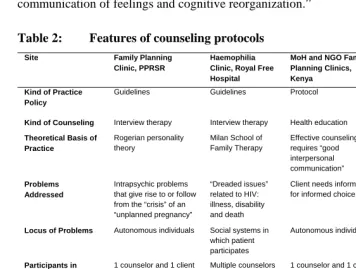
The guidelines for counseling at PPRSR were spelled out in some detail in But Why Didn’t She Use Birth Control? A New Approach to Pregnancy Test Counseling, a training manual written in 1981 by Ellen Taves, then the agency’s Director of Counseling (see Table 2). According to this manual, effective counseling does not confine itself to providing information. Except for adolescents, “[a]lmost all normally intelligent clients with a year or two of high school education have sufficient information to prevent unwanted pregnancy” (Taves 1981:6). Indeed, counselors who only provide information may find their clients returning with the same issues they presented earlier. Rather, counseling is conceived of as addressing the problems in women’s lives that gave rise to or might follow from the “crisis” of an actual or potential “unplanned pregnancy” (Beresford 1977, Baker 1985).
Counselors “took” clients, beginning their part in a patient visit, when the Patient Service Representatives in the reception area turned on a light in the Counseling Department to signal that a client was ready. Counselors began their work with a client by picking up her paperwork, which they might not read until they were sitting with her in a counseling room, if then; adding a pregnancy test visit form; doing her pregnancy test; going to meet her in the reception area, and escorting her to a room in the counseling area. Though it does not say so explicitly, the PPRSR counseling manual is based on the assumption that counseling would begin before the pregnancy test result was available and had been presented to the client (see below on “contract”).
At PPRSR, clients were conceived of as, potentially at least, autonomous individuals. Counseling, therefore, was properly one-on-one, one counselor with one client. A client might need support if she elected to have an abortion, but she could and should make her own decisions.
when “unresolved feelings” prevent us from “thinking clearly” and taking constructive action. When this occurs, counseling aims to free up action by helping us to “recognize” and “accept” our feelings and then “working [them] through.” (Taves 1981:13-28 emphasis removed). Counseling of this sort is what the psychiatrists Jerome and Julia Frank (1991:35) call an interview therapy, stressing “the communication of feelings and cognitive reorganization.”
Table 2: Features of counseling protocols
Site Family Planning
Clinic, PPRSR
Haemophilia Clinic, Royal Free Hospital
MoH and NGO Family Planning Clinics, Kenya
County DoH Family Planning Clinics, Maryland Kind of Practice
Policy
Guidelines Guidelines Protocol Standard
Kind of Counseling Interview therapy Interview therapy Health education Health education
Theoretical Basis of Practice
Rogerian personality theory
Milan School of Family Therapy
Effective counseling requires “good interpersonal communication”
Clients must be given information before they choose a contraceptive method
Problems Addressed
Intrapsychic problems that give rise to or follow from the “crisis” of an “unplanned pregnancy”
“Dreaded issues” related to HIV: illness, disability and death
Client needs information for informed choice
Client needs information for informed choice
Locus of Problems Autonomous individuals Social systems in which patient participates
Autonomous individuals Autonomous
individuals
Participants in Counseling
1 counselor and 1 client Multiple counselors and clients
1 counselor and 1 client 1 counselor and groups of clients
Forms of Client Communication
Propose “contract” Open-ended questions Requests to expand on or discuss a topic Clarifying statements Productive use of silence
Eliciting client’s stories Respectful, empathetic, and genuine Circular questions Hypothetical questions Live supervision
GATHER: Greet, Ask, Tell, Help, Explain, Return Respectful and empathetic
In the PPRSR manual, the key concerns of counseling are problem solving and empowerment. This involves
actions to solve the problem and prevent similar problems from arising in the future. (Taves 1981:8)
Written in 1981, after abortion was legalized in New York State but before PPRSR began to offer the procedure, the PPRSR manual imagines that the problems that counseling will deal with are “upstream” of the problem pregnancy, in the client’s past or in the structure of her current situation. They have to do with the intrapsychic and social conflicts that led to the problem pregnancy.
Counselors are expected to be respectful, empathetic, and genuine toward their clients. This is “essential” for “creat[ing] a supportive environment where the client can solve her own problems.” Though it is not stated explicitly, it is presumably in such an environment that a client feels able to discuss “intimate matters.” Discussion of such matters also requires counselors to recognize, work through, and control their own strong feelings: feelings related to their own issues as well as those “produced in direct response to the client’s personality.”
But Why Didn’t She Use Birth Control? also envisions that counselors may accomplish this agenda using Rogerian communication skills. A counselor may invite her client to participate in counseling by offering a “contract,” saying something like
While we’re waiting for the test result, let’s talk about how you happen to be in this situation. When the results come we can talk about where to go from here. How does that sound? 13
If the client agrees, the counselor may proceed by (1) asking open-ended questions, (2) requesting the client to expand on a topic or discuss a new one, (3) making clarifying statements that reflect back to the client something she has said,14 and (4) by using silence productively. The manual particularly encourages counselors to (5) elicit stories from their clients and to be sensitive co-participants in the construction of those stories, though it does not contain a fully worked out theory of narration and co-narration. Consistent with the focus on the problems that led to the problem pregnancy and might, if unresolved, do so again, client narratives are imagined to be retrospective.
The manual provides examples of how counselors might communicate with their clients in these ways. Thus, a client might say, “When I told him I thought I was pregnant he just laughed and said it was my problem. I haven’t heard from him in two
13 Some clients may refuse such a “contract” or only need information. In that case, counseling would focus
on exchanging information: completing intake forms, providing test results, and “clarifying any misconceptions [the client] may have about sex, birth control, [abortion,] or pregnancy (Taves 1981:8).
14 Reflection helps the client to recognize her feelings. It “allows [the client] to accept or reject our reflection
weeks. And he always said if I got pregnant he’d stand by me. I haven’t got any money.” To this an appropriate clarifying statement reflecting back to the client what she has said might be, “I’m hearing you say that you’re really mad at him for taking off when you told him you’re pregnant, and it also sounds as if you’re afraid you can’t manage the pregnancy on your own.” However, none of this adds up to a script. Nor could it since the concerns of each client and the sequence and manner in which they emerge during a counseling session are unique. Instead, the manual aims to equip counselors with essential skills.
3.2 Counseling sessions
Offering an approach and a set of skills rather than a script, the PPRSR counseling manual anticipates that counseling sessions will be improvised. This was, in fact, the case. Each client presented a unique set of concerns and did so with unique language and in a unique sequence. Counselors’ responses were unique as well. No two counseling sessions were alike.
Nevertheless, PPRSR counseling sessions shared a series of structuring resources. These included the rooms in which counseling took place, forms used by the agency, and, centrally, forms of talk. Counseling took place in one or another of the small rooms opening off the area in which counselors sat in their cubicles. Each room was equipped with several straight chairs in which the counselor could sit close to and facing her client plus a shelf holding a pregnancy date calculator, a clear plastic model of the female reproductive organs, and a box of tissues. The pregnancy test that was the nominal occasion for counseling required the client to sign an informed consent form and the counselor also completed an intake form on which the agency collected data about its clients.
Though the PPRSR manual imagines that counseling will begin before the test result is available, this was not how it always worked. Some counselors did avoid learning the result of the test before they met with the client, feeling that it was easier to “have a dialogue” before the test result was known and that it would be dishonest not to tell the client right away if they knew themselves. Other counselors, at least some of the time, told the client the result of her test right away.
counselor used a distinctive speech register,15 a tone of voice that conveyed empathy and concern and created a dyad within which the client could “open up” and discuss her feelings. This dyad was additionally invoked by the counselors’ use of the inclusive first-person pronoun ‘we’ in utterances such as
Counselor Well today we [the counselor and the client] are just going to talk through what you have been thinking about.
Counselor Well what we’re concerned about is that it’s great that you recognize that you’re pro-choice but that doesn’t mean that you would necessarily chose an abortion and that’s really important to recognize. And what we want to talk about right here is just you.
Within this private space, counselors used expressions such as “tell me about” and “let’s talk about” to voice the claim that their clients were to be the primary speakers while they were to be interested, attentive listeners. Conversely, expressions such as “I’m hearing” or “it sounds like” voiced the claim that the counselor was an understanding, insightful listener who might now take a turn as speaker, “reflecting” back to the client what the counselor has heard. Counselors and clients signaled their involvement in this dyad by using ‘uh,’ ‘hm,’ ‘okay,’ and other speech particles to demonstrate continued engagement in the interaction and to return the floor to their interlocutor.16
Entering into and sustaining a counseling session also required both counselors and clients to present themselves (Goffman 1959) in appropriate ways. Counselors presented themselves primarily as professionals who merited the role they were performing. Their claim to this identity was displayed in part through dress: something like business casual rather than the non-professional uniforms of the Patient Service Representatives, the scrubs of some clinicians, or the more formal business wear of the upper level managers. It also was displayed by pronouns that indexed (Hanks 2001) their affiliation with PPRSR. Thus when a counselor asked a client about her use of birth control, she explained,
Counselor And we [the agency as a whole and she as its representative] like to encourage women, whether they continue their pregnancy or whether they decide to terminate the pregnancy to really consider birth control ….
15 A register is a set of “conventionalized lexical, syntactic and prosodic [features] deemed appropriated for
the setting and the audience” (Tannen and Wallet 1993:63).
16 On the use of speech particles to display interest in what is being said see Schegloff (1982). Levinson
On occasion, counselors also made clear that they were not entirely caught up in their professional role, that they were the sorts of persons who understood how difficult this might be for the women they were seeing. Thus when the Pregnancy Test Visit Form was revised to include a question about experiences of sexual abuse, some of the counselors were at first uncomfortable making this new intrusion into their clients’ affairs. One posed the question in the following way, “They are asking if you have any violence issues.” “They,” the people in charge, not her.17
Counselors also used tactful forms of speech to protect their clients’ faces (Goffman 1955). For example, in the following utterance the counselor began in the client’s voice and ended in her own.18
Counselor When I’m [here “I” is the client] financially unstable, if I am, am I going to get support from them [the client’s parents]? Am I going to be able to move from my Dad’s house to my Mom’s house if I have to? Am I going to be able to rely on my Mom for childcare when I need to go out? Interview for jobs? Go to school? If I am going to go out with my friends? What I [here “I” is the counselor] want you to do is think about, I’ll write down -- I’ll write this all down for you. I want you to think about the two possibilities. Okay?
Refraining from giving the client unmitigated advice, the counselor used something like “substituted direct discourse” to say “in [her] stead what the [client] might or should have said, … what the occasion call[ed] for” (Voloshinov 1986:138), in effect inviting the client to see herself from the outside and at a future time.
Though some clients treated their visits to PPRSR as more or less routine – something like going to the dentist – most were in what the counselors saw as a crisis. Unresolved issues prevented them from using contraception effectively. They had or feared they had an unwanted pregnancy. They had to decide whether or not to continue the pregnancy. With these clients, counselors structured the trajectory of counseling sessions – the path they took from beginning to end – by inviting clients to tell the story of and co-narrating the events that led them to visit Planned Parenthood. Narratives
17 Conversely, the PPRSR clients I observed were at pains to display their claims to proper American
personhood. Very strikingly, they represented themselves as knowledgeable, as agents with goals and plans, and as connected with a variety of others – parents, sisters, boyfriends and their relatives, and friends – on whom they could call for assistance and whose views they took into account. Though African-American clients might speak Black English with their partners, friends, and relatives in the parking lot or waiting room, they spoke mainstream White English with counselors (on the use of White English by poor African-Americans in interactions with rental agencies, the Department of Social Services, and so on in another city in New York State, see Cushman 1998).
“match… a verbal sequence of clauses to the sequence of events which (it is inferred) actually occurred” (Labov 1972:359-60). They emplot aspects of our lives, “making a configuration in time, creating a whole out of a succession of events” (Mattingly 1994:812). Looking backward, narratives recapitulate and evaluate past experience. Looking forward, talk about the meaning of narratives sketches possible futures that might be brought about by actions taken now in response to past events. A co-narrative is one in which the components of the verbal sequence are shared among two or more speakers. This happens especially when a co-narrator feels that information vital to understanding the problem that motivates the actions and reactions of protagonists and others in the storytelling situation is missing. “Co-narrators [then] return, sometimes again and again, like Lieutenant Columbo, to pieces of the narrative problem in an effort to find ‘truth’ through cross-examination of the details, sometimes struggling for an illuminating shift in perspective” (Ochs et al. 1996:98).
Counselors invited clients to narrate their experiences, not by offering them a contract, but rather with requests and open-ended questions that offered them an extended turn or series of turns to speak. For example, a counselor began a session in the following way.
Counselor Okay. Tell me a little bit about what, uh, made you decide to come today. What’s been going on?
This request/question offers the client the floor and provides an abstract or summary of what she is expected to say. It also recognizes that the client is the owner of her experience (Peräkylä 1995:113ff), someone who can and should be able to provide an accounting of his or her conduct. Asked to explain why they had “come in today,” clients generally felt compelled to put at least some of their concerns on the table, even if they were “intimate matters.”19
This client responded with a story of how she discovered she was pregnant and how she and her boyfriend decided to have an abortion.
Client Well I missed my period two months in a row. So I just kind of figured that, because at first I, like I wanted to sort of, because me and my boyfriend we have been together for a long time, we plan on staying together, you know
Counselor Mm, mm,
Client and then we sat down and we talked and we decided that we just want to grow up some more, have fun and then start everything so, I don’t
19 It doesn’t always work. One counselor told me of a client who, when asked “What brought you in today?”
know, that’s, I don’t know kind of changed our mind and I think it was a little too late. I have been putting this off coming down here and I needed to come down here. I’m afraid it’s too late to, I wanted to get an abortion and everything. I hope it’s not too late for it.
As co-narrators of their clients’ experiences, counselors routinely used the verbs “to talk,” “to tell,” “to hear,” and “to sound” to negotiate changes in topic and further explore the events that brought the client to the clinic and the options she now faced. Working with a pregnant 18 year old who was unable to decide whether to continue the pregnancy or have an abortion, for example, a counselor used requests such as “tell me about,” “talk about,” “let’s talk about,” and so on to move the client through accounts of how she learned she was pregnant, who she talked to about her pregnancy and what she learned from those conversations, why she felt abortion was not for her, how she could avoid becoming like her sister who had had several abortions, what an abortion procedure would be like, continuing the pregnancy, putting the child up for adoption, and the time frame within which she needed to make a decision. Introducing the topic of abortion, the counselor said,
Counselor Um, I want to talk about two different scenarios. First let’s talk about -- um, because everything that you have said so far with the exception of some emotions about this decision lead, you know like the logical side of you from what I’m hearing is saying “okay, abortion is definitely an option.”
Client Hm, hm
Counselor So, let’s talk about how you see yourself preventing, um, becoming your sister or a person like your sister if you have an abortion.
Counselors also used statements about what they were hearing to draw out or call attention to distinct themes in terms of which their clients’ experiences and options might be understood: for example, the “parts” of clients that felt or thought one thing or another, or, more generally, the logical and emotional “sides” of their personalities. Especially when they reflected on what they were “hearing” or what the client’s talk “sounded like,” counselors participated in the evaluation of their clients’ narratives, stating or restating the morals of the stories or sketching some of their implications for future eventualities.
decision concerning a pregnancy and with the impact of that decision on her future.20 What would the client do next in a situation that had to be resolved within a few weeks? Would she use PPRSR’s abortion services or would she need to be referred to another abortion provider or to a prenatal service? Counseling continued to look backward, but it was interested in past events primarily as they entered into future decisions. Thus it was commonplace to hear a counselor respond to a telephone call by saying something like “What most women do is set up an appointment for a pregnancy test and see a counselor to talk about your decision.” Similarly, a counseling session with an undecided client began as follows:
Counselor You came in for a pregnancy test today. Client Mm, mm.
Counselor Tell me a little bit about why you decided to come in.
Client Well I really already know I’m pregnant. I don’t really know what I want to do. It’s like I’m between two decisions -- I don’t know if I want to have an abortion or if I want to keep it.
Counselor Okay.
Client And it’s like, you know a couple of my friends, well my sister’s had an abortion before and a couple of my friends have had kids and they are like just go to Planned Parenthood and then make up your own mind.
Counselor Yeah.
Client It’s like most of my friends, you know, they’re like “oh have it.” It’s like well you guys aren’t going to be there, you know, all the time to help me with everything and it’s not just an easy decision. (nervous chuckle)
Counselor Well today we are just going to talk through what you have been thinking about.
Client Mm, mm.
Counselor Okay. Kind of come to some conclusions.
PPRSR counselors structured talk in which they gave information to clients in two ways. Occasionally, counselors provided useful information to clients directly. In these instances, counselors briefly stepped outside the counseling frame or dyad. They spoke in the didactic or preceptive voice of the teacher. They used an exclusive “we” that indexed their professional affiliation with Planned Parenthood and separated them from their clients. Reciprocally, they referred to clients as “they” or “women,” members of a class of persons for whom Planned Parenthood provided services. Thus
about midway through their session, the counselor working with the undecided client says,
Counselor So, you did mention birth control pills, um -- those are extremely effective and probably you would be, what we would call, a very affective user. Which means that you would be very conscientious about taking the pill. If that’s the method you decide you want to use. And we like to encourage women, whether they continue their pregnancy or whether they decide to terminate the pregnancy to really consider birth control especially if they are coming in and protecting themselves like you. …
More often, clients were provided with useful information indirectly, within the counseling dyad and by means of co-narration. In co-narration, the counselor’s requests to “talk about” and her reflections on what the client’s narrative “sounds like” presupposed a series of expert propositions in terms of which they made sense. To continue or terminate a pregnancy is not an abstract moral choice, but is properly embedded in the circumstances of a woman’s life. The burdens of bearing and rearing a child fall primarily on women. It is for that reason, in part, that the decision to continue or terminate a pregnancy is hers alone. Coping with those burdens requires financial and emotional support. A woman should look for support, first, to her partner. If he is unable or unwilling to support her, she may ask her parents to support her, though they are not obliged to do so. The incorporation of such knowledge into the perspective of the person whose story is co-narrated is signaled by the emergence of new information and its inclusion in the story’s meaning. After the undecided client is advised to make a list of the ways in which her life would be affected -- financially, socially and emotionally -- by an abortion and by continuing her pregnancy, it emerges that she has “a little journal with all [her] ideas” that she will consult at home.
The concluding exchanges of counseling sessions routinely contained language pointing to the fact that the client was emerging with her personhood restored. She may have begun the session confronted by difficult and painful “issues.” And the session very likely involved “open” discussion of matters that were at least potentially embarrassing. By the end, however, the client had been treated as “an active, successful agent” whose future was “manageable” (Peräkylä 1995:327):
Counselor How are you feeling about all this?
college. I don’t know. It’s just I started seeing things differently now.
Counselor Mm, mm. Well that’s great. That’s good. Those are some good goals to have. (Chuckle) …
With experienced counselors and clients who appeared to understand what was expected of them, nearly all counseling performances at PPRSR were successful. There were few, if any, disruptions. Counselors and clients maintained their focus on the counseling interaction. Neither walked out of the sessions in anger or distress. The sessions arrived at some sort of conclusion. Both counselor and client gave every appearance of being satisfied. Nevertheless, just as performing artists may feel or know that their efforts have failed in one way or another, so counselors at PPRSR occasionally felt a session had fallen flat. For example, one counselor returned to the area where the counselors sat together saying she had just had “a very difficult client.” For a variety of reasons this client “wouldn’t talk,” even though she was herself a counselor at another agency in Rochester and should have known that it was necessary to “open up” if she wanted any kind of help.
All of this clearly belonged to the genre of counseling defined by the PPRSR manual (see Table 2). Counseling sessions were instances of interview therapy based on Rogerian personality theory. The client was treated as an autonomous individual. Counseling focused on intrapsychic problems that gave rise to or followed from the “crisis” of an “unplanned” pregnancy. Patient education was a subsidiary concern. Counselors used open-ended questions. They requested clients to expand on or discuss a topic. They made clarifying or reflecting statements about what they were “hearing” or what the client was “telling” them. They elicited their clients’ stories.
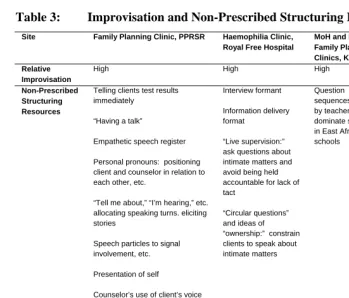
Table 3: Improvisation and Non-Prescribed Structuring Resources
Site Family Planning Clinic, PPRSR Haemophilia Clinic, Royal Free Hospital
MoH and NGO Family Planning Clinics, Kenya County DoH Family Planning Clinics, Maryland Relative Improvisation
High High High Low
Non-Prescribed Structuring Resources
Telling clients test results immediately
“Having a talk”
Empathetic speech register
Personal pronouns: positioning client and counselor in relation to each other, etc.
“Tell me about,” “I’m hearing,” etc. allocating speaking turns. eliciting stories
Speech particles to signal involvement, etc.
Presentation of self
Counselor’s use of client’s voice to mitigate advice
Co-narration
Prospective narratives
Preceptive voice
Ideas concerning the “ownership” of experience
Interview formant
Information delivery format
“Live supervision:” ask questions about intimate matters and avoid being held accountable for lack of tact
“Circular questions” and ideas of “ownership:” constrain clients to speak about intimate matters
Question sequences used by teachers to dominate students in East African schools Film Poll Jokes Preceptive voice derived from classroom
4. Counseling at other sites
In this section of the paper I test this finding by revisiting and reusing roughly comparable qualitative data from three other sites.
4.1 Royal Free Hospital, London
The Royal Free Hospital in London offers HIV counseling in two of its units. Persons seeking an HIV test are offered pre- and post-test counseling by a clinic associated with the Department of Infectious Diseases. The Haemophilia Center provides counseling to patients infected with HIV by transfusion prior to 1985 when steps were taken to insure the safety of blood products.
HIV counseling at the Royal Free Hospital was studied by Anssi Peräkylä (1995) and David Silverman (1997). The bulk of Peräkylä’s data come from the Haemophilia clinic. Silverman’s study focuses on pre- and post-test counseling and includes, in addition to material from the Royal Free Hospital, transcripts from other sites in the United Kingdom and the United States. Both use conversation analysis. Concerned with “the local, turn-by-turn organization of any sequence of talk without making prior assumptions about the relevance of our intuitive knowledge of its apparent social context, including participants’ own stated theories” (Silverman 1997:90), conversation analysis requires much more detailed transcripts than I provide for PPRSR. In neither study is the relationship between counseling models and counseling practices a central focus.
4.1.1 Counseling guidelines
As at PPRSR, the counseling offered to HIV-positive patients at the London Royal Free Hospital is an interview therapy (see Table 2). Among other things, counselors are to help their patients think about and plan for “dreaded issues” (Miller and Bor 1988, quoted in Peräkylä 1995:232): severe illness, disability, and death. However, where the counseling guidelines at PPRSR were based on a Rogerian theory of personality, the guidelines at the Royal Free Hospital are based on the Milan School of Family Therapy (Peräkylä 1995:7, Silverman 1997:19-21; see also Selvini Palazzoli et al. 1978).
react and find new (and possibly less problematic) ways of operating” (Peräkylä 1995:7, citing Boscolo et al. 1986:18).
The family systems model of counseling calls for multiple counselors and clients, each with his or her own perspective. Counselors try to work in pairs, one acting as the “principal counsellor and the other [as] co-counsellor.” In the Haemophilia Centre, patients are
repeatedly encourage[d] … to bring their ‘significant others’, usually spouses, family members or girlfriends, to the sessions. With adolescent patients, mothers or fathers are present in most interviews, and with other patients ‘significant others’ are present in about half of the sessions. All are treated as clients. (Peräkylä 1995:12)
The varying perspectives of these participants on the topics discussed are to be brought out or put to work by special kinds of verbal interactions. Clients and their significant others are to be asked “circular questions,” i.e. questions in which one client is asked about the experience of another client who also is present (Peräkylä 1995:9). The co-counselor’s role is to provide “live supervision.” Present in the room but not participating actively in the conversation, the co-counselor has a different perspective on the system of interaction developing between the counselor and the client(s). The co-counselor also may notice that the counselor and client are “stuck.” In live supervision, the co-counselor is to ask meta-questions, questions about the direct exchange between the counselor and client(s), “targeted to the clients but nominally addressed to the counsellor” (Peräkylä 1995:10). Together these forms of verbal interaction are thought to help clients realize that the problems they experience are embedded in the social system of which they are part. Hypothetical questions – for example, “‘If you had to be admitted to hospital as an in-patient, and had not told your boyfriend about your positive antibody test, what might be the effect of this on your relationship?’” – are thought to make it possible for clients to address “dreaded issues” (Peräkylä 1995:9-10).
4.1.2 Counseling sessions
Silverman (1997:41) suggests that “most of the talking done” in HIV counseling sessions at the sites he studied involves one or the other of two patterns of interaction. In the “interview format,” the counselor and client “are aligned as questioner and answerer.” For example, an extract from a counseling session at the Royal Free Hospital Department of Infectious Diseases goes as follows:
C: (…) What you think the wo;rst thing would- (.) be: (.5) knowing your result, (.) one way or they other, (1.6)
P: Erm:: (1.2)
P: Well I mean obviously (.) (if it wann’t AIDS er) (1.2)
C: um
P: that would be great (.) or: (.6)
P: but if it was positive I (really) don’t kno:w ho:w (.3)
C: um: (.2)
P: ((sniff, cough)) I would be able to deal with This.=er::
C: uhm: whad you thin:k (.2) the problems would be: immediately on hearing it,
(.2)
C: jst (.6) out of curiosity? (.3.8)
P: I don’t know ( ) (Silverman 1997:41-42, line numbers removed).
In the “information delivery format,” the counselor and client are aligned as speaker and recipient. Thus a pre-test counseling session at the genito-urinary clinic of an urban hospital in the United Kingdom includes this exchange:
C: .hhh How much do you know about the (.) test itself. (1.0)
P: Other than it’s a blood test, I really don’t know anything else:.
C: Right. .hh (.2) What it is it’s an- (.2) antibody test.
C: .hh Now from:: (.2) the time::? (.2) someone’s infected,
((information-delivery continues)) (Silverman 1997:44-45, line numbers removed).
Neither format is recognized by the counseling models, if any, employed in the agencies concerned (see Table 3).
Peräkylä observes that counselors at the Haemophilia Centre use resources outlined in the Milan School model to structure talk about “dreaded issues” in ways that the Milan School model does not anticipate (Table 3). On the one hand, live supervision makes it easier for counselors to ask what otherwise would be rude questions about life and death concerns. In the following brief excerpt, for example, two counselors, one of whom is Doctor Kaufman (C2), are talking to a patient named Michael who is HIV positive.
C1: And you can- (.2) I’ll se[nd you a letter with= C2: [letter
C1: an appointment a[nd then you can let= P: [Yeah
C1: =me know whether you want to [keep it (or not). P: [(No well) I’ll
keep walking (.3) anyway (.2) (which will make me a) ( ).
C2: Doctor Kaufman I’d like (0.3) to a::sk (1.7) what (.) at the moment hh (.2) is Michael’s main concern.
characterize the patient’s experience, the patient himself or herself, the “owner” of the experience, finds it difficult not to correct or qualify the significant other’s response (Peräkylä 1995:103-143).
4.2 County health department family planning clinics in Maryland
At clinics operated by county departments of health in Maryland, nurses offer “preventive medical care,” including contraception, to teenagers and other patients “at little or no cost” (Nathanson 1991:168).
Constance Nathanson (1991) observed family planning counseling in Maryland as part of her study of the social control of adolescent sexuality. Though her concerns were quite different from mine, her material may be used to examine the relationship between counseling models and counseling standards in the Maryland clinic setting.
4.2.1 Counseling standard
The model that informs counseling at county department of health clinics in Maryland differs sharply from those found at PPRSR or the London Royal Free Hospital Haemophilia Clinic. The Maryland State Health Department Family Planning Division requires family planning clinics to meet a fairly simple mandatory standard (Table 3). According to this standard, family planning clinics must give clients “contraceptive education and counseling” before providing them with contraceptive services and supplies (Nathanson 1991:170). Counseling is conceived of as a form of health education. The aim is to provide the client with needed information. “Intimate matters” are not a concern for this standard.
4.2.2 Counseling sessions
unanimously choose the pill, the nurse explained that method in detail and others “’lightly.’” According to Nathanson, this is how it goes:
You must start your pills on the Sunday after the first day of your next menstrual period, (“this way,” the nurse jokes, “you will never have your period on a weekend,” setting off a wave of giggles), and you must use foam and condoms with entire first pack of pills (and it would be better if you don’t have sex for the first ten pills); you must use foam and condoms if you miss even one pill; if you miss three, you must use foam and condoms till the end of the pack. You must take the pill at the same time every day. You must always remember the type of pill you’ve been taking and the date of your last menstrual period. Finally, you must never say, “I got pregnant because I lost my pills.” (Nathanson 1991:170)
Here the counselor uses some of the same resources my colleagues and I employ in teaching: films, more or less the same words to one audience after another, jokes to lighten the lecture (see Table 3). None of this is specified by the Maryland counseling standard. Beginning with a film and continuing with an educational talk to a group of clients who have few opportunities to speak, these counseling sessions appear to involve relatively little improvisation.
4.3 Family planning counseling in Kenya
In Kenya, the Ministry of Health, the Family Planning Association of Kenya, the Kenya Medical Association, Mandeleo Ya Wanawake Organization, Family Planning Private Sector and the Christian Health Association of Kenya offer family planning services at clinics located in hospitals, health centers, and dispensaries and through community-based distributors.
Family planning counseling in Kenyan clinics was studied by Young Mi Kim and her associates using transcript analysis. The translated transcripts were analyzed in two ways. To produce quantitative measures, each turn at speech in an exchange was coded using techniques borrowed from Roter and Hall’s (1992) studies of medical consultations. For example, a client’s entire speech during a turn was coded as “asks question,” if it was judged to fit the description “asks provider for information.” A provider’s speech was coded as “counseling” if it fit the description “advises clients based on their personal situation” (Kim et al. 1998:59). 21 Qualitative data consist of
21Leaving aside the differences between English and the languages of Kenya (see n9) as well as the problems
extended quotations from transcripts used to exemplify “styles” of counseling and tasks accomplished in counseling. Here I use only the qualitative material. Where Kim et al. were concerned to assess the degree to which counseling in Kenya met international standards of quality, my concern, again, is with the structuring resources counselors used.
4.3.1 Counseling protocol
The model for family planning counseling in Kenya is a protocol (see Table 2). The protocol was developed for Kenya and many other developing countries by such agencies as The Johns Hopkins Bloomberg School of Public Health's Center for Communication Programs, the Population Council, and the United States Agency for International Development. It is spelled out in documents such as “Counseling Makes a Difference” (Gallen, Lettenmaier, and Green 1987), “Why Counseling Counts!” (Lettenmaier and Gallen 1987), and The Situation Analysis Approach to Assessing Family Planning and Reproductive Health Services: A Handbook (Miller et al. 1997).
The content of this protocol lies between the interview therapies at PPRSR and the London Royal Free Hospital Haemophilia Clinic, on the one side, and Maryland’s health education, on the other. The aim of counseling is to enable clients to make informed choices. Clients are conceived of as rational decision-makers who have the “right to make their own decisions about family planning based on full and unbiased information.” The possibility, central to the counseling guidelines at PPRSR, that clients may have adequate information but are prevented from using it by psychic conflicts that can be understood in terms of a Rogerian theory of personality is not considered.
The counselor is expected to ascertain the client’s family planning needs and to provide “accurate, clear information” (Gallen, Lettenmaier, and Green 1987:1). This is facilitated if the counselor uses “good interpersonal communication” to create “a trusting and caring relationship with clients” (Gallen, Lettenmaier, and Green 1987:7; Piotrow et al. 1997:71). As at PPRSR, “good interpersonal communication” is conceived of in Rogerian terms (Gallen, Lettenmaier, and Green 1987:21). However, in the influential GATHER acronym –
Greet the client warmly and politely. …
Ask the client about his or her family planning needs. …
Tell the client about the family planning choices available …
Help clients choose a method. …
Explain how to use the chosen method correctly. …
Return visits should be planned before clients leave. (Gallen, Lettenmaier, and Green 1987:21) –
and in the observation guide for situation analyses of family planning client/provider interactions (Miller et al. 1997:50-65) the only element of “good interpersonal communication” given anything like extended treatment is the greeting. The emphasis is on the provision of complete and accurate information.
Here too counselors are expected to be empathetic and respectful, but it does not appear that “intimate matters” stand in the way of informed decisions.22
4.3.2 Counseling sessions
As at PPRSR and the Haemophilia Clinic, family planning counseling in Kenya requires extensive improvisation. The GATHER counseling protocol provides skills but not a script. Clients have many opportunities to speak and do so in unpredictable ways.
In addition, counselors use structuring resources not contemplated in the protocol (see Table 2). Consider, for example, the following passage of transcript.
Provider: Have you understood? Client: Yes.
Provider: How did I explain it?
Client: I take one every day for 21 days. Provider: When will you start?
Client: Isn’t today the 1st? It will start today. Provider: But you will rest for how many days? Client: Seven.
Provider: And then? You will start when?
Client: Won’t I stop getting that blood on the 7th, and then start?
22
Provider: You rest for 7 days, then on the 8th you continue. So any time you are asked say, “I rest for 7 days and start on the 8th.
Noting that family planning counselors in Kenya commonly failed to “check to make sure the client understood the instructions they were given, Kim et al. (1998:36) offer this interchange as a positive example of “verifying client’s understanding of instructions.” However, it is arguable that there is more to it than Kim et al. recognize. This counselor is structuring the way she verifies the client’s grasp of key instructions using a form of talk that also has been observed in East African schools (Stambach 2000:111-124, Plummer et al. 2006). 23 The counselor takes the role of teacher. She treats the client as a student, even though she is a continuing client and the “married, 31-year-old mother of three” (Kim et al. 1998:36). The counselor asks questions about the facts she has been explaining and demands that the client repeat what she has been told. The client’s responses suggest that, for the moment at least, she too accepts this definition of the situation. Though Kim et al. see this exchange as a benign instance of verification, Stambach (2000:123-12400 reports that students were humiliated by such interactions and Plummer et al. (2007) observe that they ill accord with plans to deliver AIDS prevention messages through peer education in schools.
5. Conclusion and implications
Though the “‘clinic era’” has been complemented by the “‘field era’” (Piotrow et al. 1997:5), counseling remains a key component of family planning and reproductive health services. However, counseling is very much more complicated than commonly recognized. Like the community-based distributors studied by Kaler and Watkins (2001), counselors are street-level bureaucrats. They must bridge the gaps, large or small, among the agencies in which they are employed, the clients they serve, and their own identities as members of society. They must improvise on counseling models that are never more than bare bones outlines and they must perform in a dual sense, carrying out a task and doing so in a way that is “creative, realized, achieved” (Hymes 1981:81). Perhaps especially in the fields of family planning and reproductive health, they must find ways to talk about or around “intimate topics.” To accomplish all this, they draw on structuring resources from the wider society and culture as well as the settings in which they work.
23 Stambach (2000:123-124) suggests that on Mt. Kilimanjaro, in northern Tanzania, these education practices
Counseling models do not and could not provide more than the barest indications of how counseling is to be accomplished. Nor do counseling models recognize the extent of performance and improvisation required of counselors who enact them.
Counselors must flesh out the models they employ, bring them to some sort of life, and adapt them to the situations of their clients. Counseling performances may be routinized and improvisation minimized where, as in the Maryland county department of health family planning clinics studied by Nathanson (1991), counseling is defined as straight forward health education and is offered to groups of clients who have few if any opportunities to speak. However, counseling sessions are very much more complex and variable and considerably more improvisation is required where clients are expected to speak and counseling is conceived of a form of problem-solving: dealing with a crisis at PPRSR, working out how to live with HIV/AIDS at the Royal Free Hospital Haemophilia Clinic, or making informed choices at family planning clinics in Kenya.
Everywhere counselors use resources specific to the environments in which they live as well as those in which they work to structure their performances and negotiate the difficulties involved in talking about “intimate matters.” Resources originating in the work setting include forms of communication spelled out in counseling protocols: eliciting clients’ stories, live supervision, circular questioning, greetings, instructions for contraceptive use, and so on. Resources originating in the wider milieu include speech registers, personal pronouns that position and reposition the counselor and her client(s) in relation to one another and to the agencies in which counseling takes place, voices, modes of speech used by other professionals such as teachers, ideas about personhood and the “ownership” of experience, etc.
Family planning and HIV counseling services thus are complex health interventions (Campbell et al. 2000). This is not simply because they are comprised of multiple parts and have “many potential ‘active ingredients’” (Oakley et al. 2006:413), but also because the street-level bureaucrats who implement counseling models must do so creatively. Counseling sessions vary along several dimensions. They are defined by contrasting counseling models. Some of these treat counseling as health education; others emphasize one or another form of interview therapy. Counselors may have their own agendas (Kaler and Watkins 2001). Each client or group of clients is unique. Counselors draw on a variety of culturally specific structuring resources to accomplish their work. They are more or less skilled at performance and improvisation. Each counseling session is a unique performance.
(Miller, Askew, Horn, and Miller 1998:253). This may make sense when, as in the Haitian clinic studied by Maternowska (2000) or the Egyptian doctor-patient encounters studied by Sholkamy (2001), high status, male providers treat disadvantaged, female clients with contempt. In other circumstances, it may be both impossible and wrong. Impossible because counseling protocols always must be enacted by skilled counselors. Wrong because it risks deskilling counselors, treating them as automatons and ignoring their knowledge of the milieu in which they work. Program managers might do better to learn how counselors draw on cultural resources to carry out their work and support their efforts to do so. In the heyday of the counseling program at PPRSR, this was accomplished through regular meetings or “rounds” when counselors gathered to listen to and discuss tape recordings of counseling sessions. Similarly, the RESPECT trial of HIV counseling found that allowing counselors to observe their colleagues at work improved “counselors’ techniques” (Kamb et al. 1996).
Wight and Obasi (2003:156) recently argued that evaluations must attend to the processes involved in interventions, “the extent and quality of delivery,” if they are to discover what it is that produced or failed to produce an outcome. However, several of the better-known and more interesting process evaluations of complex sexual health interventions stop short of embracing the sorts of complexity I document here. The process evaluation of MEMA kwa Vijana (MkV), a school-based adolescent sexual health intervention in Tanzania, produced limited data on the character of in-school social interactions.24 Similarly, the process evaluation of RIPPLE, a randomized peer-led sexual health intervention in 27 co-educational comprehensive schools in England, relies on reports obtained from focus group discussions with student participants rather than direct observation for its understanding of the performance of peer-delivered sex education sessions.25 Though it will no doubt complicate the analysis, process evaluations of complex health interventions should not evade the complexity and creativity involved in the roles of counselors and other providers.
25 Researchers observed a sample of teacher-led and student-led sex education sessions, but do not include
material from their fieldnotes in their analyses (Oakley et al. 2004, see also Strange et al. 2006).
24 Secondary school graduates were trained to do participant observation (PO) in “four intervention and five
6. Acknowledgements
Carol Love, President and Chief Executive Officer, and the Board of Directors of Planned Parenthood of the Rochester/Syracuse Region very generously permitted me to do fieldwork in their facilities. It is at Ms. Love’s request that I refer to PPRSR by name rather than by a pseudonym. Rick Bartell, Regional Director of Outreach Programs and Community Services, smoothly facilitated my research. Though I cannot use their names, I am much indebted to the counselors who welcomed me into their midst and to the clients who permitted me to observe and/or tape record their counseling sessions. My wife, Penelope D. Carter, who some years ago was a volunteer counselor, introduced me to Planned Parenthood’s counseling program and to a number of the counselors.
References
Ainsworth-Vaughn, N. (1998). Claiming Power in Doctor-Patient Talk. Oxford: Oxford University Press.
Ali, K. (2002). Planning the Family in Egypt. Austin, TX: University of Texas Press.
Atkinson, P. (1995). Medical Talk and Medical Work. London: Sage Publications.
Baker, A. (1985). The Complete Book of Problem Pregnancy Counseling. Granite City, IL: The Hope Clinic for Women, Ltd.
Bauman, R. (1977). Verbal Art as Performance. Prospect Heights, IL: Waveland Press.
Beresford, T. (1977). Short Term Relationship Counseling: A Self Instruction Manual for Use in Family Planning Clinics. Baltimore: Planned Parenthood of Maryland.
Berg, M. (1997). Problems and promises of the protocol. Social Science and Medicine 44(8):1081-1088.
Berg, M. (1998). Order(s) and Disorder(s): Of Protocols and Medical Practices. In: Berg, M. and Mol, A. (eds.). Differences in Medicine. Durham, NC: Duke University Press: 226-246.
Bledsoe, C. (2002). Contingent Lives: Fertility, Time, and Aging in West Africa. Chicago: University of Chicago Press.
Boscolo, L., Cecchin, G., Hoffman, L., and Penn, P. (1986). Milan Systematic Family Therapy: Conversations in Theory and Practice. New York: Basic Books.
Brown, L., Tyane, M., Bertrand, J., Lauro, D. et al. (1995). Quality of Care in Family Planning Services in Morocco. Studies in Family Planning 26(3):154-68.
Bruce, J. (1990). Fundamental Elements of the Quality of Care: A Simple Framework. Studies in Family Planning 21(2):61-91.
Campbell, M., Fitzpatrick, R., Haines, A., Kinmonth, A., Sandercock, P., Spiegelhalter, D., and Tyrer, P. (2000). Framework for design and evaluation of complex interventions to improve health. British Medical Journal 321:694-6.
Cicourel, A. (1985). Text and Discourse. Annual Review of Anthropology 14: 159-85.