DEMOGRAPHIC RESEARCH
VOLUME 30, ARTICLE 64, PAGES 1733
−
1768
PUBLISHED 4 JUNE 2014
http://www.demographic-research.org/Volumes/Vol30/64/ DOI: 10.4054/DemRes.2014.30.64
Research Article
Jobs, careers, and becoming a parent under state
socialist and market conditions:
Evidence from Estonia 1971-2006
Sunnee Billingsley
Allan Puur
Luule Sakkeus
©2014 Sunnee Billingsley,Allan Puur &Luule Sakkeus.
This open-access work is published under the terms of the Creative Commons Attribution NonCommercial License 2.0 Germany, which permits use, reproduction & distribution in any medium for non-commercial purposes, provided the original author(s) and source are given credit.
1 Introduction 1734
2 Work experience and the timing of parenthood 1736
3 The Estonian context 1739
4 Hypotheses 1742
4.1 The role of societal context: State socialism and the market economy
1743
4.2 Gender differences: Convergence or divergence 1743
4.3 Nativity status differences: Socio-economic and cultural factors 1744
5 Data and method 1745
5.1 Employment variables 1745
5.1.1 Work experience 1745
5.1.2 Career stage 1746
5.2 Other variables 1748
5.3 Modeling 1749
6 Descriptive results 1750
7 Multivariate results 1751
8 Discussion 1756
9 Acknowledgements 1760
References 1761
Appendix A 1766
Jobs, careers, and becoming a parent under state socialist and
market conditions:
Evidence from Estonia 1971-2006
Sunnee Billingsley1
Allan Puur2
Luule Sakkeus3
Abstract
BACKGROUND
Entering employment and achieving a stable position in the labour market are considered important preconditions for childbearing. Existing studies addressing the relationship between work experience and the timing of parenthood focus exclusively on Western Europe and North America. By adding an Eastern European context before and after societal transformation, this study contributes to a more comprehensive account of the role of work experience in first-birth timing in Europe.
OBJECTIVE
We investigate how work experience and career development are related to the timing of parenthood in two diverse contexts in Estonia, state socialism and the market economy, and how it varies by gender and nativity.
METHOD
The data used come from the Estonian Health Interview Survey 2006–2007. We estimate piecewise constant event history models to analyse the transition to first birth.
RESULTS
Our results suggest that in the market economy work experience became more important in the decision to enter parenthood. In the market economy the importance of work experience to entering parenthood became more similar for women and men. Non-native-origin men and women’s timing of parenthood appears to have become
1 Stockholm University, Demography Unit, Sweden and Södertörn University, The Stockholm Centre on
Health of Societies in Transition (SCOHOST). E-Mail: [email protected].
2 Estonian Interuniversity Population Research Centre, Tallinn University, Estonia. E-Mail: [email protected]. 3 Estonian Interuniversity Population Research Centre, Tallinn University, Estonia. E-Mail:
detached from their career developments. The article discusses mechanisms that may underlie the observed patterns.
CONCLUSIONS
Our study shows how work experience gained importance as a precondition for parenthood in the transition to a market economy. This lends support to the view that the increasing importance of work experience is among plausible drivers of the postponement transition that extended to Eastern Europe in the 1990s.
1. Introduction
The postponement of parenthood is the most prominent feature of contemporary fertility dynamics in Europe. Mills et al. (2011) demonstrate that women’s age at first birth has steadily increased by about one year per decade across almost all OECD countries since 1970. This widespread phenomenon has sparked a growing interest in why young adults postpone parenthood. Educational expansion is a leading explanation (Ni Bhrolcháin and Beaujouan 2012; Blossfeld and Huinink 1991; Blossfeld 1995) as this entails more years spent in higher education and waiting to begin a family. Besides the mechanical effect of prolonged education, educational expansion is also linked to postponement through factors related to women’s higher earning power. We know that one of the pre-conditions for childbearing is getting a job (Hobcraft and Kiernan 1995), but studies on developed market economies have not produced consistent predictions of how work experience or the value of men’s and women’s time in the labour market influences women’s entry into parenthood (Nicoletti and Tanturri 2008), and we know little about how these dynamics may have contributed to postponement over time.
between work experience and the timing of first births. This contribution to the literature is important for two reasons: 1) we explicitly compare differences in the relationship between work experience and the timing of parenthood across two contexts, rather than discuss the role of context only in the interpretation of our findings, and 2) existing studies focus exclusively on Western Europe and North America; by adding an Eastern European context, this study contributes to a more comprehensive account of the role of work experience in first-birth timing in Europe.
Estonia is a particularly attractive setting for studying how the relationship between employment and the timing of parenthood has changed across two dramatically different contexts, because it offers the opportunity to observe the role of both economic and cultural factors. The early years of economic transformation were tumultuous because Estonia adopted a radical path of reforms and the delineation between the ‘old’ and ‘new’ societal regime was sharper than in most Central and Eastern European (CEE) countries (Åslund 2007). Estonia eventually became one of the most successful reformers in Eastern Europe. Second, Estonia has a large Russian-speaking minority and evidence has emerged that distinct demographic patterns characterize native and non-native-origin populations (Katus, Puur, and Sakkeus 2000; ESA 2009). This heterogeneity in the population potentially enables us to examine the role of cultural characteristics in how employment influences the timing of parenthood. Beyond the contribution of a case study, we expect our findings to illuminate the plausible contribution of the increasing importance of work experience to the start of ‘postponement transition’ in Eastern Europe during the societal transformation of the 1990s.
The survey data we use (Estonian Health Interview Survey) offers rich information about events that comprise the transition to adulthood, including when respondents completed their education and took their first job and the first job in their main occupation. We first observe whether there has been a shift in the timing of life-course events that generally precede childbearing, as any delay in meeting the preconditions leads to a delay in the transition to parenthood (Hobcraft and Kiernan 1995). Our main focus is how experience in the labour market and different stages in career development are related to the timing of parenthood and how the importance of these factors differs in a market economy context and in state socialism. We investigate patterns for men as well as women, which allows us to explore gender as a stratifier in the labour market and observe gendered patterns of divergence or convergence.
population. The final sections describe the data and methods, present our main results, and offer a concluding discussion.
2. Work experience and the timing of parenthood
Several complementary mechanisms have been discussed in the literature to explain how time spent in the labour market influences the timing of parenthood; these explanations generally rely on economic argumentation. Work experience has long been argued to be positively linked to the timing of parenthood for men and negatively linked for women (Becker 1981; Hotz et al. 1997) because earnings are assumed to increase with work experience, providing men with more resources to meet direct costs and increasing indirect costs for women. But if we assume that the rational evaluation of child-related costs operates within a long-term perspective, work experience may be linked to the timing of parenthood for men and women more similarly.
Two prominent longer-term theoretical arguments explain how work experience influences the timing of parenthood (Gustaffson 2001; Nicoletti and Tanturri 2008). The first explanation—the consumption-smoothing motive (Happel et al 1984; Hotz et al. 1997)—assumes that 1) individuals consider the loss of household income due to child-related costs within a life cycle perspective and 2) men’s earnings are the most important to household income. In this case the best time to become a parent is when the man’s income reaches its highest level. When the costs of childbearing are delayed until the household income is at its highest, then household losses in income are minimized and the consumption profile over the life cycle is smoothed. This logic implies that the shape of the age-earnings profile is a mechanism that determines the relationship between work experience and parenthood according to the consumption-smoothing logic: a flat earnings profile provides less incentive to postpone childbearing than a steep profile. In the latter case, earnings tend to be low at the early career stage but increase significantly, which provides an incentive to postpone childbirth, leading to a positive association between work experience and parenthood.
experience), and how quickly their human capital will depreciate during work interruptions. The longer employment interruptions and the more difficult the return to the labour market, the larger the depreciation of human capital will be, which increases the motivation to postpone childbearing until reaching a relatively secure position in the labour market. This contributes to a positive association between work experience and parenthood.
Another mechanism that may link the timing of parenthood to the length of time in the labour market is the need to amass savings (Santow and Bracher 2001), or wealth accumulation (Kravdal 1994). We may expect, therefore, that couples accumulate a certain level of resources through labour market earnings before entering parenthood. Whereas the consumption-smoothing motivation focuses on incomes, in particular the male partner’s income, the need to accumulate household wealth is also related to the housing sector (e.g., access to affordable dwellings) and the educational sector (e.g., whether tuition at tertiary level is paid, whether young adults are expected to pay back their student loans, etc.). The greater the need to accumulate resources, the stronger the incentive to delay childbearing, and hence the more positive the relationship between work experience and entry into parenthood.
Other mechanisms may also link work experience to the timing of parenthood. Santow and Bracher (2001) propose that managing to get a good job and retain it may be evidence to a woman that she has reached maturity and is now qualified for motherhood. If symbolic maturity related to established labour market position is perceived as a prevailing norm in society, it can be expected to contribute to a positive relationship between work experience and childbearing. Likewise, accumulated work experience may offset uncertainty related to employment instability. Besides the various returns to employment that encourage postponement of childbearing until some work experience has been gained, a relationship between work experience and the timing of parenthood may be shaped by norms and values. For instance, if career development is highly prioritized, the strong orientations towards professional achievement provide an incentive to accumulate work experience before opting for parenthood, resulting in a positive association between the two. Conversely, in the absence of such norms people may regard accumulation of labour market experience as less central among the pre-conditions of parenthood, leading to a different relationship. Also, we know age norms influence the timing of parenthood (Marini 1984; Settersten & Hagestad 1996) and therefore the relationship between work experience and the timing of parenthood may be moderated by how long individuals feel comfortable waiting to enter parenthood.
For women the findings are more mixed. Happel et al. (1984) found that work experience (proxied with women’s age at marriage) had an inhibiting effect on the entrance to parenthood in the United States and this finding was supported in Blossfeld and Huinink’s (1991) study in Germany. Similarly, Martín-García and Baizán (2006) reported that pre-marital work experience appeared to suppress first births in Spain. However, these findings stand in contrast to a growing body of research: many studies across varying contexts suggest that women delay childbearing until they have accumulated work experience. Studies on Norway (Kravdal 1994) and Sweden (Hoem 2000; Santow and Bracher 2001) reveal a positive relationship between accumulated labour market experience and first birth risks. In particular, two years of paid employment appears to be a threshold women cross before becoming mothers and the likelihood of entering parenthood increases over the next few years of work experience. Vikat (2004) also reports a positive relationship between woman’s earnings and first birth risks in Finland. The authors of these studies have interpreted this positive association as part of a Nordic pattern of family formation that is particularly related to the fact that parental leave benefits in these countries are calculated as a replacement rate of previous income. However, more recently Nicoletti and Tanturri (2008) found a positive relationship across 10 West European countries: more specifically, women wait between three and seven years on average after labour market debut to have their first child.
But, as noted above, the mechanisms related to gaining work experience operating behind the postponement of first births may still be moderated by norms, including those relating to the appropriate age to enter parenthood. Despite increasing incentives to postpone parenthood, age norms do not change rapidly; which potentially explains the continuing earlier entry into parenthood in post-socialist Europe, as well as why the postponement transition took 30–40 years to occur elsewhere in Europe. Perelli-Harris (2005) found early childbearing in Ukraine to be encouraged by norms based both on traditional gender roles in the family and health concerns. Potančoková (2009) also discovered age deadlines for childbearing in Slovakia, and Mynarska (2010) found tension between push (postponing forces) and pull (forces counteracting postponement) factors in Poland; economic insecurity was a main reason for postponing parenthood, but this concern diminished as the age deadline for childbearing (30 years old) neared.
experience and the entrance to parenthood has changed over time is Winkler-Dworak and Toulemon (2007). In France work experience was positively related to when men and women entered parenthood and, between 1960 and 1990, work experience became more important in the timing of first births for both men and women. Also, Winkler-Dworak and Toulemon reported an increasing similarity for men and women of the effects of work experience on entry into parenthood. In formerly Socialist societies the labour market was characterized by a flat earnings profile, little opportunity and need for wealth accumulation, and high employment stability but low returns to human capital. All of these factors render the mechanisms predicting postponment of parenthood relatively inoperable.
In addition, family policies can modify the relationship between work experience and the timing of the first birth, because policies that assist women in maintaining careers when they have a child reduce the need to postpone parenthood (Mills et al. 2011). For example, public provision of childcare allows mothers to return to work earlier, which reduces the skill depreciation that occurs with longer interruptions in the labour market, and should lower the incentive to postpone (Happel et al. 1984). On the other hand, leave entitlements and child allowances that are tied to previous work experience and wages may increase incentives to postpone parenthood, whereas flat-rate benefits do not.
In summary, several mechanisms may shape the relationship between work experience and the timing of parenthood. Specific effects of these mechanisms on the relationship between work experience and timing of parenthood may originate in the context or be moderated by characteristics of the individual (such as whether their earnings profile is steep or flat).
3. The Estonian context
early careers (Noorkõiv et al. 1998). This shift from a flat to a steep earnings profile for young adults reflects the important change in the labour market that accompanied the transition from state socialism and implies a strengthening of the incentive to accumulate work experience before opting for parenthood.
Whether the relationship between work experience and the timing of parenthood is similar or different for men and women depends to a significant degree on gender differences in labour market participation and earnings. Estonia has ranked high in international comparisons of female employment since the early 1970s (ESA 2006). In the 1970s and 1980s the dual-earner family model prevailed and the gender gap in employment rates was primarily due to women who were on maternity and parental leave. The scale of the decline in employment rates during market transition was similar for men and women, while in the 2000s the gender difference in employment rates has diminished (See Appendix A). Although the share of part-time work in female employment has more than doubled since the early 1990s (14.5% in 2010), full-time employment clearly prevails. On the eve of the 2008 economic recession the full-time equivalent employment rate of Estonian women (64.1%, 2007) was the highest of all the EU member states (European Commission 2009). This description makes clear that women have long participated in the labour market in Estonia, due to either strong orientations toward work or norms related to women working.
On the other hand, Estonia features a relatively large gender gap in earnings, which emerged well before the transition to a market economy. Administrative wage-setting mechanisms favoured occupations and branches of the economy with a high proportion of male workers and consolidated the position of women as secondary income earners in the household. In 1989 women earned on average 31% less than men, net of human capital characteristics (Noorkõiv et al. 1998). When the previous mechanisms ceased to operate at the beginning of the 1990s the female disadvantage in wages temporarily diminished. However, it increased again thereafter and has been among the largest in the EU countries in the 2000s (ESA 2006). The fact that men remain the strongest earners may imply that men are still considered the main breadwinners, and that consumption smoothing should be related more to men’s earnings than women’s.
flat-rate payment. Another important institutional arrangement relates to housing allocation, which favoured married couples and families with children and encouraged early childbearing (Katus, Puur, and Põldma 2004).
The evidence pertaining to changes during societal transition is mixed. During the early phases of transition it was feared that the availability of public childcare would seriously decline. These concerns were temporarily realized: the childcare enrolment rate decreased from 24% to 12% among 0–2 year-olds and from 69% to 56% among 3– 6 year-olds at the beginning of the period. Also, the duration of employment interruptions related to childbirth significantly increased in the early 1990s.4 However, after reaching the lowest point, childcare enrolment rates recovered and later exceeded previous levels.5 In 2004 a major improvement was introduced in the parental leave scheme. A generous earnings-related parental benefit replaced the low flat-rate benefit; the rate of compensation amounts to 100% of the income received during the calendar year preceding childbirth.6 There is evidence that women’s employment rates prior to childbirth increased following the introduction of income-related parental leave in 2004; this suggests a strengthening of the relationship between work experience and parenthood among women (Võrk et al. 2009). The shift from administrative distribution of dwellings to a housing market increased the role of resource accumulation, which can be seen as an additional incentive to postpone parenthood in the transition context.
A specific feature of contemporary Estonian society is the presence of a large foreign-origin population that settled in the country in the aftermath of the Second World War. Immigration in the late 1940s and 1950s, mainly from neighbouring Russia, was strengthened by forced societal re-arrangements and deportations of the local population (Rahi 2003). Until the late 1980s migration to Estonia was to an important extent driven by Soviet economic policies and the somewhat higher living standards that made the country attractive for immigrants (Misiunas and Taagepera 1993; Kahk and Tarvel 1997). Following the collapse of the USSR and the restoration of Estonian independence the foreign-origin population experienced greater difficulties in adapting to the new realities of a market economy (Puur 2000a; Luuk 2009). Their employment rates and earnings appear to have been systematically lower and their unemployment rates higher than among the native population.7 Overall, these patterns
4 In the 1980s the median duration of work interruptions related to childbirth was 18 months. In the first half
of the 1990s the median duration increased to 37 months (Puur 2000b).
5 At the beginning of 2000s enrolment in childcare had exceeded the levels characteristic of the 1980s. In
2007, when the data analysed in this article were collected, 11% of 1-year olds, 58% of 2-year olds, and nearly 90% of 3–6 year olds attended public childcare in Estonia (ESA 2013).
6 Initially the payment was limited to 11 months; in 2006–2008 it was extended to 18 months.
7 In 2000–2010 the deficit in employment rates and excess in unemployment rates among the foreign-origin
appear similar to those commonly observed in the immigrant countries of Western Europe (Brinkmann 1987; Heath and Cheung 2007).
As elsewhere in Central and Eastern Europe, in Estonia the 1990s witnessed a steep fertility decline. In less than a decade the total fertility rate (TFR) fell below 1.3 children per woman (See Appendix A). Estonia experienced a relatively strong recovery of fertility rates in the 2000s, and in 2001–2011 had the highest TFR of the East European EU member states. In regards to the timing of parenthood, the mean age at first birth reached the lowest point in 1991 (22.6 years) and persistently increased afterward; the entry into motherhood was postponed by nearly 4 years (26.4 years in 2011). In general, the foreign-origin population has followed the trends characteristic of the Russian Federation, with higher fertility among older cohorts and a greater decrease to lower levels than among the native population (Katus et al. 2000). Childlessness has been lower and motherhood earlier among the foreign-origin population. This is in accord with results based on the Estonian Generations and Gender Survey (2004–2005): the evidence reveals that among the foreign-origin population, age norms prescribe a somewhat earlier entry into parenthood.8
4. Hypotheses
The discussion of mechanisms at work illustrates that deciding the optimum age at parenthood is a rather complex process, with mechanisms that likely interact. On average, however, the predominance of mechanisms (consumption smoothing, career-planning rationale, wealth accumulation, labour market security, symbolic maturity, work orientation) lead us to expect both men and women to increasingly postpone parenthood until having gained work experience; hence the relationship between work experience and first birth timing should be positive. Previous research also suggests, however, that the role of different factors affecting this decision may vary across contexts and sub-groups of the population. Based on these considerations and the empirical settings we have formulated three sets of hypotheses pertaining to the relationship between work experience and first birth timing.
8 For example, non-native-origin men and women born 1965-1983 believe that the latest individuals should
4.1 The role of societal context: State socialism and the market economy
A main expectation in this study is that the relationship between work experience and the timing of parenthood evolved as Estonia transitioned from state socialism to a market economy. Whereas simply getting a job may have sufficed as a marker of independence in the former economic system, gaining work experience and achieving stable employment should have become more important if the need or desire to accumulate economic resources and security underlies the relationship between employment and parenthood (H1: societal change hypothesis). As described in Section 3, inequality in wages significantly increased during the transition to a market economy, and individual achievement and competition began to play a greater role in career and wage developments. Specific to the mechanisms discussed, age-earnings profiles have become steeper, job instability has increased, and for women work interruptions have become longer. In addition, the administrative distribution of durable goods and housing was abolished and replaced by the market, which has implications for the accumulation of resources. These changes generate strong incentives to postpone childbearing in the market economy context and imply a strengthening of the relationship between work experience and parenthood. We have described some key changes in societal context involving mechanisms that are theoretically linked to the timing of parenthood, but this description is not exhaustive. In particular, we might expect shifts in values and norms (e.g., age norms shifting towards older age of childbearing, greater value placed upon career development) to have occurred over this time period that may also moderate the relationship between employment and childbearing.
4.2 Gender differences: Convergence or divergence
experience separately for men and women and to compare how the relationship between them has changed over time. In the case of Estonia, predicting convergence or divergence in patterns is difficult, due to the fact that gender role equality and reconciliation measures deteriorated in the early phases of transition, but afterwards gradually improved.
We do expect to see that the importance of work experience increased more for men than for women (H2a: gender divergence hypothesis), due to wage dynamics. Although during state socialism high female labour force participation was supported and the dual-earner family model was widely accepted, the gender wage gap was still significant and men were perceived as primary earners. The persistence of a large gender gap in earnings suggests that men have retained their role as the main income provider. This may give men’s earnings the higher priority in the household. Nevertheless, most mechanisms discussed in Section 2, relating work experience to the timing of parenthood, predict similar postponement for men and women. In addition, in the market economy the need to pool incomes for wealth accumulation may have increased the importance for young couples to pursue dual careers rather than simply enter the labour market, making both men and women equally important income providers for the family. If this is the case, we might expect to see the role of employment development become more similar for men and women (H2b: gender convergence hypothesis). Gender convergence in postponement of parenthood might also be related to the shift toward anticipating longer work interruptions following the birth of a child.
4.3 Nativity status differences: Socio-economic and cultural factors
non-native-origin Estonians may be less responsive to incentives to accumulate work experience. This assertion leads us to hypothesis H3b (cultural norms hypothesis).
5. Data and method
We use the Estonian Health Interview Survey (EHIS), which was administered once over a time period spanning the final months of 2006 and first months of 2007. The aim of this survey was to provide life histories for studying health (Oja et al. 2008). The sample consists of permanent residents of Estonia and was drawn with a stratified systematic sampling method, comprising over 6,434 individuals aged 15-84, with a response rate of 60%. Respondents are not observed earlier than their 16th birthday and are observed until they turn 45. We excluded individuals who experienced their first childbirth before the age of 16. We restricted our sample to the 1945-85 birth cohorts to limit our observation to more recent childbearing. In total, we are able to analyze the transition to parenthood of 3,267 individuals (1,593 men and 1,674 women).
5.1 Employment variables
The main variables of interest in this study are related to respondents’ engagement with the labour market. Unfortunately, complete job histories were not collected in the survey, which would have been ideal for the purposes of this study. However, three questions about job histories allow us to sketch key events over the working life: we know when respondents began the first job that lasted more than three months, when they began a job that was part of their main career,9 and when they were unemployed for 12 months or longer. In all models we include a time-varying dummy variable that indicates when respondents are experiencing a lengthy spell of unemployment. With the other pieces of information we construct two useful employment measures. Although our measures are imperfect, using two independent measures of progress in the labour market allows us to cross-check our empirical findings.
5.1.1 Work experience
First, we created an objective measure of work experience. At labour market debut a clock begins and categorizes respondents into having been in the labour market 0-2
years, 3-5 years, and 6 or more years. Although we can control for long periods of unemployment we do not know when respondents had short episodes of unemployment, similar to the study by Winkler-Dworak and Toulemon (2007), or exited the labour force for other reasons, similar to the study by Nicoletti and Tanturri (2008): rather, we focus on the time elapsed since entering the labour market as a “relevant step in the path towards economic independence, autonomy and adulthood” (Nicoletti and Tanturri 2008:164). Rather than observe differences by single years of time since entering the labour market, we group multiple years together to preserve adequate cell counts in three-way interactions. Splitting work experience after the second year and into the sixth year allows us to compare the results for Estonia with other European countries (Kravdal 1994; Nicoletti and Tanturri 2008; Santow and Bracher 2001).10
5.1.2 Career stage
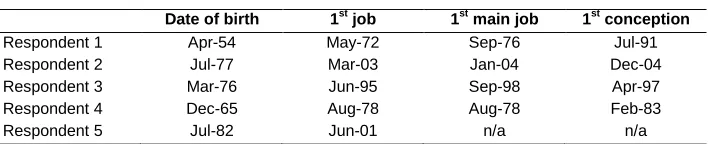
Because the work experience measure offers no information about the quality of labour market experiences or how respondents’ careers have developed, we also use a measure that subjectively tells us which career stage the respondent has entered. The second labour market variable therefore complements the objective indicator of work experience, and indicates whether respondents have not worked yet, have entered the early stage of their career, or have entered the main stage of their career. We do not distinguish between temporary and permanent contracts or between part-time and full-time work because both temporary and part-full-time contracts are relatively infrequent in Estonia, except for students. This is a time-varying covariate in which individuals usually enter the observation window (at age 16) as having never worked. When they begin working in their first job they are categorized as having entered the early stage of their career and when they begin working in their main occupation they are categorized as having entered the main stage of their career. However, respondents are also asked if their first job was their main occupation: if this was the case, respondents never contribute to the early career stage exposure as they are directly classified as having entered their main career stage. Likewise, younger respondents may claim they have not yet had a job in their main occupation.11 Table 1 displays some examples of career
10 We also used other specifications by shifting the categories a year in both directions, and the same pattern
held.
11 We use the terms ‘main occupation’ and ‘career’ interchangeably, but acknowledge that a career can consist
histories and main events that we observe in the sample to illustrate this variable, and how career progression may appear.
Table 1: Examples of career progression and main events from the sample
Date of birth 1st job 1st main job 1st conception
Respondent 1 Apr-54 May-72 Sep-76 Jul-91 Respondent 2 Jul-77 Mar-03 Jan-04 Dec-04 Respondent 3 Mar-76 Jun-95 Sep-98 Apr-97 Respondent 4 Dec-65 Aug-78 Aug-78 Feb-83
Respondent 5 Jul-82 Jun-01 n/a n/a
Because of its subjective nature and potential age dependence, we assessed the validity of the main career stage. As mentioned, we assume that a job in one’s main career should be of higher quality than jobs in the early career stage. However, it may be that this indicator captures a qualitatively different stage in a career, depending on respondents’ ages; younger respondents may have a different perspective on their working life due to having worked fewer years at the time of interview, and might claim that they began a job in their main occupation that older respondents, with a longer history, might not recall. If this is the case, we might expect that the main jobs attained by younger respondents are less of an achievement than those of older respondents. We therefore observe this potential age bias by how main career-entry jobs have changed across groups of respondents.
professional occupations in the occupational structure.12 If we look at developments in socio-economic status from the first to the main career job, we see that the increase in job quality was either the same for older and younger cohorts, or the younger cohorts achieved on average greater socioeconomic growth than the older cohorts. This implies that younger cohorts recall advancements in their career that were of similar quality to the older cohorts’ advancements.13 If we look at differences in our sample by nativity status, native-origin respondents fared better than non-native-origin respondents, which may reflect a pattern of privilege. Non-native-origin women appear to have had particularly poor progression during the period of state socialism, when we would expect fewer constraints on labour market opportunities for this group: this finding may be unstable due to the small sample of non-native women of these birth cohorts.
5.2 Other variables
In our study the non-native-origin population is defined as respondents who were not born in Estonia or who had parents who were not born in Estonia. All others were categorized as part of the native population. Using information on the highest level of completed education and the year in which this level was reached, respondents are classified as having “incomplete education” until June of the year they completed their education. After this point educational levels are given in which “basic education” includes those who completed only basic or less education, as well as those who received vocational education but completed only basic or less education beforehand. Those who completed “secondary education” may or may not have had additional vocational or specialized secondary education. All respondents who completed vocational higher education or higher education that resulted in a diploma or graduate degree were categorized as having “tertiary education”. We include dummies for whether respondents were born in an urban or rural residence, as well as the respondent’s number of siblings to account for family size predisposition. Respondents’ age is observed over five-year aggregations.
12 Estonian LFS data show that from 1989 to 2010 the proportion of jobs in managerial, professional, and
semi-professional occupations increased from 35% to 43% and the proportion of jobs in manual occupations decreased from 52% to 38%. Relative to the early 1960s, the changes are even larger.
13 We might have expected ISEI growth to have been greater when respondents reached their main job, but if
5.3 Modeling
We use piecewise constant event history models to analyze the transition to having a first child, and age is the process time. Observations are censored eight months before the first child is born to account for gestation, or eight months before the interview to account for the possibility that the respondent was pregnant at the time of the interview. The model can be expressed with the following formula:
hi(t) = h0(t) exp{β1xi1+ β2xi2(t)… + βkxik} (1)
where hi represents the intensity of transition to the 1st conception and t represents time;
h0(t) is the baseline hazard; β1xi1 represents coefficients of time-constant covariates; and
β2xi2(t) represents coefficients of time-varying variables. The time-constant variables
are sex, nativity status, urban/rural birthplace, and number of siblings. The time-varying covariates are age, work experience, career stage, educational level, and time period. We adopt a period approach in this study by distinguishing between exposure and events in two time periods: 1971-1991 and 1992-2006. We decided to limit the first time period to the 1970s-1980s in order to ensure greater homogeneity of state socialist context.14 Observing differences by period rather than by cohorts is a standard approach in studies that have contrasted family and fertility behaviour in state socialism and the market economy, because it avoids the ambiguity of dividing cohorts who entered critical periods in the event under study around the time of the critical juncture (e.g., Kantorová 2004; Klesment and Puur 2010; Billingsley 2011). To explore our hypotheses and observe whether there are statistically significant differences in how work experience and career stage influence the timing of parenthood, we interact our work variables with time period, sex, and nativity status. For example, a dummy variable indicates whether the observation occurred between 1971 and 1991 or whether it occurred between 1992 and 2006, and we interacted this dummy variable with the work experience and career stage variables in separate models. The log-likelihood ratio test tells us whether our interaction increases the fit of the model. We then explore two more sets of interactions, based on three variables: 1) the work variable, time period, and sex, 2) the work variable, time period, and nativity status.
6. Descriptive results
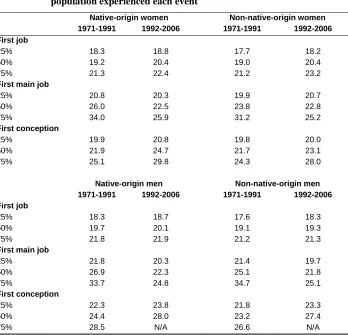
We first present descriptive results showing changes in the relationship between work experience and timing of parenthood over time, as well as variation in the relationship by gender and nativity status. We focus on the ordering of these life-course events, the intervals between them, and how similar the timing was within the population. Table 2 treats first job attainment, main job attainment, and first conception as independent events, and through calculating each Kaplan-Meier failure function we show when 25%, 50%, and 75% of the population achieve the event.
The typical order of events for both men and women during the state socialist period was getting a first job, entering parenthood, and getting a job in the main occupation. The median age at achieving the first job was around 19 for both men and women. As expected, women had their first child before men and there was little difference between when native and non-native-origin women entered parenthood: native-origin men, however, entered parenthood about a year later than non-native-origin men. In terms of when 50% of the group entered their main job, native-non-native-origin respondents did so around age 26 and the difference between men and women was minor; by contrast, non-native-origin respondents entered their main job significantly earlier, and women earlier than men (23.8 and 25.1, respectively). The fact that men enter this career stage later than women may be due to men engaging in compulsory military service. The inter-quartile range around entering the first job and parenthood was similar across all groups: there was more homogeneity in the timing of these two events than in the timing of entering a main job.
Table 2: Timing of events: when 25%, 50%, and 75% of the relevant population experienced each event
Native-origin women Non-native-origin women
1971-1991 1992-2006 1971-1991 1992-2006
First job
25% 18.3 18.8 17.7 18.2
50% 19.2 20.4 19.0 20.4
75% 21.3 22.4 21.2 23.2
First main job
25% 20.8 20.3 19.9 20.7
50% 26.0 22.5 23.8 22.8
75% 34.0 25.9 31.2 25.2
First conception
25% 19.9 20.8 19.8 20.0
50% 21.9 24.7 21.7 23.1
75% 25.1 29.8 24.3 28.0
Native-origin men Non-native-origin men
1971-1991 1992-2006 1971-1991 1992-2006
First job
25% 18.3 18.7 17.6 18.3
50% 19.7 20.1 19.1 19.3
75% 21.8 21.9 21.2 21.3
First main job
25% 21.8 20.3 21.4 19.7
50% 26.9 22.3 25.1 21.8
75% 33.7 24.8 34.7 25.1
First conception
25% 22.3 23.8 21.8 23.3
50% 24.4 28.0 23.2 27.4
75% 28.5 N/A 26.6 N/A
7. Multivariate results
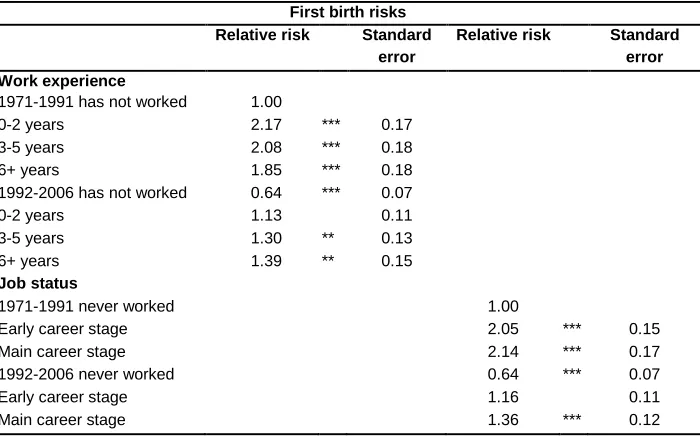
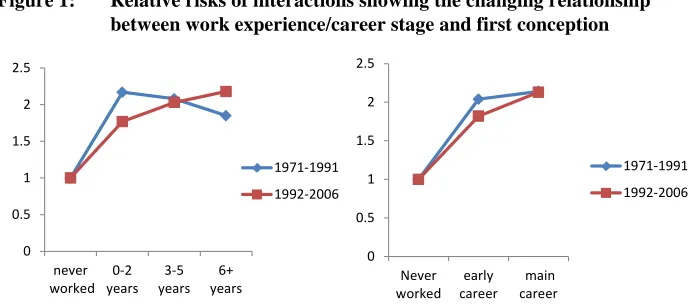
of the model and were statistically significant. In the 1971-91 time period, first conception risk peaked during the first two years after the respondent entered employment and slowly declined thereafter. Being in the early stage of a career also doubled the risk of conception and entering the main career stage increased the risk by an additional 9%. Figure 1 presents these interaction results in an intuitive format, where the impact of career development and work experience are relative to having never worked in each time period.
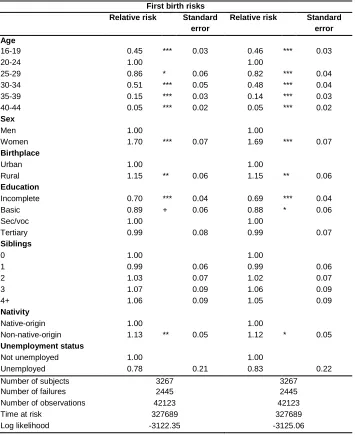
Our control variables operate as we would expect: women enter parenthood earlier than men and those born in rural locations enter parenthood earlier than those born in urban locations. When respondents were still studying they were much less likely to enter parenthood, but the timing between individuals of different educational levels hardly varied. Non-origin individuals entered parenthood earlier than native-origin individuals. The highest risk of entering parenthood occurred in the age ranges 20-24 and 25-29. Also worth noting is that being unemployed for 12 months or longer lowered the first conception risk, but this was not statistically significant.
Table 3: Full results for first conception hazard models, work experience and
career stage variables entered separately and interacted with time period
First birth risks
Relative risk Standard
error
Relative risk Standard
error Work experience
1971-1991 has not worked 1.00
0-2 years 2.17 *** 0.17
3-5 years 2.08 *** 0.18
6+ years 1.85 *** 0.18
1992-2006 has not worked 0.64 *** 0.07
0-2 years 1.13 0.11
3-5 years 1.30 ** 0.13
6+ years 1.39 ** 0.15
Job status
1971-1991 never worked 1.00
Early career stage 2.05 *** 0.15
Main career stage 2.14 *** 0.17
1992-2006 never worked 0.64 *** 0.07
Early career stage 1.16 0.11
Main career stage 1.36 *** 0.12
Table 3: (Continued)
First birth risks
Relative risk Standard
error
Relative risk Standard
error Age
16-19 0.45 *** 0.03 0.46 *** 0.03
20-24 1.00 1.00
25-29 0.86 * 0.06 0.82 *** 0.04
30-34 0.51 *** 0.05 0.48 *** 0.04
35-39 0.15 *** 0.03 0.14 *** 0.03
40-44 0.05 *** 0.02 0.05 *** 0.02
Sex
Men 1.00 1.00
Women 1.70 *** 0.07 1.69 *** 0.07
Birthplace
Urban 1.00 1.00
Rural 1.15 ** 0.06 1.15 ** 0.06
Education
Incomplete 0.70 *** 0.04 0.69 *** 0.04
Basic 0.89 + 0.06 0.88 * 0.06
Sec/voc 1.00 1.00
Tertiary 0.99 0.08 0.99 0.07
Siblings
0 1.00 1.00
1 0.99 0.06 0.99 0.06
2 1.03 0.07 1.02 0.07
3 1.07 0.09 1.06 0.09
4+ 1.06 0.09 1.05 0.09
Nativity
Native-origin 1.00 1.00
Non-native-origin 1.13 ** 0.05 1.12 * 0.05
Unemployment status
Not unemployed 1.00 1.00
Unemployed 0.78 0.21 0.83 0.22
Number of subjects 3267 3267
Number of failures 2445 2445
Number of observations 42123 42123
Time at risk 327689 327689
Log likelihood -3122.35 -3125.06
Figure 1: Relative risks of interactions showing the changing relationship between work experience/career stage and first conception
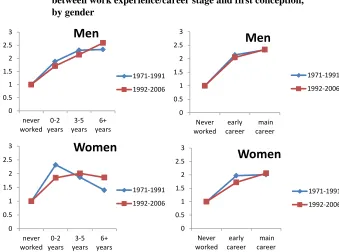
In the following three-way interactions we explore how these patterns have evolved differently for men and women, and for native-origin respondents and non-native-origin respondents. All interaction terms presented in the following figures tested statistically significant and improved the fit of our models. We present selected results, which are all adjusted for the control variables (unemployment status, siblings, education, urban/rural birthplace, and age: when the interaction does not involve sex or nativity status these were also included as control variables).
Figure 2 presents results pertaining to our second hypothesis on gender convergence and divergence. It shows that the previous results are mostly shaped by the changing pattern observed for women. By contrast, men show little change in how career advancement influences first conception. These findings indicate that the societal regime change has brought a greater adjustment to the employment-parenthood nexus among women. As a result, the characteristic patterns of men and women have become more similar over time.
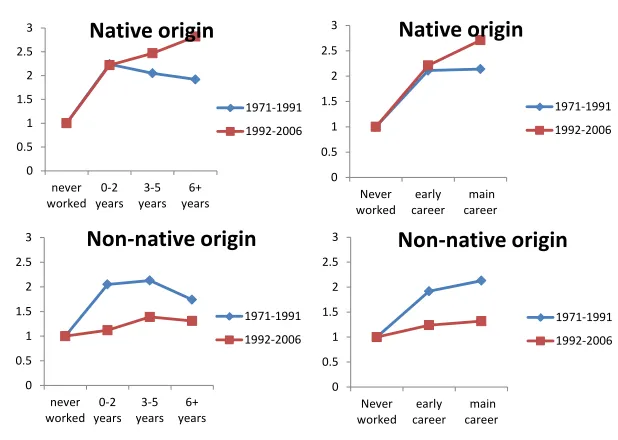
Figure 3 addresses our third hypothesis, which addresses the role of socio-economic and cultural factors. It presents the three-way interactions of time period, nativity, and employment variables. Pooling native-origin men and women together (to preserve sample size), the impact of entering the labour market is the same in the two different economic contexts. For native-origin respondents the conception risk used to peak in the first working years, followed by a steady decline. In the market economy the increase in conception risk peaks after having worked 6+ years. Conversely, for non-native-origin respondents, after 1992 labour market tenure appears unrelated to first conceptions. The same patterns emerge in the results for career stage: it is when native-origin respondents achieve their main career stage that their conception risk
0 0.5 1 1.5 2 2.5
never
worked years0-2 years3-5 years6+
1971-1991 1992-2006
0 0.5 1 1.5 2 2.5
Never
worked careerearly career main
becomes significantly higher than before. Again, the effect of career stage in the market economy loses all of its importance to non-native-origin respondents’ first conception risk.
Figure 2: Relative risks of interactions, showing the changing relationship
between work experience/career stage and first conception, by gender
The patterns by sex and nativity are clear; nevertheless we made one final estimation of a four-way interaction to more carefully observe gender differences by nativity (figure available upon request). We discuss results only for the larger sample of native-origin respondents: excluding non-native-origin respondents, the risk of first conception for men was even higher when they entered employment in the market economy and the increase in relative risks was even steeper as work experience accumulated. For native-origin women we see an even more stable plateau in relative risks after 1992, once 0-2 years of work experience has been accumulated.
0 0.5 1 1.5 2 2.5 3 never
worked years0-2 years3-5 years6+
Men
1971-1991 1992-2006 0 0.5 1 1.5 2 2.5 3 neverworked years0-2 years3-5 years6+
Women
1971-1991 1992-2006 0 0.5 1 1.5 2 2.5 3 Neverworked careerearly career main
Men
1971-1991 1992-2006 0 0.5 1 1.5 2 2.5 3 Neverworked careerearly career main
Women
Figure 3: Relative risks of interactions showing the changing relationship between work experience/career stage and first conception, by nativity
8. Discussion
In this study we investigated how changes in the institutional context may moderate the relationship between employment experience, career development, and the timing of parenthood. Specifically, we observed how employment developments were related to when men and women became parents in Estonia in the contexts of both state socialism and the market economy. We first explored descriptively the timing of employment stages and first conception to learn how these life-course events have changed in recent decades. We found evidence of substantial changes in early life-course events since the state socialist time period. First, despite educational expansion, the need for getting established in the labour market became consolidated. By contrast, the timing of when most men and women had their first child was later and became less uniform. The most dramatic change in early adult life transitions was earlier entrance into the main occupation; this appears to have become a pre-condition for childbearing in the market economy, whereas it was not before. While this finding may be partially driven by the
0 0.5 1 1.5 2 2.5 3 Never
worked careerearly career main
Native origin
1971-1991 1992-2006 0 0.5 1 1.5 2 2.5 3 Neverworked careerearly career main
Non-native origin
1971-1991 1992-2006 0 0.5 1 1.5 2 2.5 3 neverworked years0-2 years3-5 years6+
Native origin
1971-1991 1992-2006 0 0.5 1 1.5 2 2.5 3 neverworked years0-2 years3-5 years6+
Non-native origin
age at which respondents were interviewed (see 5.1.3), it may also reflect a more aggressive approach toward career establishment in the younger cohorts, as well as greater incentives and new opportunities. We explored differences by nativity status as well, and the most significant difference in the timing of parenthood emerged among women: the interval between entering employment and entering parenthood did not increase in the new economy for non-native-origin women, whereas it lengthened substantially for all other groups.
We formulated specific hypotheses regarding the relationship between work experience and entering parenthood. Our first hypothesis (labelled ‘societal change hypothesis’) was confirmed: getting established in the labour market became more important in the decision to enter parenthood under market conditions. This finding is new empirical evidence of the transformation of the role of employment development in the transition from state socialism to the market economy. Without a radical change in the institutional setting, transformations of the role of work experience or career-building may be difficult to identify, as in long-standing welfare democracies in Europe in which changes have occurred more gradually. Nevertheless, there is evidence of a recent increase in the importance of work experience to entering parenthood in France (Winkler-Dworak and Toulemon 2007).
similar to the stable gender symmetry evident in Winkler-Dworak and Toulemon’s (2007) study on France. Whether gender symmetrical relationships between the timing of parenthood and work experience are more widespread is a topic to explore in other contexts.
Our expectations concerning the patterns among the native and foreign-origin populations were mixed. On the one hand, more limited access to employment opportunities and greater labour market uncertainty could have rendered accumulation of work experience and a stable labour position more vital among immigrants and their descendants (socio-economic disadvantage hypothesis). On the other hand, there is evidence (Katus, Puur, and Sakkeus 2008; Abuladze 2011) that the foreign-origin population has followed demographic trends in Russia more than native-origin trends (cultural norms hypothesis). Our results lend greater support to the latter hypothesis, which makes our findings relevant to other settings with culturally diverse populations and indicates that the relationship between work experience and childbearing may be moderated by norms and values. After 1991, employment experiences — whether entering employment, acquiring years of experience, or entering the main career — are no longer statistically related to becoming a parent for foreign-origin men and women. Moreover, it appears that non-native-origin men and women have experienced opposite forces of detachment. Whereas the timing of childbearing for foreign-origin men appears to be pulling further away from a relatively early entrance into the labour force, it appears to be pushing against postponed labour force entrance for foreign-origin women.
We find two plausible explanations for the findings related to the non-native-origin patterns. The first one can be drawn from the theory of the value of children (Friedman, Hechter, and Kanazawa 1994), which maintains that the impetus for parenthood may be greatest among those women who perceive that their alternative pathways of self-realisation are blocked or less attractive. These women may choose to enter motherhood as a way to reduce uncertainty in one sphere of life. Interestingly, this interpretation was used by Kohler and Kohler (2002) to explain the non-negative relationship between labour market uncertainty and fertility in their study on the first years of economic transition in Russia. It may be that motherhood plays a more prominent role in the lives of foreign-origin women, whereas the need to reduce uncertainty or the means to reduce uncertainty differs for native women.
largely persisted for Russians within and outside Russia (Abuladze 2011; Nedoluzhko and Andersson 2007; Zakharov 2008). Norms regarding childbearing may explain the difference in postponement if they are more persistent or simply different for foreign-origin women. Multiple qualitative studies already indicate that childbearing is at least partially governed by age norms in some countries (Perelli-Harris 2005; Potančoková 2009; Mynarska 2010). To the best of our knowledge, no published evidence exists on age norms in Russia. However, as reported earlier in the article, the evidence from the Estonian Generations and Gender Survey (2004–2005) suggests that age norms are different for the two groups. At the least, differential findings by nativity status indicate that perceptions of preconceptions on childbearing may vary across subgroups with different cultural backgrounds.
We believe the largest shortcoming of our study is the lack of complete employment histories in the data. Our best efforts to remedy this shortcoming may fall short, but we believe combining two approaches to measuring employment developments, rather than using one simple employment entry indicator, provides an additional margin of robustness to our results. The findings related to this measure largely confirm the findings related to the work experience measure, which is similar to the measurement of work experience implemented in other studies (Nicoletti and Tanturri 2008). Moreover, we were able to control for important aspects of activity history, such as exiting education and the timing of longer unemployment spells. The validity of the results might also be supported by the fact that most of our theoretically justified hypotheses were confirmed. Nevertheless, data that includes detailed activity histories would be useful for similar analyses in the future.
support to the idea that increasing importance of work experience is among plausible drivers of the postponement transition that we have witnessed across a variety of contexts.
9. Acknowledgements
References
Abuladze, L. (2011). Socialisation and selectivity in migrant fertility: The case of Russian migrants in Estonia. Groningen: University of Groningen.
Åslund, A. (2007). How Capitalism was Built: The Transformation of Central and Eastern Europe, Russia and Central Asia. Cambridge: Cambridge University Press. doi:10.1017/CBO9780511790416.
Becker, G. (1981). A treatise on the Family. Cambridge, MA: Harvard University Press.
Billingsley, S. (2011). Economic crisis and recovery: Changes in second birth rates within occupational classes and educational groups. Demographic Research
24(16): 375-406. doi:10.4054/DemRes.2011.24.16.
Blanchard, O. (1997). The Economics of Post-Communist Transition. Clarendon Lectures in Economics. New York: Oxford University Press.
Blossfeld, H.P. (ed) (1995). The New Role of Women. Family Formation in Modern Societies. Boulder: Westview Press
Blossfeld, H.P. and Huinink, J. (1991). Human capital investment or norms of role transition? How schooling and career affect the process of family formation. The American Journal of Sociology 97(1): 143−168. doi:10.1086/229743.
Bracher, M. and Santow, G. (1998). Economic independence and union formation in Sweden. Population Studies 52(3): 275–294. doi:10.1080/ 0032472031000150466.
Brinkmann, C. (ed.) (1987). Demographic Aspects of the Labour Force and Employment. Strasbourg: Council of Europe.
European Commission. (2009). Employment in Europe 2009. Luxembourg: Office for Official Publications of the European Communities.
ESA. (2006). Women and Men. Tallinn: Statistics Estonia.
ESA. (2009). Immigrant Population in Estonia. Tallinn: Statistics Estonia.
ESA. (2013). Statistics Estonia. Statistical database. http://pub.stat.ee/px-web.2001/dialog/statfile1.asp.
Friedman, D., Hechter, M., and Kanazawa, S. (1994). A theory of the value of children.
Ganzeboom, H. and Treiman, D. (1996). Internationally Comparable Measures of Occupational Status for the 1988 International Standard Classification of Occupations. Social Science Research 25: 201−239. doi:10.1006/ssre.1996.0010. Gustafsson, S.S. (2001). Optimal age at motherhood. Theoretical and empirical
considerations on postponement of maternity in Europe. Journal of Population Economics 14: 225−247. doi:10.1007/s001480000051.
Happel, S.K., Hill, J.K., and Low, S.A. (1984). An economic analysis of the timing of childbirth. Population Studies 38: 299−311. doi:10.2307/2174078.
Heath, A. and Cheung, S.Y. (2007). The Comparative Study of Ethnic Minority Disadvantage. In: Unequal Chances: Ethnic Minorities in Western Labour Markets. The Proceedings of the British Academy No.137. Oxford University Press.
Hobcraft, J. and Kiernan, K. (1995). Becoming a parent in Europe. In: Proceedings of the European Population conference. Milan: Franco Angeli.
Hoem, B. (2000). Entry into motherhood in Sweden: The influence of economic factors on the rise and fall in fertility, 1986−1997. Demographic Research 2(4). doi:10.4054/DemRes.2000.2.4.
Hotz, V.J., Klerman, J.A., and Willis, R. (1997). The economics of fertility in developed countries. In: Rosenzweig, M.R. and Stark, O. (eds.). Handbook of population and family economics. Amsterdam: Elsevier Science B.V.: 275−347. doi:10.1016/S1574-003X(97)80024-4.
Kahk, J. and Tarvel, E. (1997). An Economic History of the Baltic Countries. Stockholm: Almquist and Wiksell International.
Kantorová, V. (2004). Education and entry into motherhood: the Czech Republic during the state socialism and the transition period (1970-1997). Demographic Research Special Collection 3(10): 245−274. doi:10.4054/DemRes.2004.S3.10. Katus, K., Puur, A., and Sakkeus, L. (2000). Fertility and Family Surveys in Countries
of the ECE Region. Standard country report. Estonia. New York and Geneva: United Nations.
Katus K., Puur A., and Põldma A. (2004). Population-related Policies in Estonia during the 20th Centrury: Stages and Turning Points. Yearbook of Population Research in Finland 40: 73−104.
Katus, K., Puur, A., and Sakkeus L. (2008). Family formation in the Baltic countries: A transformation in the legacy of state socialism. Journal of Baltic Studies 37(2): 123−156. doi:10.1080/01629770802031218.
Klesment, M. and Puur, A. (2010). Effects of education on second births before and after societal transition: Evidence from the Estonian GGS. Demographic Research 22(28): 891−932. doi:10.4054/DemRes.2010.22.28.
Kohler, H.P. and Kohler, I. (2002). Fertility decline in Russia in the early and mid 1990s: The role of economic uncertainty and labour market crises. European Journal of Population 18:233−262.
Kravdal, O. (1994). The importance of economic activity, economic potential and economic resources for the timing of first births in Norway. Population Studies
48: 249−267. doi:10.1080/0032472031000147786.
Kreyenfeld, M. (2004). Fertility decisions in the FRG and GDR: An analysis with data from the German fertility and family survey. Demographic Research Special Collection 3(11): 275−318. doi:10.4054/DemRes.2004.S3.11.
Leping, K.O. and Toomet, O. (2008). Wage Gap between Estonians and Non-Estonians during the Transitional Period 1995–2007. A Glimpse into the Working Life. Tallinn: Statistics Estonia: 88−107.
Lugus, O. and Hatchey, G.A.Jr. (eds.) (1995). Transforming the Estonian Economy. Tallinn: Institute of Economics.
Luuk, M. (2009). Labour Market Risks of Immigrants. In: Immigrant Population in Estonia. Tallinn: Statistics Estonia: 92−111.
Marini, M.M. (1984). Age and sequencing norms in the transition to adulthood. Social Forces 63(1): 229-24. doi:10.1093/sf/63.1.229.
Martín-García, T. and Baizán, P. (2006). The impact of type of education and of educational enrolment on first births. European Sociological Review 22: 259−275. doi:10.1093/esr/jci056.
Mills, M., Rindfuss, R.R., McDonald, P., and Velde, E.T. (2011). Why do people postpone parenthood? Reasons and social policy incentives. Human Reproduction Update 17(6): 848−860. doi:10.1093/humupd/dmr026.
Mynarska, M. (2010). Deadline for parenthood: Fertility postponement and age norms in Poland. European Journal of Population 26: 51−373. doi:10.1007/s10680-009-9194-x.
Nedoluzhko, L. and Andersson, G. (2007). Migration and first-time parenthood: Evidence from Kyrgyzstan. Demographic Research 17(25): 741−774. doi:10.4054/DemRes.2007.17.25.
Ni Bhrolcháin, M. and Beaujouan, E. (2012). Fertility postponement is largely due to rising educational enrolment. Population Studies 66(3): 311−327. doi:10.1080/00324728.2012.697569.
Nicoletti, C. and Tanturri, M.L. (2008) Differences in delaying motherhood across European countries: Empirical evidence from the ECHP. European Journal of Population 24(2): 157−183. doi:10.1007/s10680-008-9161-y.
Noorkõiv, R., Orazem, P.F., Puur, A., and Vodopivec, M. (1998). Employment and wage dynamics in Estonia, 1989−95. Economics of Transition 6(2): 481−503. doi:10.1111/j.1468-0351.1998.tb00060.x.
Oja, L., Matsi, A., and Leinsalu, M. (2008). Eesti Terviseuuring 2006. Metodoloogiaülevaade. Estonian Health Interview Survey 2006. Methodological
Report. Tallinn: Tervise Arengu Instituut. http://www.tai.ee/et/valjaanded/trukised-ja-infomaterjalid/download/520.
Perelli-Harris, B. (2005). The path to lowest-low fertility in Ukraine. Population Studies 59(1): 55−70. doi:10.1080/0032472052000332700.
Philipov, D. and Kohler, H.P. (2001). Tempo Effects in the Fertility Decline in Eastern Europe: Evidence from Bulgaria, the Czech Republic, Hungary, Poland, and Russia. European Journal of Population 17: 36−60. doi:10.1023/A: 1010740213453.
Potančoková, M. (2009). Postponement of childbearing in Slovakia: The role of age norms on entry into motherhood. Romanian Journal of Population Studies III(1): 131−155.
Puur, A. (2000a). Economic Activity in Transition: Population of Foreign-Origin in Estonia in the 1990s. Trames 4(3): 286−316.
Rahi, A. (2003). Mass Deportations in 1941 and 1949 in Estonia: Sources and Current Research Situation. In: Kõll, A.M. (ed.). The Baltic Countries under Occupation Soviet and Nazi Rule 1939-1991. Acta Universitas Stockholmiensis No 23.
Stockholm: Stockholm University: 47−54.
Rosenfeld, R. (1992). Job mobility and career processes. Annual Review of Sociology
18(1): 39-61. doi:10.1146/annurev.so.18.080192.000351.
Settersten, R. and Hagestad , G. (1996). What’s the Latest? Cultural Age Deadlines for Family Transitions. The Gernontologist 36(2):178-188. doi:10.1093/geront/ 36.2.178.
Santow, G. and Bracher, M. (2001). Deferment of the first birth and fluctuating fertility in Sweden. European Journal of Population 17: 343−363. doi:10.1023/A: 1012527623350.
UNICEF. (1999). Women in Transition. Regional Monitoring Report No.6. Florence: UNICEF.
Vikat, A. (2004). Women’s labor force attachment and childbearing in Finland.
Demographic Research Special Collection 3(8): 175−211. doi:10.4054/DemRes. 2004.S3.8.
Winkler-Dworak, M. and Toulemon, L. (2007). Gender Differences in the Transition to Adulthood in France: Is There Convergence Over the Recent Period? European Journal of Population 23: 273−314. doi:10.1007/s10680-007-9128-4.
Wolbers, M., Luijkx, R., and Ultee, W. (2011). Educational attainment, occupational achievements, career peaks: The Netherlands in the second part of the twentieth century. European Societies 13(3): 425−450. doi:10.1080/14616696.2011. 568265.
Võrk, A., Karru, M., and Tiit, E.-M. (2009). Vanemahüvitis: kasutamine ning mõjud tööturu- ja sündimuskäitumisele 2004–2007. Tallinn: Praxis.
Appendix A
Figure A1: Total fertility rate and employment rates in Estonia
0 10 20 30 40 50 60 70 80 90 100 0 0.5 1 1.5 2 2.5 19 70 19 72 19 74 19 76 19 78 19 80 19 82 19 84 19 86 19 88 19 90 19 92 19 94 19 96 19 98 20 00 20 02 20 04 20 06 20 08 20 10 Emp lo yme nt ra te To ta l f er til ity ra te TFR
Appendix B
Table B1: Summary statistics for ISEI of early and main career stages, by sex,
nativity, and time period
Early career Main career
mean mean ISEI growth
Native-origin men
Born 1945-1969 39 43 3.5
Born 1970-1985 38 42 4.3
Non-native-origin men
Born 1945-1969 40 42 1.8
Born 1970-1985 35 38 3.3
Native-origin women
Born 1945-1969 42 45 2.7
Born 1970-1985 39 43 3.5
Non-native-origin women
Born 1945-1969 41 40 0.3