Vol. 1, No. 1, Spring 2019 Print ISSN: 2588-6703 Pp. 35-46 Doi: 10.22034/ijsc.2019.86925
Developing and validating of talent management test in education
based on Davies model
Meysam Ghavidel*1, Mohsen Ayati2, Ali Asgari3
1 Educational Administration Ph.D Student, Faculty of Education and Psychology, Neyshabur Islamic
Azad University, Neyshabur, Iran
2 Associate Professor, Faculty of Psychology and Education, University of Birjand, Birjand, Iran
3 Assistant Professor, Faculty of Psychology and Education, University of Birjand, Birjand, Iran
Abstract
Background: Nowadays, organizations are fully aware that, to be successful in this complicated world and remain in business environment, it is necessary to have the most talented persons in their organization. “Talent management” is defined as a systematic and dynamic process of exploration and maintenance of talented individuals. Talent management is important in education. Because, school as human centered organizations, should identify and develop talented students and teachers.
Objectives: The purpose of this study is developing and validating talent management test based on Da-vies model. DaDa-vies in his book defined a model as key dimensions of talent management with four com-ponents: value, personal characteristic, working with others and strategic acumen.
Methods: The recent paper is descriptive- correlative regarding data gathering and its goal is applicable. Statistical populations are 311 teachers of primary schools of Mashhad. The data were gathered by the questionnaire designed by the researcher. The reliability of the test was defined as 0, 98 in the first run.
Results: After exploratory and confirmatory factor analysis, five components of personal characteristics, professional communication, strategic acumen and strategic leadership defined as factors that impact on talent management.
Conclusions: based on the study, it seems that Educational managers need to review and change the approach to talent management style, and five factors must be considered for successful management of talent in schools.
Keywords: developing and validating, test, talent management, education, Davies
Introduction
In the globalized age and advancement of technology, human capitals are important capitals of organiza-tions (Hitt, Chetو & Colella, 2007). This valuable resource causes changes in business priority and strate-gic perspectives and questions traditional models (Shih, & Lin, 2007). In recent age, changes are known as a necessary factor for future advancement (Falkenberg, Stensaker, Meyer, & Haueng, 2008). Nowadays, given the intense competitive environment of business, improvement of talent management is one of the most important factors in business and maintaining competitive advantages. Nobles can create a lot val-ues for their organizations and result in its growths and actualization. Modern organizations know that their advancement is owed to investment on their employees. They try to direct employees’ talents toward final success (Sweem, 2009).
Recently, talent management is one of the most important issues in the organizations. Nobles are es-sential in every respect and they are also assumed as a key strategy in maintaining relative competitive advantages against rivals. Nobility is an attitude that should be dominated at all levels of an organization (Davis, Cutt, Flynn, Mowel, & Orme, 2007). A talent I define in different ways. Someone defines it as special capabilities, capacities, skills, knowledge, experiences and qualifications that are possessed by the people. Organizations define talent, according to their need for human resources and their goals. In each organization, there is a common understanding about what is suitable for reaching organizational goals (Charles Roman, 2011).
In a project directed by Taverz Perin (2004), it was clear that none of the organizations use the same definition of talent. Introduced definitions vary according to business strategies of organizations, type of organizations, general competitive environment, and other factors. In fact, organizations use a contin-gency approach to define talent based on their situation. Talented people are the most important value adding individuals and have more roles in creating and are nurtured in the organization (Loftus, 2007). People with high potential try for the organization’s success (Laff 2006).
CIPD institute defines talent as a complex composition of skills, knowledge, cognition capabilities and high potential. Talent management goes back to the time of ancient Greece and the bible era. At first, people’s weight assumed as talent, later their wealth and then inherent values of individuals. Talent management is a novel conception in organizations (Slizer, R. & Dowell, 2010). Reviewing talent manage-ment definitions reveals that researchers’ perceptions of talent managemanage-ment are different. Cappelli (2008) suggests that talent, production needs human capital and creating a plan for its fulfillment. Blass (2007) argues that talent management refers to surplus managerial processes and opportunities that are assigned to talented people in organizations. Heinen, & O’Neill (2004) believe that talent management requires integrated methods of human resource management that are used for recruiting and maintaining skillful individuals in proper jobs at proper times.
Talent management in education
Increasingly, talent management is viewed as a strategic priority and an important factor in the develop-ment of successful organizations, exactly as it is important for schools and viewed as a vital factor. In fact, in an organization that its principal capital is human resources, the main source of talent exist in people who are working in that organization. In education, talent can be viewed as a vital factor for schools’ success (Davies and Davies, 2011). One of the key reasons for using talent management in schools is that leaders need to focus on their employees’ needs to direct them toward advancement and success. To do this process, managers need to answer these questions.
1- What are the forms of future schools?
2- How can we observe the potential of leadership of schools in the future? 3- What are the characteristics of leaders in the future?
The integrated model of talent management for schools
It is vital to have the necessary information to define individuals and choose the best of them for each organization. Assigning individuals for recent tasks and helping them to improve their capabilities is a necessary process in managing the talents. One’s behavior, speech and activity come from his or her per-formances. People show their character through their behavior. Behaviors are observable, distinguish-able, and learnable.
Each role in school reflects a set of behavior and defines how each role forms and results in the best performance. When individuals start defining how to form roles to result in the best performances, they can clear their expectation in the related roles. This job is not simply preparing a list of detail by traditional methods, but is expecting special behavior for better performances. Human being performance defines tasks and performance is proper when the individual’s behavior confirms the expectations in that role and his status. If people are asked to be the best, they will be the same. The only requirement is defining special key behavior for each job position (Davies and Davies, 2011).
On “Talent Management in Education”, Davies argues that we can prepare a long list of excellent ideas about the factors that affect on effective leadership. It is enough to ask our colleagues. He suggests that, it is necessary to have a model to define the managers’ behavior and knowledge in talent management. In this re-spect, identifying key factors that affect on a leader’s effectiveness is very important. He introduces a model as key dimensions of talent management that helps researchers in defining potential leaders and helps them to be capable of talent management. These dimensions are introduced in the Table1 (Davies and Davies, 2011).
Table 1: Davies’ Talent Management Model
Components Items
Working with others 1- communication, 2- supervision and concrn3- creditability 4- support and challenge Value 1- trust 2- honesty 3- respect
Personal characteristics 1- flexibility2- self-confidence 3- risk taking, 4- self –motivation 5- intellectual curiosity Strategic acumen 1- creating strategic goals 2- shaping future 3- work permission 4- make relationship 5-
To be a strategist, he suggests that it is necessary to fulfill the requirements. This is the first issue in this model. To build schools in route of prospective leadership, strategy and management of this process are effective factors in future. Likewise, capability of influencing on schools and informed decision making is effective factors. This issue is related to priorities and using resources to achieve these priorities. Stra-tegic leaders should care for others to activate the personnel in these affairs. Leaders can be special, but in a consistent and powerful organization, ranking of active employees in similar goals is essential. Bart (1990) argues that leaders should understand their own society and others that live in other societies to understand their own school (Davies and Davies, 2011).
Familiarity with the schools concepts framework and application of employees’ skills composes the second element of the model and defines the best people. They can find ways to interact with others and motivate individuals’ enthusiasm regarding the related schools by creating personal emotions.
The third key element is the leaders’ personal characteristics. What leaders do and know is important, but who are these leaders is more important. Effective leaders can motivate their followers to be faithful by their behavior, conviction and trust. Leaders are highly self-confident regarding who they are and who they will be, and even they can train followers who are superior to themselves. We have mentioned ethical standards, as they are the basic values and integrated elements of the model. Values should be at the center of all works that are done organizationally or personally by managers (Davies and Davies, 2011).
Schools are assumed as effective and sensitive organizations in the society. Having numerous human resources, including principals; teachers; consultants and students; schools are assumed as positive factors for promotion of the society. It is necessary to recruit effective teachers and principals for all schools and equip them with leadership and academic skills to improve students’ success significantly. Talent manage-ment is a way by which organizations predict their key personnel needs. Applying talent managemanage-ment in education can improve the quality of teachers and directly affects on teachers’ performance and indirectly affect learning performance of students (Naveh Ebrahim and Keshvari, 2012).
Due to changes in the recent half century, it is obvious that schools will change increasingly in the fu-ture. As mentioned, Davies believes that, by the advancement of technology, schools are facing changes in their physical appearances, teaching methods, organizational structures and etc. to establish such schools, creative, innovative and talented individuals are needed and leading these individuals and making their activities meaningful requires goal oriented talent management in schools.
Charles Roman (2011) in his study on “reviewing talent management in the west of Sought Africa”, using a job satisfaction questionnaire, investigated about the reasons of talented employee’ turnover in a case study of WCPT company. Then, using unstructured interviews and assessing the existed documents announced the reason of employees’ turn over as follow:
The main causes of WCPT’s turnover are job dissatisfaction such as dissatisfaction about wages, lack of training and lack of sufficient development, lack of coherent occupational planning and lack of job advancement.
Using Pierson’s correlation coefficient, Roper (2009) in his study on “the relation between employees’ perception of talent management actions and learning level and their cooperation: a case study of an or-ganization in Botswana” showed that there is insignificant evidence for supporting the relation between structures and basic variables of the project, but findings of the studies suggest high level of employees involvement and their positive perspective regarding talent management activities in the organization.
Thrift (2012) also studied on “reviewing talent management strategy in investors of common wealth companies”. This project was phenomenological and investigated the challenges of staff regarding com-mon wealth companies.
He interviewed 3 groups: specialists of human resources, chief executive officers and talented employ-ees in the organization. He asked them about the methods of development of talent management in the organization, existed a method for substitution program and the methods of identifying the talents in the organization. After analyzing the data, he suggested that, to improve talent management process in common wealth companies, it is necessary to motivate and encourage talented employees. Likewise, it is necessary to integrate and promote talent management at all levels of organizations.
Given the importance of application of talent management in education, it is necessary to build a tool for assessment of talent management of academic principals in schools. Therefore, the goal of this paper is to build a tool for this purpose to assess the degree of application of talent management in schools by principals and announces its results.
Method
Regarding the goal, this is an applied study. According to the posed questions, the methodology is cor-related, because in this research factor analysis is used as a method for identifying constructing factors of talent management. By putting together the variables which are highly correlated, factor analysis extracts limited factors among many constructive factors of talent management.
Statistical population, Sample, and sampling method
Schmel-kin, 1991). So, referring to Education organization of Khorasan, the required list was obtained. This list includes a group of teachers that are occupied in one of the primary schools of Mashhad.
Tools
To gather the data, the researcher designed a questionnaire. The questionnaire contains 65 items that are answered by Likert’s scale framework. The answers’ spectrum ranges from completely disagree to com-pletely agree. To quantify the answers, the scale is scored from 1 to 5. Assessment of the dimensions is as follows: questions 1 to 24 assess value, 25 to 39 assess personal characteristics, 40 to 53 assess working with others, and 54 to 65 assess strategic acumen.
Findings
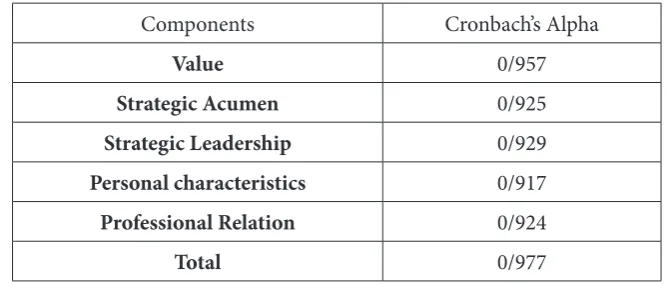
Reliability: to define reliability of this project, Chronbach’s alpha is used. To test the reliability, a primary sample and a pretest were designed. Then, using SPSS software and Chronbach’s alpha, the validity of data from the questionnaire was calculated. Then, talent management assessment test introduced to 50 teach-ers to define its reliability. According to the result in the table, standard reliability is 0.988 that suggests the reliability of the questionnaire is good.
After primary confirmation, the questionnaire was introduced to the basic samples who were 311 teachers of the primary schools of Mashhad. The results are shown in table 2.
Table 2. The reliability of the components of Talent Management Questionnaire
Cronbach’s Alpha Components
0/957
Value
0/925
Strategic Acumen
0/929
Strategic Leadership
0/917
Personal characteristics
0/924
Professional Relation
0/977
Total
Validity: to define the validity of this questionnaire and answer whether this questionnaire really assesses what it is designed for, two methods of content validity and structure validity are used. First, referring to Davies’s model of talent management in education which is the theoretical foundation of this project, components and items were extracted. To define content validity, the extracted components were given to several professors who were specialists in human resource management, planning and education man-agement to assess the factors and remove unnecessary factors. Finally 65 questions were chosen as basic items.
Table 3. The Result of KMO and Bartlett’s Test
0/957 Kaiser-Meyer-Olkin Measure of Sampling Adequacy
18550/661 Approx. Chi-Square
Bartlett’s Test of Sphericity
2080 Df
0/001 .Sig
As KMO index is between 0 and 1 and the amount of this index in this questionnaire is 0.957 and this amount is near to 1, therefore we can say that the chosen samples are sufficient for the analysis. (The Bart-tlet’s test is significant at level of 0.001).
Table 4. Total Variance Explained
Rotation Sums of Squared Loading Initial Eigenvalues
Component
% Cumulative of Variance %
Total % Cumulative
of Variance % Total 18/896 18/896 12/282 47/838 47/838 31/095 1 32/245 13/349 8/677 53/572 5/735 3/728 2 43/143 10/898 7/084 56/968 3/396 2/207 3 53/726 10/583 6/879 59/453 2/485 1/615 4 61/773 8/047 5/230 61/773 2/320 1/508 5
For factor analysis, the method of basic components analysis is used. Statistical indices in table 4 show that the values of factor 1 to 10 are more than 1 and totally define 70.89 percent of the total variance.
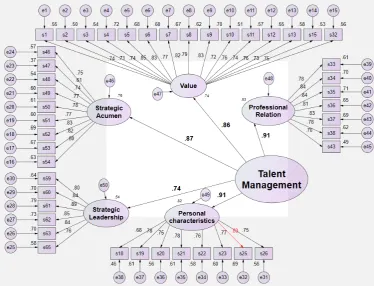
The exploratory factor analysis defines 45 items among 65 items. These items are beneath the 5 basic factors and the items with weak correlation were omitted. These items suggest components such as 1) value, 2) professional relation 3) strategic acumen 4) personal characteristics and 5) strategic leadership. For example, items of 1,2,3,4,5,6,7,8,9,10,11,12,13,15,32 located under the item of the value. Items of 14, 16, 17,24,27,28,29,30,31, 39, 40, 41, 42, 44, 45, 55, 56, 57, 58 were omitted because their loading factors were less than 0/33.
Figure 1, shows that professional relation factor and personal characteristics with a factor loading of 0.91 have a significant role in application of talent management in schools. Strategic acumen with a factor loading of .87 and the Value with a factor loading of 0.86 and Strategic leadership with a factor loading of 0.74 are placed in later sequences.
Figure 1. Latent and Observed components of the Talent Management
Chi square tests whether the given model is concordant with diffraction pattern between observed variable or not. The NFI index for values more than 0.90 is acceptable and shows the fitness of the model. The CFI index more than 0.90 is acceptable and shows, the fitness of the model. This index compares an independent model in which there is no relation between variables with a suggestive model and tests the amount of improvement. The CFI index regarding the meaning is like NFI. The difference is that it should pay fine for the volume of the sample group. The TLI index can be applied to alternative models or a sug-gestive model against zero models. The value of this index ranges between 0 and 1. Value of 0 suggests lack of fitness and a value of 1 suggests perfect fitness. Table 5 shows, model fitness indices and allowed values for each (Hooman 2005).
Table 5. Indices of the Model Fitting
Professional Relation Personal characteristics
Strategic Leadership Strategic Acumen
Value
2/851 2/069
2/725 2/680
2/533 CMIN/DF
0/970 0/971
0/977 0/960
0/921 GFI
0/980 0/975
0/985 0/967
0/943 NFI
0/974 0/980
0/982 0/967
0/955 TLI
0/987 0/987
0/990 0/979
0/979 CFI
0/077 0/059
0/075 0/074
Table 6. The correlation between the components of the Talent Management
Value StrategicAcumen Leadership Strategic Personal char-acteristics ProfessionalRelation
Value 1
Strategic Acumen **0/655 1
Strategic Leadership **0/550 **0/708 1
Personal characteristics **0/799 **0/724 **0/559 1
Professional Relation **0/751 **0/741 **0/654 **0/748 1
** p< 0/01
Given Table 6, we can conclude that the talent management basic components (value, strategic acu-men, strategic leadership, personal characteristics and professional relation) have high significant and positive correlation.
Discussion and conclusion
As noted, in new millennium organizations, there is frequent emphasis on intangible assets such as brand, innovation, creativity, entrepreneurship and information capital. These key resources are able to intro-duce the organization as an ideal organization disregarding the related industry. Such organizations focus on individuals and try to overtake their rivals only after recruitment of proper individuals for proper positions. Gradually, the role of human resources has changed by environment complexity and cultur-al and job variability. Today’s organizations need creative, flexible and accountable staff. In other hand, identification, recruitment and preservation of these nobles is the organization is more difficult than past (Brandt & Kull, 2007).
After factor analysis, components of value, personal characteristics, professional relation and strategic acumen were defined as basic components. All of these components were meaningful at 0.01 levels. Da-vies also referred to these components in his book. He suggests that for the enforcement of these compo-nents, the principals of schools should have all these components to apply talent management in schools. Ingham (2006) suggests that introducing values to employees define the form of psychological contract between employee and the organization. Those who are defined as talented need more support. This sup-port can be through guidance, direction and indirect management in an atmosphere full of honesty and respect. Harris and Foster (2010) also suggest that official acknowledgement of talented staff for their role in organizing success is one of the basic factors of talent management enforcement in the organization. Hughes and Rog (2008) argue that factors such as respectful behavior toward talented staff, feeling of ad-vancement and success and making proper relationships with other colleagues are key factors for talent management in the organizations.
create a proper level of job challenge to motivate the talented staff. Loftus (2007) argues that the identifi-cation and analysis of the needs and motivation level of talented staff are one of the outstanding charac-teristics of managers. Chiok Foong (2000) suggests that talent management is success key in organizations and all managers in each level play an effective role in this ground. Manager as official representative of the organization provide ground for coordination and productivity in the head of the organization by making a positive relation with a talented staff. Hartley (2004), assumes that the first step in success of talent is designed based on a strategy and perspective of the organization and stress on the alignment of talent management and the organization’ perspective. He points out that a manager should have the ability to adjust strategic goals. Given the acquired indices that rooted in subject theoretical base and they are validated by different statistical method, we can gather data from teachers in different academic levels regarding the amount of application of talent management in schools and assess the amount of talent management quintet components in schools.
References
Areiqat, A., & Abdelhadi, T., & Al-Tarawneh, H. (2010). Talent Management as a Strategic Practice of Human
Resources Management to Improve Human Performance. Interdisciplinary Journal of Contemporary Research
In Business, 2, (2), 100- 108
Blass, E. (2007). Talent Management – Cases & commentary. First published by Palgrave macmilan
Brandt. E. & Kull. P. (2007) Talent Management: How firms is Sweden find and nurture value adding human resources, Internationals Handelshogskolan , Available at: www.essays.se/essay/47c110a845
Cappelli, P. (2008). Talent on Demand, Harvard Business School Publishing, Boston, MA 2008.
Charles Roman, K. (2011). Assessing Talent management within western capeprovinicall treasury. Master thesis: Stellenbosch university, Faculty of Economic and Management Sciences.
Chiok Foong L. J. (2000). Leadership behaviours: effects on job satisfaction productivity and organizational commitment. Journal of Nurse Management, 9(4), 191-204
CIPD. (2006). Reflections on Talent Management: Change Agenda, CIPD, London
Creelman, D. (2004). Return on investment in talent management: Measures you can put to work right now. Human Capital Institute.
Davies, B., & Davies, B. (2011). Talent management in educatin. London: Sage.
Davis, T; Cutt, M; Flynn, N; Mowel, P. & Orme, S. (2007).” Talent Assessment: A New Steratey for Talent Management”. Gawer House.
Falkenberg, J; Stensaker, I; Meyer, C. B. & Haueng, A. C.(2005).”Research in Organizational Change and Development“. Oxford, 15,31-62.
Frank, B., Eckrich, H., & Rohr, J. (1997). “Quality nursing care, leadership makes the difference”. Journal of Nursing Administration, 27(5), 13-14.
Harris, L., & Foster, C. (2010). Aligning talent management with approaches to equality and diversity; Challenges
for UK public sector managers. Equality, Diversity and Inclusion: An International Journal. Birmingham, 29(5),
422-435.
Heinen, J. S., & O’Neill, C. (2004). “Managing talent to maximize performance. Employment Relations Today, 31, 67−82.
Hitt, M.A & Chet, M & Colella, A. .(2006) Organizational Behavior A Strategic Approach. New York: John wihey & son’s.
Hooman, H. A. (2005). Structural equation modeling with using of the LISREL software. Tehran, SAMT.
Hughes, J.C., & Rog, E. (2008). Talent management “A strategy for improving employee recruitment. retention and engagement within hospitality organizations”: Emerald.
Ingham, J. (2006). Closing the talent management gap. Strategic HR Review, Melcrum Publishig Ltd. Laff, M. (2006). Talent Management from hire to retire, T+D, November 2006.
Loftus, P. (2007). Tackle talent management to achieve high performance. Plant Engineering.
Mucha, R. T. (2004). The Art and Science of Talent management. Organizational Development Journal, 22(4),
98- 100
Naveh Ebrahim, A. R., & Keshvari, H. (2012). Teachers Talent Management: Innovations in HR. Tehran, Sooreh. Pedhazur, E. J. & Schmelkin, L. P. (1991). Measurement, design, and analysis: An integrated approach. Hillsdale,
NJ: Erlbaum.
Perrin, T. (2003), The 2003 Towers Perrin Talent Report: Working Today:Understanding what Drives Employee Engagement, Research Report, Towers Perrin, Stamford, CT.
Roper, K. (2009). The relationship between employees’ perceptions of talent management practices and levels of engagement: A Botswana organization case study. A research project submitted in partial fulfillment of the re-quirements for a Masters of Arts degree in Organizational Psychology in the Faculty of Humanities University of the Witwatersrand, Johannesburg.
Shih, Y.C. & Lin, C.T.(2007).”Agility Index of Manufacturing Firm- A Fuzzy- Logic Based Approach”. TEEE: 465-470.
Slizer, R. & Dowell, B. (2010). Strategy – driven talent management: A leader ship imperative. San Francisco: Jossey – Bass Awiley.
Stan, L. (2012). Talent management and the cultural influences on human resource management processes. Master thesis: University of Gothenburg, School of Business.
Sweem, S. L. (2009).”Leveraging employee engagement through a talent management strategy: Optimizing human capital through human resources and organization development strategy in a field study” . (Unpublished doc-toral dissertation). Benedictine University.
Tabachnick, B. G., & Fidell, L. S. (1996). Using multivariate statistics (3rd ed.). New York: HarperCollins.Wilkinson, L., & Task Force on Statistical Inference, APA Board of Scientific Affairs. (1999). Statistical methods in psy-chology journals: Guidelines and explanations. American Psychologist, 54, 594-604.
Appendix: test of talent management in education
Items
1 Managers behave in a way that teachers trust them and try for improvement of schools 2 They make relation with teachers easily and attract their trusts
3 Clear statement of the goals of schools by the managers results in attraction of teachers’ trusts 4 They acknowledge teachers shares in schools success and acknowledge them frankly
5 Honest speech of managers result in teachers’ trusts
6 Speeches and performances of managers are aligned with each other while facing teachers 7 Managers value the teachers and respect their point of views
8 Given the teachers’ personal differences, appreciate their attempts to improve the schools 9 They respect the teachers’ point of view and consult them for school activities
10 They ask teachers for help in school goals and pave the path for reaching the goals by flexibility 11 Flexibility of managers in accepting their fault result in teachers’ performance effectiveness 12 They ask teachers’ point of views regarding the schools’ goals and pave the path by flexibility
13 They interact with teachers to create positive changes in teachers’ performances and their continual improvement 14 Dominating their roles as leader, encourage teachers to reach their goals
15 They listen to teachers’ point of view actively and encourage them to make relation 16 They accept easily the presence of more experienced teachers and try to learn from them
17 They are brave enough to confess their faults and ask teachers’ point of views to compensate their faults 18 In teachers meetings they are questioners and lead the meeting by positive challenges
19 In environmental challenges, they benefit from teachers’ innovative ideas 20 He or she uses teachers’ feedback to improve his or her sprit and leadership style 21 They try to increase their own and teachers’ motivation by learning new knowledge
22 They are motivated to counter challenges and use teachers point of views to optimized them 23 They follow up teachers’ performance level and evaluate them
24 Their behaviors are in a way that teachers easily make relation with them 25 They easily understand others’ feelings and foster their enthusiasm 26 They observe the teachers’ performance and guides them to improve them
27 They are interested in learning from teachers and try to find new ways of cooperation 28 They encourage teachers to share their ideas and acknowledge them
29 They support teachers regarding environmental changes
30 They to increase the teachers’ capabilities and support them by planning for the future 31 They have a four or five year program to improve the teachers’ talent in schools 32 They use teachers knowledge and information to adjust schools’ goal
33 They have a clear perception about the future goals of the school and motivate teachers’ involvement in this ground 34 They are capable of decision making in different situations and adjust the goals according to those decisions 35 They introduce a clear picture of schools of future
36 They have a clear perspective from future and adjust the teachers’ activities by relating that perspective to present 37 They make teachers’ activity meaningful and lead them by regarding school changes in future
38 They plan for teachers employment by visualizing the future
39 they ask teachers for goal setting and creating new ways for reaching the goals 40 They ask teachers’ point of view regarding short term and long term programs
41 They will be inspired by the teachers’ ideas to create a holistic view of schools in future
42 They benefit from teachers’ capabilities and existed challenges to introduce a clear image of teachers’ role in future construction
43 Given advancement in sciences and technology and learning from environmental changes, he or she plans for im- provement of teachers’ talents