Issues
ISSN: 2146-4138
available at http: www.econjournals.com
International Journal of Economics and Financial Issues, 2018, 8(2), 243-254.
A Statistical Simulation for the Profitability of Banks: A Study
Chinedu Okeke
1, E. Chuke Nwude
2*
1Zenith Bank, Central Business District, Abuja, Nigeria, 2Department of Banking and Finance, Faculty of Business Administration, University of Nigeria, Enugu Campus, Enugu State, Nigeria. *Email: [email protected]
ABSTRACT
This study investigated the profitability of quoted banks alongside the risk content. The relevant models as enunciated in the current literatures for determining the return as well as risk were employed. The findings of the study showed that GTB is the most profitable bank in Nigeria with respect
to return on shareholders’ funds and return on assets for the entire 15-year study period. Sterling bank is crowned the most profitable bank in Nigeria with respect to return on capital employed.
Keywords: Return on Equity, Return on Assets, Return on Capital Employed, Banks, Profitability JEL Classification: G2
1. INTRODUCTION
For any economy to attain sustainable growth and development, funds must be effectively mobilized and allocated to the productive sectors of the economy. Usually the funds are mobilized through investors who are not injecting funds into the organization for purely altruistic reasons. They are expecting
returns from their investments in the firm. Shareholders supply funds to firms for a reason. That reason generally is to receive
a return on their precious resources. The return is generated by
management using the finance provided to invest in good assets
that will give the best return. Wise investors do not run risks for
fun. They are playing with real money and therefore require a high
return from their investment. To convince rational investors to
take risk, firms would have to offer reasonable expected returns,
though some investors do not think of the history of actual risk and return content of some investment before they adopt such investments. It is a clear cut fact that if investors are confronted with a choice between two investments with the same expected returns but different variances any rational investor will normally pick the one with lower variance. In practice, the expected returns and variances are calculated using historical data and are used as
proxies for future returns. In a bid to confirm the level of the risk
and return content in investments in banking stocks, this study becomes necessary.
The confusion here which constitutes the problem of the study is that banking stocks sell in large volumes on every day of trading on
the Nigerian stock exchange trading floors but it seems that many
investors are buying just to follow the crowd without minding
the profitability of such exercise. Even the researcher has been
victim so many times. Based on what is happening in the Nigerian
Stock market from 2015 till date there is need to look back and check the profitability of investing on these banking stocks in
the face of exiting foreign investors and the lowest esteem the Nigerian domestic currency the Naira is experiencing currently. The nature of return on investment (ROI) on these stocks is still a subject of serious arguments among many potential investors who are hesitant in testing the troubled waters of stock market investment. Therefore the main objective of this study is to carry out an investigation to galvanize and state the facts clear in order put the minds of the hesitant investors at rest. With this in mind,
empirical research was engaged to find out the correct position of the profitability of the quoted banking stocks with respect to their
returns on investments.
2. LITERATURE REVIEW
The basic measure of profitability is the ROI which can be viewed
from many perspectives. One of the perspectives is the return
the entire firm. Taking it from the viewpoint of only owners equity fund we have return on equity (ROE) while from the viewpoint of the employed fund by the firm we have return to the firm (RTF). Another examines profitability relative to sales by estimating the profit margin either in gross or net. These views were also captured in the work of Damodaran (2001) who suggests that it is important that we gauge the profitability of the firm in terms of percentage
returns instead of in absolute terms.
The ROE is usually calculated as the quotient of profit after tax (PAT) as numerator and shareholders’ funds (SHF) as denominator multiply by 100%. ROE relates profits to the equity investor. According to Damodaran (2001. p. 98) the book value of common equity useable is either the sum of the beginning and ending equity capital divide by two or the beginning equity capital. According to Banerjee (2009. p. 62) a variation of ROE is the average ROE. He suggests that instead of taking ROE for a single year ROE
for a number of years is calculated and the average of the returns is taken for the purpose of ROE, especially in the event of wide variation in the returns over a given period. The average method
helps to smooth out the fluctuation to a considerable extent. In their books Brealey et al. (1995) and Banerjee (2009) submitted another
method of computing ROE as the actual dividend plus accrued capital gain or loss from the investment expressed in relation to cost of investment. Symbolically, ROE = Dt+Pt-Pt−1/Pt−1. Where Dt is the dividend for year t, Pt is the share price at end of year t,
Pt−1 is the share price at beginning of year t.
Another useful measure of return which relates the operating
income to the capital invested by the firm is the return to the entire firm (RTF). In RTF, the capital employed by the firm can be defined as the gross total asset less the volatile current liabilities or the sum of the book value of debt and equity which constitute
the total asset. The former is obtained from the sum of the gross
fixed asset plus the net current asset (that is, gross fixed asset plus
current assets less current liabilities) while the latter represents
the total asset (that is, net fixed asset plus current assets). When a
substantial portion of the liabilities is either current or non-interest bearing, RTF provides a better measure of the true return earned on capital employed in the business. When the capital employed comprises of the gross total asset less the volatile current liabilities the ROI is called the return on capital employed (ROCE). When the capital employed comprises of the sum of the book value of
debt and equity which constitute the total asset the ROI is called return on asset (ROA). The ROCE measures a firm’s operating efficiency in generating profits from its non-volatile assets prior to the effects of financing (that is, before deducting interest charges), amortization and depreciation. The before-tax ROCE is equal to
operating income divide by the capital employed in the form of
the sum of the gross fixed asset plus the net current asset. That is, [EBITAD/GFA+NCA]*100. The after-tax ROCE is equal to
operating income less tax divide by the capital employed in the
form of the sum of the gross fixed asset plus the net current asset. That is, [EBITAD(1−t)/GFA+NCA]*100. Damodaran (2001. p. 96) suggests that the average capital employed useable is either
the sum of the beginning and ending capital divide by two or the beginning capital which is also known as gross capital.
The ROA measures a firm’s operating efficiency in generating profits from its total assets prior to the effects of financing (that
is, before deducting interest charges). ROA=EBIT/total assets.
By separating the financing effects from the operating profit, ROA = [Net Income+ Interest Expenses (1-tax rate)]/Total assets
which is a cleaner measure of ROA. Therefore on pre-tax basis,
ROA = EBIT/Total assets which is usually used when the firm or division is being evaluated for purchase by an acquirer with a different tax rate. Total asset is the sum of net fixed and total current assets as presented in the balance sheet of the firm.
Banerjee (2009), Arnold (2008) and Nwude (2004) agree that ROI is an accounting method that expresses the annual profit as
a percentage of initial capital invested and that investment that gives the highest rate of return (ROR) which must be higher
than or equals to the cut-off ROR (usually the firm’s WACC) is
normally selected. The initial capital invested may be original
cost of the investment or its average cost. Arnold (2008. p. 132)
posits that the above is accounting rate of return (ARR) which
can also be called the ROCE or ROI. He went further to state the
formulae for computing the ARR as follows. When computed
at annual basis, ARR = annual profit divide by book value of assets at the beginning of the financial year, that is, annual profit divide by the sum of gross fixed asset and current assets.
After the computation of the respective annual ARRs, a mean is computed to serve as the ARR for the period of study. On total
investment basis, ARR = average annual profit divide by the sum of gross fixed asset and current assets. On average investment basis, ARR = average annual profit divide by the average capital
invested. The average capital invested is the sum of the beginning and ending capital divide by two.
Ross et al. (1996. p. 226) came up with the idea of holding period return (HPR) for a number of n periods of time. If the respective annual HPR are R1, R2, R3., Rn. The HPR for n periods of time =
(1+r1) (1+r2) (1+r3)… (1+rn)-1, while the arithmetic mean (AM) of the annual returns is the sum of the annual returns divide by
the number of periods. From the perspective of Rees (1990), ROI
is made up of capital gain or loss and the dividends or coupons
received from the investment. Ituwe (2006) defines ROI as a
measure of the rate of productivity of assets in providing returns to both ordinary shareholders and on long-term credit. The higher
the return the more efficient is the utilization of assets. Pandey (1999) refers to ROI as the ratio of earnings after interest and taxes to total capital employed. Achuchaogu (2002) defines ROI as the profitability of the firm measured in relation to investment. The term
investment here may refer to total assets, capital employed or the
owners’ equity. Njoku and Jombo (2003) see ROI as a measure of
the company’s percentage returns on its capital investment which consists of shareholders funds and long term debts. They submit
that the percentage return which represents financial returns must always be on the increase. Ihesiulo (2005) states that ROI is a measure of the success of the firm in earning a net ROI and it should be on the increase. Njoku (1997) posits that ROI is a measure of profit-investment relationship in a firm. Investment here represents
shareholders funds and term liabilities while returns stands for earnings generated after payment of interest and taxes. Arnold
can be computed in many different ways. For example, ARR can
be computed based on annual net profit/total investment, annual net profit/average book value of investment, all of which rely on traditional profit rather than on cash flow and does not consider time value of money. Nwude (2004) submits that ARR can be computed based on total profit/total investment, total profit/average book value of investment, average annual profit/total investment, average annual profit/average book value of investment, all of which rely on traditional profit rather than on cash flow and does not consider time value of money. Giles and Capel (1994) and Spivey (2000) state that ROI is the average profit for a project
expressed as a percentage of the capital outlay. These opinions are
in consonance with the views of Bernstein and John (2000), Tracy (1997), Friedlob and Franklin (1996), Gill (1994), Hilton (1991), Larkin (1996), Murray (2000), Rees (1990) and Glyn et al. (1998).
Nwude (2004) suggests that ROI should take care of the
opportunity cost of capital invested, rate of inflation that affect the
purchasing power of the money invested and the risk premium.
He further states that the ROI can be nominal, true or effective
rate. Nominal ROR is the rate by which amount invested on
fixed income security (i.e., nominal face value) is multiplied by
the nominal interest rate attached to it. The true rate is the actual or current market rate of the security. Effective rate is the actual interest yield to maturity of the security. Some investors do not look at these three rates but see return simply as a measure of the
monetary benefits obtained by an investor over a specified time
period in return for a given amount of investment or amount of capital invested during the period. From this point of view, he
stressed that ROI is the amount of revenue received in a fiscal year in excess of every amount invested in the fiscal year in an activity
expressed as a percentage of the amount so invested, while not
recognizing time value of money concept. Damodaran (2001) says ROI is an accounting ROR which measures the net income a firm’s
management is able to earn with its total assets, usually obtained
by dividing the net PAT by total assets. Berk and DeMarzo (2009) and MacCormac and Teeling(1980) defines ROI as the ratio of net PAT to net asset. They state that this ratio by itself is of little value and that a better version is the return on owners’ equity, which is
the return the owners receive for investing their own funds. That
is, the return on owners investment is equals to net PATs divided by the owners net worth in the business. The Du Pont formula,
which is widely used, breaks down return on owners’ investment
into two parts namely net profit margin and asset turnover. With this, return on owners investment is equals to net profit margin
multiplied by asset turnover.
Howells and Bain (2008) state that financial asset which may take
a number of forms receives return in the form of interest at discrete intervals, some with the possibility of capital gain, and discount rate and these expressed as a percentage of original purchase price is the return on such investment. They submit that the return on an asset is usually expressed as its average or mean return over a period of time. The return will consist of any income (interest or dividend) that the asset earns plus capital gain (or loss). Thus the
return on an asset in period 1, K1, is given by K1 = D1+P1−Po, where Po is the price of the asset at the end of the previous period.
The AM return over T periods is sum of the returns from period 1
to period T divide by T. Pandey (1999) submits to this Howells and Bain (2008) position on return. They finally termed return as the cash flow generated by an asset usually expressed as a rate. Pandian (2005) states ROA as measure of the overall efficiency
of capital invested in business and expressed ROA as net income
divide by total assets and ROE as net profit divide by net worth. The ROA will be same with ROE if the firm carries out all of its
operations with owners’ funds. But most times they differ because
of financial leverage. When ROE is greater than ROA it shows that the firm has employed its borrowed funds efficiently to lever the
ROR to the advantage of shareholders. She reasons that as dividend is the regular income received by the shareholder, the shareholder would like to know the relationship between the market price and the dividend hence the need to compute dividend yield which is dividend per share divide by market price per share. Chandra
(2012) sees ROA as PAT divide by AVERAGE total assets but quickly points out ROA in formula is an odd measure because
its numerator measures the return to shareholders whereas its
denominator represents the contribution of all investors (equity and debt). He defines ROCE as EBIT (1-tax rate) divide by Average total assets. The EBIT (1-tax rate) is net operating PAT. He states that ROE also called return on net worth or return on SHF, which is a measure of interest to equity shareholders, is equity earnings divide by average equity. His reason for adopting average figures as denominator is not understood.
Arnold (2008) and Cuthbertson and Nitzsche (2005) see ROCE as ARR or ROI which they define as the ratio of the accounting profit
to the investment in the project. The ratio can be calculated in a
number of ways such as profit for the year/asset book value at start of the year, average profit/initial capital invested, average annual profit/average capital invested but the most popular approach is to take profit after the deduction of depreciation. He points out
that the amount of capital invested has to be considered alongside
the income earned. He identified many variations in consideration
of the amount of capital invested such as ROCE, ROI, ROE, and ARR, all measure return as a percentage of resources devoted.
Brealey et al. (1995) compute ROA as (EBIT-tax)/average total
assets but point out that for comparative study of operating
performance of firms, ROA equals to EBIT-(tax+interest tax shields)/average total assets should be used even if the firms have radically different debt ratios. They dissected ROA into firm’s asset turnover ratio and profit margin thus ROA = (Sales/Assets) ×
(EBIT-taxes)/Sales. ROE as earnings available for common stock
divide by average equity. Weston et al. (1996) calculate ROA as
net income/total assets, ROE as net income available to common
stockholders/common equity. Adopting preference stock as part of ownership Atrill (2006) expresses return on ordinary SHF (ROSF) as net PAT ation and preference dividend (if any)/average ordinary share capital. He states that ROCE as a fundamental measure of business performance is net profit before interest and taxation
divide by the sum of the averages of share capital, reserves and
long-term loans. He called the sum of the averages of share capital,
reserves and long-term loans the long-term capital invested in
assets. If measured prior to the effects of financing but post-tax
ROA = EBIT(1-tax rate)/Total assets. If measured after removing
the effects of financing but post-tax ROA = [Net income +Interest expenses (1-tax rate)]/Total assets. He states that the later provides
a cleaner measure of the true ROA. Ignoring taxation and effects
of debt financing ROA = EBIT/Total assets. Damodaran (2001)
submits that ROCE = EBIT (1-t) divide by the sum of book value
of debt and book value of equity. Banerjee (2009) sees ROI as average annual profit expressed as percentage of either cost of the
project or its average cost. Setting aside the effects taxes and debt
financing Fischer and Jordan (1995) state that the productivity
of total assets can be seen as ROA = EBIT/Assets which can be
dissected into asset turnover and profit margin thus: ROA = (Sales/ Assets) × (EBIT/Sales).
From the above review the make-ups of the numerator and the denominator of the ROI models utilized in this study will be shown in section three below.
3. METHODOLOGY
This empirical study collected the dataset from the financial
statements of the subject-banks as approved by the apex regulator of banks in Nigeria-the Central Bank of Nigeria (CBN) from year
2000-2014. The data were refined through series of computations in order to fit into the purpose of the study. Three models of ROI
were adopted namely the ROE, the ROA and the ROCE. The
model for ROE was obtained from ROE = net profit after interest and taxes divided by total SHF as shown in the income and
balance sheet statements respectively. ROA was obtained from ROA = earnings before interest and taxes divided by the total asset.
The total asset is the sum of the gross fixed and current assets of
each year concerned. ROCE was obtained from ROCE = earnings before interest and taxes amortization depreciation divided by the total capital invested. The total capital invested was got
from the sum of gross fixed asset and the net current asset of each
of the subject-bank. To determine the level of the volatility in the ROI of the banking stocks the standard deviation was computed
for each type of return for each bank. The ordinary least square
method was used to ascertain the relationship between the risk and return of the banks.
4. DATA PRESENTATION AND ANALYSIS
The data set and the results of various computations by the researcher are presented hereunder for the relevant interpretations and analysis.
On the basis of ROE, while the industry average return for the
study period 2000-2014 is 8.80%, some banks namely GTB,
Sterling, FBN, Zenith, UBA, StanbicIBTC, Diamond, Fidelity,
Access, Skye, and FCMB with average returns of 26.24, 26.09, 20.81, 18.15, 17.46, 15.23, 14.58, 12.00, 11.56, 10.50, and 9.00%
respectively recorded higher values above the industry average. Other banks such as UBN, Unity and Wema banks provided average returns below the industry average. On this note, on the
study period average, GTB is the most profitable quoted bank in
Nigeria followed by Sterling, FBN, Zenith, UBA, StanbicIBTC, Diamond, Fidelity, Access, Skye, and FCMB. Unity bank and
Wema bank provided negative returns of −29.43 and −32.61%
respectively to the owners of the banks based on the average return
for the study period 2000-2014 as can be seen from Table 1a.
On yearly performance, UBA with return of 43.32% was the most profitable bank in year 2000 followed by diamond, GTB, FBN, and UBN with 34.00, 33.45, 29.59, 29.12% respectively but it was only UBA, diamond and GTB that provided above the industry average in year 2000. In year 2001, Diamond, GTB, UBN banks with 41.35, 38.70, and 37.96% respectively recorded returns above the yearly industry average of 27.30% thus presenting diamond bank as the most profitable bank of the year 2001 in terms of return on SHF. In year 2002 Wema bank took the lead with 39.32% return above the industry average of 22.58%. GTB, diamond and first bank followed in the order of magnitude with 36.9, 28.50, and 23.64% respectively.
In 2003 FBN took the lead with ROE of 39.49%. It was followed by Zenith bank with 34.97%, Fidelity with 34.07% and GTB with 33.24% as the banks that provided ROE above the year industry average of 26.24%. GTB came first in 2004 with 34.40% followed by Zenith with 33.12%, FBN with 27.14, Fidelity with 25.96%, UBN with 24.82%, Access with 23.59%, UBA with 23.17% under the industry average of 23.80%. The position of the banks on the
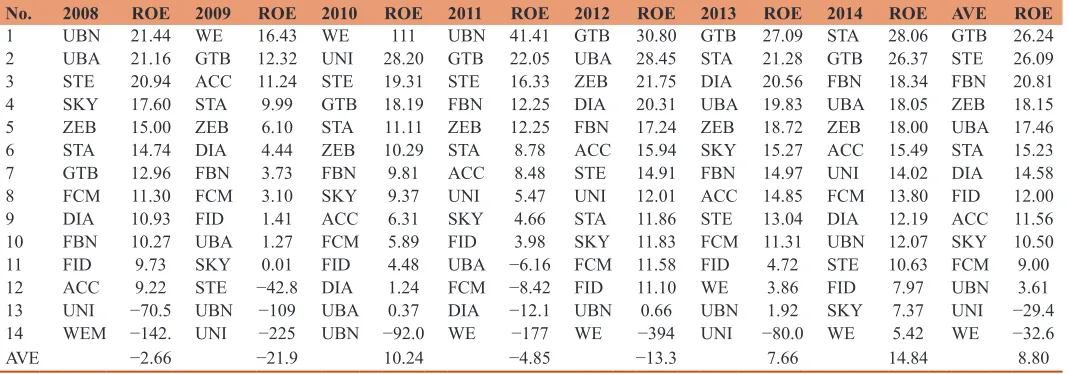
scale of ROE can be seen from Table 1b and c. It can be observed from Table 1b and c that GTB generated the highest ROE for 4 years, 2004, 2007, 2012, and 2013 out of the 15-year study period. Wema followed GTB with 3 appearances as the most profitable
bank in years 2002, 2009, 2010; FBN and UBN had 2 appearances each in 2003, 2006 and 2008, 2011 respectively; while diamond, UBA, Sterling and StanbicIBTC had 1 appearance each in 2001, 2000, 2005 and 2014 respectively as the most profitable bank with
respect to return on SHF. Access bank was the least profitable
bank in terms of ROE in years 2001 and 2002, Diamond bank in 2003, UBN in 2010, and Unity in 2007, 2009 and 2013. Wema bank was the least profitable bank in terms of ROE in years 2000, 2004, 2005, 2006, 2008, 2011, 2012, and 2014.
Therefore, with the highest number of appearance (26.67%) as the most profitable bank and the highest average ROE for the entire
15-year study period, GTB is crowned the most profitable bank in
Nigeria with respect to return on SHF. With the highest number of appearance (53.33%) as the least profitable bank and the highest negative average ROE for the entire 15-year study period, Wema
bank is crowned the most non-profitable bank in Nigeria with
respect to return on SHF.
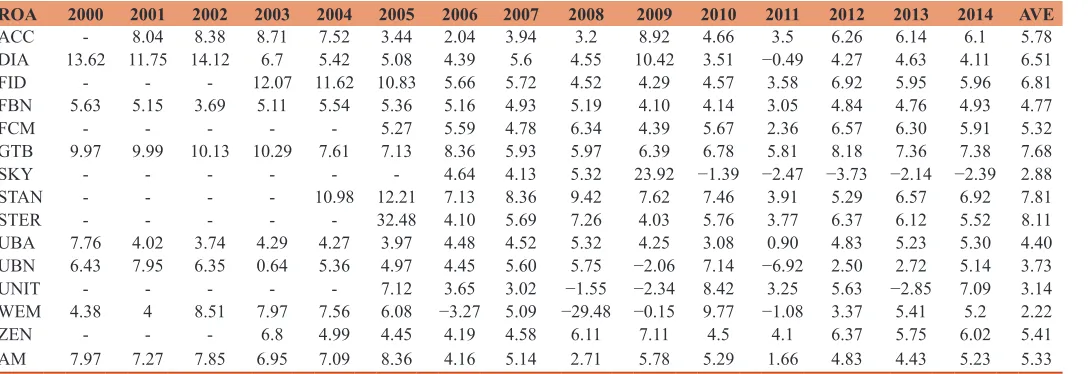
Table 2a presents the ROA of the banks from 2000 to 2014. Sterling, StanbicIBTC, GTB, Fidelity, and diamond with average returns of 8.11, 7.81, 7.68, 6.81, and 6.51% respectively had
fairly better years than other banks in terms of ROA. The industry
average ROA is 5.33% while the yearly industry average returns are 7.97, 7.27, 7.85, 6.95, 7.09, 8.36, 4.16, 5.14, 2.71, 5.78, 5.29, 1.66, 4.83, 4.43, and 5.23% for years 2000, 2001 up to 2014
respectively. The peak ROA of each of the banks were as follows,
14.12% in 2002, fidelity 12.07% in 2003, first bank 5.63% in 2000,
FCMB 6.57% in 2012, GTB 10.29 in 2003, Skye bank 23.92 in 2009, StanbicIBTC and sterling made 12.25 and 32.48% in 2005. Others can be depicted from Table 2a.
Table 1a: ROE of quoted banks in Nigeria 2000-2014
ROE 2000 2001 2002 2003 2004 2005 2006 2007 2008 2009 2010 2011 2012 2013 2014 AVE
ACC - 8.45 −2.84 23.53 23.59 3.56 2.55 21.43 9.22 11.24 6.31 8.48 15.94 14.85 15.49 11.56
DIA 34 41.35 28.5 6.76 13.48 12.13 11.36 13.1 10.93 4.44 1.24 −12.06 20.31 20.56 12.19 14.58
FID - - - 34.07 25.96 12.72 12.46 15.45 9.73 1.41 4.48 3.98 11.10 4.72 7.97 12.00
FBN 29.59 26.76 23.64 39.49 27.14 26.57 27.91 24.43 10.27 3.73 9.81 12.25 17.24 14.97 18.34 20.81
FCM - - - 11.06 11.3 19.21 11.3 3.1 5.89 −8.42 11.58 11.31 13.8 9.00
GTB 33.45 38.7 36.9 33.24 34.4 17.3 23.5 26.4 12.96 12.32 18.19 22.05 30.8 27.09 26.37 26.24
SKY - - - 9.46 18.91 17.6 0.01 9.37 4.66 11.83 15.27 7.37 10.50
STAN - - - - 20.24 15.41 12.15 13.92 14.74 9.99 11.11 8.78 11.86 21.28 28.06 15.23
STER - - - 197.54 4.1 6.87 20.94 −42.8 19.31 16.33 14.91 13.04 10.63 26.09
UBA 43.32 14 14.74 22.01 23.17 25.31 23.61 12.82 21.16 1.27 0.37 −6.16 28.45 19.83 18.05 17.46
UBN 29.12 37.96 17.83 22.04 24.82 22.42 10.74 12.83 21.44 −109.11 −91.95 41.41 0.66 1.92 12.07 3.61
UNIT - - - 14.85 4.45 2.25 −70.48 −225.06 28.2 5.47 12.01 −80.04 14.02 −29.43
WEM 10.87 23.87 39.32 20.07 12.03 3.48 −32.14 10.14 −141.98 16.43 110.69 −176.89 −394.32 3.86 5.42 −32.61
ZEN - - - 34.97 33.12 18.94 12.25 16.39 15 6.1 10.29 12.25 21.75 18.72 18 18.15
AVE 30.14 27.30 22.58 26.24 23.80 29.33 9.55 15.30 −2.66 −21.92 10.24 −4.85 −13.28 7.66 14.84 8.80
Source: Researcher’s computations from figures obtained from the subject-banks financial statements 2000-2014
Table 1b: Ranking of quoted banks in Nigeria based on ROE 2000-2007
No. 2000 ROE 2001 ROE 2002 ROE 2003 ROE 2004 ROE 2005 ROE 2006 ROE 2007 ROE
1 UBA 43.32 DIA 41.35 WEM 39.32 FBN 39.49 GTB 34.40 STE 197.5 FBN 27.91 GTB 26.40
2 DIA 34.00 GTB 38.70 GTB 36.90 ZEB 34.97 ZEB 33.12 FBN 26.57 UBA 23.61 FBN 24.43
3 GTB 33.45 UBN 37.96 DIA 28.50 FID 34.07 FBN 27.14 UBA 25.31 GTB 23.50 ACC 21.43
4 FBN 29.59 FBN 26.76 FBN 23.64 GTB 33.24 FID 25.96 UBN 22.42 FD 27.91 FCM 19.21
5 UBN 29.12 WEM 23.87 UBN 17.83 ACC 23.53 UBN 24.82 ZEB 18.94 ZEB 12.25 SKY 18.91
6 WEM 10.87 UBA 14.00 UBA 14.74 UBN 22.04 ACC 23.59 GTB 17.30 STA 12.15 ZEB 16.39
7 ACC 8.45 ACC −2.84 UBA 22.01 UBA 23.17 STA 15.41 DIA 11.36 FID 15.45
8 WEM 20.07 STA 20.24 UNI 14.85 FCM 11.30 STA 13.92
9 DIA 6.76 DIA 13.48 FID 12.72 UBN 10.74 DIA 13.10
10 WEM 12.03 DIA 12.13 SKY 9.46 UBN 12.83
11 FCM 11.06 UNI 4.45 UBA 12.82
12 ACC 3.56 STE 4.10 WEM 10.14
13 WEM 3.48 ACC 2.55 STE 6.87
14 WEM −32.1 UNI 2.25
AVE 30.14 27.30 22.58 26.24 23.80 29.33 9.55 15.30
Source: Researcher’s compilations from Table 1 above on ROE
Table 1c: Ranking of quoted banks in Nigeria based on ROE 2008-2014
No. 2008 ROE 2009 ROE 2010 ROE 2011 ROE 2012 ROE 2013 ROE 2014 ROE AVE ROE
1 UBN 21.44 WE 16.43 WE 111 UBN 41.41 GTB 30.80 GTB 27.09 STA 28.06 GTB 26.24 2 UBA 21.16 GTB 12.32 UNI 28.20 GTB 22.05 UBA 28.45 STA 21.28 GTB 26.37 STE 26.09
3 STE 20.94 ACC 11.24 STE 19.31 STE 16.33 ZEB 21.75 DIA 20.56 FBN 18.34 FBN 20.81
4 SKY 17.60 STA 9.99 GTB 18.19 FBN 12.25 DIA 20.31 UBA 19.83 UBA 18.05 ZEB 18.15
5 ZEB 15.00 ZEB 6.10 STA 11.11 ZEB 12.25 FBN 17.24 ZEB 18.72 ZEB 18.00 UBA 17.46
6 STA 14.74 DIA 4.44 ZEB 10.29 STA 8.78 ACC 15.94 SKY 15.27 ACC 15.49 STA 15.23
7 GTB 12.96 FBN 3.73 FBN 9.81 ACC 8.48 STE 14.91 FBN 14.97 UNI 14.02 DIA 14.58
8 FCM 11.30 FCM 3.10 SKY 9.37 UNI 5.47 UNI 12.01 ACC 14.85 FCM 13.80 FID 12.00
9 DIA 10.93 FID 1.41 ACC 6.31 SKY 4.66 STA 11.86 STE 13.04 DIA 12.19 ACC 11.56
10 FBN 10.27 UBA 1.27 FCM 5.89 FID 3.98 SKY 11.83 FCM 11.31 UBN 12.07 SKY 10.50
11 FID 9.73 SKY 0.01 FID 4.48 UBA −6.16 FCM 11.58 FID 4.72 STE 10.63 FCM 9.00
12 ACC 9.22 STE −42.8 DIA 1.24 FCM −8.42 FID 11.10 WE 3.86 FID 7.97 UBN 3.61
13 UNI −70.5 UBN −109 UBA 0.37 DIA −12.1 UBN 0.66 UBN 1.92 SKY 7.37 UNI −29.4
14 WEM −142. UNI −225 UBN −92.0 WE −177 WE −394 UNI −80.0 WE 5.42 WE −32.6
AVE −2.66 −21.9 10.24 −4.85 −13.3 7.66 14.84 8.80
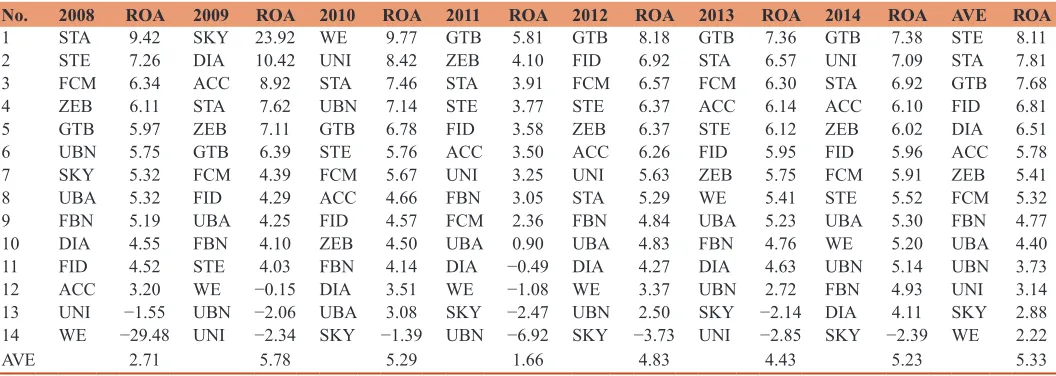
In Table 2b and c above the position of the banks for various years
based on ROA is presented. In year 2000 diamond bank first on the ladder of ROA. It is followed by GTB, UBA, UBN, FBN and Wema in the order of magnitude of ROA. In year 2000 only diamond and GTB with ROA of 13.62 and 9.97% provided ROA above the industry average ROA of 7.97% in 2000. First bank,
UBA and Wema banks had lower than industry average ROA in
2001 while diamond, GTB, Access, and UBN had excess above the industry average of 7.27% in 2001. Other positions of the banks
based on ROA can be seen from Tables 2a and c. Diamond bank
took the lead 3 years in terms of ROA in years 2000, 2001, 2002, Fidelity bank in 2 years 2003, 2004, sterling bank in 1 year 2005, GTB in 5 years 2006, 2011, 2012, 2013, 2014, StanbicIBTC in 2 years 2007, 2008, Skye bank in 1 year 2009 and Wema bank only in 2010. Wema came last in 2000, 2001, 2006, and 2008, FBN in 2002, UBN in 2003, 2011, UBA in 2004, access in 2005, Zenith in 2007, Unity bank in 2009, 2013, Skye bank in 2010, 2012 and 2014. Based on the average performance from 2000 to 2014, GTB with average ROA of 8.11% is the overall best in terms of ROA, followed closely by StanbicIBTC with 7.81, GTB with 7.68 under the industry average of 5.33%. I wonder on the position of
the big three banks in Nigeria. Does it mean they operate with excess capacity that cannot be put to useful purpose? They are almost laggards on ROA scale, even on ROE. This is amazing! Though based on industry average for the period of study, FBN,
UBN, UBA provided ROA above the industry average of 5.33% but their position is not befitting for such highly regarded big
three banks in Nigeria.
On the basis of ROCE, while the industry average return for
the study period 2000-2014 is 38.55%, some banks namely Sterling, StanbicIBTC, UBA, UBN, GTB, Wema, FBN, Access,
and Fidelity banks with average returns on capital employed
of 59.81, 59.03, 53.09, 53.09, 49.90, 48.33, 45.56, 42.51, and 40.12% respectively recorded higher values above the industry
average. Other banks provided average returns below the industry average. On this note, on the study period average,
sterling bank is the most profitable quoted bank in Nigeria followed by StanbicIBTC, UBA, UBN, GTB, Wema, FBN,
Access, and Fidelity banks. Diamond bank provided negative
return of −16.07% to the owners of the bank based on the average return for the study period 2000-2014 as can be seen
from Table 3a.
On yearly performance, UBA with return of 126.2% was the most profitable bank in year 2000 followed by GTB, UBN, and FBN with 112.5, 81.31, 72.13% respectively and these are the banks that provided above the industry average ROCE in year 2000. In year 2001, UBN, GTB, UBA, Access banks with 123.0, 109.8, 84.97 and 74.35% respectively recorded returns above the yearly industry average of 67.02% thus presenting UBN as the most profitable bank of the year 2001 in terms of ROCE. In year 2002 Wema bank took the lead with 96.92% return above the industry average of 45.18%. UBA, GTB, UBN, FBN and Access banks followed in the order of magnitude with 73.39, 68.75, 60.47, 58.47 and 54.48% respectively.
In 2003 Fidelity bank took the lead with ROCE of 108.4%, which was followed by Access, GTB, FBN, Wema, Zenith, UBA with 86.03, 82.62, 77.34, 70.13, 64.37, and 62.01% respectively. All
the above named banks provided ROCE above the year industry
average of 29.93%. Fidelity bank came first in 2004 with 92.33% followed by access with 90.51%, GTB with 70.19, Wema with 69.95%, Zenith bank with 65.92% all performing above the industry average of 61.90%. The position of the banks on the scale
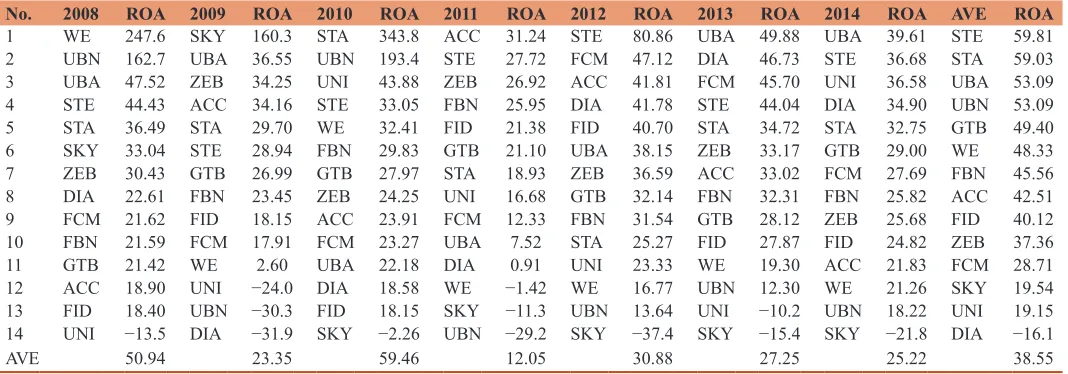
of ROCE can be seen from Tables 3a and b. It can be observed from Table 3b and c that UBA generated the highest ROCE for 4
years, 2000, 2006, 2013, and 2014 out of the 15-year study period. UBN made 1 appearance as the most profitable bank in years 2001; Wema made 2, 2003, 2008; Fidelity and sterling had 2 appearances each in 2003, 2004 and 2005, 2012 respectively; StanbicIBTC, FBN, Skye, Access, had 1 appearance each in 2010, 2007, 2009, and 2011 respectively as the most profitable bank with respect to
ROCE. Diamond bank was the least profitable bank in terms of
ROCE in years 2000, 2001, 2002, 2003, 2004, and 2009. Access bank was in 2003, Wema in 2006, Unity in 2007, 2008; Skye bank was the least profitable bank in terms of ROCE in years 2010, 2012, 2013, and 2014.
Table 2a: ROA of quoted banks in Nigeria 2000-2014
ROA 2000 2001 2002 2003 2004 2005 2006 2007 2008 2009 2010 2011 2012 2013 2014 AVE
ACC - 8.04 8.38 8.71 7.52 3.44 2.04 3.94 3.2 8.92 4.66 3.5 6.26 6.14 6.1 5.78
DIA 13.62 11.75 14.12 6.7 5.42 5.08 4.39 5.6 4.55 10.42 3.51 −0.49 4.27 4.63 4.11 6.51
FID - - - 12.07 11.62 10.83 5.66 5.72 4.52 4.29 4.57 3.58 6.92 5.95 5.96 6.81
FBN 5.63 5.15 3.69 5.11 5.54 5.36 5.16 4.93 5.19 4.10 4.14 3.05 4.84 4.76 4.93 4.77
FCM - - - 5.27 5.59 4.78 6.34 4.39 5.67 2.36 6.57 6.30 5.91 5.32
GTB 9.97 9.99 10.13 10.29 7.61 7.13 8.36 5.93 5.97 6.39 6.78 5.81 8.18 7.36 7.38 7.68
SKY - - - 4.64 4.13 5.32 23.92 −1.39 −2.47 −3.73 −2.14 −2.39 2.88
STAN - - - - 10.98 12.21 7.13 8.36 9.42 7.62 7.46 3.91 5.29 6.57 6.92 7.81
STER - - - 32.48 4.10 5.69 7.26 4.03 5.76 3.77 6.37 6.12 5.52 8.11 UBA 7.76 4.02 3.74 4.29 4.27 3.97 4.48 4.52 5.32 4.25 3.08 0.90 4.83 5.23 5.30 4.40
UBN 6.43 7.95 6.35 0.64 5.36 4.97 4.45 5.60 5.75 −2.06 7.14 −6.92 2.50 2.72 5.14 3.73
UNIT - - - 7.12 3.65 3.02 −1.55 −2.34 8.42 3.25 5.63 −2.85 7.09 3.14
WEM 4.38 4 8.51 7.97 7.56 6.08 −3.27 5.09 −29.48 −0.15 9.77 −1.08 3.37 5.41 5.2 2.22
ZEN - - - 6.8 4.99 4.45 4.19 4.58 6.11 7.11 4.5 4.1 6.37 5.75 6.02 5.41 AM 7.97 7.27 7.85 6.95 7.09 8.36 4.16 5.14 2.71 5.78 5.29 1.66 4.83 4.43 5.23 5.33
Based on the average for the study period of 2000-2014, Sterling bank with the highest ROCE of 59.81% for the entire 15-year study period, is crowned the most profitable bank in Nigeria with respect to ROCE. With the only and high negative average ROCE for the entire 15-year study period, Diamond bank is crowned the most
non-profitable bank in Nigeria with respect to ROCE.
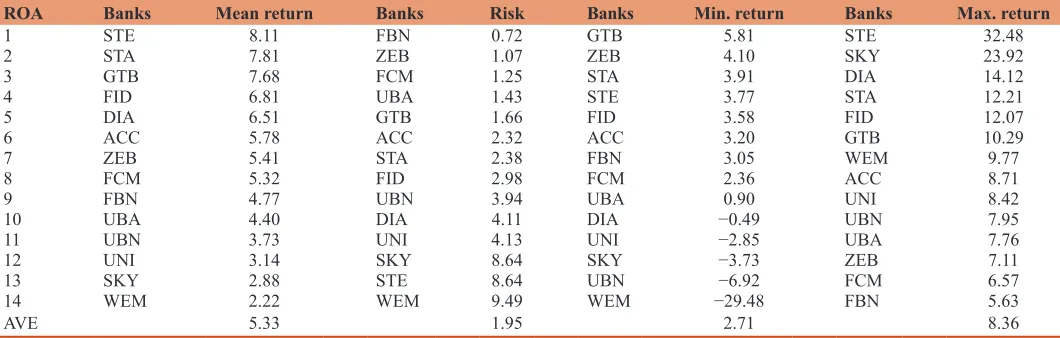
The descriptive statistics of the banks are showcased in Table 4a. On the risk scale, the industry average is 16.15 under the ROE,
1.95 under the ROA and 17.52 under the ROCE. The variation
in terms of return was highest under ROCE while it was very minimal under ROA. This picture is also supported by the figures in Tables 1a, 2a and 3a. The individual banks returns volatility can be depicted from Table 4a for the various years under the 15-year period. The minimum and the maximum rates of return under each criterion could be seen from the Table 4a.
From Table 4b based on ROE, StanbicIBTC bank was the least
risky bank in Nigeria during the period 2000-2014 with mean ROE of 15.23%. Wema bank was the most risky bank in Nigeria within the period 2000-2014 with the highest mean negative
ROE of −32.61%. The position of other banks on ROE risk,
mean return, minimum and maximum returns scales can be seen from Table 4b.
From Table 4c based on ROA, First bank was the least risky bank
in Nigeria during the period 2000-2014 with mean ROA of 4.77%.
Again, Wema bank was the most risky bank in Nigeria within the
period 2000-2014 though this time, with the least mean positive ROA of 2.22%. The position of other banks on ROA risk, mean
return, minimum and maximum returns scales can be seen from Table 4c.
From Table 4d based on ROCE, FCMB was the least risky bank
in Nigeria during the period 2000-2014 with mean ROCE of 28.71%. StanbicIBTC bank was the most risky bank in Nigeria within the period 2000-2014 with mean positive ROCE of 59.03%.
This position of StanbicIBTC bank purely illustrates the dictum in
finance that says that the higher the risk the higher the return. It has
highest risk and almost the highest mean ROCE. The position of other banks on ROCE risk, mean return, minimum and maximum returns scales can be seen from Table 4d.
Table 2b: Ranking of quoted banks in Nigeria based on ROA 2000-2007
No. 2000 ROA 2001 ROA 2002 ROA 2003 ROA 2004 ROA 2005 ROA 2006 ROA 2007 ROA
1 DIA 13.62 DIA 11.75 DIA 14.12 FID 12.07 FID 11.62 STE 32.48 GTB 8.36 STA 8.36
2 GTB 9.97 GTB 9.99 GTB 10.13 GTB 10.29 STA 10.98 STA 12.21 STA 7.13 GTB 5.93
3 UBA 7.76 ACC 8.04 WE 8.51 ACC 8.71 GTB 7.61 FID 10.85 FID 5.66 FID 5.72
4 UBN 6.43 UBN 7.95 ACC 8.38 WE 7.97 WE 7.56 GTB 7.13 FCM 5.59 STE 5.69
5 FBN 5.63 FBN 5.15 UBN 6.35 ZEB 6.80 ACC 7.52 UNI 7.12 FBN 5.16 UBN 5.60
6 WE 4.38 UBA 4.02 UBA 3.74 DIA 6.70 FBN 5.54 WE 6.08 SKY 4.64 DIA 5.60
7 WE 4.00 FBN 3.69 FBN 5.11 DIA 5.42 FBN 5.36 UBN 4.48 WE 5.09
8 UBA 4.29 UBN 5.36 FCM 5.27 UBN 4.45 FBN 4.93
9 UBN 0.64 ZEB 4.99 DIA 5.08 DIA 4.39 FCM 4.78
10 UBA 4.27 UBN 4.97 ZEB 4.19 ZEB 4.58
11 ZEB 4.45 STE 4.10 UBA 4.52
12 UBA 3.97 UNI 3.65 GTB 4.13
13 ACC 3.44 ACC 2.04 UBA 3.94
14 WE −3.27 ZEB 3.02
AVE 7.97 7.27 7.85 6.95 7.09 8.36 4.16 5.14
Source: Researcher’s compilations from Table 2a above on ROA
Table 2c: Ranking of quoted banks in Nigeria based on ROA 2008-2014
No. 2008 ROA 2009 ROA 2010 ROA 2011 ROA 2012 ROA 2013 ROA 2014 ROA AVE ROA
1 STA 9.42 SKY 23.92 WE 9.77 GTB 5.81 GTB 8.18 GTB 7.36 GTB 7.38 STE 8.11
2 STE 7.26 DIA 10.42 UNI 8.42 ZEB 4.10 FID 6.92 STA 6.57 UNI 7.09 STA 7.81
3 FCM 6.34 ACC 8.92 STA 7.46 STA 3.91 FCM 6.57 FCM 6.30 STA 6.92 GTB 7.68
4 ZEB 6.11 STA 7.62 UBN 7.14 STE 3.77 STE 6.37 ACC 6.14 ACC 6.10 FID 6.81 5 GTB 5.97 ZEB 7.11 GTB 6.78 FID 3.58 ZEB 6.37 STE 6.12 ZEB 6.02 DIA 6.51 6 UBN 5.75 GTB 6.39 STE 5.76 ACC 3.50 ACC 6.26 FID 5.95 FID 5.96 ACC 5.78
7 SKY 5.32 FCM 4.39 FCM 5.67 UNI 3.25 UNI 5.63 ZEB 5.75 FCM 5.91 ZEB 5.41
8 UBA 5.32 FID 4.29 ACC 4.66 FBN 3.05 STA 5.29 WE 5.41 STE 5.52 FCM 5.32
9 FBN 5.19 UBA 4.25 FID 4.57 FCM 2.36 FBN 4.84 UBA 5.23 UBA 5.30 FBN 4.77
10 DIA 4.55 FBN 4.10 ZEB 4.50 UBA 0.90 UBA 4.83 FBN 4.76 WE 5.20 UBA 4.40
11 FID 4.52 STE 4.03 FBN 4.14 DIA −0.49 DIA 4.27 DIA 4.63 UBN 5.14 UBN 3.73
12 ACC 3.20 WE −0.15 DIA 3.51 WE −1.08 WE 3.37 UBN 2.72 FBN 4.93 UNI 3.14
13 UNI −1.55 UBN −2.06 UBA 3.08 SKY −2.47 UBN 2.50 SKY −2.14 DIA 4.11 SKY 2.88
14 WE −29.48 UNI −2.34 SKY −1.39 UBN −6.92 SKY −3.73 UNI −2.85 SKY −2.39 WE 2.22
AVE 2.71 5.78 5.29 1.66 4.83 4.43 5.23 5.33
The result of the regression analysis produced by Eviews version 9
presented in Appendix 1 indicates that ROE-based-RISK has a negative and significant effect on the returns generated by the firms for the period under study. The coefficient of ROE-based-RISK is
Table 3a: ROCE of quoted banks in Nigeria 2000-2014
ROCE 2000 2001 2002 2003 2004 2005 2006 2007 2008 2009 2010 2011 2012 2013 2014 AVE
ACC - 74.35 54.48 86.03 90.51 20.64 15.61 48.66 18.9 34.16 23.91 31.24 41.81 33.02 21.83 42.51
DIA −65.39 −46.74 −96.2 −282.25 31.91 27.06 25.87 30.99 22.61 −31.85 18.58 0.91 41.78 46.73 34.9 −16.07
FID - - - 108.39 92.33 40,8 28.14 42.29 18.40 18.15 18.15 21.38 40.70 27.87 24.82 40.12
FBN 72.13 65.21 58.47 77.34 53.37 53.17 56.59 56.66 21.59 23.45 29.83 25.95 31.54 32.31 25.82 45.56
FCM - - - 38.82 20.87 31.78 21.62 17.91 23.27 12.33 47.12 45.70 27.69 28.71 GTB 112.48 109.76 68.75 82.62 70.19 39.49 42.60 28.36 21.42 26.99 27.97 21.10 32.14 28.12 29.00 49.40
SKY - - - 34.47 36.23 33.04 160.28 −2.26 −11.28 −37.44 −15.39 −21.83 19.54
STAN - - - - 45.52 31.00 22.99 28.21 36.49 29.70 343.80 18.93 25.27 34.72 32.75 59.03
STER - - - 248.04 20.17 34.15 44.43 28.94 33.05 27.72 80.86 44.04 36.68 59.81
UBA 126.16 84.97 73.39 62.01 43.15 50.69 81.01 33.50 47.52 36.55 22.18 7.52 38.15 49.88 39.61 53.09
UBN 81.31 123.02 60.47 0.75 56.12 63.28 .31.82 38.77 162.66 −30.26 193.42 −29.22 13.64 12.30 18.22 53.09
UNIT - - - 87.43 15.6 15.80 −13.51 −24.04 43.88 16.68 23.33 −10.22 36.58 19.15
WEM 42.01 58.6 96.92 70.13 69.95 26.92 −14.61 36.45 247.61 2.60 32.41 −1.42 16.77 19.30 21.26 48.33
ZEN - - - 64.37 65.92 42.58 29.68 34.43 30.43 34.25 24.25 26.92 36.59 33.17 25.68 37.36
AVE 61.45 67.02 45.18 29.93 61.90 59.22 29.34 35.45 50.94 23.35 59.46 12.05 30.88 27.25 25.22 38.55
Source: Researcher’s computations from figures obtained from the subject-banks financial statements 2000-2014
Table 3b: Ranking of quoted banks in Nigeria based on ROCE 2000-2007
No. 2000 ROA 2001 ROA 2002 ROA 2003 ROA 2004 ROA 2005 ROA 2006 ROA 2007 ROA
1 UBA 126.2 UBN 123.0 WE 96.92 FID 108.4 FID 92.33 STE 248.0 UBA 81.01 FBN 56.66 2 GTB 112.5 GTB 109.8 UBA 73.39 ACC 86.03 ACC 90.51 UNI 87.43 FBN 56.59 ACC 48.66 3 UBN 81.31 UBA 84.97 GTB 68.75 GTB 82.62 GTB 70.19 UBN 63.28 GTB 42.60 FID 42.29
4 FBN 72.13 ACC 74.35 UBN 60.47 FBN 77.34 WE 69.95 FBN 53.17 SKY 34.47 UBN 38.77
5 WE 42.01 FBN 65.21 FBN 58.47 WE 70.13 ZEB 65.92 UBA 50.69 UBN 31.82 WE 36.45
6 DIA −65.4 WE 58.60 ACC 54.48 ZEB 64.37 UBN 56.12 ZEB 42.58 ZEB 29.68 SKY 36.23
7 DIA −46.7 DIA −96.2 UBA 62.01 FBN 53.37 FID 40.80 FID 28.14 ZEB 34.43
8 UBN 0.75 STA 45.52 GTB 39.49 DIA 25.87 STE 34.15
9 DIA −282. UBA 43.15 FCM 38.82 STA 22.99 UBA 33.50
10 DIA 31.91 STA 31.00 FCM 20.87 FCM 31.78
11 DIA 27.06 STE 20.17 DIA 30.99
12 WE 26.92 ACC 15.61 GTB 28.36
13 ACC 20.64 UNI 15.60 STA 28.21
14 WE −14.6 UNI 15.80
AVE 61.45 67.02 45.18 29.93 61.90 59.22 29.34 35.45
Source: Researcher’s compilations from Table 3a above on ROCE
Table 3c: Ranking of quoted banks in Nigeria based on ROCE 2008-2014
No. 2008 ROA 2009 ROA 2010 ROA 2011 ROA 2012 ROA 2013 ROA 2014 ROA AVE ROA
1 WE 247.6 SKY 160.3 STA 343.8 ACC 31.24 STE 80.86 UBA 49.88 UBA 39.61 STE 59.81
2 UBN 162.7 UBA 36.55 UBN 193.4 STE 27.72 FCM 47.12 DIA 46.73 STE 36.68 STA 59.03
3 UBA 47.52 ZEB 34.25 UNI 43.88 ZEB 26.92 ACC 41.81 FCM 45.70 UNI 36.58 UBA 53.09
4 STE 44.43 ACC 34.16 STE 33.05 FBN 25.95 DIA 41.78 STE 44.04 DIA 34.90 UBN 53.09
5 STA 36.49 STA 29.70 WE 32.41 FID 21.38 FID 40.70 STA 34.72 STA 32.75 GTB 49.40
6 SKY 33.04 STE 28.94 FBN 29.83 GTB 21.10 UBA 38.15 ZEB 33.17 GTB 29.00 WE 48.33
7 ZEB 30.43 GTB 26.99 GTB 27.97 STA 18.93 ZEB 36.59 ACC 33.02 FCM 27.69 FBN 45.56
8 DIA 22.61 FBN 23.45 ZEB 24.25 UNI 16.68 GTB 32.14 FBN 32.31 FBN 25.82 ACC 42.51
9 FCM 21.62 FID 18.15 ACC 23.91 FCM 12.33 FBN 31.54 GTB 28.12 ZEB 25.68 FID 40.12
10 FBN 21.59 FCM 17.91 FCM 23.27 UBA 7.52 STA 25.27 FID 27.87 FID 24.82 ZEB 37.36
11 GTB 21.42 WE 2.60 UBA 22.18 DIA 0.91 UNI 23.33 WE 19.30 ACC 21.83 FCM 28.71
12 ACC 18.90 UNI −24.0 DIA 18.58 WE −1.42 WE 16.77 UBN 12.30 WE 21.26 SKY 19.54
13 FID 18.40 UBN −30.3 FID 18.15 SKY −11.3 UBN 13.64 UNI −10.2 UBN 18.22 UNI 19.15
14 UNI −13.5 DIA −31.9 SKY −2.26 UBN −29.2 SKY −37.4 SKY −15.4 SKY −21.8 DIA −16.1
AVE 50.94 23.35 59.46 12.05 30.88 27.25 25.22 38.55
−0.397012 which implies that an increase in the risk will result to a decrease in the return of the firms. The result is said to be significant judging from the result of the probability of t-stat of 0.0009 which is lower than 0.05, based on this we concluded that the result is statistically significant. The result of the Durbin-Watson stat
also revealed that there is no autocorrelation in the model. This conclusion is based on the rule of thumb approach which states that if the value of Durbin-Watson stat is approximately 2 then there is no autocorrelation in the model but if it is greater or less than 2 then there exists autocorrelation in the model.
Table 4a: Descriptive statistics for the Nigerian quoted banks
ROE Acc Dia Fid Fbn Fcm Gtb Sky Stan Ster Uba Ubn Uni Wem Zen AVE
Mean 11.56 14.58 12.00 20.81 9.00 26.24 10.50 15.23 26.09 17.46 3.61 −29.43 −32.61 18.15 8.80
Min −2.84 −12.06 1.41 3.73 3.10 12.32 0.01 8.78 4.10 −6.16 −109.11 −225.06 −394.32 6.10 −21.92
Max 23.59 41.35 34.07 39.49 19.21 38.70 18.91 28.06 197.54 43.32 41.41 28.20 110.69 34.97 30.14
SD 8.02 13.27 9.55 9.47 7.46 8.44 6.14 5.79 62.98 12.29 43.90 78.01 121.74 8.58 16.15
ROA Acc Dia Fid Fbn Fcm Gtb Sky Stan Ster Uba Ubn Uni Wem Zen AVE
Mean 5.78 6.51 6.81 4.77 5.32 7.68 2.88 7.81 8.11 4.40 3.73 3.14 2.22 5.41 5.33
Min 3.2 −0.49 3.58 3.05 2.36 5.81 −3.73 3.91 3.77 0.90 −6.92 −2.85 −29.48 4.10 2.71
Max 8.71 14.12 12.07 5.63 6.57 10.29 23.92 12.21 32.48 7.76 7.95 8.42 9.77 7.11 8.36 SD 2.32 4.11 2.98 0.72 1.25 1.66 8.64 2.38 8.64 1.43 3.94 4.13 9.49 1.07 1.95
ROCE Acc Dia Fid Fbn Fcm Gtb Sky Stan Ster Uba Ubn Uni Wem Zen AVE
Mean 42.51 −16.07 40.12 45.56 28.71 49.40 19.54 59.03 59.81 53.09 53.09 19.15 48.33 37.36 38.55 Min 15.61 −96.20 18.15 21.59 12.33 21.10 −37.44 22.99 20.17 7.52 −30.26 −24.04 −14.61 24.25 12.05
Max 90.51 46.73 108.39 77.34 47.12 112.48 160.28 343.80 248.04 126.16 193.42 87.43 247.61 65.92 67.02
SD 25.14 85.32 29.71 19.07 11.86 31.43 59.26 94.71 68.17 29.11 64.98 32.35 62.74 13.93 17.52
Source: Researcher’s computations from figures obtained from the subject-banks financial statements 2000-2014
Table 4b: Ranking of quoted banks in Nigeria based on descriptive statistics
ROE Banks Mean return Banks Risk Banks Min. return Banks Max. return
1 GTB 26.24 STA 5.79 GTB 12.32 WEM 110.69
2 STE 26.09 SKY 6.14 STA 8.78 STE 197.54
3 FBN 20.81 FCM 7.46 ZEB 6.10 UBA 43.32
4 ZEB 18.15 ACC 8.02 STE 4.10 UBN 41.41
5 UBA 17.46 GTB 8.44 FBN 3.73 DIA 41.35
6 STA 15.23 ZEB 8.58 FCM 3.10 FBN 39.49
7 DIA 14.58 FBN 9.47 FID 1.41 GTB 38.70
8 FID 12.00 FID 9.55 SKY 0.01 ZEB 34.97
9 ACC 11.56 UBA 12.29 ACC −2.84 FID 34.07
10 SKY 10.50 DIA 13.27 UBA −6.16 UNI 28.20
11 FCM 9.00 UBN 43.90 DIA −12.06 STA 28.06
12 UBN 3.61 STE 62.98 UBN −109.11 ACC 23.59
13 UNI −29.43 UNI 78.01 UNI −225.06 FCM 19.21
14 WE −32.61 WEM 121.74 WEM −394.32 SKY 18.91
AVE 8.80 16.15 −21.92 30.14
Source: Researcher’s compilations from Table 4a
Table 4c: Ranking of quoted banks in Nigeria based on descriptive statistics
ROA Banks Mean return Banks Risk Banks Min. return Banks Max. return
1 STE 8.11 FBN 0.72 GTB 5.81 STE 32.48
2 STA 7.81 ZEB 1.07 ZEB 4.10 SKY 23.92
3 GTB 7.68 FCM 1.25 STA 3.91 DIA 14.12
4 FID 6.81 UBA 1.43 STE 3.77 STA 12.21
5 DIA 6.51 GTB 1.66 FID 3.58 FID 12.07
6 ACC 5.78 ACC 2.32 ACC 3.20 GTB 10.29
7 ZEB 5.41 STA 2.38 FBN 3.05 WEM 9.77
8 FCM 5.32 FID 2.98 FCM 2.36 ACC 8.71
9 FBN 4.77 UBN 3.94 UBA 0.90 UNI 8.42
10 UBA 4.40 DIA 4.11 DIA −0.49 UBN 7.95
11 UBN 3.73 UNI 4.13 UNI −2.85 UBA 7.76
12 UNI 3.14 SKY 8.64 SKY −3.73 ZEB 7.11
13 SKY 2.88 STE 8.64 UBN −6.92 FCM 6.57
14 WEM 2.22 WEM 9.49 WEM −29.48 FBN 5.63
AVE 5.33 1.95 2.71 8.36
The result of the regression analysis produced by Eviews version 9
as presented in the Appendix 2 indicates that ROA-based-RISK has
a negative and insignificant effect on the returns generated by the firms for the period under study. The coefficient of ROA-based-RISK is −0.198171 which presupposes that a unit increase in the ROA-based-risk will result to a decrease of about 0.20% in the return of the firms. The result is said to be insignificant judging from the result of the probability of t-stat of 0.2765which is >0.05, based on this we concluded that the result is statistically insignificant at 5% level of significant. The result of the Durbin-Watson stat
also revealed that there is no autocorrelation in the model. This conclusion is based on the rule of thumb approach which states that if the value of Durbin-Watson stat is approximately 2 then there is no autocorrelation in the model but if it is greater or less than 2 then there exists autocorrelation in the model.
The Appendix 3 presents the regression result produced by
Eviews version 9 which indicates that ROCE-based-RISK has a negative and insignificant effect on the returns generated by the firms for the period under study. The coefficient of ROCE-based-RISK is −0.058133 which revealed that a unit increase in the ROCE-based-risk will result to a decrease of about 0.06% in the return of the firms. The result is said to be insignificant judging from the result of the probability of t-stat of 0.7931 which is greater than 0.05, and based on this we concluded that the result is statistically insignificant at 5% level of significant.
The result of the Durbin-Watson stat also revealed that there is no autocorrelation in the model. This conclusion is based on the rule of thumb approach which states that if the value of Durbin-Watson stat is approximately 2 then there is no autocorrelation in the model but if it is greater or less than 2 then there exists autocorrelation in the model.
The result of the correlation analysis indicates that there exist a
negative relationship between risk and return for the firms under study. This is revealed from the result of the correlation coefficient between ROE and ROE-based-RISK of −0.785224 or −79% which
indicates a high negative correlation between the two. On the
other hand, the correlation coefficient between ROA and ROA-based-RISK is −0.312608 or −31% which indicates a low negative
correlation between the two variables. Similarly, the result of the
correlation coefficient between ROCE and ROCE-based-RISK is −0.077193 or −8% which showed that there is a very low negative
correlation between the two variables (Table 5).
5. CONCLUSION
The findings of this study showed that GTB is the most profitable
quoted bank in Nigeria while Wema bank is crowned the most non-profitable bank in Nigeria with respect to return on SHF for the period 2000-2014. Based on the average performance from 2000-2014, GTB with average ROA of 8.11% is the overall best in terms of ROA, followed closely by StanbicIBTC with 7.81, GTB with 7.68 under the industry average of 5.33%. Based on the average for the study period of 2000-2014, Sterling bank with the highest ROCE of 59.81% for the entire 15-year study period, is crowned the most profitable bank in Nigeria with respect to ROCE. With the only and high negative average ROCE for the entire 15-year study period, diamond bank is crowned the most
non-profitable bank in Nigeria with respect to ROCE.
REFERENCES
Achuchaogu, K.C. (2002), Contemporary Issues in Financial Management.
Lagos: Knowroch.
Table 4d: Ranking of quoted banks in Nigeria based on descriptive statistics
ROCE Banks Mean return Banks Risk Banks Min. return Banks Max. return
1 STE 59.81 FCM 11.86 ZEB 24.25 STA 343.80
2 STA 59.03 ZEB 13.93 STA 22.99 STE 248.04
3 UBA 53.09 FBN 19.07 FBN 21.59 WEM 247.61
4 UBN 53.09 ACC 25.14 GTB 21.10 UBN 193.42
5 GTB 49.40 UBA 29.11 STE 20.17 SKY 160.28
6 WEM 48.33 FID 29.71 FID 18.15 UBA 126.16
7 FBN 45.56 GTB 31.43 ACC 15.61 GTB 112.48
8 ACC 42.51 UNI 32.35 FCM 12.33 FID 108.39
9 FID 40.12 SKY 59.26 UBA 7.52 ACC 90.51
10 ZEB 37.36 WEM 62.74 WEM −14.61 UNI 87.43
11 FCM 28.71 UBN 64.98 UNI −24.04 FBN 77.34
12 SKY 19.54 STE 68.17 UBN −30.26 ZEB 65.92
13 UNI 19.15 DIA 85.32 SKY −37.44 FCM 47.12
14 DIA −16.07 STA 94.71 DIA −96.20 DIA 46.73
AVE 38.55 17.52 12.05 67.02
Source: Researcher’s compilations from Table 4a
Table 5: Correlation matrix
ROE ROA ROCE ROA-RISK ROCE-RISK ROE-RISK
ROE 1 0.7173645 0.170978 −0.414399 −0.073295 −0.785224
ROA 0.7173645 1 0.1838776 −0.312608 0.1557482 −0.460456
ROCE 0.170978 0.1838776 1 −0.052555 −0.077193 0.1308727
ROA-RISK −0.414399 −0.312608 −0.052555 1 0.5479458 0.6666197
ROCE-RISK −0.073295 0.1557482 −0.077193 0.5479458 1 0.2483636
Arnold, G. (2008), Corporate Financial Management. 4th ed. Harlow,
UK: FT Prentice Hall.
Arnold, J., Hope, T. (1990), Accounting for Management Decisions. UK: Prentice-Hall.
Atrill, P. (2006), Financial Management for Decision Makes. 4th ed.
New York: FT Prentice Hall.
Banerjee, B. (2009), Fundamentals of Financial Management, Eastern Economy Edition. New Delhi, India: PHI Learning.
Berk, J., DeMarzo, P. (2009), Corporate Finance: The Core, Pearson International Edition. Pearson: Pearson Prentice Hall.
Bernstein, L.A., John, J.W. (2000), Analysis of Financial Statements. New York: McGraw-Hill.
Brealey, R.A., Myers, S.C., Marcus, A.J. (1995), Fundamentals of Corporate Finance, International Edition. Irwin: McGraw-Hill. Chandra, P. (2012), Investment Analysis and Portfolio Management.
4th ed. New Delhi: CFM-Tata McGraw-Hill.
Cuthbertson, K., Nitzsche, D. (2005), Investments – Spot and Derivatives
Markets. Cambridge, MA: John Wiley.
Damodaran, A. (2001), Corporate Finance-Theory and Practice, 2th ed. Orlando, FL: John Wiley.
Fischer, D.E., Jordan, R.J. (1995), Security Analysis and Portfolio
Management. 6th ed. Eastern Economy Edition. New Delhi: PHI Learning.
Friedlob, G.T., Franklin, J.P. (1996), Understanding Return on Investment.
Chicago: Wiley.
Giles, R.S., Capel, J.W. (1994), Finance and Accounting. 3rd ed. London: Macmillan.
Gill, J.O. (1994), Financial Basics of Small Business Success. Menlo Park, CA: Crisp Publications.
Glyn, J., John, P., Michael, P.M. (1998), Accounting for Managers. 2th ed. London: Thomson.
Hilton, R.W. (1991), Managerial Accounting. New York: McGraw-Hill.
Howells, P., Bain, K. (2008), The Economics of Money, Banking and
Finance-A European Text. 4th ed. Harlow: FT Prentice Hall.
Ihesiulo, O.S. (2005), The Principles of Business Finance. Owerri: Barloz Publishers.
Ituwe, C.E. (2006), Strategic Management: Theory and Practice. 2th ed. Lagos: Excel Bookhouse.
Larkin, H. (1996), How to Read a Financial Statement, American Medical
News, March. p11.
MacCormac, M.J., Teeling, J.J. (1980), Financial Management. Dublin: Gill and Macmillan.
Murray, B. (2000), Return on Investment. Supermarket News. p2. Njoku, P.N.O. (1997), A Practical Guide to Bank Lending and Credit
Administration. Umuahia: Du Prince and Paul.
Njoku, P.N.O., Jombo, O.C. (2003), Fundamentals of Business Finance and Financial Management. Owerri: Barloz Publishing.
Nwude, C. (2004), Basic Principles of Financial Management-A First
Course. Enugu: Nwabude.
Pandey, I.M. (1999), Financial Management, 8th ed. India: Vikas
Publishing House.
Pandian, P. (2005), Security Analysis and Portfolio Management. India: Vikas Publishing House.
Rees, B. (1990), Financial Analysis. Harlow/Essex, UK: UK, Prentice-Hall.
Ross, S.A., Westerfield, R.W, Jaffe, J. (1996), Corporate Finance. 4th ed.
New York: McGraw-Hill.
Spivey, J. (2000), Companies Searching for Ever-Elusive Internet ROI,
Mississippi Business Journal, December. p11-23.
Tracy, C. (1997), Using Financial Ratios to Assess Performance,
Association Management, July.
Weston, J.F., Besley, S., Brigham, E.F. (1996), Essentials of Managerial
Finance, 11th ed. Fort Worth, TX: The Dryden Press.
APPENDIX
Appendix 1
Dependent variable: ROE Method: Least squares Sample: 0001 0014 Included observations: 14
Variable Coefficient Standard error t-statistic P
C 20.01885 4.016004 4.984768 0.0003
ROE-RISK −0.397012 0.090377 −4.392842 0.0009
R2 0.616577 Mean dependent var 8.799286
Adjusted R2 0.584625 S.D. dependent var 17.99264 S.E. of regression 11.59617 Akaike info criterion 7.870791
Sum squared resid 1613.655 Schwarz criterion 7.962085
Log likelihood −53.09554 Hannan-Quinn criter. 7.862340
F-statistic 19.29706 Durbin-Watson stat 2.143065
Appendix 2
Dependent variable: ROA Method: Least squares Sample: 0001 0014 Included observations: 14
Variable Coefficient Standard error t-statistic P
C 6.073250 0.826870 7.344865 0.0000
ROA-RISK −0.198171 0.173828 −1.140043 0.2765
R2 0.097724 Mean dependent var 5.326429
Adjusted R2 0.022534 S.D. dependent var 1.909533 S.E. of regression 1.887896 Akaike info criterion 4.240366
Sum squared resid 42.76980 Schwarz criterion 4.331660
Log likelihood −27.68256 Hannan-Quinn criter 4.231915
F-statistic 1.299698 Durbin-Watson stat 1.648300
P (F-statistic) 0.276513
Appendix 3
Dependent variable: Return (ROCE) Method: Least squares
Sample: 0001 0014 Included observations: 14
Variable Coefficient Standard error t-statistic P
C 41.15177 11.24195 3.660554 0.0033
ROCE-RISK −0.058133 0.216748 −0.268206 0.7931
R2 0.005959 Mean dependent var 38.54500
Adjusted R2 −0.076878 S.D. dependent var 20.37008 S.E. of regression 21.13859 Akaike info criterion 9.071642
Sum squared resid 5362.081 Schwarz criterion 9.162935
Log likelihood −61.50149 Hannan-Quinn criter. 9.063191
F-statistic 0.071935 Durbin-Watson stat 2.178042