Intra Firm Bargaining and Shapley Values
Björn Brügemann
Vrije Universiteit AmsterdamPieter Gautier
Vrije Universiteit AmsterdamGuido Menzio
University of Pennsylvania and NBER
August 2017
Abstract
We study two wage bargaining games between a …rm and multiple workers. We revisit the bargaining game proposed by Stole and Zwiebel (1996a). We show that, in the unique Subgame Perfect Equilibrium, the gains from trade captured by workers who bargain earlier with the …rm are larger than those captured by workers who bargain later, as well as larger than those captured by the …rm. The resulting equilibrium payo¤s are di¤erent from those reported in Stole and Zwiebel (1996a) as they are not the Shapley values. We propose a novel bargaining game, the Rolodex game, which follows a simple and realistic protocol. In the unique no-delay Subgame Perfect Equilibrium of this game, the payo¤s to the …rm and to the workers are their Shapley values.
JEL Codes: D21, J30.
Keywords: Intra …rm bargaining; Shapley value.
1
Introduction
We revisit the problem of wage bargaining between a …rm and multiple employees. The standard axiomatic approach to this type of multilateral bargaining problem is provided by Shapley (1953), who shows that there exists a unique solution satisfying certain desirable properties. The classic game-theoretic approach to the bargaining problem between a …rm and multiple employees is provided by Stole and Zwiebel (1996a and 1996b), who propose an extensive-form game with a simple and realistic protocol and report that, in the unique Subgame Perfect Equilibrium of their game, the pro…le of wages and pro…ts coincides with the axiomatic solution by Shapley. Stole and Zwiebel (1996a, 1996b) also analyze the im-plications of their game for a wide variety of substantive issues related to the technology choice and organizational design of the …rm. The Stole and Zwiebel bargaining game has been applied widely in search-theoretic models of the labor market, where wages are not pinned down by competition because, due to search frictions, a …rm and its employees have to spend time or other resources in order to …nd alternative trading partners.1
In this paper, we analyze two perfect-information bargaining games between a …rm and multiple employees. First, we re-examine the bargaining game proposed by Stole and Zwiebel. We solve for the unique Subgame Perfect Equilibrium of the game. We characterize the equilibrium payo¤s accruing to …rm and workers and show that they are di¤erent from those reported in Stole and Zwiebel (1996a) and, hence, they are di¤erent from the Shapley values. Second, we propose a novel bargaining game between a …rm and multiple workers that follows a simple and realistic protocol and delivers the Shapley values in the unique no-delay Subgame Perfect Equilibrium. We refer to this game as the “Rolodex game,”after the rotating …le device used to store business contact information.
In the …rst part of the paper, we characterize the solution to the Stole and Zwiebel game (henceforth, the SZ game). The game includes a …rm and n workers, who are placed in some arbitrary queue. The game proceeds as a …nite sequence of pairwise bargaining sessions between the …rm and one of the workers. Each bargaining session follows the same protocol as in Binmore, Rubinstein and Wolinsky (1986, henceforth the BRW game), i.e. the worker and the …rm alternate in making proposals about the worker’s wage and, after every rejection, there is some probability of a breakdown. Each bargaining session may end either with an agreement over some wage or with a breakdown. In case of agreement, the …rm enters a bargaining session with the next worker in the queue. In case of breakdown, the worker exits the game and the whole bargaining process starts over with one less worker.
1See, e.g., Cahuc, Marque and Wasmer (2008), Ebell and Haefke (2009), Itskhoki and Redding (2010),
When the …rm reaches an agreement with all the workers who are left in the game, the agreed-upon wages are paid out and production takes place.
We prove that the unique Subgame Perfect Equilibrium (SPE) of the SZ game is such that the …rm reaches an agreement with every worker without delay. The gains from trade (and, hence, the wages) captured by a worker are decreasing with the worker’s position in the queue, i.e. the …rst worker captures more gains from trade than the second worker, who captures more gains from trade than the third, etc. . . The gains from trade captured by the …rm are equal to those captured by the last worker. The relevant notion of gains from trade is given by the output produced by the …rm andn workers net of the sum of the payo¤s that each of the n workers would obtain if he were excluded from the game and the payo¤ that the …rm would obtain if it were to bargain withn 1rather than n workers. We show that the equilibrium payo¤s to the workers imply intra-…rm wage inequality. We show that the equilibrium payo¤ to the …rm implies that the …rm has an incentive to hire more workers than it would if it were to take the wage as given.
The structure of the equilibrium payo¤s of the SZ game is easy to explain. In the bargaining session between the …rm and the last worker, the wage transfers utility from the …rm to the worker at a rate of 1 to 1. That is, if the last worker gets paid an extra dollar, the worker’s payo¤ increases by a dollar and the …rm’s payo¤ falls by a dollar. When the wage transfers utility at the rate of 1 to 1, the outcome of the BRW bargaining session is a wage that equates the gains from trade accruing to the worker and the …rm. In the bargaining session between the …rm and the i-th worker in the queue, with i < n, the wage transfers utility from the …rm to the worker at a rate of less-than-1 to 1. Indeed, if the i-th worker gets paid an extra dollar, the …rm’s pro…t falls by less than a dollar because the …rm will end up paying a lower wage to the subsequent workers. When the wage transfers utility at a rate of less-than-1 to 1, the outcome of the BRW bargaining session is a wage such that the gains from trade accruing to the worker are greater than those accruing to the …rm. And the further ahead in the queue is the worker, the lower is the …rm’s marginal cost of increasing the worker’s wage, the higher is the rate at which the wage transfers utility from the …rm to the worker and, ultimately, the higher are the worker’s gains from trade relative to the …rm’s.
the shares accruing to the workers at the head of the queue are higher than in the Shapley values, while the shares accruing to the workers at the end of the queue and to the …rm are lower.
In the second part of the paper, we study the Rolodex game, a novel extensive-form game between a …rm and multiple workers. The Rolodex game follows the same protocol as the SZ game, with one modi…cation. In the Rolodex game, when a worker rejects a countero¤er from the …rm, he moves to the end of the queue and the …rm enters a bargaining session with the worker who, among those without agreement, is now at the top of the queue. In contrast, in the SZ game, a bargaining session between a …rm and a worker continues until it reaches either an agreement or a breakdown. All other aspects of the Rolodex game are the same as in the SZ game. In particular, in the Rolodex game as in the SZ game, a breakdown in negotiations between the …rm and a worker causes the worker to exit the game and the …rm to restart the entire bargaining process with one less worker. We refer to this game as the Rolodex game because the …rm cycles through the workers without agreement, rather than bargaining with one of them until it reaches an agreement or a breakdown.
We prove that there exists a unique no-delay SPE of the Rolodex game. In this equilib-rium, the …rm and every worker–irrespective of his position in the initial queue–capture an equal share of the gains from trade. The notion of gains from trade is the output produced by the …rm withnworkers net of the sum of the workers’payo¤s if they were to be excluded from the game and the payo¤ of the …rm if it were to bargain with n 1 rather than n
workers. Since the notion of gains from trade and the share of the gains from trade accruing to …rm and workers are the same in the Rolodex game as in the Shapley values, the equilib-rium payo¤s of the Rolodex game coincide with the Shapley values. The equilibequilib-rium payo¤s to the workers in the Rolodex game imply no intra-…rm wage inequality. The equilibrium payo¤ to the …rm in the Rolodex game implies that the …rm has an incentive to hire more workers than it would if it were to take the wage as given, but fewer than if wages were determined according to the SZ game.
last worker. Overall, the …rm and every worker capture an equal share of the gains from trade, as per the Shapley values. Moreover, the notion of gains from trade is the same as for the Shapley values because, if there is a breakdown in negotiations between the …rm and a worker, the worker exits the game and the …rm restarts the whole bargaining process with
n 1 rather than n workers.
The paper is a contribution to the literature on wage bargaining between a …rm and multiple employees. The …rst part of the paper is devoted to revisiting the SZ game. The analysis of this game is of natural interest given its sensible protocol and its widespread application in the labor-search literature. We …nd that the unique SPE of the game is such that workers are paid di¤erent wages depending on the order in which they bargain with the …rm. We relate this …nding to the empirical literature on intra-…rm wage inequality and the return to seniority. We …nd that, given this wage setting game, the …rm has an incentive to hire more workers than it would in a competitive labor market, as well as more workers than it would if wages were given by the Shapley values. These …ndings are novel because the equilibrium payo¤s to the …rm and to the workers are not those reported in Stole and Zwiebel (1996a). In particular, the equilibrium payo¤s of the SZ game are di¤erent from the Shapley values, while the equilibrium payo¤s reported in Theorem 2 of Stole and Zwiebel (1996a) are the Shapley values.
If one interprets the SZ game as one of perfect information–as we do here and as we believe is natural from reading Stole and Zwiebel (1996a)–then Theorem 2 is incorrect. The mistake in the proof of Theorem 2 is to argue that the outcome of the bargaining session between the …rm and a worker is always such that the gains from trade accruing to the two parties are equalized. However, this is only true for the bargaining session between the …rm and the last worker in the queue. The outcome of the bargaining session between the …rm and any other worker is such that the gains from trade accruing to the worker are greater than those accruing to the …rm.
(1996a), but as the analysis of the perfect-information version of the SZ game.
The second part of the paper is devoted to the analysis of the Rolodex game. As the SZ game, the Rolodex game is a generalization of BRW to an environment in which the …rm bargains with multiple workers. As the SZ game, the Rolodex game features a protocol that is plausible in the context of wage negotiations between a …rm and its employees, in the sense that the …rm is involved in every negotiation and workers are involved only in negotiations regarding their own wage. In contrast to the SZ game (interpreted as a game of perfect information), the players’payo¤s in the unique no-delay SPE of the Rolodex game are the Shapley values. The Rolodex game contributes to the theoretical literature on bargaining by identifying a novel protocol that yields the Shapley values in the context of a wage bargain in a multi-worker …rm. In follow-up work (Brügemann et al. 2017), we show that the Rolodex game also yields the Myerson-Shapley values in more general contexts. Moreover, the Rolodex game contributes to the applied literature on search-theoretic models of the labor market. In fact, the Rolodex game is a game with a simple, perfect-information and plausible protocol which may be referred to by the labor-search literature as a justi…cation for using the Shapley values as the outcome of the wage bargain between a …rm and multiple employees.
Naturally, there are other perfect-information games that deliver the Shapley values. Two important games are those developed by Gul (1986) and Hart and Mas-Colell (1996). However, the protocol of these games does not provide a plausible description of wage nego-tiations in a multi-worker …rm. In the context of a wage negotiation between a …rm and its workers, the protocol of the game by Gul features situations in which a worker buys labor from a co-worker and then sells it to the …rm, as well as situations in which a worker buys the assets of the …rm and then hires additional workers. Similarly, in the context of a wage bargain in a multi-worker …rm, the protocol of the game by Hart and Mas-Colell features situations in which a worker proposes a wage not only for himself, but also for his coworkers.
2
The Stole and Zwiebel Game
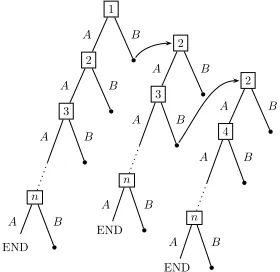
1 2 A 3 A A n END A b B b B b B b B 2 3 A A n END A b B b B b B 2 4 A A n END A b B b B b B
Figure 1: Sequence of bargaining sessions in SZ game
2.1
Environment and Preliminaries
We begin by describing the extensive form of the SZ game. The players in the game are a …rm and n 1 workers. If the …rm employs k 0 of the n workers and pays them wages w1, w2, ... wk, it attains a payo¤ of F(k) w1 w2 :::wk, where F(k) denotes
the value of the output produced by the …rm and k employees. We assume that F(k) is strictly positive, strictly increasing and strictly concave in k, i.e. F(k) < F(k + 1) and
F(k+ 1) F(k)> F(k+ 2) F(k+ 1) for k = 0;1;2:::Workers are ex-ante identical. If a
worker is hired at the wagew, he attains a payo¤ ofw. If the worker is not hired, he attains a payo¤ of w 0, wherew might represent the value that the worker can obtain from some other …rm or the value of unemployment.
The game consists of a …nite sequence of bilateral bargaining sessions between the …rm and one of the workers. Workers are placed in some arbitrary order from 1 to n. The game starts with a bargaining session between the …rm and the …rst worker in the order. A bargaining session involves the determination of the worker’s wage and may end either with an agreement over a particular wage or with a breakdown. If the session ends with an agreement, the …rm enters a bargaining session with the worker who, among those still in the game, is next in the order. If the session ends with a breakdown, the worker permanently exits the game and the entire bargain process starts over. That is, all prior agreements between …rm and workers are erased and the …rm enters a bargaining session with the worker who, among those still in the game, is …rst in the order. The game ends when the …rm has reached an agreement with all the workers still in the game. When the game ends, production takes place and the …rm pays the agreed-upon wages. Figure 1 illustrates the sequence of the bargaining sessions in the SZ game, where the number in the box denotes the position in the order of the worker with whom the …rm is bargaining at that time.
the …rm rejects the o¤er, the negotiation breaks down with probabilityq and continues with probability1 q, withq2(0;1). If the negotiation continues, the …rm makes a countero¤er to the worker. If the worker accepts the countero¤er, the bargaining session comes to an end. If the worker rejects the countero¤er, the negotiation breaks down with probability q and continues with probability 1 q. As long as the session continues, the worker and the …rm take turns in making o¤ers while facing a probabilityq of breakdown after every rejection.
The SZ game is a natural generalization of the BRW bargaining game to an environment in which the …rm is connected to multiple workers. The …rm negotiates sequentially with each individual worker over that worker’s wage. The negotiation between the …rm and a worker follows the same protocol as in BRW. The game ends when the …rm reaches an agreement with all the workers who, at that point in time, are still connected to the …rm. The game starts over whenever a negotiation breaks down and the …rm and the worker lose contact. The assumption is meant to capture the idea that–when the connection between the …rm and a worker breaks down–the physical environment of the game changes and, for this reason, all prior agreements are annulled. The SZ game seems like a plausible description of the bargaining process between a …rm and its workforce.
As in Stole and Zwiebel (1996a), we shall focus on SPE in the limit for q ! 0. Before embarking on the characterization of the equilibrium of the SZ game, it is useful to remind our readers of the solution of the BRW bargaining game between a …rm and a worker in which the worker’s marginal bene…t of a higher wage is 1, the …rm’s marginal cost of a higher wage is1 , and, thus, the wage transfers utility from the …rm to the worker at the rate of 1 to1.
Lemma 1: Consider the BRW alternating-o¤er game between a …rm and a worker. If the
…rm and the worker reach an agreement at the wage w, the payo¤ to the worker is w and the payo¤ to the …rm is y w t(w), where t(w) is a linear function of w with derivative , 2[0;1). If the …rm and the worker do not reach an agreement, the payo¤ to the worker is
w and the payo¤ to the …rm is z. (i) If y z w t(w)<0, any SPE is such that the …rm
and the worker do not reach an agreement. (ii) If y z w t(w) 0, the unique SPE2
is such that the …rm and the worker immediately reach an agreement at the wage
w=w+ 1
(2 q)(1 )[y z w t(w)]. (1)
Proof: The result follows immediately from Proposition 4.2 in Muthoo (1999). .
In the BRW game described in Lemma 1, the gains from trade are y z w t(w). The lemma states that, if the gains from trade are negative, any SPE is such that the …rm
2To be precise, there are multiple SPE of the BRW game when the gains from trade are zero. All of the
and the worker do not reach an agreement. If the gains from trade are positive, the unique SPE is such that trade takes place without delay at the wage (1). In this case, the gains from trade accruing to the worker, w w, and the gains from trade accruing to the …rm,
y z w t(w), are respectively given by
w w= 1
(2 q)(1 )[y z w t(w)],
y w t(w) z = 1 q
2 q[y z w t(w)].
(2)
Two features of the equilibrium of the BRW game are worth pointing out. First, in the limit as the breakdown probabilityqgoes to zero, the equilibrium wage and payo¤s converge to the wage and payo¤s under the axiomatic Nash bargaining solution. In fact, for q ! 0, the equilibrium wage converges to
w=w+ 1
1 [y z w t(w)]. (3)
This is the wage that maximizes the Nash product (w b) (y z w t(w)). As the equilibrium wage converges to the wage that maximizes the Nash product, it follows that the equilibrium payo¤s to …rm and to worker converge to the payo¤s under axiomatic Nash bargaining. This is a well-known result. We wished to restate it because it implies that our characterization of the SZ game would be the same if we replaced the BRW alternating-o¤er bargaining game with axiomatic Nash bargaining.
Second, in the limit for q! 0, the ratio of the equilibrium gains from trade accruing to the worker to those accruing to the …rm is given by
w w
y w t(w) z =
1
1 . (4)
That is, the ratio of the worker’s gains from trade to the …rm’s gains from trade is equal to the ratio1=(1 ) of the worker’s marginal bene…t of a higher wage to the …rm’s marginal cost of a higher wage. For = 0, utility is perfectly transferrable, in the sense that the marginal cost to the …rm of a higher wage is1, the marginal bene…t to the worker of a higher wage is1and, thus, the wage transfers utility at a rate of1to1. In this case, (4) implies that the equilibrium of the BRW game is such that the gains from trade accruing to the worker and those accruing to the …rm are equated. When >0,utility is not perfectly transferrable, in the sense that the marginal cost to the …rm of a higher wage is 1 <1, the marginal bene…t to the worker of a higher wage is 1 and, thus, the wage transfers utility at a rate of
1 to1. In this case, (4) implies that the equilibrium of the BRW game is such that the
Γn,k(s) :h1,2, . . . n−ki;hn−k+ 1, . . . ni
Γn,k+1(s+w) :h1,2, . . . n−k, n−k+ 1i;hn−k+ 2, . . . ni Γn−1,n−1(0) :∅;h1,2, . . . n−k, n−k+ 2, . . . ni
w
A B
Figure 2: Structure of generic subgame in SZ game
of the gains from trade accruing to the worker relative to those accruing to the …rm. Again this is a well-known and well-understood result. However, we wished to restate it to point out that the outcome of the BRW game is such that the …rm’s and worker’s gains from trade are equal only when utility is perfectly transferrable.
2.2
Equilibrium of the SZ Game
We begin the analysis of the SZ game by introducing some notation. We denote as n;k(s)
the subgame in which there are n workers in the game, n k of these workers have already reached an agreement with the …rm for wages summing up to s, k workers have yet to reach an agreement with the …rm, and the …rm is about to enter a bargaining session with the …rst of those k workers. We denote as wi
n;k(s) the wage of thei-th of k workers without
agreement in an SPE of the subgame n;k(s). The SZ game between the …rm andnworkers is
the subgame n;n(0). We …nd it useful to adopt some shorthand notation for the equilibrium
outcomes of n;n(0). In particular, we denote as ~n the payo¤ to the …rm and with w~in the
payo¤ to thei-th worker in an SPE of n;n(0). Clearly, ~0 =F(0).
Figure 2 illustrates the structure of a generic subgame n;k(s), in which workers1,2, . . .
n k have reached an agreement with the …rm for wages summing up to s and n k+ 1,
n k+ 2, ..., n is the order of the workers who have yet to reach an agreement with the
…rm. The subgame n;k(s) starts with a bargaining session between the …rm and worker
n k+ 1. If the session ends with an agreement at the wagew, the game enters the subgame
n;k+1(s+w), in which workers 1;2; : : : ; n k; n k+ 1 have reached an agreement with
the …rm for wages summing up tos+wand n k+ 2; n k+ 3; :::; nis the order of workers who have yet to reach an agreement with the …rm. If the session ends with a breakdown, the worker exits and the game continues with the subgame n 1;n 1(0), in which workers 1;
2; : : : ; n k; n k+ 2;...; n have yet to reach an agreement with the …rm.
The intuition behind the equilibrium properties of the SZ game can be gained by studying the game between the …rm and two workers. We solve for the SPE of the SZ game 2;2(0)by
backward induction. First, we solve for the SPE of the subgame 1;1(0) which is reached if
the bargaining session between the …rm and one of its two workers ends with a breakdown. Second, we solve for the SPE of the subgame 2;1(w1) which is reached if the bargaining
session between the …rm and the …rst of its two workers ends with an agreement at the wage
Consider the subgame 1;1(0). The subgame consists of an alternating-o¤er bargaining
session between the …rm and the one worker left in the game. If the session ends with the …rm and the worker agreeing to the wage w1, the payo¤ to the …rm is F(1) w1 and the
payo¤ to the worker is w1. If the session ends with a breakdown, the payo¤ to the …rm is
~0 and the payo¤ to the worker is w. The protocol and payo¤ structure of the subgame
1;1(0) is the same as in the BRW game characterized in Lemma 1 for y = F(1), z = ~0
and t(w1) = 0, which is obviously a linear function of w1 with derivative 0 = 0. Thus,
assuming the gains from trade F(1) ~0 w are positive, the unique SPE is such that the
…rm and the worker reach an agreement without delay at the wage
~
w11 =w+ 1
2 q[F(1) ~0 w]. (5)
In turn, this implies that the unique SPE is such that the payo¤ to the …rm is
~1 = ~0+
1 q
2 q[F(1) ~0 w]. (6)
Note that, in the bargaining session between the …rm and the only worker left in the game, utility is perfectly transferrable, as the marginal cost to the …rm of a higher wage is1 0 = 1
and the marginal bene…t to the worker of a higher wage is 1and, hence, the wage transfers utility from the …rm to the worker at a rate of1 to1.
Next, consider the subgame 2;1(w1). The subgame starts with an alternating-o¤er
bar-gaining session between the …rm and the second worker. If the session ends with the …rm and the second worker agreeing to the wage w2, the game comes to an end. In this case,
the payo¤ to the …rm is F(2) w1 w2 and the payo¤ to the second worker is w2. If the
session ends with a breakdown, the second worker leaves and attains a payo¤ of w, while the …rm enters the subgame 1;1(0) in which it renegotiates its prior agreement with the
…rst worker. In the unique SPE of 1;1(0), the payo¤ to the …rm is ~1. The set of SPE
of 2;1(w1) coincides with the set of SPE of a reduced-form version of 2;1(w1) where the
subgames following the end of the bargaining session between the …rm and the second worker are replaced with their associated SPE payo¤s (see, e.g., Proposition 9.B.3 in Mas-Colell, Whinston and Green 1995). The reduced-form version of 2;1(w1)has the same protocol and
payo¤ structure as the BRW game described in Lemma 1 for y = F(2) w1, z = ~1 and
t(w2) = 0, which is obviously a linear function of w2 with derivative 0 = 0. Thus, if the
gains from trade F(2) w1 ~1 w are negative, any SPE is such that the …rm and the
worker do not reach an agreement. If the gains from trade are positive, the unique SPE is such that the …rm and the worker reach an agreement without delay at the wage
w21;1(w1) =w+
1
2 q[F(2) w1 ~1 w]. (7)
Finally, consider the game 2;2(0). The game starts with an alternating-o¤er bargaining
session between the …rm and the …rst worker. There are three qualitatively di¤erent outcomes of the session. First, the session may end with an agreement at the wagew1 F(2) ~1 w.
In this case, the game continues with the subgame 2;1(w1). For w1 F(2) ~1 w, the
unique SPE of 2;1(w1) is such that the …rm and the second worker reach an immediate
agreement at the wage w12;1(w1) and, hence, the payo¤ to the …rm is F(2) w1 w12;1(w1)
and the payo¤ to the …rst worker is w1. Second, the bargaining session between the …rm
and the …rst worker may end with an agreement at the wage w1 > F(2) ~1 w. Also in
this case, the game continues with the subgame 2;1(w1). However, forw1 > F(2) ~1 w,
any SPE of the subgame 2;1(w1) is such that the bargaining session between the …rm and
the second worker ends with a breakdown. Hence, the second worker leaves and the …rm renegotiates with the …rst worker. The unique SPE of the renegotiation is such that the …rm attains a payo¤ of ~1 and the …rst worker attains a payo¤ ofw~11. Third, the bargaining
session between the …rm and the …rst worker may end with a breakdown. In this case, the …rst worker leaves and attains a payo¤ of w, while the …rm enters the subgame 1;1(0). In
the unique SPE of 1;1(0), the payo¤ to the …rm is ~1.
The set of SPE of 2;2(0)coincides with the set of SPE of a reduced-form version of 2;2(0)
in which the subgames following the bargaining session between the …rm and the …rst worker are replaced with their associated SPE payo¤s. The protocol of the reduced-form version of
2;2(0) is the same as the protocol of the game described in Lemma 1. The payo¤ structure
of the reduced-form version of 2;2(0)is not the same as in Lemma 1, because the agreement
payo¤s for the …rm and the …rst worker depend on whether w1 leads to a breakdown with
the second worker or not. However, assume that, whenever indi¤erent, the …rm rejects any wage o¤er from the …rst worker that would lead to a breakdown in negotiations with the second worker. Similarly, assume that, whenever indi¤erent, the …rm chooses not to make any countero¤er to the …rst worker that would lead to a breakdown in negotiations with the second worker. Under these tie-breaking assumptions, we show in Appendix C that the outcome of the reduced-form version of 2;2(0) is the same as if the agreement payo¤s
were F(2) w1 w21;1(w1) and w1 for all w1. We can then apply Lemma 1 for y = F(2),
z = ~1 and t(w1) =w12;1(w1), where t(w1) is a linear function ofw1 with derivative 1 for
1 = 1=(2 q). Thus, if F(2) ~1 w w12;1(w) 0 or equivalently F(2) ~1 2w 0,
the …rm and the …rst worker reach an immediate agreement at the wage
~
w12 =w+ 1
1 q F(2) ~1 w w
1
2;1(w) . (8)
In turn, this implies that the payo¤ to the …rm is
~2 = ~1+
1 q
2 q F(2) ~1 w w
1
2;1(w) . (9)
utility is not perfectly transferrable. The marginal bene…t to the …rst worker from receiving a higher wage is1. The marginal cost to the …rm from paying the …rst worker a higher wage is 1 1 = 1 1=(2 q), which is strictly smaller than 1. Indeed, if the …rm pays the …rst worker an extra dollar, the gains from trade between the …rm and the second worker fall by
1 dollar and, for this reason, the …rm ends up paying the second worker 1=(2 q) dollars
less. Therefore, in the bargaining session between the …rm and the …rst of its two workers, the wage transfers utility at the rate of 1 1=(2 q)<1to 1.
We are now in the position to summarize the outcome of the SZ game 2;2(0) between
the …rm and two workers. AssumingF(2) ~1 2w 0, there is a unique SPE of 2;2(0)in
which the …rm reaches an immediate agreement with the …rst worker for the wagew~1
2 in (8).
Since w~1
2 F(2) ~1 w, the …rm also reaches an immediate agreement with the second
worker for the wage w~22 =w12;1( ~w21). Substituting out w21;1(w) in (8), we …nd that the wage (and payo¤) of the …rst worker is
~
w12 =w+ 1
2 q[F(2) ~1 2w]. (10)
Evaluating w21;1(w1)at w~21, we …nd that the wage (and payo¤) of the second worker is
~
w22 =w+ 1 q
(2 q)2 [F(2) ~1 2w]. (11)
Substituting out w1
2;1(w) in (9), we …nd that the payo¤ of the …rm is
~2 = ~1+
(1 q)2
(2 q)2 [F(2) ~1 2w]. (12)
For q!0, the equilibrium payo¤s to the workers and to the …rm are given by
~
w12 =w+ [F(2) ~1 2w]/ 2;
~
w22 =w+ [F(2) ~1 2w]/ 4,
~2 = ~1+ [F(2) ~1 2w]/ 4,
(13)
where ~1 is given by (6). The expressions in (13) are easy to interpret. The term F(2)
~1 2w is a measure of the overall gains from trade between the …rm and the two workers.
implies that the outcome of the session is such that the gains from trade accruing to the …rst worker are twice as large as those accruing to the …rm. From these observations, it follows that the …rst worker captures1=2, while the second worker and the …rm each capture
1=4 of the gains from trade. Intuitively, the …rst worker captures a larger fraction of the
gains from trade than the second worker because he can take advantage of the fact that the …rm’s marginal cost of paying him a higher wage is lower. The …rst worker captures a larger fraction of the gains from trade than the …rm because the gains from trade accruing to the …rm and the second worker are equal.
The following theorem generalizes the characterization of the SPE of the SZ game between the …rm and two workers in the limit for q!0 to the case of n workers.
Theorem 1. (Stole and Zwiebel game). Consider the SZ game n;n(0) between the …rm and
n workers. Assume that the overall gains from trade are positive, i.e. F(n) ~n 1 nw 0.
In the limit for q !0, the unique SPE of the game is such that the …rm reaches an agreement with all of the workers without delay. The payo¤ ~n to the …rm is given by the di¤erence
equation
~j = ~j 1+ [F(j) ~j 1 jw]/ 2j, for j = 1;2; :::n, (14)
with initial condition ~0 =F(0). The payo¤ to the i-th of n workers is given by
~
win=w+ [F(n) ~n 1 nw]/ 2i. (15)
Proof: In Appendix A.
Theorem 1 states that the SPE payo¤s of the SZ game n;n(0) are such that the …rst
worker in the order captures 1=2 of the overall gains from trade F(n) ~n 1 nw. The
second worker in the order captures 1=4 of the gains from trade. More generally, the i-th worker in the order captures1=2iof the gains from trade. The …rm captures1=2nof the gains
from trade. The logic behind these payo¤s is simple. In the bargaining session between the …rm and the last worker, the wage transfers utility from the …rm to the worker at the rate of 1 to 1. Hence, the outcome of this bargaining session is such that the gains from trade accruing to the last worker and those accruing to the …rm are equalized. In the bargaining session between the …rm and thei-th worker, the wage transfers utility at the rate of1=2n i
to1. In fact, thei-th worker’s marginal bene…t from receiving a higher wage is1. The …rm’s marginal cost of paying thei-th worker a higher wage is only1=2n i because, if the …rm pays thei-th worker1extra dollar, it will lower the sum of wages paid to the following workers by
1 1=2n i dollars less. Hence, the outcome of the bargaining session between the …rm and
thei-th worker is such that the gains from trade accruing to the worker are 2n i as large as
those accruing to the …rm. These observations imply that the i-th worker captures 1=2i of
2.3
Properties of the Solution of the SZ Game
Having characterized the SPE of the SZ game, we now turn to discuss some of its properties. The …rst property of the SZ game we wish to discuss is the relationship between its solution and the axiomatic bargaining solution of Shapley: The SPE payo¤s of the SZ game are not the Shapley values. When the …rm hasn workers, the Shapley value n of the …rm is given by the di¤erence equation3
j = j 1+ [F(j) j 1 jw] (1 +j), forj = 1;2; :::n, (16)
with initial condition 0 =F(0). The Shapley valuewn of each of then workers is given by
wn =w+ [F(n) n 1 nw] (1 +n). (17)
In words, the Shapley values are such that the …rm and every worker each capture the same share 1=(1 +n) of the gains from trade, where the gains from trade are de…ned as
F(n) n 1 nw. The SZ payo¤s di¤er from the Shapley values in two dimensions. First,
the SZ payo¤ to the …rm is di¤erent from the Shapley value of the …rm for any n 2. To see this, notice that the di¤erence equations de…ning the …rm’s equilibrium payo¤ and the di¤erence equation de…ning the …rm’s Shapley value have the same structure but di¤erent coe¢ cients in front of the term F(j) j 1 jw. Namely, 1=2j for the equilibrium payo¤
and 1=(1 +j) for the Shapley value. Since the coe¢ cients are di¤erent for all j 2, the …rm’s equilibrium payo¤ is di¤erent from the …rm’s Shapley value for all n 2. Second, the equilibrium payo¤ to a worker depends on the worker’s position in the bargaining order, while the Shapley value is the same for every worker. This implies that the workers’ SZ payo¤s are di¤erent from the workers’Shapley values for any particular ordering of n 2
workers. Moreover, since the SZ payo¤ to the …rm is di¤erent from its Shapley value while the sum of all the players’ SZ payo¤s is the same as the sum of the Shapley values, the workers’SZ payo¤s are di¤erent from the workers’Shapley values also in expectation over any distribution of orderings for any n 2.
The second property of the SZ game that we wish to discuss is substantive: Workers are paid di¤erent wages even though they are identical and they are employed by the same …rm. The existence of intra-…rm wage inequality–i.e. the fact that similar workers are paid di¤erent wages by the same …rm–is empirically well documented (see, e.g., Postel-Vinay and Robin 2002). Yet, no consensus exists on the causes of this form of inequality. The SZ game provides a possible explanation for intra-…rm inequality which is based on the idea that workers who bargain earlier with the …rm are in a better strategic position than workers who bargain later. A compelling empirical test of this explanation would require information on
3Theorem 4 in Stole and Zwiebel (1996a) shows that the Shapley values can be written as in (16) and
2 4 6 8 10 12 0.2
0.4 0.6 0.8 1
n
nC nSH nSZ
πCn
π∗n
˜
πn
Figure 3: Pro…ts and hiring forF(n) = n23 and w= 0:4
the order in which workers bargain with the …rm. Such data is not easily available. However, Buhai et al. (2014) have data on the seniority of workers within a …rm (where seniority is de…ned as the tenure of a worker relative to the tenure of his coworkers), which is perhaps the most natural order in which a …rm might approach its employees when negotiating wages. If, indeed, seniority is related to the bargaining order, the …nding in Buhai et al. (2014) that seniority has a positive e¤ect on wages even after controlling for tenure is supportive of the SZ game explanation for intra-…rm wage inequality.
The third property of the SZ game that we wish to discuss is also substantive: If wages are determined by the SZ game, the …rm has an incentive to hire more workers than it would in a competitive labor market where it takes the wage w as given.4 First, consider the case
in which the …rm hires workers in a competitive market where the wage w is given. If the …rm hires n workers, it attains a payo¤ of
C
n =F(n) nw. (18)
SinceF(n)is strictly concave inn, so is the …rm’s payo¤ C
n. Therefore, there exists a unique
number nC of workers that maximizes the payo¤ of the …rm. Moreover, the payo¤ to the
…rm C
n is strictly increasing in n for alln nC and strictly decreasing in n for alln nC.
The properties of Cn and nC are illustrated in Figure 3.
Now, consider the case in which wages are determined by the SZ game. If the …rm hires
n workers, it attains a payo¤~n which satis…es the di¤erence equation (14). The solution to
this di¤erence equation is a weighted average of the competitive payo¤s C
i fori= 0;1; : : : n.
Namely,
~n=
Pn i=02
ihQn
j=i+1 1 2
j i C
i . (19)
4Following Stole and Zwiebel (1996a), we carry out the analysis under the assumption that hiring is
The payo¤~nis strictly smaller than the competitive payo¤ Cn for alln nC. This property
follows from the fact that ~n is a weighted average of Ci for i= 0;1; : : : nand Ci is strictly
increasing ini for alli nC. The increase ~n ~n 1 in the payo¤ from hiringn rather than
n 1workers is strictly positive for all n nC. This property follows from the observations
that ~n ~n 1 has the same sign as Cn ~n 1 and nC ~n 1 > Cn 1 ~n 1 > 0 for all
n nC. From this property of ~n ~n 1, it follows that the number nSZ of workers that
maximizes the …rm’s payo¤ ~n when wages are set as by the SZ game is greater than nC.
From the fact that ~n ~n 1 has the same sign as Cn ~n 1, it follows that nSZ is such
that the …rm’s payo¤~n is equal to the competitive payo¤ Cn up to integer rounding5, i.e.
~nSZ
:
= C
nSZ. The properties of ~n and nSZ are illustrated in Figure 3.
It is also useful to consider the case in which wages are given by the workers’ Shapley values. If the …rm hires n workers, it attains a payo¤ of n which satis…es the di¤erence
equation (16). The solution to this di¤erence equation is
n =
Pn
i=0(1 +n)
1 C
i . (20)
The payo¤ n is strictly smaller than the competitive payo¤ C
n for all n nC, as n is a
weighted average of C
i for i= 0;1; : : : n. The increase n n 1 in the payo¤ from hiring n
rather thann 1workers is strictly positive for alln nC, as n n 1 has the same sign as
C
n n 1and Cn n 1 > nC 1 n 1 >0for alln nC. Therefore, the number of workers
nSH that maximizes the …rm’s payo¤ nwhen wages are set according to the Shapley values
is greater thannC. Moreover,nSH is such that the …rm’s payo¤ nis equal to the competitive
payo¤ C
n up to integer rounding, i.e. ~nSH
:
= C
nSH. In order to comparenSH andnSZ, notice
that, while both n and ~n are weighted averages of Ci for i = 0;1; : : : n, n places more
weight on high values ofi and less weight on low values ofi. Using this observation, we can show that n ~n for all n nSH and, hence, Cn ~n 1 > Cn n 1 >0 for all n nSH.
Since ~n ~n 1 has the same sign as Cn ~n 1, it then follows that nSZ is greater than
nSH. The properties of n and nSH are illustrated in Figure 3.
There is a simple intuition behind the …nding thatnC nSH nSZ. For all wage setting
mechanisms, the …rm’s bene…t from hiring an n-th worker is positive as long as the gains from trade F(n) nw n 1 are positive. For di¤erent wage setting mechanisms, the …rm
captures a di¤erent share of the gains from trade, which implies that the …rm’s payo¤ n 1
from having n 1 workers is di¤erent. If wages are set competitively, the …rm captures all the gains from trade, which implies C
n 1 = F(n 1) (n 1)w. If wages are given by
5The payo¤-maximizing employment leveln
SZ is such that ~n= Cn up to integer rounding. From (14),
it then follows thatnSZ is such that the gains from tradeF(n) ~n 1 nware equal to zero up to integer
rounding and, hence, all workers earn approximately a wage equal to their outside option w. Thus, at the payo¤-maximizing level of employmentnSZ the outcome of the SZ game does not feature intra-…rm wage
dispersion. However, this prediction is an artifact of the assumption of costless hiring. If, as is the case in labor-search models, hiring is costly, the …rm would hire fewer thannSZ workers, the gains from trade would
the Shapley values, the …rm captures only a fraction of the gains from trade, which implies
n 1 < Cn 1. If wages are given by the SZ game, the …rm captures an even smaller fraction
of the gains from trade, which implies ~n 1 < n 1. Since ~n 1 < n 1 < Cn 1 and hiring
continues as long as F(n) nw n 1 > 0, it follows that the …rm hires more workers if
wages are set by the SZ game than if they are set by the Shapley values and, in turn, more workers if wages are set by the Shapley values than if they are set competitively.
Up to this point, we have stressed the di¤erences between the SZ payo¤s and the Shapley values. Notwithstanding these di¤erences, it is important to recognize that the SZ payo¤s and the Shapley values share a common structure in which the payo¤ n to the …rm is given
by a di¤erence equation of the form
j = j 1+ j[F(j) j jw], forj = 1;2; :::n, (21)
and the payo¤wi
n to the i-th worker is given by an expression of the type
win=w+ in[F(n) n 1 nw], (22)
with n+Pni=1 in = 1. The key feature of this common structure is that …rm and workers
share a notion of gains from trade given byF(n) n 1 nw, i.e. the outputF(n)that the
…rm and n workers produce together net of the sum nw of the payo¤s that each worker can attain if he were excluded from production and the payo¤ n 1 that the …rm could attain
if it were to bargain with n 1 rather than n workers. The SZ payo¤s have this feature in common with the Shapley values because of the assumption that–when the bargaining session between the …rm and one of the n workers breaks down–the worker exits the game and the …rm starts the game over with n 1 workers. The SZ payo¤s are not equal to the Shapley values because the division of the gains from trade among players is di¤erent. In the Shapley values, the …rm and every worker each capture the same share of the gains from trade. In the SZ payo¤s, the …rst worker captures twice as much of the gains from trade as the second worker, four time as much as the third worker etc. . . and 2n 1 as much as the
…rm. However, given the common structure between the SZ payo¤s and the Shapley values, one could say that the SZ game delivers a generalized version of the Shapley values.6
The above observations are important as they provide a recipe to construct an extensive-form bargaining game that yields the Shapley values. Such a game should maintain the assumption that a breakdown in a bargaining session between …rm and worker causes the
6In Section 3, Stole and Zwiebel (1996a) consider a generalized version of their payo¤ equations, derived
worker to exit and the …rm to restart the whole bargaining process, but it should modify the protocol of the bargaining session so that the …rm and the worker always capture an equal share of the gains from trade. The Rolodex game in the next section follows this recipe.
3
The Rolodex Game
In this section, we propose a novel bargaining game between a …rm andn workers. We refer to it as the Rolodex game. In Section 3.1, we describe the extensive form of the Rolodex game and relate it to the extensive form of the SZ game. In Section 3.2, we characterize the unique no-delay SPE of the Rolodex game. We …nd that, in equilibrium, a worker captures the same fraction of the gains from trade as the …rm, irrespective of the order in which he bargains with the …rm. We …nd that, in equilibrium, the relevant notion of gains from trade is given by the di¤erence between the output produced by the …rm andn workers net of the sum of the payo¤s that the workers can attain if they are excluded from the game and the payo¤ that the …rm can attain by bargaining with n 1 rather than n workers. We show that these properties of equilibrium imply that the payo¤s to the workers and to the …rm are equal to their Shapley values.
3.1
Environment
We start by describing the extensive form of the Rolodex game. The game consists of a sequence of bilateral bargaining sessions between the …rm and one of the workers. Workers are placed in some random queue from 1 to n. The game starts with a bargaining session between the …rm and the …rst worker in the initial queue. The bargaining session involves the determination of the worker’s wage and may end with an agreement, a rotation of the rolodex, or a breakdown. If the session ends with agreement, the …rm enters a bargaining session with the worker who, among those without an agreement, is next in the queue. If the session ends with a rotation of the rolodex, the worker moves to the end of the queue of workers without agreement. Then the …rm enters a bargaining session with the worker who, among those who have yet to reach an agreement, is next in the updated queue. If the session ends with a breakdown, the worker exits the game and the entire bargain process starts over.7 The game ends when the …rm has reached an agreement with all the workers
still in the game. Figure 4 illustrates the sequence of the bargaining sessions in the Rolodex game, where the number in the box denotes the position in the original queue of the worker with whom the …rm is bargaining at that time.
Each bargaining session between the …rm and a worker involves, at most, one o¤er and one countero¤er. The session starts with the worker making a wage o¤er to the …rm. If the
1 2 A 3 A A n END A 2 R 3 A A n 1 A END A b R b B b R b B b R b B b R b B 2 B 3 A A n END A b R b B b R b B b R b B
Figure 4: Sequence of bargaining sessions in Rolodex game
…rm accepts the o¤er, the session ends with an agreement and the …rm starts bargaining with the worker who, among those without an agreement, is next in the queue. If the …rm rejects the o¤er, the session ends with a breakdown with probability q and continues with probability1 q. If the session continues, the …rm makes a wage countero¤er to the worker. If the worker accepts the countero¤er, the session ends with an agreement and the …rm starts bargaining with the worker without agreement who is next in the queue. If the worker rejects the countero¤er, the session ends with a breakdown with probabilityq and ends with a rotation of the rolodex with probability1 q.
a bargaining session causes the worker to exit and the …rm to restart the whole bargaining process, the notion of the gains from trade is the same as in the Shapley values. Taken together, these two features imply that the Rolodex game yields the Shapley values.
3.2
Solution of the Rolodex Game
We are interested in the no-delay Subgame Perfect Equilibria of the Rolodex game, i.e. equilibria with the property that the …rm and the workers reach an agreement without delay in any subgame in which the gains from trade are positive.8 We shall use the same notation for the Rolodex game as for the SZ game. That is, we denote as n;k(s)the subgame in which
there are n workers in the game, n k of these workers have already reached an agreement with the …rm for wages summing up tos,k workers have yet to reach an agreement with the …rm, and the …rm is about to enter a bargaining session with the …rst of those k workers. We denote as wi
n;k(s) the wage of thei-th of thek workers without agreement in a no-delay
SPE of the subgame n;k(s). The Rolodex game between the …rm and n workers is then
n;n(0). We use the shorthand ~n to denote the payo¤ to the …rm and w~ni to denote the
payo¤ to thei-th worker in a no-delay SPE of n;n(0).
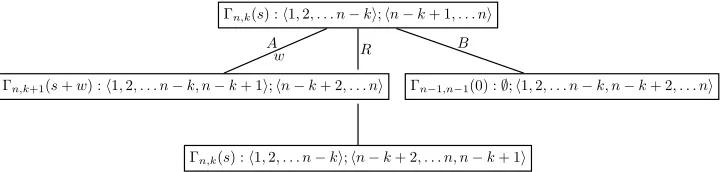
Figure 5 illustrates the structure of a generic subgame n;k(s), in which workers 1,2, ...,
n k have reached an agreement with the …rm for wages summing up to s and n k+ 1,
n k + 2, ... , n is the queue of workers who have yet to reach an agreement with the
…rm. The subgame n;k(s) starts with a bargaining session between the …rm and worker
n k+ 1. If the session ends with agreement at the wage w, the game enters the subgame
n;k+1(s+w), in which workers 1,2, ..., n k+ 1 have reached an agreement with the …rm
for wages summing up to s+w and n k+ 2, n k+ 3, ... , n is the queue of workers who have yet to reach an agreement with the …rm. If the session ends with a rotation of the rolodex, the game enters the subgame n;k(s), in which workers 1;2; :::n k have reached
an agreement with the …rm for wages summing up to s and n k + 2; n k + 3,... , n,
n k+ 1 is the queue of workers who have yet to reach an agreement with the …rm. If the
session ends with a breakdown, the worker exits and the game continues with the subgame
n 1;n 1(0), in which workers1,2, ...,n k,n k+ 2, ... , nhave yet to reach an agreement
with the …rm.
The intuition behind the equilibrium properties of the Rolodex game can be gained by studying the game between the …rm and two workers. We solve for the no-delay SPE of the Rolodex game 2;2(0) by backward induction. First, we solve for the no-delay SPE of
8For some con…gurations of the parameters, we were able to construct Subgame Perfect Equilibria of
Γn,k(s) :h1,2, . . . n−ki;hn−k+ 1, . . . ni
Γn,k+1(s+w) :h1,2, . . . n−k, n−k+ 1i;hn−k+ 2, . . . ni Γn−1,n−1(0) :∅;h1,2, . . . n−k, n−k+ 2, . . . ni
Γn,k(s) :h1,2, . . . n−ki;hn−k+ 2, . . . n, n−k+ 1i
w
A R B
Figure 5: Structure of generic subgame in Rolodex game
the subgame 1;1(0) which is reached if the bargaining session between the …rm and one
of its two workers ends with a breakdown. Second, we solve for the no-delay SPE of the subgame 2;1(w1)which is reached if the bargaining session between the …rm and one of its
two workers ends with an agreement at the wage w1. Third, we solve for the no-delay SPE
of the game 2;2(0).
Consider the subgame 1;1(0). The subgame begins with the worker making a wage
o¤er to the …rm. If the o¤er is rejected, the …rm makes a countero¤er to the worker. If the countero¤er is rejected, a rotation of the rolodex takes place and the worker is moved from the top to the bottom of the queue. However, as there are no other workers in the game, the rotation leaves the worker at the top of the queue. Thus, the worker and the …rm continue in alternating o¤ers and countero¤ers until either they reach an agreement or until the negotiation breaks down. If the …rm and the worker agree to the wagew1, the subgame
ends. In this case, the payo¤ to the …rm is F(1) and the payo¤ to the worker is w1. If the
negotiation breaks down, the subgame also ends. In this case, however, the payo¤ to the …rm is ~0 and the payo¤ to the worker is w. Overall, the protocol and the payo¤ structure
of the subgame 1;1(0) are the same as in BRW and the SPE of the subgame is given by
Lemma 1 for y = F(1), z = ~0 and t(w1) = 0. Therefore, assuming the gains from trade
F(1) ~0 w are positive, the unique SPE of the subgame 1;1(0) is such that the …rm and
the worker immediately agree to the wage
~
w11 =w+ 1
2 q[F(1) ~0 w]. (23)
In turn, this implies that the payo¤ to the …rm is
~1 = ~0+
1 q
2 q[F(1) ~0 w]. (24)
Now, consider the subgame 2;1(w1). The subgame starts with a bargaining session
the subgame ends, the payo¤ to the …rm is F(2) w1 w2 and the payo¤ to the worker
is w2. If the negotiation breaks down, the worker exits and the payo¤ to the worker is w.
The …rm enters the subgame 1;1(0), in which it renegotiates its prior agreement with the
other worker. In the unique SPE of 1;1(0), the payo¤ to the …rm is ~1. The reduced-form
version of the subgame 2;1(w1) in which the continuation subgames are replaced with the
associated SPE payo¤s has the same protocol and the same payo¤ structure as in BRW for
y=F(2) w1,z = ~1 and t(w2) = 0. Therefore, if the gains from tradeF(2) w1 ~1 w
are negative, any SPE of 2;1(w1) is such that the …rm and the worker do not reach an
agreement. If the gains from trade are positive, the unique SPE of 2;1(w1) is such that the
…rm and the worker immediately reach an agreement at the wage
w21;1(w1) =w+
1
2 q[F(2) w1 ~1 w]. (25)
Next, consider the game 2;2(0). Assume that the gains from trade F(2) ~1 2w are
positive. To characterize the unique no-delay equilibrium, we use the standard method of proof for Rubinstein-style models developed by Shaked and Sutton (1984), which proceeds by characterizing the suprema and in…ma of the sets of equilibrium payo¤s (see also Section 3.2.2 in Muthoo (1999)). Let mW and MW denote the in…mum and the supremum among
all no-delay SPE of the o¤er made by a worker to the …rm, given that the other worker has yet to reach an agreement with the …rm. Similarly, let mF and MF denote the in…mum and
the supremum among all no-delay SPE of the countero¤er made by the …rm to a worker, given that the …rm has yet to reach an agreement with the other worker. A worker can always attain the payo¤w by making o¤ers greater than w and rejecting all o¤ers smaller than w. Since we are looking for SPEs in which all equilibrium o¤ers and countero¤ers are immediately accepted, MW mW w and MF mF w. If the …rm agrees with the
worker to a wage w1 > w, with w F(2) ~1 w, the …rm enters the subgame 2;1(w1)
where it does not reach an agreement with the other worker. Since we are looking for no-delay SPE, mW MW w and mF MF w. Further, note that, if the …rm and the
worker reach an agreement at any wagew1 w, the …rm enters the subgame 2;1(w1)where
it reaches an immediate agreement with the other worker at a wage of w1
2;1(w1).
Consider any no-delay SPE of 2;2(0). First, we characterize the worker’s equilibrium
payo¤ from accepting/rejecting a countero¤er w^c 2 [w; w] from the …rm, given that the
other worker is without agreement. If the worker accepts the countero¤er, he attains a payo¤ of w^c. In fact, if the worker accepts, the …rm reaches an agreement with the other
worker at the wage w1
2;1( ^wc), the game comes to an end, and the worker is paid the wage
^
wc. If the worker rejects the countero¤er, he attains a payo¤ betweenqw+ (1 q)w12;1(MW)
and qw+ (1 q)w1
2;1(mW). In fact, if the worker rejects, he exits the game with probability
q. In this case, the worker attains a payo¤ of w. With probability 1 q, the worker moves
after the …rm and the other worker reach an agreement to some wagewo 2[mW; MW]. Since
w1
2;1(wo) is strictly decreasing in wo, the payo¤ to the worker from rejecting w^c is between
qw+ (1 q)w1
2;1(MW)and qw+ (1 q)w12;1(mW).
Second, we characterize the …rm’s equilibrium countero¤er wc2[w; w]. The equilibrium
countero¤er wc is accepted by the worker. The worker’s decision can be optimal only if the
payo¤ from accepting wc is greater than the payo¤ from rejecting wc. Since the in…mum
of the …rm’s countero¤er wc is mF, the worker’s acceptance payo¤ is wc, and the rejection
payo¤ is greater than qw+ (1 q)w1
2;1(MW), we have
mF qw+ (1 q)w12;1(MW). (26)
Similarly, note that, in equilibrium, the worker …nds it optimal to accept any countero¤er
^
wc2[w; w]greater thanqw+ (1 q)w12;1(mW). Thus, if the …rm makes such a countero¤er,
its payo¤ isF(2) w^c w21;1( ^wc). SinceF(2) w^c w12;1( ^wc) is strictly decreasing inw^c and
wc 2[w; w], the …rm’s equilibrium countero¤er wc can be optimal only if it is smaller than
qw+ (1 q)w21;1(mW). As the supremum of the …rm’s countero¤er wc is MF, we have
MF qw+ (1 q)w21;1(mW). (27)
Third, we characterize the …rm’s equilibrium payo¤ from accepting/rejecting an o¤er
^
wo 2 [w; w] from a worker, given that the other worker is without agreement. If the …rm
accepts the o¤er, it attains a payo¤ of F(2) w^o w21;1( ^wo). If the …rm rejects the o¤er, its
payo¤ is betweenq~1+(1 q)[F(2) MF w12;1(MF)]andq~1+(1 q)[F(2) mF w12;1(mF)].
In fact, if the …rm rejects the o¤er, the worker exits the game with probability q. In this case, the …rm attains a payo¤ of~1. With probability1 q, the …rm makes a countero¤er. In
this case, the …rm and the worker agree to some wagewc2[mF; MF] and then the …rm and
the other worker agree to the wagew1
2;1(wc). SinceF(2) wc w21;1(wc)is strictly decreasing
in wc, the …rm’s payo¤ from rejecting w^o is between q~1 + (1 q)[F(2) MF w12;1(MF)]
and q~1+ (1 q)[F(2) mF w21;1(mF)].
Fourth, we characterize the worker’s equilibrium o¤er wo 2 [w; w]. The equilibrium
o¤er wo is accepted by the …rm. The …rm’s decision can be optimal only if the payo¤ from
acceptingwois greater than the payo¤ from rejectingwo. Since the supremum of the worker’s
o¤er is MW, the …rm’s acceptance payo¤ is F(2) wo w21;1(wo), and the …rm’s rejection
payo¤ is greater than q~1+ (1 q)[F(2) MF w21;1(MF)], we have
F(2) MW w21;1(MW) q~1+ (1 q)[F(2) MF w12;1(MF)]. (28)
Similarly, note that, in equilibrium, the …rm accepts any o¤er w^o 2 [w; w] such that the
acceptance payo¤ is greater than the upper bound on the rejection payo¤q~1+(1 q)[F(2)
acceptance payo¤ is strictly decreasing inw^o and wo 2[w; w], the worker’s equilibrium o¤er
wo 2 [w; w] can be optimal only if the …rm’s acceptance payo¤ is smaller than the upper
bound on the …rm’s rejection payo¤. As the in…mum of the worker’s o¤erwo ismW, we have
F(2) mW w12;1(mW) q~1+ (1 q)[F(2) mF w21;1(mF)]. (29)
The inequalities (26)-(29) provide bounds on the equilibrium o¤ers mW and MW and
countero¤ersmF and MF. Combining these inequalities, it is easy to show thatmF =MF =
wc, where
wc =w+ (1 q)
2
1 + (1 q) + (1 q)2[F(2) ~1 2w]. (30)
Similarly, it is easy to show that mW =MW =wo where
wo =w+ 1
1 + (1 q) + (1 q)2[F(2) ~1 2w]. (31)
The above observations imply that, in any no-delay SPE, a worker makes the o¤erwo to the …rm whenever the other worker is without agreement, and the …rm makes the countero¤er
wc to a worker whenever the other worker is without an agreement.
We are now in the position to construct a candidate no-delay SPE of 2;2(0). In the
candidate SPE, a worker makes the o¤erwo to the …rm whenever the other worker is without agreement. The …rm accepts any o¤erw^osuch thatw^o wo and rejects any other o¤er. The
…rm makes the countero¤erwc to a worker whenever the other worker is without agreement. The worker accepts any countero¤er w^c such that w^c wc and w^c w and rejects any
countero¤er w^c < wc.9 The strategies and payo¤s associated with the subgames following
an agreement or a breakdown with the …rst of two workers without agreement are those implied by the no-delay SPE of 2;1(w1) and 1;1(0). Clearly, as any no-delay SPE is such
that the worker makes the o¤er wo, the …rm makes the countero¤erwc, and these proposals are accepted, the candidate no-delay SPE described above is unique with respect to payo¤s and outcomes.
We now need to verify that the candidate SPE is indeed an equilibrium. First, we verify that the acceptance strategy of the worker is optimal. If the …rm makes a countero¤er
^
wc w, the worker’s acceptance payo¤ is w^c and the rejection payo¤ is w12;1(wo). By
construction, the acceptance and the rejection payo¤s are equal for w^c = wc and, hence,
the worker …nds it optimal to accept wc. The acceptance payo¤ is strictly smaller than the rejection payo¤ for w^c < wc and, hence, the worker …nds it optimal to reject w^c. The
acceptance payo¤ is strictly greater than the rejection payo¤ for w^c > wc and, hence, the
worker …nds it optimal to accept w^c.
9We do not need to specify the worker’s response to a countero¤erw^
c> w because, as we shall see, the
Second, we verify that the …rm’s countero¤er wc is optimal. If the …rm makes the countero¤er wc, the worker accepts and the …rm attains a payo¤ of F(2) wc w1
2;1(wc).
If the …rm makes a countero¤er w^c < wc, the worker rejects and the …rm’s payo¤ is q~1+
(1 q)[F(2) wo w1
2;1(wo)], which is smaller than F(2) wc w12;1(wc). If the …rm
makes a countero¤er w^c > wc with w^c w, the worker accepts and the …rm’s payo¤ is
F(2) w^c w21;1( ^wc), which is smaller than F(2) wc w12;1(wc). If the …rm makes a
countero¤er w^c > w and the worker accepts, the …rm attains a payo¤ of ~1. If the …rm
makes a countero¤er w^c> w and the worker rejects, the …rm attains a payo¤ of q~1+ (1
q)[F(2) wo w1
2;1(wo)]. In either case, the …rm’s payo¤ is smaller thanF(2) wc w21;1(wc).
Overall, the …rm …nds it optimal to make the countero¤er wc.
Third, we verify that the acceptance strategy of the …rm is optimal. If the worker makes an o¤erw^o w, the …rm’s acceptance payo¤ isF(2) w^o w21;1( ^wo)and the rejection payo¤
is q~1+ (1 q)[F(2) wc w21;1(wc)]. By construction, the acceptance and the rejection
payo¤s are equal for w^o = wo and, hence, the …rm …nds it optimal to accept wo. The
acceptance payo¤ is strictly greater than the rejection payo¤ for w^o < wo and, hence, the
…rm …nds it optimal to accept w^o < wo. The acceptance payo¤ is strictly smaller than the
rejection payo¤ for w^o > wo and, hence, the …rm …nds it optimal to reject w^o > wo. If the
worker makes an o¤er w^o > w, the …rm’s acceptance payo¤ is ~1, which is strictly smaller
than the rejection payo¤. Hence, the …rm rejects such an o¤er.
Finally, we verify that the worker’s o¤er wo is optimal. If the worker makes the o¤erwo, he attains a payo¤ of wo. If the worker makes an o¤er w^o < wo, the …rm accepts and the
worker attains a payo¤ of w^o < wo. If the worker makes an o¤er w^o > wo, the …rm rejects
and the worker attains a payo¤ of qw+ (1 q)wc, which is smaller than wo. Therefore, the worker …nds it optimal to make the o¤er wo. This concludes the proof that our candidate no-delay SPE is indeed an equilibrium.
We can now summarize the outcome of the no-delay SPE of 2;2(0). Assuming F(2)
~1 2w 0, the unique no-delay SPE is such that the …rm and the …rst worker reach an
immediate agreement at the wage w~1
2 =wo, while the …rm and the second worker reach an
immediate agreement at the wage w~2
2 =w21;1(wo). The wage (and payo¤) of the …rst worker
is given by
~
w21 =w+ 1
1 + (1 q) + (1 q)2[F(2) ~1 2w]. (32)
The wage (and payo¤) of the second worker is
~
w22 =w+ 1 q
1 + (1 q) + (1 q)2[F(2) ~1 2w]. (33)
The payo¤ of the …rm is
~2 = ~1+
(1 q)2
For q!0, the payo¤s to the workers and to the …rm are given by
~ w1
2 =w+ [F(2) ~1 2w]/ 3,
~ w2
2 =w+ [F(2) ~1 2w]/ 3,
~2 = ~1+ [F(2) ~1 2w]/ 3,
(35)
where ~1 is given by (24). It is easy to understand why the SPE payo¤s of the Rolodex game
are given by (35). A breakdown in the bargaining session between the …rm and either worker causes the worker to exit the game and the …rm to restart the entire negotiation process with only one worker. For this reason, the overall gains from trade are given by F(2) ~1 2w.
The bargaining session between the …rm and the second worker is as in the BRW game with perfectly transferrable utility. For this reason, the gains from trade accruing to the …rm are the same as the gains from trade accruing to the second worker. The bargaining session between the …rm and the …rst worker is such that, if the worker rejects the countero¤er of the …rm, he moves to the end of the queue. For this reason, the …rst worker is in the same strategic position and captures the same gains from trade as the second worker. Taken together, these observations imply that the …rm and every worker capture the same fraction (1=3) of the gains from trade F(2) ~1 2w. As discussed in the previous section, these are
the Shapley values.
The following theorem generalizes the characterization of the no-delay SPE of the Rolodex game between the …rm and two workers to the case of n workers.
Theorem 2: (Rolodex game). Consider the Rolodex game n;n(0) between the …rm and n
workers. Assume that the gains from trade are positive, i.e. F(n) ~n 1 nw 0. In the
limit for q ! 0, the unique no-delay SPE of the game is such that the payo¤ to the …rm is given by the di¤erence equation
~j = ~j 1+ [F(j) ~j 1 jw]/ (1 +j), forj = 1;2; :::n, (36)
with initial condition ~0 =F(0). The payo¤ to the i-th of n workers is given by
~
wni =w+ [F(n) ~n 1 nw]/ (1 +n). (37)
Proof: In Appendix B.
Three comments about Theorem 2 are in order. First, note that the SPE payo¤s of the Rolodex game between the …rm and n workers are equal to the Shapley values. The …rm’s Rolodex payo¤ is given by the solution to (36) which is the same di¤erence equation that characterizes the Shapley value of the …rm. Thus, ~j = j for j = 0;1; : : : n. Each worker’s
Rolodex payo¤ is given by (37) which is the Shapley value of the worker. Thus,w~i
n=wn for
i = 1;2; :::n. The Rolodex payo¤s are equal to the Shapley values because, in equilibrium,
as in the Shapley values. The reason why the Rolodex payo¤s are such that every player captures an equal share 1=(n+ 1) of the gains from trade and the reason why the notion of the gains is given by F(n) ~n 1 nw are exactly the same as in the case of two workers.
Second, if wages are determined by the Rolodex game, the …rm has an incentive to hire more workers than it would in a competitive labor market where it takes the wage w as given. However, the …rm has an incentive to hire fewer workers if wages are determined by the Rolodex game than if wages were determined by the SZ game. These …ndings follow immediately from the analysis in Section 2.3 of the …rm’s hiring decision when wages are given by the Shapley values, together with the observation that the equilibrium payo¤s of the Rolodex game are the Shapley values. For the same reason, many of the results about the …rm’s organizational design and technology choice in Stole and Zwiebel (1996a and 1996b) and in follow-up papers–results that are derived under the premise that the equilibrium payo¤s of the SZ game are the Shapley values–can be applied directly to an environment in which wages are determined by the Rolodex game.
Third, Theorem 2 shows that the Rolodex game yields the Shapley values in the context of the wage bargaining between a …rm and its workers. The context is restrictive along two dimensions: (i) the …rm is essential in production; (ii) the network in which negotiations occur has a star graph, i.e. one central player bargains with a number of other players who do not interact directly with each other. In a follow-up paper (Brügemann et al. 2017) we analyze the Rolodex game in a more general context. First, we remove the assumption that one player is essential in production and instead allow the worth of coalitions to be described by a general characteristic function. We show that the equilibrium payo¤s are the Myerson-Shapley values for the corresponding star graph. Second, we adapt the extensive form to accommodate a general graph of connections between players: instead of a central player rotating through the other players, the game rotates through bilateral connections without agreement. We show that, for this graph, the equilibrium payo¤s are the Myerson-Shapley values.10
4
Conclusions
We considered the bargaining problem between a …rm and n workers. In this context, the Shapley values have a simple structure: the Shapley value of the …rm and of each worker is such that they all capture an equal share of the gains from trade, where the notion of gains form trade is given by the output that the …rm produces with n workers net of the sum of the payo¤ that each worker would attain if excluded from the game and the Shapley value of the …rm if it had n 1 rather than n workers.
10The generalized Rolodex game yields the same equilibrium payo¤s as those obtained by de Fontenay
We compared the Shapley values to the outcome of two perfect-information bargaining games. First, we revisited the game of Stole and Zwiebel (1996a). We showed that, in the unique SPE of the SZ game, the payo¤s are related but di¤erent from the Shapley values. The notion of gains from trade in the SZ game is the same as in the Shapley values, as the SZ game is such that a breakdown in negotiations between the …rm and a worker causes the worker to leave and the …rm to restart the bargaining process. The division of the gains from trade in the SZ game di¤ers from the one implied by the Shapley values. Workers at the head of the bargaining queue capture a larger share of the gains from trade than workers at the end of the queue, as they take advantage of the fact that, if the …rm pays them a higher wage, it pays a lower wage to the following workers. The …rm captures the same share of the gains from trade as the last worker in the queue. The analysis of the SZ game is relevant for two reasons. First, the equilibrium payo¤s of the SZ game are di¤erent from those reported in Stole and Zwiebel (1996a), which are equal to the Shapley values. Second, the SZ game follows a plausible protocol and it is worthwhile understanding the properties of its solution.