RELATIONSHIPS BETWEEN CFD
AND EXPERIMENTAL FLUID MECHANICS
Wojciech Sobieski
Department of Mechanics and Machine Design University of Warmia and Mazury in Olsztyn
Received 28 February 2013; accepted 26 August 2013; available on line 2 September 2013
K e y w o r d s: CFD, modeling methodology.
A b s t r a c t
This paper analyzes three popular methods of developing simulation models based on experimen-tal data. The presented variants are discussed with emphasis on their strengths and weaknesses, and they are illustrated with examples in the area of numerical fluid mechanics. The principles of developing computer models, details and objectives of mathematical models are not discussed. The relevant information can be found in the author’s previous studies which are available in scientific literature. The last section of the article proposes the most effective methods for combining and designing real and virtual experiments.
Introduction
Contemporary research in fluid mechanics relies mainly on three types of scientific activity: experiments, analyses and simulations. This division reflects the vastness of our knowledge resources and the need to select specific areas of expertise. The three types of activity can be integrated, but the results of such research often do not conform to the highest quality standards, and a greater degree of specialization may be required. When research projects are conduc-ted in a single field of inquiry, specialization brings significant benefits and it is highly effective. Despite the above, there is a growing demand for interdisci-plinary projects which combine knowledge not only from different branches of the same science, but also from very distant areas of study. The above calls for the development of a global research strategy that would make the best use of * Corespondence: Wojciech Sobieski, Katedra Mechaniki i Podstaw Konstrukcji Maszyn, Uniwersytet Warmińsko-Mazurski, ul. M. Oczapowskiego 11, 10-957 Olsztyn, phone: +48 89 523 32 40, e-mail: [email protected].
the main problems which result from the integration of experiments, analyses and simulations in the area of fluid mechanics, and it proposes practical solutions for overcoming those difficulties. It has been assumed that an experiment is the most important stage of research and that a virtual model has to be based on experimental data. This assumption follows from the general principle that a simulation model is of value when it conforms to real world observations.
Integrated fluid mechanics models
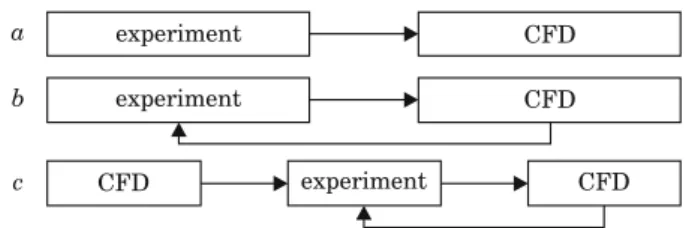
The first method of integrating experimental studies with numerical analyses in fluid mechanics is illustrated in Figure 1a. It begins with an experiment whose results are used to develop a simulation model. In this variant, information flows in one direction only: from the experiment to the simulation model. The above is observed in two cases. In the first case, a virtual model is developed based on an experiment described in literature. The developer of a simulation model is generally unable to acquire additional data and has to rely on the information available in published articles. If the experiment is well described, additional calculations can be performed to obtain new data. Analytical mechanics can act as a bridge between the experiment and the numerical model. In the second case, a simulation model is developed based on an experiment which was conducted by one researcher, a team or a different research group, preferably one that which can be directly contacted. It is assumed that the experiment cannot be wholly replicated for some reason (such as cost). Nevertheless, this case is more conducive to research than the first scenario because experimental data can be verified despite the lapse of time. The researcher can validate information relating to instruments, measurement methods, measurement accuracy, flow geometry and parameters of flow media used in the study. In some cases, additional experiments can be performed.
In the second variant (Fig. 1b), a previous experiment, which was not initially planned as a source of data for numerical modeling, can be replicated. In this approach, a virtual model is first developed based on measurements, the results of calculations (preferably subjected to a sensitivity analysis) are
Fig. 1. Basic approaches to integrating experiments in fluid mechanics with CFD
analyzed, and the experiment is replicated in view of the specific needs of the numerical model. Changes in measurement methods or instruments could be required due to a need for new data or the imprecision of measurement results. Those treatments could increase the degree of cohesion between an experiment and a virtual model, improve the compatibility and quality of results produced by both types of activity. A satisfactory degree of result cohesion testifies to the quality of the numerical model and the experiment. This issue was discussed in greater detail by SOBIESKI (2009 and 2010).
In the third variant (Fig. 1c), the project begins with the development of a preliminary simulation model based on data estimation. General principles for developing a successful computer model are reviewed at this stage. Sets of “closures”, i.e. fragments of a global mathematical model describing specific problems, which are used by other authors should be collected and analyzed. A sensitivity analysis is also recommended at this stage. In the analysis, the modeled parameters are changed (preferably by a constant value, e.g.
± 5 ÷ 10), and the impact of those changes on the results is observed. This problem has been discussed earlier, for example by SOBIESKI(2008b, 2008d). If the resulting changes are significant, the model is sensitive to the analyzed parameter, whereas minor changes indicate that the model is characterized by low sensitivity. A sensitivity analysis can be performed in most cases, not only when a numerical approach (CFD) is adopted. It supports the identifica-tion of parameters which should be of the highest quality. The resulting knowledge can be used in designing the experiment, selecting measuring methods and the precision of instruments. The correct performance of this stage will increase the reliability of the simulation model, and it will minimize the probability that errors resulting from low quality data surface in success-ive stages of research. Detailed knowledge about the possibilities and needs of the simulation model is required for designing the experiment. Additional simulations and a virtual evaluation of the future test stand can be performed at the planning stage. After the experiment has been performed and the required data has been collected, simulations can be repeated, this time with the use of real rather than estimated data. Further course of action will be determined by the degree of cohesion between the virtual model and the
experimental and numerical analyses can be conducted simultaneously by two collaborating teams, simulation models can be developed for new and unresolved research problems or experiments can be planned for theoretically predicted phenomena), but they are relatively rare, and they will not be discussed in this article. Although many tips and suggestions described in this paper may seem to be obvious, the authors’ observations indicate that the simplest and the most obvious principles are often disregarded in practice. The aim of this paper is to encourage scientists to thoroughly analyze research procedures at early stages of the project. The resulting knowledge will significantly facilitate the integration of experiments and virtual models at successive phases of research.
An example of variant A – bifurcation modeling
in a closed-off channel
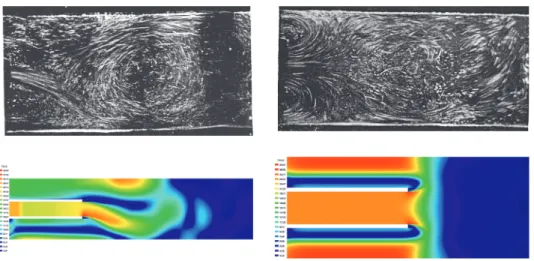
Bifurcation modeling in a closed-off channel can serve as an example of a simulation model based on an experiment described in literature. The source of data was a study by DYBAN et al. (1971) which discusses a series of 2D experiments where fluid (air or water) was pumped through a nozzle to a closed-off channel with varied geometry (the variable parameters were nozzle width and channel length). Flow structures formed inside the channel were observed. In the analyzed system, the created structures were determined mainly by channel and nozzle geometry, defined as b/B andH/B, where bis nozzle width,B – channel width andH– channel length measured from the end of the supply nozzle. Other factors, such as the type of medium and its parameters, were of secondary importance, and they merely shifted the range at which different types of bifurcations appeared. The flow structures identifi-ed in the simulation model were identical to those notidentifi-ed in the experiment, and a structure not described by the authors was additionally observed. The results of the experiment are discussed in depth by SOBIESKI(2008d). Older results can be found in SOBIESKI (2008a). In the cited study, only a high degree of qualitative cohesion was noted (Fig. 2). The degree of quantitative cohesion was not determined due to a shortage of relevant data in the source article. The lack of data caused by one-directional flow of information is the main constraint in the discussed variant.
Fig. 2. Qualitative comparison of experimental and simulation results:examples of oscillating (left) and divergent bifurcations (right)
An example of variantB – fluid dynamics modeling
in a spouted-bed grain dryer
This example discusses the process of modeling fluid dynamics in a spouted-bed grain dryer which was performed by an independent research team collaborating with the author. In the first stage, a simulation model was developed based on an existing set of measurement data. The results of numerical calculations were highly unsatisfactory, and studies reporting a much higher degree of cohesion between experimental data and simulation results were available in literature, for example in the work of SZAFRAN(2004). Initially, attempts were made to identify the causes of the above discrepancies by analyzing the configuration of the simulation model and the selection of “closures”, but the quality of the experiment was not investigated. Those efforts did not bring satisfactory results (but a significant improvement in results was achieved when the concept of a sphericity coefficient was introduc-ed into the mathematical model), and a sensitivity analysis was performintroduc-ed to test the model’s responses to changes in the modeled parameters. The results are discussed by SOBIESKI (2008b, 2008c) and SOBIESKI, MARKOWSKI (2006).
The sensitivity analysis proved to be a key step to solving the problem. It revealed that the simulation model was most sensitive to the airflow rate at dryer inlet, equivalent grain diameter and maximum bed packing. Those parameters, in particular the method and precision of their determination, were thoroughly analyzed. The method of determining airflow rate was found to be highly inaccurate (for more information, refer to SOBIESKI2009f). In the
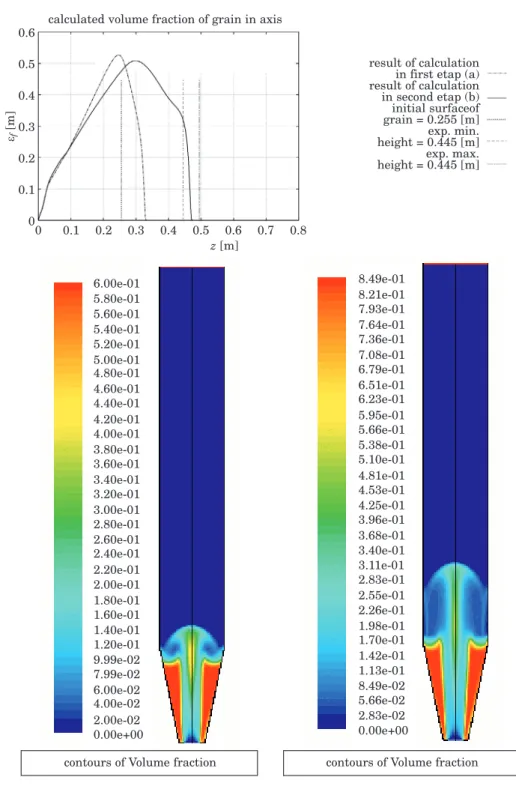
experiment, an anemometer was installed at the outlet of the dryer column in a manner that caused significant leakage. The device was equipped with a Pitot tube, but it was not used in most cases. According to experiment notes, airflow rate measured by an alternative method was more than 10% higher than that determined initially. When new data was input into the numerical model, the results were highly satisfactory. The results of both simulation phases are compared in Figure 3.
The experiment was repeated based on the new knowledge about condi-tions that guarantee cohesion between experimental and modeled results. This time, the general parameters were somewhat modified by the new context, but the accumulated experiences facilitated the development of a satisfactory simulation model. All parameters had to be repeatedly determined, in particu-lar equivalent grain diameter and maximum degree of packing. Simulation results and selected aspects of fluid dynamics modeling in spouted-bed grain dryers were discussed in a series of publications by SOBIESKI (2008d, 2009a, 2009e, 2010a, 2011) and in the work of SOBIESKI (2008e, 2009d). The main weakness of the analyzed variant is that the experiment has to be partially repeated, which is a waste of resources and time. If all parameters were measured with the required accuracy and in the required manner from the beginning of the experiment, the cohesion between experimental and modeled results would have been achieved much earlier. Sound knowledge of numerical modeling conditions is of essence, and teams which possess such knowledge can perform experiments which constitute a reliable basis for developing simulation models.
An example of variant C– modeling flow resistance
in porous media
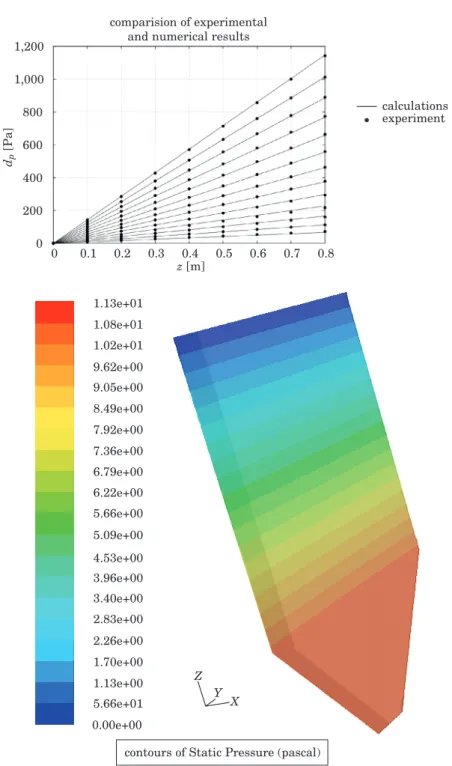
The third example discusses the modeling of flow resistance in porous media based on an experiment which was performed by the author during a research placement at the University of Manitoba in Winnipeg, Canada. Similar research had been previously carried out by the author in Poland, but at that time, variantBhad to be deployed due equipment constraints. In the new study, the test stand had to be built from scratch. New research objectives were also formulated: to analyze the bed’s lay pattern and to measure and model flow resistance in two spatial directions. Several test stands were proposed and analyzed. Two of them were modeled with the use of CFD methods. The selected variant was built by the technical group. The final simulation model, where only several experimental parameters had to be input, and supporting software were developed. Measurements were
per-Fig. 4. Comparison of experimental and numerical results: decrease in pressure at various airflow rates (left); visualization of pressure distribution in the bed (right)
formed and the results were processed. Qualitative and quantitative cohesion between experimental and modeled data was achieved within several hours. The project’s success resulted from careful preparations which involved ana-lyses of all possible relations between the experiment and the simulation model.
Conclusions
The following conclusions can be formulated based on the discussed topics: – In general, experiments described in literature should be used only for learning how to model certain phenomena and for developing estimation models. The knowledge of modeling principles is very important because flow problems, in particular multiphase flows, are highly complex (both mathemat-ically and technmathemat-ically), and high quality literature may be difficult to find. Learning about a new problem is a long process that involves reading CFD software documents, analyzing articles, courses and examples, browsing inter-net resources and consulting members of the scientific community. The learning process is complete when mathematical modeling problems have been solved and an operating and stable model has been built.
– When modeling efforts are based on an experiment described in litera-ture, researchers could benefit from exchanging experiences and data with the experiment’s authors. If collaboration is not possible, other experiments could be considered – effective communication with the authors increases the chances of the project’s success.
– Experiments described in literature should constitute a theoretical basis in the initial stages of follow-up research. Literature should be reviewed for a better insight into the current state of research in a given area, the identified problems and attempts to solve them. The first estimation model can be developed based on the acquired knowledge. The model can be used to repeat a previous experiment (variantB) or design a new one (variantC).
– Research conducted in variantBis a natural consequence of experimen-tal studies. The experimenexperimen-tal approach may become somewhat “uninspiring” when most aspects of a given problem have been measured and described. Numerical analysis encourages further scientific inquiry, and it motivates researchers to tackle new challenges. Numerical analyses and experiments can be performed by the same person or by different people as long as they collaborate in their efforts.
– VariantCis preferred when new research projects are initiated and when new equipment has to be purchased or designed and built. A preliminary numerical model can be used to adapt purchase and design decisions to the
analyses are performed by different persons or teams. Potential problems should be identified and solved in early stages of research to prevent unnecessary project costs and delays.
References
BADURJ., SOBIESKIW. 2001.Numerical simulation of Hopf bifurcations in a turning off flow. Research of the Chair of Mechanics and Machine Design, p. 63–98, Olsztyn.
DYBANE.P., MAZURA.I., JEPIKJ.J. 1971.Osobennosti istechenija plaskoj vojedushhnoj strui v tupik.
Teplofizika i Teplomehanika, 19: 41–45.
SOBIESKIW. 2007.Numerical Modeling of Fluidised Beds with the Use of the Eulerian Multiphase
Model.Professor Zbigniew Bilicki in Memoriam – Symposium. Gdańsk–Wieżyca, June 18–20. SOBIESKI W. 2008a.Basic Principles and Stages of Computer Modeling in Fluid Mechanics. In:
Elements of agricultural system engineering. University of Life Sciences, Poznań, pp. 111–129. SOBIESKIW. 2008b.Indicator of Fluidized Bed Computer Model Sensitivity to Changes in Physical
Parameters’ Values. Annual Review Of Agricultural Engineering, 6(1): 51–58.
SOBIESKIW. 2008c.Influence of Selected Eulerian Multiphase Model Parameters on the Simulation Results for a Spouted Bed Grain Dryer. Task Quarterly, 12(1): 511–536.
SOBIESKIW. 2008d.Numerical Analysis of Sensitivity of Eulerian Multiphase Model for a Spouted Bed
Grain Dryer. Drying Technology, 26(12): 1438–1456.
SOBIESKIW. 2008e.Numerical Modeling of Spouted Fluidised Beds. IV International Congress of
Technical Diagnostics. Olsztyn, September 9–12.
SOBIESKIW. 2009a.Momentum Exchange in Solid-Fluid System Modeling with the Eulerian Multi-phase Model. Drying Technology, 27(5): 653–671.
SOBIESKIW. 2009b. Numerical Analysis of Flow Bifurcations in a Closed-Off Channel. Technical Sciences, 12: 272–285.
SOBIESKIW. 2009c.Numerical and Experimental Analyses of Hopf Bifurcations in a Locally Expanded
Channel. Technical Sciences, 12: 259–271.
SOBIESKIW. 2009d.Selected Problems of Numerical Modeling of Fluidized Bed in a Spouted Grain
Dryer. Chemical Engineering and Apparatus, 1: 68–69.
SOBIESKI W. 2009e.Switch Function and Sphericity Coefficient in the Gidaspow Drag Model for
Modeling Solid-Fluid Systems. Drying Technology, 27(2): 267–280.
SOBIESKIW. 2009f.Use of Simulation Methods to Validate the Results of an Experiment. In:Knowledge Engineering and Expert Systems. EXIT Publisher, Warsaw, pp. 113–124.
SOBIESKIW. 2010a.Selected Aspects of Developing a Simulation Model of a Spouted Bed Grain Dryer
Based on the Eulerian Multiphase Model. Drying Technology, 28(12): 1331–1343.
SOBIESKIW. 2010b.Use of Numerical Models in Validating Experimental Results. Journal of Applied
Computer Science, 18(1): 49–60.
SOBIESKIW. 2011.Drag Coefficient in Solid-Fluid System Modeling with the Eulerian Multiphase
Model. Drying Technology, 29(1), pp. 111–125.
SOBIESKI W., MARKOWSKI M. 2006. The Investigations of Fluid Dynamics and Mass Transfer in a Spouted Dryer. The 6th Workshop of “Modeling the Multiphase Flows in Thermo-Chemical Systems – Numerical Methods”. Stawiska, September 4–6.