www.ijper.org
Development of Rapid and Validated RP-HPLC
Method for Concurrent Quantification of Rosuvastatin
and Aspirin form Solid Dosage Form
Mahesh Attimarad*1, Ahmed Alkadham1, Mohammed Hashem Almosawi1,
Katharigatta Narayanaswamy Venugopala1,2
1Department of Pharmaceutical sciences, College of Clinical Pharmacy, King Faisal University, Al-Ahsa, SAUDI ARABIA. 2Department of Biotechnology and Food Technology, Durban University of Technology, Durban, SOUTH AFRICA.
ABSTRACT
Background: Combination of aspirin and rosuvastatin has been successfully used for the treatment of hyperlipidemia. Objective: The objective of the project was to establish a rapid, accurate and precise liquid chromatographic method for the concurrent quantification of aspirin and rosuvastatin from solid dosage form. Methodology: The analytes were successfully separated on chromolith C18 monolithic column, using 20mM phosphate buffer (pH. 3): acetonitrile: methanol in a proportion of 50:20:30 by volume. Mobile phase was pumped at the flow rate of 2 ml/min and column temperature was set at 25OC. For recording, the response of both analytes, 240 nm wavelength was selected.
Results: The newly proposed HPLC technique was validated as per the ICH guidelines. Both the analytes along with internal standard, losartan were separated within 2 min. The method showed good linearity in the concentration range of 10 to 150 μg/ml and 1 to 15 μg/ml for aspirin and rosuvastatin respectively with good correlation coefficient (r2
≤ 0.99). The LOD and LOQ were also determined and were 0.1 and 0.3 μg/ml for aspirin and 0.23 and 0.64 μg/ml for rosuvastatin respectively. The percent relative standard deviation for intraday and intraday were less than 2% for both the analytes. The percent recovery for aspirin and rosuvastatin was found to be in the range of 98.89 to 99.73 and 99.25 to 100.75 respectively, with percent relative standard deviation and bias less than 2%. Conclusion: No signification difference was observed between suggested method and earlier reported HPLC procedure with photo diode detector method, in the results. Hence, the established HPLC technique could be adopted for repetitive quality assurance of aspirin and rosuvastatin from formulations.
Key words: RP-HPLC, Simultaneous determination, Rosuvastatin, Aspirin, Monolithic column.
DOI: 10.5530/ijper.52.1.17 Correspondence:
Dr. Mahesh Attimarad,
Department of Pharmaceuti-cal Sciences, College of Clinical Pharmacy, King Faisal University, PO Box 400, Al Ahsa, Saudi Arabia -31982 Phone no: 0096655269799 Email: Mattimarad@gmail. com
INTRODUCTION
Hyperlipidemia (dyslipidemia) is abnormally increased concentration of fats, cholesterol,
and triglycerides in the body fluid. Choles-terol slowly deposits on the inner wall of
capillary tubes and leads to arthrosclerosis, a condition where arteries lose their elasticity. Statins are new class of compounds used in the treatment of hyperlipidemia. Statins act
by inhibiting an enzyme
3-hydroxy-3-methyl-glutaryl coenzyme A (HMG–CoA), required
for the production of low density cholesterol
(LDL) in the liver, which reduces the LDL cholesterol level in the blood.1,2 Rosuvastatin
Submission Date: 14-07-2017;
Revision Date: 18-08-2017;
Accepted Date: 10-01-2018.
calcium (ROS, Figure 1) chemically (E)‐7‐[4‐
(4‐fluorophenyl)‐6‐isopropyl‐2‐[methyl
(methylsulfonyl)amino]pyrimidin‐5‐yl]
(3R,5S)‐3,5‐dihydroxyhept‐6‐enoic acid is
used in the treatment of hyperlipidemia
by increasing the metabolism of LDL and inhibiting the biosynthesis of very low
density lipoprotein.3
effect due to its inhibition effect on formation of throm
-boxane, which generally accumulate platelets to form a cover on the damaged walls in the capillaries.4,5 Aspirin
also has inhibition effect on cyclooxygenase enzyme and
hence exert anti-inflammatory activity.6 ASP along with atorvastatin reduced many cardiovascular complications due to its anti-inflammatory effect. Combination of ASP and statins reduced the cardiovascular complications produced due increased levels of lipids.6,7
The few assay procedures for the concurrent estima
-tion of ROS and ASP were reported in the literature. These reports recommended the use of spectroscopic methods.8,9,10,11 high performance thin layer chroma-tography (HPTLC).12,13 and several high performance liquid chromatography (HPLC) with UV detec
-tion methods.14,15,16,17 Unfortunately, few RP HPLC methods.14,15,16 reported for simultaneous determination of ASP and ROS, were not considered as fully validated because internal standard has not been used, which is crucial for any reliable analytical method. In another HPLC reported.17 was good in presence of degraded products but the analysis time was longer (more than 15 min). Thus the reported procedures have some dis
-advantages such as elongated investigation time, not using internal standard and narrow calibration range.
Hence, this project was designed to establish rapid,
accurate, precise and robust reverse phase liquid chro
-matographic procedure for concurrent determination of ROS and ASP with monolithic column.
MATERIALS AND METHODS
Chemicals and reagents
Pure active pharmaceutical ingredients, rosuvastatin calcium (98.67%) and aspirin (99.03%) and losartan (98.76%, Figure 1) were purchased from Biokemix
Hyderabad, India. Acetonitrile and methanol were HPLC grade and purchased from Sigma Aldrich, Billerica, USA. Double distilled water was prepared in our labora
-tory using Milli Q ultrapure water generator (Millipore Corporation, Billerica, MA, U.S.A).Sodium phosphate monobasic, Sodium phosphate dibasic and orthophos
-phoric acid were analytical grade and procured from Merck (Bibby Sterline Ltd., Stone, UK).
Instrumentation
New analytical method was developed using Shimadzu (Japan) prominence HPLC instrument equipped with pump (LC20AT), auto sampler (SIL20A), column oven (CTO20A), and UV-Vis detector (SPD20A). The analysis was controlled by CMB 20 software and quan
-titative analysis was also performed by using the same software. The analytes were separated on chromolith® speed ROD, (50 X 4.6 mm) C18 HPLC column using phosphate buffer (20 mM), pH. 3.0, adjusted using
orthophosphoric acid, acetonitrile and methanol in a
proportion of 50: 30: 20 (v/v). The UV detection was
performed at 240 nm, mobile phase was forced at the
speed of 2 ml/min and analytical column was retained
at 25OC throughout the experiment. Preparation of standard solution
Standard solutions of ROS, ASP and losartan (IS)
(1000µg/ml) were prepared separately by precisely
weighing 100 mg of ROS, ASP and losartan. Weighed samples were transferred in to 100 ml volumetric flask and 50 ml methanol was added. ROS, ASP and IS were dissolved my swirling and the flask was swirled and vol
-ume was completed until the 100 ml mark by means of methanol. Stock solutions were stored at 4OC. The
required concentrated working standard solutions of ROS and ASP were arranged by adding mobile phase just before the use.
Preparation of sample solution of solid dosage form
The powder of twenty capsules of ROS and ASP were removed, weighed accurately, and mixed with mortar and pestle. Powder corresponding to 10 mg of ROS and 75 mg of ASP was accurately weighed into 100 ml volumetric flask and 50 ml of methanol was added to dissolve the analytes. Volumetric flask was sonicated for 15 min to ensure the complete solubility of both the analytes. The mixture was filtered and the fresh methanol was added on the residue to take undissolved ASP and ROS. Finally, the volume was completed to 100 ml mark by means of methanol. Further, the sample solution was diluted using mobile phase to adjust the amount of
analytes in the range of calibration curve and analyzed using the developed method and reference method.15
Validation
Newly developed analytical method was validated asper
the ICH requirements to reassure the specificity, selec -tivity, linearity, limit of determination and detection,
accuracy, precision, and robustness.18
Selectivity
The selectivity of the procedure was evaluated by matching
the chromatograms of standard sample, blank and solid
dosage form sample solutions. Chromatograms were matched for the retention time of analytes and the capsule excipients.
Linearity
Linearity of the method was established in the range of 10 - 150 µg/ml and 1 - 15 µg/ml for ASP and ROS respectively. Six solutions were arranged in the range along with IS (50 µg/ml), and analyzed in triplicate. Calibration curve was established by plotting a graph Between ratios of peak area of analyte to IS and con
-centration of analytes and regression equation was determined from the graph.
Limit of detection (LOD) and quantification LOQ) LOD and LOQ of the proposed analytical method were determined by using standard equations LOD=3.3 d/s and LOQ=10 d/s, where d stands for mean of standard
deviation and s stands for the mean of slope of the
calibration curve.
Precision
To evaluate the precision of the established procedure
both intra-day and inter-day variations were determined
at three diverse concentrations (Low, medium and high) covering the entire calibration range. Intra-day precision was proved by investigating the solutions of both the analytes in triplicate on the same day. Inter-day precision was proved by studying the standard solutions of the analytes prepared on altered days on five successive days. The % RSD was determined for all the analysis.
Accuracy
Accurateness of the proposed procedure was evaluated
by performing the retrieval analysis of analytes by stan-dard addition method at three different concentrations
(Low, medium and high) covering the entire calibra
-tion range. A known amount of ASP and ROS were added to pre analyzed sample solutions. Solutions were
investigated in triplicate and the concentration of added
analytes were calculated using regression equation. The percentage of assay and percent bias were calculated.
Robustness
The robustness of the proposed procedure was dem
-onstrated to show the reliability of the analysis due to small changes but deliberate differences in the analytical conditions. The effect on assay results of analytes by expected variations in the HPLC analysis conditions such as mobile phase compositions(±1%), pH (±0.1),
column temperature (± 1OC) and flow rate (± 0.1) were
studied. Freshly prepared standard solution of ASP and ROS was analyzed using optimized HPLC conditions and the experiment was repeated with modifications in the experimental conditions. The percent assay results were compared and percent relative errors were determined.
RESULTS AND DISCUSSION
Many reported procedures for the concurrent determi
-nation of ASP and ROS (8-17) were time consuming due to use of long analytical column. However, use of short particle packed column may affect the resolution. Monolithic columns are filled with single highly porous rod, provides high permeability and surface area for interaction with analytes. In addition, monolithic columns have large pores along with small pores, which reduces backpressure; allowing to operate the instrument at high flow rate.19 Therefore, analytes can be separated in short time with good resolution. Hence, monolithic column can be been selected to develop rapid analytical method. The overlaying UV spectra showed that both drugs absorb appreciably at 240 nm, hence 240 nm was selected for detection of analytes. The suggested RP-HPLC procedure for the concurrent determination of ASP and ROS has been optimized for mobile phase composition, pH, and temperature and flow rate.
Different composition of mobile consisting of series of
aqueous phase with buffers at different pH, were envis
-aged along with diverse volumes of acetonitrile and methanol as organic modifier. The analytes did not elute with only aqueous phosphate buffer, hence, organic solvents methanol and acetonitrile were used along with aqueous buffer as mobile phase. With more than 20% of acetonitrile the ASP was eluting at void volume. Above 30% of methanol the ROS was eluting after 3 min. With 50% phosphate buffer, 20% acetonitrile and 30% methanol all three analytes were eluted in less than 2min with good resolution. The pH of the buffer solu
While at pH 3 both analytes were separated with good resolution and peak shape. As monolithic columns has been used with higher flow rate, hence, different flow rates were investigated and 2 ml /min flow rate was optimum. At a flow rate, 1 ml/min analytes were sepa
-rated with good resolution but undesirable long analysis time and peak broadening was observed. When mobile phase was pumped at the rate of 3 ml/min the ROS and IS were not separated with good resolution. The opti
-mized chromatographic condition for the simultaneous determination of ASP and ROS was mobile phase comprising of 20mM sodium phosphate buffer (pH 3.0 attuned using orthophosphoric acid) with acetonitrile and methanol in the proportion of 50:20;30 by volume, the flow rate was 2ml/min, wavelength was adjusted to 240nm at ambient temperature (25OC).
Validation of the RP-HPLC method
The result showed that the projected process is appropri
-ate for quantification of both analytes in combination.
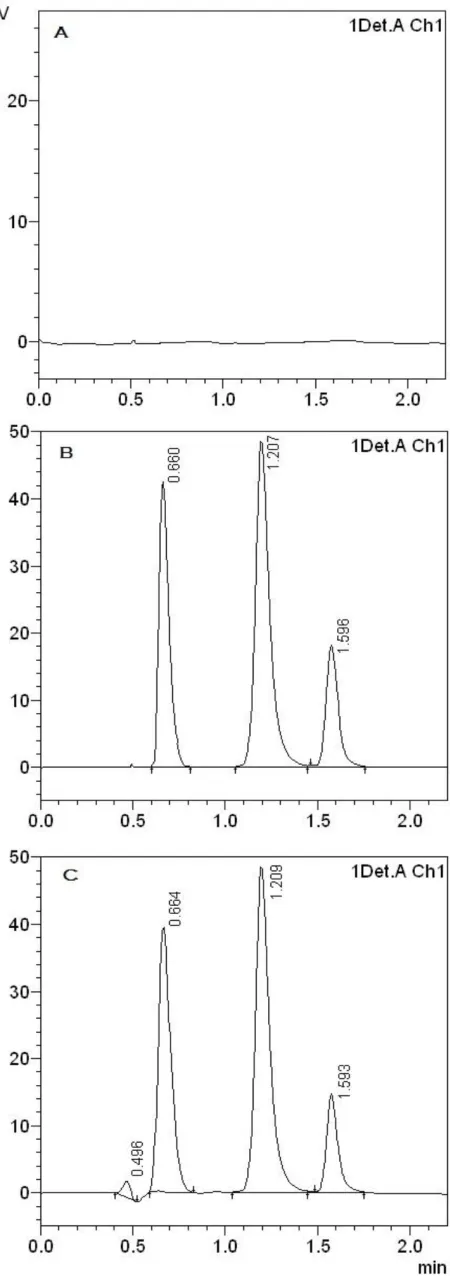
The typical chromatogram obtain for the analytes was
shown in Figure 2. The retention time of ASP, IS and ROS was found to 0.66 min, 1.20 min, and 1.59 min respectively.
Selectivity
Comparison of chromatograms (Figure 2) of blank, standard and capsule solutions, reveal that no interfering peaks from the capsule excipients were observed at the retention time of analytes. Both ASP and ROS were separated by good resolution, indicating the selectivity of the HPLC procedure.
Linearity, range and Limit of detection and
quantification
The suggested HPLC procedure provided a good
linearity range for both analytes in the range of 10 to 150 µg/ml and 1 to 15 µg/ml for ASP and ROS respec
-tively. Calibration curve was created by drawing a graph between peak area ratio of analytes to IS and analyte concertation. The established linear regression equation were y= 0.103x + 0.016 and y=0.072x + 0.022 and correlation coefficient were r2 = 0.998 and 0.999for ASP and ROS respectively. (Figure 3 and Figure 4) Limit of detection and limit of quantification were also calculated and were found to be 0.1 and 0.3 µg/ml for
ASP and 0.23 and 0.64 µg/ml for ROS respectively.
Precision
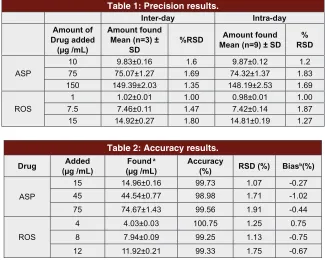
Precision of the procedure was established by determining
the inter-day and intra-day precision at three diverse
concentrations. The results showed (Table 1) that the % RSD for the inter-day precision were < 1.69 and 1.80
Figure. 2. Typical chromatograms of blank(A), standard solutions (B) and sample solution(C) Retention time of
whereas intra-day precision were< 1.83and 1.87 for ASP and ROS respectively. The %RSD were well within the acceptable range ≤2.0%.
Accuracy
Accuracy of the offered HPLC procedure was estab
-lished by recovery study at three concentration levels via standard addition method. Analysis result for percent recovery, %RSD and percent bias were calculated and recoded in Table 2. The percent recovery for ASP was found to be in the range of 98.89 to 99.73 and for ROS 99.25 to 100.75.The % RSD and % bias were less than 2%, which is well within the acceptable range, indicating the accuracy of the established procedure.
Robustness
The influence of variations in the optimized experi
-mental conditions on the assay results were shown in the Table 3. The percent assay of ASP and ROS using optimized HPLC condition were 99.56 % and 98.75% respectively. The effect of slight changes in the experi
-mental condition was not significant, since, the percent
relative error determined for the percent assay were
lower than ±2%, it is apparent from the outcomes that the newly suggested method is robust.
Application to solid dosage form
Newly proposed HPLC procedure was effectively applied for simultaneous quantification of ASP and ROS in co-formulated capsule. Accuracy and precision
Figure 3: Standard linearity graph of Aspirin.
Figure 4: Standard linearity graph of Rosuvastatin.
Table 1: Precision results.
Inter-day Intra-day Amount of
Drug added (µg /mL)
Amount found Mean (n=3) ±
SD %RSD
Amount found Mean (n=9) ± SD RSD%
ASP
10 9.83±0.16 1.6 9.87±0.12 1.2
75 75.07±1.27 1.69 74.32±1.37 1.83
150 149.39±2.03 1.35 148.19±2.53 1.69
ROS
1 1.02±0.01 1.00 0.98±0.01 1.00
7.5 7.46±0.11 1.47 7.42±0.14 1.87
15 14.92±0.27 1.80 14.81±0.19 1.27
Table 2: Accuracy results.
Drug (µg /mL)Added (µg /mL)Found a Accuracy (%) RSD (%) Biasb(%)
ASP
15 14.96±0.16 99.73 1.07 -0.27
45 44.54±0.77 98.98 1.71 -1.02
75 74.67±1.43 99.56 1.91 -0.44
ROS
4 4.03±0.03 100.75 1.25 0.75
8 7.94±0.09 99.25 1.13 -0.75
12 11.92±0.21 99.33 1.75 -0.67
a: Mean (n=3) ± SD. RE: Relative error, RSD: Relative standard Error
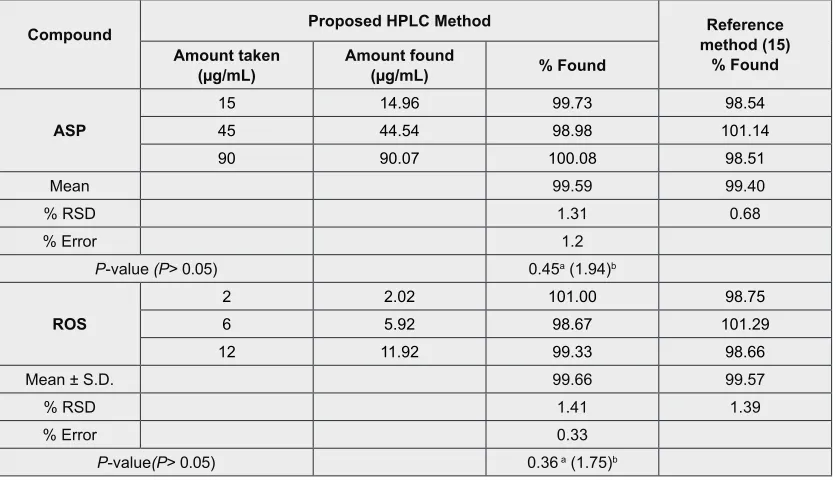
of the newly suggested procedure was compared with the previously report HPLC method.15 The average assay results, %RSD and statistical comparison results are tabulated in Table 4. The statistical results of students
“t” test between the two methods reveals that there is
no significant difference in the results.
CONCLUSIONS
Accurate, precise and robust RP-HPLC technique was established for the concurrent quantification of ASP and ROS using losartan as internal standard. The separation of both analytes with good resolution was achieved with in two min of run time using monolithic column, hence, the method is also rapid. In addition, no solid formulation excipients interfered with the analytes peak. Further, the recommended procedure was
successfully applied for simultaneous quantification of ASP and ROS from capsules. Due to short analysis time, this method could be adopted for regular investigation of formulations consisting of ASP and ROS for quality control and /or quality assurance in pharmaceutical industries and medicine regulation laboratories.
ACKNOWLEDGEMENT
Authors are thankful to Dean, Dr. Bandar E. Aldhubaib and Deanship of Scientific Research, King Faisal University, for the financial support in the form of student project (# 175036).
CONFLICT OF INTEREST
Authors have no conflict of interest.
Table 3: Robustness results.
HPLC condition altered conditionsOptimized Modification % AssayASP %RE % Assay of ROS % RE
Flow rate (ml/min) 2 1.9 98.56 -1.00 99.5 0.76
2..1 99.45 -0.11 98.09 -0.67
Column temperature (OC) 25 24 100.09 0.53 99.49 0.75
26 98.14 -1.43 98.19 -0.57
pH 3.00 2.9 98.9 -0.66 99.59 0.85
3.1 99.04 -0.52 100.04 1.31
Mobile Phase
(Buffer:ACN;MeOH) 50:20:30
40:25:35 100.12 0.56 100.13 1.40
60:15:25 99.15 -0.41 98.49 -0.26
Table 4: Assay results for the determination of the ASP and ROS from capsules by RP HPLC and reference method.
Compound Proposed HPLC Method method (15)Reference % Found Amount taken
(µg/mL) Amount found(µg/mL) % Found
ASP
15 14.96 99.73 98.54
45 44.54 98.98 101.14
90 90.07 100.08 98.51
Mean 99.59 99.40
% RSD 1.31 0.68
% Error 1.2
P-value (P> 0.05) 0.45a (1.94)b
ROS
2 2.02 101.00 98.75
6 5.92 98.67 101.29
12 11.92 99.33 98.66
Mean ± S.D. 99.66 99.57
% RSD 1.41 1.39
% Error 0.33
P-value(P> 0.05) 0.36 a (1.75)b
ABBREVIATIONS USED
HMG–CoA : 3-hydroxy-3-methylgl¬utaryl coenzyme;
LDL: low density cholesterol; HPLC: High Perfor
-mance Liquid Chromatography; UV: Ultra violet;
LOD: Limit of Detection; LOQ: Limit of Quantifi
-cation; %RSD: Percent Relative Standard Deviation;
mM: millimole.
REFERENCES
1. Davidson MH, and Toth PP. Comparative effects of lipid–lowering therapies. Progress in Cardiovascular Diseases.2004;47(2):73-104.
2. Corsini A, Bellosta S, Baetta R, Fumagalli R, Paoletti R , Bernini F. New insights into the pharmacodynamic and pharmacokinetic properties of statins. Pharmacology and Therapeutics. 1999;84(3):413-28.
3. Budawari S, The Merck Index, Thirteen edition, Merck Res. Lab. Division of Merck and Co. Inc., Whitehouse station, NJ 2001, 846, 8270.
4. Hennekens CH, Buring JE, Sandercock P, Collins R, Peto R. Aspirin and other antiplatelet agents in the secondary and primary prevention of cardiovascular disease. Circulation. 1989;80(4):749–56.
5. Burch JW, Standford N, Majerus PW. Inhibition of platelet prostaglandin synthetase by oral aspirin. The Journal of Clinical Investigation. 1978;61(2):314-19.
6. Nakamura K, Masuda H, Kariyazono H, Arima J, Iguro Y, Yamada K,
et al,. Effects of atorvastatin and aspirin combined therapy on inflammatory
responses in patients undergoing coronary artery bypass grafting. Cytokine. 2006;36(5):201-10.
7. Santos MT, Fuset MP, Ruano M, Moscardó A, Valles J. Effect of atorvastatin on platelet thromboxane A 2 synthesis in aspirin–treated patients with acute myocardial infarction. The American Journal of Cardiolog. 2009;104(12):1618-23.
8. Purkar AJ, Balap AR, Jadhav SB, Chaudhari PD. Development and Validation of UV Spectrophotometric Method for Simultaneous Determination of Rosuvastatin Calcium and Aspirin in its Pure and Pharmaceutical Dosage Forms. International Journal Of Pharmaceutical And Chemical Sciences.2012; 1(3):659-63.
9. Patel BB, Shah BB, Gohil KN and Patel PM. Development and Validation of Spectrophotometric Method For Simultaneous Estimation of Rosuvastatin
Calcium and Aspirin In Bulk and Pharmaceutical Dosage Form.International Journal of Research in Pharmacy and Science 2012; 2(2):115-22.
10. Ambole SR, Shirote PJ and Kondawar MS. Simultaneous Estimation for Rosuvastatin calcium and Aspirin from Capsule Dosage Forms by First Order.Derivative Spectroscopic Method. International Journal of ChemTech Research. 2012;4(3):966-70.
11. Solanki C, Patel N, Patel V, Patel D, Vaishy R. Development and Validation of First Order Derivative Spectrophotometric Method for Simultaneous Estimation of Rosuvastatin Calcium and Aspirin in Capsule Dosage Form. Der Pharmacia Lettre 2012; 4(3):947-53 .
12. Purkar AJ, Balap AR, Sathiyanarayanan l, Mahadik KR. development and validation of HPTLC method for simultaneous determination of rosuvastatin calcium and aspirin in its pure and pharmaceutical dosage form, International Journal of Pharmacy and Pharmaceutical Sciences.2014; 6(5):704-6. 13. Tank PH, Vadalia KR and Dedania ZR. Development and Validation of
HPTLC Method for Simultaneous Estimation of Rosuvastatin Calcium and Aspirin in Capsule Dosage Form. International Journal of Pharmaceutical Sciences and Research. 2102; 3(10):3867-70.
14. Solanki C, Patel N. Development and Validation of RP-HPLC Method for Simultaneous Estimation of Rosuvastatin Calcium and Aspirin in Capsule Dosage Form. International Journal of Pharma and Bio Sciences 2012; 3(3): 577-5.
15. Panchal A, Sanghvi G, Vachhani A, Sheth N, Vaishnav D. Simultaneous Determination of Aspirin and Rosuvastatin Calcium in Capsules by Using RP-HPLC Coupled with Photo Diode Array Detection. International Letters of Chemistry, Physics and Astronomy. 2014; 33:218-30.
16. Khivasara A, Kawale LA, Shirode L, Badhe N, Ahire P, Lale S. Development and Validation of Stability Indicating RP-HPLC Method for Simultaneous Estimation of Rosuvastatin Calcium and Aspirin in Bulk and Pharmaceutical Dosage Form. Indo American Journal of Pharmaceutical Research. 2014; 14: 218-30.
17. Divya A, Raveendra Reddy J, Ramalingam P. Simultaneous Estimation of Aspirin and Rosuvastatin Calcium in Dosage forms by RP-HPLC and its Application to Forced Degradation Studies. Journal of Pharmacy Research 2012; 5(11):5081-3.
18. ICH Guidance for Industry Q2B Validation of Analytical Procedures: Methodology, Complimentary guideline on methodology. 1996;1269. 19. Guiochon G, Monolithic columns in high-performance liquid chromatography.
J Chromatogr A., 2007,1168(1):101-68.
SUMMARY PICTORIAL ABSTRACT
• A rapid, accurate and precise liquid chromatographic method was developed for the concurrent quantification of aspirin and rosuvastatin from solid dosage form.
• Aspirin and rosuvastatin were analyzed in very short time (2min) with very good resolution. • Proposed HPLC method was compared with
Dr. Mahesh Attimarad: Is graduated from Al-Ameen College of Pharmacy and completed his doctorate in Pharmaceutical Chemistry at Rajiv Gandhi University of Health Sciences, India. He is actively involved in the research and received few research grants. His major research interests include Development of new analytical methods for drug molecules for estimation in pharmaceutical formulations and body fluids, Microwave assisted synthesis of organic compounds, Design and synthesis of NSAIDs and Screening for anti-inflammatory and analgesic activities. He has many national and international publications in peer-reviewed journals to his credit.
About Authors