by
Carolina Valderrama-Echavarria
A thesis
submitted in partial fulfillment of the requirements for the degree of
Master of Arts in History Boise State University
© 2014
DEFENSE COMMITTEE AND FINAL READING APPROVALS
of the thesis submitted by
Carolina Valderrama-Echavarria
Thesis Title: Fragmented Ties: Colombian Immigrant Experiences Date of Final Oral Examination: 20 December 2013
The following individuals read and discussed the thesis submitted by student Carolina Valderrama-Echavarria, and they evaluated her presentation and response to questions during the final oral examination. They found that the student passed the final oral examination.
John Bieter, Ph.D. Chair, Supervisory Committee Errol D. Jones, Ph.D. Member, Supervisory Committee Sergio Romero, Ph.D. Member, Supervisory Committee
iv
ACKNOWLEDGEMENTS
A magnificent blend of mentors, family, and friends were instrumental in the development and completion of this thesis. I must first thank Dr. John Bieter, my adviser and committee chair, in helping with the completion of this thesis. His guidance served to polish me into the scholar that I have become.
Second, many thanks to Dr. Errol D. Jones and Dr. Sergio Romero, who dedicated their advice and support over the course of years, for which I am eternally indebted. They generously gave their time and effort to seeing this through.
Third, I am indebted to the McNair Scholars Program and my McNair-ians at Boise State, without whom this venture would have never begun. As a result, I got to meet the most interesting folks who allowed me to share with them the good, the bad, and the ugly. They gave their support and in many other ways encouraged me to keep going. A big shout goes out to Helen, Greg, Ginna, Blain, Bob, Rosie, Kathy, Ellen, and last but not least to all my narrators. I must not forget the team at the Service-Learning Program, Kara, Faith, and Mike, who endured the last stages of this thesis half way through my term as their AmeriCorps VISTA Member. To my daughter Julia who endured her primary years with patience and understanding that momma had to work on the paper, and to my mom, sister, dad, brother, stepmom, and family in Colombia.
v
vi ABSTRACT
Social networks at places of destination play a critical role in the adaptation, adjustment and, at times, the success of immigrant groups abroad. However, despite that importance, Colombian immigrant social networks often fragment. What causes this group to do this? Three reasons for this fragmentation are domestic conflict and violence, exported divisions, and stigma and stereotypes. This paper extends the argument that the three reasons posited by scholars, together, are evidence of Historical Trauma. In order to do so it required the interweaving of three disciplinary fields, history, sociology, and psychology to answer the research question. This paper analyses the history of Colombia post 1948, it also looks at the literature on Colombian
vii
TABLE OF CONTENTS
ACKNOWLEDGEMENTS ... iv
ABSTRACT ... vi
LIST OF FIGURES ... ix
CHAPTER ONE: INTRODUCTION ... 1
CHAPTER TWO: COLOMBIAN DIASPORA AND MIGRATION IN THE 20TH CENTURY ... 6
Drug Related Factors ... 8
Exported Divisions... 10
Domestic Conflict and Violence ... 12
CHAPTER THREE: CHAPTERS OF TRAUMATIC HISTORY ... 14
Defining Historical Trauma ... 14
The Assassination of Jorge Eliécer Gaitán ... 18
El Bogotazo y La Violencia: 1948-1958 ... 19
El Frente Nacional: 1958-1974 ... 21
The Emergence of Guerrillas and Paramilitaries: 1960-1970s ... 22
Drug, Cartels, and Kidnappings: 1980-2000s ... 24
CHAPTER FOUR: CASE STUDIES OF COLOMBIAN IMMIGRANTS IN IDAHO ... 33
CHAPTER FIVE: CONCLUSION... 45
viii
ix
LIST OF FIGURES
CHAPTER ONE: INTRODUCTION
The studies on Colombian immigration at places of destination show a socially fragmented group due to weak social cohesion.1 Colombians “come with high stocks of human capital,” they “start with little social capital” rejecting the “idea of being
constrained” geographically, such as in an ethnic enclave. Recent studies consider the ramifications of the long history of “violence, distrust, narco-traffic, armed conflict, extreme violence, poverty, corruption, and social exclusion,” on the diminished “abilities of Colombians and Colombian immigrants” to use their social capital through networks. In the end, the violent and unstable history of Colombia results in a Diaspora that
manifests fear, distrust, isolation, and shame. 2
In the late 1990s, beginning with the pioneering works of Luis Eduardo Guarnizo, Arturo Ignacio Sánchez, Elizabeth M. Roach, and Luz Marina Díaz,3 scholars began to
1
Ana Maria Bidegain, Maria Aysa-Lastra, and Brooke Wooldridge, “Presencia Colombiana en Estados Unidos: Caracterización de la Población Inmigrante,” Ministerio de Relaciones Exteriores: Florida International University, Latin American and Carribean Center, Colombian Studies Institute. Bogotá, Colombia. June 8, 2008: 260.
2
A. Moriah, L. Rodriguez, and L. Sotomayo, “Building Housing Through Social Networks: New Colombian Immigrants in Toronto,” Presentation at the International Conference “Adequate and Affordable Housing for All,” International Sociological Association, Research Committee 43 on Housing and the Built Environment, Toronto, June 24–28, 2004: 11-12.
http://www.urbancentre.utoronto.ca/pdfs/housingconference/Moriah_Rodriguez_Sotomayor_.pdf
3
address the cause contributing to the Colombian fragmentation. They argued that the Colombian Diaspora exhibited mistrust, making it a reason for the fragmentation. Since then, other works agree that Colombian immigrants fracture. Continuing with their questions, this paper asks what causes Colombians to fragment more than other
immigrant groups ? By combining the discipline of history, psychology and sociology, this paper adds to the explanation of what makes Colombians fragment.
This paper offers a brief overview of Colombia’s post-1948 history to make cautious generalizations about how Historical Trauma (HT) impacts social networks and looks at the role that history may play through examples of traumatic moments. HT is a psychological theory that explains how trauma is manifested in groups leading to social fragmentation. By applying the theory to the groups’ history, evidence points to their past as one of the contributors of the fragmentation. Finally, the issue of social fragmentation itself identified in the literature, compared to interviews of Colombian immigrants in the state of Idaho, helps show the fragmentation present in this community. Fragmentation is the opposite of social cohesion, a broad term that describes the bonds that bring people together. “Social cohesion is the connectedness among individuals and social groups that facilitates collaboration and equitable resource distribution.”4 This thesis argues that HT partly explains the social fragmentation of Colombian immigrants abroad.
The theory of HT is outlined by Maria Yellow Horse Brave Heart in her studies of Native Americans. HT is central to the understanding of the social fragmentation
occurring within the Colombian Diaspora because it looks towards history to help explain
4
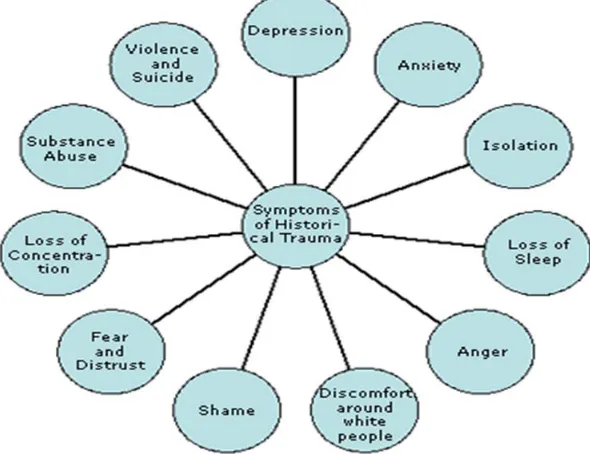
why groups manifest issues. In the populations affected by their history, manifestations take the form of: isolation, shame, fear and distrust, abuse, violence, suicide, depression, anxiety, loss of sleep, anger, discomfort around white people (in the case of Native Americans), and loss of concentration. HT posits that the trauma of their history causes “cumulative emotional and psychological wounding over the lifespan and across
generations,” resulting in “massive group trauma.”5
The second layer of this paper takes HT and applies it to the history of Colombia, to find examples of those traumas. The violent and unstable history of the country in the last half of the twentieth century resulted in many leaving their homeland in search of security, and economic mobility. The first episode of identifiable trauma identified begins with Jorge Eliécer Gaitán’s assassination on April 9, 1948, which resulted in two major events: “El Bogotazo” and “La Violencia.” These events led the Colombian people to a lack of social stability, security, and refugee-like symptoms as many in the zones of violence became displaced. A third episode came with the creation of El Frente Nacional (The National Front 1958-1974). The National Front emerged as a political coalition between the liberal and conservative parties in Colombia and destroyed Colombian people’s trust in their government and created large scale voter apathy. Other examples of moments of trauma include the formation of guerrillas and paramilitaries, and then the drug cartels. When tensions between right-wing paramilitaries and leftist guerrilla forces began in the 1960s (as a result of the government’s indifference to the social conditions of the country because of the National Front), they created divisions adding to the fear
5
and distrust among Colombians. Then, when these paramilitaries and guerrilla forces merged into the drug cartels of the 1980s and 1990s, they added to the “shame” many Colombians felt for identifying as Colombians, resulting in hesitation of contact with other Colombians, due to mistrust. As one can see, the legacy of Colombia’s turbulent history results in a diaspora which exhibits an exceptional degree of social fragmentation. These fragmentations occur as a result of exported divisions that follow immigrants wherever they have settled resulting in drug related stigma and stereotypes, and finally domestic conflict. Examples where this occurs in the Diaspora include cities like Miami, New York, Los Angeles, London, and Ontario and Toronto, Canada.
The case study of Colombians in Idaho is an attempt to document the immigration experiences of Colombians to the state of Idaho, a state not considered a top destination for Colombians. According to a report by the Pew Institute, Colombians tend to concentrate in the South (49%), mostly in Florida (31%), and in the Northeast (33%), others in New York (14%) and New Jersey (11%).6 This study provides information that is lacking in the studies of fragmentation by looking at this issue in a smaller city setting, rather than relatively large urban area.7 Even though the study was small, in the process of conducting the interviews the pattern of social fragmentation emerged. In their interviews, the men and women told stories and gave examples of divisions linked to mistrust, rumors, competitions, and socioeconomic factors.
6
Anna Brown and Eileen Patten, “Hispanics of Colombian Origin in the United States, 2011,” Pew Research Center, Washington, D.C., (June 19, 2013)
http://www.pewhispanic.org/files/2013/06/ColombianFactsheet.pdf, Accessed June 25, 2013.
7
Evidence of fragmentation in the case study suggests something at play leading to divisions, and this paper argues that Colombia’s history may contribute to them.
CHAPTER TWO: COLOMBIAN DIASPORA AND MIGRATION IN THE 20TH CENTURY
Colombian emigration began in the middle of the twentieth century due to instability within the country. Like so many migrants before, Colombians found themselves in neighboring nations in North and South America, with a small number leaving the continent. According to data from 2005, 88 percent of Colombians relocated to countries in North and/or South America. The most, about 48 percent, migrated to the United States, while 40 percent went to nearby countries such as Ecuador, Brazil, Costa Rica, Panama and Venezuela. In that same year, 12 percent crossed the Atlantic with 11 percent migrating to Europe, Spain, the United Kingdom, Germany, Italy, France, and The Netherlands. Finally, the remaining one percent moved to Asia, Oceania, and Africa.8
At places of destination their immigration experience contains evidence of social fragmentation. This pattern can be found in studies of Colombian experiences in the United States, the United Kingdom, Spain, and Canada. This puzzle to their story emerged in 1999 with the works of Luis Eduardo Guarnizo, Arturo Ignacio Sánchez,
8
Elizabeth M. Roach, and Luz Marina Díaz.9 Since then, others have built upon their works attempting to answer why Colombians fragment. In 2004, during the International Conference for Affordable Housing in Toronto, Canada, Abigail Moriah, Luz Rodriguez, and Luisa Sotomayor, stated that they “come with high stocks of human capital,” yet “start with little social capital,” rejecting the “idea of being constrained” geographically, such as in an ethnic enclave. The long history of “violence, distrust, narco-trafficking, armed conflict, extreme violence, poverty, corruption, and social exclusion, [has] diminish[ed the] abilities of Colombians and Colombian immigrants” to use their social capital through networks.10
Scholars, who study the phenomena, state that several factors come into play causing the fragmentations. These include drug related stigma and stereotypes, exported divisions—which follow immigrants wherever they have settled—and finally internal conflict and violence. Drug related factors contribute to the social fragmentation of Colombians because of the stigma and stereotype associated with the Colombian identity. This occurs as a result of the links to drug cartels making this group ashamed of their identity.11 Exported factors represent another reason, contributing to fragmentation abroad. The hidden cargo of exported issues causes divisions abroad by the
9
See the following articles: Guarnizo et al., “Mistrust, Fragmented Solidarity, and Transnational Migration”; and Luis Eduardo Guarnizo, and Luz Marina Días, “Transnational Migration: A View from Colombia.” Ethnic and Racial Studies 22, (March 1999): 397-421.
10
Moriah et al., “Building Housing Through Social Networks: New Colombian Immigrants in Toronto”, 11-12.
11
Works that address this issue include: Guarnizo et al., “Mistrust, Fragmented Solidarity, and Transnational Migration”; Guarnizo, and Díaz, “Transnational Migration”; And Michael W. Collier and Eduardo A. Gamarra, “The Colombian Diaspora in South Florida: A Report of the Colombian Studies Institute’s Colombian Diaspora Project,” Miami, FL: Latin American and Caribbean Center, Florida International University, Working Paper Series WPS No. 1, May 2001.
transplantation and replication of issues to destinations abroad.12 Others believe the domestic conflict and politically motivated violence leads to fragmentation. While these reasons overlap at times, together they point to traumatizing events in Colombia’s history as a cause of their fragmentation.
Drug Related Factors
Drug related factors add to the social fragmentation, such as the stigma and stereotype. The drug trade in the country affected Colombians abroad making them feel ashamed of their identification as Colombians. Two works began to delve into this issue, “Mistrust, Fragmented Solidarity, and Transnational Migration: Colombians in New York City and Los Angeles” and the second, “Transnational Migration: A View from Colombia.”13 The authors of these studies found that Colombian identity abroad became
12
Some important works include: Virginia M. Bouvier, “A Reluctant Diaspora? The Case of Colombia,” In Diasporas in Conflict: Peace-Makers or Peace-Wreckers? edited by Hazel Smith, and Paul B. Stares, Tokyo: United Nations University Press, 2007: 129-152; Luis Eduardo Guarnizo, “El Estado Y La
Migracion Global Colombiana.” Migracion y Desarrollo, Primer Semestre, Numero 006. Red Internacional de Migracion y Desarrollo. Zacatecas, Mexico. (2006): 79-101; Helen B. Marrow, “Colombian
Americans,” In the Encyclopedia Latina: History, Culture, and Society in the United States, Edited by Ilan Stavans and Harold Augenbraum, Danbury, Connecticut: Grolier Academic Reference, 2005; Cathy McIlwaine, “Coping Practices Among Colombian Migrants in London,” London: Queen Mary University of London, (2005); Cathy McIlwaine, "Challenging Displacement: Livelihood Practices Among Colombian Migrants in London," The Leverhulme Trust. London: Queen Mary University of London, (2008),
http://www.geog.qmul.ac.uk/docs/staff/19690.pdf (accessed February 10, 2012); Duberlis Ramos, Gustavo Neme & Felipe Rubio, “Capacity Building for Peace and Development: A Potential Role for the
Colombian Diaspora,” Paper presented at the United Nations University for Peace, Capacity Building for Peace and Development: Roles of Diaspora. High Level Expert Forum, (19-20 October, 2006), Toronto; and A. Bermúdez Torres, “Colombian Migration to Europe: Political Transnationalism in The Middle of Conflict,” COMPAS Working Paper WP-06-39, (2006).
13
“synonymous” with international drug trafficking, and as such, Colombians tended to isolate and distance themselves from other compatriots.14
The stigma and stereotype grew out of the tarnished reputation of Colombians because of the problem of the illicit global network of the Colombian drug cartels. The source to this tarnished reputation spread via media channels with television shows like “Miami Vice” that dramatized stories of the cartels, while the news concentrating on violent stories of notorious drug lords like Pablo Escobar, instilled fear about
Colombians. The stereotypes and image of Colombians at places of destination linked to these historical events, affected the ways Colombians integrated with each other.15
The drug related history of Colombia followed migrants to their destinations where “drug trafficking” and “Colombian national identity”16 often unified. From there, divisions based upon stigma and stereotypes emerged.17 Colombia’s internal drug war deeply affected the Colombian Diaspora to the point that experiences “increased levels of social fragmentation and generalized mistrust.”18 The history of the country’s drug related issues can be considered another reason behind immigrants’ current
14
Ibid.
15 Ibid.
16
Marrow, “Colombian Americans.”
17
Guarnizo, “El Estado Y La Migracion Global Colombiana,” 92.
18
fragmentation. These first studies created the platform for the interest in the phenomenon stimulating others to investigate this social occurrence.19
Exported Divisions
Social divisions that develop in the home country get replicated abroad. These factors related to fear and mistrust due to political instability and criminality.
Colombians’ inability to overcome their history and begin anew at their places of destination makes the case that abroad they have transplanted their past and carried experiences to new destinations.20 Many Colombians carry with them a state of fear created by the insecurities posed by paramilitary and guerrilla groups. In Spain, for example, the carryover of the violence and insecurity in Colombia extends there causing some Colombians to live in fear and distrust of each other due to the belief that other Colombians may be informants fulfilling political agendas. As a result Colombians who live in Spain fail to “really flee the guerrilla or paramilitaries.”21 This stressful situation then creates a sense of paranoia amongst Colombians who see themselves unable to escape the tensions developed at home.
Another example of widespread fear, fueled by personal issues from Colombia, involves the Colombians in London to fear, “family members as well as acquaintances or
19
These works include: Collier, and Gamarra, “The Colombian Diaspora in South Florida”; Marrow, “Colombian Americans”; McIlwaine, “Coping Practices Among Colombian Migrants in London.” and "Challenging Displacement.”; Guarnizo, “El Estado Y La Migracion Global Colombiana,”; Bermúdez, “Colombian Migration to Europe”; Ramos, et al., “Capacity Building for Peace and Development”; and, Bouvier, “A Reluctant Diaspora? The Case of Colombia.”
20
Marrow, “Colombian Americans.”
21
associates.”22 Some Colombians abroad are fearful of each other because they are unsure of each other, either due to problems or vendettas stemming back to the home country, or if they are subject to deportation and/or retaliation. These exported fears add to an already stressful immigration experience by fracturing an already weak group.23
Colombians migrate with a deep sense of regionalism that characterizes the country itself. Segmented into geographical regions, the country divides into five semi-autonomous regions: the Caribbean, the Pacific, the Andean, the Eastern Plains, and the Amazon. Each differs from the other culturally, economically, politically, and socially.24 As a result, Colombians by nature tend to identify and associate based upon region of origin in Colombia, for example, paisas, costeños, caleños, etc.25 When Colombians migrate, they bring with them those regional differences to countries of destination like Florida where “Colombians live and establish social networks based on … Colombian regional loyalties, just as they did in Colombia.”26 The lack of group cohesion results from an inability to distance themselves from the regional tensions developed at home which coupled with classic social group divisions, become exacerbated abroad. In Canada for example, there is a fear of distrust of regional affiliation because of “a legacy
22
Ibid., 43.
23 Ibid.
24
Jorge P. Osterling, Democracy in Colombia: Clientelist Politics and Guerrilla Warfare (New Brunswick: Transaction Publishers, 1989): 9.
25
Ibid.,14. Paisas is a term that refers to the people from the departments of Antioquia, Caldas, Risaralda y Quindío. Costeño is a term that refers to the coastal people of Colombia, basically anyone who resides in the coastal regions, beit the Atlantic or the Pacific coasts. Caleños is a term that refers to the people from the city of Cali, Colombia.
26
of suspicion about the region of origin and political affiliation.”27 This fear of affiliation based on region can cause cautious behavior amongst Colombians.
Domestic Conflict and Violence
The history of internal conflict and violence is a third consideration as a source of fragmentation of Colombians abroad. “The historical legacy [of] the
country’s…historical past has affected the diaspora and led to the divisions.”28 This history then manifests itself as fear and mistrust, a dominant experience scholars note Colombians exhibiting abroad. The studies of Colombian experiences note a carryover of the country’s violent past to their new destinations, resulting in mistrust of one another.
Their history of “violence and criminality”29 has affected Colombians of “all classes, social organizations, and territorial spaces,”30 creating wedges of divisions and polarization. The country’s history has most definitely left its mark on those who have emigrated. Studies show that the internal conflict and violence in Colombia for the past 64 years has contributed to the fragmentation, “linked not only with the legacies of conflict and divisions that people they [sic] migrate with, but also with immigration
27
Pilar Riaño and Luin Goldring, 2006 “A Colombian Diaspora? Characteristics, tensions and challenges in transnational engagements,” Prepared for the Expert Forum on “Capacity Building for Peace and
Development: Roles of Diaspora,” UN University for Peace, Toronto, October 18-19.
28
Bouvier, “A Reluctant Diaspora? The Case of Colombia,” 137.
29
Bermúdez Torres, “Colombian Migration to Europe,” 9.
30
policies and racism in the destination.”31 Once abroad, Colombians already affected by their history become even more fragmented when they meet with drug related stigma and stereotypes. 32
While divisions and polarization among immigrant populations occur, “in the case of Colombians these are exacerbated by the internal armed conflict in Colombia.”33 The collateral damage of violence contributes to the Diaspora’s fragmentation by creating cleavages in this group abroad, which in turn reflect divisions that originate at home. Colombia’s violent past has resulted in established divisions and lack of trust to the historical legacy of the country to create a recipe for social disaster. When some Colombians migrate they carry with them divisions which in turn become further
exacerbated outside of the country. These divisions occur out of their distrust of political and economic institutions, corruption, immigration status, and ideology, education, and generational differences. One scholar has attributed this lack of identity to lack of group identity, distrust of political and economic institutions, and lack of common vision and or aspirations. 34
31
McIlwaine, "Challenging Displacement,” 1.
32
Marrow, “Colombian Americans.”
33
Bermúdez Torres, “Colombian Migration to Europe,” 20.
34
CHAPTER THREE: CHAPTERS OF TRAUMATIC HISTORY
This chapter adds to the discussion on fragmentation by combining history with a psychological framework, and argues that Historical Trauma (HT) partly explains the social fragmentation of Colombian immigrants abroad. First, the theory of HT defined in this section provides the blueprint of how this theory might apply to Colombia. Second, Colombia’s post-1948 history through the lens of HT, identifies epochs or phases that qualify as moments of trauma. HT helps explain fragmentation because it looks towards the collective history of the group to answer the collective problem. By intertwining both history and psychology, cautious generalizations explore how these traumas manifest in the Diaspora and helps answer the question: what causes Colombians to fragment abroad more so than other groups?
Defining Historical Trauma
The psychological theory of Historical Trauma (HT), as outlined by Maria Yellow Horse Brave Heart in her studies of Native Americans, helps explain why groups behave in certain ways. HT posits that the trauma sustained as a result of history causes
“cumulative emotional and psychological wounding over the lifespan and across generations,” resulting in “massive group trauma.”35 These traumas in turn augment an
35
individual’s risk of experiencing upsetting stressors which then decreases the strength that one would have through culture, family, and community support.36
Populations affected by HT are, for the most part, groups that experience, poverty, dislocation, and/or war. Then as a result of their trauma, those groups tend to manifest certain behaviors in reaction to that trauma. Reactions include isolation, shame, fear and distrust, abuse, violence, suicide, depression, anxiety, loss of sleep, anger, discomfort around white people (in the case of Native Americans), and loss of concentration. These Historical Trauma Responses (HTR’s) emerge as spokes from the hub of trauma and can appear in many forms. The following diagram visualizes those trauma responses, and Colombians abroad exhibit three of them, isolation, shame, fear and distrust.
Figure 1. Constellation and Wheel of Historical Trauma
36
In the case of the Oglala Lakota, several epochs in history had a negative effect on this population. This history has manifested as several HTRs augmenting stressors and robbed them of their strength as a culture, and their family and community support. According to a study by Muid Onaje, the phases for HT within Native American Tribes are in order of occurrence:
1. First Contact: life shock, genocide, no time for grief. Colonization Period, introduction of disease and alcohol, traumatic events such as Wounded Knee Massacre.
2. Economic competition: sustenance loss (physical/spiritual). 3. Invasion/War Period: extermination, refugee symptoms.
4. Subjugation/Reservation Period: confined/translocated, forced dependency on oppressor, lack of security.
5. Boarding School Period: destroyed family system, beatings, rape, prohibition of Native language and religion; Lasting Effect: ill-prepared for parenting, identity confusion.
6. Forced Relocation and Termination Period: transfer to urban areas, prohibition of religious freedom, racism and being viewed as second class; loss of governmental system and community.37
37
As the history of groups like the Oglala Lakota in the United States or the Irish in Ireland38 has had a negative impact, likewise the history of Colombia has negatively affected Colombians. The violent and unstable history of Colombia in the last half of the twentieth century resulted in several traumatic moments. The year 1948 marks the beginning of Colombia's tumultuous history and migratory waves.39 Since then,
Colombia's history provides ample opportunity to look at events that serve as examples of HT. While research to date underscores the effect of violent trauma experienced by the Diaspora, identifying traumatizing periods in Colombia’s modern history, particularly the periods between 1948 into the early part of the Twenty-First Century, demonstrates periods where this history may have left a negative imprint on Colombian emigrants.
One event that negatively affected Colombians is the assassination of Jorge Eliécer Gaitán in 1948. Gaitán’s assassination prompted two major events, El Bogotazo and La Violencia. El Bogotazo was riots in the city of Bogota that followed his death and La Violencia (1948-1958) marked the decade of civil war between the conservative and liberal party both of which ended in many deaths. A second episode came with the creation of El Frente Nacional (The National Front 1958-1974). A third example
emerged with the rise of right-wing paramilitaries and leftist guerrilla forces in the 1960s.
38
Kenneth Coll, B. Freeman, P. Robertson, E. Cloud, E. Cloud Two Dog, and R. Two Dogs, “Exploring Irish Multigenerational Trauma and Its’ Healing: Lessons from the Oglala Lakota (Sioux),” Advances in Applied Sociology 2, (2012): 95-101, (Accessed July 17, 2012) doi: 10.4236/aasoci.2012.22013.
39
A fourth period of trauma developed from the drug related violence of the 1980s and 1990s.
This history resulted in a Diaspora whose traumatic history manifests itself with isolation, shame, fear and mistrust. The first reaction to the trauma sustained from the history of the country emerges in the Diaspora as, “isolation.” One example of this, and the most visible, is the lack of ethnic enclaves. Another manifestation takes the form of “shame,” such as the shame associated with the Colombian identity tied to the drug cartels, which at times can lead to stigma and stereotypes. In addition, Colombians also engaged in stereotyping other Colombians with an assumed involvement with the cartels, further contributing to their shame as a whole. The third manifestation “fear and
mistrust,” noted in the earliest work by scholars about the issue of social fragmentation, has had a strong effect on the Diaspora. The following section will go further into detail about this history, making cautious generalizations about the result of those experiences.
The Assassination of Jorge Eliécer Gaitán
Colombia's traumatic history in the last half of the twentieth century began with the assassination of Jorge Eliécer Gaitán. Gaitán (January 23, 1903- April 9, 1948) served as Education Minister in 1940, and then Labor Minister (1943-1944), before his run at the presidency when he reformed the country in democratic rather than
populist movement grew, many looked with hope towards Gaitán’s ascension into the presidency, which offered a fresh perspective compared to the status quo. 40
On April 9, 1948 Juan Roa Sierra killed Gaitán as he prepared for his second presidential campaign outside his office in Bogota. His death crushed the country’s chances for improved societal conditions, and set into motion a series of ill-fated events that would stir up some of the most violent and unstable history of Colombia. Following Gaitán’s death a lynch mob chased down Sierra killing him on the spot, and events escalated leading to El Bogotazo and La Violencia. Prior to these two events in 1948, political tensions between the conservative and liberal parties had been relatively minor. But that year, conservatives, tired of being electoral runner-ups, resorted to underhanded and violent tactics including the murder of Gaitán.41
El Bogotazo y La Violencia: 1948-1958
In the aftermath of Gaitán’s death, the government failed to address the political shockwave and social upheaval and instead infuriated people who took to the streets of Bogotá, devastating the city. The lack of tact by the government with quickly naming Gaitán’s successor, Darío Echandía, did not settle either. As a result, a riot known as El Bogotazo ensued, beginning when Gaitan’s supporters took to the streets. The riot lasted ten hours and during this time people robbed, looted, and destroyed buildings and
historical landmarks. As the riot slowly waned, the reality of the situation finally set in, the city lay in chaos and destruction. Fifteen hundred people died and another 20, 000
40
Forrest Hylton, "Chapter 3," In Evil hour in Colombia, London: Verso, 2006, 31-50.
suffered injuries. By the next day, a dark cloud enveloped the country as violence and crime spread, giving rise to La Violencia (1948-1958), a ten-year long civil war.42
During this time, battles for power and control in the interior of the country erupted between the rural poor and the agribusiness elite. The political rivalry that
always existed between the conservative and liberal parties of the government ignored the country’s societal issues. Preoccupied only with inter-party strife, they let the situation in Colombia get out of hand. The result was an increase in insecurity within regions most affected, displacing many in the interior to the exterior of the country. As people left their homelands in search of security, many migrated to the cities, which put pressure on the services that those cities could offer. The result of this civil war was a death toll of somewhere 200,000 to 300,000, a number still debated.43
La Violencia not only made Colombian society afraid, vulnerable, and insecure but it instigated noticeable waves of emigration both to the interior and exterior of the country. The areas most affected included the isolated rural interior regions which became too dangerous. Displaced to urban areas, Colombians migrated from places like El Norte De Santander to coastal cities like Barranquilla, causing many Colombians to experience refugee-like situations in their own country. In zones of violence which tended to take place in the interior of the country, leftist guerrillas and right-wing
paramilitary groups fought for control continuing into the following decades. The leftist movement in Colombia sought to protect the rural poor from losing their livelihoods and
42
Ibid., 41.
43
the right-wing groups, with the support of the Colombian government, attempted to break up the guerrilla groups. Eventually, those who could migrate outside of the country to escape social and political upheaval did so. The majority of them came from the lower to lower middle classes, and generally left as single men whose families later joined them.44
Figure 2. La Violencia45
El Frente Nacional: 1958-1974
As Colombia lay amidst social upheaval, Liberals and Conservatives reached a political compromise to move beyond the political strife by coming up with an accord. On June 24, 1956 both parties signed El Frente Nacional, (The National Front, 1958 and
44
Collier and Gamarra, “The Colombian Diaspora in South Florida,” 2.
45
1974) an accord that allowed conservatives and liberals to let the opposite party govern, alternating after every four years or one presidential term. Liberal President Alberto Lleras Camargo (1958 to 1962) first tested the waters of the National Front and set a good pace by expanding the infrastructure of the country and stabilizing the economy.46 However, this only lasted one term as the second president, conservative Guillermo León Valencia (1962 - 1966) abandoned the reforms of Lleras Camargo. Under León Valencia the peso devalued, social unrest increased, an underground economy expanded, and guerrilla groups emerged. While the original structure of the National Front should have lasted a period of sixteen years, dissolving in 1974, the two parties extended it to 1986.47
The National Front destroyed Colombian people’s trust in their government because instead of resolving social issues affecting the country, political bodies only set to resolve their inter-party strife. Their political coalition not only damaged the trust in the government, and in the governmental system, but inculcated mistrust, insecurity and suspicion towards one another. The violence set by El Bogotazo and La Violencia, instigated the formation of the political coalition that perhaps would not have given rise to the fragmentation of Colombians abroad, as a result of the culture of apathy.48
The Emergence of Guerrillas and Paramilitaries: 1960-1970s
The rise of paramilitaries and guerrilla groups (1964-1970) began as a response to failed attempts by the National Front to appease tensions. These groups lacking support,
46
Palacios, Between Legitimacy and Violence,135-169.
47
Ibid., 154.
then sought to protect their economic interests. Feeling excluded from the National Front and other political forces, rural poor formed revolutionary guerrilla groups. However, not just the masses became dissatisfied with the Colombian government under the
National Front, but agribusiness elites as well. To counter insurgent forces and to protect their economic interests in rural areas the agribusiness elite, with the support of
international financing institutions, formed right-wing paramilitaries. These groups created divisions adding to the fear and distrust among Colombians, a conflict that continues to the present.49
The oldest and still active guerrilla group, Fuerzas Armadas Revolucionarias de Colombia (FARC-The Revolutionary Armed Forces of Colombia 1964), began on the heels of President Valencia and President Carlos Lleras Restrepo, as a peasant army in the mountains of Colombia.50 The second group the Ejercito de Liberacion Nacional (the National Liberation Army- ELN), began that same year, and consisted of individuals that expressed their openly critical opinion in of the country’s hideously unequal distribution of income. When they united they left to train in Communist Cuba.51 The third group, the Ejercito Popular de Liberacion (Popular Liberation Army- EPL 1967) emerged under the presidency of Lleras Restrepo, as a response to persistent problems of poverty and unemployment.52 When the National Front came to a close in 1970, a fourth group emerged, known as the Movimiento 19 de Abril (M-19). This group gained momentum
49
Hylton, Evil Hour in Colombia, 70.
50
Ibid., 56-57.
51
Ibid., 57.
52
when, according to M-19 leaders, the rightful winner of the presidential election should have been General Rojas Pinilla. However, Conservative candidate Misal Pastrana Borrero (1970 -1974) assumed the presidency. As a result, M-19 formed on the belief that the 1970 elections were fraudulent. The failure of the National Front did nothing to ease the conservative-liberal tensions, and did little to improve the country or its societal conditions.53
The events that took place between the 1960s and 1970s made Colombian society afraid, vulnerable, and insecure, and instigated waves of migration. As tensions between paramilitaries and guerrilla groups escalated, another migratory wave ensued. In this wave 116,444 Colombians emigrated, the majority consisted of educated middle and upper class professionals resulting in a brain drain.54 They sought to escape drug related violence even though the country had a healthy economy.55 This historical period of economic competition saw the emergence of paramilitaries, guerrilla forces, and drug cartels who sought to protect their own economic interests at the cost of forced displacement, increasing insecurity in the country.
Drug, Cartels, and Kidnappings: 1980-2000s
As the 1970s came to a close, the clashing interests between government, drug gangs, paramilitary, and guerrilla forces increased bloodshed and uncertainty. This
53
Ibid., 62-63.
54
James S. Olson and Heather Olson Beal, The Ethnic Dimension in American History 4th ed. Malden, MA: Wiley-Blackwell, 2010: 279; and Cislo, "Psychological Distress among Cuban and Colombian Immigrants in Miami: Considering the Roles of Acculturation and Ethnic Discrimination."
55
combination caused conditions in Colombia to deteriorate, creating a wave of forced migration of those who sought to escape the violence.56 Between the 1980s and the early 2000s Colombia, with the help of the United States, attempted to eradicate the drug related issues plaguing the country. These efforts commenced with several Colombian presidents attempting peace talks with Colombian guerrilla groups and then more recently adopting Plan Colombia, and Plan Patriota. In 1978, President Julio Cesar Turbay began an anti-drug collaboration with the U.S. hoping to lessen the ongoing conflict between government, guerrilla forces, and feuding drug lords. Then, in an attempt to gain more power M-19 became a political party in 1980, but by then tensions affected all levels of society adding to the social instability of the country. 57
The severity of drug related factors came to light when M-19 took over the Supreme Court Offices of El Palacio de Justicia (The Justice Palace) in Bogota, on November 6, 1985. The seizure of the Palace resulted after failed peace talks, between M-19 and President Betancourt. The attempted peace talks resulted from the assumed illegitimate Presidential win by Misal Pastrana Borrero over M19 candidate General Rojas Pinilla. The failed talks exacerbated tensions between government and guerrilla forces, resulting in both sides drawing battles lines, in attempts at controlling who would govern Colombia. In the course of the military seizure of the Justice Palace, one hundred
56
Ana María Ibáñez and Carlos Eduardo Vélez, “Civil Conflict and Forced Migration: The Micro Determinants and Welfare Losses of Displacement in Colombia,” World Development Vol. 36, No. 4, (2008): 669, accessed July 17, 2012, doi: 10.1016/j.worlddev.2007.04.013.
57
M19 leaders, civilians, and judges lay dead. The tactics by M19 to make the point that political corruption existed only served to cement the idea within Betancourt’s
Government that a link between M-19 and the drug cartels existed. The reason this idea emerged resulted from the damage caused by the Palace takeover. In the takeover, the most damage occurred to the national archives which were completely burned, destroying the documents that contained the files for the extradition of all drug traffickers to the United States.58
In the spring of 1990, five years after the Palace takeover, another set of events occurred. That year, as presidential candidates were preparing for the upcoming elections three candidates were assassinated. Their deaths highlighted the insecurity in the
country, and exposed the country’s political links between drug cartels, police officers, and government officials. The first candidate assassinated, Luis Carlos Galán Sarmiento (September 29, 1943 – August 18, 1989), a journalist and member of the Liberal Party, held a strong position against the drug cartels. In his hopes to redefine and improve the Liberal Party, Galán Sarmiento began a new movement, New Liberalism, and supported the extradition treaty between Colombia and the United States. In doing so, he not only declared himself an enemy of the Medellin Cartel, which he saw infiltrating all levels of Colombian society, but made himself the target of assassination. On August 18, 1989, Galán Sarmiento was gunned down by hired hit men from an unidentified drug cartel in
58
front of a large crowd as he campaigned in Soacha, Cundinamarca. He eventually died from his wounds at the hospital.59
The second assassination, took the life of presidential hopeful Bernardo Jaramillo Ossa (May 2, 1956 – March 22, 1990), a politician and member of the Socialist Party in Colombia. Jaramillo Ossa saw the need for societal improvements, especially for those at the bottom. As Jaramillo Ossa prepared to board a flight, a paramilitary named Andres Arturo Gutierrez Maya shot him to death in the Bogota airport. Two decades after his murder the truth emerged in 2010 that two government officials, Alberto Romero ex-director of the Colombian Security Service (Departamento Administrativo de Seguridad, DAS), and Carlos Castaño the chief of the United Self-Defense Forces of Colombia (Auto Defensas Unidas de Colombia, a paramilitary group, known as AUC) had ties to Jaramillo Ossa’s death.60
The third candidate assassinated, Carlos Pizarro Leongómez (June 6, 1951 – 26 April 1990) a former M-19 commander in the guerrilla group, oversaw the
demobilization of the guerrilla group in exchange for amnesty for former activities. In the 1980s, Pizarro Leongómez brought the militant tactics of M-19 to the ranks of a political party. Succeeding in the demobilization, Pizarro Leongómez became the party’s
59
J. E. Méndez and Human Rights Watch (Organización), The “Drug War” in Colombia: The Neglected Tragedy of Political Violence. Human Rights Watch, 1990: 74.
http://books.google.com/books?id=ZDd4qv3HwSYC.
60
leader and candidate for the presidential seat, when M19 became a political party. Later on, like Jaramillo Ossa, his death too had ties to AUC Chief Carlos Castaño.61
In the twenty-first century, as in the 1980s, Colombia continued the struggle against the drug traffickers. By the year 2000, nationwide protests against political violence and human rights violations escalated, and as a result the U.S. appropriated $1.3 billion to help the Colombian government fight the cartels. At the same time right-wing paramilitary forces began a campaign against leftist guerrillas,62 affecting 94 percent of Colombian municipalities by this violence in 2005.63 When revelations of connections between paramilitary groups, especially between the AUC (a group that killed thousands of Colombian civilians), congressmen, and President Uribe, came to light Colombians felt fearful and mistrusted their government.64 This scandal climaxed when the Supreme Court of Colombia ordered the arrest of one hundred government officials who worked with the paramilitaries.65 Another series of events that undermined the fight against the violence in Colombia emerged from the False Positives scandal of 2008. This scandal involved a series of murders which took place as part of the armed conflict. Those involved included members of the government and the armed forces who killed some
61
Ibid., 130.
62
Andrew L. Cherry, Substance Abuse a Global View, (Westport, Conn.: Greenwood Press, 2002): 57.
63
Ibáñez and Vélez, “Civil Conflict and Forced Migration,” : 660.
64
Sibylla Brodzinsky, "Colombia's 'parapolitics' scandal casts shadow over president," The Guardian 23 Apr. 2008: 1. http://www.guardian.co.uk/world/2008/apr/23/colombia
65
1,500 innocent civilians claiming they belonged to guerrilla groups, in order to fulfill the quota of killed guerrilla combatants.66
Those caught in the middle of the conflict experienced all sorts of violence, death, insecurity, and kidnappings at the hands of paramilitaries and guerrilla groups. Between 1980 and 2000, the Migration Policy Institute stated that one in ten Colombians lived abroad, with the majority of those living in Venezuela and the United States. The Diaspora numbers increased from 8.4 million in 1990, to 16.1 million in 2000. 67 According to data, from the UN High Commission on Refugees, as of January 2012 internal refugees or Internally Displaced Persons (IDPS) within the country numbered some 3,888,309.68
The history of Colombia demonstrates moments that suggest possible “source[s] of tension”69 behind the fragmentation. According to data from the Department of Homeland Security notable Colombian emigration began in the 1950s, increasing from just 20,000 to over 200,000 by 2008. Pushed by economic and political factors,
Colombians arrived in the United States in three waves: 1950-1970, 1970-1990, and 1990-2008. Overall, Colombian migration to the U.S. grew out of the events that took
66
Jeremy McDermott, "BBC News - Toxic fallout of Colombian scandal," BBC News – Home, May 7 2009, <http://news.bbc.co.uk/2/hi/americas/8038399.stm>.
67
Bérubé, “Colombia: In the Crossfire."
68
UNHCR, "UNHCR - Colombia." UNHCR. http://www.unhcr.org/pages/49e492ad6.html#http:// (accessed March 11, 2013).
69
place in the spring of 1948.70 The following chart demonstrates the increase of migratory waves from the country that coincide with the country’s traumatic events.
Figure 1 Colombian Immigration to the United States by Decade 1930-2008.71
In conclusion, Colombia’s post-1948 history provides ample opportunity to look at traumatic events that would forever leave its mark on the country and its people. The first of these events began with the assassination of Jorge Eliécer Gaitán in 1948. This moment in history would establish the violence and lack of social stability that the
country would endure. The second period of trauma emerged after Gaitan’s death as two separate but equally devastating events, El Bogotazo and La Violencia both which
resulted in escalating violence, deaths, lack of security, emigration, and displacement. The third event that added to the trauma developed from the creation of El Frente Nacional (National Front). This political coalition weakened people’s trust in the
70
Bouvier, “A Reluctant Diaspora? The Case of Colombia,” 129-152.
71
political system, in the government, and increased their insecurity. From there, economic competition emerged with the paramilitaries and guerrilla forces that sought to protect their interests by imposing violence, and forced displacement, all of which increased and perpetuated insecurity. In addition, security problems increased with the growing power of the drug cartels.
It is impossible then to ignore the possibility that the cumulative and decade long unstable and unpredictable environment caused by territorial turf battles between drug lords, paramilitaries, guerrilla groups, and the Colombian government, has had an effect on shaping the social networks of Colombians abroad. This history has in some cases polarized Colombians by creating cleavages that otherwise might not exist. An observation of this effect of history on Colombians is that this group of people is not “conscious” of being united. They are a people fragmented not only in their homeland but also in their destinations abroad, existing in separate “parallel societies.” 72
As a result of their history they manifest traumas in the form of: shame, isolation, fear, and mistrust. The “shame” of being identified as Colombians stems from those who fear the perception that all Colombians somehow have a connection with the notorious drug cartels. In other cases, many isolate themselves by becoming geographically removed from other Colombians, refusing to settle in an ethnic cluster. Other examples include the general fear and mistrust Colombians have for other Colombians, because they feel either stigmatized or stereotyped as drug cartel collaborators. The result of an
72
CHAPTER FOUR: CASE STUDIES OF COLOMBIAN IMMIGRANTS IN IDAHO
Los colombianos traen cosas de allá, para aplicar lo mismo acá, pero acá no importa!73
At places of destination like Canada, Europe, and the United States, Colombians exhibit Historical Trauma Responses (HTR) that manifest as isolation, shame, fear, and mistrust. Dividing like other groups along regionalism, ethnicity, gender, class,
immigration status, ideology, education, and generational difference,74 the extent to which Colombians fragment differentiates this group from others. The history post 1948 as mentioned in the previous chapter highlights points in time where traumatic events can chip away at the cornerstone of the group’s social network.75 This history partially explains why fragmentation is the status quo of the immigrant experience affecting the Colombian Diaspora. This chapter will contain a brief overview of examples of fragmentation occurring in Canada, Europe, and the United States followed by a small case study of this occurrence in the surrounding area of Boise, Idaho.
73
Ruby Lupien, Follow up interview via telephone. October 29, 2012. Translation of quote: Colombians bring things from there, (Colombia) to apply here (in the Boise Area), but it doesn’t matter here.
74
Bouvier, “A Reluctant Diaspora? The Case of Colombia,” 129-152.
75
In Canada, studies have noted tensions and challenges in transnational
engagements76 like divisions and mistrust that prevent Colombians from coming together. “Colombia continues to suffer an internal conflict that impacts seriously on the civilian population.”77 This carryover from Colombia demonstrates that the history in Colombia continues to affect this group’s ability to come together as a whole. This “legacy of conflict”78 has affected the relationships between not only Colombians with other Colombians, but Colombians with Canadian groups. There the four decade long conflict affects the “social fabric of communities and social relations of Colombians.”79 Their history has affected the level of trust of Colombians in this part of the world.
In the United Kingdom, fear and insecurities affect Colombians there, “There was little unity among the Colombian population linked with a severe lack of trust and widespread fear…. and with the Colombian political situation and the misplaced stereotyping of Colombians with drugs.”80 This fear originates from the history of mistrust caused by clashing political power and drug related violence, such as that of a fear of a “Colombian mafia.”81 This fear creates a state of perpetual stress for Colombians in London, which serves to deteriorate “unity and trust”82 there. Overall, the distrust of political institutions, ongoing corruption, family feuds, and fear of deportation, get imported to life in London.83 The damage this
76
Riaño and Goldring, “A Colombian Diaspora? Characteristics, Tensions and Challenges in Transnational Engagements,” 1-23. 77 Ibid., 18. 78 Ibid., 19. 79 Ibid. 80
McIlwaine, “Coping Practices Among Colombian Migrants in London,” 5.
81 Ibid., 44. 82 Ibid., 42. 83
carryover of tensions from Colombia has on life in London causes some to remain hyper vigilant of their compatriots.84
In the United States, noticeable divisions such as stigma and stereotypes occur in cities like New York, Miami, and Los Angeles. In one of Luis Guarnizo’s early studies that delves into the topic of social fragmentation,85 he mentions the damage caused by the history of Colombia’s international drug trade on Colombians in New York and Los Angeles. According to Guarnizo, the stigma and stereotype associated with Colombian identity worldwide “had a tremendous effect on Colombian immigrants in the United States in general.” In these two cities, increased levels of fragmentation occurred as a result, and interestingly instead of group cohesion says Guarnizo, it “fomented
fragmentation.” This occurrence goes against the typical immigrant behavior when faced with a less than hospitable reception.86 In Florida, Colombians show signs of weak social capital, similar to that of their home state, like the strict socio-economic networks based on class and regional loyalties replicated from Colombia.87 According to a study by Michael Collier and Eduardo Gamarra, Colombian social networks in south Florida “outside of their small networks….are extremely weak.”88 The authors make the point that this lack of social capital prevents the community from becoming more involved characterizing their community as “guarded.” This, they argue, comes from a lack of
84
McIlwaine, “Coping Practices Among Colombian Migrants in London,”: 44.
85
Guarnizo et al., “Mistrust, Fragmented Solidarity, and Transnational Migration,”: 373-375.
86 Ibid.
87
Collier and Gamarra, “The Colombian Diaspora in South Florida,”:6.
88
identity and a national consciousness with a strong sense of community many of which choose to “not live in large concentrations or ethnic enclaves.”89 The authors suggest that self-interest rises above the collective interest.90
In the Pacific Northwest state of Idaho, interviews with first generation
Colombian immigrants residing near the city of Boise, suggests that fragmentation exists like it does in the rest of the Diaspora. The following sample contains the interviews of narrators who speak of instances where a lack of unity prevents the community from coming together. According to Yaneth, “Colombians are more divided than anyone; they are divided and think they are better than others.”91 Ruby agreed with her and
commented on similar observances and noted that she has seen other Colombians not wanting “to mix or interact”92 with one another. Another interviewee explained divisions as cultural,
“Well you know that the Colombian culture has its thing, in reality I don’t know what exactly happens to those who don’t unite with the group if they feel rejected or they feel superior to others. But we don’t really, well there’s a lot of people that are not on “the list” if we have to say it like that. But it’s not because we want to keep them off the list, I say we, because I’m on the list.” 93
The acquisition of interviewees resulted from a snowball sampling, a research method where narrators connected the researcher to other Colombians they knew like
89
Ibid., 6.
90
Ibid., 15.
91
Luz Yaneth Castillo, follow up phone interview.
92
Ruby Lupien, Interviewed by Author, Compact Disk Recording (Boise, Idaho: archived at the Idaho State Historical Society, October 2, 2010): 8.
93
friends or acquaintances. This method proved successful in uncovering the hidden Colombian population in the state. According to the 2010 Census, 1.5 million people (1,567,582) resided in Idaho, of which 11.2 percent (175,901) identified as Hispanic or Latino. Furthermore, of those who identified as Hispanic or Latino the majority, 88 percent, identified as Mexican (156,187), compared to only 635 Colombians.94
The oral stories of Colombians collected for this section contained stories from seven individuals, who reside in the surrounding Boise area. The interviews conducted took place in either Spanish or English, with the Spanish interviews eventually translated. Even though they represent but a small case study, insufficient to draw definitive
conclusions, their stories shed light into the ways divisions within this group takes place. In the following section the narrators provided examples like isolation, shame, fear, and mistrust that generate social fragmentation. The examples reflected moments they themselves experienced or observed occurring. In this section vignettes of stories and observances of personal experiences of a few Colombians demonstrate the ways this occurs.
The narrators are Luz Yaneth Castillo, Lorena Medina, Martha Laudick, Ruby Lupien, Betsy Sterk, and Luis Gomez. There were two other Colombians who asked to remain anonymous as they did not want others to know their identity. Luz Yaneth Castillo began her immigration journey in Santa Martha, Colombia in 1991, with her daughter and husband arriving in Idaho in order to rejoin with family members residing
94
U.S. Census Bureau, American Community Survey, 2010 American Community Survey 1-Year Estimates, B03001,<http://factfinder2.census. gov/faces/tableservices/jsf/pages/
in the state. Lorena Medina emigrated from Popayan to Boise Idaho in 2007, to join her husband. Ruby Lupien emigrated from Barranquilla to Boise, Idaho in 2008 to join her husband. Martha Laudick emigrated from Barranquilla, to Michigan in 1985 then to Boise, Idaho in 1995. Betsy Sterk immigrated first in the 1970s as a nursing student and then again with her family in mid 1980s, and eventually arrived in Boise, Idaho in the 1990s. Last but not least, Luis Gomez arrived to Boise, Idaho from Colombia first on a Visa in the early part of 2000s and then a few years later acquired refugee status at which point his family joined him.
One manifestation present in the Idaho case is isolation. Isolation is defined as the process or fact of isolating or being isolated. This isolation reflects similarities
experienced in the Diaspora with Colombians choosing to distance themselves from compatriots for one reason or another. Martha stated her reasons to distance herself, “I don’t integrate because I don’t want to hear the chizme (gossip) and to tell you the truth I don’t get along with most of those individuals.”95 Another narrator expressed similar reasons as to why isolation takes place. Ruby said that the way others view others problems causes divisions, “Some people are apathetic and keep separate as result.”96 This isolation causes this group to keep separate and divided like those other Colombians in the Diaspora. For the most part this occurrence tends to occur as response within groups that experience reasons to become isolated or apathetic to situations.
95
Martha Laudick, Interview by Author, Compact Disk Recording, (Boise, Idaho: Archived at the Idaho State Historical Society, November 17, 2010).
96
A second factor affecting this community centers on shame. Shame by definition is the painful feeling of humiliation or distress caused by consciously wrong or foolish behavior, likewise it is also the action of a person or situation which makes one feel ashamed. Luis mentioned an example of this shame based on the comportment of others, “I have gone to some parties and it's been a spectacle the way they dance, it's even worse than what it is in Colombia.”97 In his example Luis, felt that the values of those at the party did not align with his own, as a result he felt shame and slowly distanced himself from other Colombians. Another narrator felt the shame caused by a distressful situation Yaneth stated,
They let me know that they get embarrassed of me the Colombian because I am an embarrassment … I don’t understand why I am an embarrassment to the Colombians here since I don’t work as a politician from Colombia and I haven’t embezzled anything from the country. [sic] So I don’t understand the reason, they are referring to…. perhaps that’s the reason they don’t want me there, some people talk badly about me whatever the reason I don’t know.98
As a result of feeling ostracized, Yaneth keeps away from other Colombians in the area. Another narrator noted shame as well. Ruby mentions how in one occurrence she was asked where she resided in Colombia. “I have been asked what socioeconomic background I belong to, such as what neighborhood.”99 In Colombia, the regional tendencies of the country not only extend to the five regions of the country, but to the local level where a particular neighborhood tells others exactly who one is.
97
Luis E. Gomez, interview by author, April 8, 2013.
98
Luz Yaneth Castillo, Interviewed by Author, Compact Disk Recording (Boise, Idaho: Archived at the Idaho State Historical Society, November 11, 2010), 4.
99
There are some [sic] that just simply don’t like to socialize others, don’t like to mix with certain people; because of their social status there are some that are prejudiced towards others.100
Another instance of shame centers on stigma and stereotypes of Colombians, particularly the image of the Latina woman. Betsy told a story of an instance when she went to a barbeque with other people:
I went to a barbeque with a friend, who invited me to help cook. There an
American asked me, ‘Betsy you are different. Why are you different?’ I said what do you mean? She said you are different in the way you dress; Colombian gals dress very show-y. I said I didn’t like to dress like that.101
A third factor, fear and mistrust found in the Diaspora, affects the small case study in Idaho too. This issue stems from traumas people experience which then become engrained, affecting the way they behave. In the case of Idaho, a few narrators provided examples of this fear and mistrust. Luis said he experienced both of these things: fear of him by other Colombians and mistrust from others about his credentials. Ruby also noted how this mistrust causes people to distance themselves.
In his interview Luis told of an occurrence that happened to him with some newly arrived refugees from Colombia. Thinking he could attempt to help these refugees, he found a way to reach them via phone. However, when he began to talk to them over the phone about how he could help with employment ideas, Luis hit a wall with the fear and mistrust from those individuals once they found out about his former job, in Bogota:
I called them, once I found out where they were staying; I asked them what they may need help with in regards to employment. I had worked in many different
100
Ruby Lupien, Interview, 9.
101
places here, cleaning office buildings, and construction work; I asked if they knew what they were going to do, they said no. Then they said that I knew a lot of things, and asked me what it was that I did in Colombia. I told them I had worked as a lawyer specializing in anti-narcotics, then the phone call got really quiet and they hung up.102
Luis’ interview depicts an example of the fear and mistrust often times
experienced by Colombians abroad. Colombians are affected by the decade long drug related violence, and often as a result fragment due to a fear and mistrust associated with this historical period in Colombia. Luis then stated a reason why in his case they were fearful. He said that perhaps it was fear about what Luis could find out about these newly arrived Colombians,
I tried calling them back and never found out anything else about them. But in doing so I found something about them. Through church friends they said that they [the newly arrived Colombians] were caught trying to rob somebody here [Boise] in the middle of the night. 103
A second experience of mistrust felt by Luis occurred with the acceptance and validation of his academic credentials, “I had my CV online and people started
questioning the validity of what was on there, they were looking to see if they could find my records in Colombia….if I had those credentials in Colombia.”104 Contacting friend’s and former colleagues in Colombia, he eventually acquired the material required to validate things. A necessary step that occurs with anyone working in academia, Luis felt frustrated by the level of mistrust that he felt others expressed about him. Even though he had those and got the paperwork, he nonetheless felt stereotyped as the typical
102
Luis E. Gomez, interview by author, April 8, 2013.
103
Luis E. Gomez, interview by author, April 8, 2013.
Colombian trying to get away with something. Another narrator confirmed this
distancing based upon this mistrust. Ruby noted, “I know people who left Colombia due to the violence and have come as refugees; they separate themselves because they are not trustful of others.”105 Here Ruby, notes that the history of Colombia and what those individuals experienced back home affects the way they behave at places of destination.
When asked about the root cause of these fragmentations, many agreed that it originates in Colombia. In addition to isolation, shame and fear and mistrust, narrators expressed other reasons like competition, gossip, arrogance, and lack of education as the reason behind why this group fails to come together. Yaneth stated that she observed competition with one another as a polarizing factor, “They believe they are better and of higher class and status, than others.”106 For Martha it was the same, “Colombians are competitive, they try to see who is better than whom, and then they try to see who is not and exclude them. Then, to reach a goal, if they can step on someone to get ahead they do it.”107 What occurs in this cycle of social interactions makes people critical of the actions of others leading to “critiques” that people causing people to isolate themselves, “so that they don’t get criticized.”108 This internalized stratification then contributes to Colombian fragmentation. For some, like Luis “it depends on what social class one belongs to in Colombia”109 that then becomes an “extension of that reality in Colombia, to places of
105
Ruby Lupien, Follow up interview via telephone. October 29, 2012.
106
Luz Yaneth Castillo, Follow up interview via telephone. November 11, 2012.
107
Martha Laudick, Follow up interview via telephone. October 29, 2012.
108 Ibid.
109