www.ijper.org
Challenges in Simultaneous Analysis of
Hydrolytically Sensitive Ester Drugs in Combined
Dosage Forms
Anusha Palekar, Kshitija Kambli, Sanjay Pai*
Department of Pharmaceutical Quality Assurance, Goa College of Pharmacy, Panaji-403001, Goa, INDIA.
ABSTRACT
Objective: Two or more ester drugs in multicomponent formulations are likely to exhibit errors during analysis under acidic conditions, possibly due to hydrolysis. UV Spectrometric methods are hard to disseminate such phenomenon while HPLC methods could provide an insight into possible degradations as source for erroneous conclusions. Material and Methods: Combined dosage formulation of aspirin and clopidogrel bisulphate has been used in the study to demonstrate limitations of popular Absorbance Ratio method commonly used for simultaneous determination by UV spectroscopy. Results: Under acidic hydrolytic conditions, clopidogrel degradation was found to increase in presence of aspirin as shown by HPLC method. Validated HPLC method used for the study comprised of mobile phase methanol: 10 mM phosphate buffer (80:20), pH 7 and a C-18 Column. Rt for aspirin and clopidogrel bisulphate were found to be 2.1 and 7.3 min respectively, with flow rate of 1 mL/min. For absorbance ratio method mixture of methanol: 0.1 N HCl was used as the solvent. Conclusion: In the event of unexpected challenges involving stability of drugs in solutions, it becomes necessary to search for platforms that prevents degradation and subsequently prevent possible interactions between degradants if any.
Key words: Absorbance Ratio, HPLC,Aspirin, Clopidogrel, Hydrolysis, Degradation.
DOI: 10.5530/ijper.53.1.13 Correspondence:
Dr. Sanjay Pai P.N,
Department of Pharma-ceutical Quality Assurance, Goa College of Pharmacy, Panaji-403001, Goa, INDIA. Phone: +91 0832-2226882 E-mail: pnsanjaypai@gmail. com
INTRODUCTION
Formulations consisting of two or more ester drugs if present together are likely to throw challenges during analysis as they are generally sensitive to hydrolysis under acidic and basic conditions. Such esters and certain amides are likely to show degradation on inducing stress to form reactive degradants. As such the degradants could further react with one another forming components that have absorptivities different from the indi-vidual drugs leading to unpredictable errors during analysis. One combined dosage form of Aspirin and Clopidogrel was used for investigation to demonstrate errors in analysis. Aspirin (ASP) (Figure 1), 2-(acetyloxy) ben-zoic acid (Drug Bank Accession Number DB00945) is an odorless, white, needle-like crystalline substance and on exposure
Submission Date: 20-04-2018;
Revision Date: 05-06-2018;
Accepted Date: 14-08-2018
to moisture, hydrolyses to salicylic acid and acetic acid. Clopidogrel (Figure 1) as Bisulphate (CLP), (+)-( S)-methyl-α-(2-chlorophenyl)-(6, 7-dihydrothieno [3, 2-c] pyridine-5(4H)-acetate sulfate (Drug Bank Accession Number DBSALT000029) is an amorphous, white to off white powder, odorless compound freely soluble in water and methanol.
have to be powdered and mixed. In the event of interac-tion between such drugs, the results of analysis become unreliable.
Literature survey revealed a few analytical methods like RP-HPLC,1-3 HPTLC,4UV method5 for the simultane-ous estimation of ASP and CLP and few for individual estimation of CLP6-8 and ASP.9 For the mixture, separation by HPLC has mostly been reported on C-18 column with mobile phase comprising of either acetonitrile or methanol and water with buffers of pH ranging from 2 to 3.4. ASP, being an ester is susceptible to hydrolysis under acidic conditions. As such reported papers have not predicted the ability of the drugs to undergo degra-dation in presence of solvents, at acidic pH. It is noted from patent WO 2013133620 A1 that, contact between CLP and ASP brings about significant changes in their contents and increased formation of degradation products.
The objective of the study involves investigation of possible interaction between ASP and CLP under stress degradation conditions10 especially in acidic medium. Analysis of ASP and CLP mixture was done with validated RP-HPLC and UV Absorbance Ratio Spectro-scopic methods.11-12 Results of the study were compiled to predict the possible interaction between the drugs as such, or the degradants formed from each of the ester drugs.
MATERIALS AND METHODS
Gift samples of Aspirin (ASP) and Clopidogrel Bisul-phate (CLP) were procured from Shreya Life Sciences Pvt. Ltd., Roorkee and Unichem Laboratories Ltd., Baddi, Solan respectively as gift samples. A formulation
Clopivet® capsules (ASP-75 mg and CLP- 75 mg) mfg. by
Sun Pharma Lab Pvt Ltd was purchased from local mar-ket. Chemicals, Hydrochloric acid, (HCl) - (35-38% LR), (Sp.gr. 1.18) from SDFCL, Sodium Hydroxide (NaOH) – (96%, LR) Nice chemicals Pvt. Ltd., Methanol (extra pure, 99%) from Molychem was used for the UV spec-troscopic study. Methanol (MeOH-HPLC grade), Ace-tonitrile (ACN -HPLC grade), Water (HPLCgrade) were obtained from Rankem, Potassium dihydrogen
orthophosphate anhydrous (KH2PO4) [98-101%, AR grade Loba Chemie Pvt. Ltd.], Ortho-phosphoric acid (H3PO4), [M.W. 98, AR grade, Chemport], Sodium phosphate dibasic anhydrous (Na2HPO4) [M. W. 141.96, AR grade from Loba Chemie Pvt. Ltd], Sodium dihy-drogen orthophosphate dehydrate (NaH2PO4.2H2O) [M. W. 156.01, AR grade, from Loba Chemie Pvt. Ltd], Triethylamine (TEA) (C2H5)3N, HPLC grade, from Molychem; Trifluoroacetic acid (C2HF3O2), HPLC grade, from Loba Chemie Pvt. Ltd were used in HPLC analysis.
Equipments
Double beam UV visible spectrophotometer, Shimadzu, UV-2700 equipped with the software UVProbe2.51 UVProbe2.51 and LABINDIA UV 3000+; HPLC: Jasco CO-4061, Auto sampler (AS-4050) equipped with PDA detector, ChromNav software and Agilent HPLC: Agilent 1200 series equipped with PDA detector and Chemstation software; Wensar Digital Electronic Balance, MAB 220, ISO 9001:2000, pH meter; Labtronics, LT-10, Citizon Ultrasonic Cleaner, ISO 9001:2000 were used for the study.
UV-Absorbance Ratio Method
The UV-absorbance Ratio method uses the ratio of absorbances at two selected wavelengths, one being the isosbestic point and other the λmax of one of the two components.
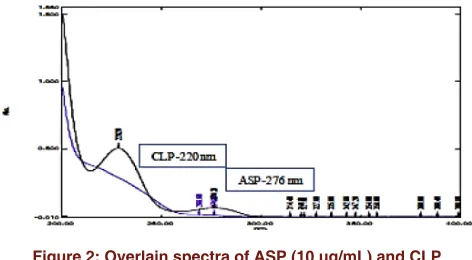
A solvent system of methanol-0.1N HCl (1:1) was selected and conditions optimized as both the drugs were found to be soluble. Detection wavelengths were 245 nm, the isosbestic point for two drugs ASP and CLP and 276 nm being the λmax of ASP (Figure 2). The developed method was validated for linearity, accuracy and precision.
Preparation of Standard Stock Solutions (100 μg/ mL)
Standard stock solutions of ASP and CLP each 1000 μg/mL was prepared by dissolving both the drugs sepa
-Figure 1: Chemical structure of Clopidogrel (A) and Aspirin (B).
rately using methanol: 0.1 N HCl (1:1). From the above standard stock solution, working standard solutions of ASP and CLP containing 100 μg/ mL was prepared by dilution using 0.1 N HCl.
Method Optimization and Validation Preparation of ASP and CLP Solutions for Determination of Concentration Range
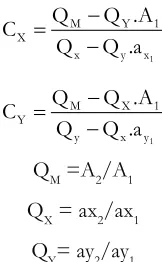
Working standard solutions of concentration 5-50 μg/mL were prepared from the standard stock solutions in 10 mL volumetric flasks separately. The volume in each case was made up to the mark with 0.1 N HCl. The absorbance values for each solution was measured at 245 nm and 276 nm against blank solution and standard calibration curve plotted. Absorptivity was determined for both ASP and CLP at both the detection wave-lengths. Concentration of ASP and CLP was calculated from the following set of equations13 used for determi-nation by Absorbance Ratio method.
C Q Q A
Q Q a
X M Y
x y x
= −
−
. . 11
C Q Q A
Q Q a
Y M X
y x y
= −
−
. .
1
1 QM =A2/A1 QX = ax2/ax1
QY= ay2/ay1
A1 and A2 are absorbances of the mixture at 245 nm and 276 nm, respectively.
aX1 and aX2 are the absorptivities of ASP at 245 nm and 276 nm, respectively.
aY1 and aY2 are the absorptivities of CLP at 245 nm and 276 nm, respectively.
Cx and Cx are the concentration of ASP and CLP, respectively.
Preparation of Sample Solutions from Capsules
Twenty capsules each containing 75 mg of each of both ASP and CLP were weighed accurately and the capsule contents emptied. Average weight of empty shells was taken to determine the weight of the powder in each capsule. Powder obtained was mixed thoroughly. An amount equivalent to 50 mg of ASP (powder contained 50 mg of CLP too) was transferred into a 50 mL Volumetric flask. About 25 mL of the solvent (Methanol: 0.1 N HCl) was added to the flask and sonicated for 10 min to disperse the material completely and then the contents were filtered through whatman fil -ter paper (No. 45). The volume was made up to the
mark (50 mL) with the same solvent to obtain stock solution of concentration 1000 μg/mL. Further, appro -priate dilutions were made with 0.1 N HCl to give solutions having concentration of 10 μg/mL each of ASP and CLP. Absorbance of the solution was recorded at 245 nm and 276 nm. Results of assay is presented in Table 3.
Determination of Accuracy
For accuracy, spiking of the standard ASP and CLP into previously analyzed sample was done at 3 levels of 80% to 120% of the test concentration. The solutions were analyzed for total content of ASP and CLP by measuring the absorbance of the mixture at 245 nm and 276 nm.
Repeatability Study
Test concentration of 10 μg/mL for both the drugs on basis of their ratio in the formulation was selected for analysis of repeatability.
Method Precision
The test sample solutions were prepared following the same procedure used in the analysis of marketed formulation. Replicate analysis was done intra-day as well as on three different days.
Results of the UV spectroscopy - Absorbance Ratio method validation parameters is presented in Table 1.
Solution Stability
Sample solution containing 10 μg/mL of each of the drugs was prepared as per the procedure used for sample preparation. The sample solution was kept at room temperature for 2 h and then analyzed by measuring the absorbance of the solution at 245 nm and 276 nm. The % RSD for response was calculated.
RP-HPLC Method
Preparation of standard stock solutions of ASP and CLP
Standard stock solutions of CLP and ASP each 1000 μg/mL were prepared by dissolving 10 mg of both the drugs separately in 10 mL volumetric flasks in 10 mL HPLC grade methanol.
Preparation of standard drug mixture
Table 1: Validation Parameters of UV Spectroscopy - Absorbance Ratio method.
Validation Parameters Aspirin Clopidogrel
Linearity (µg/mL) Accuracy (% Recovery)
Precision (% RSD)
5-50 98.61 - 102.66
0.55
5-50 97.49 - 98.6
0.1mL of standard stock solutions of each of the drugs, CLP and ASP, was transferred into 10 mL volumetric flask and diluted up to the mark with the mobile phase. The resultant solution contained 10 μg/mL of each of the two drugs, CLP and ASP.
Selection of Detection Wavelengths
10 μg/mL standard solutions of each drug, CLP and ASP was prepared in 10 mL volumetric flasks separately using the standard stock solutions of each drug using mobile phase. These solutions were scanned in the wavelength range of 200-400 nm.
Method Optimization and Validation
For optimization of the method several exploratory trials were conducted using C-8 and C-18 column using different composition of mobile phase with pH ranging from 2-7. The optimized method used Phenomenex HypercloneTM 5μm BDS C18 130 A0 (250 x 4.6 mm) column.
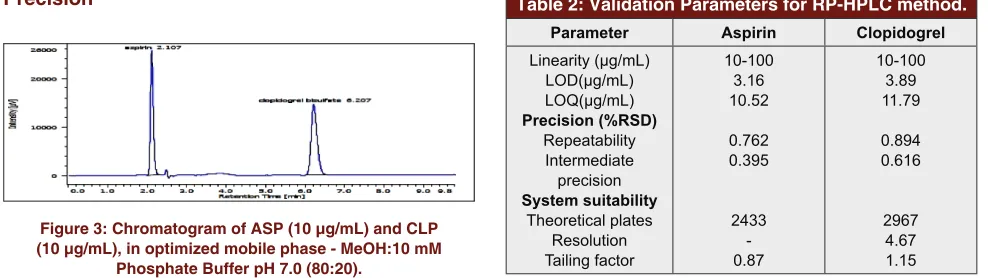
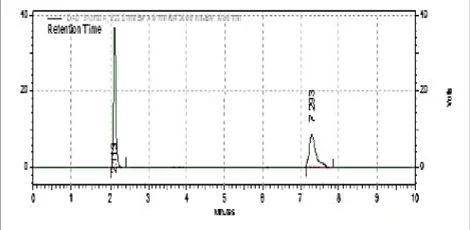
The optimized method used mobile phase comprising of MeOH: 10 mM Phosphate Buffer pH 7.0 in the ratio (80:20). The flow rate was kept at 1 mL/min, injection loop being 10 μl and detection wavelength 233 nm. Resulting chromatogram is presented as Figure 3.
Linearity and Concentration Range
From the standard stock solutions (ASP and CLP each of 1000 μg/ mL) aliquot volumes ranging from 0.1 -1.0 mL was transferred into separate 10 mL volumetric flasks and then diluted with mobile phase to obtain working standard solutions of concentrations 10-100 μg/ mL and were injected into the chromatograph and the peak areas determined from the chromatograms.
Specificity
Specificity of the method was evaluated by comparing the retention time and peak area of both standards ASP and CLP, 30 μg/ mL each injected separately and the mixture of the two containing the same concentration of 30 μg/ mL.
Precision
The sample solution was prepared by diluting 0.3 mL of sample stock solution with mobile phase to 10 mL in flask. These solutions were then injected into chromato -graph at regular intervals of 15 min over a period of 90 min and the chromatograms recorded.
Robustness
Robustness studies were done by varying the mobile phase composition by ±2%, flow rate by ± 2 mL/min and pH by ± 0.2 units with respect to the optimized conditions.
System Suitability
System suitability was demonstrated by comparing retention time, peak area, theoretical plates, asymmetry and resolution.
Results of HPLC method validation parameters is presented in Table 2.
Assay of Marketed Formulation
20 capsules (Clopivet® 75 containing 75 mg of each of ASP and CLP, manufactured by Sun Pharma Ltd) were weighed and the average weight of the powder contained in each capsule was determined. The powder was mixed thoroughly and a quantity equivalent to 50 mg of both the drugs ASP and CLP was weighed and transferred in to 50 mL volumetric flask. Around 35 mL of methanol was added and the solution was sonicated for about 10 min and then further diluted with methanol up to the mark. The solution was then filtered through 0.45 μm filter to obtain the sample stock solution. From the sample stock solution, 30 µg/mL solution was prepared using the mobile phase. This solution was then injected into the chromatograph (n=6) to obtain chromatograms from which the peak areas of both the drugs ASP and CLP was determined. Results of assay is presented in Table 3.
Stress Stability Studies
Figure 3: Chromatogram of ASP (10 μg/mL) and CLP (10 μg/mL), in optimized mobile phase - MeOH:10 mM
Phosphate Buffer pH 7.0 (80:20).
Table 2: Validation Parameters for RP-HPLC method.
Parameter Aspirin Clopidogrel
Linearity (µg/mL) LOD(µg/mL) LOQ(µg/mL)
Precision (%RSD)
Repeatability Intermediate precision
System suitability
Theoretical plates Resolution Tailing factor
10-100 3.16 10.52 0.762 0.395
2433 -0.87
10-100 3.89 11.79 0.894 0.616
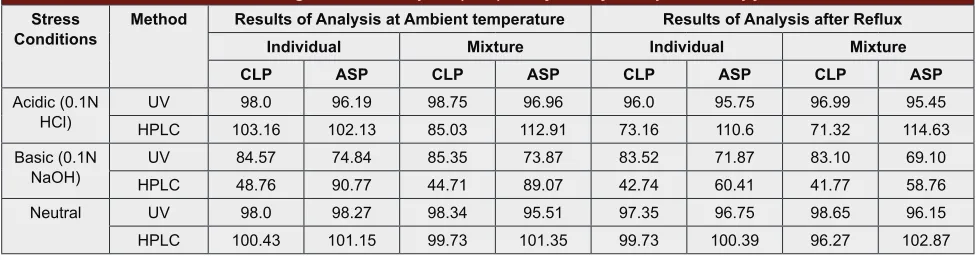
lysis). The neutralized solution was then diluted up to mark with water. For neutral hydrolyzed sample the solution was diluted up to mark with water. The blank was also prepared following the same procedure as that for the sample in the absence of the drug. Absorbance of the resulting solutions was recorded at 245 and 276 nm. Amount of ASP and CLP in degraded samples was calculated using the equation. The amount of ASP and CLP present in the degraded samples was calculated and presented in Table 4.
RP-HPLC analysis of stress degraded samples
Aliquot volume of 0.25 mL was withdrawn from the above stress degraded sample and transferred into 10 mL volumetric flasks at1 h, 4 h. The aliquot of stress samples was neutralized using 0.1 N NaOH (acid hydrolysis), 0.1 N HCl (base hydrolysis) respectively as the case may be. The neutralized aliquot solution was then diluted up to the mark with optimized mobile phase. For neutral hydrolyzed sample, the aliquot was diluted with optimized mobile phase. The blank was also prepared following the same procedure as that for the sample in the absence of the drug. The sample solutions were then injected into the chromatograph, and the resulting chromatograms are presented (Figure 4 and 5).
RESULTS AND DISCUSSION
Data in Table 4 shows results of stress induced hydro-lytic studies under acidic, basic and neutral conditions. Mixture of Clopidogrel and Aspirin when subjected to stress under acidic and basic medium showed significant differences in the result when analyzed by UV spectro-metric method and HPLC method. However, results were consistent on analysis under neutral conditions. Stress induced samples under acidic medium appeared to show promising results on analysis by UV spectro-metric method and conformed to label claim. But on analysis by HPLC method, the results clearly indicated formation of degradant or product on reaction among The optimized and validated UV spectrophotometric
and HPLC methods was applied for the analysis of the hydrolytically stressed samples of ASP and CLP.
Acid Hydrolysis
To 5 mL of standard stock solution (1000 μg/ mL) of ASP and CLP taken in a set of two separate 50 mL volumetric flasks, and one mixed solution of same concentration, 5 mL each of 0.1 N HCl was added. One set of flasks was kept at room temperature and the other set refluxed in water bath at a temperature of 70˚C for 4 h.
Base hydrolysis
To 5 mL of standard stock solution (1000 μg/ mL) of ASP and CLP taken in a set of two separate 50 mL volumetric flasks and one mixed solution of same concentration, 5 mL of 0.1 N NaOH was added. One set was kept at room temperature and the other refluxed at a temperature of 70˚C for 4 h.
Neutral Hydrolysis
To 5 mL of standard stock solution (1000 μg/ mL) of ASP and CLP taken in a set of two separate 50 mL volumetric flasks, and one mixed solution of same concentration in 50 mL std flask, 5 mL each of distilled water was added. One set of flasks was kept at room temperature and the other kept for refluxing in a water bath at a temperature of 70˚C for 4 h.
UV Analysis of the Stress Degraded Samples
The stress degraded samples were then neutralized using 0.1 N NaOH (acid hydrolysis), 0.1N HCl (base
hydro-Table 3: Results of Assay of Clopivet® by UV Absorbance Ratio and RP-HPLC Method.
Method Aspirin (mg) Clopidogrel (mg)
UV-Absorbance Ratio RP-HPLC (Label Claim)
78.75 76.22 75
74.43 77.69 75
Table 4: Results of Stress degradation samples (4 hr) analyzed by UV spectroscopy and HPLC method. Stress
Conditions Method Results of Analysis at Ambient temperatureIndividual Mixture IndividualResults of Analysis after RefluxMixture
CLP ASP CLP ASP CLP ASP CLP ASP
Acidic (0.1N
HCl) HPLCUV 103.1698.0 102.1396.19 85.0398.75 112.9196.96 73.1696.0 110.695.75 71.3296.99 114.6395.45 Basic (0.1N
NaOH) HPLCUV 84.5748.76 74.8490.77 44.7185.35 73.8789.07 83.5242.74 60.4171.87 41.7783.10 69.1058.76
Neutral UV 98.0 98.27 98.34 95.51 97.35 96.75 98.65 96.15
CONCLUSION
It should be noted that only under neutral conditions of hydrolysis, the HPLC results were consistent with UV spectrophotometric analysis and in accordance with the expected values confirming the accuracy of the analytical study. The study is an indicator to exercise caution during analysis of drugs that are sensitive to hydrolysis under conditions of stress, thereby making it imperative to select solvent cautiously and of appropriate pH after conducting stability studies for preventing errors in analysis especially when the degradant/s possesses identical spectrometric profiles to the actives.
ACKNOWLEDGEMENT
The authors acknowledge Shreya Life Sciences, Roorkee and Unichem Laboratories, Baddi for providing Gift samples of the Drugs. Also acknowledge The Principal, Goa College of Pharmacy for the encouragement and support for the study.
CONFLICT OF INTEREST
The authors declare no conflict of interest.
ABBREVIATIONS
ASP: Aspirin; CLP: Clopidogrel Bisulphate; HCl:
Hydrochloric acid; NaOH: Sodium hydroxide.
REFERENCES
1. Anandakumar K, Ayyappan T, Raghu RV, et al. RP-HPLC Analysis of Aspirin and Clopidogrel Bisulphate in Combination. Indian J Pharmaceutical Sci. 2016;597-9. http://www.ijpsonline.com/articles/rphplc-analysis-of-aspirin-and-clopidogrel-bisulphate-in-combination.htmldoi:10.4103/0250-474X.36958 2. Arayne MS, Sultana N, Ali KA, Nawaz M, et al. Simultaneous Determination
of Clopidogrel and Aspirin by RP-HPLC from Bulk Material and Dosage Formulations Using Multivariate Calibration Technique. Journal of Chromatographic Science. 2011; 49(2):165-9. https://www.ncbi.nlm.nih.gov/ pubmed/21223644
3. Shrivastava PK, Shrivastava SK, Basniwal PK, Jain D. Concurrent estimation of Clopidogrel Bisulfate and Aspirin in tablets by validated RP-HPLC method. Indian J Pharm Sci. 2008;70(5):667-9. https://www.ijpsonline.com doi:10.4103/0250-474X.45414
4. Agarwal H, Kaur N, Paradkar A, Mahadik K. Stability indicating HPTLC determination of Clopidogrel bisulphate as bulk drug and in pharmaceutical dosage form. Talanta. 2004;61(5):581-9. https://www.sciencedirect.com doi:10.1016/S0039-9140(03)00364-3
5. Kale AB, Mohanty P, Choudhari V, Sutar AS, Jagdale SC, Kuchekar BS. Spectrophotometric Simultaneous Determination of Clopidogrel and Aspirin in combined tablet Dosage Form by Ratio Derivative and Area under Curve Method. Research Journal of Pharmacy and Technology. 2011;4(1):105-8. https://www.researchgate.net/publication/286743116
6. Game MD, Gabhane KB, Sakarkar DM. Quantitative Analysis of Clopidogrel Bisulphate and Aspirin by First Derivative Spectrophotometric Method in Tablets. Indian J Pharma Sci. 2010;72(6):825-8. https://www.ncbi.nlm.nih. gov doi:10.4103/0250-474X.84609
7. Mounika A, Sriram N. Method Development and Validation of Clopidogrel Bisulphate by Reverse Phase HPLC in bulk and Pharmaceutical Dosage forms.
degradants in solution resulting in significant decrease in the peak area of Clopidogrel and an increase in peak area of Aspirin which could be due to higher absorptivity of resulting compound at λmax of Aspirin.
Inspite of HPLC studies showed varied content of the actives during degradation study, the UV spectro-metric method could not discriminate and expressed results that appeared as if both drugs remained intact during degradation under stress. The limitations of the UV-absorbance ratio method have been justified in the current study as the method could not establish the formation of possible degradants especially under acidic medium (Table 4) as results of analysis complied with the expected results (95-105%). It could thus be hypothesized here that degradants formed during analysis could have close to or identical λ max and absorptivity to the drugs of interest, and through additive effect provide results appearing accurate; without providing an insight in to the structural integrity of active drug. Such possibilities when confirmed by other specific methods render UV-spectrophotometric method to be less accurate in analysis for hydrolytically sensitive drugs. Any variation in the structures at site of action could lead to reduced efficacy of the drug and could be lethal if life saving.
Figure 4: Chromatogram of ASP (10 μg/mL) and CLP (10 μg/mL) upon acid hydrolysis by keeping for 4 h at room
temperature.
Figure 5: Chromatogram of ASP (10 μg/mL) and CLP
10. Blessy M, et al. Development of forced degradation and stability indicating studies of drugs —A review. Journal of Pharmaceutical Analysis. 2014;4(3):159-65. https://www.sciencedirect.comhttps://doi.org/10.1016/j. jpha.2013.09.003
11. Validation of analytical methods for pharmaceutical analysis. [cited on 10 June 2015] Available from: www.mournetrainingservices.co.uk/Preview_ book_method-validation.pdf
12. ICH. Validation of analytical procedures and methodology In Proceeding of the International Conference on Harmonization, Geneva, Switzerland. 2005. 13. Beckette AH, Stenlake JB. Practical Pharmaceutical Chemistry, 4th edition,
Part 2.CBS Publishers and Distributors, Delhi. 2007;286-8. International Journal of Pharmacy and Analytical Research. 2012;1(1):1-7.
https://www.sciencedirect.com/science/article/pii/S165836551400017X 8. Nagavi JB, Gurupadayya B. Stability Indicating RP-HPLC Method
Development and Validation for the estimation of Clopidogrel Bisulphate. American Journal of Pharm Tech Research. 2014;4(6):194-206. https://www. researchgate.net/publication/279758186
9. Jamadar LD, Kumar SS, Bhat K, Musmade PB, Vasantraju SG, Udupa N. Analytical method Development and validation for aspirin. International Journal of Chem Tech Research. 2010;2(1):389-99. https://manipal.pure. elsevier.com/en/publications/analytical-method-development-and-validation-for-aspirin
SUMMARY
• Ester drugs in multicomponent formulations are likely to exhibit errors during analysis under acidic conditions, possibly due to hydrolysis. Combined dosage formulation of aspirin and clopidogrel bisulphate has been used in the study to demon-strate limitations of popular Absorbance Ratio method commonly used for simultaneous determi-nation by UV spectroscopy. Under acidic hydrolytic conditions, clopidogrel degradation was found to increase slightly in presence of aspirin as shown by HPLC method, but not clearly with the UV spec-trometric method. In the event of such unexpected challenges, it becomes necessary to search for such models that could prevent degradation during analysis and thereby prevent possible interactions between degradants if any.
Anusha Palekar: Research and Development Executive at Pharma MNC with expertise on Impurity Profiling, Analytical Services Documentation, Analytical Method Development and Validation
About Authors
PICTORIAL ABSTRACT
Cite this article: Palekar A, Kambli K, Pai SPN. Challenges in Simultaneous Analysis of Hydrolytically Sensitive Ester drugs in Combined Dosage Forms. Indian J of Pharmaceutical Education and Research. 2019;53(1):97-103.
Kshitija Kambli: Research Scholar with interest on Analytical Method Development and Validation. Working as a trainee at Pharma MNC with experience on analytical services documentation.