*Corresponding author: Joshi S ISSN: 0976-3031
Research Article
IMPACT OF COGNITIVE IMPAIRMENT ON FALLS EFFICACY AND FUNCTIONAL
PERFORMANCE IN STROKE PATIENTS
Joshi S*, Pandya P, Parikh H and Patel K
Ashok and Rita Patel Institute of Physiotherapy, CHARUSAT University, India
DOI: http://dx.doi.org/10.24327/ijrsr.2018.0908.2501
ARTICLE INFO ABSTRACT
Objectives: To evaluate falls-efficacy and functional performance in stroke patients. To determine the correlation between cognitive impairment and falls-efficacy and functional performance in stroke patient.
Methods: Health Status questionnaire was obtained, that included 80 patients’ demographic detail and brief history of stroke and fall related history. The cognitive function was assessed through the Mini-Mental State Examination, fear of falling was assessed using Modified Falls Efficacy Scale, and functional performance was assessed by the Functional Independence Measure.
Results: The MMSE shows a positive correlation with falls-efficacy of the patient(r=0.384). The functional performance measured by FIM has demonstrated negative correlation with cognitive function MMSE of the patient. (r=0.416). The fear of falling showed a strong positive correlation with functional performance of the patients(r=0.800).
Conclusion: The cognitive impairment post-stroke has a deleterious effect on falls-efficacy and functional capacity of the stroke patients. Emphasis on cognitive rehabilitation post-stroke is a warranted area.
INTRODUCTION
A stroke is defined according to the World Health Organization definition as “a rapid onset event of vascular origin reflecting a focal disturbance of cerebral function, excluding isolated impairments of higher function and persisting longer than 24 hours” (Floel A, Werner C et al, 2014). It is the second most common cause of death and adult disability around the world (Strong K et al, 2001). The prevalence of stroke in India shows a huge variation of 147-922/100,000 across diverse community-based studies (Pandian JD, Sudhan P, 2013).
Cognition is the act or process of knowing, including awareness, reasoning, judgment, intuition, and memory (O’Sullivan, Schmitz TJ, 2013).Cognitive impairment may be present with lesions involving the cortex and includes impairment in alertness, attention, orientation, memory or executive functions.(4) Cognitive impairment is associated with lacunar infarct count, reduced brain volume, and white matter ultrastructuraldamage (Lawrence AJ, Patel B et al, 2013). It is important to examine cognitive abilities early because they may affect the validity of other tests and measures (O’Sullivan, Schmitz TJ, 2013).
Post-stroke cognitive impairment occurs frequently in the patients with stroke. Factors associated with vascular cognitive impairment included old age, male sex, low education, hemorrhages, recurrent or severe stroke, silent infarcts, severe cortical atrophy, and left hemispheric or sub cortical involvement.(6) The prevalence of post-stroke cognitive impairment ranges from 20% to 80%. The pathogenesis for cognitive impairment post stroke is due to different grounds such as neuroanatomical lesions caused by the stroke on strategic areas such as the hippocampus and the white matter lesions (WMLs), the cerebral micro bleeds (CMBs) due to the small cerebrovascular diseases and the mixed AD with stroke, alone or in combination (Sun TH, Tan L et al, 2014).
Patients with stroke were reported that they are more likely to experience recurrent falls and fear of falling (GohHT, Hamzah NB et al, 2016). Previous history of fall and frequent balance issue with any of the activity performed on day-to-day basis can also lead to the fear of fall (Lamb SE, Ferucci L et al, 2003). It can also be due to decreased strength and balance, hemi neglect, perceptual problems and visual problems (Batchelor FA, Said CM et al, 2012). Adding to its different reasons are i) difficulty in stooping or kneeling, ii) getting up in night to urinate more than once iii) having greater number of
International Journal of
Recent Scientific
Research
International Journal of Recent Scientific Research
Vol. 9, Issue, 8(F), pp. 28662-28666, August, 2018
Copyright © Joshi S et al, 2018, this is an open-access article distributed under the terms of the Creative Commons Attribution License, which permits unrestricted use, distribution and reproduction in any medium, provided the original work is properly cited.
DOI: 10.24327/IJRSR
CODEN: IJRSFP (USA)
Article History: Received 22nd May, 2018 Received in revised form 5th June, 2018
Accepted 16th July, 2018
Published online 28th August, 2018
Key Words:
activities to perform in a day (Mackintish SF, Goldie P et al, 2005).
Functional performance also manifests as reduced self-efficacy of the patient after stroke because of the fear of fall thus leading to hampered activities of dailyliving (Hellstrom K, Lindmark B, 2003). Even the higher-order cognitive impairments will extend the hospital stay and impair the physical function of the person (Park J, Lee G et al, 2016). Within one month of stroke, the impairment in visuospatial construction and memory can be an independent prognostic factor of functional outcome (Kumar S, Vendhan GV et al, 2008). Activity restrictions due to fear of falling can be devastating to the stroke population. Previous studies have demonstrated that reduced physical activity due to falling concerns negatively affects fatigue, spasticity, depression, quality of life, and mobility capabilities in stroke patients. Yet, to the best of our knowledge, there is no reported data on the relationship between cognitive dysfunction and its impact on falls efficacy and functional capacity. The area of cognitive dysfunction and its implications in stroke recovery is rather neglected in studies on stroke recovery, and thus we aimed to venture into the same.
MATERIALS AND METHODS
After obtaining the approval from the Institutional Scientific review Committee, the study was initiated. This multi-centric cross-sectional study was conducted in different hospitals across South Gujarat. The data from different in- and outpatient clinic setup were collected over 4 month period (January-April 2018). All the consecutive stroke patients who consulted these hospitals were screened for the inclusion and exclusion criteria. The inclusion criteria consisted of the following: subjects with age range of 18-80 years of both genders, individuals with first episode of ischemic or hemorrhagic stroke, stroke diagnosis confirmed by computed tomography or magnetic resonance imaging scan, duration of stroke ranging from 1 week- 5 years, subjects who were independently mobile prior to stroke, able to sit for at least 30 seconds (supported or unsupported). The following subjects were excluded: those who could not communicate and follow instructions of therapists as a consequence of severe aphasia, subjects who were paralyzed on both sides because of recurrence of stroke, subjects who were suffering from other neurological or cardiac co-morbidities, subjects with vestibular organ diseases, drug or alcohol addiction within last 6 months, significant current psychiatric illness defined as affecting disorder unresponsive to medication or bipolar affective disorder, psychosis, schizophrenia or suicidal tendency, current participant in another interventional trial. The sample size calculation was performed using the prevalence data available, and the formula 4pq/L2 was applied to reach the sample size of 80.
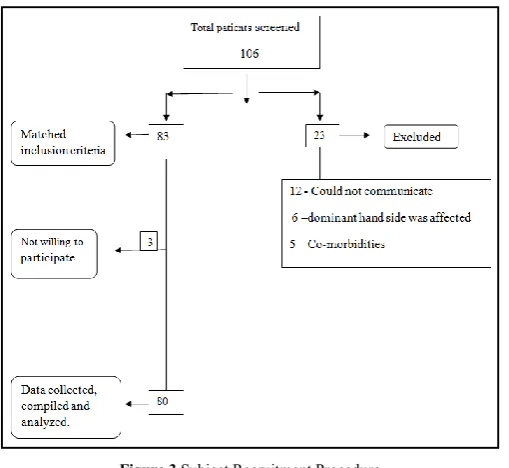
A total of 106 stroke patients were screened, out of which 83 fulfilled the inclusion criteria. The 80 participants who consented for the research were enrolled for the study and a written informed consent was obtained. The purpose of study and procedure was explained to the participants in detail. Further a Health Status questionnaire was obtained, that included patients demographic detail and brief history of stroke and fall related history. The assessment of the cognitive function through the Mini-Mental State Examination (MMSE)
was done. The MMSE is a valuable tool to identify changes in patients’ cognitive function. The questionnaire scale contains a total of 11 different questions and tasks that include speaking, memorizing, following commands, and drawing a figure. Each question contains different marks accordingly. Maximum score of MMSE is 30 out of 30 ad minimum is 0 out of 30. Interpretation of the score is questionably significant (25-30), mild (20-25), moderate (10-20) and severe (0-10) cognitive impairment.
After completion of this the Modified Falls Efficacy Scale (MFES) was administered to measure fall-related efficacy. It is the visual questionnaire scale, which has 14 different day-to-day tasks a person does. Scoring from 0 to 10 is there. 0 is equal to no confidence at all to 10 is equal to extreme confidence. The total score of less than 8 indicates the fear of falling, and above 8 indicates lack of fear. The third most component of the functional performance was assessed by the Functional Independence Measure (FIM) instrument. This scale rates the patient on their performance of the activity taking into account their need for assistance from another person or a device. 18 items (13 are motor skills and 5 are of cognition) comprise the FIM and has maximum score of 7 which indicates complete independence and lowest score of 1 that represent total assistance. Score of 6-7 suggests ‘no helper’ status and 1-5 is ‘helper’ category. All the collected data was entered into MS Excel sheet, processed and analyzed.
Figure 1
Data Collection Procedure
Figure 3 Subject Recruitment Procedure
Statistical Analysis
All the collected data was analyzed using Statistical Package for Social Science (SPSS) Version 23. Descriptive statistics like mean and SD were computed for demographics details and social characteristics. Pearson correlation analysis was done between cognitive impairment and falls efficacy, cognitive impairment and functional performance. Level of significance was set at p-value less than 0.05.
RESULTS
The cross-sectional study reported positive correlation between cognitive function and falls efficacy, functional performance in stroke patients. The study employed 80 participants, ranging from 18-80 years with a mean age of 55.66 years. Out of 80patients included in the study, there were 58 men and 22 women. About 50% of patients had a history of ischemic stroke and 50% suffered from hemorrhagic stroke. Among 80 patient 50 participant affection of stroke occur in left side and in remaining 30 affected sides was right. About 65% of patients had a fear of falls at the time of assessment and 35% did not experience fear of fall.But only 33.75% people using of assistive device other 66.25% not using any device for ambulation. The average number of drugs taken daily was 4 for majority of patients.
Table 1 Descriptive statistics of the participants
Variables Mean ± SD
Age (years) 55.66 ± 13.28
BMI(kg/m2) 24.01 ±4.12
Number of falls in last year 0.55 ±1.42
Table 2 Demographic characteristics of subjects: Mean and SD (N=80)
Variables Mean/No SD
Gender
Female/Male 22/58 0
Affected Side
Left/Right 50/30
Type of stroke
Ischemic/
Hemorrhgic 40/40
Duration
Acute/Subacte/Chronic 13/20/47 Education Level
School/University 55/25
Marrital Status
Married/unmarried/widowed 75/4/1 Fear of fall
Yes/no 52/28
Use of Assitive Device
Yes/no 27/53
No. of drug 4.07 2.06
No of Fall In Last 1 year 0.55 1.42 Medical Condition
HTN/DM/HTN&DM/NO Medical
Condition 37/6/8/29
Table 3 Mean and SD of various outcome measures (N=80)
Scale Mean ± SD
MMSE 21.42±4.19 MFES 5.58±2.31 FIM 96.06±13.90
The table shows mean and SD of the outcome measures MMSE, MFES and FIM. Maximum value of MMSE was 30 and Minimum value was 10. The Maximum value of MFES was 14 and Minimum value was 1.The maximum value of FIM was 124 and minimum was 62 in our collected data.
Table 4 Correlation between variables (N=80)
MFES FIM
MMSE 0.384** 0.416**
FIM 0.800** 1
** p<0.01.
The Pearson coefficient of correlation was used to examine the
relationship among the MMSE, MFES, and FIM.
Pearson correlation between total scores of MMSE and MFES was (r=0.384; p value-0.000) which suggests a moderate correlation between cognitive function and falls- efficacy. It can be inferred that higher cognitive levels is related to higher falls-efficacy.
Pearson correlation between total scores of MMSE and FIM was (r=0.416;p- value-0.000), which was highly significant. This suggests that improved cognitive status is correlated to higher functional independence.
Pearson correlation between total scores of FIM and MFES was (r=0.800;p-value -0.000) which suggests a strong correlation between functional independence and falls- efficacy.
Table 5 Correlation between demographic details and variables
MMSE MFES FIM
Age 0.53 -.150 -.073
Duration of stroke 0.145 0.23 .122
Fear of fall .220** 0.52** .518**
Fall in past 1 year -.28** -.287** -.293**
Educational level 0.331** 0.218** 0.240**
** Correlation significant at 0.01 levels.
There was a negative Pearson correlation between age and
functional performance (r=0.073;p-value 0.260) which suggest
This suggests that an increase in age is related to a decline in functional performance.
There was positive Pearson correlation of education level and
MMSE (r=0.339;p-value-0.001). It suggests strong positive
correlation between level of education and cognitive function, thus showing that a higher education level is related to higher cognitive function post-stroke.
Fall in past 1 year has negative Pearson correlation with cognitive function, functional performance and falls efficacy. (r= -0.28, p value: 0.10; -0.293, p value: 0.007; -0.287, p value: 0.10 respectively). It suggests stronger correlation between no. of fall in past 1 year and functional performance.
Graph 1 Scattered diagram of relationship between MMSE and MFES
The linear positive correlation of cognitive function and falls efficacy is being illustrated by the scattered diagram above.
Graph 2 Correlation between the laterality of stroke and MMSE
The above graph suggests that the rightsided stroke patients have the higher cognitive impairment, and the left side have less cognitive impairment then right.
DISCUSSION
The results of this study showed the association between the cognitive status, falls efficacy, and functional performance and the in the stroke population. The findings suggest that individuals with impaired cognition demonstrate a greater fear of falls, and reduced functional performance. Also, there is a positive correlation between fear of falling and functional performance, which suggests that people with fear of falling
might avoid falls, by limiting their participation in daily functional activities.
Therapists are advised to carefully examine the impact of cognitive decline, especially attention deficits on falls and concern of falling in stroke. According to findings from a five-year prospective study performed on the elderly, it was assumed that a decline in cognitive function may render an individual more prone to distractions while walking and perhaps less competent in the motor-cognitive coordination involved, thus increasing risk of falling. In part, falling apparently results from a decline in the ability to efficiently negotiate with the environmental stimuli and potential obstacles at the same time. As walking requires more mental effort with advancing years, the decline in EF may make an individual more prone to distractions while walking and perhaps less competent in the motor-cognitive coordination involved, thus increasing fall risk (Mirelman A, Herman T et al,2012).
There is a significant correlation between FIM and FES. This is in agreement with other studies in which activity restriction affects between 44% and 56% of people who are afraid of falling. It should be noted that in our study, among the people who said they were not afraid of falling, 6.4% (= 10 persons) nonetheless reported a reduction in some of their activities due to fear of falling. According to these authors, one hypothesis is that the restriction of people's activities has allowed them to cope with this fear, leading them to no longer being afraid of falling (Da Costa EM, Godin I et al,2012).
The study findings suggest that individuals with right hemiplegia have significantly reduced values on MMSE compared to individuals with left-sided involvement. The results also suggest statistically significant difference in laterality of hemiparesis according to the level of cognitive impairment. This is in agreement with previous studies where in patients without cognitive impairment, left-sided hemiparesis prevailed, while in patients with severe cognitive impairment, right-sided hemiparesis was more frequent.
We presumed that the achieved educational level certainly has an impact on cognitive function. The presence of severe cognitive impairment is most common in those with the lowest educational level, whereas in patients with secondary and higher education the absence of cognitive impairment is found. Our findings are in accordance with the fact that in addition to premorbid characteristics, the education of the respondents, as well as professional commitment, plays an important role in the quality of cognitive function. For example, in patients with higher levels of education, especially if their profession was related to practicing mathematical skills, degree of preservation of cognitive function will be higher, and more of these skills will certainly remain preserved, despite the damage. The results of the study, which analyzed the relationship between cognitive functioning and the level of education, and educational categories in patients after stroke, showed a statistically significant association between cognitive status and education at two educational categories of 12, in other educational categories significance is borderline. This result confirms the positive impact of education, particularly for damage that may cause cognitive decline (Arsic S, Pavlovic D et al, 2016).
0 2 4 6 8 10 12 14 16
0 5 10 15 20 25 30 35
Series1
21.13
21.46
20.9 21 21.1 21.2 21.3 21.4 21.5
CONCLUSION
The cognitive impairment post-stroke has a deleterious effect on falls-efficacy and functional capacity of the stroke patients. Emphasis on cognitive rehabilitation post-stroke is a warranted area.
Acknowledgement
We would like to thank all doctors and administrator staff of hospital to give permission to us to carry out the research work. We would like to thank all our participants without whom this study would not have been possible.
References
1. Flöel A, Werner C, Grittner U, Hesse S, Jöbges M,
Knauss J, Seifert M, Steinhagen-Thiessen E, Gövercin M, Dohle C, Fischer W.(2014).Physical fitness training in Subacute Stroke (PHYS-STROKE)-study protocol for a randomised controlled trial.Trials.15(1):45.
2. Strong K, Mathers C, Bonita R. (2001). Preventing
stroke: saving lives around the world. The Lancet Neurology.6 (2):182-7.
3. Pandian JD, Sudhan P. (2013). Stroke epidemiology and
stroke care services in India. Journal of Stroke. 15
(3):128.
4. O'Sullivan SB, Schmitz TJ, Fulk G. Physical
rehabilitation. FA Davis; 2013.
5. Lawrence AJ, Patel B, Morris RG, MacKinnon AD,
Rich PM, Barrick TR, Markus HS. (2013). Mechanisms of cognitive impairment in cerebral small vessel disease: multimodal MRI results from the St George's cognition and neuroimaging in stroke (SCANS) study. PloSone. 8 (4):e61014.
6. Renjen PN, Gauba C, Chaudhari D. (2015) Cognitive
impairment after stroke. Cureus.7 (9).
7. Sun JH, Tan L, Yu JT. (2014). Post-stroke cognitive
impairment: epidemiology, mechanisms and
management. Annals of translational medicine.2 (8).
8. Goh HT, Nadarajah M, Hamzah NB, Varadan P, Tan
MP. (2016). Falls and fear of falling after stroke: a case-control study. Physical Medicine and Rehabilitation.8 (12):1173-80.
9. Lamb SE, Ferrucci L, Volapto S, Fried LP, Guralnik JM.
(2003). Risk factors for falling in home-dwelling older women with stroke: the Women’s Health and Aging Study. Stroke. 34(2):494-501.
10. Batchelor FA, Mackintosh SF, Said CM, Hill KD.
(2012). Falls after stroke. International Journal of
Stroke.7 (6):482-90.
11. Mackintosh SF, Goldie P, Hill K. (2005). Falls incidence
and factors associated with falling in older, community-dwelling, chronic stroke survivors (> 1 year after stroke) and matched controls. Aging Clinical and Experimental research.17 (2):74-81.
12. Hellstrom K, Lindmark B, Wahlberg B, Fugl-Meyer
AR. (2003). Self-efficacy in relation to impairments and activities of daily living disability in elderly patients
with stroke: a prospective investigation. Journal of
Rehabilitation Medicine.35 (5):202-7.
13. Park J, Lee G, Lee SU, Jung SH. (2016).The impact of
acute phase domain-specific cognitive function on post-stroke functional recovery. Annals of Rehabilitation Medicine.40 (2):214-22.
14. Kumar S, Vendhan GV, Awasthi S, Tiwari M, Sharma
VP. (2008).Relationship between fear of falling, balance impairment and functional mobility in community
dwelling elderly. Indian Journal of Physical Medicine
and Rehabilitation.19 (2):48-52.
15. Mirelman A, Herman T, Brozgol M, Dorfman M,
Sprecher E, Schweiger A, Giladi N, Hausdorff JM.(2012). Executive function and falls in older adults: new findings from a five-year prospective study link fall risk to cognition. PloSOne.7 (6):e40297.
16. Da Costa EM, Pepersack T, Godin I, Bantuelle M, Petit
B, Levêque A. (2012). Fear of falling and associated activity restriction in older people. Results of a cross-sectional study conducted in a Belgian town. Archives of Public Health.70 (1):1.
17. Arsić S, Konstantinović L, Eminović F, Pavlović D. (2016).Correlation between demographic characteristics, cognitive functioning and functional independence in stroke patients. Srpskiarhivzacelokupnolekarstvo.144(1-2):31-7.
How to cite this article:
Joshi S et al.2018, Impact of Cognitive Impairment on Falls Efficacy And Functional Performance In Stroke Patients. Int J Recent Sci Res. 9(8), pp.28662-28666. DOI: http://dx.doi.org/10.24327/ijrsr.2018.0908.2501