A NOVEL TEMPORAL-FREQUENCY DOMAIN ERROR
CONCEALMENT METHOD FOR MOTION JPEG
Payman Moallem*
Department of Electrical Engineering, Faculty of Engineering University of Isfahan, Hezajerib Street, Isfahan, IRAN
Email: [email protected]
Sepideh Amoozeidi
Isfahan Telecommunication Company (TCE), Isfahan, IRAN Email: [email protected]
Mohsen Ashourian
Electrical Engineering Department, Islamic Azad University-Majlesi Branch, Isfahan, IRAN Email:[email protected]
*Corresponding Author
(Received: September 17, 2008 – Accepted in Revised Form: March 12, 2010)
Abstract Motion-JPEG is a common video format for compression of motion images with high quality using JPEG standard for each frame of the video. During transmission through a noisy channel some blocks of data are lost or corrupted, and the quality of decompression frames decreased. In this paper, for reconstruction of these blocks, several temporal-domain, spatial-domain, and frequency-domain error concealment methods are investigated. Then a novel method is proposed for recovery of channel errors with a mixture of temporal-domain and frequency-domain error concealment methods. To reconstruct the missed blocks in the proposed novel method, when two successive frames are similar, a proposed two phase block matching algorithm is performed in temporal-domain. When two successive frames are different, our proposed method reconstructs the missed block by the estimation of DC and AC coefficient, in frequency-domain. The proposed method and the other similar methods are simulated for different noise and quality factors. The results of quality measurements are indicated that in all tested video sequences, the proposed method shows
higher quality in reconstruction of missed blocks.
Keywords Motion JPEG, noisy channel, error concealment, image enhancement.
ﻜﭼ
ﻴ
ﻩﺪ
Motion-JPEG ﯽﻟﺎﻋ ﯽﺘﻴﻔﻴﮐ ﺎﺑ ﮎﺮﺤﺘﻣ ﺮﻳﻭﺎﺼﺗﯼﺯﺎﺳ ﻩﺩﺮﺸﻓ ﯼﺍﺮﺑ ﻝﻭﺍﺪﺘﻣﻲﻳﻮﻳﺪﻳﻭ ﺖﻣﺮﻓ ﮏﻳ
ﺩﺭﺍﺪﻧﺎﺘﺳﺍﺯﺍﻥﺁﻪﮐ،ﺖﺳﺍ JPEG
ﯽﻣﻩﺩﺎﻔﺘﺳﺍ ،ﺮﻳﻮﺼﺗﺏﺎﻗﺮﻫﯼﺯﺎﺳﻩﺩﺮﺸﻓ ﯼﺍﺮﺑ ﺩﻮﺷ
.
ﺯﺍﻝﺎﻘﺘﻧﺍﺭﺩﻪﮑﻴﻳﺎﺠﻧﺁ ﺯﺍ
ﮎﻮﻠﺑ ﺯﺍﯽﻀﻌﺑﺖﺳﺍﻦﮑﻤﻣ،ﯼﺰﻳﻮﻧﻝﺎﻧﺎﮐﮏﻳ ﻴﻔﻴﮐ،ﺪﻧﻮﺷﺐﻳﺮﺨﺗ،ﺮﻳﻮﺼﺗﯼﺎﻫ
ﺶﻫﺎﮐ،ﻩﺪﺷﻩﺩﺮﺸﻓﺍﻭﺮﻳﻮﺼﺗﺖ
ﯽﻣ ﺪﺑﺎﻳ
.
ﮎﻮﻠﺑﯼﺯﺎﺳﺯﺎﺑﯼﺍﺮﺑﻪﻟﺎﻘﻣﻦﻳﺍﺭﺩ ﺵﻭﺭ،ﻩﺪﺷﻢﮔﯼﺎﻫ
ﻩﺯﻮﺣﺭﺩﯼﺩﺪﻌﺘﻣﯼﺎﻫ ﺲﻧﺎﮐﺮﻓﻭﻥﺎﮑﻣ،ﻥﺎﻣﺯﯼﺎﻫ
ﯼﺩﺎﻬﻨﺸﻴﭘ ﺵﻭﺭ ﮏﻳ ﻭ ﯽﺴﻧﺎﮐﺮﻓ ﺵﻭﺭ ﮏﻳ ﺐﻴﮐﺮﺗ ﯼﺎﻨﺒﻣ ﺮﺑ ﻦﻳﻮﻧ ﯽﺷﻭﺭ ﺲﭙﺳ ﻭﻪﺘﻓﺮﮔ ﺭﺍﺮﻗﯽﺳﺭﺮﺑ ﺩﺭﻮﻣ ﯽﻣﻪﺋﺍﺭﺍ،ﯽﻧﺎﻣﺯ ﺩﻮﺷ
.
ﯽﻣﺎﮕﻨﻫ،ﯼﺩﺎﻬﻨﺸﻴﭘﺵﻭﺭﺭﺩ ﻖﺑﺎﻄﺗﺵﻭﺭﮏﻳﺯﺍ،ﺪﻨﺘﺴﻫﺮﮕﻳﺪﮑﻳﻪﻴﺒﺷ،ﯽﻟﺍﻮﺘﻣﺏﺎﻗﻭﺩﻪﮐ
ﯽﻣﻩﺩﺎﻔﺘﺳﺍ ﻩﺪﺷ ﺐﻳﺮﺨﺗﮎﻮﻠﺑ ﻦﺘﻓﺎﻳ ﯼﺍﺮﺑ ،ﻥﺎﻣﺯ ﻪﻨﻣﺍﺩ ﺭﺩ ﯼﺩﺎﻬﻨﺸﻴﭘ ﮎﻮﻠﺑ ﺩﻮﺷ
.
،ﯽﻟﺍﻮﺘﻣ ﺏﺎﻗ ﻭﺩ ﻪﮐ ﯽﻣﺎﮕﻨﻫ
ﯼﺯﺎﺳﺯﺎﺑﺵﻭﺭﮏﻳ،ﺪﻨﺷﺎﺑﺮﮕﻳﺪﮑﻳﺯﺍﺕﻭﺎﻔﺘﻣ DC-AC
،ﻩﺪﺷﺐﻳﺮﺨﺗﮎﻮﻠﺑﯼﺯﺎﺳﺯﺎﺑﯼﺍﺮﺑ،ﺲﻧﺎﮐﺮﻓﯼﺎﻀﻓﺭﺩ
ﯽﻣﺭﺎﮐﻪﺑ ﺩﻭﺭ
.
ﻭﺭ ﺵﻭﺭﺮﻳﺎﺳﺎﺑﯼﺩﺎﻬﻨﺸﻴﭘ ﺵ ﯼﺍﺮﺑ،ﻡﻮﺳﺮﻣ ﯽﻟﺍﻮﺘﻣﺮﻳﻭﺎﺼﺗﻪﻧﻮﻤﻧﺪﻨﭼ ﯼﺍﺮﺑ،ﯽﺳﺭﺮﺑﺩﺭﻮﻣ ﯼﺎﻫ
ﯽﻣﻩﺩﺍﺩﻥﺎﺸﻧﻭﻪﺘﻓﺮﮔﺭﺍﺮﻗﻪﺴﻳﺎﻘﻣﺩﺭﻮﻣ،ﻒﻠﺘﺨﻣﺰﻳﻮﻧﻥﺍﺰﻴﻣﻭﺖﻴﻔﻴﮐﺐﻳﺍﺮﺿ ﺖﻴﻔﻴﮐ،ﯼﺩﺎﻬﻨﺸﻴﭘﺵﻭﺭ ﻪﮐﺩﻮﺷ
ﮎﻮﻠﺑﯼﺯﺎﺳﺯﺎﺑﺭﺩﯼﺮﺘﻬﺑ ﺩﺭﺍﺩﻩﺪﺷﺐﻳﺮﺨﺗﯼﺎﻫ
.
1. INTRODUCTION
The compression is a processing that decreases the
quality of decompressed data. The M-JPEG or Motion-JPEG format is a video compression format to compress the motion images, and it is part of JPEG compression standard [1].
Applications of M-JPEG are very wide. It is commonly used by IP based video cameras via HTTP streams by using the multipart/x-mixed-replace content type or via RTP (Real-time Transport Protocol). Therefore, some internet browsers have native support for viewing M-JPEG streams and some of them can display M-JPG streams with the help of external plugins. Some game consoles have integrated M-JPEG decompression hardware in order to play in-game video sequences. In digital still cameras, M-JPEG is often used in movie mode that allows video encoding and playback through the integrated JPEG compression hardware with only a software modification. Also, M-JPEG is frequently used in non-linear video editing systems [2].
Generally, compressed bit streams are very sensitive to channel errors. For instance, a single bit error in a coded video bit stream may cause severe degradation on image quality. Therefore, via transmission of compressed frames through a noisy communication channel, some data blocks are destroyed and so, the quality of decompressed frames in a receiver is decreased. When bit errors occur during transmission and cannot be corrected by an error correction scheme, error concealment is needed to conceal the corrupted image at the receiver [3]. Error concealment algorithms attempt to repair damaged portions of the image, using approximate information about destroyed blocks.
In this paper, a novel temporal-frequency domain reconstruction method is proposed for high quality error concealment in M-JPEG video
sequences. In the section 2, M-JPEG standard elements are reviewed, then to reconstruct and enhance the quality of noisy decompressed images, several temporal-domain, spatial-domain, and frequency-domain error concealment methods are investigated, in the section 3. After that, in the section 4, a proposed method that is based on a novel mixture of temporal-domain and frequency-domain methods, is presented. Finally, the results of the proposed method and some other similar methods are compared and the quality of decompressed images under different noise and quality factors is studied, in the sections 5 and 6. The last section, presents a conclusion of the paper.
2. MOTION JPEG
Motion JPEG is a format to compress the motion images. In this format each frame of a video file is under the JPEG standard separately.
1.JPEG standard
The JPEG standard is used for compression of grayscale or colored images with 8 bits for each color. The compression is performed in three sequential steps: level shifting and DCT computation, quantization and variable-length code assignment [4]. These stages are shown in Figure1.
At the first stage, an input image is subdivided into pixel blocks of size 8×8. As each 8×8 blocks or sub-image is encountered, its 64 pixels are level shifted by subtracting the quantity 2n-1, where 2n is the maximum number of gray levels. When the JPEG system is used for images with 28 or 256 gray level, therefore initial sub image pixel level
are shifted by -27 (or -128) gray levels. Then Discrete Cosine Transform or DCT is applied. It transforms the array of intensity data to frequency data that indicates the intensity variation rate. With applying DCT on each block, a 8×8 matrix of frequency coefficients is created that the frequency increases when it move away from the origin.
The second stage of JPEG standard is quantization that is a principle phase that compression operation is performed there. In this phase, DCT coefficients are quantized based on the required details of image. By increasing the frequency, the human's eye sensitivity is reduced therefore the high frequency DCT coefficients can be efficiently quantized by quantization table Qtable. It means that many of coefficients with small values become zero. Commonly, in order to control image quality, Qtable is multiplied in a quality factor that has reverse with QJPEG quality factor, and then DCT coefficients matrix are divided to Qtable.
In order to compress color images by JEG standard, each color element including luminance and chrominance is compressed individually by corresponding Qtable.
The last stage of JPEG standard is coding. In this stage, output coefficients of quantized block are divided into two parts: (1) DC coefficient: This factor is the first element of coefficient matrix and is the most important coefficient that specifies the illumination of block average and it has a major role for image recovery. (2) AC coefficients: Other matrix entries call AC factors, that many of them have zero quantity. In order to coding them the Run-Length Coding (RLE) method is used. The DC coefficients are coded separately from the AC ones. Differential Pulse Code Modulation(DPCM) is the coding method.
2. YUV color space
The YUV model defines a color space in terms of one luma and two chrominance components. The YUV color model is used in the PAL, NTSC, and SECAM composite color video standards. Y stands for the luma component (the brightness) and U and V are the chrominance (color) components, U and V are blue-luminance and red-luminance differences. Equations (1) and (2) show the relation between these two color spaces.
B G R V U Y 10001 . 0 51498 . 0 615 . 0 436 . 0 28886 . 0 14713 . 0 114 . 0 587 . 0 299 . 0 (1) V U Y B G R 0 03211 . 2 1 58060 . 0 39465 . 0 1 13983 . 1 0 1 (2)
To get a digital signal, YUV images can be sampled in several different ways. In order to get the higher compression, YUV 420 [5] is used in this paper.
3.ERROR CONCEALMENT METHODS,
PREVIOUS WORKS
The compressed bit streams are very sensitive to channel errors and therefore there are usually some missed blocks during decompression. Error concealment algorithms attempt to repair damaged portions of the image. In this section, we discuss several temporal-domain, spatial-domain, and frequency-domain error concealment techniques that are used for M-JPEG coded images, and then we propose a novel method based on a mixture of temporal-domain and frequency-domain recovery methods.
1.Spatial-domain methods
In the spatial method, after receiving the compressed frame's code from noisy channel by receiver, the frame is reconstructed. Since the missed blocks don’t have any data, the information from surrounding blocks of the missed block in the same frame is used to reconstruct the missed data [6].
1) Weighted averaging
The simplest and often used method is weighted averaging. Each pixel p(i,j) of a missed block is interpolated as a linear combination of the nearest pixels in the boundaries as shown in Figure 2 [7].
B T R L B T T B R L L R d d d d p d p d p d p d j i p ) ,
( (3)
2) Triangular propagation
missed data as shown in Figure 3. The missed block is divided to four triangles and the values of neighbor pixels are propagated through corresponding triangles [8].
2.Frequency-domain methods
In frequency based methods after receiving the compressed frame's code from noisy channel, data are encoded. Before computing the inverse DCT of blocks, the missed blocks are reconstructed by neighboring blocks of the missed block in DCT domain.
1) Averaging
In the averaging method, each frequency of the missed block is replaced by the average of the four corresponding frequencies of the neighborhood blocks. If F(i,j) is the frequency of (i,j) in the
missed block, then it is computed by the equation (4), where FU(i,j), FD(i,j), FL(i,j) and FR(i,j) are the
corresponding frequencies in the up, down, left and right neighborhood blocks, respectively. Figure 4 shows the details.
(, ) (, ) (, ) (, )
4 1 ) ,
(i j F i j F i j F i j F i j
F U D L R
(4)
2) Triangular propagation
In triangular propagation method, the replacement method for missed block, according to Figure 5 is based on propagation the values of pixels from neighboring blocks.
Figure 3. Triangular propagation method in spatial domain.
Figure 5. Triangular propagation method in frequency-domain.
Figure 4. The averaging method in frequency-domain. The
center block is missed block and F(i,j) should be replaced by
information of corresponding (i,j) frequencies in the
3) Estimation of DC and AC coefficients Since the DC coefficient of a block represents the average pixel value of the block, a loss of the DC coefficient will affect the brightness or color of the corresponding block. There are several ways to recover the DC coefficient when it is lost or damaged.
One estimate for the DC coefficient of a corrupted block is the simple average or median value of DC coefficients of the neighboring blocks. Taking four neighboring blocks for the DC estimate turns out to be more effective. For low-frequency AC coefficients, as illustrated in Figure6, AC coefficients of the center block that is assumed to be lost are predicted as weighted sums of DC values of surrounding blocks.
The first five low-frequency AC coefficients are estimated using the following prediction equation.
8 / ) 5 2 6 4 ( 27881 . 0 5 8 / ) 7 3 9 1 ( 16213 . 0 4 8 / ) 5 2 8 2 ( 27881 . 0 3 8 / ) 8 2 ( 13885 . 1 2 8 / ) 6 4 ( 13885 . 1 1 DC DC DC AC DC DC DC DC AC DC DC DC AC DC DC AC DC DC AC (5)
DC5 coefficient is obtained as the median of the DC values of surrounding blocks. The other remained erroneous high-frequency AC coefficients are assumed to be zero [9][10][6].
3.Temporal-domain methods
These kinds of reconstruction methods extract some necessary information from temporal correlation of the sequence to conceal the error. Usually, motion estimation using previous frames is performed to reconstruct the missed block.
1) Copy paste
”copy-paste” is the simplest temporal error concealment method called also” previous frame concealment” [7]. The missed blocks of one frame according to (6) are simply replaced by spatially corresponding blocks from the previous frame.
) , ( ) ,
(i j P 1 i j
Pn n (6) 2) Optimum boundary matching
Several block matching techniques have been used in temporal-domain error concealment methods. The optimum boundary matching is one of the most popular and efficient one [9][11][12]. Since the information inside of a missed block has been lost, only the value of boundary pixels are considered for block matching. All 36 boundary pixels (8×4+4) are compared with boundary pixels of all candidate blocks in a corresponding search region of the previous frame. This method is graphically shown in Figure 7. The search region S×S is considered based on the maximum motion that is typically set to 16×16. The most similar block is selected as the best block for replacing.
4. PROPOSED NOVEL METHOD
The quality of reconstructed block completely depends on video sequences. Considering two successive frame in a video sequence, two cases are possible: slow motions and sudden changes. In the first case, the frame containing a missed block and the previous frame are similar. It means that
Figure 7. The optimum boundary matching method.
there is only a slow motion in video sequence and temporal based error concealment methods leads to the best results. On the other hand, in the second case when there is a sudden change in two successive frames, frequency based error concealment methods show higher quality. Therefore, the first stage of our proposed method is a change analyzer that tries to detect “slow motion” or “sudden change” cases in the current frame. Then a proper proposed error concealment method is used for each case.
1.Change Analzser
Change analyzer, is a simple video sequence analysis algorithm that tries to distinguish two possible cases “slow motions” and “sudden changes”. To detect these two cases, the similarity of some blocks of one frame is compared with the corresponding blocks in the previous frame via normalized cross-correlation criterion that is according to (7).
i i
i i
i
i i
B B A A
B B A A NCC
2 2
) ( ) (
)) )(
((
(7)
In our implementation, only 9 blocks of the current frame (with dimension of 8×8 as is used in JPEG standard) that are selected randomly are compares with the corresponding blocks of the previous frame. To compute the NCC criterion, only gray level information is used and the NCC threshold value is set to 0.35. If there are at least 5 similar blocks, “slow motion” case is detected.
2.Error Concealment
In the case of “sudden changes”, our proposed method uses reconstruction by the estimation of DC and AC coefficient method that show good results, based on the equation (5). While in the case of “slow motion”, our proposed novel method finds the best matched block in the previous frame based on a proposed block matching algorithm.
1) Proposed Block Matching
Usually, computational cost is one the most disadvantages of full search blocks matching algorithms. Therefore we propose a novel two phase, coarse to fine block matching algorithm with low cost and high performance for error concealment.
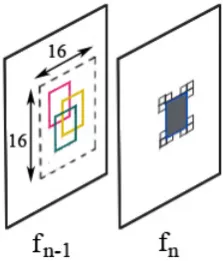
At the first phase of the proposed block
matching algorithm, three most similar blocks are found in a search window of 16×16 dimensions in the previous frame. For this step, in spite of the optimum boundary matching method, only 12 pixels of neighbor pixels of missed block corners are compared with available pixels in the search window as shown in Figure 8.
At the second step of our proposed block matching, the optimum boundary matching is used only for 3 similar blocks which found at the first phase. After the second phase, the missed block is replaced by the most similar ones.
This proposed two phase block matching is faster than the optimum boundary matching, because the computational cost of the first phase is lower and the other hand, the computational cost of the second phase is negligible. Our simulations which will be presented in the next section show that the proposed two phase block matching executes faster than conventional optimum boundary matching.
5. SIMULATION AND RESULTS
sequence include several objects in each frame. In the Mobile video sequence, there is also a little rapid in camera motion, many objects and sharp edges. In all benchmarks, 100 frames of the tested video sequences are considered.
1.Image quality evaluation
To evaluate the results of reconstructed images, both quality and quantity measurements are considered. Visual inspection as a criterion for quality measurement and image differencing and PSNR (Peak Signal to Noise Ratio) calculations as quantity measurement are used. PSNR analysis uses a standard mathematical model to measure an objective difference between two images. It is commonly used in the development and analysis of compression algorithms, and comparing visual quality between different compression systems. PSNR is calculated by the following equation:
MSE PSNR
2
255 log 10
dB (8)
∑∑
-10 1
0
2 *
) , ( -) , ( .
1 N
i M
j
j i f j i f M
N MSE
(9)
In the equation (9), f is the decompressed noiseless image while f* is the reconstructed noisy image with applying the error concealment algorithm. For PSNR higher than 37dB, the quality of the reconstructed block is very high and then the difference between two images is not recognizable. The quality of reconstructed block is good when the PSNR is between 31dB to 37dB and it is acceptable when it is higher than 25dB.
2.Noise factor
To simulate a noisy channel, several blocks over entire frames of video sequence are damaged. Noise factor means the number of blocks which are damaged by noise in one hundred blocks. For example, if the dimension of one frame is 352×288 pixels, it will have 1584 blocks. For a 6% noise factor, approximately it has 9500 noisy blocks on total 100 frames of a video sequence.
3.Simulation results
Motion-JPEG compression and decompression are simulated in MATLAB environment and some experiments are done on the benchmark video sequences including Akiyo, Tennis and Mobile.
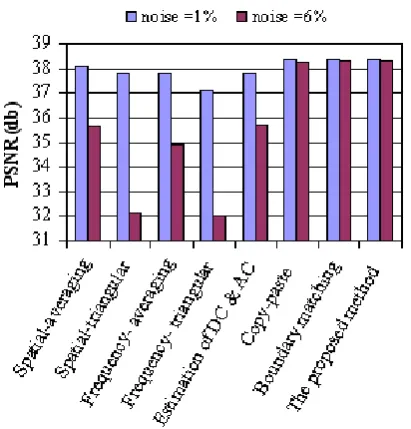
Quality factors (Q) used in these tests were 25 and 50. Also, noise factors used for the channel error were 1% and 6% which are representing low and high noisy environment. The results are represented by giving average of PSNR of one hundred noisy frames and comparing with the average of PSNR of reconstructed frames with applying eight different methods including spatial averaging, spatial triangular, frequency averaging, frequency triangular, estimation of DC and AC, copy paste, optimum boundary matching and finally our proposed novel method. The total of the statistical results are indicated in Tables 1, 2 and 3. Finally, some image samples are represented.
1- Akiyo video sequence a)Without error concealment
The average of PSNR value for one hundred noisy frames with Q=25 and 1% noise factor is 29.1482 dB and 6% noise factor is 21.9791dB, with Q=50 and 1% noise factor is 28.9185dB and 6% noise factor is 21.4683dB.
b)With error concealment
The average of PSNR values with Q=25 and Q=50, obtained by eight different methods for reconstruction of one hundred frames of the Akiyo video sequence are shown in figures 9 and 10 respectively.
2- Tennis video sequence a)Without error concealment
The average of PSNR value of one hundred noisy frames with Q=25 and 1% noise factor is 27.8952 dB and 6% noise factor is 22.0895dB, with Q=50 and 1% noise factor is 25.3251dB and 6% noise factor is 21.728dB.
b)With error concealment
The average of PSNR values with Q=25 and Q=50, obtained by eight different methods for reconstruction of one hundred frames of the Tennis video sequence are shown in figures 11 and 12 respectively.
3- Mobile video sequence a)Without error concealment
b)With error concealment
The average of PSNR values with Q=25 and Q=50, obtained by eight different methods for reconstruction of one hundred frames of the Mobile video sequence are shown in figures 13 and 14 respectively.
6. DISCUSSION
All of the PSNR results are presented in the Tables 1 and 2 for the noise factor 1% and 6%, respectively. Some samples of reconstruction blocks by the proposed novel method are also
Figure 9. PSNR average values for the reconstruction of Akiyo sequence with Q=25.
Figure 11. PSNR average values for the reconstruction of Tennis sequence with Q=25.
Figure 12. PSNR average values for the reconstruction of Tennis sequence with Q=50.
shown in Figures 15 to 18. Just as indicated in Tables 1 and 2, the average PSNR of hundred reconstructed frames are increased by raising the quality factor and decreased by raising the noise factor. Also, by averaging from all of the results of available reconstruction methods in Table 1, specifies that from 1% to 6% noise factors and 25
to 50 quality factors, the PSNR will be nearly 30.76dB to 32.7dB. The difference between the most and least PSNR quantities for 1% noise factor is nearly 0.57dB and in 6% noise factor is nearly 3.28dB.
The average PSNR values for the proposed method and the optimum boundary matching are close to each other, but the computational cost of the proposed method is lower, because the block matching in the proposed method needs lower computational cost. Table 3 shows the relative reduction of the execution time (including the JPG computations and the error concealment) of the proposed method respect to the optimum boundary matching, where all methods are implemented in Matlab environment.
Figure 13. PSNR average values for the reconstruction of Mobile sequence with Q=25.
Figure 14. PSNR average values for the reconstruction of Mobile sequence with Q=50.
Figure 15. The noisy frames of Akiyo video sequence without reconstruction.
7. CONCLUSSION
In this paper, after review of different methods for reconstruction of missed blocks, the proposed two stages method that is based on a novel mixture of temporal-domain and frequency-domain
reconstruction methods is proposed. The first stage of the proposed method tries to distinguish two cases of video frames including “slow motion” and “sudden changes” by computing the similarity of some blocks of one frame with the same blocks in the previous frame by the normalized cross-correlation criterion.
In the case of “slow motion”, the proposed two
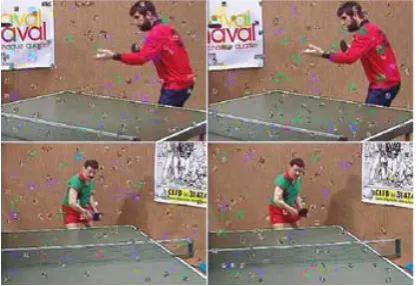
Figure 17. The Noisy frames of Tennis video sequence without reconstruction.
TABLE1.Comparing the statistical results of different reconstruction method for the different video sequences with noise factor equal to 1%
Reconstruction methods (Noise factor=0.01)
Akyio Tennis Mobile
Q=25 Q=50 Q=25 Q=50 Q=25 Q=50
Spatial-weighted
averaging 36.2183 38.1003 31.7937 33.1391 27.8028 29.2468
Spatial-triangular
propagation 36.036 37.7735 31.6932 32.9837 27.7004 29.1017
Frequency-averaging 36.0574 37.8086 31.7466 33.0676 27.6904 29.0828
Frequency-triangular
propagation 35.5934 37.1465 31.6091 32.8959 27.4662 28.7746
Estimation of DC and AC
coefficients 36.0848 37.8146 31.7598 33.0869 27.7086 29.1123
Copy-paste 36.3419 38.3301 31.7701 33.136 27.8413 29.2913
Optimum boundary
matching 36.339 38.3393 31.839 33.2257 27.8989 29.4034
The proposed novel method 36.3385 38.33 31.8333 33.213 27.8653 29.3499
phase block matching algorithm is performed in temporal-domain. In the case of “sudden changes”, our proposed method reconstructs the missed block by the estimation of DC and AC coefficient, in frequency-domain.
The proposed novel method is compared with
those of some other reconstruction method including spatial averaging, spatial triangular, frequency averaging, frequency triangular, estimation of DC and AC, copy paste and optimum boundary matching methods. The simulation results for one hundred frames of three standard TABLE2.Comparing the statistical results of different reconstruction method for the different
video sequences with noise factor equal to 6%
Reconstruction methods (Noise factor=0.06)
Akyio Tennis Mobile
Q=25 Q=50 Q=25 Q=50 Q=25 Q=50
Spatial-weighted
averaging 34.6046 35.6615 31.0472 32.0426 27.0274 28.1257
Spatial-triangular
propagation 31.8864 32.1562 29.4229 29.9618 26.0109 26.795
Frequency-averaging 34.1054 34.8989 30.988 31.9164 26.5854 27.5365
Frequency-triangular
propagation 31.7638 32.0291 29.7955 30.4182 25.4982 26.1615
Estimation of DC and AC
coefficients 34.6306 35.7247 31.3134 32.4389 26.7674 27.7902
Copy-paste 36.2951 38.2603 31.4278 32.6229 27.3542 28.5517
Optimum boundary
matching 36.3085 38.3009 31.6938 33.0237 27.6392 29.0508
The proposed novel method 36.2996 38.271 31.6396 32.9784 27.4262 28.7526
TABLE3.Percentage of execution time reduction of the proposed method respect to the optimum boundary matching
Percentages of execution time reduction Q
Percentage of Noise factor
Movies
22 25
1
Akiyo 50 19
18 25
6
50 15
20 25
1
Mobile 50 19
13 25
6
50 13
27 25
1
Tennis 50 15
15 25
6
video sequences including Akiyo, Tennis and Mobile with different quality factor (Q) and noise factors are compared. The reconstruction results show that subjective quality of the proposed method is better than the other compared methods. On the other hand, the average PSNR values of the proposed method and the optimum boundary matching method are close to each other. For the second compared methods, the average PSNR values are improved about 1.93 dB by the proposed novel method. The investigations show that PSNR improvement is higher for monotonous frames. On the other hand, PSNR improvement is increased when quality factor (Q) is increased.
Although, the average PSNR values of the proposed method is close to the optimum boundary matching, but the computational cost of the proposed method is lower. On the other hand, the subjective quality is also higher. The computational cost of the proposed method is higher than the other compared methods, but the subjective and objective quality of reconstructed blocks is also higher, and therefore the proposed novel method is more proper for high quality Motion-JPEG applications.
8. REFRENCES
1. Motion JPEG, Videoconferencing Cookbook, Popular
Collaborative Technologies, Motion JPEG (MJPEG),
http://www.vide.net
2. Motion JPEG, Wikipedia, Motion JPEG,
http://en.wikipedia.org/wiki/Motion_JPEG
3. M. Khademi, "Adaptive Spectral Separation Two Layer
Coding with Error Concealment for Cell Loss
Resilience", International Journal of Engineering,
Vol. 13, (2000), 27-44.
4. R.C. Gonzalez and R.E. Woods, "Digital Image
Processing", 3rd edition, Prentice Hall, (2007).
5. YUV, Wikipedia, http://en.wikipedia.org/wiki/ YUV
6. Y. Wang and Q. F. Zhu, "Error Control and
Concealment for Video Communication: A Review",
Proceedings of IEEE, Vol. 86, (1998), 974-997.
7. I.C. Todoli, "Performance of Error Concealment
Methods for Wireless Video", Diploma Theses, TU Wien, (2007).
8. A.Al Moghrabi, "Error Concealment Method for Video
Transmission over Wireless Networks", Diploma Theses, TU Wien, (2005).
9. J.W. Suh, Y.S. Ho, "Error Concealment Based On
Directional Interpolation", IEEE Transaction on
Consumer Electronics, Vol. 43, (1997), 295-302.
10. W. Pongpadpinit, A. Pearmain, "Recovery of Motion
Vectors for Error Concealment Based on an
Edge-Detection Approach", IEE Proceedings of Vision,
Image and Signal Processing, Vol. 153, (2006), 63-69.
11. A.K. Katsaggelos, F. Ishtiag, L.P. Kondi, M.-C. Hong,
M. Banham, and J. Brailean, "Error Resilience and
Concealment in Video Coding", Proceeding of
European Conference on Signal Processing, Vol. 1,
(1998), 221-228.
12. Q. Chen, "Robust Video Coding using Multiple
Description Lattice Vector Quantization with Channel Optimization", Masters Theses, Royal Institute of Technology, (2005).
13. Xiph.org Test Media, http://ftp.osuosl.org/pub/xiph/

![Figure 6 . The Estimation of DC and AC Coefficient method in frequency-domain [9].](https://thumb-us.123doks.com/thumbv2/123dok_us/239763.2018665/5.595.366.488.420.545/figure-estimation-dc-ac-coefficient-method-frequency-domain.webp)