International Journal of Engineering
J o u r n a l H o m e p a g e : w w w . i j e . i rNeural Network Based Recognition System Integrating Feature Extraction and
Classification for English Handwritten
J. Pradeepa,*, E. Srinivasana, S. Himavathib
a Department of Electronics & Communication Engineering, Pondicherry Engineering College, Puducherry, India b Department of Electrical & Electronics Engineering, Pondicherry Engineering College, Pondicherry, India
A R T I C L E I N F O
Article history: Received 22 July 2011
Received in revised form 6 January 2012 Accepted 16 February 2012
Keywords:
Handwritten Character Recognition Image Processing; Feature Extraction Back Propagation Neural Network Nearest Neighbour Network Radial Basis Function Network
A B S T R A C T
Handwriting recognition has been one of the active and challenging research areas in the field of image processing and pattern recognition. It has numerous applications that includes, reading aid for blind, bank cheques and conversion of any hand written document into structural text form. Neural Network (NN) with its inherent learning ability offers promising solutions for handwritten character recognition. This paper identifies the most suitable NN for the design of hand written English character recognition system. Different Neural Network (NN) topologies namely, back propagation neural network, nearest neighbour network and radial basis function network are built to classify the characters. All the NN based Recognition systems use the same training data set and are trained for the same target mean square error. Two hundred different character data sets for each of the 26 English characters are used to train the networks. The performance of the recognition systems is compared extensively using test data to draw the major conclusions of this paper.
doi:10.5829/idosi.ije.2012.25.02b.03
1. INTRODUCTION1
Handwriting Character Recognition (HCR) has been quite a fascinating and challenging research area in field of image processing and pattern recognition. It contributes immensely to the advancement of automation process and improving the interface between man and machine in numerous applications. Several research works have been focusing on different methodologies in an attempt to reduce the processing time while simultaneously improving recognition accuracy [1,2].
In general, handwriting recognition can be classified into two major categories, namely off-line and on-line handwriting recognition methods. In the off-line recognition, the writing is usually captured optically using a scanner and the completed writing is available as an image. In the on-line system, the two dimensional coordinates of successive points are represented as a function of time and the order of strokes made by the writer are also available. The on-line methods have been shown to be superior to their off-line counterparts in recognizing handwritten characters due to the temporal
*Corresponding author: Email- [email protected]
information available with the former [3].
Off-line handwriting recognition is comparatively a difficult task, as different people exhibit different handwriting styles. Optical Character Recognition (OCR)/Image Character Recognition (ICR)engines have been primarily developed for recognizing machine printed and hand printed texts, while the recognition of handwritten documents entails special consideration as it involves recognizing the characters written with varying styles.
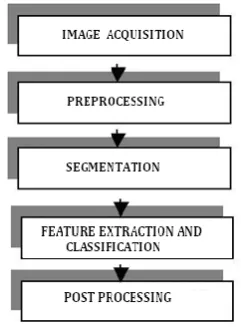
The steps in any handwritten recognition system are pre-processing followed by segmentation, feature extraction and classification. Pre-processing shapes the input image into a form suitable for segmentation [4]. This includes filtering, morphological operations, noise modelling and normalization. In the segmentation, the input image is segmented into individual characters and then, each character is resized into m x n pixels towards the training network. Segmentation includes external and internal segmentation. External segmentation decomposes page layout into logical units. while internal segmentation decomposes words into characters.
Feature extraction is a method widely used in pattern recognition. Feature extraction determines the important
properties such as Aspect Ratio, Percent of pixels above horizontal half point, Percent of pixels to right of vertical half point, Number of strokes and Average distance from image centre. This approach provides the recognizer more control over the properties used in identification. However, certain methods of modelling can incorporate both the feature extraction and classification stages together for simplifying the process of recognition. Such methods include the Hidden Markov models and Artificial Neural networks.
Hidden Markov models (HMM) are especially known for their application in handwriting and gesture recognition. A hidden Markov model can be considered as a generalization of a mixture models where the hidden variables, which control the mixture component to be selected for each observation, are related through a Markov process rather than independent of each other. Extraction and recognition of handwritten alphanumeric characters from application forms using discrete hidden Markov models is reported in [5]. The system recognizes 60 alphanumeric characters (26 English upper-case letters, 24 Greek upper-case letters and 10 numerals). The experiments carried out have yielded recognition rates of 93% in character level and 88% in word level. The latter improved to 97% by lexical confirmation. Multi HMM can also be used. Alceu de Britto et al [6] proposed an approach for recognizing the handwritten numeral strings that relies on the two-stage HMM-based method. HMM suffer from intrinsic limitations, mainly due to their arbitrary parametric assumption. Artificial neural networks (ANNs) appear to be a promising alternative in this respect.
Neural network recognizers learn from an initial image training set. The trained network then performs the character identification. Each neural network uniquely learns the properties that differentiate training images. It then looks for similar properties in the target image to be identified. Neural networks are quick to setup; however, they can be inaccurate if the learning is incomplete or if the system has over learnt unimportant data in the target. Yet any system using this approach requires substantially less development time than a feature extraction based network or a HMM based method.
The artificial neural network as the backend for performing classification and recognition tasks using segmented images have been reported in literature. The architecture of the neural network to a large extent determines the capability for classification. The popular methods are Template matching, feed forward networks, nearest neighbourhood method and radial basis network. The methods reported in literature include single layer networks, multilayer networks and use of multiple neural network structures.
A back proagation NN with single hidden layer is proposed by Said et al [7]. The proposed method
optimizes the number of neurons in the hidden layer independent of the intial value.
Multilayer Feedforward networks were used by Saleh Ali K. Al-Omari et al [8]. They proposed two different architectures namely 600-50-10 with one hidden layer and 600-250-6-10 with two hidden layers for recognizing the handwritten isolated Arabic digits using neural networks. The network uses 1000 digits for training using back propagation algorithm. These studies were conducted on the Arabic handwritten digits of 10 independent writers who contributed a total of 1300 Arabic digits, divided into two data sets. The two hidden layer network performs better with an overall accuracy of 95% on the test data set of 300 digits.
The effect of activation function on a feed-forward NN based recognition system has been studied and presented in [9]. For sample creation, 250 numerals were collected from 35 people. After binarization, these numerals were clubbed together to form training patterns for the neural network. Experiments were conducted by selecting different combinations of two activation functions out of the three activation functions namely logsigmoid, tansigmoid and purelinear. The results revealed that the percentage recognition accuracy of the neural classifier was observed to be optimum when tansigmoid activation functions are used for hidden and output layers.
Multiple Neural Network models are also reported in the literature. In paper [10], multiple neural network models are used to recognize the Kannada language characters and the period during which the script was written. This involves two phases. The first phase of the work incorporates an Artificial Neural Network for identifying the base character. The second phase consists of a Probabilistic Neural Network model designed for the identification of age pertaining to the base character. Characters dated from century BC to the present day are used for analysis and experimentation results. Another multiple Neural Network approach to recognize a manually typed cheque amount was proposed in [11]. It employs a group of four neural networks of different types that are applied in parallel to reduce the chances of incorrect readings and the digits are classified. The overall accuracy using Multi Layered perceptron (MLP) neural network is 85%.
classifiers, namely, (i) Feed forward network, (ii) Radial basis network and (iii) Nearest neighbour network. Also, the simplest technique, namely, template matching is used for comparison. An extensive simulation study identifies the best possible network in terms of recognition accuracy and network complexity. The results obtained are presented and discussed.
The rest of the paper is organized as follows. In section II, introduction to handwritten recognition system is described. In section III, an integrated approach for feature extraction and classification is presented using neural network based classification and compared with convention template matching technique. The experimental results are presented in section IV, and the paper is concluded in section V.
2. HANDWRITTEN RECOGNITION SYSTEM
In this section, the proposed recognition system is described. A typical handwriting recognition system consists of pre-processing, segmentation, feature extraction, classification and post processing stages. The general schematic diagram of the recognition system is shown in Fig.1.The proposed method in which both the feature extraction and classification processes together are preformed in a single stage is shown in Fig.2.
Figure 1. General off-line character recognition system
Figure 2. Schematic diagram of the proposed off-line
recognition system
2.1. Image Acquisition
In Image acquisition, the recognition system acquires a scanned image as an input
image. The image should have a specific format such as JPEG, BMP etc. This image is acquired through a scanner, digital camera or any other suitable digital input device. Data samples for the experiment have been collected from different individuals. Samples of the collected handwritten English characters A to Z are shown in Fig.3.
Figure 3. Samples of handwritten English characters A to Z
2.1. Image Acquisition In Image acquisition, the recognition system acquires a scanned image as an input image. The image should have a specific format such as JPEG, BMP etc. This image is acquired through a scanner, digital camera or any other suitable digital input device. Data samples for the experiment have been collected from different individuals. Samples of the collected handwritten English characters A to Z are shown in Fig. 3.
2.2. Pre-processing Thepre-processing is a series of operations performed on the scanned input image. It essentially enhances the image, making it suitable for segmentation. The various tasks performed on the image in the pre-processing stage are shown in Fig. 4. Binarization process converts a gray scale image into a binary image using global thresholding technique. Detection of edges in the binarized image is done using sobel technique. Image dilation and filling of holes are performed in the last two stages to produce the pre-processed image suitable for segmentation [12].
Figure 4. Pre-processing of handwritten character of image
characters and each character is assigned a number using a labelling process. This labelling provides information about number of characters in the image. Each individual character is uniformly resized into 30X20 pixels for classification and recognition stage. 2.4. Feature Extraction The widely used feature extraction methods are Template matching, Deformable templates, Unitary Image transforms, Graph description, Projection Histograms, Contour profiles, Zoning, Geometric moment invariants, Zernike Moments, Spline curve approximation, Fourier descriptors, Gradient feature and Gabor features [14-16]. Due to the nature of handwriting with its high degree of variability and imprecision extracting these features, is a difficult task.
This paper does not adopt any of the above stated methods for feature extraction. The binary image is segmented into individual characters and then, each character is resized into 30x20 pixels. Each resized character is subjected to the classification and recognition tasks. That is, each resized character has 600 pixels and these pixels are taken as feature inputs to the different classifiers.
2.5. Classification The classification stage is the decision making part of the recognition system. The 600 pixels derived from the resized character in the segmentation stage form the input to the classifier. In general the feature vector is denoted as X, and defined as X = (f1, f2,…, fd), where f denotes features and d is the total number of pixels present in the each character. The number of input neurons is determined by length of the feature vector d. The total numbers of characters n determines the number of neurons in the output layer. 2.6. Post-processing Post-processing stage is the final stage of the proposed recognition system. It prints the corresponding recognized characters in the structured text form by calculating equivalent ASCII value using recognition index of the test samples.
3. INTEGRATED APPROACH TO FEATURE EXTRACTION AND CLASSIFICATION
During the last few decades, the field of character recognition has received a major attention from research workers in diverse disciplines such as conversion of handwritten document to an editable soft format, recognition of postal addresses for automated postal system, data and word processing, data acquisition in bank checks and processing of archived institutional records. Some methods integrate the feature extraction and classification tasks. Such methods are simpler and easier to implement. In this paper such methods are studied and the accuracy achieved is reported.
3.1. Template Matching Template matching is a simple and commonly used classification technique for character recognition. The unknown input character image is compared pixel-by-pixel with the templates of the recognizable characters. The character,whose template has the closest resemblance to the input image in terms of maximum pixel matching, is declared as the input character. In this paper, each test data was resized into an image of size 30x20 pixels. The printed character template (Times New Roman style) is saved in the database. No training is required. The test data was given as input and the recognition accuracy obtained is 54.27%. This method is simple, but recognition is poor as handwritting styles vary considerably among different people and some English characters have similar structures. Hence this method cannot be used in applications, which require high recognition rates [17]. 3.2. Neural Network based classifier Neural Network (NN) techniques offer a promising solution as classifiers in the handwritten character recognition system. The image after resizing is taken as an input. The classification capability of the network depends on the architecture and learning rule. The architectures considered in this paper are feed forward architecture [18-19], nearest neighbourhood [20] and radial basis function architecture [21]. To evaluate the performance of the proposed method the handwritten uppercase English alphabets were collected from different individual writers. Of the 7800 samples collected, 5200 samples were used for training purpose and remaining 2600 samples were used for testing. The proposed recognition system has been implemented using Matlab 7.1. The recognition systems were designed using different methods as listed below.
forward neural network architecture was trained for a target MSE of 10e-8. After the network is satisfactorily trained, the parameters of the trained network are fixed to enable testing.
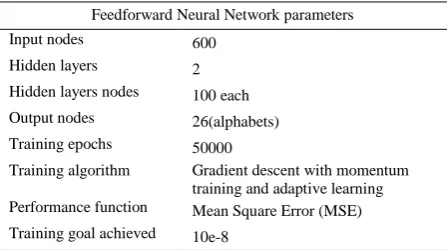
The architecture of the three layer neural network for the handwritten recognition system is shown in Fig.5 and the network training parameters are shown in Table 1. The results obtained are shown in Table. 2.
TABLE 2. Performance Comparison of Different Classifiers
Number of training samples 5200 samples
Number of testing samples 2600 samples
Classifier Number of correctly recognized alphabets
Recognition rate in %
Template Matching 1411 54.27
Feed Forward NN 2448 94.15
Nearest neighbour NN 2244 86.96
Radial basis function NN 2245 89.42
The feed forward neural architecture of the network with two hidden layers used for character recognition is illustrated in Fig. 5.
Figure 5. Two hidden layer neural network for character
recognition
The output of the
i
th layer is defined by1
log ( )
i i i i
a sig w a b (1)
where,
0
a and i [1, 2, 3], i
w = Weight vector of
i
thlayeri
a = Output of
i
thlayeri
b = Bias vector for ithlayer
P = input vector for the network
3.2.2 Nearest Neighbour classifier In pattern recognition, the k-nearest neighbour algorithm is used for classifying the characters based on neighbourhood in the feature space. Different types of Nearest Neighbour techniques have been reported in the literature [22]. The k-nearest neighbour technique using Euclidean distance method is used in this paper. The binary images are resized into 30x20 pixel images. Two hundred sets of each alphabet are used in the training phase. The training phase of the algorithm consists of storing the feature vectors with class labels of the training samples. A different data set consisting of 2600 samples is used for testing. The performance of kNN classifier is observed for different values of k ranging from 1 to 10. The Euclidean distances are computed between the test vectors to all the stored vectors. The computed distances are ranked in ascending order. The k nearest neighbours are chosen. The majority rule with the nearest point tie-break is used for classification.
Simulation results show that k = 4 yields good accuracy for recognizing the handwritten English alphabets. The results obtained for recognizing the handwritten English alphabets are summarized in Table.2.
3.2.3 Radial basis classifier Radial basis function (RBF) networks is a good classifier and used for a wide range of applications [23]. It is a linear combination of radial basis functions. The RBF architecture used for character recognition is shown in Figure 6.
The total number of radial basis function neurons is 100. The output layer has 26 neurons corresponding to 26 English alphabets.
Figure 6. Radial basis function architecture for character
recognition
TABLE 1. Feedforward Neural Network Training Parameters
Feedforward Neural Network parameters Input nodes 600
Hidden layers 2
Hidden layers nodes 100 each
Output nodes 26(alphabets)
Training epochs 50000
Training algorithm Gradient descent with momentum training and adaptive learning Performance function Mean Square Error (MSE)
The output of
i
thlayer is given by )( i,i i i1 l
i radbas IW p b
a (2)
)
( 1 2
1 , 2
2 purelinLW a b
a (3)
Where,
1
i
a = ith element of a1
1,1
iIW is a vector made of the
th
i
row ofi
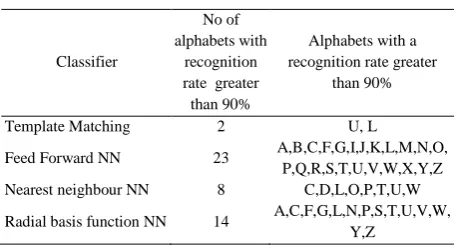
thIW1,1The results obtained are summarized in Table 3.
TABLE 3. Summary of the results achieved by the proposed
methods
Classifier
No of alphabets with
recognition rate greater than 90%
Alphabets with a recognition rate greater
than 90%
Template Matching 2 U, L
Feed Forward NN 23 A,B,C,F,G,I,J,K,L,M,N,O, P,Q,R,S,T,U,V,W,X,Y,Z Nearest neighbour NN 8 C,D,L,O,P,T,U,W
Radial basis function NN 14 A,C,F,G,L,N,P,S,T,U,V,W, Y,Z
4. RESULTS AND DISCUSSION
The experimental results obtained in recognizing the handwritten English characters using four different classifiers are summarized in Table.2. The recognition accuracy obtained for the template matching method and the NN methods are also summarized in Table 2. The results in Table 2 indicate the superior recognition accuracy of Feedforward Neural network as compared to other classifiers. Using a number of handwritten test data the confusion matrix was obtained for the four different classifiers. This was to investigate the recognition accuracy for each alphabet. This parameter is important as any written text would have a varied number of each alphabet. If the classifier has more than 90% recognition rate for each alphabet then the overall worst case recognition rate would be almost constant irrespective of the data.
Table 3 reports the number of alphabets having recognition rate less than 90% and the alphabets are also listed. It is seen from Table 3 that template matching has a poor recognition rate for 24 alphabets and hence has very poor recognition accuracy. Among the NN based classifiers the Feed forward neural network recognizes 23 alphabets with over 90% accuracy and is the best classifier.
The classification accuracy of the Feedforward NN is shown separately for each alphabet in Fig. 7. The
maximum number of misclassification occurs for the letter D which is misclassified 16 times for every 100 presentations (84% recognition). All the other alphabets have better recognition accuracy.
Figure 7. Performance illustration the correct & error
individual alphabets for the Feed forward NN
5. CONCLUSIONS
6. REFERENCES
1. Mori, S., Suen, C. Y. and Kamamoto, K., “Historical review of OCR research and development”, Proceedings of IEEE, Vol. 80, (1992), 1029-1058.
2. Fujisawa, H., “Forty years of research in character and document recognition-an industrial perspective”, Pattern Recognition, Vol. 41, No. 8, (2001), 2435-2446.
3. Plamondon, R. and Srihari, S. N., “On-line and off- line handwritten character recognition: A comprehensive survey”,
IEEE Transactions on Pattern Analysis and Machine Intelligence, Vol. 22, No. 1, (2000), 63-84.
4. Arica, N. and Yarman Vural, F. T., “An overview of character recognition focused on off-line handwriting”, IEEE Transactions on Systems, Man, and Cybernetics, Part C: Applications and Reviews, Vol. 31, N. 2, (2001), 216–233. 5. Kavallieratos, E., Antoniades, N., Fakotakis, N. and Kokkinakis,
G. V., “Extraction and recognition of handwritten alphanumeric characters from application forms”, Proceedings of International Conference on Digital Signal processing, Vol. 2, No.13, (1997), 695 -698.
6. Alceu de Britto, S., Sabourin, R., Bortolozzi, F. and Ching Suen, Y., “The recognition of handwritten numeral strings using a two-stage HMM-based method”, International Journal of Document Anal. Recognition, Vol. 5, (2003), 102-117. 7. Said, F., Yacoub, A. and Suen, C., “Recognition of English and
Arabic Numerals Using a Dynamic Number of Hidden Neurons”, Proceedings of the Fifth International Conference on Document Analysis andRecognition, (1999), 237–240. 8. Al-Omari, S. A. K., Sumari, P., Sadik, Al-t. and Anas, J. A. H.,
“Digital recognition using neural network”, Journal of Computer Science, Vol. 5, No. 6, (2009), 427-434.
9. Choudhary, A., Rishi, R., Ahlawat, S. and Dhaka. V. S., “Performance analysis of feed forward MLP with various activation functions for handwritten numerals”, Proceedings of International Conference on Computer and Automation Engineering, (2010), 26-28.
10. Kashyap, K., Bansilal, H. and Koushik, P. A., “Hybrid neural network architecture for age identification of ancient Kannada scripts”, Proceedings of the International Symposium on Circuits and System, Vol. 5, (2003), 25-28.
11. Palacios. R., Gupta, A. and Wang, P. S., “Handwritten bank check recognition of courtesy amounts”, International Journal of Image Graph,Vol. 4, (2004), 1-20.
12. Gonzalez, R. C., woods, R. E. and Eddins, S. L., “Digital Image Processing using MATLAB”, Pearson Education, Dorling Kindersley, South Asia, (2002).
13. Casey, R. G. and Lecolinet, E., “A Survey of Methods and Strategies in Character Segmentation,” IEEE Transactions on Pattern Analysis and Machine Intelligence, Vol. 18, No. 7, (1996), 690-706.
14. Jain, A. K. and Taxt, T., “Feature extraction methods for character recognition-A Survey”, Pattern Recognition, Vol. 29, No. 4, (1996), 641-662.
15. Rajashekararadhya, S. V. and VanajaRanjan, P., “Efficient zone based feature extraction algorithm for handwritten numeral recognition of four popular south-Indian scripts”, Journal of Theoretical and Applied Information Technology, Vol. 4, No. 12, (2008), 1171-1181.
16. Ramteke, R. J. and Mehrotra, S. C., “Recognition of Handwritten Devnagari Numerals”, International Journal of Computer Processing of Oriental Languages, Vol. 1, No. 2, (2008), 1-9. 17. Nadeem, D. and Rizvi, S., “Character Recognition Using
Template Matching”, Jamie Millie Islamic, New Delhi, (www.cs.uic.edu/~srizvi/BIT_Thesis.pdf.)
18. Pal, A., Singh, D., “Handwritten English Character Recognition Using Neural Network,” International Journal of Computer Science & Communication, Vol. 1, No. 2, (2010), 141-144. 19. Singh, M. P. and Dhaka, V. S., “Handwritten character
recognition using modified gradient descent technique of neural networks and representation of conjugate descent for training patterns International”, Journal of Engineering, Transactions A: Basics, Vol. 22, No. 2, (2009), 145-157.
20. Lee, D. Y., “Handwritten Digit Recognition Using K Nearest neighbor, Radial Basis Function and Back propagation Neural Networks,” IEEE Neural Computation, Vol. 3, No. 3, (1991), 440-449.
21. Brijesh, K. and handwritten, V., “Hindi character recognition using multilayer perceptron and Radial Basis Function Neural Network”, Proceedings of International Conference on neural network, Vol. 4, (1995), 2115-2115.
22. Bhatia, N. and Vandana, “Survey of Nearest Neighbor Techniques,” International Journal of Computer Science and Information Security, Vol. 8, No. 2, (2001), 302-305.
TECHNICAL NOTE
Neural Network Based Recognition System Integrating Feature Extraction and
Classification for English Handwritten
J. Pradeepa,*, E. Srinivasana, S. Himavathib
a Department of Electronics & Communication Engineering, Pondicherry Engineering College, Puducherry, India b Department of Electrical & Electronics Engineering, Pondicherry Engineering College, Pondicherry, India
A R T I C L E I N F O
Article history: Received 22 July 2011
Received in revised form 6 January 2012 Accepted 16 February 2012
Keywords:
Handwritten Character Recognition Image Processing; Feature Extraction Back Propagation Neural Network Nearest Neighbour Network Radial Basis Function Network
هديكچ
طخ تسد يياسانش
زا يکي هزوح يشهوژپ ياه كرحم
رد زيگنارب شلاچ و هنيمز
شزادرپ يسانش وگلا و ريوصت هدوب
تسا
. هزوح نيا
ياهدربراک ياراد يددعتم
لماش هک تسا يارب يکمک
ندناوخ کچ ،انيبان دارفا يارب
ياه
کناب
ي
، ليدبت و
د دنس عون ره هب هتشون تس
نتم مرف يراتخاس تسا
.
يبصع ياه هکبش (
NN
)
يياناوت اب يريگداي يتاذ هار دوخ لح ياه
هدننک راوديما يا
رتکاراک يياسانش يارب هئارا اه هتشون تسد ياه
يم دهد
.
هلاقم نيا نيرت بسانم
NN
يارب ار يحارط
يياسانش ار تسد اب هدش هتشون يسيلگنا رتکاراک يياسانش متسيس يم
دنک
.
يژولوپوت فلتخم ياه هکبش
ياه يبصع (
NN
)
ينعي
،
بقع هب ورراشتنا هکبش
يبصع ياه
نيرتکيدزن ،
هکبش هياسمه اب هکبشو هياپ عبات يعاعش تسا يدنب هقبط يارب
هدش هتخاس اهرتکاراک دنا
.
يمامت متسيس ياه يياسانش رب ينتبم
NN
هداد هعومجم زا هدافتسا يناسکي يشزوما ياه
هدومن
طسوتم هب نديسر يارب و دننيبيم شزوما يناسکي ياطخ عبرم
. فلتخم رتکاراک هعومجم تسيود زا کي ره
62 رتکاراک
يسيلگنا يارب شزومآ هکبش دوش يم هدافتسا
. درکلمع هلاقم نيا زا يياهن هجيتن تفايرد روظنم هب
هب يياسانش ياه متسيس
هداد زا هدافتسا اب هدرتسگ تروص تست ياه
دنا هدش هسياقم .