and Complex Argumentation
ANDRÉ JUTHE
Myrvägen 26
747 32 Alunda, Sweden
Affiliation: University of Amsterdam, The Netherlands [email protected]
Abstract: This paper addresses several issues in argumentation theory. The over-arching goal is to discuss how a theory of analogical argument schemes fits the pragma-dialectical theory of argument schemes and argument structures, and how one should properly reconstruct both single and complex argumentation by analogy. I also propose a unified model that explains how formal valid deductive argumentation relates to argument schemes in general and to analogical argument schemes in particular. The model suggests “scheme-specific-validity” i.e. that there are contrasting species of validity for each type of argument scheme that derive from one generic conception of validity.
Résumé: Cet article traite de plus-ieurs questions dans la théorie de l’argumentation. L’objectif englob-ant est de décrire comment une thé-orie des schèmes d'arguments par analogie correspond à la théorie pragma-dialectique sur les schèmes et les structures d’arguments, et comment on devrait reconstruire correctement les arguments par analogie simples et complexes. Je propose également un modèle unifié qui explique comment l’argumen-tation formelle déductivement valable se rapporte aux schèmes d'argument en général et aux schèmes d'arguments analogiques en particulier. Le modèle suggère une «validité-spécifique-au-schème» : pour chaque type de schème d'argu-ment dérivé d’une conception génér-ique de validité il y a différentes espèces de validité.
Keywords: analogical argument schemes; argumentation by analogy; vertical determining relation; horizontal one-to-one correspondence; formal validity; material validity; pragmatic validity; argumentation structure; reconstruction; scheme-specific-validity
1. Introduction
of argument schemes versus argument structures, and so on, is an assumed framework. The goal is also to understand how analogical argument schemes could fit into a larger model of argumentation which covers both formally valid argument patterns—as traditionally understood—and the typology of argument schemes in the pragma-dialectical system.
In order to fully satisfy this goal in the broad sense that I want, I need to achieve four subgoals:
(1) Explain how analogical argument schemes achieve transfer of the acceptability of the “argument” to the standpoint according to my theory of analogical inference. This is done in section [2]. In this section I also discuss how single argument by analogy should be reconstructed and interpreted within a pragma-dialectical framework.
(2) Show how my theory of analogical inference configuration outlined in section [2] fits into a larger model of argumentation that coherently explains inference and validity and explains the connection between formal logically valid patterns (like modus ponens) and argument schemes that fit with the pragma-dialectical system. In this section, the notions of formal and material inference as well as “material validity,” “pragmatic validity” and “scheme-specific validity” are explained in terms of the larger model. In this section, it is also argued that analogical argument schemes cannot be reduced to any of the other argument schemes in the pragma-dialectical system. This is all done in section [3].
(3) Show how to correctly reconstruct complex argumentation structures that employ analogical arguments in a way that displays all the critical aspects essential to evaluation, and how the Amsterdam school of dialectical of argumentation structures relates to the north American conception of logical argumentation structures. This is done in section [4].
will activate certain complex argumentation structures. This is done in section [5].
The reader should have an understanding of pragma-dialectical theory and the terminology thereof in order to fully assimilate the discussion of this paper.1
2. Analogical argument schemes
In this section, I will give an account of my theory on how to understand the analogical argument scheme. For a more elaborate discussion about this theory of analogical inference, see (Juthe 2005; 2009)2. In subsection [2.1] the basic theory of analogical inference configuration will be outlined. In subsection [2.2] the theory will be applied to a concrete example of single argumentation by analogy so that the reader understand how the theory work in concrete cases of single analogical argumentation.
2.1 The basic components of analogical argument schemes
In this subsection, I will look at the basic elements that any argumentation by analogy will essentially have and the abstract pattern of that scheme.
In the pragma-dialectical framework an argumentation can be either single or complex and the idea is that a complex argumentation is always composed of a combination of single argumentations. Thus, any complex argumentation can be broken down into single arguments. Each single argument instantiates one argument scheme and consists of a standpoint, an explicit premise (labeled the “argument” that supports the standpoint and the “linking premise” (often unexpressed) that
1 In this paper, the term argument is used in the ordinary sense as the whole
constellation with premises and the conclusion, however if the expression is “argument” (with double quotes) then it refers to the technical pragma-dialectical meaning corresponding to reason. In the pragma-dialectical system, what is called “argument” does not refer to all the propositions that make up an argumentation. An argumentation in pragma-dialectics consists of three propositions: the standpoint; that is to be defended by an “argument”; and the linking premise that entitles the “argument” to be a reason for the standpoint. Argumentation can either be single argumentation consisting of only one argument or complex argumentation which is composed of many arguments.
2 My theory of analogical inference has been inspired by Steinhart (2001);
enables a unique way of conveying the acceptability from the explicit “argument” to the standpoint. The linking premise of an
argument functions as a justification of the inference of the “arg ument” to the standpoint. Argument schemes are forms of
argument that model uniform patterns of atomic reasoning. That is, you cannot find smaller pieces of reasoning than the inference configuration of an argument scheme and they are therefore “atomic” in that sense. An argument scheme is the inference configuration that justifies and entitles (or warrants in Toulmin’s words) the inference of the argumentation. The schemes are distinguished by the type of inference configuration that transfers the acceptability of the argument to the standpoint. In the pragma-dialectical typology you have three main types of argument schemes: the symptomatic, causal and analogical argument schemes.3
An argumentation by analogy (or analogical argument-ation) is an argumentation that employs an analogy as a means to justify the inference. The Collins English Dictionary captures the basic intuition of analogical reasoning when it defines it as “a form of reasoning in which a similarity between two or more things is inferred from a known similarity between them in other respects” (1991: 53). The standard pragma-dialectical account of the analogical argument scheme is:
1. Y is true of X, [standpoint] because: 1.1 Y is true of Z, [argument]
and: 1.1' Z is comparable to X. [linking premise]
However, the linking premise 1.1' of this scheme cannot achieve a license of the transference of the acceptability of the “argument” to the standpoint unless comparability is more than
mere similarity. Everything is similar to everything in some
respect and dissimilar in some other respect, therefore you cannot infer anything from mere similarity as such. In order to justify an inference something more than mere similarity is needed. Analogical argumentation is a species of analogical reasoning and it should capture this basic intuition.
In my view, all analogies are composed of four components and two critical relations. The components are the
AnalogueA, which is the source from which a predicate is transferred to and concluded about the Target-Subject. The
3 Some have argued that these schemes can be reduced into two “super
Target-SubjectTS is that to which one assigns a new predicate; the Assigned-PredicateAP is the new predicate that is transferred,
mutatis mutandis, to the Target-Subject, because the element∈ “determines” the Assigned-Predicate and because this element is comparable to a counterpart element∈* in the AnalogueA. This essential constitution of my theory of argumentation by analogy would have the following scheme in the pragma-dialectical system of single argumentation:
1. The Target-SubjectTS has the Assigned-PredicateAP*. 1.1 The element∈ of the AnalogueA is comparable with
element∈* of the Target-SubjectTS
(1.1' The element of the AnalogueA element determines the AnalogueA's Assigned-PredicateAP.)
In some cases, the “argument” would express the comparability and the linking premise expresses the determining relation as in the scheme above. However, sometimes the reverse will hold (see later in this present section for examples) so that the “argument” expresses the vertical determining relation and the linking premise would express the analogous relation:
1. The Target-SubjectTS has the Assigned-Predicate*AP. 1.1 The element∈ of the AnalogueA element determines
the AnalogueA's Assigned-PredicateAP.
(1.1' The element∈ of the AnalogueA is comparable to element∈* of the Target-SubjectTS)
The essential structure is, however, the same. Note that the argument scheme is formally invalid in the sense that the conclusion of the scheme does not follow by virtue of the logical concepts alone. Rather, the inference proceeds via a
determining relation between the element ∈ of the Analogue(A)
and the Assigned-Predicate(AP) of the Analogue(A), which in logical symbols is not signified by logical entailment ' ⇒ ' but is
signified with the . In this way, we define relevance. Thus the fact that ∈ is relevant to AP is reduced to a determination
(here I follow Davies 1988) written as A(∈) AP. This
species, explanatory, etc., but can always be reduced to having two modes: definitely or non-definitely. Note furthermore that the determining relation says neither that the element ∈ of the
Analogue always determines the Assigned-Predicate nor that the element ∈ of the Analogue in general determines the
Assigned-Predicate. Rather, it says that the element ∈ determines the
Assigned-Predicate in the Analogue. It is this particular Analogue's element ∈ that determines this particular Analogue's
Assigned-Predicate. This is important because it explains why my account of analogical inference cannot be reduced to any other type of inference configuration. The inference proceeds via an insight of resemblance between particulars and not via any general principle; the act of comparison is essential for the inference.
The inference is same-level-reasoning that moves from
particular to particular (or from general to general) and you could not infer that a vertical determining relation exists in the Target-Subject unless you knew that it obtained in the Analogue
and that there were corresponding elements in the Target-Subject. Thus, without the act of comparison and the similarity between the Analogue and the Target-Subject, you could not infer that the elements of the Target-Subject stand in the same
vertical determining relation. This also explains why analogical inference is defeasible in the traditional sense and “valid” in the sense defined in this paper—a validity that allows the inference to be defeated (see section [3.3] for more about my account of “validity”). It explains why there is always an issue concerning relevant similarities and relevant differences concerning argumentation by analogy.
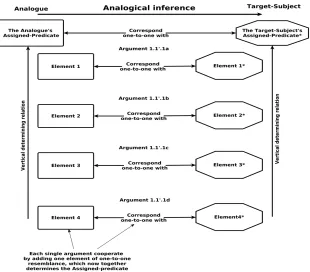
The comparability operates as the justification of the inference by means of which the same type of vertical determining relation can be inferred to hold in the Target-Subject. 'Comparability' means that each element in the Analogue that has a vertical determining relation to the Assigned-Predicate also has a horizontal one-to-one corres-pondence to a counterpart element in the Target-Subject. Thus, the transference of the Assigned-Predicate is justified because the element ∈ in the Analogue corresponds one-to-one to a
counterpart element ∈* in the Target-Subject. Thus, the terms
'resemblance', 'similarity', 'comparable' or 'analogous' in the argument mean:
Element∈ in the AnalogueA corresponds one-to-one with
Thus, any argumentation by analogy tacitly assumes that the element(s) of the Analogue are comparable to the element(s) in the Target-Subject, and that the Assigned-Predicate mutatis mutandis (Assigned-Predicate*) therefore can be transferred from the Analogue onto the Target-Subject by means of the determining relation that can be extended to hold in the Target-Subject by virtue of the comparability.
As stated, the sense of ‘determining’ is broad and, as such, only indicates that there is some kind of material connection
between the determining element and the Assigned-Predicate in the Analogue so that the connection can be transferred via the one-to-one correspondence. Thus, analogical inference is an example of materially valid inference in virtue of a substantial argument scheme. An argumentation that employs a correct analogy is materially valid, although not formally valid and, if it is consistent with the rules of the critical discussion, it will be
pragmatical valid as well. (These concepts are all explained in section [3.3].) While you could supply the “logical minimum”4 that would make an analogical argumentation formally valid:
If the Analogue's element ∈1, ∈2 ... ∈n determines Assigned-Predicate in the Analogue, and the Target-Subject also has element ∈1, ∈2 … ∈n (or a mutatis
mutandis corresponding element ∈1*, ∈2* ∈n* ), then,
unless there is another element in the Target-Subject that counteracts the effect of element ∈1*, ∈2* ∈n*, the
Target-Subject's element will also determine the Assigned-Predicate (or a corresponding mutatis mutandis
Assigned-Predicate*) in the Target-Subject)
—the same can be done with any argumentation including every inductive argumentation ever made. Such reformulations have no positive merit, but are de facto negative, in that they confuse necessary background assumptions with unexpressed linking premises and make the argument into a non-analogical deductive modus ponens that only preserves truth and not plausibility. (See section [3] for more about this point.) A genuine argumentation by analogy is an argumentation that
4 The logical minimum is the minimum proposition that states explicitly what
employs an analogy to justify the inference of the argument-ation. If each element in the analogue that vertically determines the Assigned-Predicate has a counterpart in the Target-Subject so that each has a one-to-one correspondence, then the vertical relation in the analogue can be extended and conveyed to the Target-Subject and the Assigned-Predicate* of the corres-ponding domain can be concluded about the target subject. Just having a deductive modus ponens with a premise that “contains an analogy” is not an analogical inference.5
Moreover, I believe that the concept of “relative essence” is another crucial concept of analogical inference where the elements that stand in a one-to-one correspondence constitute
5 You would not claim that a deductive argument with empirical premises is
an “inductive argument.” Besides being clearly counter-intuitive, a taxonomy in which argument types are defined by the content and not by its inference configuration entails an infinite number of argument types. During a seminar in which the manuscript of this paper was under discussion, one of the participants of the seminar suggested an alternative analogical argument scheme in an attempt to avoid the vertical determining relation. According to the suggestion the argument scheme could be this:
(1) x and y both have A;
(2) Two things that have A are also similar with respect to B (that is either both have B or both lack B);
(3) x has B; (4) Thus y has B.
However this does not attain any analogical inference. Instead it is just a deductive argumentation, with a superfluous premise. It is either modus ponens or the disjunctive syllogism. The argumentation can either be interpreted as:
(1) x is similar to y with respect to A;
(2) If something is similar with respect to A, then it is also similar with respect to B;
(3) x has B. (4) y has B.
This makes the argument an instance of the formally valid modus ponens with (3) being superfluous. It can also be interpreted as:
(1) A(x) & A(y) (x and y have A)
(2) B(x) & B(y) ∨ ~B(x) & ~B(y) ('∨' is here interpreted as exclusive). (Either x and y both have B, or neither of them has B) (3) B(x).
________ (4) B(y).
what is “essential” to a certain framework of context. Two objects being analogous means that they have the same essential features, but 'essential' means only essential with respect to a certain contextual framework. This notion cannot be explicated here but is further elaborated in (Juthe forthcoming b).
2.2 An example of single argumentation by analogy
In this subsection, I will apply my explication of the analogical argument scheme to a concrete example of single argumentation by analogy. We will take a closer look at the art of recon-structing complex analogical argumentation in section [4], and will here only focus on the reconstruction of single argu-mentation. The example is a bit ambiguous with respect to how it should be interpreted, which I think will clarify for the reader how my theory of analogical argument schemes should be applied. The single argumentation:
The Porsche and the Chevrolet are both in the $40,000 price range, and the Porsche is of excellent quality. Therefore, the Chevrolet is probably also of excellent quality.6
has the determining vertical relation between the “Porsche's $40,000 price range” and the “Porsche's excellent quality.” Thus, the element “$40,000 price range,” in the case of the Porsche either definitely or non-definitely determines its “excellent quality.” Thus, the reconstruction with all tacit assumptions is:
1. The ChevroletTS is probably of excellent qualityAP . 1.1 The $40,000 price range∈ of the PorscheA corresponds
one to-onewith the price range of the Chevrolet∈*. 1.1' The $40,000 price range∈ of The PorscheA
non-definitely determines excellent qualityAP.
For sake of convenience, I will continue to use the terms
6 In a previous work (Juthe 2005) I claimed that this argument was a distinct
'relevance' and 'comparable' or 'analogous' but in the sense defined in the previous subsection. Thus, the above reconstruction will be simplified as:
1. The Chevrolet is comparable with the Porsche with respect to excellent quality.
1.1 The Chevrolet is comparable with the Porsche with respect to $40,000 price range.
(1.1' The $40,000 price range of the Porsche is relevant for its excellent quality.)
I want to emphasize that there is more than one proper way to reconstruct the same analogical argumentation, as long as the reconstruction retains the crucial features relevant for an evaluation in a given situation. However, although there may be more than one proper way to reconstruct analogical argumentation there are far more erroneous ways to do it. Sometimes it is very tricky to settle how to reconstruct an argumentation. For instance, one could claim that this argumentation should also be reconstructed as:7
1. The Chevrolet is probably of excellent quality. 1.1 Porsche is of excellent quality.
(1.1' The Chevrolet is comparable with the Porsche) 1.1'.1 The Chevrolet is also in the $40,000 price range.
This is also a prima facie good reconstruction. Notice that this latter reconstruction interprets the argument as complex (with one subordinative addition). The question is, should “Both are in the $40,000 price range” be taken as the result of a dialectical
move, or as something—part of the intrinsic structure of the
scheme itself—that resides in any “valid” analogical argument? My assessment is that this argumentation should be interpreted as single argumentation. Note that the linking premise is imprecise in this formulation and if we make it more precise we will see difficulties. If we specify it as: “The Chevrolet is comparable with the Porsche with respect to quality,” it would be circular reasoning, since that is what the argument is supposed to “prove” (and such an interpretation would violate the principle of charity).
However, if we specify it as: “The Chevrolet is comparable with the Porsche with respect to price,” then the argument becomes different, because it no longer says the same
thing. It is a very different claim to claim that: “its $40,000 price range is relevant to the excellent quality of the Porsche” and to claim that: “price range in general is relevant for quality in general.” The latter claim makes it into a symptomatic
argumentation, since you do not need knowledge about the
particular Porsche any longer. It makes the knowledge about the Porsche redundant. You can use that generalization alone to justify the inference. Such a formulation would also need an
additional linking proposition that expresses that price range is relevant for quality:
1. The Chevrolet is probably of excellent quality. 1.1 The Porsche is of excellent quality.
(1.1' The Chevrolet is comparable to the Porsche with respect to price range.
(1.1'' Price range is relevant to quality.
1.1'.1 The Chevrolet is also in the $40,000 price range.
This seems to stretch the argumentation into a more complex reconstruction than necessary. There is no evidence for the claim that the pre-reconstructed argumentation assumes 1.1''. It violates the criterion for establishing the committed premise (see section [4.2]) since it assumes more than what is necessary to make the argument materially valid (see next section for an explanation of this concept).
Moreover, this reconstruction would violate the pragma-dialectical axiom that each single argumentation consists of two propositions, the “argument” and the “linking premise,”8 which support the standpoint. Therefore, there are reasons to interpret the argumentation as single without any dialectical addition. The logic of this analogical inference can be seen visually in Figure 1, on the next page.
The non-definitely determining relation of the vertical relation makes the argument an “argument by inconclusive analogy”in contrast to analogical arguments that have a definite vertical determining relation, which makes the argument an “argument by conclusive analogy.” (This distinction is more elaborated in Juthe 2005; 2009.)
8 Nor yet can you make 1.1' and 1.1'' missing parenthesis into just one linking
premise by expressing them as one conjunction because that would be inconsistent with how you in general express the connection between the argument and the linking premise in the pragma-dialectical system. 1.1 and 1.1' is supposed to be one single argumentation in itself and 1.1' 1. another
Figure 1. Single argumentation by inconclusive analogy
While a price range surely correlates with quality, it does not definitely determine quality. The determination relation between price and quality is plausibly never stronger than a correlation, which is the reason why the standpoint has the mode of “probably.” The fact that the Target-Subject has a counterpart element for each of the analogue's element entails that there is a “horizontal relation” as well, which enables the analogical inference.
It is not my claim that an analogical argument has to be
explicit in exactly which features are relevant for the comparison. You do not necessarily need to know exactly which they are in order to make a correct comparison. The elements and the vertical determining relation may often be tacit or
unknown, which entails that you neither can account for the one-to-one correspondence.
A comparison is often just based on an intuitive judgment of similarity, as Govier points out: “The trick about analogies— and their charm as well, I think—is that we are often able to see or sense important resemblances between cases without being able to spell them out exhaustively in just so many words” (Govier 1989, p. 148).9 The point is rather that, according to my
9 Govier seems to claim that if we knew which similarities it was we could
theory of analogical inference, all genuine analogical arguments are committed to the existence of these components even though they may be completely unknown and implicit, just like a deductive argument may be committed to several implicit assumptions that we are not aware of, although we still understand that the argument is formally valid without being able to formulate the unexpressed linking premise. For example, the very simple argumentation:
This vaccine works on cows. Therefore it may also work on humans.
would be an example of advancing a single argumentation by analogy and the standard scheme in pragma-dialectics would reconstruct it10:
1. The vaccine may work on humans. [Standpoint] 1.1 The vaccine works on cows. [Argument]
(1.1' Cows are comparable to humans.) [Implicit linking premise]
As we saw in the previous subsection, my theory of analogy entails that every single argument that employs an analogical argument scheme contains the same two crucial assumptions. Thus, the linking premise 1.1' is an elliptic expression of the proposition that de facto expresses the horizontal one-to-one relation between the Target-Subject and the Analogue. The second assumption of the vertical determining relation applied to this particular single argument, would be that a “basic physiological feature ∈” causally but non-definitely determines
the positive effect of the vaccine on cows. Since it has a counterpart “basic physiological feature ∈*” of humans, so that
the Assigned-Predicate, the “positive effect of the vaccine,” can be transferred to the human population. Thus it should be reconstructed:
1. The vaccine may workAP on humansTS. [Standpoint]
1.1 The vaccine worksAP on cowsA because of some
even general claim, since there may be dissimilarities that counteract and outweigh the similarities. See also Guarini (2004) pp. 156, 163.
10 This argument might be interpreted as one employing a symptomatic
basic physiological feature∈ of cowsA.11 [argument that express vertical determining relation]
(1.1'. The basic biological feature∈ of CowsA is analogous to the basic biological feature∈* of humansTS.) [linking premise that express the horizontal one relation]
The term comparable or analogous in single arguments should be analyzed in terms of the components discussed earlier. Therefore, my theory assumes that the linking premise 1.1'
means:
basic physiological feature ∈ of cows corresponds
one-to-one with basic physiological feature ∈* of humans.
This does not mean that the author of the argumentation is committed to the claim that he knows what these basic physiological features are (they may be totally unknown); the point is solely that the author of this argument is committed to the ontological claim that they exist.
The “because” of this determining relation in the case of how the vaccine works on cows is loose, and hence it is an example of argument by “inconclusive analogy.” Presumably, the vaccine did not work on every cow and therefore only a correspondingly probabilistically qualified predicate can be transferred to the Target-Subject in the standpoint—in this case humans—in the analogical inference. Just as a correct inductive inference does not yield a certain conclusion, only presumptive or probabilistic, arguments by inconclusive analogy only yield a plausible conclusion regardless of how certain the analogy may be.
Thus, my theory assumes that argumentation like this very simple one is committed to the implicit assumption that the similarity in question is relevant for (determines) the effect of the vaccine, and that not every similarity is relevant, even though it is not specified exactly what these relevant similarities consist of. However, most cases of argumentation by analogy provides information about what elements are part of the determining relation and how they are related.
Besides the distinction between argument by “incon-clusive” analogy and argument by “con“incon-clusive” analogy, there is
11 In other words, the basic physiological feature
∈is relevant for the vaccine
a distinction between argument by same-domain and different-domain analogy (Juthe 2005; 2009; 2014) as well as close-domain analogy (Juthe forthcoming b).
A same-domain analogy means that the Assigned-Predicate does not change in the analogical inference when transferred to the Target-Subject, because they belong to the same domain, whereas in a different-domain and close-domain analogy, the Assigned-Predicate has changed mutatis mutandis
in accordance with the domain of the Target-Subject so that a higher-level of abstraction is needed in order to subsume them under the same topical predicate.
Moreover, in a different domain-analogy, the elements in the one-to-one correspondence would consist of different predicates, whereas the one-to-one corresponding elements in a same-domain analogy would consist of the same type of predicate (even though the particular objects of comparison are not the same).
This example with the cars, is a same-domain analogy because: (1) the object of comparisons belong to the same domain: the domain of cars, and the Assigned-Predicate does not change mutatis mutandis at all, and (2) the predicate-element “$40,000 price range” is the exactly the same in both the Analogue and in the Target-Subject (in different-domain analogies the predicate-element would be dissimilar in accordance with their respective domains).
3. The “validity” and the sui generis character of analogical inference
I have in section [2] explained how the inference operates in analogical argument schemes and how to reconstruct single analogical argumentation. In this section [3], I will give an account of the “validity,” and defend the sui generis characterof the analogical inference that was outlined in previous section [2], and explain how analogical argument schemes fit into a unified model of inference and the “validity” of argument schemes. I will argue that we should reject the traditional notion of validity as a concept that only means the formal validity of deductive arguments. Instead, I argue that every instance of
In subsection [3.2], I will define and explain how I understand ‘inference’ and ‘material inference.’ In subsection [3.3], we will take a closer look at the crucial notions of the
material and pragmatic validity of analogical inference and contrast it with “formal validity” and how these notions fit into a unified model. In subsection [3.4], I introduce the notion of
scheme-specific validity, which means that validity is specific for each type of argument scheme. Scheme-specific validity follows from the unified model of argument schemes.
Finally, in subsection [3.5], I argue that analogical inference is sui generis and cannot be reduced to some other type. I have elsewhere argued that arguments by analogy cannot be reduced to deductive types of argument (Juthe 2005, 2009) and many other theorists have argued for that as well (Govier 1989; Guarini 2004; Bermejo-Luque 2014).
However, that argument by analogy cannot be a genuine inference configuration by itself and must be reduced to some other type of inference is a common view (see Shecaira 2013 for a recent defense of such a view and for deductivism). I will therefore in this section provide further support that the schemes of argument by analogy are indeed legitimate argument schemes; but I will focus on the question whether the analogical argument scheme can be reduced to a symptomatic or causal argument scheme. Before all this, however, we will in the first subsection [3.1] take a brief look at deductivism.
3.1 Deductivism
Deductivism may roughly be described as the view that all arguments should be interpreted and/or evaluated as attempts to employ deductive argumentation, or that all good arguments are deductively valid, i.e., formally valid (exactly how I define 'validity' will be discussed in section [3.3]). There are many problems with deductivism (Godden 2005)12, and one reason against deductivism is that arguments with deductive architecture only preserve truth and certainty, they fail to preserve plausibility, probability and likelihood (Godden 2005).13 Another problem are those arguments that are
12 Several of them are advanced by Godden (2005) and refers to Govier. The
standard objections are: (i) deductivism prevents contrasting degrees of evidential support between premises and conclusions; (ii) deductivism fails to provide an account of fallacies, or the account it provides is a faulty account of fallacies; (iii) deductivism does not do justice to the structure of natural language arguments.
seemingly counterexamples in that they resist a plausible deductive formulation and are better arguments in their non-deductive formulation. An example of what some authors call inductive analogical argument:14
(1) a, b, c ... each has been observed to have property F
and property G;
(2) n is observed to have property F; _________
Therefore, probably n has property G
The very same argument should according to a deductivist interpretation be formulated with a deductive step, making it formally valid:
(1*) a, b, c ... each has been observed to have property F
and property G;
(2*) n is observed to have property F; (3*) All F's are G's
__________
*Therefore n is G (or: n is probably G)
However, this is an essentiallydifferent argumentation, since the method and outcome of the evaluation of this reformulated argumentation would be completely dissimilar from the first argument. The first argument works via induction and resemblance, whereas the other via a universal generalization. What is interesting here is that the first inductive version is, from an epistemic point of view, a clearly better argument than the deductive version, since it is not based on the very questionable premise (3).15 As Barker pointed out, we are not entitled to attribute higher likelihood to the conclusion of the deductive version, than the likelihood we are entitled to assign to the generalization about All F's are G's. Yet we do frequently reach particular conclusions with a considerably higher degree of plausibility than we are in making such generalizations (Barker 1989, makes this point, pp. 173-177, see especially p.175). Thus, such reasoning goes more plausibly from case to case and not via a universal generalization and/or by virtue of
fail to “properly represent the nature of inference warrants as distinct from premises” (p. 174).
14 Barker S.F. (1989) calls it an “inductive argument by analogy”.
15 Others, like Reidhav has made the same points see Reidhav (2007, pp.
logical form. As Bertrand Russell noted:
The probability of the general law is obviously less than the probability of the particular case, since if the general law is true, the particular case must also be true, whereas the particular case may be true without the general law being true. (Russell [1913] 2013, chapter VI)
Thus, dissimilar formulations of one and the same argument will yield dissimilar argumentative merits, a result that should be unacceptable and is evidence that such deductive reformulation yields essentially different arguments. Although you could always employ the qualifier “probably” and reformulate an essentially inductive argument into a deductive, the question remains how this would make the argument better from any point of view. In a trivial sense you can always add the “if..., then” clause to any set of propositions asserting if these propositions, then this proposition, and therewith making it into a formally valid argument.
But such a move would be quite meaningless if you are interested in correctly reconstructing an argumentation in order to evaluate its argumentative merits. It says nothing about how
or by which means the premises are related to the conclusion with respect to other aspects than just logical form, even something that may be crucial when you want to evaluate the argumentation. Reformulating an essentially non-deductive argument into a deductive one, transforms the question of evaluation the inference link into a question of the truth of the premises. Is there any reason to believe that such transformation has any real value?
3.2 Material inference and substantial argument schemes
In this section, I will define 'formal argument schemes' versus 'substantial argument schemes' and 'formal inference' versus 'material inference.'
sense that it cannot be broken down into fewer components and retain any inference configuration.
A “single argumentation” is intended to be one concrete instance of one argument scheme. While all inference is based on the “syntax” of an argument scheme and the meaning of the concepts therein, it can be subdivided according to whether the inference occurs via logical concepts alone or whether factual
concepts play a role as well; whether the argument scheme has a definite material content as part of its syntax. All inference is based on the meaning of the concepts of the argument scheme, but there is a contrast between the types of concepts, logical or factual, that justify the inference. I will here explicate the notion of material inference (Bringandt 2010). The idea of “material inference” is to some extent inspired by Bringandt (2010), but also a development of some ideas expressed earlier (Juthe 2005, 2009).
Although all inferences are material in the sense that no concept is never completely devoid of material content, I do distinguish between formal (or logical) and substantial (or material) argument schemes.
I see no reason for the claim that patterns like modus ponens, and modus tollens, etc., are not “argument schemes” if
we hold to the definition just outlined. Logical patterns like
modus ponens and the syllogisms, are also fixed patterns of “inference configurations” that enable one proposition (the “minor premise”) to give reason for another proposition, the “conclusion,” by virtue of another proposition (the “major premise'”) that operates in conjunction with the “minor premise.”16
This general description holds both for argument schemes and the logical forms that are sometimes labeled “reasoning schemes.” The formal inference configuration shares everything that is essential to the general inference configuration of argument schemes traditionally understood. Such a perspective provides a unified model of the taxonomy of argumentation where argumentation that employs formal reasoning is just another type of argumentation.17 You cannot object that my model confuses different levels of an argumentation (i.e., that also substantive argument schemes must instantiate patterns as
16 Immediate deduction is of course exception to this general but not
universal description.
17 This does not exclude that you make a distinction when you employ the
modus ponens, or modus tollens).18 The internal “logical” structure of arguments by analogy is the scheme that was outlined in section [2] and even if these substantial schemes in turn presuppose the logical minimum stated in section [2.1] and/or perhaps the proposition: ”if, this scheme, then this conclusion” as an assumption, such assumptions are not
unexpressed premises but rather necessary background assumptions, and this also holds equally for formally valid “argument schemes.” Thus, the “logical minimum” should not be thought of as a gap-filling premise in substantial argument schemes but as a background assumption. In fact every
argument scheme of any type as well as any formal valid scheme assumes a benign infinite regress of such “logical minimum’s.”19
Moreover, there is another route you can take. You could deny that an author of argumentation that employs a substantial argument scheme is committed to the logical minimum as presupposition, and claim that the author is rather committed to claims like: “my arguments are good grounds for the standpoint,” or “these reasons are good ones,” etc., (Godden 2005, makes this point p. 179).
The idea that every argumentation besides instantiating an argument scheme also must have a formally valid logical form, like modus ponens or modus tollens as inference configuration in order to transfer acceptability the standpoint, is incoherent. It would make any talk about causal or symptomatic or analogical argument schemes pointless. The inference would work by virtue of logical form alone and not by any substantial principle.20 It would reduce the testing procedure of the inference to solely a question of the truth of the premises. Rather, the logical form is a necessary condition for the inference in argument with a substantial argument scheme
18 You cannot claim that it is only a matter of how “externalized” the
argumentation is; that would beg the question as to why we should assume that every externalized argumentation should be formally valid. The question is also how you can be justified to assign an argument scheme to an argumentation that makes the reconstruction formally invalid, while you
simultaneously claim that the original pre-reconstructed argumentation in
realityis (when fully externalized) formally valid.
19 That is, if we accept that substantial argument schemes like the
symptomatic and causal and analogical scheme assume such a presupposition, then so does any of the “reasoning schemes” as well.
20 Robert Pinto makes another classification by distinguishing between
whereas it is a necessary and sufficient condition for the inference of an argument employing a formal argument scheme. This model fits well with the revision of the ten rules of the critical discussion in the pragma-dialectical system (van Eemeren & Grootendorst 2004, pp. 193-195).21
In my view, substantial argument schemes of course have a “logical form,” but their internal structure needs a particular material content in order to function as an inference configuration. The inference does not proceed via a universal generalization or in virtue of the logical form alone. Therefore, my point is that while every argumentation does have a logical structure in some sense, only a deductively valid argumentation can be reduced to an inference configuration that is formally valid, i.e., that transfers acceptability by virtue of logical concepts without any reference to material content. Thus, while a substantial argument at the logical level does have a (logical) structure, it cannot operate on that level alone in order to transfer acceptability to the standpoint. Substantial argument schemes have a logical structure as a necessary presupposition,
21 In van Eemeren et al. (2002) you have the rule 7, the Argument scheme
but do not employ any proposition that makes the argument formally valid (such as the logical minimum or something similar) as the linking premise, in contrast to formally valid argument schemes.22 The linking premise expresses the efficient principle that operates to entitle the inference in an argument, and the linking premise of substantial argument schemes always have a material content as a necessary component.23
A formal argument scheme makes the “argument” a relevant reason for the standpoint, ceteris paribus, by means of the logical concepts in the scheme alone, whereas a substantial argument scheme (like the symptomatic, causal or analogical) makes the “argument” a relevant reason for the standpoint,
ceteris paribus by means of the substantial content of the linking premise, and not the logical concepts alone. While there is a generic material inference there is distinction between schemes that employ a “formal inference” and those that employ a “material inference.” A correct formal scheme yields a formal inference and a formally valid argumentation, whereas a correct material scheme yields a material inference and a materially valid argumentation.
However, although I make a distinction between formal and substantial argument schemes, I reject the notion of empty “pure laws of form” completely separated from matter. All inferences are ultimately based on a material aspect since all inferences are based on how the meaning of our concepts succeeds in mirroring reality and logical concepts are no different in that respect. That means that you cannot assume the
universal validity of even the modus ponens, etc.
All inferences, even formal ones, are to some extent, material in their nature. The distinction between inference by “logical concepts” and “factual concepts” is simply not
22 For instance, an argument instantiating “Y is true of X, because Z is true of
X, and Z is typical/symptomatic of Y” might presuppose the universal: “If Z is typical/symptomatic of Y, then probably Y is true of X.” However, as I have emphasized again and again, such a proposition would be an implicit background assumption and not a gap-filling linking premise.
23 This seems to be consistent with what other theorist in the
pragma-dialectical schools have held. Bart Garssen (2001) states (p. 81), that “Each argument scheme represents a specific principle of support.”, and in the footnote of this sentence (p. 96) he states: “Argument schemes are general and abstract patterns with an infinite number of possible substitution instances. In this respect they correspond to logical reasoning patterns. With an argument scheme, however, the transfer of acceptability is based on more
absolute, just as the distinction between “analytical” and “synthetic” truths is not an absolute one (as Quine has argued). Thus, while I make the distinction between formal and substantial argument schemes by virtue of contrasting sources of the justification of the inferences (the meaning of logical concepts vs. the meaning of non-logical factual concepts), I simultaneously maintain that the meaning of logical concepts is never completely empty of material content; they are essentially connected to the non-logical content they logically connect. Logic is both in the mind and in the world in a substantive sense, a sense that would not be possible unless the mind and reality both were dimensions that were necessarily interconnected.
The idea that there exist any pure abstract logical forms devoid of any factual content has epistemological, metaphysical and semantical objections and is even refuted by several counterexamples. Inference is always a subject-matter relationship. See for example: Theron (1997), Smith (1986, pp. 173–194; 1988, pp. 124-176), McGee (1985).
Besides these strong objections from semantics and counterexamples, we have two reasons provided by Brigandt (2010). The first is that formal inference can be analyzed in term of material inference but not vice versa. The class of formally valid inferences can be interpreted as the class of inferences that remain materially valid under any replacement of non-logical concepts (Brigandt 2010, following Brandom 1994).24 However, the class of materially valid inferences cannot be analyzed in terms of formal inference, since material validity contains that which is not captured by formal argument schemes (Brigandt 2010). The second reason is that material inference captures Wittgenstein's idea that meaning is (at least to some extent) use;
we are able users of concepts and syntax without being able formulate the explicit rules for the use (if such exist at all). We can make materially valid, as well as formally valid, inferences even though we cannot always make the rule explicit that we follow in making such inferences.
Moreover, perhaps such rules do not even exist and some kind of “inferential particularism” is true. For more about “material inferences” see: Theron (1997), Brigandt (2010), Norton (2003).
24 However, this has to be modified to: the class of inference that remain
Semantical paradoxes, on the other hand, are no reason against material inferences. The reason that semantical incoherences arise, is in my opinion due to the fact that our conceptual apparatus is fallible. We as fallible creatures can never in an exhaustively and perfectly manner mirror reality with our concepts (here the perspective of “critical realism” becomes relevant). Our concepts and the language thereof will lack perfect correspondence with reality. But that will neither contradict the general reliability of our material inferences nor of our concepts. However, no human logic or semantics will be without paradoxes.
Thus, all argument schemes are inferences entitled in virtue of truths embodied in concepts in a certain pattern. Substantial argument schemes employ material inferences: inferences by virtue of material content in factual and logical concepts. Formal argument schemes employ formal inferences: inferences by virtue of the “material content” in logical concepts alone (because not even logical concepts are completely devoid of material content).
3.3 Formal, material and pragmatic validity
Here I will define the notions of “pragmatic validity” and “material validity” in contrast to “formal validity” and explain what it means that an argumentation achieves “pragmatic validity.” It would be inconsistent to define argument schemes with various inference configurations unrelated to formal
validity and simultaneously claim that every argument must be
formally valid. A “formal inference” is “formally valid” if and only if the justification of the inference is based solely on the meaning of the logical concepts of an argument scheme, whereas a “material inference” is “materially valid” if, and only if, the justification of the inference is based on the meaning of the various non-logical concepts of the argument scheme and not solely on the logical concepts. A material inference is justified by the factual content embodied in the concepts contained in the argument scheme and such schemes may have various degrees of strength.
just like a formally valid argument—according to received opinion—that employs modus ponens with true premises will confer truth to the conclusion. Having an argument scheme which does not convey any acceptability to the standpoint pre-sents itself as an absurd idea. An argumentation, that fails to transfer an increase of acceptability, to the standpoint, does not employ a legitimate scheme or make an inappropriate appli-cation of a scheme and is therewith an “invalid” argumentation. An appropriately applied legitimate “argument scheme” means that the linking premise of the argumentation will make the “argument” if it is accepted—into a reason ceteris paribus, for the standpoint, whereas an incorrect or inappropriate applied argument scheme fails to accomplish that. This is the generic
sense of 'validity.' Whether this reason is sufficient by itself for the standpoint, or whether it needs further arguments in order to accomplish that, is an open question that relates to the dialectical setting with respect to the concepts of acceptability, relevance and sufficiency. This is an important aspect because it explains why complex argumentation structures arise from a dialectical point of view. Additional arguments are the result of their dialectical function with respect to overcoming (antici-pated) doubts or criticism to the “first” single argument.
This “generic validity” can be subdivided into the standard notion of “formal validity” and what I label “material validity.” The latter can be further sub-subdivided according to which
mode the inference operates; “conclusive” versus “inconclusive” inference. The terms 'conclusive' vs. 'inconclusive' and 'material' vs. 'formal' in this context are technical terms and only define the means and the mode by which the argumentation achieves transference of acceptability to the standpoint, and do not refer to any evaluation of the argument as such.
An argument scheme that has a conclusive mode makes the standpoint acceptable, ceteris paribus, to the same extent
that the “argument”isacceptable, whereas the “argument” in an inconclusive scheme will increase the acceptability of the standpoint, but to a lesser degree than that of the “argument.”25
25 More precisely: An argumentation has an inconclusively valid argument
Argumentation with inconclusive argument schemes will conveys less “acceptability valence” than that of the “argument” to the standpoint. The argument with such a scheme will make it implausible that the standpoint is false if the “argument” is true.
The reason for the ceteris paribus clause for all types of inference configurations is that even argumentation with “conclusive” argument schemes can be defeated. There is a difference between refuting and defeating an argument, and while a sound deductive argument cannot be refuted it can— contrary to received opinion—be defeated (Tomic 2013). In other words, even a deductively valid and sound argumentation can still be defeated by additional information that yields a new conclusion that is preferred over the original (Tomic 2013) .
This does not change the real contrast between conclusive
and inconclusive “validity.” There is a real difference between an argumentation that employs an inference which, unless defeated by additional information, confers a reason for a standpoint to the same extent that there is reason for the “argument,” on the one hand, and an argumentation that employs an inference which, unless defeated by additional information, confers reason for the standpoint but to a lesser
extent than there is reason for the “argument,” on the other hand. Thus, any single argumentation with plausible premises regardless of whether it has “conclusive material validity” or “conclusive formal validity,” does not make the argumentation into a conclusivereason for a standpoint, since its premises may be uncertain, or there may be counter-arguments against the standpoint or whatever.
In order to distinguish between argument schemes that can be defeated by underminers26 and those that cannot be defeated in that way, I introduce the notion of compactness, which means that the premises of the argumentation exclude the possibility that any additional premise may defeat the justification of the inference. The standard syllogisms of Aristotle may be examples of compact single argumentation.
All this means that the interpretation of an argument by identifying it according to what type it belongs is necessary prior evaluating its inference link. It does certainly matter how which is already equally or more plausible than that of the "argument" in question.
26 There is a distinction between defeaters that defeat an argument by
one formulates, interprets and classifies an argument with respect to evaluating its argumentative merits. I believe that argumentation that employs substantial argument schemes and are valid by material means, also can be of the “conclusive type.” For instance, “arguments by conclusive analogy” is an example or such type of arguments.
The sub-subdivided materially valid argumentation into conclusive and inconclusive variants can in turn be sub-sub-subdivided by which means the material validity is achieved: into the symptomatic, causal and analogical argument scheme.
In sum, that a single analogical argumentation in this sense is “conclusive” and “materially valid,” means that the argumentation succeeds in being a reason, ceteris paribus, by means of an analogical argument scheme (which is a substantial scheme and therefore a material inference), for accepting the standpoint, to the same extent that there is reason to accept the “argument” of the argumentation. That a singular analogical argument is “inconclusive” and “materially valid” means that the argumentation succeeds in transferring acceptability from the “argument” to the standpoint and therewith increases its acceptability by means of an analogical argument scheme (which is a substantial scheme and therefore a material inference), but to a lesser extent than that of the acceptability of the “argument.”
This distinction coheres very well with my previous distinction between argument by conclusive and argument by inconclusive analogy (Juthe 2005; 2009). An “argument by inconclusive analogy” is an argumentation that is “incon-clusively valid” (in the sense defined in this paper) by material means, whereas an “argument by conclusive analogy” is an argumentation that is “conclusively valid” (in the sense defined in this paper) by material means.
reason, ceteris paribus for q, by substantial means. The reason that I choose that route is that I think that James Freeman is accurate in claiming that the type of relevance that connects propositions in an argumentation is primarily syntactical and not semantic in nature (Freeman 2011, pp. 142-148).27
The concepts of formal and material validity, however, should be supplemented with the concept of pragmatic validity. This is a dialectical notion that encompasses both material and formal validity and defines when an argumentation achieves transfer of acceptability from the perspective of the antagonist, and is consistent with the ten rules of the critical discussion.
Thus, whereas the notion of material and formal validity are “objective,” relating to the argumentation in itself, the notion of pragmatical validity is relative to the critical discussion. Hence, it follows that any argumentation that aims to be successful must be “pragmatically valid.”
This also means that we can define when a fallacy is successful in deceiving a participant in a critical discussion, and when a fallacy is exposed as a fallacy. We can provide an extra dimension to our understanding of what a fallacy is. In the extended pragma-dialectical model, a fallacy occurs when the balance between the protagonist's goal of being reasonable is outweighed by the goal of being effective, and the protagonist's argumentation derails into violating one or more of the ten rules of the critical discussion (van Eemeren 2010). To this we can add that an argumentation that is “successful” in accomplishing effectiveness at the expense of reasonableness, is an argument-ation which is pragmatically invalid, since regardless of whether it is formally or materially valid in itself, it could still violate one of the rules of the critical discussion (such as the unexpressed premise rule or the starting point rule) and fail to provide a reason for the standpoint in the critical discussion.28 A materially or formally invalid argument is, however, also automatically pragmatically invalid (it automatically violates one or more rules of the critical discussion).
27 Note the resemblance of analyzing the “relevance” of the vertical relation
in terms of a determining relation and this syntactical notion. A materially valid argument scheme “determines” a connection to the standpoint.
28 For example, the argumentation could in a critical discussion beg the
The notion of “pragmatic validity” is fruitful in the system of pragma-dialectics and its idea of opposing parties in a critical discussion. The concept is particularly fruitful with analogical argumentation, since such “validity” will, as it should, depend on the background information of the participants of the critical discussion, which is obviously the case with argumentation by analogy. What the participants of the critical discussion consider
relevant will be determined by the background information and what perspectives they have.
What you consider relevant will always depend on which theories and assumptions you have accepted. For instance, in an ethical discussion, judgments of relevance depend on what ethical viewpoints (say an utilitarian or deontological, etc.) the participants have, and while compared cases can be analogous from a utilitarian viewpoint, they could be completely dis ana-logous from a deontological point of view. Thus, a pragmatically valid argumentation is an argumentation in which an argument scheme succeeds in conveying the argument's accept-ability to the standpoint in a critical discussion, consistent with the rules of the critical discussion. Such an argument would probably also be successful from the viewpoint of the antagonist.
3.4 Scheme-specific validity
In the previous section I clarified the concepts of formal versus material validity as well as pragmatic validity. In this section I add another notion that relates to validity; scheme-specific validity, which means that validity is specific to each type of argument scheme. The concept of “scheme-specific validity” is a meta-description that qualifies every type of formal and material validity. Every type of scheme has its own type of “validity” in the sense that each scheme has its own standard as to when the inference connection is adequately established. If “validity” relates to the adequacy of the inference link and entitlement of the inference, the standard for this entitlement will vary according to the type and mode of the argumentation.
argument by standards of formal validity unless it is committed to a deductive interpretation. For example the argumentation:
Have you noticed that the lawn was wet? It was already wet so it must have been raining during the night.
could be interpreted as an attempt of single deductive argu-mentation:
1. It has been raining during the night; 1.1 The lawn is wet;
(1.1' If it rains, the lawn will be wet);
which would make it (formally) invalid as defined in this paper: The “argument,” i.e., 1.1., does not transfer acceptability to the standpoint to the same extent that it itself is acceptable by means of the formal concepts of the argument scheme alone. However, if this argumentation is interpreted as an abductive argument-ation ("inference to the best explanargument-ation”), the argument might be perfectly “valid” according to the scheme of abductive reasoning. Interpreted as an abductive argumentation, it fulfills the standard for inconclusive argument schemes (assuming a normal context): the “argument” 1.1 makes the standpoint more
acceptable than without 1.1, but to a less degree than that of 1.1 itself. Hence the argumentation is “valid” if interpreted as an
abductive argumentation.
This is does not mean that any formulation of a scheme will be valid “according to its type” so that it becomes meaningless to talk about “invalidity” at all or that any erroneous argumentation would be “valid” in “some sense.” My point is that you cannot assess the “validity” of an argument-ation unless you first have identified which type of argument scheme the arguer is committed to. A deductive single argumentation is an argumentation that is committed to employ a formal argument scheme that transfers the same acceptability as that of the “argument,” ceteris paribus, to the standpoint, by means only of the logical concepts of the scheme.