Measles in NSW, 2002
–
2011
Alexander Rosewell
A,B, Tracie Reinten-Reynolds
Aand Paula J. Spokes
AA
Health Protection NSW B
Corresponding author. Email: [email protected]
Abstract:Measles has been eliminated in NSW for more than a decade; however outbreaks asso-ciated with international travel do occur. This EpiReviewdescribes the epidemiology of measles in NSW from 2002–2011. A total of 281 cases of measles were notified during the period, an average annual notification rate of 0.41 notifica-tions per 100 000 population (range: 0.06–1.25). There were 139 hospitalisations recorded with a measles diagnosis in the 10-year reporting period, corresponding to a rate of 0.20 hospitalisations per 100 000 population. Of the 80 measles virus speci-mens genotyped, five genotypes were identified: D9 (38%), D8 (24%), D4 (16%), D5 (14%) with H1 identified less frequently (9%). No single genotype was associated with local transmission across successive years. To sustain good measles control, children should be vaccinated against measles on time through routine childhood immu-nisation, and all young adults who travel interna-tionally should be vaccinated. Clinician awareness remains important in the early identification and control of measles to avoid further transmission during outbreaks and to enable the timely imple-mentation of public health measures.
Measles is an acute and highly contagious viral disease that is currently the most important cause of
vaccine-preventable death globally.1Measles is rare in Australia
with low rates of hospitalisation and death.2 Measles is
transmitted by airborne particles, droplets or fomites and humans are the only host of the measles virus. Common symptoms of measles include fever, rash, cough, coryza, conjunctivitis, diarrhoea and loss of appetite. Complications include ear infections, pneumonia, convulsions, croup, encephalitis and death. A milder illness is sometimes seen
in vaccinated individuals,3 and severe disease tends to
occur in infants and malnourished persons.1 Sub-acute
sclerosing panencephalitis is a rare, delayed, fatal compli-cation of measles virus infection.
In Australia, measles-mumps-rubella (MMR) vaccines are scheduled as two doses for all children: the first at
12 months and the second at 4 years of age.4In 2013, the
inclusion of measles-mumps-rubella-varicella vaccine (MMR-V) on the childhood immunisation schedule will bring forward the second measles dose to 18 months from
4 years.5In addition, documented immunity to measles has
been a mandatory requirement for new health care workers in New South Wales (NSW) since 2007. In NSW, the percentage of children immunised with at least one dose of
MMR at 2 years of age is 93.9%,6 with some variation
across local health districts (LHDs) and Aboriginal
com-munities.7 People at highest risk of measles infection
include: infants aged less than 1 year (who are too young to be vaccinated); children aged 1–4 years who have received only a single dose of vaccine, especially if received late; and those born in the late 1960s to mid 1980s (who were neither infected with measles, nor
vacci-nated against it).8
Multiple lines of evidence suggest measles elimination (the absence of endemic measles transmission) has been
achieved in Australia since 1999.9Contributing to this was
the high population immunity achieved during the measles control campaign (1998) and maintained through high
vaccination rates among children.9High vaccination
cov-erage is required for each new birth cohort to maintain measles elimination: at least 95% for a single dose and at
least 90% for two doses.4
However, outbreaks do occur in NSW and are generally linked to case-patients who acquired their illness overseas. Further transmission has historically been contained to non-immune direct contacts and contained within one to two generations of transmission. The number of chains of transmission from imported case-patients is directly related to the pool of susceptible people in the population. At the time of publication the largest measles outbreak in more than a decade was being investigated across metropolitan Sydney affecting infants too young to be vaccinated and some population groups with apparent low vaccination coverage.
An objective of measles surveillance is the timely
detec-tion of all cases10to enable the identification and
imple-mentation of public health measures to limit the spread of infection. Control strategies include protection of contacts
through administration of vaccine or normal human
immu-noglobulin, active case finding, exclusion and isolation.11
Measles surveillance also enables the epidemiological monitoring of the disease to inform prevention strategies. In this report we describe measles epidemiology in NSW from January 2002 to December 2011.
Methods
Notification and hospitalisation data were used to describe trends in measles epidemiology in NSW.
Notifications
During this period, doctors, hospitals and laboratories were required to notify all measles cases to their local public
health unit (PHU) under the NSW Public Health Act
1991*. Measles cases were defined according to National Case Definitions. The case definitions remained constant during the reporting period. A ‘confirmed’ case requires laboratory definitive or clinical and epidemiological evidence, a ‘probable’ case requires clinical and laboratory suggestive evidence, and a ‘suspected’ case requires
clini-cal evidence alone.12In this report, a person with an illness
that meets the case definition is called a case-patient.
On receipt of a notification, a public health unit surveil-lance officer determines whether or not the notification meets the definition of a case of measles, and if so, enters data gathered on each notified case into the NSW
Notifi-able Conditions Information Management System
(NCIMS). Vaccination status is collected by these officers and, where possible, validated using the Australian Child-hood Immunisation Register (since 1996) or other forms of evidence. We analysed the NCIMS notification data for measles cases with onset dates during the 10-year period from January 2002 to December 2011. Average annual case notification rates were calculated using annual
mid-year population estimates from the Australian Bureau of Statistics (ABS).
Genotyping is generally performed in defined circum-stances to support public health investigations. Sequencing and genotyping is routinely performed by the Victorian Infectious Diseases Reference Laboratory. Genotyping involves the amplification of part of the N (nucleocapsid) gene, and genotype classification is based on nucleic acid sequencing of the polymerase chain reaction products
using established methods.13
Hospitalisations
Measles hospitalisation data was obtained from the Admit-ted Patient Data Collection for NSW residents with an ICD-10-AM diagnosis code of B05 (measles) admitted between July 2001 and June 2011. Hospitalisation rates were calculated using annual end-year population estimates from the ABS.
Results
Notifications
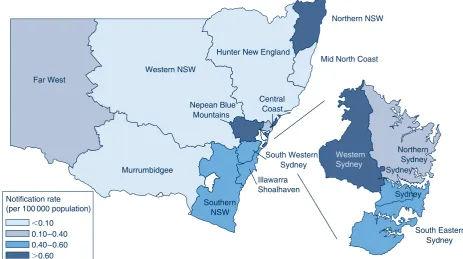
During the 10-year reporting period, 281 cases of mea-sles were notified at an average annual notification rate of 0.41 per 100 000 population (range: 0.06–1.25). Of the 281 cases of measles, 247 (88%) were laboratory con-firmed, with no trend in the annual case confirmation rates identified (range: 80–100%). There were case notifications every year, with as many as 90 reported in 2011 and as few as four in 2007; 2011 was also the first year in the study period when cases were reported every month (Figure 1). The highest average annual case notification rate in this period was in Northern NSW LHD (0.71 per 100 000 population) and the lowest was in Western NSW LHD (0.04 per 100 000 population) (Fig-ure 2). In total, 145 of the measles case-patients (52%)
0 5 10 15 20 Au g -0 1 Dec-0 1 A p r-0 2 Au g -0 2 Dec-0 2 Ap r-0 3 Au g -0 3 Dec-0 3 Ap r-0 4 Au g -0 4 Dec-0 4 A p r-0 5 Au g -0 5 Dec-0 5 Ap r-0 6 A u g-0 6 Dec-0 6 Ap r-0 7 A u g-0 7 Dec-0 7 Ap r-0 8 Au g -0 8 Dec-0 8 Ap r-0 9 Au g -0 9 Dec-0 9 Ap r-1 0 Au g -1 0 Dec-1 0 Ap r-1 1 Au g -1 1 Dec-1 1 Notifica tions Month, Year
Figure 1. Number of measles case notifications and hospitalisations by month of onset, NSW, 2002–2011.
were male, with annual fluctuations (range: 40–75%). There were 66 measles case-patients who were children aged under 5 years (24% of all measles cases) (Figure 3), of which 21 (7% of all measles case-patients) were infants aged under 1 year. Measles case notification rates were highest in the under 5-year age group (1.49 per 100 000 population) followed by 10–14-year olds (0.92 per 100 000 population) and 15–19-year olds (0.82 per 100 000 population). Notification rates for case-patients less than 5 years of age peaked in 2006 at 4.81 per 100 000 population (35% of 2006 cases) and were lowest
in 2005 (n¼0). During this period, the majority of
case-patients (n¼274, 98%) were among those born during or
since 1966. Since then, measles has been less common and people were unlikely to have been exposed to the illness as a child.
The completeness of reporting Aboriginal status for measles cases improved during the reporting period, with
an average annual completeness of 92% (range:
78–100%). There were 11 case-patients identified as Aboriginal people (rate 0.72 per 100 000 population), which was almost double that of non-Aboriginal people
(Rate Ratio¼1.80; 95% CI 0.27–12.11). Nearly all
(n¼10) of these cases occurred in 2011 and were
distributed across three LHDs: South Eastern Sydney, Far West
Western NSW
Murrumbidgee
Hunter New England
Northern NSW
Mid North Coast
Southern NSW
Illawarra Shoalhaven
Central Coast Nepean Blue
Mountains
Northern Sydney
Sydney
South Eastern Sydney South Western
Sydney
⬍0.10 Notification rate (per 100 000 population)
0.10–0.40 0.40–0.60
⬎0.60
Western Sydney
Sydney
Figure 2. Average annual measles case notification rates in NSW, for each local health district (per 100 000 population), NSW, for the period 2002–2011.
Source: NSW Notifiable Conditions Information Management System, Health Protection NSW.
0 1 2 3 4 5 6
2002 2003 2004 2005 2006 2007 2008 2009 2010 2011
Rate per 100
000 population
Year 0–4 yrs
5–9 yrs
10–14 yrs
15–24 yrs
25–39 yrs
40⫹ yrs
Figure 3. Measles case notification rate per 100 000 population for six age groups and year of onset, NSW, 2002–2011. Source: NSW Notifiable Conditions Information Management System, Health Protection NSW.
Illawarra Shoalhaven and Western Sydney. In 2011, case notification rates were significantly higher for Aboriginal people compared to non-Aboriginal people (6.03 and 1.14 per 100 000, respectively).
Of the 281 cases, 145 (52%) had not been vaccinated, 72 (26%) had unknown vaccination status, while 62 (22%) reported being partially and two fully vaccinated. Of the 217 without evidence of vaccination, 21 were too young to vaccinate (less than 1 year old), 31 were aged between 1 and 4 years, and 165 were aged over 4 years. Of the notifications in children aged 18 months to 4 years, 20 (77%) had not been vaccinated or had unknown vaccination status.
During the period, measles outbreaks were associated with infectious residents returning from international travel and infecting unimmunised people upon their return. Affected groups included high school students, culturally and lin-guistically diverse groups, prisoners, a faith-based group, infants too young to be immunised, children in child care, as well as visitors to general practices and emergency
departments.3,14–18 There were 38 case-patients who
acquired measles outside of Australia; one was in a visitor from overseas, the remainder were NSW residents return-ing from overseas travel (Figure 4). The median age of case-patients who acquired their infection overseas was 19 years (range: 6 months–41 years). The geographic origin of most of these imported measles cases were from the Asia Pacific and European regions.
Internationally, there are eight different clades and 24
subclades of measles viruses referred to as genotypes.19
During the reporting period, 80 (28%) measles case-patients
had specimens genotyped: 30 were found to be D9 (38%), 19 were D8 (24%), 13 were D4 (16%), 11 were D5 (14%) with H1 identified less frequently (9%) (Figure 5). No single genotype was identified in a large number of successive years, with the largest annual diversity of genotypes being four in 2008 and 2010, then three in 2009 and 2011, with fewer in other years.
Hospitalisations
There were 139 hospitalisations recorded with a measles diagnosis in the 10-year reporting period, corresponding to a rate of 0.20 hospitalisations per 100 000 population. There were 54 measles hospitalisations reported in chil-dren aged under 5 years (39% of all measles hospitalisa-tions), of which 21 were aged under 1 year. Hospitalisation rates in the under 5-year age group peaked in 2005–2006 at 2.08 per 100 000 (38% of 2005–2006 measles
hospitalisa-tions) and were lowest in 2004–2005 (n¼1).
Hospitalisa-tion rates were highest in those aged under 5 years (1.22 per 100 000 population) followed by 30–34-year olds (0.44 per 100 000) and 25–29-year olds (0.33 per 100 000). There were seven hospitalisations recorded with a diagnosis of measles in those aged over 65 years (in the same period, there were no measles notifications in this age group). There were seven Aboriginal people hospitalised with measles in the 10-year period (5% of all measles hospita-lisations), associated with a hospitalisation rate of 0.46 per 100 000 population. Aboriginal people had a 2.4 (95% CI 0.2–25.5) times greater yearly measles hospitalisation rate than non-Aboriginal people in NSW between 2001–2002 and 2010–2011. Measles with complications were reported in 25 cases (18%); encephalitis was reported in two cases, one in 2003–2004 and the other in 2010–2011; and measles complicated by pneumonia was recorded in 10 cases. 0
10 20 30 40 50 60
2006 2007 2008 2009 2010 2011
Number of
noti
fi
cati
ons
Year of onset
Figure 4. Number of measles case notifications by place of acquisition and year of onset, NSW, 2006–2011.
Discussion
Measles has generally been well controlled in NSW over the past decade. However, outbreaks of limited duration have occurred. For example, in 2006 an outbreak affecting more than 40 case-patients was found to be associated with a national tour of a spiritual leader. The public health investigation found that some members of the tour group were likely to have been infected with measles prior to
their arrival in Australia.17Further transmission occurred
in families members associated with the tour group.
Outside of the occasional outbreak, there have been low numbers of measles cases notified. In addition, cases have been found to have various genotypes identified during the period with no indigenous measles strain identified during the last decade. Sequencing and genotyping are powerful molecular tools to support epidemiological investigations
and to assist countries to adhere to elimination criteria.13
Access to genotyping information for measles cases is important to demonstrate the interruption of circulating virus strains and identify new importations of the measles virus.
The average annual case notification rate during the 10-year period dropped markedly compared to the pre-vious report for the period 1991–2000 (from 10.4 to
0.41 per 100 000 population).20 Case notification rates
differed by geographic area and were highest in the LHD
with the lowest vaccination coverage.21The 0–4-year old
age group had the highest notification rates, and within this age group most case patients were aged between 18 months and 4 years. We found that 52% of all case patients had not received any doses of measles-containing vaccine. Some of the unvaccinated case-patients were due or overdue for measles-containing vaccine, which is supported by a
detailed analysis of cases notified in 2011.13This
high-lights the importance of timely childhood vaccination. The introduction of MMR-V vaccine and bringing forward the timing of the second measles dose may further reduce disease burden among 0–4-year olds.
Under-immunised population groups that are susceptible to measles remain a feature of outbreaks, including: prisoners, culturally and linguistically diverse groups, as well as persons who object to the vaccination of their children. As
with previous national reports,22,23measles case
notifica-tion rates and hospitalisanotifica-tion rates were almost double for Aboriginal people during the overall reporting period but was not found to be statistically significant. However in 2011, this differential increased, and Aboriginal persons had statistically significantly higher measles notification rates.
Measles surveillance systems will not always identify
every case of disease,13,24as evidenced by the
retrospec-tive identification of measles index cases in emergency
department outbreaks13,25,26 and through analysis of the
hospitalisation data that identified possible case-patients that were not notified. Diagnostic or coding errors would most likely explain the additional measles hospitalisations identified among persons aged 65 years and over that were not notified. This misclassification may contribute to an overestimation of measles hospitalisations. Strategies for enhancing clinician awareness of measles are important for early diagnosis and have been successfully implemented at
the LHD level in NSW.27
Despite the successes in regional and global measles
control since 2000,28,29unvaccinated young international
travellers remain at risk of infection (and a potential source of infection for unimmunised contacts), as demonstrated 0
5 10 15 20 25
2002 2003 2004 2006 2007 2008 2009 2010 2011
Notif
icati
ons
Year D4
D5
D8
D9
H1
Figure 5. Number of measles case notifications by virus genotype and year of onset, NSW, 2002–2011.
Source: NSW Notifiable Conditions Information Management System, Health Protection NSW.
eliminated, importations have been found to reflect travel
destinations rather than global measles incidence.30In the
context of steadily increasing short term international departures from NSW during the reporting period, which
reached the highest on record in 2011,31 the current
targeting of this group with communication interventions by health authorities would appear relevant. The median age of imported measles cases indicates that international travellers of school age should also be targeted, as evi-denced by the outbreaks among school groups returning from overseas trips and in schools subsequent to student travel to affected areas.
Conclusion
Vaccination remains the only available protection against measles and is highly effective. Several challenges remain for NSW to maintain good measles control. All children should be vaccinated against measles on time through routine childhood immunisation. Identifying inadequately vaccinated children at the time of school entry could provide a fail-safe mechanism to increase immunisation coverage to the levels required to sustain control over the long-term. All young adults who travel internationally should be vaccinated. Continued effort is required to improve vaccination coverage among under-immunised populations; including prisoners, culturally and linguisti-cally diverse communities and Aboriginal communities. Clinician awareness remains important in the early identi-fication and control of measles to avoid outbreaks, and to enable the timely implementation of public health measures.
Acknowledgments
We acknowledge those who have notified cases of measles as well as the surveillance officers in public health units who manage NCIMS data. We also recognise the crucial work of laboratories performing measles diagnosis and are extremely grateful to the Victorian Infectious Diseases Reference Laboratory for performing sequenc-ing and genotypsequenc-ing of specimens.
References
1. Moss WJ, Griffin DE. Measles.Lancet2012; 379: 153–64.
doi:10.1016/S0140-6736(10)62352-5
2. Chiu C, Dey A, Wang H, Menzies R, Deeks S, Mahajan D et al. Vaccine preventable diseases in Australia, 2005 to 2007.
Commun Dis Intell2010; 34(Supp): S1–167.
3. Sheppeard V, Forssman B, Ferson MJ, Moreira C, Campbell-Lloyd S, Dwyer DE et al. Vaccine failures and vaccine effectiveness in children during measles outbreaks in
New South Wales, March-May 2006.Commun Dis Intell2009;
33: 21–6.
4. National Health and Medical Research Council. The Australian Immunisation Handbook. 9th ed. Canberra: Australian Govern-ment DepartGovern-ment of Health and Ageing; 2008.
6. National Centre for Immunisation Research and Surveillance. Vaccination. National vaccination coverage estimates. Available at: http://www.ncirs.edu.au/immunisation/coverage/ estimates/index.php (Cited October 2012).
7. Macartney KK, Durrheim DN. NSW immunisation perfor-mance: continuing progress but no room for complacency.
N S W Public Health Bull2011; 22: 169–70. doi:10.1071/ NB11040
8. Gidding HF, Gilbert GL. Measles immunity in young Australian
adults.Commun Dis Intell2001; 25: 133–6.
9. Heywood AE, Gidding HF, Riddell MA, McIntyre PB, MacIntyre CR, Kelly HA. Elimination of endemic measles
transmission in Australia.Bull World Health Organ2009; 87:
64–71. doi:10.2471/BLT.07.046375
10. Heath T, Burgess M, McIntyre P, Catton M. The national measles surveillance strategy. The National Centre for Disease
Control Measles Elimination Advisory Committee.Commun
Dis Intell1999; 23: 41–50.
11. NSW Ministry of Health. Measles response protocol. Available at: http://www.health.nsw.gov.au/factsheets/guideline/measles. html (Cited October 2012).
12. Australian Government Department of Health and Ageing Communicable Diseases Network Australia. Measles case definition. Available at: http://www.health.gov.au/internet/ main/publishing.nsf/Content/cda-surveil-nndss-casedefs-cd_ measl.htm (Cited October 2012).
13. Jayamaha J, Binns PL, Fennell M, Ferson MJ, Newton P, Tran T et al. Laboratory diagnosis, molecular characteristics, epidemiological and clinical features of an outbreak of measles
in a low incidence population in Australia.J Clin Virol2012;
54(2): 168–73. doi:10.1016/j.jcv.2012.02.025
14. Spokes PJ, Gilmour RE. NSW Annual Vaccine-Preventable
Disease Report, 2010.N S W Public Health Bull2011;
22(9–10): 171–8.
15. Spokes PJ, Gilmour RE. NSW Annual Vaccine-Preventable
Disease Report, 2009.N S W Public Health Bull2010;
221(9–10): 197–209.
16. Communicable Diseases Report, NSW, January and February
2008.N S W Public Health Bull2008; 19(4): 78.
17. Communicable Diseases Report, NSW, March and April 2006. N S W Public Health Bull2006; 17: 88–94. doi:10.1071/ NB06022
18. Communicable Diseases Report, NSW, for May 2003.N S W
Public Health Bull2003; 14(7): 151–8.
19. Measles virus nomenclature update: 2012.Wkly Epidemiol Rec
2012; 87(9): 73–81.
20. Brotherton J. EpiReview: Measles in NSW, 1991–2000.N S W
Public Health Bull2001; 12: 200–4. doi:10.1071/NB01068
21. Hull B, Dey A, Campbell-Lloyd S, Menzies RI, McIntyre PB.
NSW Annual Immunisation Coverage Report, 2010.N S W
Public Health Bull2011; 22: 179–95. doi:10.1071/NB11021
22. Menzies R, Turnour C, Chiu C, McIntyre P. Vaccine preventable diseases and vaccination coverage in Aboriginal and Torres
Strait Islander people, Australia 2003 to 2006.Commun Dis
23. Menzies R, McIntyre P, Beard F. Vaccine preventable diseases and vaccination coverage in Aboriginal and Torres Strait
Islander people, Australia, 1999 to 2002.Commun Dis Intell
2004; 28(Suppl 1): S1–45.
24. Measles – United States. 2011. MMWR 2012; 61(15): 253–7. Available at: http://www.cdc.gov/mmwr/preview/mmwrhtml/ mm6115a1.htm?s_cid=mm6115a1_e (Cited October 2012).
25. Bowen AC, Ferson MJ, Palasanthiran P. Consequences of an unrecognized measles exposure in an emergency department. Emerg Med Australas2009; 21: 491–6. doi:10.1111/j.1742-6723.2009.01230.x
26. Hope K, Boyd R, Conaty S, Maywood P. Measles transmission in health care waiting rooms: implications for public health
response.Western Pacific Surveillance and Reponse Journal
(in press).
27. Kohlhagen JK, Massey PD, Durrheim DN. Meeting measles elimination indicators: surveillance performance in a regional
area of Australia.Western Pacific Surveillance and Response
Journal2011; 2, e1–e1.
28. Medicine NL. of Progress Towards the 2012 Measles Elimina-tion Goal in WHO’s Western Pacific Region, 1990–2008. Releve´ e´pide´miologique hebdomadaire/Section d’hygie`ne du
Secre´tariat de la Socie´te´ des Nations¼Weekly epidemiological
record/Health Section of the Secretariat of the League of Nations 2009; 84, 271–9.
29. Progress in global measles control, 2000–2010.Wkly Epidemiol
Rec2012; 87: 45–52.
30. Rota PA, Rota JS, Redd SB, Papania MJ, Bellini WJ. Genetic analysis of measles viruses isolated in the United States between 1989 and 2001: absence of an endemic genotype
since 1994.J Infect Dis2004; 189(Suppl 1): S160–4.
doi:10.1086/374607
31. Australian Bureau of Statistics 3401.0 – Overseas Arrivals and Departures, Australia, Dec 2011 Media release: Short-term resident departures reach all time high. (2012). Available at: http://www.abs.gov.au/AUSSTATS/[email protected]/Previousproducts/ 3401.0Media%20Release1Dec%202011?opendocument& tabname%Summary&prodno=3401.0&issue=Dec%202011& num=&view= (Cited October 2012).
*ThePublic Health Act 2010(NSW) (http://www.health.nsw.gov.au/phact/)
ThePublic Health Act 2010(NSW) was passed by the NSW Parliament in December 2010 and commenced on 1 September 2012. The Public Health Regulation 2012 was approved in July 2012 and commenced, along with thePublic Health Act 2010(NSW), on 1 September 2012. The objectives of the Regulation are to support the smooth operation of the Act. The Act carries over many of the provisions of thePublic Health Act 1991(NSW) while also including a range of new provisions.