A Monthly Double-Blind Peer Reviewed Refereed Open Access International e-Journal - Included in the International Serial Directories
International Journal in Management and Social Science
http://www.ijmr.net.in email id- [email protected]
Page 120 IMPACT OF NEW TECHNOLOGY ON THE EXPORT POTENTIAL OF MSMEs: A STUDY OF INDOREREGION
PARUL SHARDA, Designation- RESEARCH SCHOLAR DEVI AHILYA UNIVERSITY, INDORE
ABSTRACT
This paper explores the impact of new technology on the export potential of MSMEs (Micro Small and Medium scale Enterprises) in Indore region. The study undertaken is descriptive in nature which includes surveys & facts finding enquiries to measure the impact of new and updated technology on the productivity of MSMEs in Indore region. The study is primarily based on primary data collected from 192 Micro, Small and Medium Enterprises in Indore. The paper concludes that the MSMEs situated in Indore region are equipped with latest technology in their production process that results in high quality products and cost effective production.
Key Words: Export Potential, Indore region, MSMEs (Micro Small and Medium scale Enterprises), new technology, productivity.
INTRODUCTION
In India the role of micro, small and medium enterprises (MSMEs) in the economic and social development of the country is well established. MSMEs contribution towards GDP was 22% in year 2011-2012, and rose to 37.54% in year 2012-2013 (PIB July 2014) showing a consistency of 11% growth rate every year. The major advantage of the sector is its employment generation at low capital cost. Its total employment in the MSME sector is 805.24 lakh in 2012-2013(PIB July 2014). The labor potential of the MSME sector is much higher than that of large enterprises. The sector provides employment to about 69 million persons through 26 million enterprises throughout the country. In recent years, the MSME sector has consistently registered higher growth rate compared with the overall industrial sector. With its agility and dynamism, the MSME sector has shown admirable innovativeness and adaptability to survive the recent economic downturn and recession.
As per the Report of the Working Group on Micro, Small and Medium Enterprises (MSMEs) Growth for 12th Five Year Plan (2012-2017), the sector accounts 45% of the manufacturing output and 40% of total exports of the country. Over 6000 products ranging from traditional to high-tech items are being manufactured by the MSMEs in the country. The labor to capital ratio in MSMEs and the overall growth in the sector is much higher than in the large industries. The geographic distribution of the MSMEs is also more even. Thus, MSMEs are important for the national objectives of growth with equity and inclusion.
The development of the micro, small and medium enterprises (MSME) sector is on the priority of Government Agenda. As per the Results-Framework Document (RFD) for Ministry of Micro, Small and Medium Enterprises (2012-2013), the Mission of the government is to – “Promote growth and development of globally competitive Micro, small and Medium Enterprises, including Khadi, Village and Coir industries, in cooperation with concerned Ministries / Departments, State Governments and other stakeholders by providing support to existing enterprises and encouraging creation of new enterprises. To endeavor and to achieve a cumulative growth of 40%-50% in the number of registered enterprises by the end of 12th Plan and enhance this sector's contribution to GDP from the present 8% to 10% by the end of 12th Plan.”
A Monthly Double-Blind Peer Reviewed Refereed Open Access International e-Journal - Included in the International Serial Directories
International Journal in Management and Social Science
http://www.ijmr.net.in email id- [email protected]
Page 121and it could only be possible when we match our product quality according to international standards. Therefore by adopting new and updated technology MSMEs can achieve the goal of government “MSMEs- Promote and grow global”. Internet-enabled environment helps in fast and accurate decision-making by the SMEs due to increased mobility. The critical components before SMEs are speed of services, access to information, empowering employees in terms of skill and delivering highest valued services at competitive cost. SMEs need IT-based solutions in terms of multi-tasking, expanding customer base, raising productivity, controlling cost, working remotely, fast and accurate decision-making and facilitating collaboration. SMEs have various needs to function in an aggregative manner in order to reach out for value addition by keeping in mind the variable cost model. IT usage by the SMEs raises productivity of the sector in particular and the economy in general (Shambhu Ghatak , 2009). Exporting can be one way of stimulating growth of SMEs; if SMEs gradually improves the quality standards of manufactured products they can capture more global shares. Boosting the contribution of small and medium enterprises in total exports of India is vital to India’s future economic growth (Divya Sampath 2006).
Definitions of Micro, Small & Medium Enterprises
In India, the term SSI (Small Scale Industries) is used far more often than SME and is based upon investment in assets. Although definition differ across countries, they have one thing in common ; the vast majority of SMEs are relatively small and over 95% of SMEs in Asia employ less than 100 people . Based on this, broad comparisons of the nature and role of SMEs are still possible even with differing definitions.
According to the provision of Micro, Small & Medium Enterprises Development (MSMED) Act, 2006 the Micro, Small and Medium Enterprises (MSME) are classified in two Classes:
(a) Manufacturing Enterprises- The enterprises engaged in the manufacture or production of goods pertaining to any industry specified in the first schedule to the industries (Development and regulation) Act, 1951) or employing plant and machinery in the process of value addition to the final product having a distinct name or character or use. The manufacturing enterprises are defined in terms ofinvestment in plant and machinery.
(b) Service Enterprises: The enterprises engaged in providing or rendering of services and are defined in terms of investment in equipment.
The limit for investment in plant and machinery / equipment for manufacturing / service enterprises, as notified, are as under:
Manufacturing Enterprises – Investment in Plant & Machinery
Description INR USD($)
Micro Enterprises up to Rs. 25Lakhs up to $ 62,500
Small Enterprises above Rs. 25 Lakh & up to Rs. 5 Crores
above $ 62,500 & up to $ 1.25 million
Medium Enterprises
above Rs. 5 Crores & up to Rs. 10 Crores
A Monthly Double-Blind Peer Reviewed Refereed Open Access International e-Journal - Included in the International Serial Directories
International Journal in Management and Social Science
http://www.ijmr.net.in email id- [email protected]
Page 122 Service Enterprises – Investment in EquipmentsDescription INR USD($)
Micro Enterprises up to Rs. 10Lakhs up to $ 25,000
Small Enterprises above Rs. 10 Lakh & up to Rs. 2 Crores
above $ 25,000 & up to $ 0.5 million
Medium Enterprises
above Rs. 2 Crores & up to Rs. 5 Crores
above $ 0.5 million & up to $ 1.5 million
Source: www.dcmsme.gov.in
Characteristics of MSMEs
Born out of individual initiatives &skills
Greater operational flexibility
Low cost of production
High propensity to adapt technology
High capacity to innovate & export
High employment orientation
Utilization of locally available human & material resources
Role of MSME-DI Indore
MSME-Development Institute (MSME-DI), Indore is a field level agency of Ministry of Micro, Small & Medium Enterprises (MSME) to take care of the needs of the MSME Sector in the state of M.P. in the area of Techno-economic and managerial consultancy service.
MSME headed by the Development Commissioner, under the ministry of Micro, Small & Medium Enterprises (MSME). Government of India is an apex body as well as the nodal agency for formulating, co-coordinating and monitoring the policies and programmes meant for promoting and development of Micro, Small & Medium Enterprises (MSME) throughout the country.
MSME DI, started in 1958 (Formerly known as SISI), is one of the field level agencies of MSME and is the only one of its kind in M.P Apart from offering various consultancy services, this institute also offers various technical and management training programmes for the benefit of prospective/ existing entrepreneurs. To assist the sector, having Field Testing Station at Bhopal and Branch MSME DIs at Gwalior & Rewa under the administrative control of MSME DI, Indore.
The MSME-DI Indore offers various services like training programmes and workshops for enhancing the knowledge of entrepreneurs related to improvement of new and updated technology in MSMEs.
Some of them are:
Modernization and Technology Up-gradation
a. Technology Up gradation studies/In plant studies.
b. Production-cum-process development Diversification of project
A Monthly Double-Blind Peer Reviewed Refereed Open Access International e-Journal - Included in the International Serial Directories
International Journal in Management and Social Science
http://www.ijmr.net.in email id- [email protected]
Page 123
UPTECH (Integrated Technology)
Up gradation and Management Programme, The objective of the project is to implement an integrated Technology Up gradation and Management programme addressed to the smaller skills based enterprises The programme is organized around clusters of enterprises and is designed to provide for the promotion cost that are inherent in transfer of technology from its producer to the end user .
MSME DI –SDTI (Micro, Small & Medium Enterprises (MSME -DI) – Selective Dissemination of Technology Information)
The objective of the project is to build up a database on the technologies that are available indigenously with technology institution and with industry, and also to build up a parallel database of the technology requirements of Micro, Small & Medium Enterprises (MSME -DI). The project provides an excellent opportunity to the small enterprises as well as those institutions and units that have technologies for offer /sale.
LITREATURE REVIEW
DC-MSME (June, 2014) During primary research it was found that the Development Center of Micro, Small and Medium Enterprises identified, MSME sector as engine of growth all over the world. Many countries of the world have established a SME Development Agency as the nodal agency to coordinate and oversee all Government interventions in respect of the development of this sector. In the case of India, also Medium establishment has for the first time been defined in terms of separate Act, governing promotion and development of Micro, Small and Medium Enterprises (MSME) i.e. Micro, Small and Medium Enterprises (MSME) development Act, 2006 (which has come into force from 02nd Oct, 2006) the Office of Development Commissioner (Micro, Small and Medium Enterprises) functions as the nodal development Agency under the Ministry of Micro, Small and Medium Enterprises (MSME).Consequent to the increased globalization of the Indian economy, MSMEs are required to face new challenges. Office of the Development Commissioner (MSME) has recognized the changed environment and is currently focusing on providing support in the fields of credit, marketing, technology and infrastructure to MSMEs. Global trends and national developments have accentuated Office of the Development Commissioner (MSME)'s role as a catalyst of growth of MSMEs in the country.
Dr. S.Baskaran (2013) identified thatSmall and Medium Enterprises play a vital role for the growth of Indian economy by contributing 45% of the industrial output, 40% of exports, 42 million in employment, create one million jobs every year and produces more than 8000 quality products for the Indian and international markets. As a result, MSMEs are today exposed to greater opportunities for expansion and diversification across the sectors. The Indian market is growing rapidly and Indian industry is making remarkable progress in various Industries like Manufacturing, Precision Engineering, Food Processing, Pharmaceuticals, Textile & Garments, Retail, IT, Agro and Service sectors. SMEs are finding increasing opportunities to enhance their business activities in core sectors.
A Monthly Double-Blind Peer Reviewed Refereed Open Access International e-Journal - Included in the International Serial Directories
International Journal in Management and Social Science
http://www.ijmr.net.in email id- [email protected]
Page 124the part of the government to take careful decisions and honest policy implementation to overcome the problems of MSME sector. A technologically vibrant, internationally competitive small and medium industry should be encouraged to emerge, to make a sustainable contribution to national income, employment and exports. It is imperative to take care of MSME sector to enable it to take care of the Indian economy.
Shambhu Ghatak (2009) in his study highlighted the impact of Information technology or Internet-enabled environment on SMEs; it helps in fast and accurate decision-making by the SMEs due to increased mobility. The critical components before SMEs are speed of services, access to information, empowering employees in terms of skill and delivering highest valued services at competitive cost. SMEs need IT-based solutions in terms of multi-tasking, expanding customer base, raising productivity, controlling cost, working remotely, fast and accurate decision-making and facilitating collaboration. SMEs have various needs to function in an aggregative manner in order to reach out for value addition by keeping in mind the variable cost model. IT usage by the SMEs raises productivity of the sector in particular and the economy in general.
4th All India Census for MSMEs 2006-2007 reports that, of the total working enterprises, proportion of micro, small and medium enterprises were 94.94%, 4.89% and 0.17%, respectively. Data also reveals that 10.49 lakh units (67.10%) were manufacturing enterprises, 2.52 lakh units (16.13%) were repairing and maintenance enterprises and 2.62 lakh units (16.78%) were service enterprises. Proportion of the enterprises operating in rural areas was 45.23 %.
Divya Sampath (2006) in her research considered Exporting to be one way of stimulating growth of SMEs; she finds that if SMEs gradually improves the quality standards of manufactured products they can capture more global shares. Boosting the contribution of small and medium enterprises in total exports of India is vital to India’s future economic growth.
METHODOLOGY & DESIGN
A Monthly Double-Blind Peer Reviewed Refereed Open Access International e-Journal - Included in the International Serial Directories
International Journal in Management and Social Science
http://www.ijmr.net.in email id- [email protected]
Page 125 SAMPLING PLANUniverse: Micro, Small and Medium enterprises situated in Indore region.
Sampling Unit: The research covered 192MSMEs as target respondents. Responses had been collected from different categories of enterprises as given below.
Types of Organizations
Micro Enterprise Small Enterprise Medium Enterprise
Sample Size: 192 enterprises have been examined falling into different categories.
Types of Organizations
Micro Enterprises 31 responses
Small Enterprises 77 responses
Medium Enterprises
84 responses Total 192
THE TOOLS
For Data Collection: Data has been collected using self designed questionnaire. The questionnaire was based on predetermined questions. The questionnaire was based on nominal scale (Yes /No) type questions.
For Data Analysis: Once the response is collected it was converted into the useful data that can be used for statistical analysis by using SPSS software. Further, to meet the objective of the research Graph is used as a statistical tool
RESEARCH HYPOTHESES:
H01: New technology has not significantly improved the production of MSMEs in Indore region.
RESULT
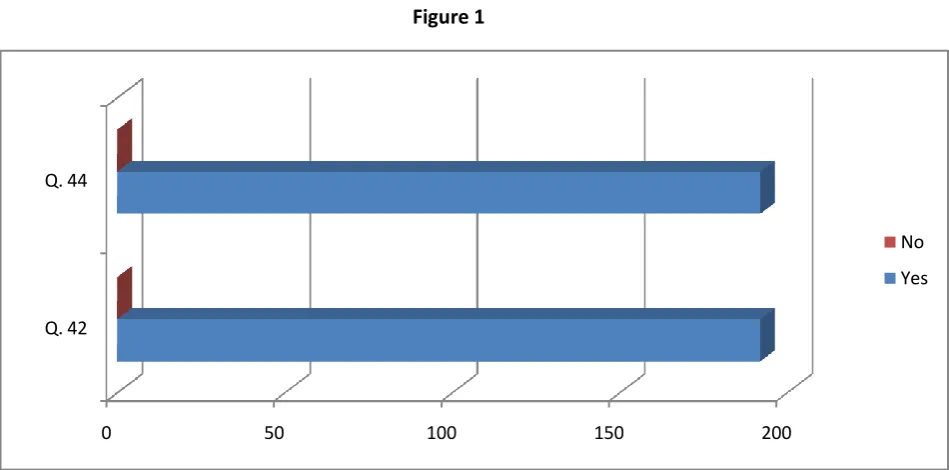
For the hypotheses, “H01: New technology has not significantly improved the production of MSMEs
A Monthly Double-Blind Peer Reviewed Refereed Open Access International e-Journal - Included in the International Serial Directories
International Journal in Management and Social Science
http://www.ijmr.net.in email id- [email protected]
Page 126 Figure 1Source: Author made graph.
The null hypothesis H01 stands rejected as the test was found significant.
The above graphical presentation of obtained result revealed that latest technology has significant impact on productivity of MSMEs. The study found that the MSMEs situated in Indore region are equipped with latest technology in their production process that results in high quality products and cost effective production. Out of the total responses it was found that 100 % of studied MSMEs have installed new technology (Refer Figure 1).
CONCLUSION: “New technology unknowingly gives birth to Innovation”
Hence, the result revealed that there is a significant relation between new technology and improved production of MSMEs in Indore and therefore the export potential is present in MSMEs in Indore. The study finds that the production increased due to new technology were ranging from 10 % to 40 %. The studied MSMEs also have given credit to the government schemes, workshops and training programmes held in Indore time to time in MSME-DI. It is a significant indicator which indicates that the enterprises in Indore region are ready and efficient in meeting export requirements related to capacity, quality and standards.
0 50 100 150 200
Q. 42 Q. 44
No
A Monthly Double-Blind Peer Reviewed Refereed Open Access International e-Journal - Included in the International Serial Directories
International Journal in Management and Social Science
http://www.ijmr.net.in email id- [email protected]
Page 127 REFERENCES Divya Sampath (2006), How SMEs become export competitive? CRISIL young thought leader series,Symbiosis Institute of Business Management, Pune.
ISHU GARG, SURAJ WALIA (2012), MICRO, SMALL & MEDIUM ENTERPRISES (MSMEs) IN POST REFORM INDIA: STATUS & PERFORMANCE, International Journal of Latest Trends in Engineering and Technology (IJLTET) Vol. 1 Issue 3 September 2012 134 ISSN: 2278-621X pp: 134-141.
October 2013, Dr. S.Baskaran, THE ROLE OF SME SECTOR IN NATION DEVELOPMENT, Asia pacific journal of research,Volume: I, Issue: X,ISSN-2320-5504.
PIB-Press Information bureau (2014).GOI, Ministry of MSME, July.
Shambhu Ghatak (2009). Micro, Small and Medium Enterprises (MSMEs) in India: AnAppraisahttp://www.linksme.co.in/documents/Small_and_Medium_Enterprises_in_India.
Working Group Report on MSME sector,(2012).www.dcmsme.gov.in.
www.msmeindore.nic.in