Econplast Technology Recycling of Plastic Waste
into Concrete in Absence of Heating Treatment
Tanveer A. Inamdar
Department of Mechanical Engineering Pune, Maharashtra, India
Abstract
Non-bio-degradable waste plastic is a staunch global problem. Plastic wastes have harmful effects on the all the biological creatures in the ecosystem. The aim of this study is to solve the problems related to the degradation of waste plastic without harming the environment through ‘Economical Concrete and Plastic’ (Econplast) technology. It includes bonding of all categories of waste plastic and concrete mixed with specialized ‘Economically Concrete Optimizer’ (ECO) solution in absence of heat and heating treatment. The experimental setup is divided into four units, plastic waste is converted into granules in the shredding unit, which is then mixed and processed with crush sand, cement and ECO along with water in mixing unit, resulting into plastic mixed concrete, this plastic mixed concrete further molded or compress by vibrating unit and manual brick press unit to obtain different product for infrastructural development. Test samples are prepared with different percentage of plastic, concrete and ECO. Two types of tests have been carried out, i.e. wet test (fluidity and bulk density), mechanical test (compression). Results indicate that there is an improvement in the physical property of concrete with an increase in the percentage of plastic. Furthermore, there is also an acceptable decrement in the mechanical property of concrete. ECO plays an important role in bonding and settling of concrete and waste plastic. In this technology, due to the absence of the heating effect, there is a reduced carbon emission, therefore, reducing the carbon footprints.
Keywords: Plastic Waste Recycling Technology, Econplast, ECO, Concrete Products, Strength, Bulk Density, Increased Productivity, Recycling Without Heating Treatment, Cement, Brick, Pavement Block, 50 Micron, Plastic Waste, Concrete
_______________________________________________________________________________________________________
I. ECONPLAST TECHNOLOGY
Recycling of Plastic Waste into Concrete in Absence of Heating Treatment
Waste plastic especially plastic bags and bottles do not only pollute the land but also the oceans and rivers (Conserve Energy Future). Plastic waste is documented in the body of marine animals which effects to injured 400 species of marine animal, 7 species of sea turtle (The Effects of Plastic Waste on Animals, 2015). The USA, China, and India are the major plastic producing countries, and plastic production in India rise to 4.77 MT (Million Ton) in a period of 2005-2006 (TirthankarBanergy, 2012). The Traditional recycling technologies contain heating treatment and create carbon emission, which is responsible to increase carbon footprints. In the past, researchers have carried out studies of plastic mixed with concrete and analyzed its behavior. A proper percentage of fine aggregate replaced by the HDPE plastic may be beneficial to tensile strength development. (CHIEN-CHUNG CHEN, 2015). Waste plastic bag increase the workability, fluidity of concrete significantly (Youcef Ghernouti, 2014). The use of plastic waste in concrete increases the air content of the HDPE concrete, inhibiting the transfer of heat through the slab. (CHIEN-CHUNG CHEN N. J., 2015)
In the year 2016 team of C Gopu Mohan introduce the technology to reuse plastic waste in concrete, this technology required heating process on plastic before immersing it with sand particles, the result of this method leads to decrease adhesive strength between waste plastic and sand particles (C Gopu Mohan, 2016). In 2015 Dr. G Kaliavarathan and team presented the technology with similar ideology, this technology contains a heating process on the wet mixture of concrete and plastic (Dr. G Kaliavarathan1, 2015) . However, the heating process on the wet mixture of concrete directly affected the water level contain and property of cement (HAGER∗, 2013).
This paper presents the Econplast manufacturing technology, which is design to reuse plastic with concrete, without indulging in any heating treatment. This technology reuses and recycles all type of waste plastic with special reference to plastic below 50-micron, and produce plastic mixed concrete (Econplast Concrete) that reduce the carbon emission and is environmentally sustainable. This Econplast concrete can be used to make Pavement block, Brick, Road divider, Benches, and different concrete products by molding or compressing.
II. MATERIALS
Magnesia (MgO) 0.1 to 4% Sulphur trioxide (SO3) 1 to 3% Soda and/or Potash (Na2O+K2O) 0.5 to 1.3% The Chemical Property of Cement (The constructor )
Property of Waste Plastic
Waste plastic is a combination of a different category of plastic having variety in their physical and chemical property.
Property of ECO
ECO is the specialized solution, design to act as a binding agent between plastic and concrete. Different amount of ECO is manipulated in the mixture along with an appropriate amount of water.
III. TECHNOLOGY
Econplast manufacturing technology is divided into four units, the detail working is as follows.
Plastic Shredder
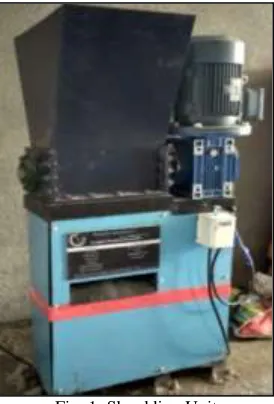
Plastic Shredder is a compact arrangement of Spiral cutting blade, Multi-cutter ring blade, Adjustable front blade, and separating plate. The compact arrangement of different blades provides the scissor effect, which results in the shredding of plastic material into fine granules ranging from 2mm to 5mm. Plastic shredder is designed to operate on all type and category of plastic waste in a single cycle.
Fig. 1: Shredding Unit
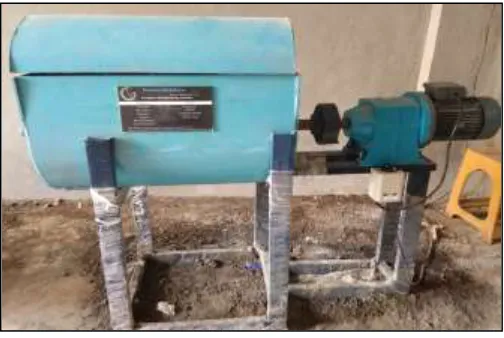
Mixing Unit
Fig. 2: Mixing Unit
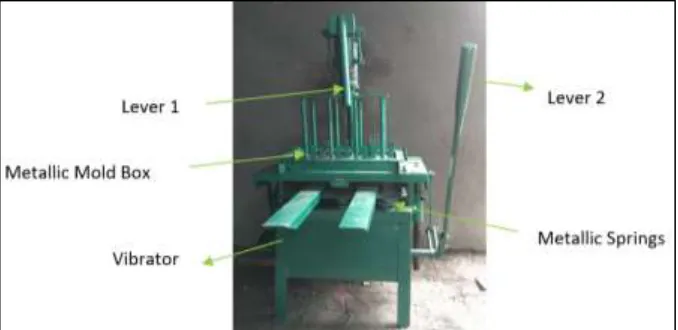
Manual Brick Press Unit
Manual brick press machine is the fully human operating system along with the electrical vibrator. The principle of lever reaction is manipulated to achieve manually required compression force. The present system has the arrangement to mold and compresses four brick block in a single cycle with the dimension of 220*120*50 mm each.
Fig. 3: Manual Brick Manufacturing Unit
Vibrating Table
Vibrating table is a bulky metallic table; it has the arrangement of the electrical vibrating motor to generate a required frequency of vibration.
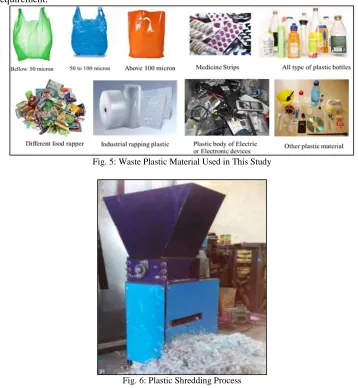
Fig. 5: Waste Plastic Material Used in This Study
Fig. 6: Plastic Shredding Process
Mixing
The strength of concrete is directly proportional to homogeneity of the mixture. The shredded waste plastic, cement, Crush sand, ECO along with water, homogeneously mixed in the mixing chamber for the specific time cycle.
Table – 1
Quantity of Mixing Material Sr.
No Material 0% plastic 10% plastic 20% plastic 30% plastic
1 Cement 22% 22% 22% 25%
2 Crush
sand 77% 77.42% 76.50% 75%
3 Plastic 0% 0.58%(by weight) 10% (by volume)
1.5%(by weight) 20% (by volume)
2%(by weight) 30%(by volume) 4 ECO --- 8ml/Kg of cement 15ml/Kg cement 20ml/kg of cement
5 Water 800-900 ml/kg of
Fig. 7: Plastic Granules, Cement, Crush Sand & ECO in Mixing Unit
Molding & Setting
Econplast concrete has two be mold into a different size, and shapes, to be used for infrastructural development. In this study, two methods are manipulated for molding and settling of Econplast concrete i.e. Vibrating Unit and Manual Brick Press Unit.
Vibrating Unit
Econplast concrete is poured in rubber mold box and vibrated on desired frequency for specific time duration on a vibrating table. This process helps to release air bubbles which are trapped inside the mold box and wet Econplast Concrete, and also increases the compactness and surface finish of the final product.
Fig. 8: Wet Molds & Final Products
After this process, the Econplast concrete allows settling for the specific duration of time along with mold box. Manual Brick Press Unit
Econplast concrete is poured in the metallic molds, which are placed on the removable wooden plank. Removable wooden plank is placed on the arrangement of metallic springs and electrical vibrator. With the help of an arrangement of linkages and levers i.e. lever 1, the wet Econplast concrete is compressed by manual force along with vibration generated by an electrical vibrator. Use of an electrical vibrator reduces the required manual forces for compression.
Fig. 10: Econplast Bricks
Once the compression process is completed, the electrical vibrator is turned off, and the metallic mold box is lifted, and molded bricks are separated by actuating lever 2 followed by lever 1. Molded Econplast brick is allowed to settle along with wooden plank for the specific duration of time.
V. TESTING
It is important to understand the efficiency and impact of Econplast technology on Econplast concrete production. It is also important to identify the physical and mechanical property of Econplast concrete without heating treatment by the use of ECO solution as an adhesive.
Preparation of Specimen
In this study, plastic is introduced in four different categories, i.e. 0% 10 %, 20% & 30% by volume, along with the different amount of ECO, as shown in table .01. With each individual composition, three molded samples are prepared with the dimension of 60*120*250 mm.
Slump Test
Slump test relates with the fluidity of concrete. In this study plastic granules replace the granules of crush sand, plastic is smooth and lighter than crush sand. As per the recorded observation, the fluidity of Econplast concrete is directly proportional to the increase in the percent of plastic.
Graph 1: Slump Test in CM vs. Compositions
In this study, composition with 30% of plastic by volume shows higher fluidity than the other compositions.
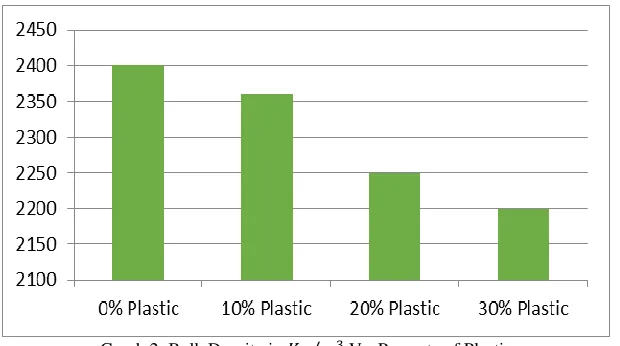
Bulk Density of Concrete
Graph 2: Bulk Density in 𝐾𝑔 𝑚⁄ 3 Vs. Percente of Plastic
The Results states that composition with 30% of plastic by volume shows lowest bulk density.
Weight
Test samples with similar shape and size are prepared by using four different compositions. Observation states that the weight of the sample is inversely proportional to the increase in the percent of plastic.
Graph 3: Weight in Kg vs. Percent of Plastic
Compressive Strength
Compressive strength is tested on a test sample cured for the duration of 14days and 28days, with the plastic percent ranging from 0%, 10%, 20%, and 30% along with ECO. Observation and results indicate that the compressive strength is indirectly proportional to the increase in the percent of plastic granules.
Fig. 11: Compression Test
Graph 4: Load in N vs. Percent of Plastic Granules
VI. CONCLUSION
This study presents ECONPLAST Technology, Investigate Econplast Concrete with variation in percent of waste plastic granules, and ECO solution as an adhesive between plastic and concrete. Analyzing the working of technology, observation, and results of Econplast concrete, the following conclusions are drawn
The Shredding unit of ECONPLAST technology is capable to shred all type and category of plastic waste into fine granules ranging from 2mm to 5mm in one cycle. This unit especially shows high results on plastic bellow 50micron to 200micron. The Mixing Unit of ECONPLAST Technology, capable to reduce the impact of centrifugal forces on plastic and gives a homogeneous mixture, results in high quality of Econplast concrete.
The Vibrating unit of Econplast technology is capable to efficiently remove the air bubble and air gaps from the rubber mold by vibrating on specific frequency for a specific time duration, and also increases the compactness and surface finish of the final product.
The Manual Brick manufacturing unit has manipulated the lever principle and linkages, this arrangement is capable to manually generate required compressive force and gives desired compactness and surface finish to the final product.
The appropriate use of ECO in the mixture along with water acts as a binding agent between plastic and concrete. The use of ECO reduces the requirement of heating process on plastic for recycling. An appropriate amount of ECO in the mixture increases the compactness and reduces the setting time for Econplast concrete.
The use of plastic granules increases the fluidity of Concrete. The fluidity of concrete is directly proportional to the increase in the percent of plastic waste. Use of 30% of plastic waste by volume increases the fluidity by 40%. Due to increment in fluidity, Econplast concrete is capable to flow and settle in a sharp corner and round edges which improve the surface finish of the output product.
The bulk density of concrete is inversely proportional to the increase in the percent of plastic waste. Use of 30% of plastic waste by volume reduces the Bulk density by 10%. The Decrement in bulk density results to increase the productivity of Econplast concrete.
The results of the decrement in bulk density also reduce the weight of the Econplast concrete block. Use of 30% plastic by volume reduces the weight by 18 to 20%. The decrement in weight reduces the handling and transportation efforts.
The observation and results indicate that the compressive strength is inversely proportional to the increase in the percent of plastic. Use of 30% plastic by volume reduces the compressive strength by 9 to 10%.
REFERENCES
[1] CHIEN-CHUNG CHEN, 2. J. (2015). CONCRETE MIXTURE WITH PLASTIC AS FINE AGGREGATE. International Journal of Advances in Mechanical and Civil Engineering, ISSN: 2394-2827.
[2] Civil digital . (n.d.). Retrieved from https://civildigital.com/compressive-strength-concrete-concrete-cubes/
[3] Conserve Energy Future . (n.d.). Retrieved from https://www.conserve-energy-future.com/reasons-why-plastic-bags-should-be-banned.php [4] Hager. (2013). Behaviour of Cement Concrete at Temprature. Bulletine of the Polish Academy of Sciences Technical Sciences, vol 61, 1.
[5] Kaliavarathan, D. G. (2015). Design and fabrication of plastic reinforced brick manufacturing machine. International Resurch Journal of Engineering and Technology.
[6] Mohan, C. G. (2016). Fabrication of Plastic Brick Manufacturing Machine and Analysis . IJIRST.
[7] P.Rajkumar. (2015). A study on the Plastic Waste and Environmental Degradation . Madurai India: ABC Journal of Advance Resurch,Volune 4,N. 1 (2015). [8] The constructor . (n.d.). Retrieved from https://theconstructor.org/building/composition-of-portland-cement/5725/
[9] (2015). The Effects of Plastic Waste on Animals. Rainbow Light Nutritional Systems Inc.
[10] TirthankarBanergy. (2012). PLASTICS WASTE MANAGEMENT IN INDIA: AN INTEGRATED SOLID WASTE MANAGEMENT APPROACH. Handbook of Environmental and Waste Management Vol. 2 , 4.