Undergraduate Journal
Volume 1 | Issue 2
Article 4
2014
Applying Genetic Programming to Bytecode and
Assembly
Eric Collom
University of Minnesota, Morris
Follow this and additional works at:
http://digitalcommons.morris.umn.edu/horizons
Part of the
Programming Languages and Compilers Commons
This Article is brought to you for free and open access by University of Minnesota Morris Digital Well. It has been accepted for inclusion in Scholarly Horizons: University of Minnesota, Morris Undergraduate Journal by an authorized administrator of University of Minnesota Morris Digital Well. For more information, please [email protected].
Recommended Citation
Collom, Eric (2014) "Applying Genetic Programming to Bytecode and Assembly,"Scholarly Horizons: University of Minnesota, Morris Undergraduate Journal: Vol. 1: Iss. 2, Article 4.
Applying Genetic Programming to
Bytecode and Assembly
Eric C. Collom
University of Minnesota, Morris
[email protected]
ABSTRACT
Traditional genetic programming (GP) is typically not used to perform unrestricted evolution on entire programs at the source code level. Instead, only small sections within pro-grams are usually evolved. Not being able to evolve whole programs is an issue since it limits the flexibility of what can be evolved. Evolving programs in either bytecode or as-sembly language is a method that has been used to perform unrestricted evolution. This paper provides an overview of applying genetic programming to Java bytecode and x86 as-sembly. Two examples of how this method has been imple-mented will be explored. We will also discuss experimental results that include evolving recursive functions and auto-mated bug repair.
Keywords
evolutionary computation, x86 assembly code, Java byte-code, FINCH, automated bug repair
1.
INTRODUCTION
GP is a set of techniques used to automate computer prob-lem solving. This is done by evolving programs with an evolutionary algorithm (EA) that imitates natural selection in order to find a solution. Traditional GP has commonly been used to evolve specific parts of programs instead of full-fledged programs. This is because it is very hard to deal with semantic constrains in source code. Source code is purely syntactical and does not represent the semantic constraints of the language. However, if we would deal with these se-mantic constraints it would allow for unrestricted evolution and more flexibility in GP. Evolving bytecode and assem-bly, instead of source code, is a method that allows for this flexibility. This is possible because bytecode and assembly languages are less restrictive syntactically than source code. We discuss this issue further in Section 3.
Orlov and Sipper [5] propose a method for applying GP to full-fledged programs that requires a program to be in Java bytecode. Schulte, et al., [7] apply a similar method with
This work is licensed under the Creative Commons Attribution-Noncommercial-Share Alike 3.0 United States License. To view a copy of this license, visit http://creativecommons.org/licenses/by-nc-sa/3.0/us/ or send a letter to Creative Commons, 171 Second Street, Suite 300, San Fran-cisco, California, 94105, USA.
UMM CSci Senior Seminar Conference, April 2014Morris, MN.
both Java bytecode and x86 assembly. Orlov and Sipper [6] focus on evolving simple programs as a whole while Schulte, et al., [7] focus on automated bug repair in programs.
This paper is organized as follows: Section 2 covers the background needed for understanding the application of GP to bytecode and assembly. It contains information on Evo-lutionary Computation (EC), Java bytecode, and the Java Virtual Machine. Section 3 describes the benefits of evolv-ing assembly and bytecode. Section 4 illustrates how Orlov and Sipper [6] evolved Java bytecode. Section 5 explores how Schulte, et al., [7] evolved both x86 assembly and Java bytecode. Section 6 summarizes some of the experimental results from [6] and [7]. Section 7 discusses possible future work and ideas.
2.
BACKGROUND
The components of EC and GP will be explored in this section. Java bytecode and various details of theJava Vir-tual Machine (JVM) will also be discussed. We will only address Java bytecode since knowledge of x86 assembly is not required in order to understand the research done by Schulte, et al., [7]. Also, throughout the rest of this paper, the term instruction-level code will be used when referring to either Java bytecode or x86 assembly.
2.1
Evolutionary Computation
EC is a field of computer science and artificial intelligence that is loosely based on evolutionary biology. EC imitates evolution through continuous optimization in order to solve problems. Optimization in EC is driven by the selection of more successful individuals. The representation of what an individual is depends on the problem being solved. For example, it can be a string of bits, a parse tree, or a struc-tured object. In this paper, the individuals will be programs in Java bytecode and x86 assembly.
Initial Population
Offspring Population
Problem Solved?
Return Solution
NO
Yes Selection
Individuals Selected For Reproduction
Genetic Operators
Figure 1: The process of Evolutionary Computation
the process of evolution is repeated until a solution is found or until a predetermined number of generations is reached. If the limit of generations is reached then the most fit indi-vidual is returned.
GP is a tool that uses the EC process to evolve programs. A fashion in which GP selects individuals, for sexual repro-duction, is through tournament selection. A certain number of individuals are chosen for a simulated competition and the individual with the highest fitness wins. That individual is then selected to be a parent.
One way sexual reproduction is simulated in GP is through the genetic operator calledcrossover. Crossover is the pro-cess of taking two parent individuals and extracting a section of code from one and then replacing it with a section from the other program to form an offspring. Mutationis another genetic operator that is used to produce offspring. Mutation performs random changes on a randomly chosen section of a program.
2.2
Java Bytecode and the JVM
Java bytecode is an “intermediate, platform-independent representation” [5] of Java source code. However, “imple-mentors of other languages can turn to the Java Virtual Machine as a delivery vehicle for their languages” [2]. A few examples of languages with which this has been done are Scala, Groovy, Jython, Kawa, JavaFx Script, Clojure, Er-jang, and JRuby. All these languages can be compiled to Java bytcode and be evolved at the instruction-level.
The JVM executes bytecode through a stack-based archi-tecture. Each method has a frame that contains an array of local variablesand its ownoperand stack. A new frame is created when a method is invoked. When a method is done executing, the frame is destroyed [1].
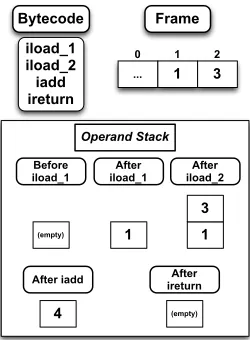
Figure 2 is a simple example of what Java bytecode looks like and how the stack works. Bytecode consists ofoperation codes(opcodes) that perform operations and can manipulate both the stack and the frame. Each of the opcodes in Figure 2 contain the prefixiwhich stands for the primitive integer type. These opcodes can only manipulate integers. The
iload_1 iload_2 iadd ireturn
Bytecode Frame
... 1 3
After iload_1
1
After iload_2
1 3
After iadd
4
After ireturn
(empty)
Operand Stack
1 2
0
Before iload_1
(empty)
Figure 2: In this example we are assuming that the frame already contains the local variables 1 and 3 to retain simplicity. Wheniload_1is executed, it takes the element from the frame at index 1 and pushes it onto the stack. iload_2 does the same thing but with index 2. iaddpops two elements from the stack, which both must be of integer type, adds them and then pushes the result to the stack. ireturn simply pops the stack and returns that element.
prefix is followed by the operation to be executed.
The opcodes used in this paper are: iconst_n,istore_n,
iload_n, iadd, isub, and ireturn. iconst_n pushes an integer value of n on the stack. istore_n pops the stack and stores that value at index n on the local variable array on the frame. iload_n takes the value of the element at indexnon the array of local variables and pushes it to the stack. iadd pops two elements from the stack, adds them and pushes the result to the stack. Similarly, isub pops two elements, subtracts the second element from the first element and pushes the result to the stack. ireturnsimply pops the stack and returns that value.
3.
CONSTRAINTS AND BENEFITS
While it would be useful, it is difficult to evolve an en-tire program in source code due to semantic constraints. This section will explore why it is difficult to deal with se-mantic constraints in source code and why it is easier at the instruction-level. We will discuss some of the benefits that arise from being able to deal with these constraints and evolving at the instruction-level.
3.1
Source Code Constraints
mean-float x; int x=7;
int y=7; float y;
if(y>=0){ if(y>=0){
x=y; y=x;
}else{ x=y;
x=-y; }
} System.out.println(z);
System.out.println(x);
(a) (b)
Figure 3: Both (a) and (b) are valid code syntac-tically however (b) is not valid semansyntac-tically. This is because y is uninitialized and then called in the if statement. Also, assigning a float to an int vio-lates type constraints and z in the print statement is undefined. Adapted from [6].
class Robot{ ...
double robotSpeed(){
double evolvedVariable = valueFromEA; return (robot.location + evolvedVariable)/2; }
... }
Figure 4: This is a simple example of how tradi-tional GP typically only evolves small sections of code. In this example everything before and after
robotSpeed() is already written and is not evolved. The only thing that the EA modifies is the variable
evolvedVariablewhich is assigned the value of some expression evolved by the EA.
ing. For example, the sentence “The sun rises in the west” is syntactically correct. However, the sentence is semantically incorrect since the sun rises in the east. The same concept applies to source code. In Figure 3 both 3(a) and 3(b) com-ply with the syntactical rules of Java but 3(b) breaks the semantic rules and thus is illegal code. In 3(b), variableyis uninitialized before the test in the if statement, assigningy
toxviolates a type constraint, and variablezis not defined. In order to write a program to evolve source code we would have to deal with all these constraints. While this task is possible, it would require creating a full-scale compiler to check for these semantic constraints [6].
Due to the difficulty of dealing with semantic constraints, in source code, it is frequently easier and less time consuming to avoid dealing with as many constraints as possible. Be-cause of this it is common in traditional GP to evolve only specific areas in a program such as expressions or formulae. This usually results in most of the program being written before, and remaining the same after, evolution. Figure 4 is an example of one way GP typically evolves source code.
3.2
Instruction-Level Code Benefits
Instruction-level code generally consists of a small set of instructions [7]. For example, Java bytecode consists of two
Line Parent 1 Parent 2 Good Bad Offspring Offspring 1 iconst 1 iconst 4 iconst 4 iconst 4 2 iconst 3 iconst 2 iconst 2 istore 1
3 istore 1 istore 1 istore 1 istore 2
4 istore 2 istore 2 istore 2 istore 2 5 iload 1 iload 1 iload 2 iload 1 6 iload 2 iload 2 iload 2 iload 2
7 iadd isub isub isub
8 ireturn ireturn ireturn ireturn
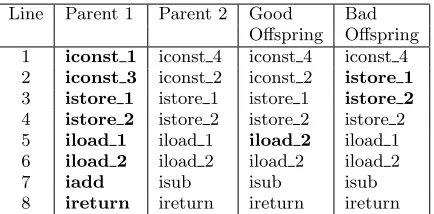
Figure 5: This is an example of two possible out-comes of performing unrestricted crossover on par-ents 1 and 2. The bold in the good and bad offspring represent the code from parent 1 replacing code in parent 2. The bad offspring breaks atistore_2since there is nothing on the stack to pop.
hundred and two instructions [2].1 Instruction-level code is usually simpler syntactically and there are less semantic constraints to violate. There is a lower risk of producing a non-executable program during evolution and it is easier to design an EA that deals with the semantic constraints. Thus, it is easier to create an EA, at the instruction-level, that can perform unrestricted evolution on programs.
One of the benefits of performing unrestricted evolution on a program is that evolution can be performed on the program as a whole. The EA does not have to focus on a specific part of the program in order to perform evolution. When evolving instruction-level code the initial population of programs do not have to harness a great deal of code in order to find a solution. An EA can evolve a minimal amount of code into a full-scale working program.
Also, when an EA is developed for source code, it usu-ally only works for a single high-level language. However, a program written in a high-level language can be compiled to instruction-level code. Then, that program can be evolved at the instruction-level. Once evolved, the result can be decom-piled back to its original language. Figure 8 is an example of this being done with Java source code. There are many high-level languages that compile into instruction-level code, such as the ones listed in Section 2.2 that compile to Java bytecode.
4.
FINCH
FINCH is a program developed by Orlov and Sipper [5, 6] that evolves Java bytecode programs through crossover. It takes two programsAandBand identifies randomly cho-sen sections αand β respectively. It then takes sectionα
and inserts it into the previous location ofβ. The resulting program is then analyzed to see if it is executable.
4.1
Crossover and Validating Offspring
Evolving Java bytecode reduces but does not remove the possibility of producing non-executable bytecode. While Java bytecode has a simpler syntax than source code, it still continues to have syntactical constraints. Orlov and Sipper [5] address this issue by checking if an offspring is ex-ecutable before letting it join the evolved population, thus ensuring offspring produced through crossover contain valid
1Java bytcode consists of 255 instructions but 53 of them
bytecode. If an illegal offspring is produced, the reproduc-tion process is repeated, with the same parents, until a good offspring is produced or a predetermined number of attempts have been made.
In order to clarify, letαandβ be sections of code of two programsAand B, respectively, on which crossover is being applied. Semantic constraint checks for stack depth, variable type, and control flow were done to assure good crossover. The following is how these checks were made.
The stack and its frame must be type compatible. The stack must have enough elements on it so thatstack under-flow does not occur. Stack underflow is an attempt to pop from an empty stack. Stack and frame compatibility is ac-complished by assuring that stack pops ofβ have identical types to the pops in α, and that stack pushes of α have identical types to stack pushes ofβ.2
When replacing β with α, variables written before and after must be compatible with the change. Variables written byα must have identical types that are read afterβ. All variables read afterβand not written byαmust be written beforeβ. Finally, all variables read byα must be written beforeβ.
All jumps within the bytecode should not cause the pro-gram to break. There must be no jumps intoβand no jumps out ofαsince there is a high probability that such a jump would break the code. For example, even though a jump out ofαis assured to go to an existing line of code inA, it is not assured do go to an existing line of code inB when replacingβ.
Figure 5 is an example of unrestricted crossover resulting in both a good and a bad offspring. Letα be the opcode
iload_2 from parent 1 and β be iload_1 from parent 2. Replacingβwithαin parent 2 results in a good a crossover. This is because the value at index 2 on the frame is an integer which respects the type constraints. Now, letαbe lines
istore_1 istore_2
in parent 1 andβbe lines
iconst_2 istore_1
in parent 2. In this case, replacingβ with α in parent 2 results in a bad offspring. Only one integer is pushed to the stack followed by twoistorecalls. The secondistore
call at line 3 attempts to pop from an empty stack causing stack underflow. This offspring would fail the stack depth constraint.
4.2
Non-Halting Offspring
A problem that arises from evolving unrestricted bytecode is that the resulting program might enter a non-halting state. The previously mentioned checks for good offspring, in Sec-tion 4.1, do not check for this issue. This is because it is a run time error. This especially becomes a concern when evolving programs that contain loops and recursion. Orlov and Sipper [6] deal with this by counting how many calls are made to each function while running the program. An exception is thrown if too many calls are made to a function. The lowest possible fitness is assigned to an individual who fails this test.
2In [5] the constraints are more sophisticated. See [5] for
more details.
Orlov and Sipper [6] chose to count the calls to each func-tion to avoid having to either run each program on a separate thread or set a run time limit. They decided against running each program on a separate thread because killing a thread can be unreliable and unsafe for the GP as a whole. They also decided against setting a time limit due to the difficulty of defining how long a program should run, since this could vary greatly depending on the program being run and the CPU load.
5.
AUTOMATED BUG REPAIR
Schulte, et al., [7] focused on evolving x86 assembly and Java bytecode for the purpose of program repair and debug-ging. In their tests they took medium to large sized pro-grams in Java, C, and Haskell that contained a bug. These bugs were common human errors such as having a for-loop index off by one.
5.1
Validating Offspring
Schulte, et al., [7] chose not to assure that their offspring were valid instruction-level code. Instead, they decided to let all produced offspring into the next generation. This produced a considerable number of individuals with a fitness of zero due to being non-executable.
Test cases were used to calculate the fitness of each in-dividual. The test cases consisted of a set ofpositive tests and one negative test. Positive tests were already passing tests and the negative test was the initially failing test. The positive tests were used to make sure the program retained functionality. The negative test was used to check if an offspring fixed the bug. Each offspring was assembled and linked to either an executable binary (x86) or a class file (Java bytecode). If the program failed to assemble or link, it obtained a fitness of zero. Otherwise, it was run against the tests. The fitness score was calculated as the weighted sum of tests passed, with the negative test being worth more since it represented the bug being repaired.
5.2
Genetic Operators
Schulte, et al., [7] used multiple tournaments consisting of three individuals to select fit individuals for reproduction. Mutation was used on 90% of the population and crossover on the rest to produce the offspring population. A preference was given to mutation because they found it produced better results for the type of problems being solved. Since each bug only required a minor change, such as changing a zero to a one, using a large amount of crossover or more complex operators generally lengthened the search time.
Many of the programs being evolved were very large, con-sisting of thousands of lines of instruction-level code. Be-cause of this [7] used a weighted path to select what sec-tions of code to apply mutation and crossover to. Each line of instruction-level code was given a weight that was calcu-lated by checking which tests had executed that instruction. This weight was used to indicate how relevant that line of code was to the bug. A path weight of 1.0 was assigned if the instruction was only executed by the negative test case. A weight of .1 was given if the instruction was executed by both the negative test case and at least one positive test case. For all other cases a path weight of 0 was given.
Mutate-delete selected an instruction based on its negative weight and deleted it. Mutate-swap selected two instruc-tions based on their negative weight and swapped them. The probability of mutation for each path was calculated by multiplying the mutation rate and the weighted path. The higher the product, the more likely that path was cho-sen for mutation. Since paths that were not executed by the negative test case received a weight of zero, they had a zero probability of being selected for mutation.
A simple version of crossover was also implemented that swapped sections from two programs and then created two new offspring.
5.3
Non-Halting Offspring
Schulte, et al., [7] chose a different approach than that of Orlov and Sipper [6] when dealing with non-halting off-spring. They decided not to check for non-halting cases and instead ran each individual on avirtual machine (VM) with an eight second timeout on the process. A problem with programs not responding to termination requests was noted. This supports Orlov and Sipper’s claim that termi-nating threads is unreliable. There were also issues with buffer overflow which occurs when there is an attempt to write to a memory address outside of a data structure’s le-gal memory. This can cause the program and system as a whole to crash. However, since one of the type of bugs that Schulte, et al., [7] were trying to fix was buffer overflow, this was expected. Since each individual was ran on a VM, if buffer overflow did occur, only the VM would crash and not the entire EA
6.
RESULTS
Orlov and Sipper, and Schulte, et al., [6, 7] were able to evolve programs successfully at the instruction-level. The different designs of their EAs was due to the type of prob-lems they were trying to solve. Orlov and Sipper [6] fo-cused on evolving simple programs that performed a specific task while Schulte, et al., [7] focused on debugging programs through evolution.
6.1
FINCH
The five problems that Orlov and Sipper [7] focused on were symbolic regression, artificial ant, intertwined spirals, array sum, and tic-tac-toe. We will discuss their results from the symbolic regression and array sum problems. FINCH was able to evolve programs that solved each of these prob-lems.
In each test, FINCH was given a program that had a zero fitness. The elements included in the programs were the minimal components needed to successfully evolve and solve the problem. For example, if the problem consisted of adding all the elements in an array, then a loop or a recur-sive call was provided along with one variable of each type needed. Figure 6 is an example of this. Only one variable of typedoubleis provided along with a the small function set of{+, *}.
6.1.1
Symbolic Regression
Symbolic regression is a method of finding a mathemati-cal function that best fits a finite set of points. Orlov and Sipper [6] chose to use 20 random points, between−1 and 1, from various polynomials. Fitness was calculated as the number of points hit by the function. The function set
class SymbolicRegression{
Number symbolicRegression(Number num){ double x = num.doubleValue(); return Double.valueOf((x+x)*x); }
}
Figure 6: Example of a possible starting program, before compilation, for a symbolic regression prob-lem.
int sumlistrec(List list){ int sum = 0;
if(list.isEmpty())
sum *= sumlistrec(list); else
sum += list.get(0)/2 + sumlistrec( list.subList(1, list.size())); return sum;
}
Figure 7: An initial population function, used for the array sum problem, before being compiled to Java bytecode to be evolved. This function enters into infinite recursion in the if statement. Based on [6].
{+,−,∗,%, sin, cos, e, ln}3 was used for most of the
exper-iments. This was done in order to mimic previous experi-mentation [4] and to compare the results to traditional GP. Each experiment started off with an individual of fitness zero and usually with a minimal amount of code, such as in Figure 6. Orlov and Sipper [6] found it possible to evolve minimalist programs to full-fledged working programs that solved symbolic regression of up to 9-degree polynomials. This demonstrates how little content is needed to find a solution.
In [6], they evolved programs with a 90% chance of crossover using a simple fitness algorithm. With a maximum of fifty-one generations, 99% of the time a maximum fitness indi-vidual was found. With a more complex fitness algorithm, that allowed for a small margin of error when calculating each point, an individual with a maximum fitness was al-ways found.
6.1.2
Array Sum
The array sum problem consists of adding up all the val-ues in an array. This problem is important because it re-quires evolving a loop or recursion to find a solution. This would show that FINCH is capable of evolving more com-plex programs. FINCH was able to produce a solution to this problem using both recursion and loops. It was also demonstrated that FINCH was able to apply evolution to different list abstractions such as List and ArrayList.
When evolving array sum with recursion the initial popu-lation consisted of an individual who entered infinite
recur-3
Fig. 21. Evolving method of the seed individual for theListversion of the array sum problem. Note that although the new Java 5.0 container iteration syntax is simple to use, it is translated to sophisticated iterators machinery [9], as is evident in the best-of-run result in Fig. 22.
Fig. 22. Decompiled ideal individual that appeared in generation 12. Vari-able names were manually restored for the purpose of clarity, but Java 5.0 syntax features (generic classes, unboxing, and enhanced for) were not restored.
Fig. 23. Evolving method of the seed individual for the recursive List version of the array sum problem. The call to thegetmethod returns the first list element, andsubListreturns the remainder of the list (the two methods are known as car andcdr in Lisp). Some of the obstacles evolution must overcome herein are the invalid stop condition that causes infinite recursion, and a superfluous operation on the first list element.
were taken modulo array size. FINCH, however, has no such abstract model of the bytecode (nor does it need one). Afor loop is compiled to a set of conditional branches and variables comparisons, and array access via an out-of-bound index raises an exception.
Of course, FINCH is not limited to dealing with integer arrays—it can easily handle different list abstractions, such as those that use the types defined in the powerful Java standard library. Fig. 21 shows the seed method used in a slightly modified array sum class, where the Listabstraction is used for a list of numbers. Solutions evolve just as readily as in the integer array approach—see Fig. 22 for one such individual.
Having demonstrated FINCH’s ability to handle loops—
Fig. 24. Decompiled ideal individual for the recursive List array sum problem version, which appeared in generation 2. Java 5.0 syntax features were not restored.
Fig. 25. Negamax(node,d,α,β,c): anα-β-pruning variant of the classic minimax algorithm for zero-sum, two-player games, as formulated at the Wikipedia site, wherein programmers might find it. The initial call for the root minimax tree node isd,−∞,∞, 1. The function Utilityreturns a heuristic node value for the player with colorc= 1.
used to evolve recursive solutions to the array sum problem. Note that this method enters a state of infinite recursion upon reaching the end of the list, a situation which in no way hinders FINCH, due to its use of the instruction limit-handling mechanism described in Section II-C. Solutions evolve readily for the recursive case as well—see Fig. 24 for an example.
E. Tic-Tac-Toe
Having shown that FINCH can evolve programmatic so-lutions to hard problems, along the way demonstrating the system’s ability to handle many complex features of the Java language, we now take a different stance, that of program improvement. Specifically, we wish to generate an optimal program to play the game of tic-tac-toe, based on the negamax algorithm.3
Fig. 25 shows the negamax algorithm, a variant of the clas-sic minimax algorithm used to traverse game trees, thus serv-ing as the heart of many programs for two-player games—such as tic-tac-toe. Whereas in the previous examples we seeded FINCH with rather “deplorable” seeds, programs whose main purpose was to inject the basic evolutionary ingredients, herein our seed is a highly functional—yetimperfect program.
We first implemented the negamax algorithm, creating an optimal tic-tac-toe strategy, i.e., one that never loses. We then seeded FINCH with four imperfect versions thereof,
3Tic-tac-toe is a simple noughts and crosses game, played on a 3×3 grid,
Figure 8: One of FINCH’s decompiled solutions to the array sum problem. Taken from [6].
sion as shown in Figure 7. Due to the way FINCH deals with non-halting programs, this was not a problem and evolution ensued. One of the resulting solutions is shown in Figure 8.
6.2
Automated Bug Repair
Schulte, et al., [7] were able to demonstrate that it is possi-ble to fix human programming errors by evolving instruction-level code. They were able to successfully debug various programs containing bugs such as infinite loops and buffer overflow. The interesting thing about these experiments was that they were performed on programs written by software developers and at times the programs consisted of thousands of lines of code. Some bugs that were fixed through the evo-lution of instruction-level code were not possible in their previous work [3] with source code. For example, their EA in their previous work was not capable of fixing incorrect type declarations or incorrect variable assignments. This suggests that it is easier to repair a wider array of bugs by evolving instruction-level code.
Although a considerable number of offspring with a fit-ness of zero were produced, this did not seem to damage the result. The average number of fitness evaluations required to produce an offspring that passed all the tests was 74.4 for assembly compared to 63.6 for C from previous work [3]. This indicates that computational work needed to evolve re-pairs in assembly is comparable to that of source code. Even programs that contained thousands of lines of code only re-quired relatively few generations. Thus, using instruction-level evolution to automate bug repair is feasible.
7.
FUTURE WORK AND CONCLUSIONS
Future work may include evolving programs whose solu-tions are much longer and more complicated. Orlov and Sipper [6] proved that, by applying GP to bytecode, it is possible to solve many simple problems. However, most of the solutions only consisted of a small number of lines of code. It would be exciting to see something more complex be evolved. Also, as shown in Figure 8, a solution given by FINCH might not be clearly legible once decompiled back to source code. Refactoring would have to be done to make the code more readable and maintainable.
An extension of future work, using the research in [7], could include debugging on less focused areas, such as at-tempting to fix bugs that require multiple fixes throughout the code rather than simply altering one line. Also, there is the question of how applicable automated bug repair is in a real world situation. In most real world scenarios, test coverage is very minimal and would rarely cover the entire
code base. Some changes to a program could cause it to break. If test cases do not cover that case, then a fix to the original bug could contain a different bug.
Evolving entire programs at the instruction-level is pos-sible and feapos-sible. It is easier to deal with semantic con-straints than at the source code level and as a result easier to perform unrestricted evolution on whole programs. Orlov and Sipper, and Schulte, et al., [6, 7] showed that evolving instruction-level code is just as viable as source code and at times better, such as for debugging incorrect type dec-larations. In conclusion, evolving instruction-level code is exciting for the field of EC. It opens up many possibilities that were once unavailable.
Acknowledgments
A special acknowledgment to Nic McPhee and Elena Machka-sova for their time and assistance. Also, thanks to Debra Dogotch, Chris Thomas, Peter Dolan, and Tim Snyder.
8.
REFERENCES
[1] The Java Language Specification. Oracles America, Inc. and/or affiliates, 500 Oracle Parkway, Redwood City, California 94065, U.S.A., 2013.
[2] The Java Virtual Machine Spefication. Oracles America, Inc. and/or affiliates, 500 Oracle Parkway, Redwood City, California 94065, U.S.A., 2013.
[3] S. Forrest, T. Nguyen, W. Weimer, and C. Le Goues. A Genetic Programming Approach to Automated
Software Repair. InProceedings of the 11th Annual Conference on Genetic and Evolutionary Computation, GECCO ’09, pages 947–954, New York, NY, USA, 2009. ACM.
[4] J. Koza.Genetic Programming: On the Programming of Computers by Means of Natural Selection. A Bradford book. Bradford, 1992.
[5] M. Orlov and M. Sipper. Genetic Programming in the Wild: Evolving Unrestricted Bytecode. InProceedings of the 11th Annual Conference on Genetic and Evolutionary Computation, GECCO ’09, pages 1043–1050, New York, NY, USA, 2009. ACM.
[6] M. Orlov and M. Sipper. Flight of the FINCH Through the Java Wilderness.Evolutionary Computation, IEEE Transactions on, 15(2):166–182, April 2011.