© 2018, IRJET | Impact Factor value: 6.171 | ISO 9001:2008 Certified Journal | Page 1712
Bhopal(M.P.)
4Assistant Professor, Department of Automobile Engineering, Oriental Institute of Science & Technology,
Bhopal(M.P.)
---***---Abstract:
The “Research on designing of Automatic Reversewheel Locking Mechanism” is a preferred embodiment provides systems and methods for preventing a vehicle from reverse movement on a slope. The paper presented here reveals the construction and designing of the system which is being analyzed by finite element analysis method and designed by considering all safety conditions according to the vehicle used. The mechanism calculations are outlined by the help of diagrams illustrated and the finite element analysis is carried to study an assortment of stresses in ratchet wheel and pawl.
Key Words: Ratchet, Pawl, DC Motor & Inclinometer.
1. INTRODUCTION
The ratchet and pawl mechanism plays an important role in providing one way transmission and safety against uneven and heavy loading conditions. A ratchet is a wheel that has teeth cut out of it and a pawl that follows as the wheel turns.
In engineering, machines that alternately turn and stop often employ ratchet mechanisms – in particular, free-play ratchet mechanisms. In a recent analysis of fatal accident statistics showed that reversing activities were involved in 12% of all the fatal transport accidents. Accidents during reverse movement results less in injury but, more damage to vehicles and other human properties.
Objective
The main objective of our project is to design a system which could prevent the accidents caused by the unexpected rearward motion of the vehicle on hilly or slopy terrains with some less complicated and economical means.
To protect pedestrians and other vehicles from disastrous accidents occurring due to loss of control and improper handling of equipment.
To ensure safety for heavy loaded vehicles from reverse movement on hilly terrains.
To increase the life expectancy of brakes.
1.2 Problem Definition
The most common problem in the hilly regions is to park the vehicles in the slope and to start up. The problem associated with the brakes is that it
locks all the four wheels of the vehicle so that it will not be able to move in forward as well as in the reverse direction.
The problems associated with uneven movement of vehicle on inclined due to unnecessary stoppages. So as to avoid such cases we designed a simple and
economical system which provide solution to the above mentioned problems.
2. COMPONENTS
There are basically four components which are used for the designing of the equipment, and they are:
a) Ratchet b) Pawl c) DC Motor
d) Inclinometer(Inclination Sensor)
a) Ratchet
© 2018, IRJET | Impact Factor value: 6.171 | ISO 9001:2008 Certified Journal | Page 1713 Fig -1: Ratchet
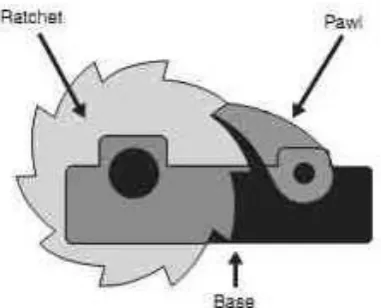
[image:2.595.66.257.385.539.2]When the teeth are moving in the unrestricted (i.e., forward) direction, the pawl easily slides up and over the gently sloped edges of the teeth when the teeth move in the opposite (backward) direction, however, the pawl will catch against the steeply sloped edge of the first tooth it encounters, thereby locking it against the tooth and preventing any further motion in that direction.
Fig -2: Locking of Ratchet and Pawl
Because the ratchet can only stop backward motion at discrete points (i.e., at tooth boundaries), a ratchet does allow a limited amount of backward motion. This backward motion which is limited to a maximum distance equal to the spacing between the teeth is called backlash.
b) Pawl
A pawl is a mechanical device allowing rotation in only one direction. It is a pivoted lever shaped which engages with notches on the lower edge of the horizontal bar, which prevents the bar from being moved back until it has drawn fully forwards or the tip of which engages the notches of a ratchet wheel, preventing the backward motion.
Fig -3: Pawl
The pawl bears against the surface at an angle so that any backward motion will cause the pawl to jam against the surface and thus prevent any further backward motion. Since the backward travel distance is primarily a function of the compressibility of the high friction surface, this mechanism can result in significantly reduced backlash.
c) DC Motor
A DC motor is an electrical machine that converts dc electrical energy to mechanical energy. It has some internal mechanism which is either electromechanical or electronic.
The motor is basically used to actuate the linakge between pawl and sensor so that the pawl could be engaged with ratchet as soon as the threshold angle is achieved.
d) Inclinometer
[image:2.595.332.535.485.721.2]An inclinometer measure the angle of an object with respect to the force of gravity, external accelerations like rapid motions, vibrations or shocks will introduce errors in the tilt measurements.
© 2018, IRJET | Impact Factor value: 6.171 | ISO 9001:2008 Certified Journal | Page 1714 Material to be used for ratchets and pawls are Grey Cast Iron
C45. The reasons behind selecting these materials are :
Readily available
Available in required standard sizes Economical to use
High tensile strength Moderate factor of safety
1. Designing Calculations of Ratchet wheel & Pawl
for safety considerations
RATCHET CALCUATIONS:
Peripheral force P= W*Cos45° = 20*9.81*0.707 = 138.7N ≃ 139 N
After Considering 2 Ratchets and 2 Pawls P’ = 139/(1*1)
P’ = 139N-m
Transmitting Torque T= P’ * C.G.
T= 139* 0.35
T= 48.7 N-m ≃ 48.7*103 N-mm
Now, assuming
No. of teeth on ratchet(z) = 20 α(b/m) = 2
Ultimate Bending stress for C45 = 600 N/mm2 Factor of Safety(FOS) = 3
Design Bending stress after FOS(σb) = 200 N/mm2
Module
m = 3.65 mm ≃ 4mm
Diameter of the ratchet D = m*z
D = 4*20 D = 80 mm
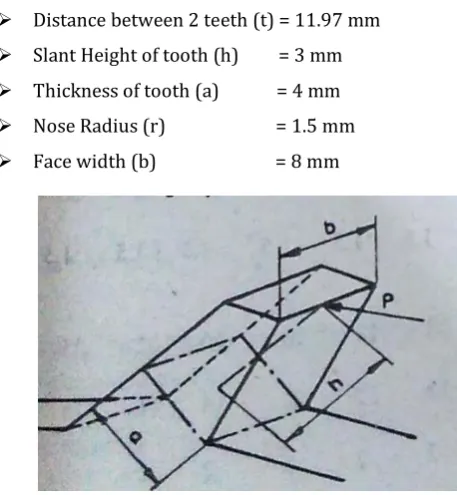
[image:3.595.310.539.101.349.2] Face width (b) = 8 mm
Fig-6: Ratchet Tooth
PAWL CALCULATIONS:
P = 2T/D
P = 2*48.7*103/80 P = 1217.5 N
Bending Moment of Pawl (Mb1) = 650*103 N-mm
Stresses to be checked for safety considerations
σ =
σ=
σ = 195 + 3.04 ≤ [σ] σ = 198.04 ˂ 200
Hence, the design of pawl is safe.
Diameter of Pawl pin
d = 2.71
×
2.63© 2018, IRJET | Impact Factor value: 6.171 | ISO 9001:2008 Certified Journal | Page 1715 Fig-7: Pawl
Fig-8: External engagement of ratchet and pawl
Dimensions of Pawl
Height of pawl tooth(h1) = 4 mm Thickness at pawl pin tip (a1) = 2 mm Nose Radius (r1) = 2 mm
2. Developed stresses during Finite Element
Analysis Method
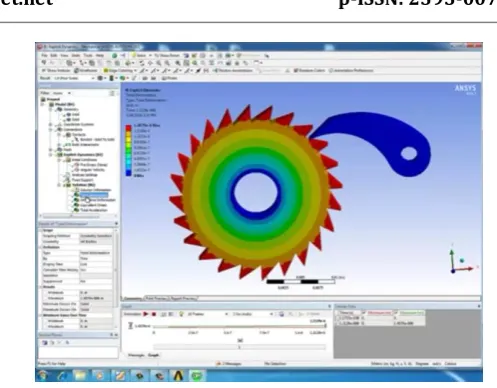
Fig- 9: Shear Stresses developed on ratchet by applying load
Fig- 10: Stresses developed indicating wearing of teeth
4. CONCLUSION
Our project “ Automatic Reverse Wheel Locking Mechanism” would help in avoiding the rearward motion of the vehicle on the hilly terrains and Ghats. Since a less complex structure is been used in our design, it can be easily used by new drivers. Thus the mechanism can stop the vehicle from rolling back in hill roads. This would be more helpful for the drivers to drive their cars and park them comfortably in hilly roads.
ACKNOWLEDGEMENT
It gives us immense pleasure to express our deepest sense of gratitude and sincere thanks to our highly respected and esteemed guide Ms. Madhvi Sharma, Automobile Department, OIST Bhopal, for their valuable guidance, encouragement and help for completing this work. Their useful suggestions for this whole work and co-operative behavior are sincerely acknowledged.
I also wish to express my gratitude to Prof. P. K. Prasad, HOD (Automobile Department) for his kind hearted support. I also wish to express my indebtness to my parents as well as my family members whose blessings and support always helped me to face the challenges ahead. At the end I would like to express my sincere thanks to all my friends and others who helped me directly or indirectly during this project work.
REFERENCES
[1] Health & safety Authority review on “Transport Safety
Reversing Vehicles”, 2009.
[2] Brian Hartley; Chesterfield, UK(1995); “Anti roll back
device”; US Patent 5388672A Feb 1995.
[image:4.595.304.553.60.254.2]© 2018, IRJET | Impact Factor value: 6.171 | ISO 9001:2008 Certified Journal | Page 1716 [6] Yashwant Bhesota, Sumit Paroliya, Pro. Madhvi Sharma;