INTERNATIONAL JOURNAL OF ADVANCES IN ENGINEERING RESEARCH
OPTIMIZATION OF FIR FILTER USING MULTIPLE
CONSTANT MULTIPLICATION
1
S.Ateeb Ahmed, 2Mr.S.Yuvaraj
1
Student, Department of Electronics and Communication/ VLSI Design SRM University, Chennai, India
2
Assistant Professor (O.G), Department of Electronics and Communication SRM University, Chennai, India
ABSTRACT
For implementing transposed direct-form FIR filters Multiple Constant Multiplications (MCM) are widely used. Constant multiplication methods are widely used for reducing computational complexity of implementation of FIR filters. In MCM the main focus has been on more on common sub expression elimination, the optimization of adder-trees, which sum up the computed sub-expressions for each coefficient, is largely omitted. In this paper it is identified that problem in the scheduling of adder-tree operations for the MCM block, and presented a mixed integer programming (MIP) based algorithm for more efficient MCM-based implementation of FIR filters.
INTRODUCTION
INTERNATIONAL JOURNAL OF ADVANCES IN ENGINEERING RESEARCH
Fig. 1. Block diagram of MCM FIR filter
This paper presents a common sub expression elimination (CSE) method which used binary number representation as opposed to the commonly used canonical signed digit (CSD) representation. To reduce the complexity CSD representation can be used for the multiple coefficients. In signed digit representation a ternary representation with digits representing 1,0, and -1 is used where -1 represents subtraction. In this paper the idea is to show the efficiency of MCM compared to the conventional FIR filters and CSD filter. A great deal of research has been
done to develop effective
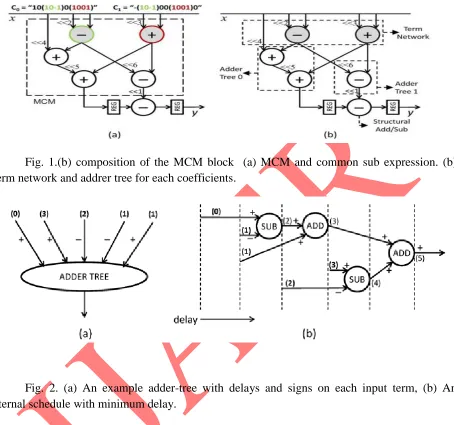
algorithms to identify the optimal set of non-redundant sub expressions to achieve the minimum number of logic operators and the minimum logic depth of the MCM . Irrespective of differences in methodology and the level of optimality, in all these works, after the common sub expression terms are determined and the ADD/SUB network of non-redundant sub expressions (or terms) is formed, the product value corresponding to each of the coefficients is computed by an adder-tree that sums up its relevant terms. As shown in Fig. 1b(b), two adder-trees are formed, for computing the product of a pair of coefficients using shifted versions of unique CS terms „1‟, „10-1‟ and „1001‟ from the term-networks or subexpression-networks. Fig. 1b(a)). Each such
intermediate result in an MCM process
INTERNATIONAL JOURNAL OF ADVANCES IN ENGINEERING RESEARCH
Fig. 1.(b) composition of the MCM block (a) MCM and common sub expression. (b) Term network and addrer tree for each coefficients.
Fig. 2. (a) An example adder-tree with delays and signs on each input term, (b) An internal schedule with minimum delay.
ADDER-TREE SCHEDULING PROBLEM
Given input terms and their earliest T={T0,……,Tn-1} arrival time/delay di , the objective of an
adder-tree scheduling algorithm is to define an assignment of binary addition and subtraction operations to sum up the input terms such that the total delay to produce the final output is minimized.
A GREEDY ADDER TREE SCHEDULING
INTERNATIONAL JOURNAL OF ADVANCES IN ENGINEERING RESEARCH
ADD/SUB to form a new term with delay max{Di , Dj}+1, until a single term is reduced to. Fig. 2 gives an example of the schedule for an adder-tree on the left with minimum delay. Note that either a positive or negative sign is associated with each input term (see Fig. 2(a)), which denotes whether the corresponding term should be added to or subtracted from the summation. These signs also determine whether an addition operation or a subtraction operation should be used when the algorithm collapses a pair of terms in the adder-tree based on the following rules. (1) If two input edges are of the same sign, an ADD will be used; otherwise, it will be a SUB. (2) The sign of the output edge is always the same as that of the “left” input edge (i.e., the minuend edge in the subtraction case).Using these two rules, it is possible that the final term producing the summation result may carry a negative sign, such that a negation is needed after the adder-tree to correct the value. For an FIR filter, results from multiple adder-trees are accumulated by a structural adder-register line. So the negation can be eliminated by replacing the structural adder with a subtractor.
B. COST MODEL
INTERNATIONAL JOURNAL OF ADVANCES IN ENGINEERING RESEARCH
C. Logic Depth Relaxation
The clock performance of the entire FIR filter is decided by the largest of the delays of all coefficients. Assuming the delay of an ADD/SUB operator to be 1 unit, the delay of the constant multiplication by a coefficient can be simply measured by the number of ADD/SUB steps on a maximal path in the part of the network corresponding to the coefficient. We generally use logic depth to describe the required ADD/SUB steps. For a coefficient whose logic depth is less than the filter‟s logic depth, incrementing (relaxing) its logic depth may reduce the resource consumption.
Given an algorithm which computes the adder-tree of the minimum resource on a given depth for a coefficient, if is less than the filter‟s logic depth, one can always try increasing L by 1 and rescheduling onto L+1 a depth adder-tree for possible reduction of resource without degrading the filter‟s clock performance.
MINIMUM RESOURCE ADDER-TREE SCHEDULING USING MIP
INTERNATIONAL JOURNAL OF ADVANCES IN ENGINEERING RESEARCH
Given a set of input terms T={T0,……,Tn-1} and their earliest arrival time or delay Di, we
try to form an adder-tree of maximum depth to sum up the input terms and at the same time minimize the hardware resource used.
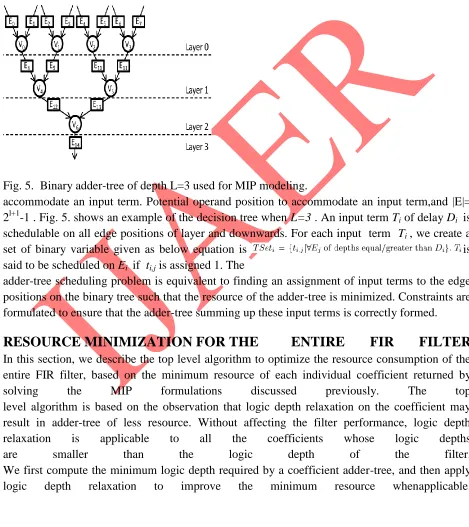
In order to model the above problem, we construct a complete binary tree G(V, E) of depth L.
Each node Vi € V on the tree is a position to hold a binary operator (ADD/SUB), and |V|= 2l-1. Each edge Ei € E is a potential operand position to
Fig. 5. Binary adder-tree of depth L=3 used for MIP modeling.
accommodate an input term. Potential operand position to accommodate an input term,and |E|= 2l+1-1 . Fig. 5. shows an example of the decision tree when L=3 . An input term Ti of delay Di is schedulable on all edge positions of layer and downwards. For each input term Ti , we create a
set of binary variable given as below equation is is
said to be scheduled on Ei if ti,j is assigned 1. The
adder-tree scheduling problem is equivalent to finding an assignment of input terms to the edge positions on the binary tree such that the resource of the adder-tree is minimized. Constraints are formulated to ensure that the adder-tree summing up these input terms is correctly formed.
RESOURCE MINIMIZATION FOR THE
ENTIRE
FIR
FILTER
In this section, we describe the top level algorithm to optimize the resource consumption of the entire FIR filter, based on the minimum resource of each individual coefficient returned by
solving the MIP formulations discussed previously. The top
level algorithm is based on the observation that logic depth relaxation on the coefficient may result in adder-tree of less resource. Without affecting the filter performance, logic depth
relaxation is applicable to all the coefficients whose logic depths
are smaller than the logic depth of the filter.
We first compute the minimum logic depth required by a coefficient adder-tree, and then apply
INTERNATIONAL JOURNAL OF ADVANCES IN ENGINEERING RESEARCH
A. Minimum logic depth of a coefficient Adder-Tree
Firstly, the total number of ADD/SUB operator needed to sum up N input terms is N-1. Based on the binary tree model of the MIP formulation a input term Ti with latency /logic depth of Di
nullifies at least 2D i-1 predecessor operator positions on the binary tree. As a result ,the
minimum binary tree required to accommodating the input terms should consists of at least
N-1+ operators positions. On the other hand binary tree of depths L contains 2L
-1operators.thus we have 2L-1≥ N-1+ .The minimum depth required by the
coefficient is computed by
L ≥ [log2 N-1+ ]
The logic depth of the entire FIR filter takes the largest one among all its coefficients logic depths.
B. Resource minimization algorithm for FIR filter
The algorithm for resource minimization of the entire FIR filter is elaborated in
Algorithm 1. For
INTERNATIONAL JOURNAL OF ADVANCES IN ENGINEERING RESEARCH
current attempt did improve the minimum resource (line 6). At the end of the algorithm, each coefficient is resource minimized with its adder-tree schedule. The total resource of the entire filter is minimized, without increasing its overall logic depth.
SIMULATION RESULTS
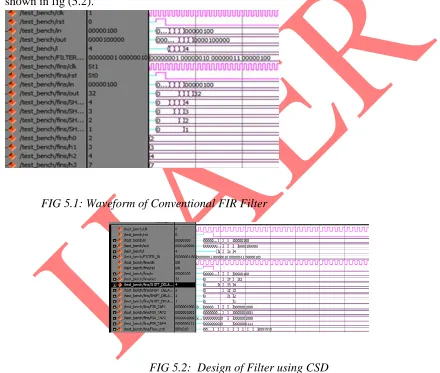
Multiple Constant Multiplication is implemented using shift add and subtract operations. Designed circuits are simulated using ModelSim ALTERA 6.4a. The normal conventional FIR Filter of four tap is shown in fig (5.1) and four tap filter using Canonical Sign Digit (CSD) is shown in fig (5.2).
FIG 5.1: Waveform of Conventional FIR Filter
INTERNATIONAL JOURNAL OF ADVANCES IN ENGINEERING RESEARCH
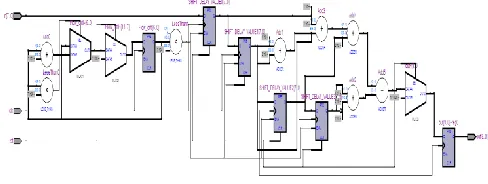
FIG 5.3: RTL schematic view of CSD filter
The performance analysis of both these filter are implemented in cadence synthesize tool where area and power are calculated . The below table illustrates the comparison differences of convention fir filter and csd filter.
TYPE Area(logic cells) Power(mW) Frequency(MHz)
Multiplier Based 33396 0.669 286.2
CSD Based 18334 0.354 167.28
B)DESIGN OF FILTER USING CSD AND MIP (L=3)
For Binary Adder tree of the depth L=3 is used here since we are using the depth of three, we are going for the higher order filter. Figure (5.4) shows the waveform of Canonical Sign Digit (CSD) of ten tap fir filter and figure (5.5) shows the waveform result of Mixed Integer Programming (MIP) of ten tap fir filter for the logic depth of three.
INTERNATIONAL JOURNAL OF ADVANCES IN ENGINEERING RESEARCH
FIG 5.5: Waveform of filter MIP for L=3
FIG 6.6: RTL schematic view of filter using MIP
TYPE Area(logic cells)
Power(mW) Frequency(MHz)
CSD Based
69575 1.346 68.68
MIP Based
57259 0.561 66.77
The table above shows the performance analysis of CSD and MIP based FIR filters.
CONCLUSION
INTERNATIONAL JOURNAL OF ADVANCES IN ENGINEERING RESEARCH
REFERENCES
[1] .M. B. Gately, M. B. Yeary, and C. Y. Tang, “Multiple real-constant multiplication with
improved cost model and greedy and optimal searches,” in Proc. IEEE ISCAS, May
2012, pp. 588–591.
[2] L. Aksoy, C. Lazzari, E. Costa, P. Flores, and J. Monteiro, “Design of digit-serial FIR
filters: Algorithms, architectures, and a CAD tool,” IEEE Trans. Very Large Scale
Integration (VLSI) Syst., vol. 21, no. 3, pp. 498–511, Mar. 2013.
[3] Y. Voronenko and M. Püschel, “Multiplierless multiple constant multiplication,” ACM
Trans. Algorithms, vol. 3, no. 2, 2007.
[4] L. Aksoy, C. Lazzari, E. Costa, P. Flores, and J. Monteiro, “Design of digit-serial FIR
filters: Algorithms, architectures, and a CAD tool,” IEEE Trans. Very Large Scale
Integration (VLSI) Syst., vol. 21, no. 3, pp. 498–511, Mar. 2013.
[5] M. B. Gately, M. B. Yeary, and C. Y. Tang, “Multiple real-constant multiplication with
improved cost model and greedy and optimal searches,” in Proc. IEEE ISCAS, May
2012, pp. 58.
[6] .M. Kumm, P. Zipf,M. Faust, and C.-H. Chang, “Pipelined adder graph optimization for
high speed multiple constant multiplication,” in Proc IEEE ISCAS, May 2012, pp. 49–52.
[7] . R. Hartley and A. Casavant, “Tree-height minimization in pipelined architectures,” in