IJPAR |Vol.6 | Issue 3 | July - Sep -2017 Journal Home page: www.ijpar.com
Research article Open Access
Development and validation of RP-HPLC method for simultaneous
estimation of paracetamol and chlorzoxazone in bulk form
Hajera N. Khan*, Mahajan Swarali, Chopde Asha, Mohammad Zameeruddin,
Vishvanath B. Bharkad.
Department of Quality Assurance, Indira college of Pharmacy, Vishnupuri, Nanded, Maharashtra, India.
*Corresponding Author: Hajera N. Khan
ABSTRACT
High performance liquid chromatography (HPLC) method was developed and validated for the analysis of Paracetamol and Chlorzoxazone. Chromatographic separation achieved isocretically on C -18 column Zorbax Eclipse XDB- C18 (4.6~250mm~5µ). Utilizing a mobile phase Acetonitrile: Water in the ratio 50:50v/v. with a flow rate of 1.5ml/min. UV detection was carried out at 274nm. The retention time of Paracetamol and Chlorzoxazone <10 min respectively. The developed method was validated in terms of recovery, precision,,rggedness, robustness, linearity as per ICH guidelines. This study aimed at developing and validating an HPLC method.
Keywords:
RP-HPLC, Paracetamol, Chlorzoxazone, Validation.INTRODUCTION
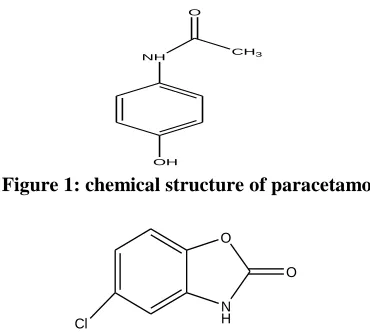
Paracetamol (PCM) chemically is 4-hydroxyacetanilide [1]. Paracetamol acts by complex and includes the effects of both the peripheral (COX inhibition) and central (COX serotonergic descending neuronal pathway, L-arginine/NO Pathway, cannabinoid system) antinociception processes and redox mechanism. [2] Paracetamol is well tolerated drug and produces few side effects from the gastrointestinal tract. Chemical structure of PCM in given fig.1. Chlorzoxazone(CHZ) Chemically is 2(3H)-Benzoxazolone,5-chloro-5-chloro-2
Chlorzoxazone acts by inhibiting multi synaptic reflexes involved in producing and maintaining skeletal muscle spasm of varied aetiology. It acts on the spinal cord by depressing reflexes. CHN a synthetic compound inhibits antigen-induced bronco spasms.CHN inhibits degranulation of mast cells. Subsequently preventing the release of histamine and slow-reacting substance of anaphylaxis (SRS-A), mediators of type-1 allergic reactions. CHZ also may reduce the release of inflammatory leukotrienes.[4] in given in CHZ in fig.2.
Literature survey revealed that various analytical technique such as spectrophotometric
technique [5-8]. Several method based on separation technique including HPLC [9-11], have been reported. The method was validated as per the
International Conference on Harmonization (ICH) guidelines [12, 13]
Figure 1: chemical structure of paracetamol
Figure 2: chemical structure of chlorzoxazone
MATERIALS
Materials Paracetamol was received as a gift samples from Glenmark Pharmaceuticals Ltd. (Goa, India) and Chlorzoxazone was received as a gift samples from Flemingo Pharmaceuticals Nanded, India. HPLC grade Acetonitrile and water were procured from Merk India .
Instrument
The instrument used was Agilent LC-1220 series HPLC instrument [14]. The instrument is equipped with an Agilent LC-1220 Pump and variable wavelength programmable UV detector and a 20µl inject port.
Chromatographic conditions
C18 column Zorbax Eclipse XDB- C18 (4.6~250mm~5µ) was used for separation. The mobile phase containing Acetonitrile: Water in the ratio 50:50v/v was delivered at a flow rate 1.5ml/min and the elution was monitored at 274nm. Injection volume was 20µl and the analysis was performed at ambient temperature.
Preparation of mobile phase
A mobile phase consisting of Acetonitrile (HPLC grade), Water in the ratio 50:50v/v was prepared and then filtered through a 0.45µ membrane filter.
Preparation of standard stock solution
Accurately about 100 mg of standard PCM & CHZ each were weighed and transferred to separate 100 ml volumetric flasks. The drugs were dissolved in Acetonitrile: Water (50:50,v/v) then volume made up to the mark with same solvent to obtain standard stock solution of each drug of concentration 1000 µg/ml.
Preparation of standard working solution
Appropriate aliquot portion (0.13ml of PCM & 0.1 ml of CHZ) was transferred to10 ml volumetric flask and diluted with Distilled Water to obtain the concentration of 13µg/ml of PCM and 10µg/ml of CHZ volume of 20 L of solution was injected with the help of Hamilton Syringe. All measurements were repeated three times for each concentration and from the Peak area, the amount of drug were calculated, Chromatogram shown in fig. 3.
NH
OH
CH3 O
N H O
O
Figure no.3: HPLC chromatogram of mixture of PCM & CHZ
Construction of calibration curve
The calibration curves were plotted between the mean peak areas vs. respective concentrations calibration curve is shown in fig. 4 and 5 for PCM & CHZ are respectively. The standard working curve equation for PCM was found to be Y= 868499x+643469 with a correlation coefficient value of r2 = 0.9926. For CHZ the working curve equation was found to be Y=73175x+58333 with correlation coefficient value of r2=0.998.
METHOD VALIDATION
System suitability is a Pharmacopoeial requirement and is used to verify, whether the resolution and reproducibility of chromatographic system are adequate for analysis to be done. The tests were performed by collecting data from five replicate injection of standard drug solution. System suitability test result is shown in Table 1.
Table no.1: Optimum Values of Parameters
Parameters Optimum values
Retention Time < 10 min
No.of Theoretical plates > 2000 Resolution > 2 Tailing factor < 2
Capacity factor 1-10
Selectivity -
Linearity
The standard calibration curve for PCM & CHZ was plotted separately as peak area Vs the respective concentration of PCM & CHZ. Good linearity was obtained in the concentration range of 2-12 µg/ml and 5-35µg/ml for PCM & CHZ respectively. Correlation co-efficient for calibration curve PCM and CHZ were found to be 0.427184
Precision
one week. This result shows reproducibility of the assay
Recovery
Accuracy of an analytical method is the closeness of the test results obtained by that of the true value. Accuracy of proposed method has been carried out by recovery studies. It was performed by recovery study using standard addition method at 80, 100, and 120 % level; known amount of standard PCM & CHZ was added to reanalysed sample (8, 10, 12 g/mL) and subjected them to the proposed HPLC method. . Percentage recovery for PCM was 0.745592 and for CHZ was 0.705647.
Ruggedness
From stock solution, sample solution of PCM & CHZ (10 µg/mL) was prepared and analysed by two different analysts using similar operational and environmental conditions. Peak area was measured for same concentration solutions. Conditions the % RSD for Robustness was found to be 0.52457 for PCM Hcl and 0.183627 for CHZ.
Robustness
It expresses the precision within laboratories, Variation like different solvent. Robustness of the methods was assessed by carrying out assay 3 times with different solvent by using same equipment.
Parameters PCM CHZ
Linearity 2-12 5-35
Slope 868499x 731751x
Intercept 643469 583333 Prcision (% RSD)
Intraday 0.394066 0.586806 Interday 0.526879 0.035125 Recovery 0.745592 0.705647 Ruggedness 0.52457 0.183627 Robustness 0.070874 0.091873 Specificity Specific Specific n=3
RESULTS
HPLC method was developed, validated and used for quantitative determination of Paracetamol (PCM) and Chlorzoxazone (CHZ) from its bulk dosage form. Chromatographic separation was performed on Zorbax Eclipse XDB-C18 (4.6×250mm×5µ), with a mobile phase comprising of mixture of Acetonitrile: Water (50:50) at flow rate 1.5 ml/min, with detection at 274nm with Rt 5
min. Sepration was completed in less than 10 min. As per (ICH) guidelines the method was validated for linearity accuracy, precision, limit quantitation, limit of detection and robustness. Linearity of PCM was found to be in the range of 2-12 µg/ml. The
correlation coefficient was 0.9926. & Linearity of CHZ was found to be in the range of 5-35 µg/ml. The correlation coefficient was 0.998. The results of bulk drug analysis (n=5) were found to be 99.92 with + 0.14565% standard deviation for bulk drug. Percent recovery of bulk drug was found to be 99.98%.
Acknowledgement
Author is thankful to Glenmark Pharmaceuticals Ltd. (Goa, India). And Flemingo Pharmaceuticals Nanded, for providing gift sample of Chlorzoxazone and Paracetamol .
REFRENCES
[1]. Indian Pharmacopoeia, Government Of India, Ministry of Health and Family Welfare, (3), 2010, 1859. [2]. Barar F.S.K. Essential of Pharmacotherapeutics. 5th edn; S.Chand, 5, 2009, 124.
[5]. Khan Ghulam M; SA; Shabbir A. Development of a UV-Spectrophotometric method for the simultaneous determination of Aspirin and Paracetamol in tablets. 6(2), 2011, 417-421.
[6]. Ekta JP; Kapupara P; Shah KV. Development and validation of simultaneous estimation of Diclofenac potassium, Paracetamol and serratiopeptidase by First order derivative UV Spectroscopy method in pharmaceutical formulation. 6(5), 2014, 912-924.
[7]. Joshi RS; Pawar NS; Katiyar SS. Development and validation of UV Spectrophotometric method for Simultaneous estimation of Paracetamol and Ibuprofen in pure and tablet dosage form. 2(3), 2011, 164-171. [8]. Harshini S; Priyanka G; Swathi K. Simultaneous estimation of Paracetamol nd Ibuprofen in bulk and
Pharmaceutical dosage form by using UV Spectrophotometric method. International Journal Of innovative pharmaceutical sciences and research. 2(8), 2014, 1854-1860.
[9]. Kakadiya J; Parmar N; ShahN. Development and validation of RP-HPLC method for simultaneous estimation of Promethazine Hydrochloride and Paracetamol in combined liquid formulation. Asian Journal of Research in Biological and pharmaceutical sciences. 2(1), 2014, 11-26.
[10]. MD Irshad Alam; Khanam N; Ganguly S. Development of assay method and forced degradation study of Dexibuprofen and Paracetamol by RP-HPLC in tablet formulation. 6(3), 2014, 184-191.
[11]. MD. Sarowar Jahan; Islam J; Begum R. A Study of method Development, Validation and Forced degradation for simultaneous Quantification of Paracetamol and Ibuprofen in pharmaceutical dosage form by RP-HPLC method. (9), 2014, 75-81.
[12]. ICH, Q2A, Text on validation of Analytical procedures, International Conference On Harmonization, Geneva, Octomber 1994, 1-5.
[13]. ICH, Q2A, Text on validation of Analytical procedures: Methodology, International Conference On Harmonization, Geneva, November, 1996, 1-8.