Vol. 14, 2018, 11-16
ISSN: 2349-0632 (P), 2349-0640 (online) Published 20 August 2018
www.researchmathsci.org
DOI: http://dx.doi.org/10.22457/jmi.v14a2
11
Journal of
Reduced Second Hyper-Zagreb Index and its Polynomial
of Certain Silicate Networks
V.R.Kulli
Department of Mathematics,
Gulbarga University, Gulbarga 585106, India e-mail: [email protected]
Received 8 July 2018; accepted 15 August 2018
Abstract. We introduce the reduced second hyper-Zagreb index of a graph. Considering this index, we define the reduced second hyper-Zagreb polynomial of a graph. Also we define the reduced second Zagreb polynomial of a graph. In this paper, we compute the reduced second hyper-Zagreb index and its polynomial of certain families of networks such as silicate and chain silicate networks. Also we determine the reduced second Zagreb polynomial of certain silicate networks.
Keywords: reduced second hyper-Zagreb index, silicate network.
AMS Mathematics Subject Classification (2010): 05C05, 05C07, 05C35
1. Introduction
Let G be a finite, simple, connected graph with vertex set V(G) and edge set E(G). The degree dG(v) of a vertex v is the number of vertices adjacent to v. We refer [1], for other
undefined notations and terminologies.
A molecular graph is a graph such that its vertices correspond to the atoms and edges to the bonds. Chemical Graph Theory is a branch of mathematical chemistry, which has an important effect on the development of Chemical Sciences. Several topological indices have been considered in Theoretical Chemistry and have found some applications.
Recently Furtula et al. proposed the reduced second Zagreb index, defined as [2]
( )
(
( )
)
(
( )
)
( )
2 G 1 G 1 .
uv E G
RM G d u d v
∈
=
∑
− − (1)Recently, some new reduced indices were studied, for example, in [3, 4, 5, 6, 7].
Considering the reduced second Zagreb index, we introduce the reduced second Zagreb polynomial of a graph G as
(
)
( ( ) )( ( ) )( )
1 1
2 , .
G G
d u d v
uv E G
RM G x x − −
∈
=
∑
(2)12
( )
(
( )
)
(
( )
)
( )
2
2 G 1 G 1 .
uv E G
RHM G d u d v
∈
=
∑
− − (3)Considering the reduced second hyper-Zagreb index, we introduce the reduced second hyper-Zagreb polynomial of a graph G as
(
)
( ( ) )( ( ) )( )
2
1 1
2 , .
G G
d u d v
uv E G
RHM G x x − −
∈
=
∑
(4)Recently, some new topological indices were studied, for example, in [8, 9, 10, 11, 12, 13, 14, 15, 16, 17, 18, 19, 20, 21, 22, 23]. Also some new polynomials were studied, for example, in [ 24, 25, 26 27, 28, 29, 30, 31].
In this paper, the reduced second Zagreb polynomial, reduced second hyper-Zagreb index and its polynomial of silicate and chain silicate networks are computed. For more information about silicate networks see [32].
2. Results for silicate networks
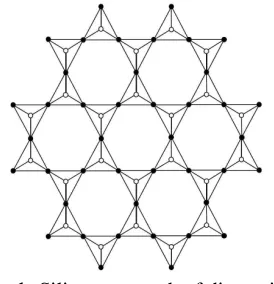
Silicate networks are obtained by fusing metal oxide or metal carbonates with sand. A silicate network is symbolized by SLn, where n is the number of hexagons between the
center and boundary of SLn. A silicate network of dimension two is shown in Figure 1.
Figure 1: Silicate network of dimension two
Let G be the graph of a silicate network SLn with |V(SLn)|=15n
2
+3n and |E(SLn)|=36n
2
. By algebraic method, there are three types of edges in G based on the degree of end vertices of each edge as in Table 1.
dG(u), dG(v)\ uv E(G) (3, 3) (3, 6) (6, 6)
Number of edges 6n 18n2 + 6n 18n2 – 12n
Table 1: Edge partition of SLn
Theorem 1. The reduced second Zagreb index and its polynomial of a silicate network
SLn are
(i) RM2(SLn) = 630n
2
+ 216n. (ii) RM2(SLn, x) = 6nx
4
+ (18n2+6n)x10 + (18n2 – 12n)x25 .
13 (i) By using equation (1) and Table 1, we obtain
( )
(
( )
)
(
( )
)
( )
2 n G 1 G 1
uv E G
RM SL d u d v
∈
=
∑
− −= (3–1)(3–1)6n + (3–1)(6–1)(18n2+6n) + (6–1)(6–1)(18n2 – 12n) = 630n2 – 216n.
(ii) By using equation (2) and Table 1, we obtain
(
)
( ( ) )( ( ) )( )
1 1
2 ,
G G
d u d v
n
uv E G
RM SL x x − −
∈
=
∑
= 6nx(3–1)(3–1) + (18n2+6n)x(3–1)(6–1) + (18n2 – 12n)x(6–1)(6–1) = 6nx4 + (18n2+6n)x10 + (18n2 – 12n)x25.
Theorem 2. The reduced second hyper-Zagreb index and its polynomial of a silicate
network SLn are
(i) RHM2(SLn) = 13050n
2
– 6804n.
(ii) RHM2(SLn, x) = 6nx16 + (18n2+6n)x100 + (18n2 – 12n)x625 .
Proof: Let G = SLn be the graph of a silicate network.
(i) By using equation (3) and Table 1, we obtain
( )
(
( )
)
(
( )
)
( )
2
2 n G 1 G 1
uv E G
RHM SL d u d v
∈
=
∑
− − =[(3–1)(3–1)]26n+[(3–1)(6–1)]2(18n2+6n)+[(6–1)(6–1)]2(18n2–12n) = 13050n2 – 6804n.
(ii) By using equation (4) and Table 1, we obtain
(
)
( ( ) )( ( ) )( )
2
1 1
2 ,
G G
d u d v
n
uv E G
RHM SL x x − −
∈
=
∑
( )( )
[ ]2
(
)
[( )( )]2 ( ) [( )( )]23 1 3 1 2 3 1 6 1 2 6 1 6 1
6 − − 18 6 − − 18 12 − −
= nx + n + n x + n − n x
= 6nx16 + (18n2+6n)x100 + (18n2 – 12n)x625.
3. Results for chain silicate networks
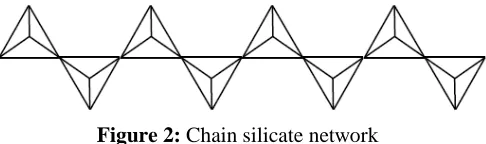
We now consider a family of chain silicate networks. This network is symbolized by CSn
and is obtained by arranging n tetrahedral linearly, see Figure 2.
Figure 2: Chain silicate network
Let G be the graph of chain silicate network CSn with |V(CSn)|=3n+1 and
|E(CSn)|=6n. By algebraic method, CSn, n 2, there are three types of edges based on the
degree of end vertices of each edge as in Table 2.
dG(u), dG(v)\ uv E(G) (3, 3) (3, 6) (6, 6)
Number of edges n + 4 4n – 2 n – 2
14
Theorem 3. The reduced second Zagreb index and its polynomial of a chain silicate
network CSn are
(i) RM2(CSn) = 69n – 54.
(ii) RM2(CSn, x) = (n+4)x
4
+ (4n – 2)x10 + (n – 2)x25 .
Proof: Let G = CSn be the graph of chain silicate network.
(i) By using equation (1) and Table 2, we deduce
(
)
(
( )
)
(
( )
)
( )
2 n G 1 G 1
uv E G
RM CS d u d v
∈
=
∑
− −= (3–1)(3–1)(n+4)+(3–1)(6–1)(4n – 2) + (6–1)(6–1) (n – 2) = 69n – 54.
(ii) By using equation (2) and Table 2, we deduce
(
)
( ( ) )( ( ) )( )
1 1
2 ,
G G
d u d v
n
uv E G
RM CS x x − −
∈
=
∑
= (n+4)x(3–1)(3–1) + (4n – 2)x(3–1)(6–1) + (n – 2)x(6–1)(6–1) = (n+4)x4 + (4n – 2)x10 + (n – 2)x25.
Theorem 4. The reduced second hyper-Zagreb index and its polynomial of a chain
silicate network CSn are
(i) RHM2(CSn) = 1041n – 1386.
(ii) RHM2(CSn, x) = (n+4)x
16
+ (4n – 2)x100 + (n – 2)x625.
Proof: Let G = CSn be the graph of chain silicate network.
(i) By using equation (3) and Table 2, we deduce
(
)
(
( )
)
(
( )
)
( )
2
2 n G 1 G 1
uv E G
RHM CS d u d v
∈
=
∑
− − =[(3–1)(3–1)]2(n+4)+[(3–1)(6–1)]2(4n–2)+[(6–1)(6–1)]2(n–2) = 1041n – 1386
(ii) By using equation (4) and Table 2, we deduce
(
)
( ( ) )( ( ) )( )
2
1 1
2 ,
G G
d u d v
n
uv E G
RHM CS x x − −
∈
=
∑
( ) [( )( )]2 ( ) [( )( )]2 ( ) [( )( )]2
3 1 3 1 3 1 6 1 6 1 6 1
4 − − 4 2 − − 2 − −
= n+ x + n− x + n− x
= (n+4)x16 + (4n – 2)x100 + (4n – 2)x625.
4. Conclusion
In this paper, the explicit formulas for the reduced hyper-Zagreb index and its polynomial of silicate and chain silicate networks are computed. These expressions can correlate the molecular structure of silicate and chain silicate networks to information about their physical structures.
REFERENCES
1. V.R.Kulli, College Graph Theory, Vishwa International Publications, Gulbarga, India (2012).
15
3. I.Gutman, B.Furtula and C.Elphick, Three new/old vertex degree based topological indices, MATCH Commun. Math. Comput. Chem., 72 (2014) 617-682.
4. B.Horoldagva, L.Buyantoglokh and S.Dorjsembe, Difference of Zagreb indices and reduced second Zagreb index of cyclic graphs with cut edges, MATCH Commun. Math. Comput. Chem., 78 (2017) 337-350.
5. V.R.Kulli, On reduced Zagreb indices of polycyclic aromatic hydrocarbons and benzenoid systems, Annals of Pure and Applied Mathematics, 18(1) (2018).
6. V.R.Kulli, General reduced second Zagreb index of certain networks, submitted. 7. V.R.Kulli, Some multiplicative reduced indices of certain nanostructures, submitted. 8. V.R.Kulli, On K indices of graphs, Int. J. Fuzzy Mathematical Archive, 10(2) (2016)
105-109.
9. V.R.Kulli, On K coindices of graphs, Journal of Computer and Mathematical Sciences, 7(3) (2018) 107-112.
10. V.R.Kulli, On K-edge index of some nanostructures, Journal of Computer and Mathematical Sciences, 7(7) (2016) 373-378.
11. V.R.Kulli, On K Banhatti indices and K hyper-Banhatti indices of V-Phenylenic nanotubes and nanotorus, Journal of Computer and Mathematical Sciences, 7(6) (2016) 302-307.
12. V.R.Kulli, General topological indices of circumcoronene series of benzenoid, International Research Journal of Pure Algebra, 7(5) (2017) 748-753.
13. V.R.Kulli, Computation of some Gourava indices of titania nanotubes, Interational Journal of Fuzzy Mathematical Archive, 12(2) (2017) 75-81.
14. V.R.Kulli, Edge version of multiplicative atom bond connectivity index of certain nanotubes and nanotorus, International Journal of Mathematics and its Applications, 6(1-E) (2018) 977-982.
15. V.R.Kulli, Computing Banhatti indices of networks, International Journal of Advances in Mathematics, 2018(1) 2018) 31-40.
16. V.R.Kulli, Some new fifth multiplicative Zagreb indices of PAMAM dendrimers, Journal of Global Research in Mathematics, 5(2) (2018) 82-86.
17. V.R.Kulli, Multiplicative connectivity Banhatti indices of dendrimer nanostars, Journal of Chemistry and Chemical Sciences, 8(6) (2018) 964-973.
18. V.R.Kulli, Connectivity Revan indices of chemical structures in drugs, International Journal of Engineering Sciences and Research Technology, 7(5) (2018).
19. V.R.Kulli, Computation of F reverse index and modified reverse indices of some nanostructure, Annals of Pure and Applied Mathematics, 18(1) (2018) 37-43.
20. V.R.Kulli, On augmented reverse index and its polynomial of certain nanostar dendrimers, International Journal of Engineering Sciences And Research Technology, 7(8) (2018) 237-243.
21. V.R.Kulli, On two arithmetic-geometric Banhatti indices of certain dendrimer nanostars, International Journal of Fuzzy Mathematical Archive, 16(1) (2018) 7-12. 22. V.R.Kulli and M.H.Akhbari, Multiplicative atom bond connectivity and
16
23. V.R.Kulli, B.Chaluvaraju and H.S.Baregowda, K-Banhatti and K hyper-Banhatti indices of windmill graphs, South East Asian J. of Math. and Math. Sci., 13(1) (2017) 11-18.
24. V.R.Kulli, General Zagreb polynomials and F-polynomial of certain nanostructures, International Journal of Mathematical Archive, 8(10) (2017) 103-109.
25. V.R.Kulli, General fifth M-Zagreb indices and fifth M-Zagreb polynomials of PAMAM dendrimers, International Journal of Fuzzy Mathematical Archive, 13(1) (2017) 99-103.
26. V.R.Kulli, Certain topological indices and their polynomials of dendrimer nanostars, Annals of Pure and Applied Mathematics, 14(2) (2017) 263-268.
27. V.R.Kulli, Reverse Zagreb and reverse hyper-Zagreb indices and their polynomials of rhombus silicate networks, Annals of Pure and Applied Mathematics, 16(1) (2018) 47-51.
28. V.R.Kulli, Hyper-Revan indices and their polynomials of silicate networks, International Journal of Current Research in Science and Technology, 4(3) (2018). 29. V.R.Kulli, Revan indices and their polynomials of certain rhombus networks,
International Journal of Current Research in Life Sciences, 7(5) (2018) 2110-2116. 30. V.R.Kulli, On ve-degree indices and their polynomials of dominating oxide
networks, Annals of Pure and Applied Mathematics, 18(1) (2018) 1-7.
31. V.R.Kulli, Computing the F-ve-degree index and its polynomial of dominating oxide and regular triangulate oxide networks, International Journal of Fuzzy Mathematical Archive, 16(1) (2018) 1-6.