Monograph of
Diplachne
(Poaceae, Chloridoideae, Cynodonteae)
Neil Snow1, Paul M. Peterson2, Konstantin Romaschenko2, Bryan K. Simon3, †
1 Department of Biology, T.M. Sperry Herbarium, Pittsburg State University, Pittsburg, KS 66762, USA 2 Department of Botany MRC-166, National Museum of Natural History, Smithsonian Institution, Washing-ton, DC 20013-7012, USA 3 Queensland Herbarium, Mt Coot-tha Road, Toowong, Brisbane, QLD 4066 Australia (†)
Corresponding author: Neil Snow ([email protected])
Academic editor:C. Morden | Received 19 September 2017 | Accepted 28 December 2017 | Published 25 January 2018
Citation: Snow N, Peterson PM, Romaschenko K, Simon BK (2018) Monograph of Diplachne (Poaceae, Chloridoideae, Cynodonteae). PhytoKeys 93: 1–102. https://doi.org/10.3897/phytokeys.93.21079
Abstract
Diplachne P. Beauv. comprises two species with C4 (NAD-ME) photosynthesis. Diplachne fusca has a nearly pantropical-pantemperate distribution with four subspecies: D. fusca subsp. fusca is Paleotropical with native distributions in Africa, southern Asia and Australia; the widespread Australian endemic D. f. subsp. muelleri; and D. f. subsp. fascicularis and D. f. subsp. uninervia occurring in the New World. Diplachne gigantea is known from a few widely scattered, older collections in east-central and southern Africa, and although Data Deficient clearly is of conservation concern. A discussion of previous taxonom-ic treatments is provided, including molecular data supporting Diplachne in its newer, restricted sense. Many populations of Diplachne fusca are highly tolerant of saline substrates and most prefer seasonally moist to saturated soils, often in disturbed areas. Some populations of Diplachne fusca in southern Asia combine nitrogen-fixation, high salinity tolerance and palatibilty to livestock, which should be pursued with further research for purposes of soil reclamation. Diplachne fusca subsp. uninervia is the most inva-sive of the subspecies and is becoming weedy in some non-native areas, including in the Old World. This monograph provides detailed descriptions of all taxa, a key to the species and subspecies, geographic dis-tributions and information on the anatomy of leaves, stems, lemmatal micromorphology and discussions of the chromosome numbers. Lectotypes are designated for: Atropis carinata Grisb.; Diplachne acuminata Nash; Diplachne capensis (Nees) Nees var. concinna Nees; Diplachne capensis (Nees) Nees var. obscura Nees, Diplachne capensis (Nees) Nees var. prolifera subvar. minor Nees, Diplachne halei Nash, Diplachne mar-itima E.P. Bicknel, Diplachne muelleri Benth., Diplachne reverchonii Vasey, Diplachne tectoneticola Backer, Leptochloa imbricata Thurb., Leptochloa neuroglossa Peter, Leptochloa uninervia var. typica fo. abbreviata Parodi, Triodia ambigua R. Br. and Triodia parviflora R. Br.
http://phytokeys.pensoft.net
Copyright Neil Snow et al. This is an open access article distributed under the terms of the Creative Commons Attribution License (CC BY 4.0),
which permits unrestricted use, distribution, and reproduction in any medium, provided the original author and source are credited.
Keywords
Azoarcus, cleistogamy, conservation, leaf anatomy, lectotypification, Leptochloa, NAD-ME photosynthesis, nitrogen fixation, plastid DNA sequences, phylogeny, reclamation, stem anatomy, stellate aerenchyma, systematics, typification, weediness
Introduction
Recent molecular phylogenetic studies (Peterson et al. 2010, 2012, 2014, 2016; Aliscioni et al. 2012; Soreng et al. 2015, 2017) documented the polyphyly of Leptochloa P. Beauv. sensu lato (Parodi 1927; Hitchcock 1951; McNeill 1979; Phillips 1974, 1982; Clayton and Renvoize 1986; Nicora 1995, 2006; Snow 1997a, 2003, 2012). In-depth sampling within and among genera by Peterson et al. (2010, 2012, 2014, 2015) recovered five strongly supported clades among members of Leptochloa s.l. The clade bearing the type species of the genus Diplachne had strong support levels and merits recognition as a distinct genus, which already is recognised by many authors (Kellogg 2015; Soreng et al. 2017). As re-circumscribed here, Diplachne has a narrower circumscription than recognised by many previous authors (e.g. McNeill 1979; Jacobs 1987; Watson and Dallwitz 1992).
The first species now included in Diplachne was described by Linnaeus (1762) as Festuca fusca L. (= D. fusca (L.) P. Beauv. ex Roem. & Schult.). Diplachne itself was established by Palisot de Beauvois (1812) in the same publication that he established Leptochloa P. Beauv. (type species: L. virgata (L.) P. Beauv.) and Rhabodchloa P. Beauv., the latter of which has been reduced to synonymy (e.g. Snow 1997a; Peterson et al. 2001; Soreng et al. 2012). Gray (1848), who first reduced Diplachne to synonymy under Leptochloa, initially did not indicate a taxonomic rank, but later specified its rank as sub-genus (Gray 1857). Diplachne fusca was transfered to Uralepis by Steudel (1855). Hackel (1887, 1900, 1902) was an early advocate of maintaining Diplachne as a genus distinct from Leptochloa, but his concept of Diplachne was broad and included species presently placed by most workers in Bewsia Goossens, Gouinia E. Fourn. ex Bentham & Hook. f., Cleistogenes Keng (=Kengia Packer), Odyssea Stapf, Pogonarthria Stapf and Trichoneura Andersson (e.g. Fig. 1 in Valls [1978]). The generic name Diplachne R. Br. ex Desf. also once was applied to a species now placed in Verticordia DC., an Australian genus of Myrtaceae (Snow 1997a). After Hackel, the generic boundaries of Diplachne remained highly unstable (Parodi 1927; McNeill 1979; Phillips 1974, 1982; Clayton and Ren-voize 1986; Watson and Dallwitz 1992; Jacobs 1987; Snow 1997a). Synonymy within Diplachne fusca is complex and summarised mostly under the subspecies of D. fusca.
Materials and methods
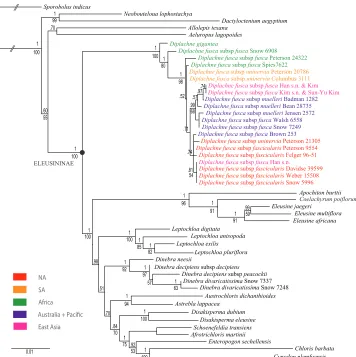
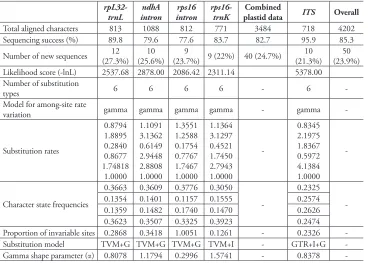
Phylogenetic analyses. Detailed methods for DNA extraction, amplification, se-quencing and phylogenetic analysis are given in Peterson et al. (2010, 2012, 2014, 2015, 2016). In brief, the phylogeny was estimated among members of Diplachne based on the analysis of five molecular markers (nuclear ITS 1&2 and plastid rpL32-trnL, ndhA intron, rps16 intron, and rps16-trnK DNA sequences). For this study, a sampling of species was included within subtribe Eleusininae, including the outgroups Aeluropus Trin. (Aeluropodinae), Allolepis Soderstr. & H.F. Decker (Allolepiinae, see Peterson et al. [2017]), Dactyloctenium Willd., Neobouteloua Gould (Dactylocteniinae) and Sporobolus R. Br. (Sporobolinae). The backbone of this phylogram (Fig. 1) was generated with existing data from Peterson et al. (2010, 2012, 2015, 2016) and the addition of sixteen new samples: thirteen of Diplachne fusca, two of Dinebra divari-catissima (one of which initially was misidentified as D. fusca) and one of Diplachne gigantea. Voucher information and GenBank numbers for all samples (including the new ones) are given in Table 1.
Morphology. Morphological characters from approximately 2200 specimens from over 80 herbaria were examined by the first author between 1986 and 2017, representing the entire geographic range of Diplachne (see Acknowledgements; abbre-viations of herbaria following Thiers [2017]). Given the wide distribution of Diplachne fusca and its representation in virtually every herbarium the first author has visited, it is estimated that less than half of the specimens of D. fusca globally are cited here, particularly those from eastern Asia, middle eastern and west African herbaria, as well as more regionally-focused herbaria worldwide. The first author has collected speci-mens of D. fusca from North America (including Mexico), southern Africa (Botswana, South Africa, Namibia) and Australia (New South Wales and Queensland) and grown specimens from these continents in a greenhouse. The second author has collected members of Diplachne from North America, South America and Africa. The fourth author collected specimens from Africa and Australia, including the rare Diplachne gigantea. Geocoordinates are excluded in specimens examined given that most lacked such data at the time of study or were examined before reliable geocoordinates had been added or updated.
Type specimens. Details of types are indicated for those that have been confirmed (including also in Excluded Names); those that merely indicate “type” have not been confirmed or seen. Barcode numbers are enclosed by square brackets; accession num-bers are indicated with a hyphen (–) following the herbarium’s acronym.
Species concept. A general lineage species concept (de Queiroz 1998) a diagnos-ability criterion were used based primarily on gross mophology (Snow 1997b; Snow et al. 2003). However, the molecular data also tested the monophyly of each taxon (Peterson et al. 2014, 2015; Fig. 1).
located in the field during this project (see comments under that species). Leaves were sectioned by a rotary microtome at Rancho Santa Ana Botanic Garden in the labora-tory of Dr. J. Travis Columbus or by hand by the first author at the Missouri Botanical Garden. Data from lemmatal micromorphology (Snow 1996) and caryopsis morphol-ogy (Snow 1998b) are included from those publications.
Descriptive terminology for leaf anatomy largely follows Ellis (1976) and includes information from Snow (1997a). This includes keel to refer to the proliferation of pa-renchyma (abaxially, but usually more prominent adaxially) that surrounds the central-most (median) vascular bundle, which typically extends laterally to at least the first vascular bundle on either side of the median bundle. Lacunae in the keel refer to areas
Afrotrichloris martinii
Diplachne fusca subsp fusca Brown 253
Eleusine jaegeri Diplachne fusca subsp fusca Peterson 24322
Astrebla lappacea Enteropogon sechellensis Apochiton burttii Neobouteloua lophostachya Disakisperma dubium Austrochloris dichanthioides Disakisperma eleusine
Diplachne fusca subsp fascicularis Davidse 39599
Diplachne fusca subsp muelleri Badman 1282
Diplachne fusca subsp muelleri Jensen 2572
Diplachne fusca subsp fascicularis Weber 15508
Diplachne fusca subsp uninervia Peterson 20786
Eleusine multiflora Eleusine africana
Schoenefeldia transiens Dinebra neesii
Diplachne fusca subsp muelleri Bean 28735
Diplachne fusca subsp fusca Walsh 6558 Sporobolus indicus
Leptochloa anisopoda
Dactyloctenium aegyptium
Diplachne gigantea
Leptochloa exilis
Diplachne fusca subsp fascicularis Peterson 9554
Diplachne fusca subsp fusca Snow 7249
Cynodon nlemfuensis Diplachne fusca subsp fascicularis Snow 5996
Diplachne fusca subsp fusca Snow 6908
Diplachne fusca subsp fascicularis Felger 96-51
Allolepis texana
Dinebra decipiens subsp decipiens Leptochloa pluriflora Aeluropus lagopoides
Chloris barbata Diplachne fusca subsp uninervia Peterson 21305
Leptochloa digitata
Coelachyrum poiflorum
ELEUSININAE
Dinebra decipiens subsp peacockii Dinebra divaricatissima Snow 7337
Dinebra divaricatissima Snow 7248
NA SA Africa Australia + Pacific
1 1 1 1 1 1 1 .70 100 100 100 1 92 .60 1 1 .99 .74 .81 1 85 1 82 1 1 97 1 .98 .51 .70 1 94 .84 1 100 1 1 100 .92 1 100 .99 99 100 55 80 98 68 54 59 91 91 96 57 63 75 53 70 East Asia
Diplachne fusca subsp uninervia Columbus 3111
Diplachne fusca subsp fusca Spies7622
Diplachne fusca Diplachne fusca subspsubsp fusca fusca Kim s.n. & Sun-Yu Kim Han s.n. & Kim
Diplachne fusca subsp fusca Han s.n.
.71 .52 .57.97
.74
0.01
Tab le 1. T ax on v oucher (collector , number
, and wher
e the specimen is housed), countr
y of origin, and G
enB
ank accession
for DNA sequences of rps16-trnK, rps16
intr
on, rpl32-trnL, ndhA intr
on, and IT
S r
egions (bold indicates ne
w accession); a dash (–) indicates missing data; an asterisk (*) indicates sequences not generated
in our lab
. Tax on Voucher Countr y rps16-tr nK rps16 intr on rpl32-tr nL ndhA intr on ITS Aelur opus lagopoides (L.)
Trin. ex Thwaites
W
einer
t s.n. & M
osawi (US) Iraq GU360576 GU360284 GU360013 GU359391 GU359261 Afr otrichloris mar tinii Chio v. H
emming 3407 (FT
) Somalia, M udug KP873645 KP873962 KP873428 KP873827 KP873212
Allolepis texana (
Vasey) S
oderstr
. & H.F
. D
ecker
H
itchcock 7541 (US)
M exico, D urango GU360573 GU360318 GU360015 GU359388 GU359264 Apochiton bur ttii C.E. H ubb .
Peterson 24163, S
or
eng,
Romaschenko & A
beid (US) Tanzania, D odoma KP873646 KP873963 KP873429 KP873828 KP873214 Astr ebla lappacea (Lindl.) D omin M
cKinlay s.n. (US)
Australia GU360568 GU360312 GU360009 GU359395 GU359270 Austr ochloris dichanthioides (E verist) Lazarides
Anson s.n. (US)
Australia, Q ueensland GU360566 GU360310 GU359860 GU359420 GU359272 Chloris barbata S w. Saar
ela 1830, P
eterson, S or eng & Judzie wicz (CAN) Australia, N or thern Territor y KP873659 KP873977 KP873443 KP873838 KP873228 Coelachyr um poiflor um Chio v.
Burger 2915 (US)
Ethiopia GU360601 GU360457 GU359843 – GU359236 Cynodon nlemfuensis V ander yst
Peterson 24058, S
or
eng,
Romaschenko & A
beid (US) Tanzania, Mbeya KP873742 KP874024 KP873542 KP873900 KP873324 D actyloctenium aeg yptium (L.) W illd.
Peterson 24110, S
or
eng,
Romaschenko & A
beid (US) Tanzania, R ukwa KX582953 KX582889 KX582601 KX582462 KX582328 Dinebr a decipiens subsp . decipiens (R. B r.) P . M.
Peterson & N. S
no
w
Sno
w 7328 & S
imon (MO) Australia, Q ueensland JQ345242 JQ345285 JQ345327 JQ345211 JQ345174 Dinebr a decipiens subsp . peacockii (M aiden & Betche) P
. M. P
eterson & N. S
no
w
Sno
w 7361 & S
imon (MO) Australia, Q ueensland JQ345244 JQ345287 JQ345329 MF353842 JQ345176 Dinebr a div aricatissima (S.T . B lake) P
. M. P
eterson
& N. S
no
w
Sno
w 7248, J
acobs & S
no w (NSW ) Australia, Q ueensland – – MF353850 – MF353830 Dinebr a div aricatissima (S.T . B lake) P
. M. P
eterson
& N. S
no
w
Sno
w 7337 & S
imon (BRI) Australia, Q ueensland – – MF353851 – MF353831 Dinebr a neesii (Thwaites) P
. M. P
eterson & N. S
no
w
Sno
w 7380 & S
imon (BRI) Australia, Q ueensland JQ345254 JQ345297 JQ345339 JQ345221 JQ345186 Diplachne fusca (L.) P . B eauv
. ex R
oem. & Schult.
H
an s.n. (HCCN)
K or ea (S outh), Siheung-si – – – – KP057059 * Diplachne fusca (L.) P . B eauv
. ex R
oem. & Schult.
H
an s.n. & Kim (HCCN)
Tax on Voucher Countr y rps16-tr nK rps16 intr on rpl32-tr nL ndhA intr on ITS Diplachne fusca (L.) P . B eauv
. ex R
oem. & Schult.
Kim s.n. & S
un-Y
u Kim (HCCN)
K or ea (S outh), G angwon-do – – – – KP057061 * Diplachne fusca subsp . fascicularis (Lam.) P . M.
Peterson & N. S
no
w
D
avidse 39599 (US)
USA, M issouri MF353870 MF353863 MF353853 MF353844 MF353833 Diplachne fusca subsp . fascicularis (Lam.) P . M.
Peterson & N. S
no
w
Felger 96-51, Schneider
,
G
illenwater
, T
ittle & Chav
ez (US) M exico, S onora MF353871 MF353864 MF353854 MF353845 MF353834 Diplachne fusca subsp . fascicularis (Lam.) P . M.
Peterson & N. S
no
w
Peterson 9554 (US)
USA, Louisiana MF353872 MF353865 MF353856 MF353846 MF353836 Diplachne fusca subsp . fascicularis (Lam.) P . M.
Peterson & N. S
no
w
Sno
w 5996 (KSP)
USA, M issouri MF353873 MF353866 MF353857 MF353847 MF353837 Diplachne fusca subsp . fascicularis (Lam.) P . M.
Peterson & N. S
no
w
W
eber 15508 (US)
USA, Colorado MF353875 MF353868 MF353860 MF353849 MF353840 Diplachne fusca subsp . fusca (L.) P . B eauv
. ex R
oem.
& Schult.
Br
own 253 (MEL)
Australia, Q ueensland KP873752 – KP873550 KP873909 KP873334 Diplachne fusca subsp . fusca (L.) P . B eauv
. ex R
oem.
& Schult.
Peterson 24322, S
or
eng,
Romaschenko & Mbago (US)
Tanzania, Ar usha KP873754 KP874035 KP873553 KP873911 KP873337 Diplachne fusca subsp . fusca (L.) P . B eauv
. ex R
oem.
& Schult.
Sno
w 6908 (KSP)
Botswana – – MF353858 – MF353838 Diplachne fusca subsp . fusca (L.) P . B eauv
. ex R
oem.
& Schult.
Sno
w 7249 (KSP)
Australia, Q ueensland MF353874 MF353867 MF353859 MF353848 MF353839 Diplachne fusca subsp . fusca (L.) P . B eauv
. ex R
oem.
& Schult.
W
alsh 6558 (MEL)
Australia, W estern Australia KP873755 KP874036 KP873554 KP873912 KP873338 Diplachne fusca subsp . fusca (J. P resl) P
. M. P
eterson
& N. S
no
w
Spies 7622 (BLFU)
South Africa, Fr
ee S tate – – – – DQ655804 * Diplachne fusca subsp . muelleri (B enth.) P . M.
Peterson & N. S
no
w
Badman 1282 (MO)
Australia, S outh Australia JQ345249 JQ345292 JQ345334 JQ345216 JQ345181 Diplachne fusca subsp . muelleri (B enth.) P . M.
Peterson & N. S
no
w
Bean 28735 (BRI)
Australia, Q ueensland MF353869 MF353862 MF353852 MF353843 MF353832 Diplachne fusca subsp . muelleri (B enth.) P . M.
Peterson & N. S
no
w
Jensen 2572 (BRI)
Australia, Q ueensland – – MF353855 – MF353835 Diplachne fusca subsp . uniner via (J. P resl) P . M.
Peterson & N. S
no
w
Columbus 3111 (RSA)
Tax on Voucher Countr y rps16-tr nK rps16 intr on rpl32-tr nL ndhA intr on ITS Diplachne fusca subsp . uniner via (J. P resl) P . M.
Peterson & N. S
no
w
Peterson 20786, S
or
eng,
Romaschenko & G
onzale z-Eliz ondo (US) Per u, Ar equipa JQ345250 JQ345293 JQ345335 JQ345217 JQ345182 Diplachne fusca subsp . uniner via (J. P resl) P . M.
Peterson & N. S
no
w
Peterson 21305, S
aar
ela & F
lor es V illegas (US) M exico, Q uer etar o GU360694 GU360391 GU359809 GU359461 GU359147 Diplachne gigantea Launer t Br
owning 8 (P)
Botswana – – MF353861 – MF353841 Disakisper ma dubium (K unth) P
. M. P
eterson & N.
Sn
ow
Peterson 22334 & S
aar ela (US) M exico, O axaca GU360695 GU360416 GU359811 GU359442 GU359145 Disakisper ma eleusine (N ees) P
. M. P
eterson & N.
Sn
ow
Sno
w 6982 (MO)
South Africa, JQ345248 JQ345291 JQ345333 JQ345215 JQ345180 Eleusine africana K enn.-O’B yrne
Peterson 24072, S
or
eng,
Romaschenko & A
beid (US) Tanzania, R ukwa KP873757 KP874038 KP873563 KP873914 KP873347 Eleusine jaegeri P ilg.
Peterson 24299, S
or
eng,
Romaschenko & Mbago (US)
Tanzania, Ar usha KP873762 KP874043 KP873574 KP873918 KP873358 Eleusine multiflor a H
ochst. ex A. Rich.
Peterson 24272, S
or
eng,
Romaschenko & Mbago (US)
Tanzania, S hinyanga KP873763 KP874044 KP873576 KP873919 KP873360 Enter opogon sechellensis (B aker) T. D
urand & Schinz
Peterson 23815, S
or eng & Romaschenko (US) Tanzania, D ar Es Salaam KP873787 KP874064 KP873602 KP873934 KP873386 Leptochloa anisopoda
(Scribn. ex B.L. R
ob
.) P
.M.
Peterson
Pr
oosdij 813, v
an de Riet & Z
auder (US) Ar uba KP873777 – KP873593 KP873928 KP873377 Leptochloa digitata (R.B r.) D omin
Risler 476, K
errigan (MO) Australia, N or thern Territor y JQ345246 JQ345289 JQ345331 JQ345213 JQ345178 Leptochloa exilis (R env oiz e) P .M. P eterson
Anderson 37049, S
tieber & Kir kbride (US) Brazil, B ahia S tate KP873676 – KP873464 – KP873250 Leptochloa pluriflor a (E. F ourn.) P
. M. P
eterson &
N. S
no
w
Peterson 15048 & R
efulio-Rodrigue z (US) Per u, Cajamar ca GU360623 GU360334 GU359905 GU359554 GU359212 N eobouteloua lophostachya (G riseb .) G ould
Peterson 11515 & Annable (US)
Argentina, S an J uan GU360725 GU360273 GU360004 GU359396 GU359123 Schoenefeldia tr ansiens (P ilg.) Chio v.
Peterson 24216, S
or
eng,
Romaschenko & Mbago (US)
Tanzania, T anga KP873815 KP874088 KP873632 KP873954 KP873415 Spor obolus indicus
(L.) R. B
r.
Peterson 22025 & S
of the keel in which parenchyma disintegrates during laminar ontogeny. Projection, in association with primary and secondary vascular bundles, is a term relative to the horizontal level of adjacent adjacent intercostal zones.
Geographical distributions. Abbreviations follow Brummit (2001) for both na-tive and non-nana-tive distributions. Given the large number of specimens cited and to assist readers, countries are offset in bold and first-level divisions (states, provinces etc.) are underlined.
Results and discussion
Phylogeny. A total of 46 new sequences from four species are newly reported in GenBank (Table 1). The total aligned characters for individual regions and other parameters are noted in Table 2. The plastid–ITS sequences were combined in the analysis since there was little incongruence among between these data sets (Figure 1).
The maximum-likelihood tree from the combined analysis of ITS and four plastid regions (rpL32-trnL, ndhA intron, rps16 intron and rps16-trnK) is well resolved with strong support for the monophyly of Diplachne (Fig. 1; posterior probability (PP) = 1, bootstrap (BS) = 100].
Within Diplachne, D. gigantea is sister to the numerous accessions of D. fusca. Among the accessions of D. fusca, the most strongly supported clade is an east Asian-Australian clade (PP = 99; BS = 68). However, genetic variation among DNA sequenc-es separatsequenc-es only some of accsequenc-essions of D. fusca unequivocally. The basal-most accsequenc-ession of D. fusca subsp. fusca (Snow 6908 from Botswana) has strong support (PP = 1, BS = 80) and the remainng accessions of D. fusca also are well supported (PP = 1, BS = 98). The three earliest-arising accessions of D. fusca are African (Snow 6908; Peterson 24322; Spies 7622 [Table 1]) which, with the basal-most (and African) D. gigantea, suggest an African origin of the genus.
Table 2. Characteristics of the five regions, rpL32-trnL,ndhA intron, rps16 intron, rps16-trnK and ITS, and parameters used in Bayesian analyses indicated by Akaike Information Criterion (AIC).
rpL32-trnL intronndhA intronrps16 rps16-trnK plastid dataCombined ITS Overall
Total aligned characters 813 1088 812 771 3484 718 4202
Sequencing success (%) 89.8 79.6 77.6 83.7 82.7 95.9 85.3
Number of new sequences (27.3%)12 (25.6%)10 (23.7%) 9 (22%) 40 (24.7%)9 (21.3%)10 (23.9%)50
Likelihood score (-lnL) 2537.68 2878.00 2086.42 2311.14 5378.00
Number of substitution
types 6 6 6 6 - 6
-Model for among-site rate
variation gamma gamma gamma gamma - gamma
-Substitution rates 0.8794 1.8895 0.2840 0.8677 1.74818 1.0000 1.1091 3.1362 0.6149 2.9448 2.8808 1.0000 1.3551 1.2588 0.1754 0.7767 1.7467 1.0000 1.1364 3.1297 0.4521 1.7450 2.7943 1.0000 -0.8345 2.1975 1.8367 0.5972 4.1384 1.0000
-Character state frequencies
0.3663 0.3609 0.3776 0.3050
-0.2325
-0.1354 0.1401 0.1157 0.1555 0.2574
0.1359 0.1482 0.1740 0.1470 0.2626
0.3623 0.3507 0.3325 0.3923 0.2474
Proportion of invariable sites 0.2868 0.3418 1.0051 0.1261 - 0.2326
-Substitution model TVM+G TVM+G TVM+G TVM+I - GTR+I+G
-Gamma shape parameter (α) 0.8078 1.1794 0.2996 1.5741 - 0.8378
-The location of some accessions (Peterson 20786, Columbus 3111) of the am-phitropical (Snow 2003, 2012) D. fusca subsp. uninervia near the base of the fusca clade suggests the possibility of a South American origin of this subspecies, but that interpretation needs further testing and does not explain the presence of one accession from Estado de México, México (Peterson 21305) in a large polytomy elsewhere. Of all subspecies, D. f. subsp. uninervia has the greatest weedy tendencies and is now distrib-uted across many non-native areas (e.g. Snow and Simon 1999; Pérez et al. 2010). The significant separation of the Mexican accession from the South American accessions also suggests that subsp. uninervia may not have had a singular origin.
The three accessions of the exclusively Australian D. f. subsp. muelleri likewise are not monophyletic, given that one (Badman 1282 from South Australia) forms a clade containing two accessions of D. f. subsp. fusca from Korea and another clade includes an accession (Jensen 2527) with two accessions of subsp. fusca (Snow 7249; Walsh 6558). The Korean sequences were obtained from GenBank, but vouchers have not been seen.
then the molecular data suggest that the morphological characters used to separate the subspecies may be inadequate. The frequent inability of morphological characters, by themselves, to accurately recover genera within Poaceae, is well known (Kellogg 2015). In contrast, if the subspecies are monophyletic as recognised herein (largely) by mor-phological data, then any of several factors may have contributed to the incongruity of geographical region of origin and clade placement among subspecies of D. fusca, in-cluding: multiple mutational hits among base pairs, lineage sorting, hybridisation and long-distance dispersal. Among long-distance dispersal events, some of these might in-clude human-mediated dispersal events within the last few millennia. In the authors’ view, a more in-depth sampling of populations is necessary to test further hypotheses of monophyly among the subspecies. Another possibility, of course, is that the taxonomy at the subspecific level needs adjusting, but that would require extensive re-analysis of the thousands of herbarium specimens that underlie the morphologically-based taxa. A high sampling priority in the authors’ view is to obtain DNA samples of D. fusca subsp. fusca from South America, to see where they fit into the phylogenetic framework.
Elsewhere in Figure 1, two accessions of Dinebra divaricatissima formed a clade that rendered D. decipiens paraphyletic. If further sampling upholds this arrangement, then D. divaricatissima might be better treated as a subspecies of D. decipiens. An ear-lier placement (Peterson et al. 2015) of Dinebra divaricatissima within Diplachne was based on a misidentified individual of Diplachne fusca.
Morphology. The elongate, broadly to narrowly acute membranous ligule of Diplachne and numerous, dorsally rounded or flattened florets (before seed develop-ment), most consistently diagnose the genus from species formerly placed in Leptochloa sensu lato (Snow 1997a, 2003). As reported previously (Peterson et al. 2012), band-ing patterns from chloroplast DNA restriction site analysis of populations of D. fusca subspp. fascicularis and uninervia were virtually identical, but consistently different from other North American members of Leptochloa s.l. (Snow unpublished, 1991). More recently, Peterson et al. (2014) demonstrated that DNA barcoding generally can separate members of Leptochloa s.l. with relatively high levels of confidence.
Leaf anatomy. Detailed anatomical descriptions follow each taxon. In general, leaves show C4 (NAD-ME) anatomy; primary vascular bundles project considerably more than secondary bundles and a prominent parenchymatous keel is present in the midnerve region, which typically develops a single (often prominent) lacuna.
Sutton (1973a) commented briefly on leaf anatomy of D. fusca subsp. fasicularis (as Leptochloa fascicularis [sic]) but not in a comparative context with other taxa. Earlier workers also made limited observations of leaf anatomy. Hattersley and Watson (1976) used the presence of an “intervening cell” to predict a XyMS+ anatomy for D. fusca (as Diplachne parviflora (R. Br.) Benth.). Clifford and Watson (1977) illustrated the trans-verse section of Diplachne parviflora. Ellis (1977) reported NAD anatomy in Diplachne fusca. However, Valls (1978) carried out the most extenstive investigation of species for-merly placed in Leptochloa s.l., which now inludes that genus, Disakisperma Steud., Dine-bra, Trigonochloa P.M. Peterson & N. Snow and Diplachne (Peterson et al. 2012; 2014, 2015). Watson and Dallwitz (1992: 324) briefly mentioned leaf anatomy in Diplachne.
Valls (1978) studied cross sections of all of subspecies of D. fusca (under various names). Based on the prominent adaxial projection of the primary vascular bundles of D. fusca, Valls (1978) reported them as being “nodular” in transverse section, meaning that the primary (and to some degree secondary) vascular bundles project from the ad-jacent tissues. He also noted the broad and prominent parenchyma midnerve region of the adaxial surface among subspecies of D. fusca (Valls 1978), which is simply referred to as the keel. Most specimens of D. fusca have prominent keels on the abaxial surface, but these become increasingly narrow distally.
Whereas Snow (1997a) did not examine cellular detail of leaf surfaces, Valls (1978) observed saddle-shaped silica bodies for Diplachne fusca subspp. fascicularis, fusca and uninervia. All three species of Disakisperma (Snow and Peterson 2013) also had saddle-shaped silica bodies on the laminar surface (Valls 1978), as did Leptochloa malayana (C.E. Hubb.) Jansen ex Veldkamp and L. longa Griseb., species not included in molecular stud-ies (Peterson et al. 2012) and which presently are incertae sedis at the generic level.
Stem anatomy. Comparative studies of stem anatomy in Poaceae have been lim-ited (but see de Wet 1960; Ebinger and Carlen 1975; Sánchez 1979, 1981a-b; Sánchez et al. 1989; Clark and Fisher 1987). The internodes of D. fusca are hollow, whereas stellate aerenchyma comprises the pith of D. gigantea. Stellate aerenchyma is known from some grasses (Pohl and Lersten 1975) and is not uncommon among plants that remain submerged to somewheat emergent in water, which appears to be the preferred, if not exclusive, habitat of D. gigantea.
Lemmatal micromophology. All examined specimens of Diplachne share a com-bination of micromorphological characters including the presence of long and short cells, silica cells, cork cells and bicellular microhairs (Snow 1996). All members of Diplachne fusca have macrohairs with obtuse or rounded apices, but these were absent or scant for D. gigantea and, if present, then restricted to the base of the lemma (Snow 1996, 1997a). Diplachne fusca and D. gigantea have papillate short cells (Snow 1996).
to be plants that showed intrastigmatic anthers crushed at the top of a mature fruit. In contrast, for D. fusca subsp. uninervia Valls (1978: 96) observed flowering in the first two panicles in a greenhouse-grown specimen (Valls 3514 [TAES]) that produced numerous seeds. Anthesis was not observed despite a daily check, suggesting complete cleistogamy during this interval. However, the next two inflorescences to emerge were observed to undergo anthesis (by virtue of exserted stamens) and production of seed, suggesting the possibility of seasonable shifts in chasmogamy and cleistogamy. Valls (1978) also reported observing crushed anthers in D. fusca subsp. muelleri, which also suggests the possibility of cleistogamy. In contrast, he reported no evidence of cleisto-gamy for D. fusca subsp. fusca. Given that anthers tend to be significantly shorter in the predominantly Neotropical subspecies of D. fusca (fascicularis and uninervia) com-pared to the native Paleotropical subspecies (fusca and muelleri), Valls (1978) suggested that predominately chasmogamous and predominantly cleistogamous lineages appear to co-exist in D. fusca, which he used also as evidence that the three subspecies he stud-ied (all excluding D. f. subsp. fusca) could be treated conspecifically, as in the present paper. Further, he posited that cleistogamous lines were developed from polymorphic chasmogamous stock in D. fusca subsp. fusca (Valls 1978: 97).
Caryopsis morphology. The caryopsis of Diplachne is flattened dorsally, with the pericarps of D. fusca and D. gigantea easily separable when soaked in water at room temperature (Snow 1998b). Dorsal flattening and readily separable pericarps also oc-cur in species now treated in Disakisperma and among other genera of Chloridoideae (Snow and Peterson 2013), but most caryopses of Disakisperma also are broadly con-cave at maturity. A slightly concon-cave surface has been noted previously (Valls 1978) for some specimens of D. fusca, although the caryopses of Diplachne are generally elliptic in transverse section and, if concave, then notably less so than the normal condition in Disakisperma (Snow and Peterson 2013).
Embryo formula. Reeder (1957, 1961) took the results of previous studies of grass embryos and those of his own to create an “embryo formula”, which typified variation in a few observable characters of grass embryos. Reeder used the letters “F” and “P” to represent the condition typically found in subfamilies Festucoideae and Panicoideae in their former, much broader circumscriptions (e.g. Hitchock 1951). In addition, Reeder (op. cit.) indicated presence (+) or absence (–) of an epiblast. The typical formula for genera in subfamily Chloridoideae was P+PF, indicating (in order): an elongation of the vascular system between the point of divergence of the scutellum and coleoptile (P); epiblast present (+); presence of a cleft between the lower part of the scutellum and the coleorhiza (second P); and embryonic leaf in cross section with non-overlapping margins and relatively few vascular bundles (F). According to Valls (1978: 109), Reeder based his summary of Leptochloa (i.e. including the species treated here as Diplachne) on four species, but did not indicate specifically which species were examined. Valls (1978: 110 [voucher: Valls 3468 {TAES}) confirmed the formula for D. fusca subsp. fusca as P+PF.
aperture, an insular exine and a “sculptural density” of 0.5–2 µm2. These authors also showed that Dinebra (=Leptochloa) panicea (Retz.) P.M. Peterson & N. Snow has two aperatures, in contrast with the single aperture of D. fusca, the latter of which has also a minute annulus surrounding the aperture. Further study may reveal characters of pollen that reliably diagnose Diplachne from related genera.
Fungal infections. The fungal genera Puccinia Pers. and Ustilago (Pers.) Roussel have been reported for species included in Diplachne (Watson and Dallwitz 1992). The Australian Ustilago serena Syd. was first collected on Diplachne in 1936 (Shivas and Vánky 2003; see also U. serena on Diplachne parviflora [= D. fusca subsp. fusca); http:// www.padil.gov.au/aus-smuts/pest/main/140235).
Etymology. From the Greek diploos (=double) and achne (=awn), referring to the 2-toothed condition of some specimens of the lemma.
Key to Diplachne and morphologically similar genera
A recurring and emergent theme from DNA sequencing studies in Poaceae is that morphological characters alone frequently are unreliable indicators of phylogenetic re-lationships (Kellogg 2015). A corollary is that generic keys are not always easily written using morphological characters. The following key is modified slightly from Peterson et al. (2012) for Diplachne and related genera.
1 Ligules (1.5–)4–8(–15) mm long, apex acute to attenuate, becoming lacerate by tearing with age; spikelets sometimes quite distant along primary branch-es; spikelets and lemmas somewhat dorsally rounded or flattened; nearly worldwide in tropical and warm-temperate regions below 2000 metres, often of low-lying, seasonally mesic and disturbed soils ...Diplachne
– Ligules 0.2–7 mm long, apex usually truncate to obtuse and somewhat erose; spikelets rarely if ever distant along primary branches; spikelets and lemmas somewhat to distinctly laterally compressed; distribution various ...2 2 Apex of lemmatal hairs mostly clavicorniculate (obtuse to somewhat acute in
D. dubium); base of lemma often indurate and sometimes 5-veined; plants perennial; ligules 0.8–2.2 mm long, apex erose ...Disakisperma
– Apex of lemmatal hairs acute to obtuse, never clavicorniculate; base of lemma soft and almost always 3-veined; plants annual or perennial; ligules (0.2–) 0.5–5.5(–7.0) mm long, apex usually entire ...3 3 Panicle branches usually with 2 or more branches per node; lemmas 1- to
3-awned or unawned (the awns often >2 mm); plants perennial; culms solid; ligules 0.5–3.0 mm long, apex ciliate ...Leptochloa
Taxonomic treatment
Diplachne Beauv., Syn. Pl. Glumac. 1: 287. 1854.
Diplachne P. Beauv., Ess. Agrostogr. 80. 1812. Leptochloa subg. Diplachne (P. Beauv.) A. Gray, Man., rev. ed., 555. 1857. Diplachne P. Beauv. sect. Eudiplachne Asch. and Graebn., Syn. Mitteleur. Fl., 2: 339. 1900. TYPE: Diplachne fascicularis (Lam.). P. Beauv. [= Diplachne fusca subsp. fascicularis (Lam.) P.M. Peterson & N. Snow].
Type species. Diplachne fusca
Description. Plants cespitose, annual or perennial, arising from fibrous roots or sometimes rhizomatous. Culms (3–)10–250(–300) cm tall, round or somewhat compressed, mostly ascending to erect, often geniculate at lower nodes (rarely de-cumbent and rooting at nodes; sometimes highly reduced and prostrate), often branching. Internodes hollow or with stellate arenchyma; nodes glabrous. Leaves cauline, midrib (“keel”) prominent proximally on upper surface, blades flat or be-coming involute when dry, apex attenuate; sheaths open, longer or shorter than internodes. Ligules (1.5–)4–8(–15) mm, membranous or hyaline, acute to atte-nutate but becoming lacerate in age. Inflorescence a panicle of spicate primary branches, terminal or sometimes lateral, completely exserted or partially enclosed basally in sheath. Panicle branches numerous, steeply erect to divergent or even re-flexed (in age) but mostly ascending, stiff, minutely scabrous, whorled, subwhorled or (mostly) alternate along the rachis, typically one-sided throughout their length with spikelets in 2 rows, each branch terminating in a functional spikelet. Spike-lets rounded to somewhat compressed, becoming more rounded or flattened in maturity (with caryopsis), distant to tightly imbricate, green to plumbeous (lead-coloured) in flower; callous glabrous; florets mostly (2–)4–12(–20), perfect (oc-casionally male or female); rachilla only rarely prolonged. Glumes unequal, mem-branous, 1-nerved. Lemmas 3-nerved, glabrous to serious on midvein and lateral nerves, especially proximally; apex acute, obtuse, sometimes emarginate, awnless, mucronate or awned; lateral nerves distinct and occasionally excurrent. Palea mem-branous, typically subequal to lemma. Stamens 1, 2, or (mostly) 3, anthers 0.2–2.7 mm long, yellow or maroon. Caryopsis elliptic to narrowly elliptic in hilar profile; dorsally compressed. n=10; 2n=19, 20.
Key to the species of Diplachne
1 Plants erect or geniculate, to 170 cm tall, sometimes rooting at the lower nodes; culms hollow; lemmas more or less hairy on the nerves; sheaths glabrous; panicle branches 3–25 cm long, relatively stiff, mostly erect to ascending, much less frequently divergent to reflexed; florets sometimes tightly imbricate entirely or mostly concealing the rachilla ...Diplachne fusca
– Plants mostly erect, to 300 cm tall, sometimes rhizomatous; culms with abun-dant stellate aerenchyma; lemmas glabrous or with short hairs near the base of the nerves; lower sheaths pubescent, but becoming glabrous with age; panicle branches 12–18 cm long, somewhat lax, probably divergent to reflexed when fresh (not confirmed in field); florets less tightly imbricate and sometimes revealing rachilla ...Diplachne gigantea
Diplachne fusca (L.) P. Beauv. ex Roem. & Schult., Systema Vegitabilum 2. 1825.
Festuca fusca L., Syst. Nat., ed. 10, 2: 876. 1759. Leptochloa fusca (L.) Kunth, Révis. Gramin. 1: 91. 1829. Diplachne fusca (L.) P. Beauv. ex Stapf, Fl. Cap. 7: 591. 1900, nom. illeg. hom. Diplachne fusca (L.) P. Beauv. ex Stuck., Anales Mus. Nac. Buenos Aires 11: 128. 1904, nom. illeg. hom. Uralepis fusca (L.) Steud., Syn. Pl. Glumac. 1: 247. 1855.
Type. Palestine, F Hasselquist s.n. (lectotype: LINN 92.21!; designated by Phillips, Fl. Trop. East Afr. Gram. (2): 281. 1974)
nar-rowly ovate, ovate, or elliptic, the lateral nerves distinct and sometimes slightly excurrent, more or less sericeous on lateral nerves and the midnerve (hair tips rounded), apex trun-cate, obtuse, to acute or acuminate and sometimes bifid, awnless, mucronate, or awned to 3.5 mm; palea subequal or slightly exceeding lemma, more or less sericeous on nerves; apex acute or obtuse. Stamens 1, 2 or mostly 3; anthers 0.2–2.7 mm. Caryopses 1.0–2.4 ×0.7–1.2 mm, elliptic, ovate, or obovate in hilar profile, transversely elliptic to depressed obovate in transverse section, hilar groove lacking, smooth or sometimes slightly rugose, brown; pericarp weakly adnate to the endopserm.
Stem anatomy. Stems are hollow in Diplachne fusca (Canfield 1934; Ebinger and Carlen 1975; Brown 1975; Auquier and Sommers 1967; Valls 1978). When branching occurs in D. fusca it tends to be concentrated in the upper nodes (Valls 1978). Valls (1978: 33) observed that branching in D. f. subsp. uninervia tends to occur after the terminal inflorescence is fully developed, suggesting that branching is facultative and dependent on favourable growing conditions, presumably adequate soil moisture.
Phenology. Flowering throughout the year in tropical latitudes; usually commenc-ing early to mid-summer in temperate areas.
Distribtution. Native: Widespread and common to abundant in warm–temperate and tropical areas, between approximately 49°N and 40°S in the New World and 40°N and 42°S in Old World; mostly below 2000 m. Non-native: See under subspecies.
Vernacular names. Malabar sprangletop; Chinese: shuang fu cao (双稃草) (and
see others under subspecies).
Comments. Localised populations of the Diplachne fusca complex can be somewhat distinct morphologically from conspecifics occurring elsewhere, which is reflected in the many names that have been created to reflect such variation. However, all charac-ters intergrade when considered globally (Snow 1997a), suggesting that the localised morphological variants do not merit recognition at the specific level. Field observations, herbarium work and multivariate statistical studies (Snow unpubl.) based on eleven population samples (n=20) from North America, Africa and Australia, which included over 80 morphometric traits, supported the recognition of four subspecies, which gen-erally can be differentiated with little difficulty. These include: D. fusca subsp. fusca, a polymorphic Paleotropical taxon adventive in a few areas in the New World (Nicora 1995; Snow 2012); D. f. subsp. muelleri, known from much of the interior portions of Australia, particularly the Northern Territory; D. f. subsp. uninervia, native to the Neo-tropics but adventive elsewhere (e.g. Snow and Simon 1999) and D. f. subsp. fascicularis, native to the temperate and tropical regions of the New World.
Differentiating between subspecies can be particularly difficult in parts of Califor-nia and Argentina, where D. f. subsp. fusca is adventive and sympatric with subspecies fascicularis and uninervia and in the Middle East and Australia (Western Australia, Queensland), where D. f. subsp. uninervia has become established (Snow and Simon 1999). It seems unlikely that D. f. subsp. fusca has persisted in California.
Key to subspecies of Diplachne fusca
1 Lowermost panicle branches generally exserted from sheath; uppermost leaf blade length generally shorter than the terminal panicle; leaf sheaths only rarely mottled with anthocyanin pigments; lemmas at maturity smoky white or not, sometimes dark green, but usually lacking a distinct dark spot ...2 – Lowermost branches of panicles generally partially to mostly inserted in up-per sheath; upup-permost leaf blade length usually exceeding length of panicle; leaf sheaths sometimes mottled with anthocyanin pigments; lemmas often smoky white at maturity and with a dark spot in lower half ...3 2 Lemma apices various, obtuse to acute or acuminate, notched or not; lemmas
of various colours; spikelets 6–14 mm; anthers usually 0.5–2.7 mm; mostly Old World, southern South America, introduced into North America ... ...Diplachne fusca subsp. fusca
– Lemma apices obtuse to truncate, usually notched and often mucronate; lemmas often dark green or lead coloured; spikelets relatively short, 5–10 mm, anthers usually less than 0.7 mm; rachilla rarely visible during anthesis; mostly New World tropics ...Diplachne fusca subsp. uninervia
3 Lemmas flat, relatively broad, to 2.0 mm wide; panicles narrow, mostly less than 5 cm wide; panicle branches generally steeply erect, often flexuous near tips; hairs on lateral nerves of lemma sericeous to velutinous, often densely so and typically becoming divaricate with age; lemma apices mostly broadly acute, awnless or sometimes mucronate; Australian interior ... ...Diplachne fusca subsp. muelleri
– Lemmas slightly keeled, relatively narrow, mostly less than 1.5 mm wide; panicles somewhat broad, particularly at base, to 22 cm wide; panicle branch-es somewhat erect to reflexed, the branchbranch-es not flexuous near tips; hairs on lateral nerves of sericeous, rarely densely so, typically remaining more or less appressed; lemma apices acute to acuminate, awnless or with awns to 3.5 mm long; mostly New World ...Diplachne fusca subsp. fascicularis
Diplachne fusca (L.) P. Beauv. ex Roem. & Schult. subsp. fusca
Figure 2
Poa malabarica L., Sp. Pl. 69. 1753, nom. utiq. rej. (Snow and Davidse 1998). Panicum malabaricum (L.) Merr., Philipp. J. Sci. 4: 248. 1909. Ottochloa malabarica (L.) Dandy, J. Bot. 69 (2): 55. 1931. Diplachne malabarica (L.) Merrill, Bull. Torrey Bot. Club 60: 635. Leptochloa malabarica (L.) Veldkamp, Blumea 19: 64. 1971. 1933. Type. Rheede, Hort. Malab. 83, t. 45. 1703! (lectotype: designated by Mer-rill, Bull. Torrey Bot. Club 60: 635. 1933).
Bromus polystachios Forssk. Fl. Aegypt.–Arab. 23. 1775. Type. EGYPT. Alexandria, P Forsskål 1016 (holotype: C [C10001861]!).
Poa contracta Retz. Observ. Bot. 3: 11. 1783. Leptochloa contracta (Retz.) Blatt. and McCann, Sci. Monogr. Imp. Counc. Agric. Res. 5: 243. 1935. Type. INDIA. JG König s.n. (fragment, K!).
Festuca indica Retz., Observ. Bot. (Retzius) iv. 21. 1786. Diplachne indica (Retz.) Spreng., Syst. Veg. 1: 351. 1825. Tridens indicus (Retz.) Nees in Wight, Cat. Ind. Pl., 106. 1794, nom. nud. Type. INDIA. JG König s.n. (holotype: LD [1287467!]; fragment, K!; isotype: BM!). Contrary to Snow (1997a: 225), lectotypification is not needed now that the location of the holotype is known.
Triodia parviflora R. Br., Prodr. 182. 1810. Festuca brownii F. Muell., Fragm. 8: 129. 1873. Diplachne parviflora (R. Br.) Benth., Fl. Austral. 7: 620. 1878. Leptochloa parviflora (R. Br.) Verloove & Lambinon, Syst. Geogr. Pl. 76: 219. 2006. Type. AUSTRALIA. Northern Territory, Arnhem Bay, “Littora Nova Hollandiae intra tropicum”, R. Brown 6254 (lectotype, here designated: BM! [BM000514993]; isolectotype: K [K000899898]!; isolectotype fragment: BRI!).
Triodia ambigua R. Br., Prodr. 183. 1810. Type. AUSTRALIA. Queensland, Keppel Bay, R Brown 6253 (lectotype, here designated, BM! [BM000514991]; isolecto-type: BM!; BM fragment, BRI!).
Tridens capensis Nees, Linneana 7: 324. 1832. Uralepis capensis (Nees) Kunth, Enum. Pl. 1: 319. 1833. Diplachne capensis (Nees) Nees, Fl. Afr. Austr. 256. 1841. Triodia capensis (Nees) Th. Dur. and Schinz, Consp. Fl. Afr. 5: 877. 1895. Type. SOUTH AFRICA. “Bei Doornhoogte in der Capschen Fläche, Dec. 1824, Ecklon”. No specimen is cited in the protologue; lectotypification is probably needed.
Diplachne capensis (Nees) Nees var. concinna Nees, Fl. Afr. Austr. 257. 1841. Type. SOUTH AFRICA. Ad Weltevrede in ripa Gamka..., Drège s.n. (lectotype, here designated: B ([! by Snow {1997a, but unpublished}; not found electronically on-line]; isolectyotypes: BM! P [P00083372], [P00083373]!; fragment: PRE!). Note: Drège or a later worker assigned this species or sheet the number 2553, which at PRE is also assigned to Diplachne livida (below).
Diplachne capensis (Nees) Nees var. minor Nees, Fl. Afr. Austr. 257. 1841. Type. SOUTH AFRICA, Drège 3900 (fragment of holotype: PRE!).
Diplachne capensis (Nees) Nees var. obscura Nees, Fl. Afr. Austr. 256. 1841. Type. SOUTH AFRICA. Circa Graaf Reynet solo Karro, Ecklon s.n.; In Herb. Reg. Berol, Mundt s.n.; Ad sinum Plettenbergbai, George s.n., (fragments syntypes [Ecklon s.n., Mundt s.n.]: PRE!)
Diplachne capensis (Nees) Nees var. prolifera Nees, Fl. Afr. Austr. 257. 1841. Type. SOUTH AFRICA, Ad flumen Gauritzrivier solo Karro, George s.n. (Fragment of type: PRE!)
Diplachne capensis (Nees) Nees var. pauciflora Nees, Fl. Afr. Austr. 257. 1841. Type. South Africa. In districtus Caledon montibus. Since Poaceae types of Nees were destroyed at B, selection of a neotype may be necessary.
Diplachne livida Nees, Fl. Afr. Austr. 254. 1841. Uralepis livida (Nees) Steud., Syn. Pl. Glum. 1: 248. 1855. Triodia livida (Nees) Th. Dur. and Schinz, Consp. Fl. Afr. 5: 877. 1895. Type. SOUTH AFRICA. Namaqualand, In valle praerupta montium Kamiesbergen prope Kuile alt. 3000’... JF Drège (2553?; see comment above un-der Diplachne capensis var. concinna) (holotype: B!; isotypes: BM! P [P00439436], [P00439437], [P00083371]!).
Diplachne pallida Hack., Bull. Herb. Boiss. 3: 387. 1895. Type. SOUTH AFRICA. Transvaal, Boshveld, Klippan, A Rehmann 5371 (holotype: W-17607!; isotype: K [K000366665]!, fragments: PRE!, US! [US-865866]).
Leptochloa neuroglossa Eichinger, Repert. Spec. Nov. Regni Veg. Beih. 40 (1, Anhang): 75. 1930, and 264, 1931. Type. TANZANIA. Pare District, Mkomazi, Lake Manga, A Peter 41078 (holotype: B†). A neotype specimen at B (!) (“S. Pare, km 164 Sumpfgebiet Mkomasi -Mkumbara, A Peter 10497”) was suggested earlier (Snow 1997a: 227) but the specimen has not been seen recently.
Diplachne cuspidata Launert, Prod. Fl. Südwestafrika 34 (160): 221. 1970. Type. NAMIBIA. Etoscha-Pfanne, Okaukuejo, 5 Meilen westlich von Okondeka im Omuramba, 27 Feb 1963, W Giess, OH Volk, & B Bleissner 6105 (holotype: M [M0103386]!; isotype: BM [BM000514989]!).
Diplachne amboensis Roiv., Ann. Bot. Fenn. 11: 34. 1974. Type. NAMIBIA. Ovam-boland, Ondonga, M. Rautanen s.n. (holotype: H! [H1057541]; isotype: H [H1003258]!; Z [Z-000017953]!).
Diplachne amboensis Roiv. var. plurinodis Roiv., Ann. Bot. Fenn. 11: 36. 1974. Type. NAMIBIA. Ovamboland, Ongandjera, Okahao, pool in valley, Soini s.n. (holo-type: H! ([H1057542]).
Diplachne wahlbergii Roiv., Ann. Bot. Fenn. 11: 36. 1974. Type. SOUTH AFRICA, Caput Bonae Spei, J Wahlberg s.n. (holotype: S!; isotype: K!, S!).
Figure 2. A–G Diplachne fusca (L.) Kunth subsp. fuscaA habit B inflorescence C ligule D spikelet
6–14 mm long, distant to tightly imbricate; florets (4–)6–12(–14); callus glabrous or hairy; lower glumes 1.9–3.0(–4.9) mm long, ovate, scabrous on midnerve, ob-tuse to acute, rarely bifid; upper glumes 3.0–4.7(–5.5) mm long, ovate, scabrous on midnerve, obtuse to acute, rarely bifid; lemmas 3.0–4.7(–6.0) mm long, 3-nerved, narrowly ovate to ovate, the lateral nerves pronounced and often extending to the tips, sericeous (at least below) on lateral nerves and often on midnerve, glabrous between nerves, apex obtuse to acute or acuminate, sometimes bifid, unawned, mucronate, or awned; paleas subequal to slightly exceeding lemma, elliptic, more or less sericeous along nerves; apex obtuse to acute. Stamens 1–3; anthers 0.5–2.7 mm long (typically longer in perennials), maroon or yellow. Caryopses 1.6–2.3 mm long, 0.9–1.2 mm wide, obovate in hilar profile, transversely elliptic to depressed obovate in transverse section, hilar groove lacking, smooth, brown; pericarp weakly adnate to endosperm.
Leaf anatomy. Midrib present (or rarely absent) in mature leaves; central lacuna present. Primary bundles: protruding adaxially and abaxially and to a greater degree than secondary bundles; outer bundle sheaths continuous adaxially, interrupted abaxi-ally; extension cells present adaxiabaxi-ally; adaxial cells enlarged, abaxially cells not enlarged; sclerenchymatous girders present adaxially and abaxially, or abaxially only as strands. Colourless cells present between primary and secondary bundles; chlorenchyma con-tinuous or disconcon-tinuous between adjacent bundles. Secondary bundles: protruding adaxially or not, flush abaxially; outer bundle sheath continuous or interrupted abaxi-ally; sclrenchymatous girders present abaxially. (Vouchers [all at MO] and country of orgin: Snow & Chatakutah 6767, 6829, 6908 (Botswana); Snow & Burgoyne 7108 (South Africa); Snow & Burgoyne 7176, 7196 (Namibia); Snow et al. 7208, 7214, 7215, 7217 (Australia); Ellis specimens from South Africa [all at PRE]: Ellis 1908, 3410, 3653, 4779.)
Stem anatomy. Stems can root at the nodes and functionally act as stolons (e.g. Hitchock 24410 [US], Drège 3900 [P]; Valls 1978). When branching occurs, it is mostly towards the base and at lower nodes. Elliptic air canals subjacent to the epider-mis of culms typically are present in populations emergent in water.
Culms hollow; pith parenchyma isodiametric; inner sclerenchymatous ring pre-sent; peripheral sclerenchymatous ring prepre-sent; inner sclerenchymatous ring canal tis-sue present (see Culm Anatomy under D. gigantea); Kranz sheath cells absent; Kranz sheath cell canal tissue absent. Vouchers (at MO): Snow & Chatakutah 6808 (Bot-swana); Snow & Chatakutah 6829 (Bot(Bot-swana); Snow & Burgoyne 7196 (Namibia); Snow et al. 7217 (Australia); Snow et al. 7208 (Australia); Snow et al. 7239 (Australia); Snow et al. 7249 (Australia).
Chromosome numbers. n=10 (Gould 1958, 1966, 1968; Reeder 1971; Valls 1978; Spies et al. 1991); 2n=19 (Spies and Vogues 1988); 2n=20 (Larsen 1963; Bir and Sahni 1986).
Phenology. Flowering throughout the year but seasonally locally.
ANG, BOT, BZE-PB, BUR, CHA, ETH, JAW, IND, IRQ, ITA-IT, KEN, MDG, MLW, MLY-SI, MOZ, MYA, NAM, NGA, NGR, NSW-NS, NTA, OFS, PAK, PHI, QLD-QU, SEN, SOA, SRL, TAI, TAN, THA, UGA, VIC, WAU-WA, YEM-NY, ZAI.) Non-native: Persisting in Argentina, but non–persisting elsewhere. (TDWG: AGE-BA, AGE-ER, AGE-MI, AGS-RN, AGW-LR, AGW-SJ, BOL, CAL, CZE-CZ, GBR, GER, NWG-PN, SCA, SWI.). Diplachne fusca subsp. fusca was grown in experi-mental gardens in the early part of the 20th century in Chico and Berkeley, California, as introductions from New South Wales (McKee, SPI 17213 [NA]; Wight 1359 [NA] (Beetle s.n., 1941 [NA]). It has been collected outside the plots in California, but evi-dently has not become widely established in that state.
Conservation status. Widespread; not of concern.
Etymology. The Latin fuscus refers to dark, dusky, or swarthy and possibly alludes to the dark green or plumbeous spikelets of some specimens.
Vernacular names. Malabar sprangletop; Beetlegrass sprangletop. Japan: Hama-gaya (Koyama 1987). Tanzania: Msinti (Fipa and Kifipa); Milepa (Bullock 3605 and 2474, US); Hîsh (Simpson 5183, B). Iraq: Sabut (Springfield 12545, US). Egypt: Sayfoum, (Drar 9/123, NY). China: Shuang fu cao. Myanmar: Myet–cho.
Comments. Diplachne fusca subsp. fusca is the most widely distributed taxon in the complex and occurs throughout the range of the species in the Paleotropics, with some introductions in the Neotropics and North America (California, South Caro-lina). It is sometimes considered a weed of rice paddies (McIntyre and Barrett 1985, McIntyre et al. 1989).
Distinguishing D. f. subsp. fusca from subsp. fascicularis where the two are sym-patric can be difficult, particularly in Argentina (Snow 2012), where the populations of subsp. fusca may be non-native. The authors’ interpretation of taxa in the complex differs from Nicora (1995), who synonymised Diplachne uninervia (J. Presl) Parodi var. procumbens Parodi under D. fascicularis. In contrast, the authors synonymise the former under D. fucsa subsp. fusca. The subsp. fusca is differentiated from subsp. fas-cicularis primarily by the latter having panicle branches inserted at the base and having anthers shorter than 0.5 mm, whereas the former more typically has fully exserted panicles and anthers exceeding 0.5 mm (sometimes significantly so).
The floret morphology of some specimens from western Africa (Audru 2704; Adam 19242; Garba 7471; Trochain 878 [all at P]), southern Africa (Snow & Chatakuta 6908 [KSP]; Strohbach & Sheuyange BD3162 [US; Fig. 2) and New Guinea [Backer 16301 {duplicates at P, U, and W}]; Backer 24130 [U]; and Brass 6065 [BRI]) closely resembles that of subsp. D. f. subsp. uninervia. The specimens from New Guinea may be from New World propagules that arrived during World War II. The spikelets of the type specimen of Diplachne pallida Hack. also closely resemble those of D. f. subsp. uninervia.
The length of the awns varies throughout the range of D. fusca subsp. fusca and is too inconsistent to be of taxonomic value.
within a spikelet from one to three (e.g. Snow and Burgoyne 7196), which has been noted also by Nicora (1995). The anthers also vary considerably in length between specimens, but typically are consistent within a specimen and within populations.
Thrips (Order Thysanoptera) of an indetermined genus were found in virtually every floret of fresh material of a specimen of D. fusca subsp. fusca from Queensland, Australia (Snow et al. 7249-F). In a study of germination, populations in Australia were affected more by nighttime than daytime temperatures (Myers and Morgan 1989).
Some populations of this subspecies have high to very high levels of tolerance for saline or sodic soils (Beadle 1948a-b; McVaugh 1983; Hackett and Wickens 1984; My-ers and Morgan 1989; Kernick 1990; Chapman 1996; Ahmad 2009). This tendency is most developed in Australia, Asia and Africa and is least well documented for subsp. uninervia. For example, the label of Trapnell 1112 in Zambia states the species grows amidst ca. 5 cm of solid salts. Another specimen from Zambia (Greenway 6228) states that the species becomes a dominant pioneer in areas trampled out in brackish pans in grassland dominated by the grass genus Hyparrhenia E. Fourn. Others also have noted the high levels of salinity tolerance (Reinhold et al. 1986; Hurek et al. 1987; Reinhold-Hurek et al. 1993). Joshi et al. (1983) reported salt excretion on the leaves via small apical pores in papillate structures that they designated as salt glands. Chapman (1996) also reported that some populations of D. f. subsp. fusca excrete salt from glands on the leaves and that this taxon has been advocated for its use for lowering salt levels in soils. The ability of many populations of this subspecies to tolerate and even thrive in saline soils was one of many factors contributing to the decision to recognise them at the subspecific, rather than specific rank (Snow 1997a). In southern Africa, D. fusca subsp. fusca can be common to abundant in pans (low-lying areas that accumulate seasonal moisture but which dessicate in the dry season), where it sometimes is decumbent to geniculate and stoloniferous (Breen et al. 1993; e.g. see Hitchcock 24410 [US]; Snow 6829 [MO]).
Herbarium labels from African collections sometimes indicate grazing, presumably by the native fauna, and others indicate good grazing for livestock. The subspecies may occur in pure or nearly pure stands in Africa. In Australia, Lazarides (1970) reported the taxon as having high palatability and being preferentially grazed, but that it typi-cally occurs in relatively small populations. Denny (1993a, 1993b: 27) and Ahmad (2009) indicated that among grasses generally, Diplachne fusca appears to maximally combine adaptations to wetness and salinity, combined with palatability, of any species of grass. Kernick (1990: 171) linked the salinity tolerance and palatability of D. fusca and suggested that additional screening for salinity tolerant races would be worth-while. The salinity tolerance of D. fusca subsp. fusca, high viability of its seeds (Chap-man 1996; Snow, pers. obs. in greenhouse), and high palatability of the subspecies among ruminants (Chapman 1996; Snow pers. obs.) collectively make D. fusca an excellent candidate for reclamation of saline soils (Haq and Khan 1971; Sandhu et al. 1981; Chapman 1996; Ahmad 2009).
nitrogen-fixing genus of bacteria, Azoarcus (Reinhold et al. 1986, 1993; Hurek et al. 1987, 1993, 1994; Reinhold-Hurek and Hurek et al. 1997). Subsequent studies docu-mented Azoarcus to be a nitrogen-fixing endosymbiont of many grasses, including rice (Hurek et al. 1997; Krause et al. 2006). Given increasing problems of salinisation in some areas and the biologically and economically important properties of the Paki-stani populations (nitrogen-fixing, salinity tolerance, perennial growth form and high palatability), these populations should be investigated further for their reclamation potential of saline soils, given that they also could provide useful fodder. More recent research has examined the rhizosphere for bacterial species of D. f. growing in indus-trial sites (Abou-Shanab et al. 2005).
Diplachne fusca has been studied recently augmented with three experimentally introduced endophytic bacteria, as a species for use in constructed wetlands for biore-mediation of wastewater from tanneries (Ashraf et al. 2017).
Ahles & Haesloop 53442 (NCU); ibid., Ahles & Haesloop 47048 (NCU); ibid., Ahl-es & HaAhl-esloop 52773 (NCU); ibid., AhlAhl-es & HaAhl-esloop 43027 (NCU). Florence Co., Wellman Wool Combing Mill, N of Johnsonville on SC Rt. 41, Ahles 42895 (MO, USCH); ibid., Ahles 42984 (NCU), Ahles & Haesloop 30873 (NCU), and Ahles & Haesloop 30876 (NCU), and Ahles 42895 (OKL). Yemen. Rada, Westinga 3 (K); just N of Rada, Wood 3207 (BM, K). Uruguay. San José: Rio San José, Puerto Tres Bocas, Rosengurtt B–7316 (P). Zambia. Kabwe: Kakumbasa Riv., Verboom 3185 (K). Sen-anga: Barotseland, Mulonga and Siloana plains, Verboom 1125 (BM, K). Districts unconfirmed: Kafue flats, Magabuka, Astle 1404 (K) and Greenway 6228 (K); Monze, near Lochinvar, Rensburg 2707 (K); Lochinvar estates, Trapnell 1112 (K); Fort Jame-son, Van Rensburg 2135 (B); Kafue N.P., Mitchell 24/42 (B, BM); Muckle Neuk, 12 mi.N of Choma, Robinson 587 (M); 12 mi. N of Choma, Robinson 2857 (M, P); Njeju Game Reserve, Verboom 749 (BM, K); Kakumbasa Riv., Kabwe rural, Verboom 3185 (MO); Lake Chisi, E of Mwera wa Ntipa, Michelmore 428 (K). Zimbabwe. Gwampa Forest Reserve, Goldsmith 10/56 (B, BRI, CANB, NY, P, UC, US); Lower Sabi District, Rattray 1235 (BRI, P, US); Shashi Irrigation Scheme, 12 mi. SE of Tuli, Drummond 5924 (BM); Sentinel Ranch, some 12 mi. N of Pazhi–Limpopo conflu-ence, Drummond 5982 (BM); Beaufort West, Bleak House Farm, Gibbs Russell et al. 370 (MO); Ft. Beaufort, 3226 DD Alice, “Woodstock” H. E. Matthews’ farm, Giffen 1624 (MO).
Diplachne fusca subsp. muelleri (Benth.) P.M. Peterson & N. Snow. Ann. Bot.
109: 1327. 2012. Figures 3–4
Diplachne muelleri Benth., Fl. Austral. 7: 619. 1878. Leptochloa muelleri (Benth.) Sta-ce, Watsonia 18: 413. 1991. Leptochloa fusca subsp. muelleri (Benth.) N. Snow, Novon 8: 78. 1998. Diplachne fusca (L.) Kunth var. muelleri (Benth.) J.M. Black, Fl. S. Austr. 1: 76. 1922. Diplachne fusca (L.) Kunth var. muelleri (Benth.) P.M. Peterson & N. Snow, Phytoneuron 2012-72: 2. 2012, isonym, nom. inval.
Type. AUSTRALIA. Northern Territory: Charlotte Waters, Giles s.n., Herb. Wm. Munro (lectotype, designated here: K [K000899903, specimen on right side of sheet]!; isolectotypes: K!, US [734098]!).
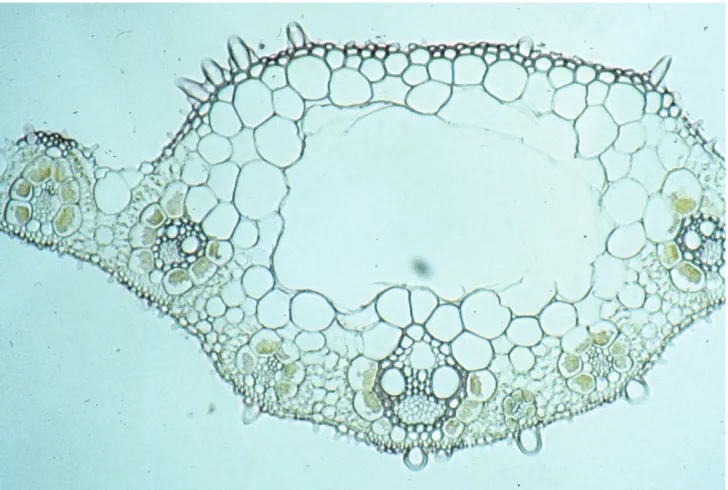
Figure 4. Cross section of leaf of D. fusca subsp. muelleri (Badman 675) showing midrib (central area), midrib lacuna (ML) and vascular bundle with centripetal chloroplasts (CC) of the mestome sheath.
Figure 5 Typical growth form (left) of Diplachne fusca subsp. fascicularis (Montgomery Co., Kansas; Snow 10978 [KSP]). As typical for the subspecies, it has fewer, longer, and more widely spaced panicle branches (right) than L. f. subsp. uninervia, with one or more of the lower panicle branches enclosed in the uppermost leaf sheath.
Leaf anatomy. Voucher: Badman 675 (CANB) (Fig. 5). Description as per D. fusca subsp. fascicularis.
Stem anatomy. Not examined. Choromsome number. Unknown.
Phenology. Flowering January through October.
Distribution. Native: Widespread across inland Australia, particularly the central regions; wet areas such as streambanks, around boreholes, and swamps, in a variety of soil types (TDWG: WAU-WA, NSW, VIC, QLD-QU, NTE.) Elevation from near sea level, upper elevation unconfirmed. Non-native: TDWG: SWI; not confirmed.
Conservation status. Least Concern (IUCN 2012) due to its widespread distribu-tion across Australia.
Etymology. Named after German-Australian botanist Ferdinand von Mueller (1825–1896).
Vernancular names. Mueller sprangletop; Mueller beetlegrass, Sugar Grass (in the Maranoa District of Queensland, Australia).
Comments. Diplachne fusca subsp. muelleri is most easily recognised by the rela-tively narrow panicles, which are largely inserted at their bases and the presence of inflorescences at most points of branching on the culms. The mature lemmas often have a dark spot at the base at maturity, are relatively broad, flattened and the dense trichomes along the nerves typically spread widely at maturity.
especially from lateral inflorescences. However, the upper glumes are generally much broader than the primarily North American subspecies.
Another occasional trait is a pronounced magenta to purplish mottling of the leaf sheaths (e.g. Carolin 6300 [US, K], Weber 8769 [US, W]), which typically is absent in D. fusca subsp. fusca, another native Australian subspecies, but which recurs sometimes in the American subspecies fascicularis. The relatively short spikelets of Lazarides 4381 (CANB), Chippendale 2036 (CANB), Hubbard & Winders 6263 (B, CANB), cou-pled with inserted, narrow panicles, suggest hybridisation between between D. fusca subsp. muelleri and fusca.
This subspecies is a relatively short-lived annual, whose relative abundance is of-ten associated with the vagaries of water availability, particularly along watercourses and bores (=wells). The label of Symon 5617 (CANB, US) states the specimen grew relatively close to the hottest water emerging from the bore (ca. 110°F / 42°C). Cattle will graze the foliage and pastured horses eagerly consumed freshly collected specimens when offered (Snow pers. obs. 1996).



![Figure 5 Typical growth form (left) of Diplachne fusca subsp. fascicularis (Montgomery Co., Kansas; Snow 10978 [KSP])](https://thumb-us.123doks.com/thumbv2/123dok_us/875160.2081239/36.468.53.418.60.274/figure-typical-growth-diplachne-fusca-fascicularis-montgomery-kansas.webp)