Establishing Disciplinary English in the
Curriculum for English Majors in Chinese
Tertiary Education
Zhongqing He
School of Foreign Studies, University of Science and Technology Beijing, China
Abstract—Despite several reforms in English language teaching (ELT) for English majors at university level in China over the past decades, few studies have paid attention to how the curriculum for English majors needs modifying. The article calls for the establishment of disciplinary English as an important component in the English major curriculum in Chinese tertiary education. Focusing specifically on the development of ELT for English majors, this article discusses how disciplinary English might help solve literacy problems faced by English majors and clarifies the need for disciplinary English and its position in the English major curriculum. Disciplinary English is the research and teaching of English used in disciplines in higher education context and it can be further classified in line with different types of disciplines and fields of practice. Disciplinary English is related to English for academic purposes (EAP) and disciplinary literacy in six aspects: context, students, nature, syllabus, aim, and focus. The establishment of disciplinary English in the English major curriculum has important implications for the future development of ELT for English majors in China.
Index Terms—disciplinary English, ELT, English major, Chinese tertiary education
I. INTRODUCTION
Since the opening up in the late 1970s, there has been a rapid growth in English language teaching (ELT) in China, as evidenced by both the popularity of English learning at all levels of schooling and an ever-increasing population of English learners of different ages (Bolton & Graddol, 2012; Cortazzi & Jin, 1996). Accordingly, learning English has been a trend for more than three decades (Lam, 2002), and China now is said to have the largest population of English learners in the world, amounting to as much as more than 400 million (Wei & Su, 2012).
Among this large population, English learners at the university level are of particular interest to researchers (Bolton & Botha, 2015; Heng Hartse & Jiang, 2015; Lam, 2002). They are generally divided into two groups—English majors and non-English majors. In the past decades, there have been several attempts at reform in ELT for English majors, such as the proposal to cultivate ‘interdisciplinary talents’ (Hu, 2002; Zhang, 1996), or ‘general talents’ (Hu & Sun, 2006; Zhou & Fan, 2010), and later some other approaches (Dai & Wu, 2010; Wen, 2014). Despite these efforts, there is a dearth of literature investigating how the curriculum for English majors should change, particularly in the context of the explosive spread of English for academic purposes (EAP) courses for non-English majors in China’s universities on the one hand, and on the other, of the increasing popularity of disciplinary literacy in US secondary schools. Indeed, to the best of my knowledge, no study so far has tried to draw on research on EAP and disciplinary literacy to improve the curriculum design for English majors in China’s universities.
The present study addresses these gaps by reviewing ELT for English majors at the university level in China and by making the case for establishing disciplinary English as an essential component in the curriculum for English majors.
II. ELT FOR ENGLISH MAJORS IN CHINESE TERTIARY EDUCATION
ELT in Chinese tertiary education dates to the late nineteenth and early twentieth centuries, when some English-medium universities and colleges were established in China by US missionary organizations to teach ‘modern knowledge’ as well as Christianity (Bolton & Botha, 2015). Since then, ELT at the university level in China has experienced drastic fluctuations, with the place of English in the Chinese educational system being taken by Russian in the early period of the founding of People’s Republic of China and then even removed during the Cultural Revolution. At the start of the ‘reform and opening up’ period in the late 1970s, English regained its dominant role and has retained a central place in foreign language education in China’s universities ever since (Heng Hartse & Jiang, 2015: 8).
More recently, however, this rapid development has slowed down, and two problems are beginning to loom large. First, ELT for English majors is becoming increasingly homogeneous. Although English major programs can be found in more than two thousand universities in China, the curriculum design is more or less the same, and this fails to manifest features specific to different schools, consequently hindering the development of ELT for English majors and making it difficult for them to meet the demanding needs of society and the market (Feng, 2016; Jiang, 2019).
Second, English as a major is gradually losing its appeal and advantages compared with other majors. Over the past decade, general English proficiency in China has been significantly improved due to several factors, such as globalization (Fang, 2011), internationalization in China’s universities (Shu, 2015), and the new English education policy set by Ministry of Education in China in 2001, which requires that English should be taught as early as the 3rd grade in primary schools (Bolton & Graddol, 2012). However, ELT for English majors in most universities in China still focuses on the development of students’ language skills, especially listening and speaking. Since English training organizations offer better services in this respect, there is widespread uncertainty as to what the purpose is for the English major. Consequently, English major graduates are facing increasing challenges in the job market and have lost their advantages over graduates of other majors (Shu, 2015).
Over the past decades two major reforms have taken place in ELT for English majors to cope with the above problems. The first reform, which began in 1980 and culminated in 2000, featured the cultivation of ‘interdisciplinary talents’. With the greater demand of graduates of high English proficiency and appropriate content-area knowledge, particularly in finance and economics in the 1980s, many universities in China began to modify the curriculum for English majors, adding subjects from other content areas or fields of practice, notably journalism, economics, and business management. In this context, some scholars (Hu, 2002; Zhang, 1996) then put forward the idea of ‘interdisciplinary talent’ and stressed that the goal of ELT for English majors in China was to cultivate talents capable of undertaking work in different fields through the medium of English. This idea was gradually accepted in many China’s universities and interdisciplinary programs for English majors began to emerge in large numbers, making this reform ‘the most widespread and the most influential reform in China’s foreign language education in the past decades’ (Hu, 2008).
The second reform came when some scholars started to question the feasibility of interdisciplinary programs and put forward the idea of ‘general talent’ in ELT for English majors (Hu & Sun, 2006). Realizing that the cultivation of interdisciplinary talents in the English major program is probably a step too far for both students and teachers, researchers (e.g. Hu, 2008; Zhou & Fan, 2010) called for a return for the humanistic nature of the English major on the ground that the English major inherently belongs with the arts and humanities and that the goal of an English major program should be directed to the cultivation of ‘general talents’, that is, graduates with wide knowledge in different fields, rather than knowledge specifically orientated towards certain disciplines or content areas.
From ‘interdisciplinary talents’ to ‘general talents’, ELT for English majors in China seems to have gone from one extreme to the other. Uncertainties remain as to how to develop ELT for English majors in the future. Nevertheless, the two reforms and some later endeavors suggest that ELT for English majors in China’s universities might need to learn from EAP studies in non-English major programs in China and pay attention to changes taking place in the educational system in other countries in order to find a way out for its future development.
III. THE NEED FOR DISCIPLINARY ENGLISH IN THE CURRICULUM
The seemingly abrupt shift of focus in the two reforms of ELT for English majors has generated much discussion among scholars and educators. Over the past decade, great interest has been shown in reconciling the goals of the two reforms and in drawing on EAP studies in ELT for non-English majors. As Chang (2007) demonstrated in his large-scale survey, interdisciplinary programs have positive effects on English majors, including changing their learning methods and improving their English learning. Therefore, it is necessary to add to the English major curriculum some content-based instruction (CBI) courses. In this vein, some studies (Dai & Wu, 2010; Wen, 2014) have tried to take an eclectic approach to reform. These studies advocate the re-orientation toward the cultivation of ‘general talents’ in the English major program, and at the same time argue for equal emphasis to be placed on the development of students’ discipline-specific knowledge in different content areas.
In recent years, there has been a growing consensus that ELT for English majors in China might learn from ELT for non-English majors and benefit from the setting up of English for special purposes (ESP) or EAP courses in the curriculum. As Liang, Chen, & Lu (2006) pointed out, the effectiveness of ESP/EAP courses for English majors are closely related to the cultivation of interdisciplinary talents, and these courses might provide the major channel through which English majors equip themselves with appropriate discipline-specific knowledge. Li (2011) went further and argued that the distinction between English for general purposes (EGP) and ESP/EAP courses is the driving force for the potential reforms taking place in ELT for English majors and that ESP/EAP courses might point to the general direction of development of ELT for English majors in China. Similarly, Shu (2015) discussed existing ESP/EAP courses in English major programs and argues that the setting up of ESP/EAP courses is essential to ‘revive English as a major’ in China’s universities.
curriculum in Chinese tertiary education, are focusing more on language features and practices specifically found in different disciplines, highlighting the feature of ‘disciplinary specificity’ and rendering the traditional distinction between English for general academic purposes (EGAP) and English for specific academic purposes (ESAP) almost unnecessary (Bruce, 2011; Hyland 2002, 2006). On the other, as stated above, ELT for English majors in China’s universities during recent years has responded to the literacy demands of professional careers and has gradually shifted to uncovering and teaching discipline-specific routines, skills, language, and practices by establishing ESP/EAP courses in the curriculum. This trend in ELT in Chinese tertiary education, described as ‘specialization of English for non-English majors and publicization of English for English majors’ (Zhang, 2005), indicates that there are some common grounds between ESP/EAP courses in English and non-English major curriculums. However, as ELT for English majors and ELT for non-English majors are inherently two different systems, differing from each other in such aspects as students, teaching purposes, and contents, ESP/EAP courses in English and non-English major programs are not the same. It is important that we tease apart the distinctions between the two and clarify the different aspects of ESP/EAP courses in the curriculum for English majors.
Another factor that needs to take into consideration is the rapid development of disciplinary literacy in US secondary education. In the past decade, disciplinary literacy has emerged as a response to find a solution to literacy problems experienced by adolescents in US middle and secondary schools (Fang & Schleppegrell, 2008; Moje, 2008, 2015; Rainey, 2016; Schanahan & Shanahan, 2008). Likewise, in China’s universities, the English major is now also experiencing a ‘literacy crisis’, which shows that most of English-major students have great difficulty in reading and writing in English, particularly the texts they encounter as part of learning CBI courses in the program (Peng, 2019; Zhang, 2012). Therefore, the future development of ELT for English majors in China’s universities also calls for an ‘advanced literacy instruction’ (Shanahan & Shanahan, 2008), focusing on the specialised practices of literacy inherent in certain disciplines, just like the situation in US middle and secondary school settings.
IV. THE POSITION OF DISCIPLINARY ENGLISH
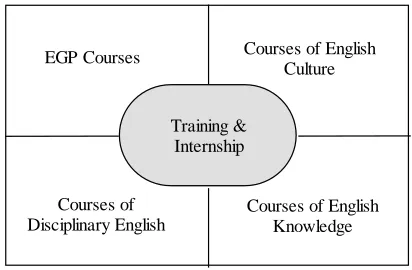
As shown in Figure 1, there are four basic categories of courses in the English major curriculum and their importance may vary in accordance with the goals of English major programs in different universities. The first category consists of EGP courses, specifically those that are designed to improve students’ language skills. They are usually timetabled early on, in the first and second years of college education. Through these courses, English majors are expected to develop a good mastery of the English language and be able to cope with situations which require basic communication skills in English.
Training & Internship
EGP Courses Courses of English Culture
Courses of Disciplinary English
Courses of English Knowledge
Figure 1. Four categories of courses in the English major curriculum
The second category consists of courses about English culture. These are usually provided at the intermediate stage of English major program, in the second or third year. Together with the first category, these are usually regarded as the basic courses in the traditional English major curriculum.
The third category consists of courses of English knowledge per se. These are the courses that are particularly unique to the English major program. They are designed to help students research English as a subject and develop their professional knowledge of the English language. Such courses are usually set in the junior and senior years at college and they focus on different aspects of the study of the English language, such as linguistics, etymology, literature, and translation studies. In recent years, researchers has shown a resurgence of interest in putting greater emphasis on these courses on the grounds that ELT for English majors in past decades has given too much attention to EGP courses, thus reducing English majors to students without their own academic specialty (Feng, 2016; Zhang, 2012).
professional orientations’ (Feng, 2016). It is these courses that enable English majors to meet career demands with discipline-specific strategies within academic disciplines or fields of practice.
The four categories comprise the core courses in the English major curriculum. In addition, there might be other peripheral courses or components that are believed to work together to contribute to the development of ELT for English majors. First, as shown in Figure 1, training and internship is an important component. Whatever types of talents the English major program seeks to cultivate, training and internship is essential for English majors to put into practice what they have learnt in class and so develop various skills essential for their future jobs in terms of organization, communication, problem-solving and teamwork. Second, as the English major is a program in the arts and humanities, there has been an urgent call to reinstate courses of ‘general education’ (Wen, 2014), or ‘public basic courses’ (Feng, 2017; Jiang, 2014) in recent years, with an aim of developing students’ general knowledge in such fields as literature, philosophy, history, and critical thinking.
V. DISCIPLINARY ENGLISH,EAP, AND DISCIPLINARY LITERACY
A. Definition of Disciplinary English
In many respects, disciplinary English is related to EAP and disciplinary literacy. It can be said to be an interface between EAP and disciplinary literacy. In this section we try to further clarify the aspects of disciplinary English, and then explore the connections and relations between disciplinary English, EAP, and disciplinary literacy.
Disciplinary English, simply put, refers to the research and teaching of English used in disciplines in higher education. It is concerned with the exploration and instruction of linguistic features, skills, and routine practices that are used for the construction and building of knowledge specific to certain academic disciplines or fields of practice. Like EAP and disciplinary literacy, disciplinary English is the ‘co-existence of teaching and research’ (Hamp-Lyons, 2011). It is not just an approach to ELT specifically oriented to English majors at the university level in China, but also an important area of research for linguists and educators. As detailed below, much of the work in disciplinary English is to focus on the analysis and description of routine practices and text features inherent in different disciplines.
B. Taxonomy of Disciplinary English
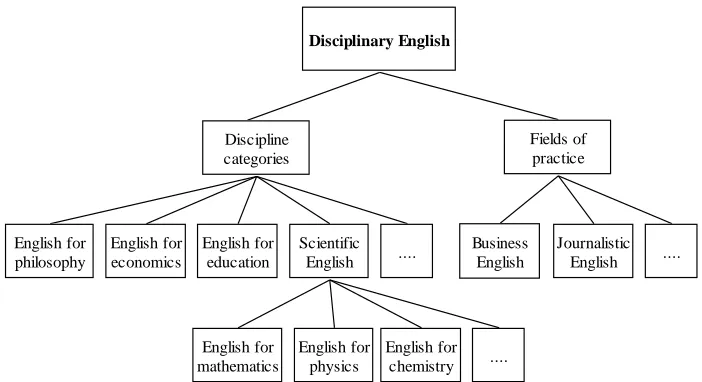
As disciplinary English focuses on the linguistic features and practices specific to different disciplines or fields of practice, the taxonomy of disciplinary English involves classification in line with the taxonomy of other disciplines. In the Chinese educational system, there are 13 categories of disciplines, including philosophy, economics, law, education, literature, history, science, engineering, agriculture, medical science, military science, management, and art. Each category may include several primary and secondary disciplines. In addition, disciplinary English also encompasses English oriented to some important fields of practice, such as business English, legal English, and journalistic English. With all this in mind, the taxonomy of disciplinary English can be depicted in Figure 2.
Disciplinary English
Discipline categories
Fields of practice
English for philosophy
English for economics
English for education
Scientific English ....
Business English
Journalistic English
English for mathematics
English for physics
English for chemistry
....
....
Figure 2.The taxonomy of disciplinary English
C. Disciplinary English in the Language-content Continuum
Taking an overall view of ELT in China, we can see that the various approaches to ELT are in effect located in different positions along the language-content continuum, which places different degrees of emphasis on either language or content. As shown in Figure 3, at the left end of the language-content continuum, we have EGP, which largely focuses on learning language, and at the right end we have English as medium of instruction (EMI), which is mainly concerned with the learning of different content areas with English as a medium of instruction. In between, there are various approaches to ELT, including the two subtypes of EAP, namely EGAP and ESAP, and disciplinary English.
Language Content EGP EGAP ESAP disciplinary
English EMI
Figure 3.Approaches to ELT in China along the language-content continuum
The language-content continuum indicates that as Chinese learners of English progress in their English learning, they have a greater need to use English as a medium to navigate discipline-specific texts and perform tasks in different content areas. As shown in Figure 2, at the preliminary stage of English learning in China, in elementary and secondary schools, and probably in the first one or two years of college, learners are largely learning EGP courses, which mainly focus on the improvement of learners’ language proficiency. As learners move up to the later stage of college-level English learning, non-English learners and English learners take different routes in their English education. Specifically, non-English learners usually proceed through EGAP to ESAP, then to English-medium instruction (EMI), while English majors go through disciplinary English to EMI.
The ELT routes for English and non-English major students in China’s universities are also indicative of the trend to convergence in content in ELT for English and non-English majors, and of the inherent relatedness between disciplinary English and EAP, particularly ESAP. For non-English majors, at the initial stage, their EAP learning largely focuses on EGAP, that is, the skills and language features thought to be common to all disciplines. At a later stage, however, ESAP takes over and ELT for them usually centers on ‘the teaching of skills and language which are related to the demands of a particular discipline or department’ (Hyland, 2006: 9). However, as stated above, in recent years, there is a general agreement that EAP should focus more on an understanding of the social, cognitive, and linguistic demands specific to academic disciplines. This trend, in a way, points in the same direction as disciplinary English in ELT for English majors, which also demands more focus on content of academic disciplines. The common ground here is that learning academic language cannot be separated from content areas. In other words, learning a discipline largely involves the learning how to use language in ‘disciplinarily approved ways’ (Hyland, 2006: 38).
D. Disciplinary English in Comparison with EAP and Disciplinary Literacy
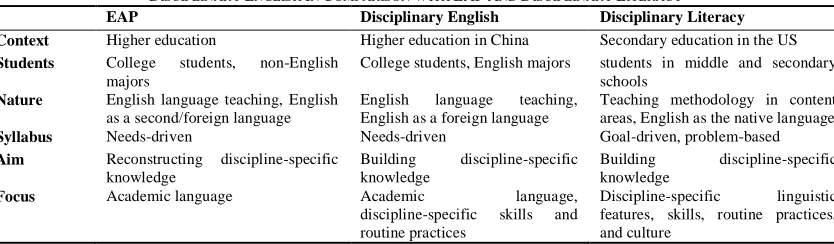
Next, we consider the major differences and relationships between disciplinary English, EAP, and disciplinary literacy. As shown in Table 1, disciplinary English is mainly different from and related to EAP and disciplinary literacy in six aspects: context, students, nature, syllabus, purpose, and focus.
In terms of context, both EAP and disciplinary English reside in higher education. Disciplinary English may be more region-specific, referring specifically to higher education settings in China. However, as Blaj-Ward (2014: 53) pointed out, although located in the higher education context, EAP and disciplinary English practitioners do not necessarily need to be ‘insiders’ in the disciplines on which they focus, although collaboration between experts from these disciplines and teachers of English is much to be anticipated and desired. On the other hand, disciplinary literacy is largely located in US secondary education. It starts in middle and secondary schools in the US, and by now its popularity and importance has been largely confined to this context.
TABLE 1
DISCIPLINARY ENGLISH IN COMPARISON WITH EAPAND DISCIPLINARY LITERACY
EAP Disciplinary English Disciplinary Literacy
Context Higher education Higher education in China Secondary education in the US
Students College students, non-English
majors
College students, English majors students in middle and secondary schools
Nature English language teaching, English as a second/foreign language
English language teaching, English as a foreign language
Teaching methodology in content areas, English as the native language
Syllabus Needs-driven Needs-driven Goal-driven, problem-based
Aim Reconstructing discipline-specific knowledge
Building discipline-specific knowledge
Building discipline-specific knowledge
Focus Academic language Academic language,
discipline-specific skills and routine practices
Next, EAP and disciplinary English students are all adult learners. Specifically, EAP students are non-English majors at college, while disciplinary English students are English majors. Disciplinary literacy students, however, are adolescents in US middle and secondary schools. In other words, learners of EAP and disciplinary English are non-native speakers, while learners of disciplinary literacy are English native speakers. This aspect, as detailed below, has an important influence on the nature and focus of the three.
In terms of nature, EAP and disciplinary English are both approaches to ELT, while disciplinary literacy is largely a teaching methodology in content areas. Specifically, in EAP and disciplinary English teaching and research, English is a foreign language. Therefore, much of the work in EAP and disciplinary English involves the learning of English used in different academic disciplines and fields of practice. By contrast, English in disciplinary literacy is the native language for learners, and much of the work focuses on uncovering the linguistic features, skills and practices specific to content areas.
With respect to syllabus, both EAP and disciplinary English are needs-driven activities. Needs analysis underlies the syllabus design, materials development, organization of class activities and evaluation of students’ performance in EAP and disciplinary English, with an aim of addressing the needs of college students at an advanced stage of English learning to use English in academic contexts or fields of practice. Disciplinary literacy, however, is more a goal-driven and problem-based activity. In other words, disciplinary literacy sets out to help solve literacy problems for students in secondary education (Moje, 2008), and it has a fundamentally ‘social and problem-based nature’ (Rainey, 2016).
As for purpose, as EAP students have their own majors or academic areas in their college education, they are largely reconstructing discipline-specific knowledge when taking EAP courses. Conversely, since disciplinary English students, namely English majors in China’s universities, are not yet involved in learning other content areas, they are, in fact, building discipline-specific knowledge when taking disciplinary English courses. Similarly, for students in US middle and secondary schools, learning disciplinary literacy is also a process of learning the specialized language and practices inherent in certain content areas and forming ‘big ideas’ about different disciplines. Therefore, in this respect, both disciplinary English and disciplinary literacy are more focused on teaching students to become ‘well-informed amateurs’ (Heller, 2010), preparing them to acquire discipline-specific knowledge in their further studies.
Lastly, since EAP and disciplinary English are approaches to ELT, they both focus on academic language used in different disciplines. As Alexander et al. (2008: 9) pointed out, academic language is the most important component of EAP. Likewise, in disciplinary English, academic language is also the focus. Just as in EAP, much of the work in a disciplinary English class focuses on the input and uncovering of discipline-specific vocabulary, grammar and other aspects of language. Consequently, a central role should be reserved for language description in the study of EAP and disciplinary English. On the other hand, the focus in disciplinary literacy is much more complicated. As Moje (2015) proposes, disciplinary literacy involves a number of elements that contribute to the production of knowledge and critical thinking, including not only discipline-specific linguistic codes, technical vocabulary, and discourse practices, but also cultures ‘in which certain kinds of texts are read and written for certain purposes and with or to certain audiences’. Therefore, the focus in disciplinary literacy might be discipline-specific language, or practices and expertise, or cultures, depending on the researcher’s perspective.
EAP Disciplinary
English
Disciplinary Literacy
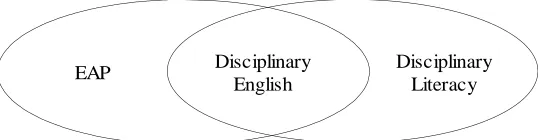
Figure 4. Disciplinary English as an interface between EAP and disciplinary literacy
Overall, disciplinary English is located between EAP and disciplinary literacy, displaying features of EAP at one point, and features of disciplinary literacy at another. In most cases, disciplinary English shows features of both EAP and disciplinary literacy. Therefore, as shown in Figure 4, disciplinary English can be regarded as an interface between EAP and disciplinary literacy, interwoven with them in many respects.
VI. CONCLUSION
literacy and is an interface study between the two, requiring scholars and educators to draw on both for the studies of disciplinary English.
The design and implementation of disciplinary English courses in the curriculum for English majors poses several difficulties and challenges for the different parties involved. First, as disciplinary English largely revolves around the academic language of specific disciplines, the implementation of disciplinary English needs to attach great importance to the language description of English used in different academic disciplines or fields of practice. Second, the implementation of disciplinary English courses requires collaboration between teachers of English and experts in evidence-based academic disciplines, such as science, engineering, and business studies. The implementation of disciplinary English courses will pose great challenges to teachers of English in particular. They need to work with scholars or teachers in different academic disciplines to uncover and examine the different tools used for building knowledge in those disciplines (Fang, 2014). Nevertheless, disciplinary English offers an approach to solving problems in current ELT for English majors in China’s universities. By establishing disciplinary English courses in the curriculum for English majors in Chinese tertiary education, teachers can help English majors better engage with interdisciplinary work and develop their ‘advanced literacies’ in different academic disciplines.
ACKNOWLEDGEMENTS
This work was supported by China Scholarship Council [grant number 201606465043], Beijing Social Science Foundation [grant number 19YYB004] and the Fundamental Research Funds for the Central Universities [grant number FRF-BR-19-007B]. I thank Gina Cervetti at University of Michigan, who initiated me into the area of disciplinary literacy and guided me to form ideas of this article. I am deeply grateful to Professor Zhihui Fang at University of Florida for his valuable and constructive suggestions to revise the article. Thanks also go to Dr. Mark Buck at University of Science and Technology Beijing for proofreading my manuscript and offering enlightening discussions.
REFERENCES
[1] Alexander, O., Argent, S., & Spencer, J. (2008). EAP essentials: A teacher’s guide to principles and practise. Reading, UK: Garnet.
[2] Blaj-Ward, L. (2014). Research contexts, practices and pedagogies in English for academic purposes. New York: Palrave Macmillan.
[3] Bolton, K., & Graddol, D. (2012). English in China today. English Today, 28(3), 3-9.
[4] Bolton, K., & Botha, W. (2015). English in China’s universities: Past and present. World Englishes, 34, 190–210. [5] Bruce, I. (2011). Theory and concepts of English for academic purposes. London & New York: Palgrave Macmillan.
[6] Chang, J. (2007). Gaodeng xuexiao yingyu zhuanye yingyu jiaoxue dagang shishi xiaoguo de yingxiang fenxi: Yong yingyu kaishe xiangguan zhuanye zhishi kecheng de yingxiang fenxi [A qualitative study on the implementation of the Curriculum of English Major in Higher Educational Institutions]. Waiyu Jiaoxue yu Yanjiu [Foreign Languages and Their Teaching], (9), 36–40.
[7] Cortazzi, M., & Jin, L. (1996). English teaching and learning in China. Language Teaching, 29(1), 61–80.
[8] Dai, W., & Wang, X. (2014). Woguo gaodeng jiaoyu neihanshi fazhan beijing xia yingyu zhuanye de jianshe silu [On the construction of English major under the background of connotative development of higher education in China]. Waiyujie [Foreign Language World], (3), 2–11.
[9] Dai, W., & Wu, F. (2010). Woguo waiyu xueke fazhan de yueshu yu duice [On the development of foreign language studies in China: Constraints and strategies]. Waiyu Jiaoxue yu Yanjiu [Foreign Language Teaching and Research], (3), 170–175. [10] Dai, W., & Zhang, X. (2007). Dui woguo yingyu zhuanye benke jiaoxue de fansi [Reflections on the undergraduate program of
English majors in China]. Waiyujie[Foreign Language World], (4), 2–11.
[11] Draper, J., Smith, L. K., Hall, K. M., & Siebert, D. (2005). What’s more important—Literacy or content? Confronting the literacy-content dualism. Action in Teacher Education, 27(2), 12–21.
[12] Fang, X. (2011). Globalizing ELT: From Chinglish to China English. Journal of Language Teaching and Research, 2, 377–381.
[13] Fang, Z. (2014). Preparing content-area teachers for disciplinary literacy instruction: The role of literacy teacher educators.
Journal of Adolescent and Adult Literacy, 57(6), 444–448.
[14] Fang, Z., & Schleppegrell, M. (2008). Reading in Secondary Content Areas: A Language-Based Pedagogy. Ann Arbor: The University of Michigan Press.
[15] Feng, G. (2016). Xinyilun yingylei zhuanye jiaoyu gaige: Huigu he zhanwang [The current reform in the English major program: Retrospect and prospect]. Waiyujie [Foreign Language World], (1), 12–17.
[16] Hamp-Lyons, L. (2011). English for academic purposes. In E. Hinkel (ed.), Handbook of research in second language teaching and learning. New York & London: Routledge, 89–105.
[17] Heller, R. (2010). In praise of amateurism: A friendly critique of Moje’s “Call for Change” in secondary literacy. Journal of Adolescent & Adult Literacy, 54(4), 267–273.
[18] Heng Hartse, J., & Jiang, D. (2015). English language teaching and learning at the national level in China. In J. Heng Hartse & D. Jiang (eds.), Perspectives on teaching English at colleges and universities in China. Alexandria, VA: TESOL Press, 5–13. [19] Hu, Z. (2002). Dui zhongguo yingyu jiaoyu de ruogan sikao [Reflections on China’s English education]. Waiyu Yanjiu
[Foreign Language Research], (3), 2–5.
[21] Hu, W., & Sun, Y. (2006). Tuchu xueke tedian, jiaqiang renwen jiaoyu: Shilun dangqian yingyu zhuanye jiaoxue gaige [On strengthening humanistic education in the English language curriculum]. Waiyu Jiaoxue yu Yanjiu [Foreign Language Teaching and Research], (5), 243–247.
[22] Hyland, K. (2002). Specificity revisited: how far should we go now?. English for Specific Purposes, 21, 385–395. [23] Hyland, K. (2006). English for academic purposes: An advanced resource book. London & New York: Routledge.
[24] Jiang, H. (2014). Guanyu Yingyu Zhuanye Benke Jiaoyu Zhiliang Guojia Biaozhun zhiding de jidian sikao [Some thoughts on the compilation of The National Criteria of Teaching Quality for Undergraduate English Majors]. Waiyu Jiaoxue yu Yanjiu [Foreign Language Teaching and Research], (3), 456–462.
[25] Jiang, H. (2019). Xinshidai waiyu zhuanye fuhexing rencai peiyang de sikao [Reflections on the cultivation of interdisciplinary talents in the new era]. Zhongguo Waiyu [Foreign Languages in China], (1), 11–14.
[26] Lam, A. (2002). English in education in China: Policy changes and leaners’ experiences. World Englishes, 21, 245–256. [27] Li, H. (2011). Dui yingyu jiaoyu zhuanye jianshe de sikao jiqi gaige celve [On the construction and reform strategies of Engl ish
education program]. Waiyu Jiaoxue [Foreign Language Education], (6), 49–52.
[28] Liang, X., Chen, J., & Lu, Y. (2006). Yingyu zhuanye ESP kecheng jianshe zhong de wenti yu duice [Problems and strategies in the setting up of ESP courses in English major programs]. Waiyujie [Foreign Language World], (4), 30–35.
[29] Moje, E. B. (2008). Foregrounding the disciplines in secondary literacy teaching and learning: A call for change. Journal of Adolescent & Adult Literacy, 52(2), 96–107.
[30] Moje, E. B. (2015). Doing and teaching disciplinary literacy with adolescent learners: A social and cultural enterprise. Harvard Educational Review, 85(2), 254–278.
[31] Peng, X. (2019). Xueke yingyu yanjiu: Gaoshuiping yingyu jiaoyu wenti yu duice shuyao [Disciplinary English studies: Problems and strategies in high-level English education]. Waiyu Jiaoxue [Foreign Language Education], (2), 1-7.
[32] Rainey, E. C. (2016). Disciplinary literacy in English language arts: Exploring the social and problem-based nature of literacy reading and reasoning. Reading Research Quarterly, 0(0), 1–19.
[33] Shanahan, T., & Shanahan, C. (2008). Teaching disciplinary literacy to adolescents: Rethinking content-area literacy. Harvard Educational Review, 78(1), 40–59.
[34] Shu, D. (2015). Gaoxiao yingyu zhuanye “fuxing” zhi sanda lujing [Three approaches to reviving English as a major in Chinese universities]. Zhongguo Waiyu [Foreign Languages in China], (5), 4–8.
[35] Wei, R., & Su, J. (2012). The statistics of English in China: An analysis of the best available data from government sources.
English Today, 28(3), 10–14.
[36] Wen, Q. (2014). Yingyulei zhuanye shijian duoyuan rencaiguan mianlin de tiaozhan yu duice [English-based BA programs with multiple concentrations: Challenges and suggestions]. Waiyu Jiaoxue yu Yanjiu [Foreign Language Teaching and Research], (1), 118–126.
[37] Zhang, C. (1996). Gaoxiao yingyu zhuanye yingyu fuhexing rencai peiyang duice de sikao. [On the cultivation of interdisciplinary talents in English major programs in China’s universities]. Waiyujie [Foreign Language World], (1), 6–10. [38] Zhang, J. (2005). Gonggong yingyu jiaoxue de zhuanyehua yu zhuanye yingyu jiaoxue de gonggonghua: Woguo gaoxxiao
yingyu jiaoxue gaige de biyou zhilu [The specialization of ELT for non-English majors and the publicness of ELT for English majors in China]. Waiyu yu Waiyu Jiaoxue [Foreign Languages and Their Teaching], (11), 28–31.
[39] Zhang, S. (2012). Duxie weiji: Dangjin yingyu zhuanye mianlin de zuida tiaozhan [Literacy crisis: The biggest challenge to th e English major]. Waiyu Jiaoxue Lilun yu Shijian [Foreign Language Learning Theory and Practise], (2), 1–5.
[40] Zhou, X., & Fan, Y. (2010). Yingyu zhuanye fuhexing rencai peiyang mubiao neihan yu cengci dingwei [On the objectives and levels of cultivating interdisciplinary English majors]. Waiyujie [Foreign Language World], (4), 36–42.