e- ISSN 0975 – 9328 Print ISSN 2229 – 7472
International Journal of Phytopharmacology
Journal homepage:
www.onlineijp.com
EVALUATION OF NOOTROPIC ACTIVITY OF
VIGNA
MUNGO
LINN. ON SCOPOLAMINE INDUCED COGNITIVE
DYSFUNCTION IN MICE
*Krishna Mohan Chinnala, Swetha Pinninti, Madhan Mohan Elsani
Department of Pharmacology, St.John College of Pharmacy, Yellapur, Hasanparthy, Warangal-506371. Andhra Pradesh, India.
ABSTRACT
Memory loss is universal and is the first symptom to manifest in majority of the patients suffering from Alzheimer’s disease. This study is designed to investigate the effect of ethanolic extract of Vigna mungo Linn., on learning and memory in mice. Learning and memory were evaluated using Elevated plus maze, Y- Maze and Morris Water Maze after the oral administration of two safe doses (200 mg\kg and 400 mg\kg) of ethanolic extract of Vigna mungo Linn., Piracetam is used as standard in all studies. Brain acetylcholinesterase activity (Ellman method) and antioxidant activity (DPPH Radical scavenging activity) were also estimated. Ethanolic extract of Vigna mungo Linn., produced significant improvement in memory score i.e. Escape latency in Morris Water Maze (P<0.001), % alternations in Y-Maze (P<0.001) and dose dependent improvement of transfer latency in Elevated Plus Maze model (P<0.001), Dose dependent inhibition of brain acetylcholinesterase (P<0.05) and significant improvement in antioxidant levels were also noted. Memory enhancing potential of Vigna mungo Linn., can be attributed to its anti Acetylcholinesterase activity and antioxidant properties. Hence, dietary usage of Vigna mungo Linn., is beneficial and can also be employed as an adjuvant to existing anti-dementia therapies.
Key words: Vigna mungo Linn., Dementia, Antioxidant activity, Learning, memory.
INTRODUCTION
Alzheimer’s disease is a type of dementia or loss of brain function, that causes behavioral, memory and thinking problems. Alzheimer’s is also categorized as a degenerative disease. Alzheimer’s disease is thought to be caused by a combination of genetic and environmental factors but it is still not totally clear what exactly causes the disease. A diagnosis of Alzheimer’s disease can only be made when certain symptoms are present in an individual and symptoms of other types of dementia are not present (Anns Morrrison and Constantine Lyketsos, 2005).
Symptoms of the disease include difficulty in several areas of mental function including language,
Corresponding Author
Krishna Mohan Chinnala
Email: [email protected]
memory, perception, emotional behavior and personality and cognitive skills. In the early stages of the disease, symptoms just appear as forgetfulness. As Alzheimer’s disease progresses, the symptoms get worse and become more obvious. The symptoms also begin to interfere more with the individual’s day-to-day life and self care becomes increasingly more difficult. Once a person with Alzheimer’s disease has reached the severe stages of the disease, they become immobile and are totally disabled (Anns Morrrison and Constantine Lyketsos, 2005).
support to family members and caregivers (Bischkopf et al., 2002).
Vigna mungo Linn.,(family: Fabaceae) is one of the oldest cultivated plants in the world. Vigna mungo Linn., is also referred as urad dal, urd bean, urd, urid, black matpe bean, black gram, black lentil. It is bean grown in southern Asia. It is also transferred from Phaseolus to Vigna. Phaseolus has been investigated to contain genstein, kievitone, hydroxydiazein, dalbergioidin, cyclokievitone, isoferreinin, eugenol, glycinol, demethylvesitol, hemicelluloses A and pectin. It also contains albuminoids, starch and oil. Seeds contain saponin I, II, III. Among legume, they are more useful because they are the main sources of amino acid as well as protein (Brahma SK and Debnath PK, 2003: Gangarao Battu and Anjana, 2011).
Roots of the plant are narcotic and are used for ostalgia, abscess and inflammations. Plant is used in asthma, cough, cystitis, piles, paralysis, rheumatism, liver diseases and fever. Seeds are sweet, emollient, thermogenic, diuretic, aphrodisiac, tonic, antipyretic, nutritious, dropsy, galactagogue, appetizer, laxative and nervine tonic. Plant is useful in dyspepsia, anorexia, constipation, appendicitis, haemorrhoids, hepatopathy, neuropathy, measles, smallpox, chicken pox, typhoid, agalactia. The pulse is astringent, used to strengthen the eye and as a diet in fever(Jasmine Chowdary and Akash Gain, 2011).
MATERIALS AND METHODS Plant material:
The Leaves of Vigna mungo Linn. werecollected from local areas of Warangal district (India)in the month of January and authenticated by taxonomist Dr. Vatsavaya S.Raju, Senior Professor,Department of Botany, Kakatiya University, Warangal, Andhra Pradesh.
Preparation of Ethanolic Extract of Vigna mungo
Linn., :
The leaves of plant Vigna mungo Linn.,were cleaned and removed adherent sand and dust particles. It was dried and reduced to fine powder to obtain a powder of desired particle size.
The powder material was subjected to (95%) continuous extraction with soxhlet apparatus using ethanol as a solvent at (60 – 700 C). After the effective extraction, the solvent were distilled off and the extract was then concentrated by evoparating the solvent (Manisha et al., 2011).
Experimental Animals
Swiss albino male mice (20-25gm) were procured and housed at CPCSEA approved (Reg.No.1278/ac/09/CPCSEA) animal house of St. John College of Pharmacy, Warangal. The animals were kept
in polypropylene cages (6 in each cage) under standard laboratory condition (12 hr light and 12 hr dark cycle) and had free access to commercial pellet diet (Hindustan lever Ltd, Bombay, India) with water ad libitum. The animal house temperature was maintained at 25 ± 20C with relative humidity at (50 ±15%). Ethical norms were strictly followed during all experiments and the study was approved by the Institutional Animal Ethical Committee of St. John College of Pharmacy (IAEC No. 006/IAEC/StJCOP/2011).
Experimental Design
Animals were divided into 5 groups of six animals each
Group I : Control: Vehicle p.o. 1ml
Group II : Negative control: Scopolamine
1mg/kg i.p
Group III : Pretreatment with Vigna mungo
Linn.,(200 mg/kg, p. o)
Group IV : Pretreatment with Vigna mungo Linn.,
(400 mg/kg, p. o)
Group V : Standard control: Piracetam
150mg/kg i.p (Eckert 1999)
In-vivo Pharmacological studies
Elevated Plus Maze
The elevated plus maze (EPM) consisting of two open arms (50x10 cm) crossed with two closed arms (50x10x40 cm) was used in this study to evaluate nootropic activity. The arms were connected together with a central square (10x10 cm). The apparatus was elevated to the height of 70 cm in a dimly illuminated room. The EPM was placed inside a light and sound attenuated room. Mice were placed individually at the end of an open arm of EPM facing away from the central platform and note the time it took to move from the end of open arm to either of the closed arms. Transfer Latency (TL) was recorded which is used as a parameter for estimation of memory enhancing property.
The Transfer latency (TL) was taken as the time taken by mouse to move into one of the covered arm with all its four legs and the TL was assigned as 90 sec. The mouse was allowed to explore the EPM for 10 sec and then returned to its home cage. Memory retention was examined 24 h after the first day trial(i.e., on 2nd day). On the 19th day, 90 min after the treatment of last dose first trial is given and after 24 hr TL was noted for second time (i.e. on 20th day). The inflexion ratio (IR) was calculated by the formula.
IR = (L0-L1) / L0
Where, L0 is the initial transfer latency (TL) in Sec on first
time,
L1 is the transfer latency (TL) in Sec on 2nd time.
memory impairment (Hanumanthachar Joshi and Milind Parle, 2006: Venkata Rao et al, 2008).
Y Maze Test
Y-maze task is used to measure the spatial working memory through the spontaneous alternation behaviour. The maze is made of black painted wood. Each arm is 40 cm long, 13 cm high, 3 cm wide at the bottom, 10 cm wide at the top and converges at an equal angle. Each mouse is placed at the end of one arm and allowed to move freely through the maze. Mice tend to explore the maze systematically, entering each arm in turn.
The ability to alternate requires that the mice know which arm they have already visited. The series of arm entries, including possible returns into the same arm are recorded visually. Immediate working memory performance was assessed by recording spontaneous alternation behavior in a single session in Y-maze. Alternation is defined as the number of successive entries into the three arms (A, B, C) on overlapping triplet sets i.e., ABC, CAB, or BCA but not BAB. Percentage of alternation was calculated as
% Alternation = {(No. of alternations) / (Total arm entries– 2)} X 100.
On the 19th day, 90 min after the treatment of last dose arm entries was recorded visually and percentage alteration was calculated (Hanumanthachar Joshi and Milind Parle, 2006; Habibur Rahman and Palayyan Muralidharan, 2010).
Morris Water Maze Test
The Morris water maze (MWM) represents a versatile tool in which a number of distinct tasks can be measured to evaluate working memory in mice. MWM consists of large circular tank made of black opaque PVC or hard board coated with fiber glass and resin and then surface painted white (1.8-2.0m in diameter and 0.4-0.6m height). The pool is filled with water (20-220C) to a depth of 0.3-0.4m and rendered opaque by the addition of small quantity of milk or milk powder or non-toxic white colour.
The floor of circular tank is marked off into four equal quadrants arbitrarily designed north, south, east or west. Escape platform is made up of plexiglass with a 13cm square platform attached to a 34cm long clear plexiglass, cylindrical pedestal (3cm diameter) mounted on a 1sq. m (5mm thick) plexiglass base. The top of the platform is covered with a coarse material that provides a good grip for the mice when climbing on a platform. For the hidden platform task, water is added to circular tank to a level 2cm above the top of the platform. The simplest measure of performance is the Latency to escape from the water on to the hidden platform.
The platform remains fixed in the position during the training session. Each animal is subjected to
four consecutive trials for four days (from 15th to 18th day) during which they are allowed to escape on to the hidden platform and allowed to remain there for 20 sec.
Escape latency (EL) is the time to locate the hidden platform in MWM is noted as an index of acquisition or learning. In case the animal is unable to locate the hidden platform within 120 sec, it is gently guided by hand to the platform and allowed to remain there for 20 sec. On the 19th day, 60 min after the last dose, platform is removed and time spent by each animal in target quadrant searching for the hidden platform is noted as an index of retrieval (Habibur Rahman and Palayyan Muralidharan, 2010; Sunil N and Kshirsagar, 2011).
In-vitro pharmacological study
Estimation of brain Acetylcholinesterase (AChE) activity
Acetylcholinesterase plays an important role in working memory as it metabolises acetylcholine which is useful for memory retention. On the ninteenth day animals were euthanized by cervical dislocation carefully to avoid any injury to tissues. The whole brain AChE activity was measured using the ‘Ellman method’. The end point was the formation of the yellow color because of the reaction of thiocholine with dithiobisnitrobenzoate (DTNB) ions. The rate of formation of thiocholine from acetylcholine iodide in the presence of tissue cholinesterase was measured using spectrophotometer. The resulting yellow color is due to reduction of DTNB by certain substances in the brain homogenate and due to non-enzymatic hydrolysis of substrate. After calibration of the instrument, change in absorbance per min of sample was read at 420 nm (Pramodinee et al., 2011).
Change in the absorbance / min
Rate = ‐‐‐‐‐‐‐‐‐‐‐‐‐‐‐‐‐‐‐‐‐‐‐‐‐‐‐‐‐‐‐‐--- × (5.74 × 10 ‐ 4)
C0
Where,
Rate = Moles of substrate hydrolyzed per min per gram of tissue
C0 = Original concentration of brain tissue (mg/ml)
Antioxidant Test
DPPH Radical Scavenging Activity:
reaction mixture indicates higher free radical scavenging activity (Eckert, 1999).
The Capability to scavenge the DPPH radical was calculated by using following equation:
DPPH Scavenging Effect (%) =
{(A control – A sample)/ (A control)} X 100
Where,
A control = Absorbance of the control reaction and
A sample = Absorbance in the presence of the sample
extracts.
The antioxidant activity of extract is expressed as IC50. The IC50 value is the measure of concentration in
(μg/ml) of extract that inhibits 50% of DPPH radicals.
Statistical analysis
The mean ± S.E.M. values were calculated for each group. The data was analyzed using Graph pad prism software version 5.0, 2011 by one-way (ANOVA) followed by Dunnet’s t test. P< 0.05 (95% confidence limit) was considered to be statistically significant.
RESULTS
Phytochemical and Acute toxicity studies:
The quantitative phytochemical investigation on the ethanolic extract of Vigna mungo Linn., (EEVM) was found to contain, carbohydrates, protein, sterols, flavanoids, glycosides, saponins, tannins. Acute toxicity studies were conducted according to OECD guidelines 423 and safe doses were selected for the study. No mortality or sign of toxicity was observed even at maximum dose of 2000mg/kg body weight by EEVM. Hence, it was concluded to be safe. Thus, 1/10th of maximum safe dose i.e. 200mg/kg was selected as starting dose. A higher dose of 400 mg/kg was also employed for further testing of effectiveness.
Elevated Plus Maze
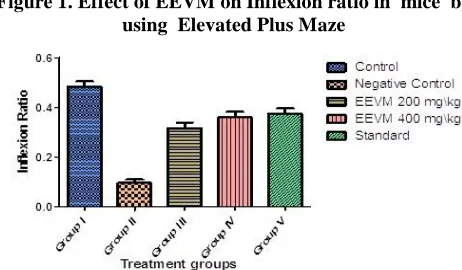
The Inflexion ratio (IR) of the Group II animals were significantly (p< 0.001) decreased in comparison with the Group I (normal control) animals. EEVM (200 & 400 mg/kg) dose dependently increased IR in Group III &
Group IV significantly (p< 0.001) in comparable with Group II. Piracetam (150mg/kg) increased IR in group V when compared with group II. Results shown in Figure 1.
Y maze task
The percentage of alternation was reduced in Group II when compared with Group I animals significantly (P<0.001). Groups III, IV animals treated with EEVM (200 and 400 mg/kg) and the percentage of alternation was increased in both groups when compared with Group II animals. EEVM and Piracetam (150 mg/kg) showed significant increased percentage alternation. Results shown in Figure 2.
Morris water maze task
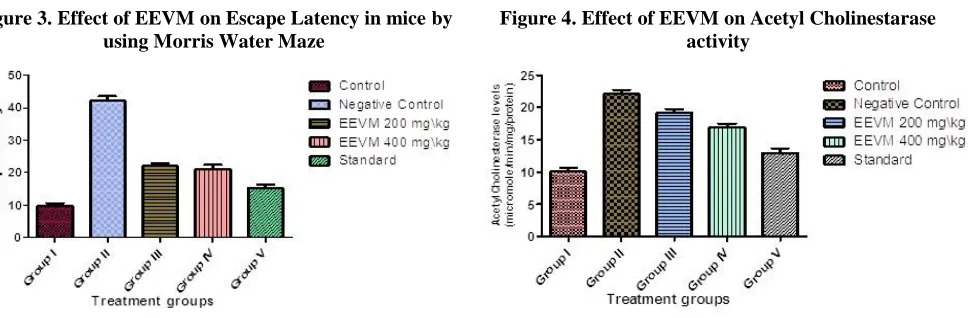
The escape latency of Group II animals were increased in comparison with Group I (Control) animals significantly (p<0.001). EEVM (200 and 400 mg/kg) treated groups showed significant (p<0.001) decrease in latency to escape on to the hidden platform in comparison with the Group II animals. EEVM and Piracetam (150 mg/kg) showed significant (p<0.001) decrease in escape latency in comparison with the Group II animals. Results shown in Figure 3.
Effect on Brain Acetyl cholinesterase Activity:
The Acetylcholinesterase activity of whole brain was markedly elevated after Scopolamine treatment in comparision with Control. In the treated groups a significant (p < 0.05) reduction in enzyme levels was observed in both 200 mg/ kg and 400 mg/ kg of EEVM treated mice. Piracetam treated group showed significant decrease in Acetyl cholinesterase levels. Results shown in Figure 4.
Anti-oxidant activity
IC50 values were calculated from the absorbance
obtained. IC50 value for standard Ascorbic acid was found
to be 37.7 µg/ ml and for EEVM it was found to be 59.31 µg/ ml. Results shown in Figure 5.
Figure 1. Effect of EEVM on Inflexion ratio in mice by using Elevated Plus Maze
Values represented in (Mean ± S.E.M, n=6), ns Non Significant, p <0.001
Figure 2. Effect of EEVM on % Alternations in mice by using Y – Maze
Figure 3. Effect of EEVM on Escape Latency in mice by using Morris Water Maze
Values represented in (Mean ± S.E.M, n=6), ns Non Significant, p <0.001
Figure 4.Effect of EEVM on Acetyl Cholinestarase
activity
Values represented in (Mean ± S.E.M, n=6), ns Non Significant, p <0.001
Figure 5. Percentage inhibition of Ascorbic acid and EEVM.
Table 1.Effect of EEVM on Inflexion ratio in mice by using Elevated Plus Maze
Comparisons were done between: a) Group I vs Group II; b) Group II vs Group III, IV, V;
Values represented in (Mean ± S.E.M, n=6), ns Non Significant, ** p <0.001, * p <0.01.
Table 2.Effect of EEVM on % Alternations in mice by using Y – Maze
Comparisons were done between: a) Group I vs Group II; b) Group II vs Group III, IV, V;
Values represented in (Mean ± S.E.M, n=6), ns Non Significant, ** p <0.001, * p <0.01.
S.NO Group Treatment Inflexion ratio (Mean ± SEM)
1 I Control 0.522 ± 0.004782
2 II Negative Control 0.086 ± 0.01520a**
3 III EEVM (200mg/kg) 0.261 ± 0.004193b*
4 IV EEVM (400mg/kg) 0.309 ± 0.00627b**
5 V Piracetam (150mg/kg ) 0.343 ± 0.003584b**
S.NO Group Treatment Percentage alternation(Mean ± SEM)
1 I Control 47.52 ± 0.2311
2 II Negative Control 24.20 ± 0.2951a**
3 III EEVM (200mg/kg) 35.15 ± 0.09457b*
4 IV EEVM (400mg/kg) 38.18 ± 0.1738b**
Table 3.Effect of EEVM on Escape Latency in mice by using Morris Water Maze
Comparisons were done between: a) Group I vs Group II b) Group II vs Group III, IV, V
Values represented in (Mean ± S.E.M, n=6), ns Non Significant, ** p <0.001, * p <0.01.
Table 4. Effect of EEVM on Acetylcholinesterase activity
Comparisons were done between: a) Group I vs Group II b) Group II vs Group III, IV, V
Values represented in (Mean ± S.E.M, n=6), ns Non Significant, ** p <0.001, * p <0.01.
Table 5. Antioxidant activity of Vigna mungo linn
DISCUSSION AND CONCLUSION
Memory is the ability of an individual to record sensory stimuli, events, information etc., retain them over short or long periods of time and recall the same at a later date when needed. Poor memory, lower retention and slow recall are common problems in today’s stressful and competitive world. Alzheimers disease is a neurodegenerative disorder characterized by a progressive loss of memory and cognition (Bischkopf et al., 2002; Jeanne Jackson Seigal, 2005). In this study, Leafs of Vigna mungo Linn. were subjected to successive solvent extraction with 95 % ethanol and we observed that Ethanolic Extract of leaves of Vigna mungo Linn. (200 and 400 mg//kg) has shown significant protection from loss of memory and cognition impairment in scopolamine induced cognitive dysfunction. Earlier, pharmacological investigation on Vigna mungo Linn. suggests about its hepatoprotective (Solanki and Jain, 2011), immunostimulatory effects (Solanki and Jain, 2010), proteolytic activity (Iracema Lima Ainouz and Ana Lúcia Ponte Freita, 2010) and antihyperlipidemic
activity (Solanki and Jain, 2010; Thomas and Leelamma, 1983)
Nootropic activity of EEVM was evaluated using various parameters. In invivo studies EPM, Y- Maze and MWM were used for estimation of working memory in mice (Amir Farshchi, 2010). Invitro studies include determination of Acetylcholinesterase levels and estimation of antioxidant activity.
Transfer latency (TL) was recorded using EPM. TL was recorded before and after the treatment of test compound. Inflexion ratio was calculated from the TL values. Inflexion ratio was decreased in negative control i.e. scopolamine treated group and increased in plant extract and piracetam treated groups. Decreased IR indicates the induction of amnesia and increased IR (Treatment groups) indicates protection from loss of memory and improved cognition (Chintawar, 2002).
Y-Maze was used to determine the percentage alternations. Percentage alternation were decreased in Negative control and increased in plant extract and piracetam treated groups. Increased percentage alternations indicates that protection from loss of memory
S.NO Group Treatment Escape Latency(Mean ± SEM)
1 I Control 10.47 ± 0.1401
2 II Negative Control 42.47 ± 0.2267a**
3 III EEVM (200mg/kg) 23.04 ± 0.4455b*
4 IV EEVM (400mg/kg) 18.20 ± 0.2017b**
5 V Piracetam (150mg/kg ) 14.98 ± 0.1107b**
S.NO Group Treatment Acetylcholinesterase Level (Mean ± SEM)
1 I Control 13.33±0.72
2 II Negative Control 10.11± 0422a**
3 III EEVM (200mg/kg) 19.23 ± 0.395b*
4 IV EEVM (400mg/kg) 16.75 ± 0.68b**
5 V Piracetam (150mg/kg ) 11.88 ± 0.467b**
S.NO Concentration of Extract(µg /ml) Ascorbic acid EEVM
1 10 73.35 38.60
2 25 92.80 45.65
3 50 97.43 55.90
4 75 97.53 60.88
5 100 97.55 70.05
and the decreased percentage alternation indicates decreased working memory.
Learning and memory involve mechanisms like acquisition, storage, consolidation and recall. MWM learning is a reasonably good test for cognitive function. Ability of the animal to identify the hidden platform may implicate long term memory. Escape latency was determined using MWM. Escape Latency was decreased in extract and piracetam treated groups due to cognitive functioning and increased in negative control due to cognitive impairment.
Ethanolic Extract of leaves of Vigna mungo Linn. was found to be having antioxidant activity. Brain Acetylcholinesterase levels elevated due to scopolamine and decreased due to ethanolic extract of leaves of Vigna mungo Linn. and standard piracetam.
The present pharmacological investigation revealed that ethanolic extract of Vigna mungo Linn., enhances memory while observed in EPM. Y- Maze and MWM. Ethanolic extract of Vigna mungo Linn., producing antioxidant activity and also decreased brain acetylcholinesterase enzyme levels and thereby elevated the acetylcholine concentration in brain and ultimately improved memory in scopolamine induced mice.
Thus, a combination of anticholinesterase and antioxidant effect exhibited by Vigna mungo Linn., may be the responsible mechanism for this memory improving effect. Hence dietary usage of Vigna mungo Linn., would be beneficial and it can also be added as an adjuvant to existing therapies for the treatment of dementia.
REFERENCES
Amir Farshchi, Golbarg Ghiasi, Samireh Farshchi, Peyman Malek Khatabi. Effects of Boswellia papyrifera gum extract on learning and memory in mice and rats. Iranian journal of basic medical sciences, 13, 2010, 9-15.
Anns Morrrison, Constantine Lyketsos. A Review on the pathophysiology of Alzheimers disease and directions in treatment. Advanced studies in nursing, 3, 2005, 5.
Bischkopf J, Busse A, Angermeyer MC. Mild Cognitive impairment a review on prevalence, incidence, prevalence & mortality and outcome according to current approaches. Blackwell munks, 106, 2002, 403-14.
Brahma SK and Debnath PK. Therapeutic importance of Rasayana drugs with special reference to their multi-dimensional actions. Aryavaidyan, 16, 2003, 160-3.
Chintawar Sd, Rs Somani, Veena S Kasture, Sb Kasture. Nootropic activity of Albizzia lebbeck in mice. Journal of Ethnopharmacology, 81, 2002, 299–305.
Eckert GP. Piracetam reverses hippocampal membrane alterations in Alzheimer's disease. Journal of Neural Transmission, 106, 1999, 757-61.
Gangarao Battu, Anjana Ch K V L S N. A Phytopharmacological Review On Vigna Species. An International Journal of Advances In Pharmaceutical Sciences, 2, 2011, 276-283.
Habibur Rahman and Palayyan Muralidharan. A research article on Nardostacys jatamansi protects from the loss of memory and cognition deficits in sleep deprived alzheimer’s disease mice model. International journal of Pharmaceutical sciances review and research, 5, 2010, 160-67.
Hanumanthachar Joshi and Milind Parle. Nootropic activity of calyces of Hibiscus sabdariffa linn. Iranian journal of pharmacology and therapeutics, 5, 2006, 15 – 20.
Iracema Lima Ainouz and Ana Lúcia Ponte Freita. Proteolytic activity cotyledons of vigna unguiculata, Walp using azoalbumins and azoglobulins as substrates. Rev. Bras. Fisiol. Vegetal, 3(1), 1991, 1-6.
Jasmine Chowdary, Akash Gain. A review on the worth of genous phaseolus. International jouranal of pharmaceutical research and development, 3, 2011, 54– 60.
Jeanne Jackson Seigal, A Review on Our current understanding of pathophysiology of Alzheimers disease. Advanced studies in Pharmacy, 2, 2005, 126–35.
Manisha R, Chikanea, Dilip V, Parwate B, Vishwas N, Ingleb , Santosh Chhajjedc and Animesh Chandra G, Haldarb. A Research article on In vitro Antioxidant effect of seed coats extracts of Vigna mungo. Journal of Pharmacy Research, 4, 2011, 656-7.
Pramodinee D, Kulkarni, Mahesh M Ghaisas, Niranjan D, Chivate, Poournima S. Memory enhancing activity of Cissampelos pariera in mice. International journal of pharmacy and pharmaceutical sciences, 3, 2011, 206–11. Solanki YB, Jain SM. Antihyperlipedemic activity of clitorea ternate and Vigna mungo against in rats. pharma Biol, 48,
2010, 915–23.
Solanki YB, Jain SM. Hepatoprotective effect of Clitorea ternate and Vigna mungo Linn, against acetaminophen and carbon tetra chloride induced hepatotoxicity in rats. Journal of pharmacology and toxicology, 6, 2011, 30–48.
Solanki YB, Jain SM. Immunostimulatory activities of Vigna mungo L.extract in male Sprague dawley rats. Journal of immunotoxol, 7, 2010, 213–8.
amnesia in mice. International journal of pharmtech research, 3, 2011, 104-9.
Thomas M, Leelamma S. Effect of Black gram fiber ( phaseolus mungo ) on hepatic hydroxylmethyl glutyryl- CoA reductase activity, cholestrogenesis and cholesterol degradation in rats. The journal of nutrition, 113, 1983, 1104–8.