212
Available online at www.ijiere.com
International Journal of Innovative and Emerging
Research in Engineering
e-ISSN: 2394 - 3343 p-ISSN: 2394 - 5494
Study on the behavior of self compacting concrete with fly ash
and glass powder as partial replacements for cement
Binu P
aand Deepa Balakrishnan
ba Research Scholar, Department of Civil Engineering, Cochin University of Science and Technology, Kochi, Kerala
bAssociate Professor, Cochin University of Science and Technology, Kochi, Kerala
ABSTRACT:
Self compacting concrete is one of the most innovative engineered materials achieved by concrete researchers. The advanced achievements of SCC as compared to normal vibrated concrete are the reduction in risk due to human factor, freedom in design and constructions, improved durability, safer working environment, economic efficiency, sustainability etc. This paper makes an effort to find the effectiveness of SCC in different ratios and combinations of fly ash and glass powder and a comparative study is made with conventional concrete. The acceptance criteria in fresh state behaviour such as slump flow, V Funnel and L box are verified. The hardened state properties such as compressive strength at the end of 7 and 28 days are also determined. An environmental friendly and energy efficient SCC using glass powder and fly ash with acceptable strength and durability is found to enhance sustainable infrastructure development.
Keywords: Self compacting concrete, Fly ash, Glass powder, Viscosity Modifying Agent (VMA), rheology.
1.INTRODUCTION
Self compacting concrete has been described as the most revolutionary advancement and significant innovation in concrete construction industry for the past several decades[8]. Originally developed in Japan it is an engineered material or a fluid mixture consisting of cement, aggregate, water and admixture with additional constituents like colloidal silica, pozzolanic material like fly ash, Ground Granulated Blast Furnace Slag, Microsilica, Metakaolin etc[7]. The addition of glass powder obtained as waste from the glass factory are also effectively utilised to make medium strength SCC[9].Self compacting concrete was first developed in Japan in 1988for reduction of skilled labour in construction industry but achieved tremendous growth and huge development for the past few decades. The developments initially took place in chemistry incorporated but later on extended to the rest of the constitutive materials such as all sort of natural and recycled aggregates, mineral residues, fillers etc[10]. These additions, fillers and replacements not only reduce the cost but also decreases CO2 emission to the environment and contributes green energy. Recently SCC is much popular due to its peculiar structural behaviour. However, the lack of standardized test methods, specifications and higher cost drag backwards and make it acceptable to the specific purpose only. The hardened SCC is denser and homogeneous than normal vibrated concrete [10]. One of the reasons for higher production cost is due to higher powder content which can be reduced by the use of cementitious waste materials both industrial as well as natural[1]. Fresh state characteristics, risk of crack due to heat of hydration, strength, durability etc. can be improved by incorporating inert pozzolanic mineral additives. SCC with inert fine powders have desirable fresh properties and excellent surface finish and higher strength values than with pozzolanic fine powder. This may be due to improved particle packing, water retention of fresh mixes and chemical reactions involved during hydration [11]. The additives such as fly ash along with hydraulic lime has been found to be beneficial when used in SCC and silica fume which is an expansive additive when used along with super plasticizer is found to need additional water cement ratio for required workability [17]. Limited work has been carried out on application of ground glass in SCC, but glass which exhibited higher pozzolonic reactivity than ClassF fly ash was successfully applied in lightweight SCC without segregation and bleeding[11]. But the mechanical properties like flexural strength and compressive strength has been found to decrease with increase in glass powder content
[6].
II.FRESH STATE PROPERTIES
213 constituent ingredients and of composition. In contrast with vibrated concrete workability properties required for self-compaction cannot be maintained easily over a long time [2]. As per EFNARC guidelines workability which is a measure of the ease with which fresh concrete can be placed and compacted is a complex combination of aspects of fluidity, cohesiveness, transportability, compatibility and stickiness[7].
A. Requirements for Constituent Material
In this experimental study ordinary Portland cement of 53 grade confirming to IS 12269 (1987)was used. The standard consistency of cement used is found to be 34% and fineness modulus as 1%. Chemical admixture used is Auromix 300+which is a high range water reducer and viscosity modifying agent having specific gravity 1.08. Class F fly ash is the mineral admixture used. M sand is used as fine aggregate and crushed granite stone of particle size passing through 12.5 mm and retaining on 10mm is used as coarse aggregate. The specific gravity of the constituents used are listed in Table 1.
Table 1 : Specific gravity of the constituents used Sl.No. Material Specific gravity
1. Cement 3.10
2. Fly ash 2.20
3. Glass powder 2.60
4. Fine Aggregate 2.68 5. Coarse Aggregate 2.72
B. Test Methods for developing Self Compacting Mixes
The test methods for SCC are filling ability or flow ability, passing ability or free from blocking at reinforcements and stability or resistance to segregation[10]. Slump flow test and T50cmtest, Ring test, V Funnel test, L box test, U box test and Fill box test are commonly adopted standard tests to verify the suitability of fresh state properties of SCC[2]. Fresh state properties are influenced by water cement ratio and water powder ratio. To keep stability and flow ability of SCC, solid fraction of paste phase of concrete is to be increased [8]. VMA improves paste viscosity by increasing water phase viscosity.[4]
Table 2 : Recommended limits for different fresh state properties (as per EFNARC 2005)
Sl. No. Property Range
1. Slump flow Diameter 500 -700 mm
2. T50 cm 2 - 5 Sec
3. V Funnel 6 -12 Sec
4.. L Box (H2/H1) ≥0.8
Table 2 shows the proposed standards to satisfy the fresh state and flow able characteristics as per EFNARC guide lines. B1. Slump Flow Test
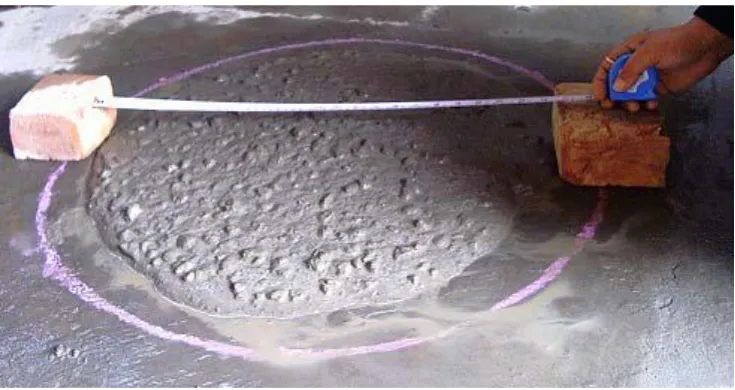
The slump flow test is used to assess the horizontal free flow of SCC in the absence of obstructions. On lifting the slump cone, filled with concrete, the concrete flows. The average diameter of the concrete circle is a measure for the filling ability of the concrete. The time T
50cm is a secondary indication of flow. It measures the time taken in seconds from the instant the cone is lifted to the instant when horizontal flow reaches diameter of 500mm[2]. Figure 1 shows the experimental set up for slump flow test.
214 B2. V – Funnel Test
The flow ability of the fresh concrete can be tested with the V-funnel test .The funnel is filled with about 12litres of concrete and the time taken for it to flow through the apparatus is measured. Further, T
5min is also measured with V-funnel, which indicates the tendency for segregation, wherein the funnel can be refilled with concrete and left for 5 minutes to settle. If the concrete shows segregation, the flow time will increase significantly [2]. Figure 2 represents the experimental set up of V Funnel test.
Figure 2. V Funnel Test
B3. L- Box test
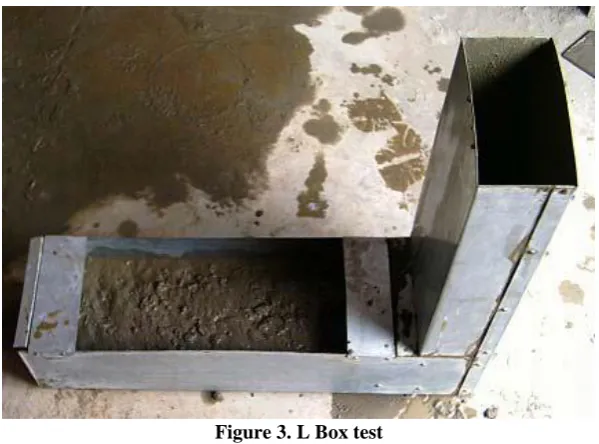
The passing ability is determined using the L- box test. The vertical section of the L-Box is filled with concrete, and then the gate lifted to let the concrete flow into the horizontal section. The height of the concrete at the end of the horizontal section is expressed as a proportion of that remaining in the vertical section (H2/H1). This is an indication of passing ability. The specified requisite is the ratio between the heights of the concrete at each end or blocking ratio to be ≥ 0.8 [2]. Figure 3 shows experimental set up of L box test set up.
Figure 3. L Box test
III. Experimental procedure for developing self-compacting concrete
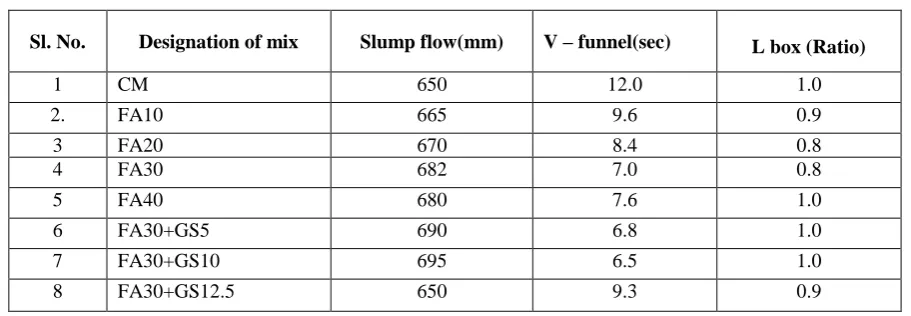
215 Tables 3 and 4 represents the quantity of the constituent material for replacements with fly ash (FA) and glass powder (GS). Table 5 gives the fresh state properties and table 6 the compressive strength at 7 and 28 days. Figures 4, 5, 6 and 7 shows the slump flow, V Funnel, L box and 28 day compressive strength gain with replacements of cement by fly ash and glass powder. CM stands for control mix. FA10 represents replacing 10% of cement by fly ash and so on. As a trial replacement by glass powder, FA 30, 30% replacement of cement by fly ash, is selected for again replacing with glass powder as it gave comparatively good result in fresh and hardened properties with minimum admixture and no reduction in expected target strength.
Table 3 : Replacement of cement with fly ash
Table 4 : Replacement of cement with fly ash and glass powder Mix proportion for 1m3 concrete
Sl. No. Designation of mix Total binder(kg) Cement (kg) Fly ash (kg) Glass powder (kg) CA (kg) FA (kg) Water (kg) VMA
% W/C W/P
1 FA30+GS5 526.30 342.09 157.89 26.31 725.88 908.04 200 0.90 0.38 0.98 2 FA30+GS10 526.30 315.78 157.89 52.63 725.05 905.22 200 0.90 0.38 0.97 3 FA30+GS12.5 526.30 302.63 157.89 65.78 723.60 903.60 200 0.90 0.38 0.96
Table 5: Fresh state properties of SCC with fly ash and glass powder as replacement
Sl. No. Designation of mix Slump flow(mm) V – funnel(sec) L box (Ratio)
1 CM 650 12.0 1.0
2. FA10 665 9.6 0.9
3 FA20 670 8.4 0.8
4 FA30 682 7.0 0.8
5 FA40 680 7.6 1.0
6 FA30+GS5 690 6.8 1.0
7 FA30+GS10 695 6.5 1.0
8 FA30+GS12.5 650 9.3 0.9
Table 6: Compressive strength of SCC with fly ash and glass powder as replacement
Sl. No. Designation of mix
Compressive strength (MPa)
7th day 28th day
1 CM 63.0 70.5
2 FA10 58.0 64.0
3 FA20 47.0 55.0
4 FA30 44.5 51.0
5 FA40 35.8 45.0
6 FA30+GS5 38.0 54.0
7 FA30+GS10 36.5 45.4
8 FA30+GS12.5 29.3 36.0
Sl.
No. Mix
Total binder(kg) Cement (kg) Fly ash (kg) Glass powder CA (kg) FA (kg) Water (kg) VMA
% W/C W/P
216 Figure 4. Flow value with varying glass powder content
Figure 5. V Funnel Time with varying glass powder content
Figure 6. Blocking Ratio with varying glass powder content
640 650 660 670 680 690 700
0 2 4 6 8 10 12 14
Sl
um
p di
a i
n
mm
Cement Replaced in Percentage
SLUMP FLOW -( FA30+GS)
0 1 2 3 4 5 6 7 8 9 10
0 2 4 6 8 10 12 14
T
im
e i
n Seconds
Cement Replaced in Percentage
V FUNNEL- ( FA30+GS)
0.88 0.9 0.92 0.94 0.96 0.98 1 1.02
0 2 4 6 8 10 12 14
B
lock
ing R
at
io
Cement Replaced in Percentage
217 Figure 7. Compressive strength at 28 days with varying glass powder content
IV. Results and discussion
The compressive strength obtained for the self compacting mix trials with replacements by fly ash and waste glass powder is tabulated in table 6. The fresh properties of self compacting concrete like slump flow, V- funnel and L box test values has been determined by conducting experiments like slump flow, V funnel and L box test. The result obtained for fly ash replacement of 30% of cement has been observed to be within the acceptable range of values for these tests and further tests with glass powder replacement up to 12.5% also gave acceptable results. Optimum compressive strength has been obtained for trial mix with 30% replacement of cement with fly ash. Beyond this, the compressive strength is observed to decrease with further replacement of fly ash. The addition of glass powder up to 12.5% of cement along with fly ash has been observed to give compressive strength within the target mean strength of the design mix.
V. Conclusions
The latest researches are concentrated on innovative concrete using various industrial waste products. The primary objective is to develop a medium strength self compacting concrete using glass powder addition in concrete so as to achieve economy as well as environmental friendly sustainability. The developed SCC mix with addition of fly ash and glass powder provided satisfactory rheological properties and acceptable medium compressive strength . The use of fly ash and glass powder will significantly help to bring sustainability in construction industry.
REFERENCES
[1] Bouzoubaâa N, Lachemib M. Self compacting concrete incorporating high-volumes of class F fly ash: preliminary results. Cem Concr Res 2001; 31(3):413–20.
[2] Brussels, 2005. 63 p. Draft prEN 12350-8. Testing fresh concrete – Part 8: Self compacting concrete–Slump-flow test
[3] Chen CH, Huang R, Wu JK, Yang CC. Waste E-glass particles used in cementitious mixtures. Cement Concrete Res 2006; 36(3):449–56.
[4] Felekoglu B. Utilisation of high volumes of limestone quarry wastes in concrete industry (self-compacting concrete case). Resource Conserv Recycl2007; 51:770–91.
[5] Jin, W.; Meyer, S.; Baxter, S. 2000. Glassconcrete – concrete with glass aggregates, ACI Material Journal 97(2): 208–213.
[6] Mayur B. Vanjare, Shriram H Mahure.2012.Experimental investigation on self-compacting concrete using glass powder, International Journal of Engineering Research and Applications, Vol 2,Issue 3, pp.1488-1492
[7] Okamura, H., Ozawa, K. 1995. Mix design for self-compacting concrete, concrete library of JSCE 25: 107–120. The European guidlines for self-compacting concrete. Specification, production and use.
[8] Ravindrarajah, Farrokhzadi, a Lahoud 2003. Properties of flowing concrete and self-flowing concrete with high performance superplasticizer, Proceedings of 3rd international symposium , Reykjavik, Iceland (RILEM Publications) 1 Vol, pp1048
0 10 20 30 40 50 60
0 2 4 6 8 10 12 14
C
om
pres
si
ve
Str
enght
in
MPa
Cement Replaced in Percentage
218 [9] Rajathi A, G Portchejian 2014, Experimental study on self-compacting concrete using glass powder,Vol 3, no
3,IJSCER
[10] SelcukTurkel, Ali Kandemir 2008, Fresh and hardened properties of SCC made with different aggregates and mineral admixtures, American Society of Civil Engineers, JMCEE7 , ISSN:0899- 1561
[11] Schwarz, N.; Neithalath, N. 2008. Influence of a fine glass powder on cement hydration: Comparison to fly ash and modeling the degree of hydration, Cement and Concrete Research 38: 429–436. doi:10.1016/j.cemconres.2007.12.001
[12] Shao, Y.; Lefort, T.; Moras, S.; Rodriguez, D. 2000. Studies on concrete containing ground waste glass, Cement and Concrete Research 30: 91–100. doi:10.1016/S0008-8846(99)00213-6
[13] Shayan, A. 2002. Value-added utilisation of waste glass in concrete, in Proc. of IABSE symposium, Meulborne, 2002, 384–385 (abstract, full paper in CD).
[14] Shayan, A.; Xu, A. 2006. Performance of glass puzzolanic material in concrete: A field trial on concrete slabs,
Cement and Concrete Research 36: 457–468. doi:10.1016/j.cemconres.2005.12.012
[15] Siddique, R. 2008. Waste materials and by-products in Concrete. Berlin, 427 p. ISBN 978-3-540-74293-7 [16] Skarendahl A, Petersson Ö. State-of-the-art report of RILEM Technical Committee 174- SCC, self-compacting
concrete. Cachan Cedex, Francia: RILEM Publications S.A.R.L.; 2000.