Volume 58, 2019, Pages 368–377
Proceedings of 34th International Confer-ence on Computers and Their Applications
Construction Scheme of a Scalable
Distributed Stream Processing Infrastructure
Using Ray and Apache Kafka
Kasumi Kato
1, Atsuko Takefusa
2, Hidemoto Nakada
3, and Masato Oguchi
41
Ochanomizu University,
2-1-1 Otsuka, Bunkyo-ku, Tokyo, 112-8610, Japan
National Institute of Informatics,
2-1-2 Hitotsubashi, Chiyoda-ku, Tokyo 101-8430, Japan
National Institute of Advanced Industrial Science and Technology (AIST), 2-3-26 Aomi, Koto-ku, Tokyo, 135-0064, Japan
Ochanomizu University,
2-1-1 Otsuka, Bunkyo-ku, Tokyo, 112-8610, Japan
Abstract
The spread of various sensors and the development of cloud computing technologies en-able the accumulation and use of large numbers of live logs in ordinary homes. To operate a service that utilizes sensor data, it is difficult to install servers and storage in ordinary homes and to analyze the collected data from sensors. Those data are typically trans-mitted from sensors to a cloud and analyzed in the cloud. However, services that involve moving image analysis must transfer large amounts of data continuously and require high computing power for analysis. Hence, it is highly difficult to process them in real time in the cloud using a conventional stream data processing framework. In this research, we propose a construction scheme for a highly efficient distributed stream processing infras-tructure that enables scalable processing of moving image recognition tasks according to the amount of data that are transmitted from sensors. We implement a prototype system of the proposed distributed stream processing infrastructure using Ray and Apache Kafka, which is a distributed messaging system, and we evaluate its performance. The experi-mental results demonstrate that the proposed distributed stream processing infrastructure is highly scalable.
1
Introduction
In addition, deep learning technology has been widely used for image and speech recognition processing. Deep learning is a machine learning method that uses multilayered intermediate layers that perform identification in a neural network. Many deep learning libraries, such as TensorFlow [1] and Chainer [2], have been developed. However, a key issue for deep learning is heavy processing loads.
To operate a service that utilizes sensor data, it is difficult to install servers and storage in ordinary homes and analyze the collected data from sensors. Typically, those data are transmitted from sensors to a cloud and analyzed in the cloud. However, services that involve moving image analysis require large amounts of data to be transferred continuously and high computing power for the analysis; hence, it is difficult to process them in real time in the cloud using a conventional data processing framework.
We propose a construction scheme for a highly efficient distributed stream processing infras-tructure that enables scalable processing in moving image recognition according to the amount of data that is transmitted from sensors.
First, we perform preliminary experiments using Apache Spark [3] (hereinafter called Spark) and Ray [4]. Spark is a representative cluster computing platform that is designed to be fast and versatile, and Ray is a newer distributed execution framework. We investigate the characteristics of their distributed recognition processing and demonstrate that Ray enables scalable distributed processing. However, according to our previous work [6], it is difficult to perform effective distributed processing using Spark because it aims at high-throughput processing of multiple user tasks based on a data affinity policy. In the preliminary experiments, the image identification processes are distributed and parallelized using Spark and Ray with various parameters, and the behaviors of each distributed process are visualized. Image data that are identified are provided by the ImageNet [5]. We demonstrate that scalable distributed processing can be performed using Ray from the experimental results.
Next, we implement a prototype system of the proposed distributed stream processing in-frastructure using Ray and Apache Kafka [7] (hereinafter called Kafka), which is a distributed messaging system, and demonstrate its performance. In the previous work [9], we investigated the performance characteristics of Kafka and confirmed that a Kafka cluster with an appropriate configuration enables the performances of large amounts of image data messaging. Therefore, we employ Kafka as a messaging system for the prototype system. In the experiments on the prototype system, Kafka transmits image data to the Ray cluster and we investigate the performance of distributed recognition processing using PyTorch [8] and TensorFlow, and neu-ral network libraries. The experimental results show that the implemented distributed stream processing infrastructure that uses Ray and Kafka is highly scalable.
2
Distributed stream processing infrastructure
Table 1: Performance of the computer used in the experiment
OS Ubuntu 16.04LTS
CPU Intel(R) Xeon(R) CPU W5590 @3.33 GHz 4 core×2 sockets(8 core)
GPU NVIDIA GeForce GTX 980
Memory 48 Gbyte
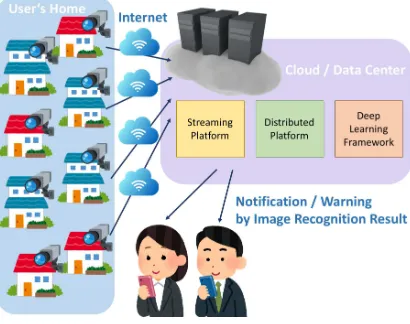
is the foundation on which a large amount of data is efficiently processed using clusters that are composed of many computers. In this system, identification processing of a large amount of image data is performed in a cluster and the image data are identified in a short time.
Figure 1: Assumed infrastructure for large-scale distributed stream processing.
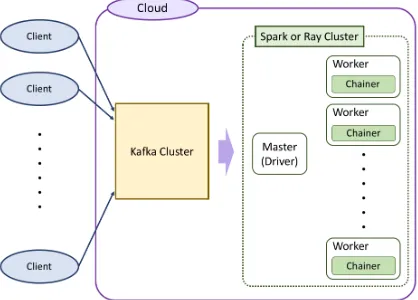
Specifically, we propose the distributed stream processing infrastructure that is shown in Fig. 2. Since it was confirmed that Kafka can construct a scalable messaging system, we use Kafka as a stream processing infrastructure. Data are transferred from the Kafka cluster to the Spark cluster or the Ray cluster and image identification processing is performed by their workers in the cluster. The Kafka Producers are placed in the Clients and the image data that are acquired from the sensors are sent to the Broker in the Kafka Cluster. The Broker transmits the acquired image data to the Kafka Consumer running on the worker nodes of the Spark or Ray cluster and the image data recognition processing is performed in the Consumers.
3
Distributed processing efficiencies in Spark and Ray
Figure 2: Overview of the proposed distributed stream processing infrastructure, which uses Kafka and Spark or Ray.
Figure 3: Experimental environment.
experiments. Table1shows the performance of a cluster node used in the experiments. Nodes with the same performance are used for the master and all workers. Each node is connected by a 1 Gbps network as shown in Fig. 3. In the experiments, we use Spark v. 2.3.1, Ray v. 0.5.3, PyTorch v. 0.4.1, and TensorFlow v.1.8.0.
3.1
The efficiency of Spark distributed processing
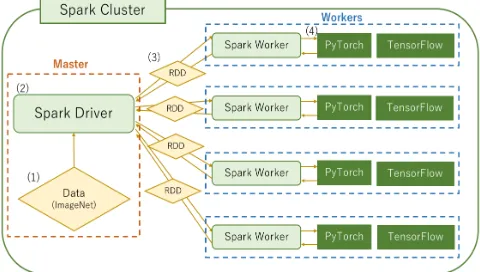
Fig. 4 shows master-worker processing in the case of Spark. The round rectangle drawn by a solid line represents the entire Spark cluster and the dotted rectangles represent a physical node. Among the physical nodes, a node that is used as a master is represented by a red dotted line and a node that is used as a worker is represented by a blue dotted line. Distributed processing in Spark is performed as follows: (1) Execute the Python program on the master. (2) Make Spark read the ImageNet data and create the RDD. (3) Pass the created RDD to the worker. (4) Identify ImageNet data using PyTorch in workers. RDD is a fault tolerance distributed data set, and Spark automatically distributes data by using RDD and its processing methods provided by Spark. Each node is connected in Spark Standalone Mode.
Figure 4: Master-Worker processing using Spark and PyTorch
Figure 5: Processing times of distributed processing by Spark.
parameter that determines how many tasks are to be divided and distributed to workers. In general, the larger the number of partitions, the smaller the task bias between workers becomes. In Fig. 5, the horizontal axis indicates the number of nodes and the vertical axis indicates elapsed time; each color shows different experimental results when the number of partitions is set from 8 to 48. According to Fig. 5, the processing time is reduced as the number of nodes increases, while the results obtained by different numbers of partitions are almost comparable.
3.2
The efficiency of Ray distributed processing
Fig. 6 shows master-worker processing in the case of Ray. The round rectangle drawn by a solid line represents the entire Ray cluster and the dotted rectangles represent physical nodes. Among the physical nodes, a node that is used as a master is represented as a red dotted line and a node that is used as a worker is represented as a blue dotted line.
Figure 6: Master-Worker processing using Ray and PyTorch.
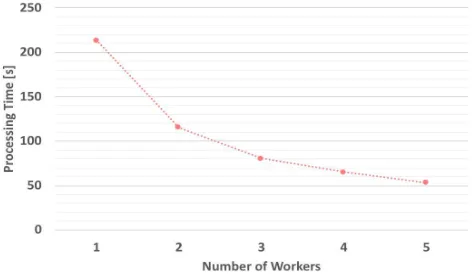
Figure 7: Processing times of distributed processing by Ray.
to the global scheduler. (4) The global scheduler sends instructions to local schedulers of each node. (5) Ray workers evaluate ImageNet data using PyTorch. The data are stored and shared in Object Store deployed over the Ray cluster nodes.
As with Spark, we measure the execution times of Ray on 10000 tasks as we change the number of nodes from 1 to 5. Since Ray does not have the concept of a partition as Spark does, we distribute data to workers 1 to 5 in a round-robin manner. The average values of 10 measurements is shown in Fig. 7. The horizontal axis is the number of nodes and the vertical axis indicates elapsed time. In Fig. 7, as the number of nodes is increased, the processing time is reduced. It seems that Ray’s ImageNet data identify process is highly scalable.
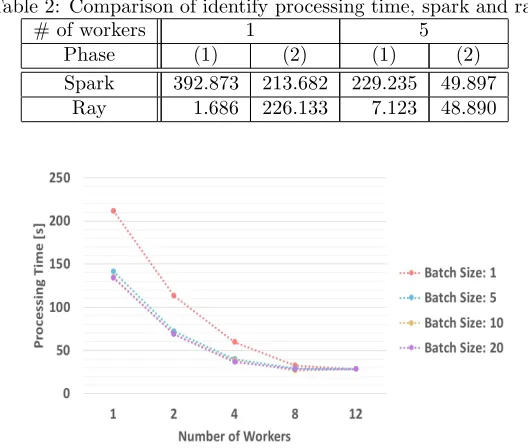
Table 2: Comparison of identify processing time, spark and ray.
# of workers 1 5
Phase (1) (2) (1) (2)
Spark 392.873 213.682 229.235 49.897
Ray 1.686 226.133 7.123 48.890
Figure 8: Processing times of batch-based distributed processing by Ray.
faster than Spark.
Further, in this experimental configuration, batch processing can be applied for remote func-tions. Batch processing is a method of identifying multiple image data simultaneously together after storing a specified amount of data. It is possible to convert many matrix×vector
exe-cutions to a few matrix×matrix executions, thereby possibly shortening the overall processing
time. The number of worker nodes is varied among 1, 2, 4, 8, 12; and the batch size is varied among 1, 5, 10, 20. Fig. 8 shows the average values of 10 measurements of processing 10000 images. The horizontal axis is the number of workers and the vertical axis indicates the elapsed time; Fig. 8is drawn for the results of different batch sizes. In the Fig. 8, increasing the batch size from 1 to 5 can shorten the processing time by 70 seconds when the number of workers is 1. However, even if the number of workers and the batch size are increased, the processing time converges to approximately 28 seconds.
4
Distributed stream processing infrastructure
According to the investigation of the distributed processing efficiencies in Section 3, Ray is faster and more scalable than Spark for the distributed parallel identification processing of an image.
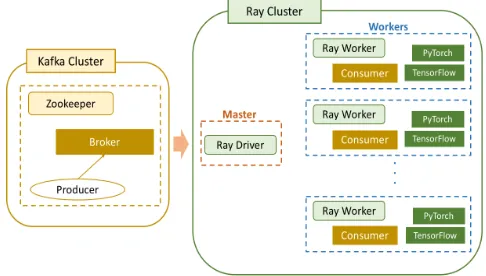
Figure 9: Distributed stream processing infrastructure using Ray and Kafka.
Figure 10: Distributed stream processing composition by Ray and Kafka.
4.1
Adaptation to a streaming environment by Kafka
We perform distributed stream processing using Kafka and Ray. The experimental configuration is shown in Fig. 10. The round rectangles drawn by solid lines represent the Ray cluster and the Kafka cluster and the dotted rectangles represent physical node. When Kafka is started and a Python program is executed, image data are transmitted from Producer to Broker. Upon receiving the data, the Broker sends the data to the Consumers deployed in the worker nodes in the Ray cluster and the Consumers identify the image using PyTorch and TensorFlow.
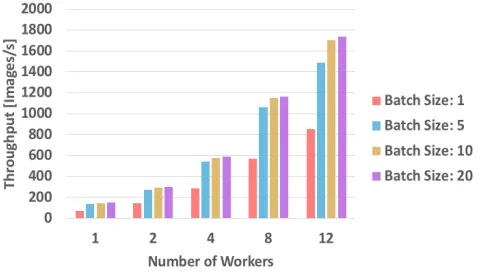
Figure 11: Throughputs of batch-based distributed stream processing by Kafka and Ray.
5
Related Work
Chen et al. [10] use the Producer-Consumer model of Kafka as a streaming data acquisition layer for moving images and the real-time processing framework Spark Streaming, combined with OpenCV [11], as a data processing layer, with memory, HDFS and HBase [12] used as data storage layers and Web Technology for final result display. The performance is evaluated by adjusting the numbers of worker nodes and batch slices and the CPU usage rate. This method can extract simple information from a video. Further development requires the detection of moving objects and the recognition of behaviors, for which models that support CNN and 3D CNN are necessary. Our research uses TensorFlow, which is supporting CNN deep learning framework.
In our research, we aim at accelerating distributed stream processing using a general data processing infrastructure.
6
Conclusions
We proposed a construction scheme of a distributed stream processing infrastructure using Kafka and Ray. In the preliminary experiments, image processing by PyTorch was distributed in parallel, using Spark or Ray and those efficiencies were investigated. We found that scal-able distributed processing is possible using Ray. Next, we implemented a distributed stream processing infrastructure using Ray and Kafka. The experimental results showed that it is possible to implement a highly scalable distributed stream processing infrastructure with Ray and Kafka. Moreover, its performance is further improved by batch processing. In the future, we will consider adapting the system to the processing of moving images, increasing the sizes of Kafka and Ray clusters, and conducting experiments in a larger-scale environment to improve the performance.
Acknowledgments
JSPS KAKENHI Grant Number JP16K00177, and the open collaborative research at National Institute of Informatics (NII) Japan (FY2018).
References
[1] M. Abadi, A. Agarwal, P. Barham, E. Brevdo, Z. Chen, C. Citro, G. S. Corrado, A. Davis, J. Dean, M. Devin, S. Ghemawat, I. Goodfellow, A. Harp, G. Irving, M. Isard, Y. Jia, R. Jozefowicz, L. Kaiser, M. Kudlur, J. Levenberg, D. Mane, R. Monga, S. Moore, D. Mur-ray, C. Olah, M. Schuster, J. Shlens, B. Steiner, I. Sutskever, K. Talwar, P. Tucker, V. Vanhoucke, V. Vasudevan, F. Viegas, O. Vinyals, P. Warden, M. Wattenberg, M. Wicke, Y. Yu, and X. Zheng, “TensorFlow: Large-scale machine learning on heterogeneous sys-tems,” 2015, http://download.tensorflow.org/paper/whitepaper2015.pdf. pp. 1- 19. [Online]. http://tensorflow.org/.
[2] S. Tokui, K. Oono, S. Hido, and J. Clayton, “Chainer: a next-generation open source framework for deep learning,” in In Proceedings of Workshop on Machine Learning Systems (LearningSys) in The Twenty-ninth Annual Conference on Neural Information Processing Systems (NIPS), 2015, 6 pages.
[3] “Apache Spark,” https://spark.apache.org/.
[4] P. Moritz, R. Nishihara, S. Wang, A. Tumanov, R. Liax, E. Liang, W. Paul, M. I. Jor-dan, and I. Stoica, “Ray: A Distributed Framework for Emerging AI Applications,” 2017. http://ray.readthedocs.io/en/latest/index.html/.
[5] J. Deng, W. Dong, R. Socher, K. Li, and L. Fei-Fei, “ImageNet: A large-scale hierarchi-cal image database.” IEEE Conference on Computer Vision and Pattern Recognition, 2009. http://www.image-net.org/.
[6] K. Kato, A. Takefusa, H. Nakada, and M. Oguchi, “Consideration of parallel data processing over an apache spark cluster,” Poster Session in IEEE International Conference on Big Data (2017). [7] “Apache kafka,” https://kafka.apache.org/.
[8] A. Paszke, S. Gross, S. Chintala, and G. Chanan, “Pytorh: Tensors and dynamic neural networks in python with strong gpu acceleration,” 2017. Available: https://pytorch.org/.
[9] A. Ichinose, A. Takefusa, H. Nakada, and M. Oguchi, “A Study of a Video Analysis Framework Using Kafka and Spark Streaming,” Second Workshop on Real-time and Stream Analytics in Big Data (2017).
[10] H. Chen, F. Luo, L. Zhao, and Y. Li, “Design and Implementation of Real-Time Video Big Data Platform Based on Spark Streaming,” International Conference on Computer Science and Application Engineering (CSAE), 2017.