N-HyDAA- Big Data Analytics for Malaysia
Climate Change Knowledge Management
Mohammad Fikry Abdullah
1, Mohd Zaki Mat Amin
1, Mohd Fauzi
Mohamad
1, Marini M Ideris
1, Zurina Zainol
1and Nik Yusaimi Yussof
21 National Hydraulic Research Institute of Malaysia, Selangor, Malaysia
2 Ministry of Natural Resources and Environment, Wilayah Persekutuan Putrajaya, Malaysia
[email protected], zaki@nahri,gov.my, [email protected],
[email protected], [email protected], [email protected]
Abstract
With the changing climate, the prognosis is that weather extremes such as floods, drought and EL Nino are likely to increase in frequency and intensity can expand billions of economic losses and effect human lives. NAHRIM Hydroclimate Data Analysis Accelerator (N-HyDAA), known as Malaysia Climate Change (CC) Knowledge Portal, the only CC knowledge portal in Malaysia primarily developed for providing CC and water-related data, information, knowledge and technologywhich is crucial for present and future water related bussines activities, engineering practices and environment. It has eight hydroclimate-environment modules, which amongst others are rainfall, floods, droughts and water stress condition using Big Data Analytics (BDA) technology by means of comprehensive analysis and interactive visualization tools. N-HyDAA is able to trace, detect, identify and visualise future water issues associated with the adverse impacts of climate change in Malaysia. N-HyDAA assist business entities, water operators, engineers, planners and decision-makers in designing, planning and developing water related program and risk management in combating climate change impact either mitigation or adaptation actions.
Keywords: Big Data Analytics, Climate Change, Data Management, Knowledge Management
1
Introduction
Climate change (CC) is real and happening now. A catastrophe caused by CC is seen as the biggest potential threat to the global economy [1]. Anthropogenic climate change will add greater pressure on resources, jeopardize sustainability, and intensify inter-sectorial conflicts over water.
Engineering Volume 3, 2018, Pages 10–17
Climate change issue have been given serious attention and commitment by the Government of Malaysia either at national or international levels, and it is a very complex issue. Malaysia has agreed and respond under Paris Agreement on threat of climate change by keeping a global temperature rise this century well below 2 degrees Celsius above pre-industrial levels and to pursue efforts to limit the temperature increase even further to 1.5 degrees Celsius [2]. The implementation of adaptation to climate change has been emphasized by Malaysia particularly in water and coastal, food and health sectors through National Policy on Climate Change [3].
CC knowledge is paramount important for Government, Private Sector and Industry in tackling social, environment and economics issues exacerbated by global warming through CC impact at regional and local level. The knowledge is primarily created through voluminous of data and information that produced from CC modeling and impact study. It is a comprehensive modeling, analysis and processes for transforming and bridging the said data and information in order to accomplish an acceptable and details CC knowledge for a faster and holistic action plan.
Since 2006, NAHRIM have been carrying R&D on impacts of climate change, however, translating and disseminate the scientific data and knowledge into engineering practices becomes a real challenge to scientist and engineers.
Therefore, Malaysia Climate Change (CC) Knowledge portal known as N-HyDAA is primarily developed for providing CC and water-related information, and technology. CC knowledge is crucial for present and future water related business activities, engineering practices and environment particularly for sustainable development. N-HyDAA is mainly developed as CC Knowledge tool associated with Risk Assessment and Engineering mechanisms in order to assist decision-makers, planner and project implementer in combating climate change impacts such as floods, drought and sea level rise. N-HyDAA has eight hydroclimate-environment modules, which amongst others are rainfall, floods, droughts and water stress condition for optimizing insight and foresight of future climate resilience (proofing) using Big Data Analytics (BDA) technology.
2
N-HyDAA’s Materials and Methods: Evolution of Big Data
Analytics Technology
Kaisler et al. [4] define “Big Data” as the amount of data just beyond technologies capability to store, manage and process efficiently which the limitations are only discovered by a robust analysis of the data itself, explicit processing needs, and the capabilities of the tools used to analyse it. BDA has been escalating in various sectors as it increases the value of data in organisations for different purposes. The awareness and understanding of BDA among top management has been familiarised to ensure how data can be analysed, improved and enriched to become a new key economic factor that can alleviate an organisation’s performance [5].
Big data creates a radical shift in how we think about research, thus reframing key questions about the constitution of knowledge, the processes of research, how we should engage with information and the nature and the categorisation of reality [9].
N-HyDAA was developed by means of Big Data Analytics (BDA) approach that allow voluminous of climate change projection data fully utilised and translated into water-related risk management information and knowledge. N-HyDAA used approximately 10 billion projected hydroclimate data under the changing climate scenario of Intergovernmental Panel Climate Change (IPCC) Special Report on Emissions Scenarios (SRES) which are A1Fi, A1B, A2 and B1. Development of N-HyDAA is focusing on 2 main elements which are (i) Data Acquisition and (ii) Data Management. By recognizing the effectiveness of BDA technology for handling huge dataset, N--HyDAA is empowered through data driven approach using accelerated heterogeneous computing platform.
N-HyDAA objective is:-
i. To resolve uncover hidden pattern, unknown correlations and projection for trends of future hydro-climate;
ii. To enhance risk management, technology & engineering practices
iii. To strengthening climate change adaptation action by Decision Makers & Stakeholders iv. To visualise, identify, detect & trace water related risk & disaster using 1450 simulations years (1970-2100)
BDA technology visualization incorporated in N-HyDAA are flexible in determining the type and format of the information to be analysed and stored, for example based on time interval, shape of region, analysis model, total average interval etc. This unique feature is a distinctive facility to increase the ability of data analysation based on suitability and requirement of the user. The combination and integration of spatial and non-spatial data for analysis and output display is value added to increase understanding and facilitate the delivery of information to the non-technical groups.
Data acquired for this system is a pre-processed data generated from NAHRIM Regional Hydroclimate Model (RegHCM-PM) through dynamic downscaling processes at water scale using High Performance Computing (HPC) system, a supercomputer with 192 (16 blades with 6 cores of 2 processors for each blade) Intel Xeon X5675 3.06Ghz CPU cores, delivering up to 2.35 teraflops. The RegHCM-PM developed by coupling the Mesoscale Atmospheric Model and the regional Watershed Environmental – Hydrology Model.
The display of detailed and dynamic data is a combination data from various agencies, which for each 6km x 6km area of 3,888 grid consists of 1186 MCU data from NAHRIM DEM, 13 river basin, land use data, water demand data, meteorological data and geospatial data. The response time to analyse 10 billion records data is about 14 seconds for one scenario model or 3.5 minutes for 15 scenarios models enable early warning system and precaution planning been set up and developed.
General-Purpose computing on graphics processing units (GPGPU) is applied in this accelerator through GPU Server (2 x Intel Xeon Processor 10 Core 2.2 GHz, 2 x NVIDIA Tesla K40c) to manage and speed up parallel data processing that involves calculating huge amount of hydro-climate data based on hydrology equation and formula.
Climate Change (UNFCCC). Output and outcome of the related CC study has been used for conducting CC vulnerability and adaptation assessment for Malaysia. Among studies conducted by NAHRIM are: -
i. Climate Change Impact on the Hydrologic Regime and Water Resources for Peninsular Malaysia (NAHRIM, 2006)
ii. Climate Change Impact on the Hydrologic Regimes, Water Resources and Lanfuse For Sabah & Sarawak (NAHRIM, 2010)
iii. Study of The Impact of Climate Change on Sea Level Rise at Peninsular Malaysia and Sabah & Sarawak (NAHRIM, 2010)
iv. Climate Change Impact on the Hydrologic Regime and Water Resources for Peninsular Malaysia (NAHRIM, 2014)
3
Results and Discussion
N-HyDAA serves as a Risk Management-Assessment and Engineering Tool, and act as Decision Support System in handling issues on water resources management and water related disaster which are intensified by climate change. The visualization of climate-environment data and information is precise and comprehensive to facilitate analysis and decision by stakeholders to have a strategic plan for mitigation and adaptation in combating climate change. N-HyDAA generates projected multiple maps by indicating specific area affected due to CC such as floods and droughts.
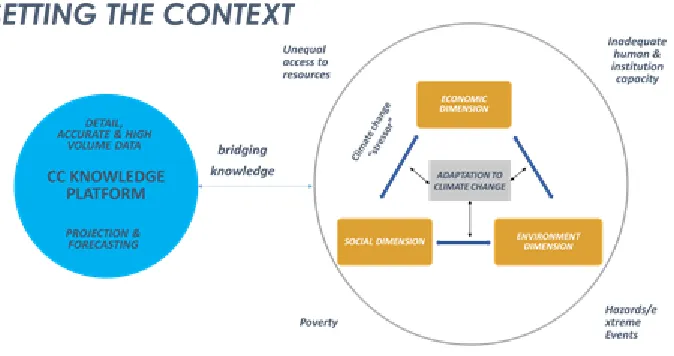
As a CC knowledge platform that comprises with details, accurate and high volume of data, the analysis conducted through N-HyDAA able to project and forecast potential water-related climatic events potentially happened in Malaysia. Thus, data and knowledge shaped need to be bridging for a sustainable development growth that cover Social (poverty), Environment (hazards/extreme events) and Economic (unequal access to resources and inadequate human & institution capacity) Dimension. Figure 1 shows the relation between N-HyDAA relate sustainable development growth through Social, Environment and Economic dimension.
Figure 2, shows N-HyDAA developed as web-based portal that designed in unique features based on the concept of Visualise, Identify, Detect and Trace by means of 8 key modules which are (i) Rainfall & Runoff (ii) Drought (iii) Drought & Temperature (iv) Stream Flow (v) Storm Center (vi) Climate Change Factor (vii) Water Stress Index (WSI) (viii) WSI Simulation [4]
Figure 2: Malaysia Climate Change Knowledge Portal (N-HyDAA) Portal
For example, Figure 3 shows the system managed to visualise future water stress by means of water stress index (WSI), pattern and magnitude for year 2030 and 2050 which is helpful to face the extreme drought episodes in future due to El Nino as occurred in 2016 that caused water shortage and rationing throughout the country due to the drawdown of water supply dam storage (Bukit Merah Dam, Timah Tasoh Dam, Upper Layang Dam and etc.).
Figure 3: Malaysia Future Water Stress for year 2030 and 2050
Apart from that, issues such as water supply, water resources river flow and river pollution that impacted the environmental degradation, increase risk management cost and loss of lives, infrastructure and properties can be detected, identify and trace using Rainfall module as shown in Figure 4.
Figure 4: Malaysia Future Water Stress for year 2030 and 2050
Analysed data obtained from N-HyDAA help to speed-up the development of 3 nos. of NAHRIM CC engineering technical guidelines which are i) Estimation of Future Design Rainstorm Under the Climate Change Scenario In Peninsular Malaysia, ii) Estimation of Future Design Rainstorm Under the Climate Change Scenario In Sabah And Sarawak and iii) Estimation Of Design Low Flow Under the Climate Change Scenario For Peninsular Malaysia.
The N-HyDAA hydroclimate data can be enriched with the addition of current CC study is expected to be complete in 2019. Thus this expansion will form more robust and comprehensive portal. The portal and CC modeling technology can produce downstream business activities that could be expanded to regional and international level for example United Nations South East Asia Network Of Climate Change Offices (SEAN-CC) and United Nations Developing Program (UNDP).
N-HyDAA has leveraging ICT as enabler to CC knowledge for achieving Sustainable Development Goals (SDG) especially related to SDG No. 6, No.9, No. 11 and No. 13. N-HyDAA has definitely strengthened a required CC platform and mechanism for assisting business entities, water operators, engineers, planners and decision-makers in designing, planning and developing water-related program, risk and disaster management. By means of 8 specific modules in N-HyDAA, it helps the country and stakeholders to achieve the said SDG Goals through determination of areas prone to CC impacts and thus promote risk reduction. N-HyDAA able to improve communication, planning, management and analysis towards achieving a sustainable development and to minimise the disaster impact of CC.
The information and knowledge provided can be expanded based on key sectors related to CC such as:
i. SDG No.6: Water sector –improvements to be carried out for cross-sectorial issues related to water and other sectors such as water-energy-food nexus.
iii. SDG No.2: Agricultural sector – the impacts of flood, drought, rainfall and temperature rise to the commodity yield such as palm oil, rubber, cocoa, paddy and aquaculture.
iv. SDG No.9: Infrastructure sector – involves existing or upcoming infrastructure such as utilities, transportation, communications, buildings, roads, highways and drainage systems. v. SDG No.7: Energy sector – involves electricity, oil and gases mainly in the construction of transmission line, substation, dam and mini-hydropower.
vi. SDG No.3: Health sector – involves healthcare facilities such as water supply, sanitation and hygiene in clinics and hospitals that are affected by flood events.
Apart from that, N-HyDAA was developed to support and enhance Malaysia’s National Agendas in: -
i. The viscosity of the climate through National Agenda (Thrust 4) which is focus country the 5-years development programme of 11th Malaysia Plan (MP) [10]
ii. Malaysia National Policy on Climate Change [3]
a. Support knowledge-based decision making through intensive climate relate R&D and capacity building;
b. Strengthen National Data Repository;
c. Efficient communication & collaboration among all stakeholders for effective implementation of climate change responses.
4
Conclusions
Appropriate, effective and innovative adaptation strategies are required to reduce the negative impacts of climate change and to achieve sustainable development. N-HyDAA helps Stakeholders to determine areas prone to climate change impacts and thus promote risk reduction. N-HyDAA able to improve communication, planning, management and analysis towards achieving a sustainable development and to minimise the disaster impact of climate change.
Emergence of global digital revolution force society to bridge the gap in economy, infrastructure, knowledge and others. This required ICT to act as the enabler and tools to support the digital revolution where it will create new opportunity and strength but at the same time expose to new threat and weakness.
N-HyDAA is a model that integrate various type of user in understanding the impact of CC from the context of social, economy and environment. As an enabler, N-HyDAA fully utilised ICT concept from data acquisition, processing, access, dissemination, analysing and visualisation to support decision making in dealing and planning CC impact.
Scientific data produced from N-NyDAA will encourage new knowledge creation and to support current and past data, information and knowledge that elevate N-HyDAA as an environmental ICT solution specific in CC impact where it provides a benefit by uplifting the quality and sustainability life of society.
main toolbox and select the Citation tab instead. From there you can add and insert referenced publications as in other versions of Word.
The references (or the bibliography) section of the article is created by clicking on the Bibliography
Document Elements tab of the ribbon control in Microsoft Word for Mac). After inserting this section, the style of its header should be set to References.
The automatically generated References section may need to be explicitly updated to reflect further changes done in the bibliography. When clicking on the automatically generated text of the section, a
Bibliography button will appear in the text and offer a menu with an update command. The style used for citations in this template is APA. You are free to use any other style.
This is an example of the use of citations and references:
Not much is written yet about EasyChair. Apart from the Wikipedia article that comes and goes and contains a sketchy and questionable material (Wikipedia), there is an abstract of a keynote talk on EasyChair presented at the 2014 Automated Software Engineering Conference (Voronkov, Keynote talk: EasyChair, 2014) and a guide for writing documents for EasyChair authors (Voronkov & Hoder, Templates)
The references themselves are placed at the end of this document.
5
References
1 ‘World Economic Forum: The Global Risks Report 2016 11th Edition’, in Editor (Ed.)^(Eds.): ‘Book World Economic Forum: The Global Risks Report 2016 11th Edition’ (2016, edn.), pp.
2 UN: ‘The Paris Agreement’, in Editor (Ed.)^(Eds.): ‘Book The Paris Agreement’ (2015, edn.), pp.
3 Malaysia, M.o.N.R.a.E.: ‘National Policy on Climate Change’, in Editor (Ed.)^(Eds.): ‘Book National Policy on Climate Change’ (2009, edn.), pp.
4 Kaisler, S., Armour, F., Espinosa, J.A., and Money, W.: ‘Big data: Issues and challenges moving forward’, in Editor (Ed.)^(Eds.): ‘Book Big data: Issues and challenges moving forward’ (IEEE, 2013, edn.), pp. 995-1004
5 Abdullah, M.F., Ibrahim, M., and Zulkifli, H.: ‘Resolving the Misconceptions on Big Data Analytics Implementation Through Government Research Institute in Malaysia’, in Editor (Ed.)^(Eds.): ‘Book Resolving the Misconceptions on Big Data Analytics Implementation Through Government Research Institute in Malaysia’ (2017, edn.), pp. 261 – 266
6 Russom, P.: ‘Big data analytics. TDWI Best Practices’, in Editor (Ed.)^(Eds.): ‘Book Big data analytics. TDWI Best Practices’ (2011, edn.), pp.
7 Bi, Z., and Cochran, D.: ‘Big data analytics with applications’, Journal of Management Analytics, 2014, 1, (4), pp. 249-265
8 Troester, M.: ‘Big Data meets Big Data Analytics: Three key technologies for extracting real-time business value from the Big Data that threatens to overwhelm traditional computing architectures’, SAS Institute Inc. White Paper, 2012
9 Boyd, D., and Crawford, K.: ‘Critical questions for big data: Provocations for a cultural, technological, and scholarly phenomenon’, Information, communication & society, 2012, 15, (5), pp. 662-679