26 Available online at www.ijiere.com
International Journal of Innovative and Emerging
Research in Engineering
e-ISSN: 2394 – 3343 p-ISSN: 2394 – 5494
Optimization of Hole Making Operations for Sequence
Precedence Constraint
Santosh Khalkar
a, Dharmesh Yadav
bAbhishek Singh
caOriental institute of science and technology, Bhopal, India. [email protected] bOriental institute of science and technology Bhopal, India, [email protected]
cAITRC Chhindwara, India, [email protected]
ABSTRACT
Most of the times the hole making operation followed by subsequent operations. Therefore the operation precedence constraint has got importance. In this paper along with the optimization of hole-making operations in conditions where a hole making operations drilling followed by reaming with sequence precedence should be required. An efficient solution made by using real coded Genetic Algorithm. The objective of interest in the considered problem is while considering drilling and reaming sequence precedence is to minimize the summation of tool travel time and tool changing time. The objective of the study get affected by the drilling and reaming sequence precedence through which each operation of each hole is done. The problem is formulated as a mathematical model. The paper includes an illustrative example of a typical industrial part and optimizes the sequence of the hole making while considering the sequence precedence of drilling and reaming by a proposed algorithm. The performance of the proposed algorithm is tested through solving real industrial problem. The computational result conducted in this research indicates that the proposed method is both effective and efficient. Keywords: Hole-making; drilling , reaming, Tool change time; Tool travel time; Optimization; genetic algorithm;
I. INTRODUCTION
There are many kinds of holes in hole making operation. A “through” hole goes completely through a work piece. A “Blind” hole is drilled only to a certain depth. “Interrupted” holes intersect at some point with other holes within a work piece . holes may be drilled for coolant passages or to procide access for part inspection. Holes may also be threaded for fasteners. Hole making has never been as good as it is today. The ctting tools for making almost any typw of hole have recently taken a leap forward. New generations of drills have been andf are being introduced’ and more are in the pipeline. This is good news for the dedicated drilling of components in large batches’ where cycle times and security are the main priorities. These developments are also positive for the general drilling of a vroad range of varied holes in smaller mumbers’ where versatility is an important priority. Hole making is the most common metalworking o improving drilling is a measure that pays off well in the ecomomics of manufacturing where machining is included.
Drilling’ the most common of hole making prixesses’ consumes half of the cutting tools used in all chip making processes. There are a lot of areas where drilling is used.drilling is defined as “ An implement with cutting edges or a pointed end for boring hole inhard material’ usually by a rotating obrasion or repeated blows”
Initial hole drilling is usually followed by some kind of finishing operation. Reaming is one such method. A reamer removes just enough metal to provide a smooth finish and accurate size to the hole. Reamers may be right or left handed’ straight or tapered. Boring is an internal turning operation that enlarges and finishes an existiong hole. Boring uses a bar with single point cutting tool’ or a too; with two or three edges. Boring can improve a hole’s geometry and location, since the hole shape is primarily determined by machine tool motions. Roller burnishing is a polishing operation which smoothes irregularities on the hole wall and often produces a mirror like finish. Honing is an abrasive method which gices very accurate final sizing and finish to the hole. Other post drilling operations include counter boring which enlarges hole diameter to a specific depth, countersinking which produces an angle antry to the hole to allow certain types of hardware to be flush to the materal’ssurface,and spot facing . spot facers, like counter bores, are pilot guided tools that provide a flat clean surface on angled or irregular surfaces. The largest amount of money spent on any one class of cutting tools in spent on drills. Therefore, from the viewpo8nt of cost and productivity, modeling and optimization of drilling processes are extremely important for the manufacturing industry.
27 machining cost and tool cost are affected by the selection of tool combination for each hole. Hence, the proper determination of the operation sequence and the cottesponding machining speed used to perform each operation are crucial in reducing the total cost of production. [1]tool movement and switching time take70% of the total time in a manufacturing process, on average.[2]
The present work is focused on the formulation of the model and proposes teal coded genetic algorithm approach to solve the optimization of hole making problem. Therefore , it is mecessary to determine the order by which a particular hole should be drilled by a specific tool in order to minimize the summation of tool airtime and tool switch time. It is natable that the sequence of holes still needs to be optimally detemimed even if each hole requires only a single tool to be made.[2] the objective is to minimize production cost which consists of tool travel cost and tool switch cost.
II. PROBLEM STATEMENT
Whenever there is sequence precedence is criteria for the hole making operation, we have to be assure that the operations should be get followed in proper sequential manner. Otherwise the objective function should be get penalized. So that the chances of the value of objective function to enter in next converging pool will get minimized. Tools of different sizes required to make a complete hole. This is specially a must when the diameter of the hole to be made is large. In this case, the hole is initially made using the small-sized tools and then it is enlarged to the size of interest using the large-sized tools. The selection of the set of tools and their sequence can directly affect the machining time and cost. It is common in practice that several holes need a particular tool and a hole may need different tools. The time needed to move from a hole to one another is called as airtime .To minimize tool airtime, it may be initially thought that a hole should be completed through different tools before movement into another hole. However, this may result in excessive tool switches and thus increments in tool switch time. On the other hand, one may decide to process all the holes which need the tool currently in use. Although, this decision will decrease the tool switch time, it can result in a huge increment in tool airtime.[1]
For each hole in Fig. 1 the largest tool, shown by number 3, has to be used to drill the hole to its final size. Some pilot or intermediate tools, shown by number 2, may also be used. For instance, for hole A, there could be four different sets of tools; {1,2,3}, {2,3}, {1,3}, and {3}. The selection of tool set for each hole directly affects the required number of tools switches, and tool travel distance. The problem is now to select a set of operations along with the optimum sequence those operations in such a way that the total processing cost is minimized.[1]
Figure1. A schematic representation of alternative sets of tools for hole making [3] The cost components considered in this paper include:
a) Tool travel cost: This is the cost of moving the tool from its previous location to the current drilling position. Tool travel cost is proportional to the distance required for the spindle to move between two consecutive drilling locations.[4] b) Tool switch cost: This cost occurs whenever a different tool is used for the next operation. If for any operation tool type
is not available on the spindle, then the required tool must be loaded on the spindle prior to performing operation. This causes a longer tool switch time and hence a higher tool switch cost.[4]
III. PROBLEM FORMULATION
A. Objective function
The objective of interest in this paper is to minimize the summation of tool airtime and tool switching time .To minimize the production cost, the following model can be formulated.
Cost (Z) = Cost (y) + Penalty value (750) ∗ Number of constraint violation. [5]
However the penalty value is selected such that number of constraints violation should not be appear in optimum sequence. For this particular problem penalty value is calculated 750. Following table shows objective function value and number of constraints violation for initial 10 sequences.
28 Existing method
Generally in actual industrial practice there is no any optimum sequence is used. Operator can used any sequence
for the drilling operation. Consider sequence as follows.
5d 28d 12d 23d 2d 24d 10d 7d 16d 32d 6d 11d 1d 22d 4d 21d 30d 25d 14d 31d 8d 27d 18d
13d 3d 19d 2r 29d 32r 26d 17d 8r 15d 11r 27r 20d 23r 9d .
The objective function value for the initial population is calculated by using formula,
Violation 1 2r 5d 22d 3d 11d 30d 7d 23d 13d 19d 8r 27d 24d
4d 10d 1d 32d 28d 20d 2d 17d 12d 29d 27r 6d 16d 8d 25d 9d 32r 11r 15d 21d 14d 18d 26d 23r 31d
2453.5
2
2
2 23r 17d 22d 2r 14d 30d 26d 13d 6d 27r 8r 21d 10d 31d 18d 28d 15d 5d 12d 9d 19d 16d 24d 25d 29d 8d 11d 20d 23d 4d 3d 32d 7d 2d 11r 1d 27d 32r
3963.0 4
3 11r 18d 32r 4d 23d 1d 5d 8d 31d 19d 27d 7d 2d 20d 24d 13d 17d 28d 15d 26d 12d 29d 6d 32d 16d 10d 25d 11d 9d 23r 21d 14d 3d 22d 8r 2r 30d 27r
2515.7
2
2
4 27r 17d 29d 8d 2r 15d 22d 9d 30d 14d 32r 13d 20d 3d 7d 11r 28d 1d 26d 12d 18d 6d 21d 23r 25d 8r 31d 10d 16d 23d 27d 24d 5d 32d 4d 19d 2d 11d
4653.9
5
5
5 5d 28d 12d 23d 2d 24d 10d 7d 16d 32d 6d 11d 1d 22d 4d 21d 30d 25d 14d 31d 8d 27d 18d 13d 3d 19d 2r 29d 32r 26d 17d 8r 15d 11r 27r 20d 23r 9d
923.78
0
0
6 24d 30d 8r 9d 10d 19d 27d 20d 2d 21d 22d 15d 4d 32d 29d 16d 27r 18d 12d 17d 11d 7d 26d 31d 3d 32r 25d 14d 13d 11r 23d 28d 5d 1d 6d 8d 2r 23r
1710.9
1
1
7 2d 6d 13d 26d 17d 14d 4d 5d 7d 11r 1d 18d 29d 19d 25d 15d 31d 22d 23r 9d 2r 20d 8d 16d 28d 32d 10d 30d 12d 3d 27d 21d 24d 8r 11d 23d 32r 27r
2414.1 2
8 23r 32r 30d 25d 24d 22d 2d 10d 20d 3d 31d 9d 23d 27r 21d 12d 13d 32d 7d 17d 1d 11d 8d 4d 2r 28d 16d 15d 27d 14d 6d 19d 5d 8r 18d 29d 26d 11r
3142.8
3
3
9 19d 14d 28d 6d 4d 17d 8r 5d 32r 12d 29d 16d 23r 26d 9d 1d 20d 7d 15d 3d 10d 8d 18d 32d 24d 21d 11r 23d 25d 22d 30d 31d 2r 27r 13d 11d 27d 2d
5474.84 6
10 2d 18d 23d 15d 25d 21d 11d 22d 8d 3d 16d 27r 26d 24d 32d 5d 31d 12d 30d 7d 10d 1d 28d 8r 20d 14d 29d 4d 13d 2r 6d 27d 17d 9d 23r 19d 32r 11r
29 Cost (Z) = Cost(y) + Penalty value (750) * Number of constraint violation.
= 923.78 + 750 * 0= 923.78 Rs.
Result : The results thus obtained using existing method is directly compared with the result obtained using c programming of genetic algorithm. Since more number of iteration need to be carried out to arrive at the optimum solution.
IV. OPTIMIZATION TECHNIQUE
Genetic Algorithms (GAs) are adaptive heuristic search algorithm premised on the evolutionary ideas of natural selection and genetic. The basic concept of GAs is designed to simulate processes in natural system necessary for evolution, specifically those that follow the principles first laid down by Charles Darwin of survival of the fittest. As such they represent an intelligent exploitation of a random search within a defined search space to solve a problem.
A. GA operator
The GA operators are used to perform certain function, which help to produce and select good offspring from, a set of candidate solutions. The various GA operators that are used generally for solving a problem are given below. [6]
B. Reproduction
It is usually the first operator applied on a population. Reproduction select good string in a population and form a mating pool. This is why the reproduction operator is sometime known as the selection operator. Selection is the stage of a genetic algorithm in which individual genomes are chosen from a population for later breeding (recombination or crossover). [6]
C. Crossover
In the crossover operator, new string are created by exchanging information among strings of the mating pool. In most crossover operators, two strings are picked from the mating pool at random and some portions of the strings are exchanged between the strings. A single point crossover operator is performed by randomly choosing a crossing site along the string and by exchanging all bits on the right side of the crossing site. [6]
D. Mutation
In genetic algorithms, mutation is a genetic operator used to maintain genetic diversity from one generation of a population of chromosomes to the next. It is analogous to biological mutation. The classic example of a mutation operator involves a probability that an arbitrary bit in a genetic sequence will be changed from its original state. A common method of implementing the mutation operator involves generating a random variable for each bit in a sequence. This random variable tells whether or not a particular bit will be modified. The purpose of mutation in GAs is to allow the algorithm to avoid local minima by preventing the population of chromosomes from becoming too similar to each other, thus slowing or even stopping evolution. Generally GA is used to solve the maximization problem but GA can also handle minimization problems. This can be done by choosing a fitness function suitably.[6]
Method Sequence Total cost(Z)
Rs. Existing
(actual industrial practice)
5d 28d 12d 23d 2d 24d 10d 7d 16d 32d 6d 11d 1d 22d 4d 21d 30d 25d 14d 31d 8d 27d 18d 13d 3d 19d
2r 29d 32r 26d 17d 8r 15d 11r 27r 20d 23r 9d 923.78
Real Coded Genetic Algorithm (RCGA)
2d 10d 16d 12d 5d 24d 7d 32d 1d 28d 11d 6d 4d 23d 22d 27d 14d 30d 31d 8d 25d 13d 19d 3d 18d 26d 32r
30
Figure 2.
Flow Chart For Real Coded Genetic AlgorithmCASE STUDY
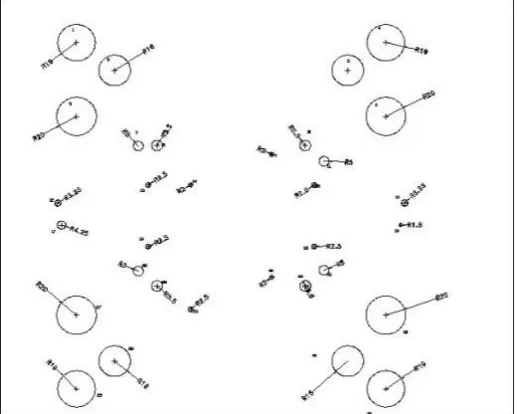
The proposed algorithm was coded in C-programme to determine the optimum sequence of operations for the part shown in fig.3 which requires drilling operation. The proposed mathematical model used to determine the cost of non productive travelling distance and switching cost of tool requires for drilling operation. The process parameters are: a=0.04 Rs/min and b=50 Rs/min. The tool switch times are considered to be in the range of 0.2 to 0.5 minutes depending on the operator skills. To investigate the effect of genetic algorithm on search performance, the search was repeated for optimum result.
Figure 3. Top view of example part.
A. Cost evaluation using existing method
31 5d 28d 12d 23d 2d 24d 10d 7d 16d 32d 6d 11d 1d 22d 4d 21d 30d 25d 14d 31d 8d 27d 18d 13d 3d 19d 2r 29d 32r 26d 17d 8r 15d 11r 27r 20d 23r 9d .
The objective function value for the initial population is calculated by using formula, Cost (Z) = Cost(y) + Penalty value (750) * Number of constraint violation. = 923.78 + 750 * 0
= 923.78 Rs.
B. Cost evaluation using genetic algorithm
After several trials, The various parameters of the genetic algorithm are set as shown in Table 1.
Table 1. Parameters for Genetic Algorithm
Parameter Value
Population Size Crossover Fraction
10
0.8
Mutation Fraction0.20
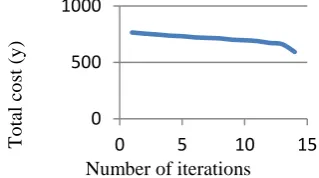
Using the above parameter setting for GA, the convergence of GA is as shown in Fig. 4.
Figure 4. Convergence of GA for example case study
Table 2 shows the results of optimization for example case study using existing approach and using GA.
Table 2. Results of optimization
V. CONCLUSION
This paper shows how we can minimize the summation of non productive travelling distance and tool changing cost in hole making operations while considering sequence precedence. Obtained results using genetic algorithm shows that the total production cost can be significantly reduced compare to the existing method. Optimization of tool path for drilling and reaming operation is considered. The same approach for reaming and tapping can also be the scope for further analysis in tool path optimization.
REFERENCES
[1] Kolahan, Liang (2000), “Optimization of hole-making operations: a tabu-search approach” International Journal of Machine Tools & Manufacture, vol- 40, pp- 1735–1753.
[2] Kenneth Castelino.et al., (2002), “Tool path optimization for minimizing airtime during machining” journal of manufacturing systems,vol-22/no.3, pp-173-180.
[3] Khalkar, et al.(2015), ”Optimum path planning for hole making process” International journal of innovative and emerging research in engineering, vol. 2 issue no. 6
[4] Khan, et al., (2010), “ Sequential and non-sequential procedure for drilling on a switch board using TSP” Canadian Journal on Computing in Mathematics, Natural Sciences, Engineering & Medicine,Vol. 1, No. 2,pp-37-48.
[5] Ghaiebi, Solimanpur (2007), “An ant algorithm for optimization of hole-making operations” Computers & Industrial Engineering, vol-52, pp- 308–319.
[6]
Kumar , Pachauri (2012) , “ Optimization Drilling Sequence by Genetic Algorithm” ,
International Journal of Scientific and Research Publications, Volume 2, Issue 9.0 500 1000
0 5 10 15
Method Used
Genetic Algorithm Existing method
664.48 Rs 923.78 Rs Number of iterations (x)
T
o
tal
co
st (
y