[Iwan* 6(6): June, 2019] ISSN 2349-4506
Impact Factor: 3.799
G
lobal
J
ournal of
E
ngineering
S
cience and
R
esearch
M
anagement
INCREASING VALUE AND IMAGES OF BANKING THROUGH OPTIMIZATION
OF FEE BASED INCOME
Triadi Iwan*
*
Polieknik Praktisi Bandung, Indonesia
DOI: 10.5281/zenodo.3250737
KEYWORDS
: Customer Value, Image, Fee Based Income.
ABSTRACT
Contribution in enhancing the Banking the fee-based income from foreign transactions is relatively not optimal. At the same time, the image of a foreign exchange bank is relatively Banking has not won a place in the business of community in West Java. The figure is probably because of the service (service value) perceived low customer. The low value of services allegedly because the mix of marketing services, including those who specialize in foreign exchange is still not available. Likewise, the human resources is not generated from the branches of the exchange.
This study aims to: Knowing the value of Foreign Exchange Bank in Banking Service. Knowing the image of the Banking a foreign exchange bank. Determine the effects of service against the image of the Bank as Banking's Bank of Foreign Exchange. The research method used is the descriptive and explanatory methods of the Bank's foreign exchange banking clients numbering 50 people as respondents. This type of investigation in this study is causality.
The findings in this study is the Image Banking as foreign banks will wake up if the value of financial services products and services Increased Provided to foreign customers. Banking are in creating, communicating, and delivering value to customers of foreign exchange as well as physical infrastructure, reliability in service, foreign customers, attention to foreign exchange, and foreign exchange to build customer confidence..
INTRODUCTION
Banking's contribution in increasing fee-based income from foreign transactions is relatively not optimal because even the market share is relatively low. At the same time, the image of Banking as a Foreign Exchange Bank has not yet reached a place in West Java and Banten business communities. This weak image was allegedly because the service value felt by customers was still low. The low value of services is suspected because the service marketing mix including people who specifically handle foreign transactions is still not available in foreign exchange branches other than the Bandung Main Branch. Likewise, the filler HR of the foreign exchange branch organizational structure has not been effective in communicating that the branch is a foreign exchange branch because there is no special work unit that handles foreign bank fund products and services so that the services of this foreign exchange bank have not been optimally empowered to generate optimal fee-based income at foreign exchange branch.
In addition to the marketing mix of products / services, people, process and physical evidence that have not been able to produce service values that meet customer expectations and tend to cause the image of Banking as a Foreign Exchange Bank not well known in the community, also because the channel of distribution offers foreign exchange bank services limited in number, so Banking is still not doing network optimization and existing HR in order to sell foreign exchange bank services.
[Iwan* 6(6): June, 2019] ISSN 2349-4506
Impact Factor: 3.799
G
lobal
J
ournal of
E
ngineering
S
cience and
R
esearch
M
anagement
In accordance with the above problems, this study aims to:
1. To assess the value of services perceived by customers of the Banking Foreign Exchange Bank.
2. To review the image of Banking as a Foreign Exchange Bank.
3. To develop the concept of the influence of service values perceived by customers on the image of Banking as a Foreign Exchange Bank.
THEORETICAL FRAMEWORK
Customer value can refer to the quality of service (Lovelock & Wright, 2002). In accordance with the related theory conveyed by Parasuraman, Zeithaml and Berry (1997; 39), these values refer to the dimensions of service quality, such as the attractiveness of physical facilities, equipment, and materials used by Banking and employee appearance, understanding Banking service officers to the problems of its customers and act in the interests of customers, the ability of Banking service officers to provide accurate service from the first time without making any mistakes and deliver services in accordance with agreed time, willingness and ability of employees to help customers and respond to their requests. And the ability to grow customer trust in Banking and can create a sense of security for its customers.
According to Kotler & Keller (2010: 41), the value received by customers is the difference between total customer value (total value for customers) and total customer cost (total cost for customers).Total customer value (total value for customers) is a collection of benefits expected by customers of a particular product or service. Total customer cost is a collection of sacrifices that customers expect will occur in evaluating, obtaining, and using the product or service. Therefore a service company can improve its marketing performance if it is able to provide maximum benefits and minimize customer costs, so that the company's image will be built. Image is the whole of one's perception of one thing that is formed through the process of information obtained from various sources.
Flavian, Torres, and Guinaliu (2004; 384) in his research on the measurement of banking images produced four elements that can form the banking framework, namely access to services, service offered, personal contact,security and reputation , which will be used in this study . . This is similar to the expression Grönroos in Rio, Rodolfo, and Victor (2003) in JJournal of Consumer Marketing, that"A favorable and well knownimage - corporate and / or local is an asset for any organization Because the image can be impact perceptions of quality, value, and satisfaction, in other words, images are formed through customer perceptions of service quality, value, and satisfaction.
METHODOLOGY
This research method is causality and descriptive. Descriptive research is research that aims to obtain a description of the characteristics of variables, both independent variables (X) and the dependent variable (Y). The nature of research verification basically wants to test the truth of a hypothesis carried out using statistical tools. D nature of this study will test the hypothesis that the value of the customer affect the Bank's image as a Foreign Exchange Banking.
Type of investigation used is causality, ie the type of research that suggested a causal relationship between the
independent variable, in terms of customer value effect on the dependent variable, namely the image
of Bank BANKING. The unit of analysis of this study is the individual, which means, entrepreneurs who conduct foreign transactions at Banking.
Judging from the time horizon- her, this study is cross sectional, ie information from the majority of the population (the sample of respondents) were collected directly at the scene empirically, in order to know the opinion of the majority population of the object being studied, as proposed by (sekaran , 2006 ; 161, Malhotra, 2004; 80). The study was conducted in January 2008 until February 2010.
[Iwan* 6(6): June, 2019] ISSN 2349-4506
Impact Factor: 3.799
G
lobal
J
ournal of
E
ngineering
S
cience and
R
esearch
M
anagement
Figure 1.
Research Population and Samples
No. Area Population Sample
1 Bandung 40 10
2 Jakarta 20 5
3 Cirebon 36 9
4 Cilegon 28 7
5 Bekasi 32 8
6 Tangerang 28 7
7 Kebayoran Baru 16 4
Total 200 50
Sumbe r: Treading the Trail of Swinging the Steps of Banking, 2010
So in this study the population is all foreign exchange customers in West Java and Banten who carry out foreign transactions through Banking, by taking a sample of 50 people.
RESEARCH RESULTS
Value of Banking Customers
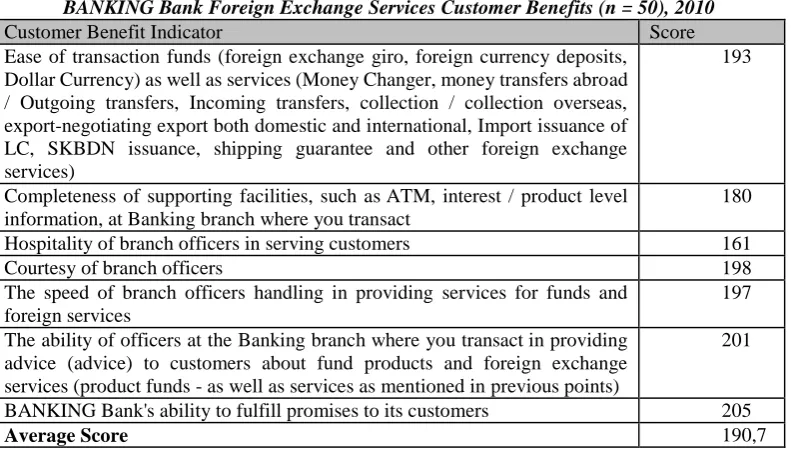
BANKING Bank Foreign Exchange Services Customer Benefits (n = 50), 2010
Customer Benefit Indicator Score
Ease of transaction funds (foreign exchange giro, foreign currency deposits, Dollar Currency) as well as services (Money Changer, money transfers abroad / Outgoing transfers, Incoming transfers, collection / collection overseas, export-negotiating export both domestic and international, Import issuance of LC, SKBDN issuance, shipping guarantee and other foreign exchange services)
193
Completeness of supporting facilities, such as ATM, interest / product level information, at Banking branch where you transact
180
Hospitality of branch officers in serving customers 161
Courtesy of branch officers 198
The speed of branch officers handling in providing services for funds and foreign services
197
The ability of officers at the Banking branch where you transact in providing advice (advice) to customers about fund products and foreign exchange services (product funds - as well as services as mentioned in previous points)
201
BANKING Bank's ability to fulfill promises to its customers 205
Average Score 190,7
Source: Data Processing, Questionnaire
Based on the table above, it turns out that the highest score is the ability of banking to fulfill its customers' promises (image benefits) of 205, while the lowest score is 161 in branch staff hospitality in serving customers. This shows that the BANKING's foreign exchange services unit has been able to fulfill the promises of its customers, but the hospitality of its service staff needs to be improved.
[Iwan* 6(6): June, 2019] ISSN 2349-4506
Impact Factor: 3.799
G
lobal
J
ournal of
E
ngineering
S
cience and
R
esearch
M
anagement
BANKING Bank Foreign Exchange Service Fee (n = 50), 2010
Customer Cost Indicator Score
Fund transaction fees (foreign exchange giro, foreign currency deposits, Dollar Currency) as well as services (Money Changer, foreign money transfers / Outgoing transfers, Incoming transfers, collection / collection abroad, export-negotiating export both domestic and international, Import issuance of LC, SKBDN issuance, shipping guaranteed other foreign exchange services)
112
Time of foreign transactions at Banking 112
Your convenience in getting foreign exchange services at Banking Branches 111
Worried about failure to transact 108
Average Score 110.75
Source: Data Processing, Questionnaire
Based on the table above, it turns out the lowest score (small cost) is 108, which is a concern for transaction failure, while the highest score (high cost) is transaction costs and transaction time. Therefore, the cost and time of the transaction must be considered to be shortened again.
The recapitulation of the customer value of Banking's foreign exchange services can be seen in the table below:
Recapitulation of Banking's Foreign Exchange Customer Value
No. Customer Value Score
1 Benefits 190,71
2 Cost 110.75
Source: 2010 Data Processing Results
Based on the results of the recapitulation, the value felt by foreign exchange customers is good. This can be seen from the benefit score of 190.71 which is greater than the average cost score of 110.75, so the customer value of Banking's foreign exchange services is seen based on the benefit and cost ratio of 190.71 / 110.75 which is 1.722. This shows that Banking has provided benefits felt by Devise customers through the ease of transactions, complete transaction facilities, hospitality, politeness, the ability of service personnel, and the ability to fulfill promises. This is in line with the opinion of Barsky and Nash (2003: 213) which states that in the service industry, superior value creation can be done by providing easy transaction services along with all facilities properly.
Image of Banking as a Foreign Exchange Bank
1. As many as 50% of foreign exchange customers made respondents stated that Banking is less well known
as a foreign exchange bank, namely a bank that provides foreign currency fund products such as Foreign Currency Checks, Foreign Currency Deposits, Foreign Currency savings and provides foreign exchange service products such as outgoing transfers, incoming transfer money changers, collection / collect overseas, export negotiations on export bills for both domestic and international markets, import-issuance of LCs, issuance of SKBDN, shipping guarantees and other foreign exchange services. While 34% of foreign exchange customers know Banking as a foreign exchange bank. This shows that Banking is still relatively not maximizing socialization to the community, so that the public knows Banking as a regional bank that serves PNS only.
2. Likewise, most of the foreign exchange customers (52%) are still relatively unfamiliar with
[Iwan* 6(6): June, 2019] ISSN 2349-4506
Impact Factor: 3.799
G
lobal
J
ournal of
E
ngineering
S
cience and
R
esearch
M
anagement
3. The products of foreign funds and services offered by Banking are less well known as attractive offers by 48% of foreign exchange customers who were used as respondents, even though there are 40% of other foreign exchange customers who know that Banking offers attractive foreign exchange products. This shows that the promotion / integrated marketing communication function is very instrumental in introducing foreign exchange products to the community, so that the public will know the attractiveness of Banking's foreign exchange products. Therefore, the element of promotion / marketing communication is expected to be further investigated in relation to the image of Banking as a Foreign Exchange Bank.
4. As many as 58% of foreign exchange customers made respondents claimed to have known that Banking
employees were easy to contact in the distribution of funds or foreign services, even 16% of the other foreign exchange customers claimed to be very familiar with Banking , that employees were easily contacted when funds and outside services transactions country. This shows that Banking is very concerned about the willingness of its foreign exchange customers, so that the interaction between employees / leaders of Banking and foreign exchange customers is greatly facilitated.
5. BANKING Bank is known to be safe by 64% of foreign exchange customers who were used as respondents
in transacting foreign funds and services, even 14% of other foreign exchange customers claimed to be very familiar with Banking as a safe foreign exchange transaction place. This shows that Banking is very concerned about the core business of banking, namely the security factor, and has been able to instill in the minds of the public, regarding the security of foreign exchange transactions in Banking.
6. BANKING Bank is known by 52% of foreign exchange customers as respondents that they have a good reputation, even 12% of other foreign exchange customers claim to be very familiar with the good reputation of Banking in the service of foreign products and services. This shows that Banking has maintained their reputation in the eyes of the public, so that they were not impressed by mistakes in serving transactions of funds and foreign services.
The image of Banking as the foreign exchange bank that is best known by foreign exchange customers is that Banking has a good reputation with a total score (200), while the one that is least known by foreign exchange customers is Banking provides convenience in fund transactions (foreign exchange giro, foreign currency deposits) and foreign services in serving foreign exchange customers with a total score (175).
Effect of Customer Value towards Citra PT.BANKING Bank as a Foreign Exchange Bank.
To reveal the influence of a variable or set of variables to another variable, can use Path Analysis (Path Analysis) which has developed Sewall Wright. He said that path analysis is the same as the Pearson correlation analysis if an independent variable is linked to one dependent variable as in this study, that is, customer value is associated with the image. In this path analysis the magnitude of the influence of a variable on other variables, both directly and indirectly can be known. Before making a decision regarding the magnitude of the influence of a variable on the other variables, first testing the hypothesis, both testing as a whole or individually.
Based on the results of the analysis and hypothesis testing, it turns out that the value of Foreign Exchange Bank services delivered by Banking is proven to be able to provide an attraction for foreign exchange customers to transact. Likewise, Banking's image is proven to be able to show the professionalism of Banking in serving foreign exchange customers. While the value of services (service value) proved to affect the Bank's image as a Foreign Exchange Banking.
The results of the hypothesis testing above reinforce the results of the research presented by Kenna (1991: 132) that customer negation has two important elements, namely trust and commitment. Friendliness customers
will create customer value, and customer value will build confidence (trust) and
commitment (commitment) customer, so that finally the image of the company will build.
[Iwan* 6(6): June, 2019] ISSN 2349-4506
Impact Factor: 3.799
G
lobal
J
ournal of
E
ngineering
S
cience and
R
esearch
M
anagement
LeBlanc (1988: 55) states that in principle there are two components of corporate image, namely functional and emotional. Functional components are related to components that are tangible so that measurement is easier, while the emotional component is related to the psychological form that is shown through various feelings and attitudes. Gronroos (1984) in Nguyen and LeBlanc (198 8:55) argues that imagery is built largely through customer value, namely how the company delivers the service.
The other factors of 6 6.2 % that affect the banking image, in addition to customer value , as stated by Zikmund (2003: 867), that the company's image is influenced by several factors, such as service quality, trust, satisfaction, and communication. Because it is expected to be further investigated
The image of Banking as a foreign exchange bank will be built if the customer value of the products of foreign funds and services provided to customers increases, so that Banking in creating, communicating, and conveying value to foreign exchange customers can pay attention to physical infrastructure, reliability in service, response to problems with foreign exchange customers, pay attention to the needs of foreign exchange customers, and build trust in foreign exchange customers.
CONCLUSION
This research was conducted to answer some of the problems that had been formulated previously. The results of the study are summarized along with the following conclusions:
1. The customer value of the Foreign Exchange Bank delivered by Banking is able to provide an attraction
for foreign exchange customers to transaction. Banking's customer value is more focused on the ease of transaction, the completeness of transaction facilities, friendliness, politeness, the ability of service personnel, and the ability to fulfill promises.
2. The image of Banking is able to show the professionalism of Banking in serving foreign exchange customers. The image of Banking as the foreign exchange bank that is best known by foreign exchange customers is that Banking has a good reputation, while the one that is least known by foreign exchange customers is Banking provides convenience in fund transactions (foreign exchange demand deposits, foreign currency deposits) and foreign services in serving customers foreign exchange .
3. The value of Banking's foreign exchange services can enhance the image of Banking as a Foreign Exchange Bank. The image of Banking as a foreign exchange bank will be built if the value of the services of the products of funds and foreign services provided to customers increases. Banking in creating, communicating, and conveying value to foreign exchange customers can pay attention to physical infrastructure, reliability in service, response to problems of foreign exchange customers, pay attention to the needs of foreign exchange customers, and build trust in foreign exchange customers.
BIBLIOGRAPHY
1. Achim Walter, Thomas Ritter. 2003. The influence of adaptations, service values, and commitment on
trust functions of customer relationships. Journal of Business & Industrial Marketing. ISSN:
0885-8624Year: Aug 2003 Volume: 18 Issue: 4/5 Page: 353 - 365 DOI: 10.1108 /
08858620310480250 Publisher: MCB UP Ltd.
2. Achmad Bachrudin and Hope L Tobing. 2002. Data Analysis for Survey Research using LISREL 8. Department of Statistics FMIPA UNPAD. Bandung.
3. Alan Cowling, Karin Newman, 2005. Banking on people: TQM, service value and human
resources. Journal:Personnel Review. ISSN: 0048-3486. Year: Nov 2005. Volume: 24 Issue: 7: 25 -
40. DOI: 10.1108 / 00483489510095789. Publisher: MCB UP Ltd
4. Avery M. Abernethy, Daniel D. Butler, 2003. Promoting customer contact people: a key difference in
service and product advertising. Journal of Services Marketing. I SSN: 0887-6045 Year: Mar
2003Volume: 7 Issue: 1 DOI: 10.1108 / 08876049310026051 Publisher: MCB UP Ltd
5. Bank Indonesia, 2001, Quarterly Economic Statistics 2001, BPS, Jakarta._____________, 2002, Annual
report. BI, Jakarta.
6. BANKING Bank, 2010, Data Runs. Bandung.
[Iwan* 6(6): June, 2019] ISSN 2349-4506
Impact Factor: 3.799
G
lobal
J
ournal of
E
ngineering
S
cience and
R
esearch
M
anagement
8. Berry, Leonard L. and A. Parasuraman, 1991, Services Marketing, Macmillan Inc., Englinton Avenue
East, New York.
9. Carpenter, Gregory S, Rashi Glazer, and Kent Nakamoto, 1997, Readings on Market Driving Strategies:
Towards a New Theory of Competitive Advatage , Addison Wesley Longman, Inc., USA.
10. Chatura Ranaweera, Jaideep Prabhu. 2003. The influence of satisfaction, trust and switching barriers on customer retention in continuous purchasing settings. International Journal of Service Industry Management. ISSN: 0956-4233 Year: Oct 2003 Volume: 14 Issue: 4 Page: 374 - 395 DOI: 10.1108 / 09564230310489231 Publisher: MCB UP Ltd.
11. Chisnall, Peter M., 1995, Strategic Business Marketing, 3rd Edition, University Press, Cambridge.
12. Chwen Sheu, Roger McHaney, Sunil Babbar. 2003. Service process design flexibility and customer waiting time. Journal:International Journal of Operations & Production Management. ISSN:
0144-3577.Year: Aug 2003 Volume: 23 Issue: 8 Page: 901 - 917. DOI: 10.1108 /
01443570310486347. Publisher: MCB UP Ltd.
13. Consuelo Sevilla, G, 1998, An Introduction to Research Methods, Rax Printing Company, New York.
14. Damian Hine, Neal Ryan. 2001. Small service firms - creating value through
innovation. Journal:Managing Service Quality. ISSN: 0960-4529. Year: Dec
2001 Volume: 9 Issue: 6 Page: 411 - 422. DOI: 10.1108 / 09604529910302109. Publisher: MCB UP Ltd.
15. David A. Collier. 2005. Modeling relationships between process values errors and overall service process
performance. Journal:International Journal of Service Industry Management. ISSN:
0956-4233.Year: Oct 2005 Volume: 6 Issue: 4 Page: 4 - 19. DOI: 10.1108 /
09564239510096876. Publisher: MCB UP Ltd
16. David Potts, 2003. The new People's Network service. Journal:VINE. ISSN: 0305-5728 Year: Sep 2003 Volume: 33 Issue: 3 Page: 115 - 118. DOI 0.1108 / 03055720310510080. Publisher: MCB UP Ltd. 17. Finny Redjeky. 2009. Effect of Value of Services on the Image of Bank Jabar Banten as a Foreign
Exchange Bank. MM UNPAD Thesis. Bandung
18. Flavian, Torres, and Guinaliu (2005) the influence of corporate image on customer trust: A comparative analysis in traditional versus internet banking. International Journal of Bank Marketing; Volume 15 No.4, MCB University Press, London.
19. ________________________ (2004) corporate image measurement: A further problem for the
tangibilization of Internet banking services. International Journal of Bank Marketing; Volume 22 Issue.5, MCB University Press, London.
20. Gargouri, Ezzedine and Alain d'Astous, 2001, Consumer evaluations of brand imitations, European Journal of Marketing, Vol 36 No. 1/2, pp. 153-167, MCB University Press, London.
21. Gronroos, Christian, 2001, the perceived service quality concept - a mistake? , Journal of Managing Service Quality , Volume 11 No. 3, pp. 150-152, MCB University Press, London
22. Groth, John, 1995, Important factors of sale and pricing of services ,Management Decision; Volume 33 No. 7, MCB University Press, London.
23. Haksever, Cengiz, Berry Render, Roberta S Russel, and Robert G Murdick 2000, Service Management
and Operations , Second Edition, Prentice Hall International, USA.
24. Harun Al-Rasjid, 1998, Path Analysis as a Statistical Facility in Causal Analysis, LP3-UNPAD, Bandung.
25. Hawkin, Del I, Roger J. Best, and Kenneth A.Coney, 2000, Consumer Behavior, Building Marketing Strategy, Eighth Edition, McGraw-Hill, United State.
26. Hee-Woong Kim, Young-Gul Kim. 2001. Rationalizing the customer service process. Journal:Business
Process Management Journal. ISSN: 1463-7154. Year: May 2001 Volume: 7 Issue: 2 Page: 139 - 156.DOI: 10.1108 / 14637150110389713. Publisher: MCB UP Ltd.
27. Heskett, James, L and W. Earl Sasser, JR, and Leornad A. Schlesinger, 1997, The Service Profit Chan, The Free Press, New York.
28. Horovitz, Jacques, 2000, Seven Secrets of Service Strategy, Prentice Hall, Hrlow, England.
[Iwan* 6(6): June, 2019] ISSN 2349-4506
Impact Factor: 3.799
G
lobal
J
ournal of
E
ngineering
S
cience and
R
esearch
M
anagement
30. Howard, Jhon A, 1994, Buyer Behavior in Marketing Strategy, Second Edition, Prentice Hall International Editions, USA.
31. Joseph Cronin, Michael K. Brady, Richard R. Brand, Roscoe Hightower Jr., Donald J. Shemwel. 2006.
A cross-sectional test of the effect and conceptualization of service value. Journal:Journal of Services Marketing. ISSN: 0887-6045. Year: Dec 2006 Volume: 11 Issue: Page 6: 375 - 391. DOI: 10.1108 / 08876049710187482. Publisher: MCB UP Ltd.
32. Jaebeom Suh, Swinder Janda, Sunhee Seo. 2006. Exploring the role of culture in trust development with
service providers. Journal of Services Marketing. ISSN:
0887-6045 Year: 2006 Volume: 20 Issue: 4Page: 265 - 273 DOI: 10.1108 /
08876040610674607 Publisher: Emerald Publishing Group Limited.
33. Jan Mattsson. 2004. Using Service Process Models to Improve Service Value:: Examples from New
Zealand. Journal:Managing Service Quality. ISSN: 0960-4529. Year: Feb
2004 Volume: 4 Issue: 1 Page: 47 - 52. DOI: Publisher: MCB UP Ltd.
34. Jeff Hess, John Story. 2005. Trust-based commitment: multidimensional consumer-brand
relationships. Journal of Consumer Marketing. ISSN: 0736-3761 Year: Oct
2005 Volume: 22 Issue: 6 Page: 313 - 322DOI: 10.1108 / 07363760510623902 Publisher: Emerald Publishing Group Limited.
35. Kanuk, Lilian, and John Schiffman, 2000, Consumer Behavior, Eighth Edition, McGraw-Hill, United State.
36. _____________________________, 2004, Consumer Behavior, Eighth Edition, McGraw-Hill, United
State.
37. Karl J. Mayer, John T. Bowen, Margaret R. Moulton. 2003. A model of the descriptors of service
process. Journal:Journal of Services Marketing. ISSN: 0887-6045. Year: Nov
2003 Volume: 17 Issue: Page6: 621 - 639. DOI: 10.1108 / 08876040310495645. Publisher: MCB UP Ltd
38. Kotler, Philip and Armstrong, 2001, Principle of Marketing, Prentice Hall International, Inc. A Division of Simon & Scuster, Englewood Cliffs, Nj07632.
39. _____________ And Keller, 2009, Marketing Management,, Prentice Hall International, Inc. A Division of Simon & Scuster, Englewood Cliffs, Nj07632.
40. _____________, 2000, Marketing Management: Planning, Implementation, and Control,
Millennium Edition, Prentice Hall International, Inc. A Division of Simon & Scuster, Englewood Cliffs, Nj07632.
41. _____________, 2001, A Framework for Marketing, Prentice Hall International, Inc. Upper Saddle River, New Jersey, 07458.
42. ______________, 2003, Marketing Management: Planning, Planning, Implementation, and Control,
Millennium Edition, Prentice Hall International, Inc. A Division of Simon & Scuster, Englewood Cliffs, Nj07632.
43. Kristina Heinonen, Tore Strandvik. 2005. Communication as an element of service
value. Journal:International Journal of Service Industry Management. ISSN: 0956-4233. Year: Apr 2005 Volume: 16 Issue: 2 Page: 186 - 198. DOI: 10.1108 / 09564230510592306. Publisher: Emerald Publishing Group Limited.
44. Kuei, Chu-Hua, 1999,Internal Service Quality-An Empirical Assessment, International Journal of Quality & Reliability Management, Vol. 16 No. 8, pp. 783-791, London.
45. Laurie Jerome, Brian H. Kleiner. 2005. Employee morale and its impact on service value: what companies do to create a positive service experience? Journal: Managing Service Quality. ISSN:
0960-4529. Year: Dec 2005 Volume: 5 Issue: 6: 21 - 25. DOI: 10.1108 /
09604529510104356. Publisher: MCB UP Ltd
46. Liliana L. Bove, Lester W. Johnson. 2000. A customer-service worker relationship
model. Journal: International Journal of Service Industry Management. ISSN: 0956-4233 Year: Dec 2000 Volume: 11 Issue: 5 Page: 491 - 511 DOI: 10.1108 / 09564230010360191 Publisher: MCB UP Ltd.
[Iwan* 6(6): June, 2019] ISSN 2349-4506
Impact Factor: 3.799
G
lobal
J
ournal of
E
ngineering
S
cience and
R
esearch
M
anagement
48. Low, Jimmy, 1994, Towards 2000, Impact Strategy: The Dynamics of Organizational Renewal, Trans
Pacific Publishing House, USA.
49. Lovelock, Christoper, H and Lauren. K. Wright, 1999, Service Marketing and Management, Prentice Hall International, Inc. New Jersey
50. ________________________________________, 2002, Service Marketing and Management, Prentice
Hall International, Inc. New Jersey
51. Malhotra, Narest, K, 1999, Marketing Research, an Applied Orientation, International Edition, Prentice Hall, USA.
52. Martijn Hesselink, Frits van den Assem. 2002. Building people and organizational excellence: the Start
service value program. J Journal: Managing Service Quality. ISSN: 0960-4529. Year: June
2002 Volume: 12 Issue: 3 Page: 139 - 145. DOI: 0.1108 / 09604520210429196. Publisher: MCB UP Ltd 53. Maureen Eastgate. 2000. Businesses profit through people. Journal: Industrial and Commercial Training. ISSN: 0019-7858. Year: Sep 2000 Volume: 32 Issue: 5 Page: 161 - 163. DOI: 10.1108 / 00197850010345782. Publisher: MCB UP Ltd
54. Michael K. Brady, Christopher J. Robertson. 2001. An exploratory study of service value in the USA
and Ecuador. Journal: International Journal of Service Industry Management. ISSN:
0956-4233. Year: Dec 2001 Volume: 10 Issue: 5 Page: 469 - 486. DOI: 10.1108 /
09564239910289003. Publisher: MCB UP Ltd. Mix, Journal of Marketing Intelligence and Planning, MCB University Press, 151-156, London.
55. Morrison, Alastair, M, 1996, Hospitality and Travel Marketing, Second Edition, Delmar Publisher, Washington.
56. Nader Baroukh, Brian H. Kleiner, 2002. Recruitment and training of public
servants. Journal: Management Research News. ISSN: 0140-9174. Year: March
2002 Volume: 25, Issue: 3 Page: 28 - 42. DOI: Publisher: Barbaric Publications.
57. Peter J. Danaher, Jan Mattsson. 2004. Customer Satisfaction during the Service Delivery
Process. Journal: European Journal of Marketing. ISSN: 0309-0566. Year: May
2004 Volume: 28, Issue: 5 Page: 5 - 16. DOI: 10.1108 / 03090569410062005. Publisher: MCB UP Ltd.
58. Pratibha A. Dabholkar, Jeffrey W. Overby. 2005. Linking service process and outcome to service value
and customer satisfaction evaluations: An investigation of real estate service
agents. Journal: International Journal of Service Industry Management. ISSN: 0956-4233. Year: Feb 2005 Volume: 16 Issue: 1 Page: 10-27 DOI: 10.1108 / 09564230510587131.
59. Ravald, Annika and Christian Grönroos, 1996, The value concept and relationship marketing , European Journal of Marketing , Vol. 30 No.2, pp. 19-30, MCB University Press, London.
60. Ricky Ryssel, Thomas Ritter, Hans Georg Gemünden. 2004. The impact of information technology deployment on trust, commitment and value creation in business relationships. Journal of Business & Industrial Marketing. ISSN: 0885-8624 Year: May 2004 Volume: 19 Issue: 3 Page: 197 - 207 DOI: 10.1108 / 08858620410531333 Publisher: Emerald Publishing Group Limited.
61. Rod B. McNaughton, Phil Osborne, Brian C. Imrie. 2002. Market-oriented value creation in service
firms. J Journal: European Journal of Marketing. ISSN: 0309-0566. Year: Oct
2002 Volume: 36 Issue: 9/10 Page: 990 - 1002. DOI: 10.1108 / 03090560210437299. Publisher: MCB UP Ltd.
62. Roderick D. Iverson, Colin S. McLeod, Peter J. Erwin. 2006. The role of employee commitment and
trust in service relationships. Journal: Marketing Intelligence & Planning. ISSN: 0263-4503 Year: June 2006 Volume: 14 Issue: 3 Page: 36 - 44 DOI: 10.1108 / 02634509610117348 Publisher: MCB UP Ltd. 63. Roger Bennett, Helen Gabriel. 2001. Reputation, trust and supplier commitment: the case of shipping
company / seaport relations. Journal of Business & Industrial Marketing. ISSN: 0885-8624 Year: Nov 2001 Volume: 16 Issue: Page 6: 424 - 438 DOI: 10.1108 / EUM0000000006018 Publisher: MCB UP Ltd.
64. Sekaran, Uma, 2003, Research Method for Business, International Edition, Prentice Hall, USA. 65. Spiros P. Gounaris. 2002. Trust in industrial service relationships: behavioral consequences, antecedents
and moderating effect of the duration of the relationship. Journal of Services Marketing. ISSN:
0887-6045 Year: Dec 2002 Volume: 16 Issue: 7 Page: 636 - 655 DOI: 10.1108 /
[Iwan* 6(6): June, 2019] ISSN 2349-4506
Impact Factor: 3.799
G
lobal
J
ournal of
E
ngineering
S
cience and
R
esearch
M
anagement
66. Sung-Eui Cho, Kwangtae Park. 2003. Characteristics of product / service process and customer trust of geographical accessibility in electronic commerce. J Journal: International Journal of Service Industry Management. ISSN: 0956-4233. Year: Dec 2003 Volume: 14 Issue: Page 5 : 520 - 538. DOI: 10.1108 / 09564230310500200. Publisher: MCB UP Ltd.
67. Tanner, Jr., John F, 1998, Users' role in the purchase: their influence, satisfaction and desire to participate in the next purchase , Journal of Business and Industrial Marketing; Volume 13 No. 6. MCB University Press, London
68. Thomas N. Garavan. 2006. Interpersonal skills training for quality service
interactions. Journal: Industrial and Commercial Training. ISSN: 0019-7858. Year: June
2006 Volume: 29 Issue: 3 : 70 - 77. DOI: 10.1108 / 00197859710165056. Publisher: MCB UP Ltd 69. Urban, Glen, L and Steven H. Star, 2000 Advanced Marketing Strategy: Phenomenon, Analysis,
Decision, Prentice Hall, Englewood, New Jersey 07632, 1991.
70. Walker, Orville C, Harper W Boyd, and Jean Claude Larreche, 1999, Merketing Strategy: Planning and
Implementation, Third Edition, Irwin McGraw-Hill, Boston.