[Badawairea* 6(12): December, 2019] ISSN 2349-4506
Impact Factor: 3.799
G
lobal
J
ournal of
E
ngineering
S
cience and
R
esearch
M
anagement
SOME ROBUST RIDGE ESTIMATORS: A COMPARATIVE STUDY
Abdulrasheed Bello Badawairea*, Kayode Ayindeb, M. L. Danyaroc, Umar A. Ahmedd
*
Department of Mathematics & Statistics, Federal University Wukari, Nigeria
Department of Statistics, Federal University of Technology Akure, Nigeria
Department of Basic Science,Yobe State College of Agriculture Gujba, Nigeria
Department of Basic Science,Taraba State College of Agriculture Jalingo, Nigeria
DOI: 10.5281/zenodo.3591003
KEYWORDS
:
Multicollinearity, Outlier(s), Robust Ridge, Robust Generalised Ridge.
ABSTRACT
In the presence of multicollinearity and outliers, the Ordinary Least Square estimator is found to be inefficient
due to the inflated standard errors. In this paper, some forms of Generalized Ridge regression parameters proposed
by Fayose and Ayinde (2019) were combined with robust estimators to estimate the parameters of linear regression
model when multicollinearity and outliers are jointly evident. Linear regression models with three and five
regressors (p = 3 and p = 5), three levels of multicololinearity (
𝜌 = 0.900, 0.990 𝑎𝑛𝑑 0.999)
, three levels of
percentages of outliers (
𝑛1% = 5%, 10% 𝑎𝑛𝑑 20%)
, three levels of magnitude of outliers (
𝜎
𝑜𝑢𝑡𝑙𝑖𝑒𝑟𝑠2= 10,
100 𝑎𝑛𝑑 250)
and three levels of sample size
(𝑛 = 20, 40 𝑎𝑛𝑑 100)
were considered through Monte Carlo
experiments. The experiments were carried out 1000 times, and the performances of these combined estimators
and Ordinary Least Square were investigated and compared using the Mean Square Error (MSE) criterion. Results
show that the Maximum form of Fayose and Ayindes’ modified Generalized Ridge parameter of Troskie and
Chalton (1996) when combined with robust Least Absolute Deviation estimator (
𝛼̂
𝐿𝐴𝐷𝐹𝐴1𝑚𝑎𝑥)
consistently performed
more efficiently than all other methods of parameter estimation of linear regression model considered. It also
shows that increasing the sample size, the number of explanatory variables, degree of multicollinearity, the
magnitude of outliers and percentage of outliers affect the efficiency of these estimators.
INTRODUCTION
Ordinary Least Squares (OLS) estimator is the most popular estimator used in estimating the parameters of the
linear regression model. This estimator is the Best Linear Unbiased Estimator when all the assumptions of the
Classical Linear Regression Model are met (Fonby, 1984; Maddala, 2002).
One of the problems encountered in regression analysis is the existence of outlier(s) in a dataset which is one of
the violations in the classical linear regression model. Outlier(s) renders the OLS residuals to be non-normal.
Consequently, the OLS estimator will be inefficient, and the estimates obtained from it will be imprecise as a
result of the inflated error variance (Ayinde et al., 2015). The following estimation techniques are developed to
handle the problems of outliers; M estimator proposed by Huber (1964), MM estimator proposed by Yohai (1987),
S estimator proposed by Rousseuw and Yohai (1984), LAD estimator proposed by Dielman (1984), LTS proposed
by Rousseuw, P. J. and Van Driessen, K. (1998). Different researchers such as Neykov and Neytchev (1991),
Atkinson and Weisberg (1991), Stronberg (1993), Rousseeuw and Van Driessen (1999), Agullo (2001), Jung
(2005), Li (2005), Cizek (2005) and Rousseeuw and Van Driessen (2006) also suggested different algorithms for
computing the LTS estimates.
[Badawairea* 6(12): December, 2019] ISSN 2349-4506
Impact Factor: 3.799
G
lobal
J
ournal of
E
ngineering
S
cience and
R
esearch
M
anagement
Multicollinearity and outlier problem can exist together in a dataset. Research works done to handle these
problems jointly includes robust M estimator for ridge regression proposed by Holland (1973), robust regression
methods based on M, MM, S, and GM estimators proposed by Samkar and Alpu (2010), ridge regression with M,
MM, S, LTS, LMS and LAD introduced by Lukman et al., (2014), Ridge Least Absolute Value Estimator
proposed by Pfaffenberger & Dielman (1990), Ridge MM estimator proposed by Habshah & Marina (2007), ridge
regression based on robust MM estimator for high dimensional data developed by Maronna (2011).
This article aims to investigate the performances of some ridge regression estimators when combined with some
robust regression estimators to combat the problems of outliers and multicollinearity in a linear regression model.
MATERIALS AND METHODS
Consider the standard linear regression model of the form:
𝑌 = 𝑋𝛽 + 𝑈
(1)
where
𝑌
is an n x 1 random vector of dependent variable,
𝑋
is an n x p matrix with full rank,
𝛽
is a p x 1 vector
of estimable parameters, and
𝑈
is an n x 1 random vector of residuals distributed as
𝑁(0, 𝜎
2𝐼
𝑛
)
. The Ordinary
Least Squares estimator of
𝛽
is
𝛽̂
𝑂𝐿𝑆= (𝑋
′𝑋)
−1𝑋′𝑌
(2)
Let T be an orthogonal matrix, satisfying
𝑇
′𝑋
′𝑋𝑇 = Λ = 𝑑𝑖𝑎𝑔(𝜆
1
, 𝜆
2, … , 𝜆
𝑝)
, where
Λ
is a diagonal matrix of
order p x p with diagonal elements
𝜆
1, 𝜆
2, … , 𝜆
𝑝as the eigen values of
𝑋
′𝑋
. T and
Λ
are the matrices of eigen
vectors and eigen values, respectively. Hence, the canonical form of model (1) is:
𝑌 = 𝑍𝛼 + 𝑈
(3)
where
𝑍 = 𝑋𝑇
and
𝛼 = 𝑇′𝛽
.
Hence, the OLS estimator of
𝛼
is:
𝛼̂
𝑂𝐿𝑆= Λ
−1𝑍′𝑌
(4)
2.1 Robust Estimators
M Estimator
M-estimator proposed by Huber (1964) perform parameter estimation by minimizing the sum of a less rapidly
increasing function of the residuals. It performs better when the outliers are in the y-direction but less robust to
leverage. The objective function of M estimate is given by:
𝑚𝑖𝑛 ∑
𝜌 (
𝑈𝑖 𝑆)
𝑛𝑖=1
= 𝑚𝑖𝑛 ∑
𝜌 (
𝑌𝑖−𝑍′𝛼̂𝑖 𝑆
)
𝑛𝑖=1
(5)
where s is the scale estimate obtained as function of residuals and is estimated by
𝑆 =
𝑚𝑒𝑑𝑖𝑎𝑛|𝑈𝑖−𝑚𝑒𝑎𝑑𝑖𝑎𝑛(𝑈𝑖)|ℎ
(6)
When n is large, an appropriate choice of h makes S an approximately unbiased estimator of
𝜎
.
To minimize (5), a system of normal equations is solved by taking partial derivative with respect to
𝛽
and equating
them to zero, which gives
∑
𝑋
𝑖𝜓 (
𝑌𝑖−𝑍′𝛼̂𝑖𝑆
) = 0
𝑛𝑖=1
(7)
Where
𝜓
is
𝜌
′and
𝑍
𝑖
is the
𝑖
𝑡ℎobservation. Then Iterative Reweighted Least Squares (IRLS) or nonlinear
optimization techniques is used to solve these equations.
MM-Estimator
[Badawairea* 6(12): December, 2019] ISSN 2349-4506
Impact Factor: 3.799
G
lobal
J
ournal of
E
ngineering
S
cience and
R
esearch
M
anagement
1.
Initial estimates
𝛼̂
(1)found using a high breakdown point estimator are used to compute the initial
residuals
𝑈
𝑖(1).
2.
M-estimate of the scale of residuals
𝑆
𝑛are computed using the initial estimate of residuals
𝑈
𝑖 (1)in step 1.
3.
M-estimates of regression coefficients are obtained from Weighted Least Squares (WLS) whose first
iteration uses the residual scale
𝑆
𝑛from step 2 and the estimates of residuals
𝑈
𝑖 (1)from step 1
∑
𝑍
𝑖𝑤
𝑖(
𝑈𝑖(1)𝑆𝑛
) = 0
𝑛𝑖=1
(8)
4.
Residuals from the initial Weighted Least Squares (WLS) in step 3 are used to construct new weights,
which again is used in Weighted Least Squares estimation. The process is continually reiterated until
convergence.
S-Estimator
S-estimator proposed by Rousseuw and Yohai (1984), is a high breakdown value that minimize the dispersion of
residuals. S-estimator minimize the dispersion in residuals as the solution of
1
𝑛
∑
𝜓 (
𝑈𝑖𝑠
)
𝑛𝑖=1
= 𝐾
(9)
Where K is a constant.
Least Trimmed Squares Regression Estimator
Another estimator proposed by Rousseuw (1984), is the Least Trimmed Squares (LTS) regression. It is also a high
breakdown value method that minimizes the sum of the trimmed squared residuals. LTS estimator is
𝛼̂
𝐿𝑇𝑆= 𝑎𝑟𝑔𝑚𝑖𝑛(∑
ℎ𝑖=1𝑈
𝑖2)
(10)
Where h is defined in the range
𝑛2
+ 1 ≤ ℎ ≤
3𝑛+𝑃+14
, n and P representing sample size and number of parameters
in the model.
Least Absolute Deviation Estimator
Least Absolue Deviation (LAD) regression proposed by Dielman (1984) is very resistant to observations with
unusual Y values. Estimates are obtained by minimizing the sum of the absolute values of the residuals.
𝑚𝑖𝑛 ∑
𝑛𝑖=1|𝑈
𝑖|
= 𝑚𝑖𝑛 ∑
𝑛𝑖=1|𝑌
𝑖− 𝑍
𝑖𝛼̂|
(11)
LAD fails to account for leverage (Mosteller and Turkey 1977), and thus has a breakdown point of zero.
Generalized Ridge Estimator
The Generalized Ridge estimator of
𝛼
is given by:
𝛼̂
𝐺𝑅= [𝐼 − 𝐾(Λ + K)
−1]𝛼̂
𝑂𝐿𝑆(12)
Where
K = 𝑑𝑖𝑎𝑔(𝑘
1, 𝑘
2, … , 𝑘
𝑝)
, is a p x p diagonal matrix whose elements
𝑘
1, 𝑘
2, … , 𝑘
𝑝are the p different ridge
parameters corresponding to p different regressors considered. Therefore, the Generalized Ridge estimator of
𝛽
is
𝛽̂
𝐺𝑅= 𝑇𝛼̂
𝐺𝑅(13)
The mean square error of Generalized Ridge estimator is:
𝑀𝑆𝐸(𝛼̂
𝐺𝑅) = 𝜎
2∑
𝜆
𝑖⁄
(𝜆
𝑖+ 𝑘
𝑖)
2+
𝑝𝑖=1
∑
𝑘
𝑖2𝛼̂
𝑖2⁄
(𝜆
𝑖+ 𝑘
𝑖)
2 𝑝𝑖=1
(14)
While the MSE of
𝛼̂
𝑂𝐿𝑆is given by:
[Badawairea* 6(12): December, 2019] ISSN 2349-4506
Impact Factor: 3.799
G
lobal
J
ournal of
E
ngineering
S
cience and
R
esearch
M
anagement
The generalized ridge parameters used in this study are those proposed by Fayose and Ayinde (2019).
Fayose and Ayinde (2019) proposed some generalized ridge parameters by taking the Minimum (MIN), Maximum
(MAX), Mid-Range (MID), Arithmetic Mean (AM), Median (MD), Geometric Mean (GM) and Harmonic Mean
(HM) of eigen values (
𝜆
𝑖)
of
𝑋
′𝑋
matrix to(of) the ridge parameter estimators proposed by Nomura (1988),
Troskie and chalton (1996), Firinguetti (1999), Batach
et. al
(2008), Dorugade (2016) and Lukman and Ayinde
(2017).
The estimators of generalized ridge parameters used in this study are the modification of Troskie and Chalton
(1996) and Firinguetti (1999) by Fayose and Ayinde. The generalize ridge parameter by Troskie and Chalton is:
𝑘
𝑇𝐶= 𝜆
𝑖𝜎
2⁄
(𝜆
𝑖𝛼̂
𝑖2+ 𝜎
2)
(16)
While that of Firinguetti is computed as:
𝑘
𝐹= 𝜆
𝑖𝜎
2⁄
(𝜆
𝑖𝛼̂
𝑖2+ (𝑛 − 𝑝)𝜎
2)
(17)
Where n is the sample size and p is the number of independent variables in the model.
Hence, the generalized ridge parameters used are:
𝑘
𝐹𝐴1𝑚𝑖𝑛= 𝜆
𝑚𝑖𝑛𝜎
2⁄
(𝜆
𝑚𝑖𝑛𝛼̂
𝑖2+ 𝜎
2)
(18)
Where
𝜆
𝑚𝑖𝑛= minimum (
𝜆
𝑖)
, i= 1, 2, …, p
𝑘
𝐹𝐴1𝑚𝑎𝑥= 𝜆
𝑚𝑎𝑥𝜎
2⁄
(𝜆
𝑚𝑎𝑥𝛼̂
2𝑖+ 𝜎
2)
(19)
Where
𝜆
𝑚𝑎𝑥= maximum (
𝜆
𝑖)
, i= 1, 2, …, p
𝑘
𝐹𝐴1𝑚𝑖𝑑= 𝜆
𝑚𝑖𝑑𝜎
2⁄
(𝜆
𝑚𝑖𝑑𝛼̂
𝑖2+ 𝜎
2)
(20)
Where
𝜆
𝑚𝑖𝑑= (𝜆
𝑚𝑎𝑥+ 𝜆
𝑚𝑖𝑛) 2
⁄
𝑘
𝐹𝐴1𝑚𝑑= 𝜆
𝑚𝑑𝜎
2⁄
(𝜆
𝑚𝑑𝛼̂
𝑖2+ 𝜎
2)
(21)
Where
𝜆
𝑚𝑑= median (
𝜆
𝑖)
, i= 1, 2, …, p
𝑘
𝐹𝐴1𝑔𝑚= 𝜆
𝑔𝑚𝜎
2⁄
(𝜆
𝑔𝑚𝛼̂
𝑖2+ 𝜎
2)
(22)
Where
𝜆
𝑔𝑚= (𝜆
1× 𝜆
2×. . .× 𝜆
𝑝)
1 𝑝𝑘
𝐹𝐴1ℎ𝑚= 𝜆
ℎ𝑚𝜎
2⁄
(𝜆
ℎ𝑚𝛼̂
𝑖2+ 𝜎
2)
(23)
Where
𝜆
ℎ𝑚= 𝑝 ∑
1 𝜆𝑖 𝑝 𝑖=1⁄
.
Following a similar fashion, these forms are again applied to equation (17).
Robust Generalized Ridge Estimator
The robust generalized ridge estimator used in this study that jointly solve the problems of multicollinearity and
outliers is given by
𝛼̂
𝑅𝐺𝑅= [𝐼 − 𝐾
𝑅𝑜𝑏𝑢𝑠𝑡𝐹𝐴(Λ + 𝐾
𝑅𝑜𝑏𝑢𝑠𝑡𝐹𝐴)
−1]𝛼̂
𝑅𝑜𝑏𝑢𝑠𝑡(24)
Where
𝐾
𝑅𝑜𝑏𝑢𝑠𝑡𝐹𝐴are the Fayose and Ayindes’ generalized ridge parameters computed from robust (M, MM, S,
LTS, LMS and LAD) estimates instead of the usual OLS estimates, and
𝛼̂
𝑅𝑜𝑏𝑢𝑠𝑡is the robust (M, MM, S, LTS,
LMS, LAD) estimator of the model parameters.
e.g,
𝑘
𝑅𝑜𝑏𝑢𝑠𝑡𝐹𝐴1𝑚𝑖𝑛= 𝜆
𝑚𝑖𝑛𝜎
𝑅𝑜𝑏𝑢𝑠𝑡2⁄
(𝜆
𝑚𝑖𝑛𝛼̂
𝑅𝑜𝑏𝑢𝑠𝑡𝑖2+ 𝜎
𝑅𝑜𝑏𝑢𝑠𝑡2)
(25)
𝑘
𝑅𝑜𝑏𝑢𝑠𝑡𝐹𝐴2𝑚𝑖𝑛= 𝜆
𝑚𝑖𝑛𝜎
𝑅𝑜𝑏𝑢𝑠𝑡2⁄
(𝜆
𝑚𝑖𝑛𝛼̂
𝑅𝑜𝑏𝑢𝑠𝑡𝑖2+ (𝑛 − 𝑝)𝜎
𝑅𝑜𝑏𝑢𝑠𝑡2)
.
(26)
Where equation (25) and (26) are the robust minimum forms of Fayose and Ayinde’s modified ridge parameters
of Troskie and Chalton (1996) and Firinguetti (1999) respectively.
[Badawairea* 6(12): December, 2019] ISSN 2349-4506
Impact Factor: 3.799
G
lobal
J
ournal of
E
ngineering
S
cience and
R
esearch
M
anagement
Simulation Study
In this paper, a Monte-Carlo experiment was carried out. The relation that yield the predictant is:
𝑌 = 𝑋𝛽 + 𝑈
(27)
The procedure adopted by [20] and Kibria (36) was used to generate the predictors, the procedure is:
𝑋
𝑡𝑖= (1 − 𝜌
2)
12
𝑍
𝑡𝑖+ 𝜌𝑍
𝑡𝑝(28)
Where
𝑍
𝑡𝑖are the standard normal and independently distributed random variables, each with mean zero and unit
variance,
𝜌
is the degree of relationship between any two predictors, which is varied as
𝜌 = (0.900, 0.990, 0.999)
so as to study the effect of variation in degrees of multicollinearity.
The error term was simulated to have a Gaussian mixture, i.e.
𝑈
𝑡~(1 − 𝑛1%)𝑁(0,1) + 𝑛1%𝑁(0, 𝜎
𝑜𝑢𝑡𝑙𝑖𝑒𝑟𝑠2).
Where
𝑛1% = (5%, 10%, 20%)
were the percentages of outliers injected into the data, and
𝜎
𝑜𝑢𝑡𝑙𝑖𝑒𝑟𝑠2= (10,
100, 250)
is the magnitude of outliers considered.
The number of predictors were varied as p = (3, 5) so as to study the impact of increase in number of predictors
in the model. When p = 3, the true parameter values were fixed as:
𝛽
1= 0.8
,
𝛽
2= 0.1
,
𝛽
3= 0.6
, and when p =
5,
𝛽
1= 0.6
,
𝛽
2= 0.3
,
𝛽
3= 0.2,
𝛽
4= 0.15
and
𝛽
5= 0.7
, such that
𝛽
′𝛽 = 1
in both cases.
To investigate the impact of sample size on the performance of these estimators, three sample sizes were
considered, n = 20, 40, 100.
This experiment is replicated 1000 times and at each stage, the MSE is computed. The MSE of all the estimators
is average over the number of replications and parameters as:
𝐴𝑀𝑆𝐸(𝛽̂) =
11000
∑
∑
(𝛽̂
𝑖𝑗− 𝛽
𝑖)
2 1000𝑗=1 𝑝
𝑖=1
.
(29)
This criterion was used in investigating the performances of these estimators.
DISCUSSION OF RESULTS
The average of the estimated MSE of OLS and seventy-two (72) other robust generalized ridge estimators over
the number of parameters of a varying number of predictors at different sample sizes, the magnitude of outliers,
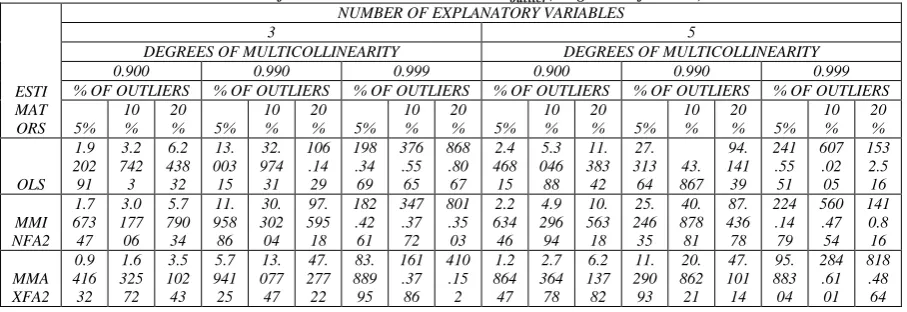
levels of multicollinearity and percentage of outliers are presented in Table 1 to Table 9 at the Appendix. From
Table 1 to Table 9, we observed that, at a fixed magnitude of outliers, number of explanatory variables, levels of
multicollinearity and percentage of outliers, as sample size increase, the AMSE of the estimators’ decreases. The
AMSE of the estimators increases with an increase in the magnitude of outliers.
Also, AMSE increases as the number of explanatory variables increase and as levels of multicollinearity increases.
𝛼̂
𝐿𝐴𝐷𝐹𝐴1𝑚𝑎𝑥Consistently has the smallest values of AMSE, even though
𝛼̂
𝐿𝐴𝐷𝐹𝐴1𝑚𝑖𝑑compete with it favourably. OLS
consistently has the largest values of AMSE, at all the levels of sample size, magnitude of outliers, number of
explanatory variables, levels of multicollinearity and percentage outliers considered.
CONCLUSSION
In this study, the performances of some forms of Generalized Ridge parameters proposed by Fayose and Ayinde
(2019) when combined with Robust estimators to jointly combat the problems of multicollinearity and outliers
were evaluated and compared using the MSE criterion.
[Badawairea* 6(12): December, 2019] ISSN 2349-4506
Impact Factor: 3.799
G
lobal
J
ournal of
E
ngineering
S
cience and
R
esearch
M
anagement
REFERENCES
1.
Agullo, J. (2001), ‘New algorithms for computing the least trimmed squares regression estimator’,
Computational Statistics and Data Analysis
36(4), 425–439.
2.
Atkinson, A. & Weisberg, S. (1991), simulated annealing for the detection of multiple outliers using
least squares and least median of squares fitting,
in
W. Stahel & S. Weisberg, eds, ‘
Directions in Robust
Statistics and Diagnostics’
, Springer-Verlag, New York.
3.
Ayinde, K., Lukman, A. F.
and Arowolo, O.T. (2015). Robust regression diagnostics of influential
observations in linear regression model.
Open Journal of Statistics
, 5, 1-11.
4.
Batah, F., Ramanathan, T. and Gore, S. (2008). The efficiency of modified Jacknife and Ridge Type
Regression Estimators: A Comparison, Surveys in Mathematics and its Applications, 24(2),
F.
157 – 174.
5.
Belsley, D. A., Kuh, E., & Welsch, R. E. (1980). Regression Diagnostics: Identifying Influential Data
and Sources of Collinearity.
Wiley Series in probability and Mathematical Statistics
. New York: John
Wiley & Sons.
6.
Chatterjee, S. and Hadi, A.S. 2006. Regression by Example. 4
thEdition, A Wiley-Interscience
Publication, John Wiley and Sons.
7.
Chatterjee, S., Hadi, A.S. and Price, B. 2000. Regression by Example. 3
rdEdition, A Wiley-Interscience
Publication, John Wiley and Sons.
8.
Cizek, P. (2005), ‘Least trimmed squares in nonlinear regression under dependence’,
Journal of
Statistical Planning and Inference
136(11), 3967–3988.
9.
Dorugade, A. V. (2014). New Ridge Parameters for Ridge Regression. Journal of the Association of
Arab Universities for Basic and Applied Sciences, 15(1), 94 – 99.
10.
Firinguetti, L. A (1999). Generalized Ridge Regression Estimator and its Finite Sample Properties.
Communications in Statistics. Theory and Methods 28(5), 1217 – 1229.
11.
Fomby, T. B., Hill, R. C. and Johnson, S. R. 1984. Advance Econometric Methods. Springer-Verlag,
New York, Berlin, Heidelberg, London, Paris,Tokyo.
12.
Habshah Midi & Marina Zahari. “A Simulation Study on Ridge Regression Estimators in the Presence
of Outliers and Multicollinearity.”
Jurnal Teknologi
. 47(C): 59-74, 2007.
13.
Helland I. S. 1990. Partial least squares regression and statistical methods. Scandinavian Journal of
Statistics, 17, 97 – 114.
14.
Holland, P. W. (1973). Weighted ridge regression: Combining ridge and robust regression methods.
NBER Working Paper Series 11, 1-19.
15.
Hoerl, A. E. & Kennard, R.W. "Ridge Regression Biased Estimation for Nonorthogonal
Problems",
Technometrics
,Vol.12, 55-67, 1970.
16.
Huber, P. H. 1964. ‘‘Robust estimation of location parameter.’’ The Annals of Mathematical Statistics,
35 7 101.
17.
Jung, K. (2005), ‘Multivariate least-trimmed squares regression estimator’,
Computational Statistics and
Data Analysis
48(2), 307–316.
18.
Li, L. (2005), ‘An algorithm for computing exact least-trimmed squares estimate of simple linear
regression with constraints’,
Computational Statistics and Data Analysis,
48(4), 717–734.
19.
Lukman, A.F, Arowolo, O. and Ayinde, K. (2014). Some robust ridge regression for handling
multicollinearity and outlier. International Journal of Sciences: Basic and Applied Research 16(2),
192-202.
20.
Lukman, A.F, and Ayinde, K. (2017). Review and Classifications of the Ridge Parameter Estimation
Techniques. Haccetteppe Journal of Mathematics and Statistics, 46 (5), 953 – 967.
21.
Lukman, A. F., Ayinde, K., Binuomote, S. and Onate, A. C., (
2019
). Modified ridge‐type estimator to
combat multicollinearity: Application to chemical data
. Journal of Chemometrics
, e3125.
22.
Maddala, G. S. 2002. Introduction to Econometrics. 3
rdEdition, John Willey and Sons Limited, England.
23.
Maronna, R.A. “Robust Ridge Regression for High-Dimensional Data.”
Technometrics
, 53(1): 44- 53,
2011.
24.
Massy, W.F. (1965). Principal Components Regression in exploratory statistical research. J. Am. Stat.
Assoc., 60, 234-256.
[Badawairea* 6(12): December, 2019] ISSN 2349-4506
Impact Factor: 3.799
G
lobal
J
ournal of
E
ngineering
S
cience and
R
esearch
M
anagement
26.
Neykov, N. & Neytchev, P. (1991), ‘Least median of squares, least trimmed squares and S estimations
by means of BMDP3R and BMDPAR’,
Computational
Statistics Quarterly
4, 281–293.
27.
Nomura, M. (1988). On the Almost Unbiased Ridge Regression Estimator. Communication in Statistics
– Simulation and Computation, 17(3), 729 – 743.
28.
Pfaffenberger, R. C., & Dielman, T. E. “A comparison of regression estimators when both
multicollinearity and outliers are present.” In
Robust regression:Analysis and applications
, K. Lawrence
& J. Arthur (Eds.), 243-270. New York: Marcel Dekker, 1990.
29.
Phatak, A. and Jony, S. D. 1997. The geometry of partial least squares. Journal of Chemometrics, 11,
311 – 338.
30.
Rousseeuw, P. J. & van Driessen, K. (1999), ‘A fast algorithm for the minimum covariance determinant
estimator’,
Technometrics
41(3), 212–223.
31.
Rousseeuw, P. & van Driessen, K. (2006), ‘Computing LTS regression for large data sets’,
Data Mining
and Knowledge Discovery
12(1), 29–45.
32.
Rousseeuw p. j., and Yohai, 1984. ‘‘Robust regression by means of S estimators in Robust and Nonlinear
Time Series Analysis’’, Franke J. Hardle, W. and Martin, R. D. Lecture Notes in Statistics, 26, New
York: Springer-Verlag 256 - 274.
33.
Rousseeuw, P. J. and Van Driessen K., ‘‘Computing LTS for Large Data Sets.’’ Technical Report,
University of Antwerp, submitted, 1998.
34.
Samkar, H. and Alpu, O. (2010). Ridge regression based on some robust estimators. Journal of Modern
Applied Statistical Methods: 9(2), 495-501.
35.
Stein, C. M. (1960). Multiple Regression, Contributions to Probability and Statistics, Stanford
University Press, 424-443.
36.
Stromberg, A. (1993), ‘Computing the exact least median of squares estimate and stability diagnostics
in multiple linear regression’,
SIAM Journal on Scientific Computing
14(6),
1289–1299.
37.
Taiwo, S. F. and Kayode Ayinde (2019). Different Forms Biasing Parameter for Generalized Ridge
Regression Estimator. International Journal of Computer Applications, 181(37), 0975 – 8887.
38.
Tibshirani, R. (1996).
Regression shrinkage and selection via the LASSO
. J. Royal. Statist. Soc B., Vol.
58, No. 1, p 267-288).
39.
Troskie, C. G. and Chalton, D. O. (1996). A Bayesian Estimate for the Constants in Ridge Regression.
South African Statistical Journal, 30, 119 – 137.
40.
Yohai, V. J. ‘‘High breakdown point and high efficiency robust estimates for regression.’’ The Annals
of Statistics, 15, 642 – 656, 1987.
41.
Wold, H. (1966). Estimation of Principle Components and Related Models by Iterative Least Squares.
In P. R. Krishnaiaah (Ed.). Multivariate Analysis. (pp.391420) New York, Academic Press.
APPENDIX
Table 1: AMSE of the estimators when n = 20 and 𝝈𝒐𝒖𝒕𝒍𝒊𝒆𝒓𝟐 ( magnitude of outliers) = 10
ESTI MAT ORS
NUMBER OF EXPLANATORY VARIABLES
3 5
DEGREES OF MULTICOLLINEARITY DEGREES OF MULTICOLLINEARITY
0.900 0.990 0.999 0.900 0.990 0.999
% OF OUTLIERS % OF OUTLIERS % OF OUTLIERS % OF OUTLIERS % OF OUTLIERS % OF OUTLIERS
5% 10 %
20
% 5%
10 %
20
% 5%
10 %
20
% 5%
10 %
20
% 5%
10 %
20
% 5%
10 %
20 %
OLS 1.9 202 91
3.2 742 3
6.2 438 32
13. 003 15
32. 974 31
106 .14 29
198 .34 69
376 .55 65
868 .80 67
2.4 468 15
5.3 046 88
11. 383 42
27. 313 64
43. 867
94. 141 39
241 .55 51
607 .02 05
153 2.5 16
MMI NFA2
1.7 673 47
3.0 177 06
5.7 790 34
11. 958 86
30. 302 04
97. 595 18
182 .42 61
347 .37 72
801 .35 03
2.2 634 46
4.9 296 94
10. 563 18
25. 246 35
40. 878 81
87. 436 78
224 .14 79
560 .47 54
141 0.8 16
MMA XFA2
0.9 416 32
1.6 325 72
3.5 102 43
5.7 941 25
13. 077 47
47. 277 22
83. 889 95
161 .37 86
410 .15 2
1.2 864 47
2.7 364 78
6.2 137 82
11. 290 93
20. 862 21
47. 101 14
95. 883 04
284 .61 01
[Badawairea* 6(12): December, 2019] ISSN 2349-4506
Impact Factor: 3.799
G
lobal
J
ournal of
E
ngineering
S
cience and
R
esearch
M
anagement
MMI DFA2
1.0 506 62
1.7 775 99
3.7 609 4
5.9 635 05
13. 221 88
47. 821 83
83. 991 75
161 .71 46
410 .63 37
1.3 841 77
2.9 379 98
6.4 282 57
11. 349 54
21. 054 58
47. 422 67
95. 969 41
284 .73 8
818 .73 43
MMF A2
1.6 093 1
2.6 953 13
5.4 253 32
11. 351 34
26. 427 17
82. 010 56
159 .61 79
327 .41 81
710 .05 7
2.0 385 35
4.1 709 41
8.8 682 4
21. 831 84
36. 899 91
69. 320 83
186 .65 23
437 .69 29
103 1.2 92
MGM FA2
1.4 497 41
2.4 310 05
4.8 909 83
9.0 729 7
19. 665 86
65. 757 4
106 .81 28
218 .88 22
504 .25 14
1.9 913 35
4.0 857 6
8.5 163 66
15. 423 66
28. 339 96
57. 475 73
109 .32 78
304 .35 02
849 .11 99
MHM FA2
1.7 535 82
2.9 469 29
5.6 486 14
12. 768 1
32. 577 09
105 .28 94
198 .12 74
376 .14 11
867 .97 13
2.3 184 06
5.0 423 96
10. 892 91
27. 159 39
43. 582 28
93. 660 36
241 .40 72
606 .70 1
153 1.9 49
MMI NFA1
1.1 221 67
1.9 814 48
4.0 401 87
7.6 459 53
18. 826 8
64. 120 16
117 .22 33
223 .31 27
540 .91 44
1.5 801 98
3.5 067 29
7.8 248 79
16. 837 99
29. 041 8
64. 269 45
151 .91 09
396 .43 43
104 5.0 39
MMA XFA1
0.8 146 81
1.4 684 02
3.2 264 69
5.6 436 13
12. 945 76
46. 778 84
83. 795
161 .06 49
409 .69 73
1.1 794 39
2.5 025 8
5.9 917 45
11. 237 83
20. 688 93
46. 811 09
95. 803 09
284 .49 15
818 .25 62
MMI DFA1
0.8 221 23
1.4 783 33
3.2 437 59
5.6 524 22
12. 953 8
46. 809 44
83. 800 9
161 .08 44
409 .72 67
1.1 866 88
2.5 191 65
6.0 073 37
11. 241 56
20. 700 99
46. 831 41
95. 808 78
284 .49 99
818 .27 26
MMF A1
0.9 514 36
1.6 715 38
3.6 570 95
6.8 676 7
15. 083 92
51. 891 71
95. 959 9
196 .99 21
458 .51 2
1.3 424 96
2.7 945 62
6.4 836 74
13. 240 07
24. 219 94
50. 494 69
113 .16 38
308 .00 32
848 .74 16
MGM FA1
0.8 830 23
1.5 730 12
3.4 136 94
5.9 317 09
13. 441 87
48. 322 04
85. 210 27
164 .71 48
415 .74 69
1.3 168 82
2.7 584 3
6.3 635 95
11. 561 09
21. 359 94
47. 776 74
96. 634 54
285 .75 42
820 .32 59
MHM FA1
1.0 859 87
1.8 396 97
3.8 229 42
10. 495 71
28. 063 31
94. 883 8
194 .78 08
369 .82 38
855 .20 36
1.6 754 39
3.6 609 99
8.3 022 38
25. 370 91
40. 436 33
88. 188 67
239 .38 91
602 .34 4
152 4.1 73 MM
MINF A2
1.7 596 34
2.9 985 51
5.7 208 6
11. 895 57
30. 128 87
96. 778 34
181 .48 3
344 .75 09
793 .65 17
2.2 464 02
4.8 929 38
10. 436 4
25. 117 06
40. 561 22
86. 404 39
222 .88 15
554 .67 1
138 8.9 58 MM
MAX FA2
0.7 635 57
1.1 139 97
2.1 021 14
4.1 904 65
7.8 009 62
23. 596 61
57. 924 43
95. 081 6
190 .42 46
0.9 150 36
1.8 079 71
3.0 077 07
7.4 559 75
11. 487 36
22. 783 02
64. 755 68
160 .79 14
338 .06 6 MM
MID FA2
0.9 002 49
1.3 202 51
2.5 416 09
4.4 040 01
7.9 936 95
24. 351 43
58. 048 66
95. 504 6
191 .11 13
1.0 545 43
2.1 168 37
3.4 045 04
7.5 320 91
11. 768 46
23. 284 27
64. 863 43
160 .97 11
338 .46 41 MM
MFA 2
1.5 817 29
2.6 068 2
5.2 565 5
11. 206 9
25. 564 59
76. 443 28
155 .03 92
320 .96 87
672 .55 57
1.9 684 04
3.9 204 41
7.8 627 79
21. 150 3
35. 532 73
59. 598 13
179 .14 5
388 .28 97
738 .80 75 MMG
MFA 2
1.3 936 21
2.2 556 54
4.4 651 25
8.4 362 77
16. 875 79
52. 122 66
87. 744 47
176 .11 56
346 .88 98
1.9 067 66
3.8 031 05
7.2 522 19
12. 993 24
23. 225 17
40. 122 71
82. 339 03
190 .28 48
393 .93 69 MMH
MFA 2
1.7 445 97
2.9 191 36
5.5 610 33
12. 764 23
32. 572 83
105 .28 11
198 .12 72
376 .14 04
867 .97 01
2.3 101 52
5.0 25
10. 853 14
27. 158 36
43. 579 22
93. 655 32
241 .40 71
606 .70 07
153 1.9 49 MM
MINF A1
0.9 901 03
1.6 163 75
3.0 358 72
6.5 993 28
15. 751 41
49. 565 53
101 .42 86
182 .38 1
408 .38 52
1.3 371 8
2.9 733 12
6.0 057 89
14. 853 67
24. 294 06
51. 359 05
136 .69 69
328 .09 94
765 .56 67 MM
MAX FA1
0.6 113 65
0.8 992 14
1.6 488 83
4.0 070 52
7.6 309 63
22. 941 53
57. 808 84
94. 689 71
189 .78 7
0.7 696 38
1.4 617 77
2.6 231 45
7.3 878 07
11. 244 56
22. 352 73
64. 656 2
160 .62 53
337 .69 93 MM
MID FA1
0.6 195 72
0.9 107 81
1.6 727 05
4.0 175 17
7.6 411 33
22. 980 07
57. 816 02
94. 714
189 .82 67
0.7 788 49
1.4 842 99
2.6 476 77
7.3 925 63
11. 261 04
22. 381 74
64. 663 27
160 .63 71
337 .72 54 MM
MFA 1
0.7 757 74
1.1 686 48
2.3 581 38
5.5 803 83
10. 606 26
30. 427 81
73. 455 2
144 .92 12
269 .38 09
0.9 947 14
1.8 969 52
3.5 080 51
10. 075 08
16. 775 43
28. 409 51
87. 368 43
195 .82 57
393 .22 96 MMG
MFA 1
0.6 913 09
1.0 322 58
1.9 384 52
4.3 635 51
8.2 948 57
25. 066 35
59. 557 43
99. 400 87
198 .72 62
0.9 581 58
1.8 415 73
3.2 840 2
7.8 115 04
12. 230 08
23. 853 43
65. 701 83
162 .41 56
[Badawairea* 6(12): December, 2019] ISSN 2349-4506
Impact Factor: 3.799
G
lobal
J
ournal of
E
ngineering
S
cience and
R
esearch
M
anagement
MMH MFA 1
0.9 451 68
1.4 308 24
2.6 744 84
10. 196 87
27. 545 3
93. 636 22
194 .72 52
369 .66 69
854 .89 24
1.4 815 39
3.1 970 93
7.0 025 14
25. 245 25
40. 083 79
87. 545 68
239 .36 69
602 .28 09
152 4.0 73
SMIN FA2
1.7 700 2
3.0 089 4
5.7 320 37
11. 973 98
30. 267 15
96. 944 68
182 .18 95
346 .56 14
795 .15 64
2.2 589 38
4.9 056 66
10. 461 63
25. 241 73
40. 769 47
86. 585 14
224 .15 32
556 .55 91
139 1.5 42
SMA XFA2
0.9 521 96
1.3 408 53
2.3 521 87
5.7 988 36
11. 207 73
27. 508 2
75. 429 88
140 .28 3
227 .29 81
1.1 604 29
2.1 895 21
3.5 724 02
10. 704 22
16. 809 76
27. 085 02
99. 019 65
213 .04 67
418 .95 38
SMID FA2
1.0 604 22
1.5 208
2.7 581 32
5.9 688 44
11. 366 59
28. 225 14
75. 539 58
140 .64 86
227 .93 64
1.2 706 92
2.4 538 66
3.9 433 42
10. 768 76
17. 039 66
27. 562 11
99. 109 06
213 .20 39
419 .32 02
SMF A2
1.6 155 68
2.6 507 52
5.2 878 48
11. 379
26. 218 5
77. 453 17
158 .27 37
325 .51 3
679 .69 01
2.0 160 31
4.0 151 91
8.0 516 52
21. 807 77
36. 395 32
61. 417 54
187 .62 54
406 .74 15
786 .53 05
SGM FA2
1.4 584 39
2.3 383 6
4.5 419 82
9.1 212 96
18. 839
54. 437 74
100 .49 23
205 .88 55
373 .49 08
1.9 637 21
3.9 110 81
7.4 888 37
15. 169 5
26. 215 44
43. 340 59
112 .55 95
237 .84 43
470 .34 03
SHM FA2
1.7 555 42
2.9 327 92
5.5 770 95
12. 768 83
32. 576 01
105 .28 29
198 .12 74
376 .14 08
867 .97 03
2.3 167 57
5.0 315 63
10. 860 5
27. 159 1
43. 581
93. 656 28
241 .40 72
606 .70 08
153 1.9 49
SMIN FA1
1.1 319 47
1.7 787 51
3.2 144 31
7.6 791 42
17. 893 51
52. 024 66
112 .01 38
210 .92 03
431 .21 54
1.4 960 8
3.1 878 11
6.3 440 89
16. 663 09
27. 083 84
53. 785 69
154 .21 7
354 .60 4
810 .93 17
SMA XFA1
0.8 334 55
1.1 520 89
1.9 292 95
5.6 492 65
11. 069 2
26. 883 15
75. 327 57
139 .94 27
226 .70 46
1.0 465 47
1.8 896 52
3.2 096 46
10. 645 73
16. 607 4
26. 671 12
98. 936 78
212 .90 11
418 .61 63
SMID FA1
0.8 396 57
1.1 623 81
1.9 519 51
5.6 579 41
11. 077 43
26. 920 05
75. 333 92
139 .96 37
226 .74 16
1.0 536 58
1.9 096 5
3.2 329 91
10. 649 84
16. 621 28
26. 699 21
98. 942 68
212 .91 15
418 .64 03
SMF A1
0.9 618 39
1.3 885 87
2.5 887 79
6.8 867 54
13. 561 99
33. 968 75
88. 539 02
180 .86 25
300 .86 86
1.2 233 3
2.2 657 55
4.0 398 28
12. 830 4
21. 026 94
32. 377 05
116 .37 33
242 .47 26
469 .68 92
SGM FA1
0.8 953 47
1.2 693 32
2.2 005 23
5.9 368 37
11. 617 01
28. 902 65
76. 852 88
143 .95 78
235 .00 99
1.1 944 46
2.2 183 22
3.8 309 27
11. 001 48
17. 411 94
28. 100 44
99. 794 39
214 .45 68
421 .73 4
SHM FA1
1.0 948 51
1.6 102 6
2.8 792 26
10. 523 18
27. 905 59
93. 875 26
194 .76 75
369 .76 73
854 .94 97
1.6 139 96
3.3 821 31
7.2 353 74
25. 341 85
40. 289 5
87. 652 04
239 .38 69
602 .30 26
152 4.0 83 LTSM
INFA 2
1.7 876 24
3.0 399 86
5.7 847
12. 109 72
30. 581 17
97. 987 47
183 .95 39
350 .63 62
802 .43 13
2.2 953 54
4.9 767 96
10. 611 34
25. 603 48
41. 374 33
87. 850 77
227 .31 18
566 .71 55
141 4.7 2 LTSM
AXFA 2
1.1 779 56
1.8 262 82
3.2 934 13
7.5 462 74
16. 536 68
46. 776 47
105 .69 76
204 .23 96
391 .26 97
1.6 196 19
3.2 740 44
6.2 058 89
16. 064 77
26. 151 6
49. 795
147 .74 4
360 .77 89
794 .07 41 LTSM
IDFA 2
1.2 548 66
1.9 525 69
3.5 723 27
7.6 714 84
16. 656 85
47. 311 57
105 .77 31
204 .50 07
391 .75 64
1.6 827 56
3.4 277 01
6.4 246 02
16. 104 15
26. 298 94
50. 106 28
147 .80 01
360 .87 35
794 .30 94
LTSM FA2
1.6 640 43
2.7 597 6
5.4 218 89
11. 639 92
27. 415 82
82. 763 58
164 .97 46
334 .31 29
710 .78 77
2.1 299 23
4.3 698 29
8.9 520 85
23. 175 12
38. 365 51
71. 171 74
202 .73 97
473 .65 79
101 7.8 34 LTSG
MFA 2
1.5 442 24
2.5 294 38
4.8 481 38
9.9 561 42
22. 028 5
65. 985 05
122 .80 75
249 .35 71
492 .69 84
2.0 963 12
4.3 036 48
8.5 923 2
18. 850 91
31. 957 84
60. 051 23
156 .24 02
375 .71 53
825 .44 85 LTSH
MFA 2
1.7 760 17
2.9 783 03
5.6 576 05
12. 780 86
32. 587 44
105 .30 11
198 .12 82
376 .14 26
867 .97 21
2.3 379 68
5.0 718 05
10. 920 22
27. 164 04
43. 592 55
93. 668 58
241 .40 79
606 .70 19
153 1.9 5 LTSM
INFA 1
1.3 059 39
2.1 327 4
3.8 896 32
8.9 128 89
21. 352 28
64. 261 23
130 .93 07
252 .81 25
532 .40 41
1.8 128 25
3.8 595 64
7.8 766 76
19. 801 24
32. 491 32
66. 487 79
181 .93 7
443 .68 85
103 2.8 85 LTSM
AXFA 1
1.0 944 44
1.6 913 64
3.0 016 62
7.4 356 69
16. 430 05
46. 295 61
105 .62 72
203 .99 61
390 .81 56
1.5 535 74
3.0 991 55
5.9 910 98
16. 029 19
26. 020 46
49. 519 74
147 .69 19
360 .69 12