The Role of Warming Up Activities in Adolescent Students’ Involvement
during the English Class
*El papel de actividades de motivación inicial en la participación de estudiantes adolescentes en la clase de inglés
Rosalba Velandia**
Porfirio Barba Jacob School, Bogotá – Colombia
In this article we want to share the experience we had when we applied warming up activities to seven graders at Porfirio Barba Jacob, a public school in Bogotá, during 2004. Our main objective was to get students’ attention at the beginning of the class by means of enjoyable and short activities as well as to observe how possible it was to engage them in the steps that followed. We sought to explore students’ involvement in the English class while we tried to motivate them through appropriate warm ups. We used journals, students’ surveys and field notes to collect data. The analysis of information collected showed us that the use of warm up activities increases students’ attention and helps us link the processes of the class.
Key words: Warming up activities, students’ attention, students’ participation
En este artículo compartimos la experiencia que tuvimos al aplicar actividades de motivación inicial con alumnos de grado séptimo del colegio Porfirio Barba Jacob, una institución pública en Bogotá, durante el año 2004. Nuestro objetivo principal fue captar la atención de nuestros estudiantes mediante actividades cortas y divertidas al comienzo de la clase, que los comprometieran con las siguientes etapas de la misma. Exploramos la participación de los estudiantes en la clase de inglés motivándolos a través de actividades de iniciación adecuadas. Para la recolección de datos empleamos diarios, entrevistas a alumnos y el diario de campo. El análisis de la información recolectada mostró que el uso de actividades de iniciación incrementa la atención de los estudiantes y ayudan a conectar los procesos de la clase.
Palabras claves: Actividades de iniciación, atención de los estudiantes, participación de los estudiantes
* This paper reports on a study conducted by the authors while participating in the PROFILE Teacher Development Program, at Universidad Nacional de Colombia, in 2004. The program was sponsored by Secretaría de Educación de Bogotá, D.C. Code number:
30102005346, Universidad Nacional de Colombia, Facultad de Ciencias Humanas.
It was a collaborative work conducted with the author of this paper and Luz Hasbleidy Martínez Melo. ** E-mail: [email protected]
Address: Carrera 108 81A- 55
Introduction
We decided to carry out this project when we formed part of the Red Profile
PFPD (Professional Development Program),
at the National University in 2004. This work was implemented at the Porfirio Barba Jacob School, a public school located in “La Palestina” neighborhood of Bosa, on the west side of Bogotá (Zone 7), with seventh graders who were usually bored or not interested in the English class and, if so, they did not engage enough in class work.
As we looked for alternatives to support our pupils’ learning and motivation,
we concluded that the use of warm up activities is a topic commonly mentioned in methodologies suggested for English classes. However, it has not been given enough importance as compared to other stages or phases of classes such as practice, students’ production or presentations, which mainly involve the warm up activity, an activity to identify the knowledge students have about the topic, and the introduction of new vocabulary. So, we decided to plan some lessons with warming up activities and to investigate our students’ learning of the foreign language.
Considering the aspects mentioned above, our main question was as follows:
Whatis the role of warming up activities
in students’ involvement in the English class? The execution of this project took six months. During this process, we analyzed and included the steps and principles of the communicative approach in our work with warming up activities, selected useful and interesting warm up activities, implemented them by means of the careful design of lesson plans that allowed us to involve
students in the classes according to the topic we were working with, and, finally, analyzed and evaluated the results.
The institutional project considers three axes: cognitive development, self-action and education in values. The English curriculum led to a special organization of students by levels per grade. This organization by levels, according to students’ performance, established basic, intermediate and
advanced levels. We worked with
intermediate and advanced groups of 7th
grade with an average of 30 students each and took turns with the implementation stage. Thus, we acted as teachers and observers in each other’s class. Each class was designed by both of us, taking special care of the type of warm up and the close connection with the language focus.
In the next sections you will find the theoretical bases that support our study, including the research design we implemented, the corresponding data collection instruments and analysis and, finally, the conclusions and pedagogical implications that our study yielded.
Literature Review
Elements such as the role of motivation,
the stages of classes in EFL as well as
aspects of a warm up activity were taken into consideration in the development of our project. They are considered in the following paragraphs.
Motivation and Warm up Activities
the learning of the subject matter, in our case, language learning.
Warming up activities can foster motivation and this is, in turn, an essential component when planning warming up activities. According to Dornyei (2001), teachers need to try and actively generate positive students’ attitudes toward learning. He also claims that the key issue in
generating interest is to widen the student’s appetite; that is, to arouse the students’ curiosity and attention and to create an attractive image for the class so that they will get more involved with it and a better learning process will take place.
Warming up and Attention
The importance of having warming up activities was mentioned at the beginning of this paper, but a question remains: What is a warming up activity? Allwright (1984) considers that warm up activities are designed to attract students’ attention, to help them put aside distracting thoughts, and to get them ready to focus individually and as groups on whatever activities that follow. They will cause people to stop whatever they are doing or thinking and refocus their attention. We could say a warming up activity is a motivating starting point that will lead students to become animated to work efficiently in the language class. For the purpose of our study, it was the activity used to encourage students’ involvement and permeate the development of the whole lesson, so we avoided looking at them as isolated activities. These kinds of activities might also be called zealous, enthusiastic or suggestive activities. How we can include these activities in the process
of a class will be the next focus in our discussion.
The Place of Warm up in the English Lesson
When preparing lesson plans for
our EFL classes, we must include at least
the following parts so that warming up activities can play a clear and meaningful role in our teaching. Kay (1995) describes the stages of a lesson plan in the following way:
Warm up: “It is an effective way to help the students begin to think in English and to review previously introduced material. Different types of warm ups help provide variety and interest in the lesson” (p. vi). A warm up to prepare students for a period of concentration may involve physical movement with activities that keep them active by standing up, walking, jumping, matching pictures with sentences or vocabulary, drawing or writing personal experiences or stories, and singing or
listening to familiar songs and chants. These are, among others, enjoyable and motivating warms ups.
Presentation: The first part of the presentation often involves pre-teaching to encourage the flow of information. In this initial stage, we conduct activities to present the new language by providing a context for each situation.
Application: The application provides students with hands-on opportunities to use what they have learned. This part of the lesson can also be considered part of the practice –particularly less controlled and free practice.
Assessment: Some assessment activities like games, tasks or projects let students carry out the activity while the teacher is circulating in the classroom monitoring their use of the language, to examine students’ progress and achievement. Also, a written assessment and a self evaluation section could be included.
Useful Strategies when Implementing Warming up Activities
For the purpose of our project, we considered some specific aspects related to warm up activities which we thought could make students’ learning more stimulating. They were as follows:
Breaking the monotony of learning: •
About this one, Dornyei (2001) highlights the importance of the “motivational flow” when talking about the general rhythm and sequence of events in class and suggests starting it with a warmer, which can be a short stimulating game to set the tone.
Making the tasks more interesting: •
The author claims that humans are able to produce concentrated effort if they want to. Generating this interest involves a set of characteristics. Most of them can be adaptable; thus, they become challenging for students since they have interesting content,
novelty, and intriguing, exotic, fantasy and personal elements; they stimulate competition and humor. Increasing the involvement of the •
students: He considers that it is important to make students active participants and suggests selecting tasks which require mental or bodily involvement of each participant and creating specific rules and personalized assignments for everybody.
Diagram 1 shows some of the principles that a teacher must consider when preparing a warm up activity. It emerged as a result of our reflections upon our conceptual framework and the implementation process we designed.
The principles contained in this diagram make us realize that warm up activities are not only processes to begin the class, but tools that help us catch students’ attention. If you start with an exciting and interesting activity you can be sure the other steps can be developed easily. This warm up must also be short because it is like a preparation for the other class stages. That is why it has to be related with the topic and centered in communicative aspects which could involve activities that emphasize the practice of different skills.
element adds meaning to the issue of applying learning styles.
Learning English highly depends on pupils’ positive attitude toward the class. Consequently, learning must be stimulating and enjoyable through breaking what might cause monotony in this process and strengthening what makes tasks more interesting, as well as what increases students’ involvement. The use of warming up activities implies features as the ones previously described in order to get
students’ attention, to make them interested in what is going on, to focus on language items and to increase learners’ expectations by consciously arranging the conditions in a way that they put the learner in a more positive or optimistic mood.
Research Design
As has already been said, this research was developed with 68 students who
belonged to two groups of 7th grade.
Thirty-five belonged to the advanced level and
the others to the intermediate. They were between 12 and 15 years old and did not participate a lot in class. Most of them seemed bored or not interested in the activities.
The study was carried out simultaneously by the two teachers participating in it, taking turns for implementing the project in the
corresponding groups and observing each other’s class, so that each researcher acted as a teacher and as an observer. At the end of each lesson we implemented, students were asked to fill in a journal, which was then analyzed with the field notes taken by the observer. Teachers had the possibility to work together because they only taught English and their professional experience had been in this subject for no fewer than 10 years.
We decided to work based on action research because it is contextual, evaluative and reflective and it aims to bring about change and improvement in practice. We decided to follow Kemmis & McTaggart’s
model (as cited in Nunan, 1989, p. 73), which considers four main aspects as follows:
To develop a plan of action to •
improve what is already happening. To do so, we designed a chronogram including the necessary aspects to be worked: The pedagogical strategy and the necessary tools to explore what happened during such implementation.
To act to implement the plan. In •
this step, we not only designed the lesson plans, including warming up activities, but also developed them with the chosen groups.
To observe the effects of action in the •
context in which it occurs. This was done by means of class observation, field notes and journals.
To reflect on the effects of the use •
of warm ups as a basis for further planning and subsequent action, through a succession of cycles. To do so, after each class we gathered information to analyze what we had observed in relation to the effects of
the warm up and shaped our plan for the next one.
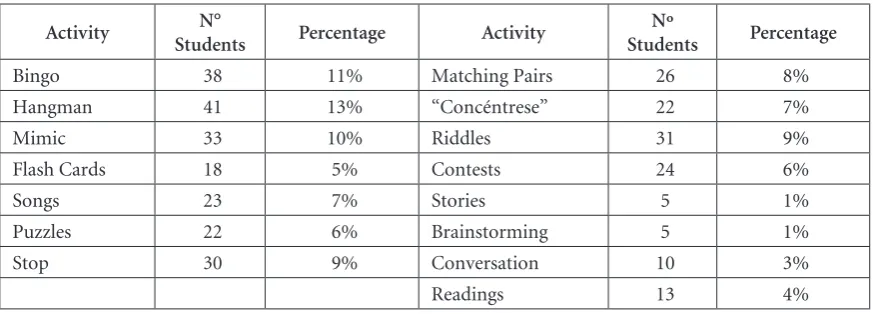
The research involved reflection based on our experiences and on the literature. We reflected about what was happening in class, why this happened in that way, how we could take advantage of some activities that caused students to be motivated. This implied collaborative work between a pair of teachers. Teachers found out what was going on in the classroom practice in order to make changes and produce actions. It meant to try to increase motivation and the students’ involvement during the class, so that they could have more tools to improve their language learning process. All of these efforts allowed teacher-researchers to have new available activities useful to be applied in the daily work as the ones included in the lesson plans (see a sample in Appendix 1). It should be clarified that we took into account the ideas suggested by the students in the diagnostic questionnaire that we applied at the beginning of our project. The results can be seen in Table 1.
We also asked students about the activities that encouraged them to work in
Table 1. Activities students liked the most to start the class.
Activity N°
Students Percentage Activity
Nº
Students Percentage
Bingo 38 11% Matching Pairs 26 8%
Hangman 41 13% “Concéntrese” 22 7%
Mimic 33 10% Riddles 31 9%
Flash Cards 18 5% Contests 24 6%
Songs 23 7% Stories 5 1%
Puzzles 22 6% Brainstorming 5 1%
Stop 30 9% Conversation 10 3%
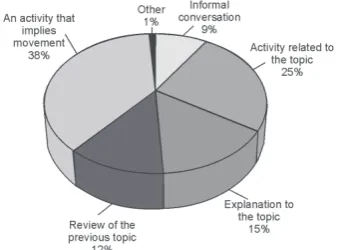
class and the ones they liked the most to start it. The results were as follows:
Graph 1. Activities that encouraged students to work in class.
Based on the information gathered in the diagnostic stage, we created six lesson plans for the implementation stage. These plans were developed during the last three months of 2004. They were organized according to the aspects we considered important for our research (see sample provided in Appendix 1). Similar to this example, we implemented some warm ups connected to the topic of the lessons (see Table 2).
Data Collection Instruments
The first instrument designed was a questionnaire. As we already explained, it
Table 2. Warm up activities implemented during the project.
Topic Warm up
Routines and daily activities Matching pictures to expressions Daily activities and their frequency Bingo
Daily activities and their time Memory Game Sensations and health habits Hangman
Health habits Duck into the water
was elaborated in order to identify some aspects related to the students’ point of view about the class stages, the activities they liked the most, and the ones that helped them to become involved during the class process.
According to this preliminary stage, we found that most of the students had more interest in activities that implied movement or those like hangman, bingo, mimics, or guessing, to start the class. In addition, they apparently preferred working in small groups. Also, they suggested games or dynamics, and varied activities to have a good start in the lesson. It seemed that these activities could encourage them to understand better, increase their attention and interest and promote interaction among classmates.
we continued the process of data collection as described in the next lines.
Students’ Journals
They were filled in and analyzed class by class. We programed 6 lesson plans and also collected an average of 60 journals per class. At the end of each session, students were asked to fill in his/her journal which included some headings that encouraged them to write (see Appendix 2). They were motivated to do that because it did not imply a score or grade and also because we explained that they had the possibility of helping the teacher to improve the class and to control their own learning process.
Field Notes
They were taken by one of the teacher-researchers, the one who observed, and they allowed us to identify and reflect on the findings. As well as with the journals, field notes were written during the process of each class.
Data Analysis and Findings
We based our observation on
suggestions given by Nunan (1989), who recommends organizing the findings in categories as they are analyzed. The collection and later analysis of the gathered information led us to identify key aspects in relation to the role of warm up activities in students’ involvement in the English class. We organized information into four main categories: strengthening knowledge about language, students’ involvement, interaction, and values (see Diagram 2).
1. Strengthening Knowledge about Language: This category is related to the language competence; that is to say, acquiring pronunciation, structures, and functions. This category is also closely related to cognitive processes like memorization, establishing relations and concentration, which emerged when students participated in the warm ups.
We found in the students journals that they thought they learnt different aspects of language according to the warm ups worked in class. For example, in the class where the memory game was applied, students said they had learnt vocabulary. Likewise, in the class where hangman was played, most of them said they had learnt to describe sensations and some others mentioned gains in spelling.
Graph 2 illustrates students’ answers at one of the times when journals were collected and highlights the language aspects they could reinforce.
Another interesting aspect that
students mentioned in the journals was the identification of language functions as a
result of the learning process, as can be seen in the following examples:
Chiqui: I learned how food smell or taste. Jordan: I learned to make recommendations related to a balanced diet
Daniel: I learned about how often my partners do some activities.
Pato: I learned about good and bad habits
The aspect of paragraph construction and language structures learned was also evidenced in the data collected. This could be observed in statements like these:
Jacky: I learned to write a short paragraph about my partner
Felipe: I learned to place the adverbs of frequency in a sentence
Sandra: I learned to write questions using ‘How often…’
As can be noticed, functions and structures were learned easily as a result of the use of funny and enjoyable activities, combined with other important communicative aspects. That means the warm up let teachers link the way language can be used with its formal construction (structures). As mentioned by Howatt (1994), it is not merely a question of activating and exciting but of stimulating
the development of the language system itself.
2. Students’ Involvement: This refers to the range of engagement that students had with the whole class. Here, two
subcategories were drawn: participation and individual work.
Participation: This refers to continuous students’ contributions to the class, by answering questions related to particular topics or situations. They took part in the activities, encouraged each other and took turns participating in problem-solving activities.
Individual work: This refers to learners’ engagement with the activities in an individual way. Students got involved in writing, drawing, speaking, trying to memorize, and getting information and being focused on fulfilling the objective of the lessons.
Making reference to individual work and written production, a good number of students appeared to be interested in doing activities in their notebooks. Besides, it could be noticed that individual work later contributed to group work. After fulfilling the goals set out for individual tasks, when they worked as a group, students also contributed to task completion by looking for notes in their notebooks’ or just giving suggestions.
We can illustrate students’ involvement in individual work with the following examples taken from the field notes during the lesson on sensations and health habits when we applied hangman as the warm up.
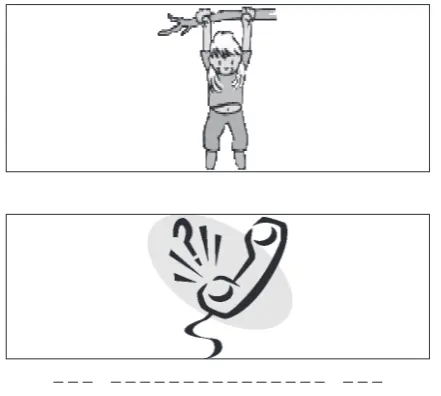
The students worked in groups of 5 or 6. One of them directed the game based on the sentences given by the teacher in secret. Each captain took two pictures of objects
Graph 2. Language aspects students could strengthen. Findings from the journal analysis
Each captain was also given the blanks in a piece of paper and the different parts of a human body (puzzles) for the game. Next we can witness some observations registered in a group:
Student 1: We had just said the “U”
Captain of the group: Nooo… o Yes?? (Checking with the blanks given to complete)
S1. Good, la “ci” This is there oh no? La “Ci” … no the “es”. ¿the “ci” it’s not? That is right so the “s” (the pronunciation was given in Spanish)
S2: (Trying to remember the English alphabet) ei, bi, ci, di, ef, …
In another class, after the
implementation of the warm up Ducks into
the water, in the practice step, the students were organized in small groups and they had to classify all the habits from the board as good or bad ones as fast as possible. Then we could observe the following:
They looked very anxious to get the work finished. Students were writing the habits from the board and trying to identify them. Students asked a lot of questions in order to continue working in a right way
Ex: Teacher, “Are there the same number of bad and good habits?”
The groups seemed to participate actively because they were organized quickly and also they developed the activities in the time planned.
During the whole activities a big average of students participated actively, gave the answers and solved the tasks carefully. They tried also to be the winners all the time. They were raising their hands, paying special interest to class.
(Field notes. Lesson 3).
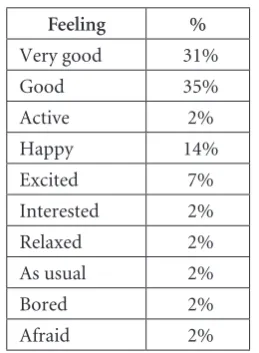
Likewise, the analysis of the students’ journals, which included some headings to encourage them to write, showed that warm up activities produce positive feelings such as happiness, motivation and excitement. It could be noticed in the analysis we made about these aspects for each warm up. For
example, in the The Memory Game warm up
Table 3. Sentences for each group.
Group one The orange juice tastes sour. The pillow feels soft.
Group two The telephone sounds loud. The ice cream tastes sweet.
Group three The spaghetti taste delicious. The soap smells good.
Group four The hamburger tastes salty. The soccer ball looks hard.
Group five The T.V. set looks new. The stereo sounds loud.
Group six The rice smells good. The cake tastes sweet.
Group seven The tire feels hard. The toaster feels hot. – – – – – – – – – – – – – – – – – – – – –
The telephone sounds loud (Secret Sentence) Picture 1. Warm up: Hangman.
(see Appendix 1), students expressed that they felt as follows:
Table 4. Students’ expressed feelings during The Memory Game warm up.
Feeling %
Very good 31%
Good 35%
Active 2%
Happy 14%
Excited 7%
Interested 2%
Relaxed 2%
As usual 2%
Bored 2%
Afraid 2%
3. Class Interaction: This category is related to how the students tried to get information as well as how they shared knowledge or information. The students showed they interacted in order to get actively involved in the warm up activities. Some examples of this category are shown in the following extract from field-notes (in lesson 2) while students were working on daily activities and routines.
Students try to get information asking to their partners and using simple expressions in English or in Spanish. Also, they asked the teachers: Is this a good Habit?
T: You say: How often do you play tennis?
Javier: How can I make the question’ Please repeat me.
They correct each other.
Javier: Yes, but here you`re wrong!!.
Daniel: The I. Oh, you guess the letter.
Javier: La “yi”S2.Noo!!..la “i” ya!!.
Some students also interacted with the teacher asking for a chance or criticizing her about organization or presentation of the materials. This shows a clear interest in the class, as can be seen in the following examples taken from lesson 4:
T: Bad habits to the center!!
Jordan: Profe, ¿me da la revancha? (Teacher, can you give me another chance?)
(When the teacher showed the cards related with good and bad habits)
Student: Profe, ¡let me see!…you only let see to this part of the room but you don’t let see to this side.
During the implementation stage, we also observed that students continuously asked the teacher questions. The students wanted to be explained exactly what to do.
During the class where the activity Ducks
into the water was used, students were asked to classify the good and bad habits that were stuck up on the board. Some students from each group walked to the board trying to look at it carefully and went back to their groups to help their peers complete the activity. Likewise, students’ attitude was remarkable during this time; it was always positive; they tried to answer the questions asked by the teacher in the different class
stages. Several students went to the center
and a student helped to check who was right or wrong. On the whole, students seemed to actually enjoy the classes because the general vision was a class drawing, writing, talking or listening carefully whenever the class activities required doing so.
values like honesty, self-confidence and responsibility. During the development of the classes, students encouraged each other. Also, when they participated in the activities they respected their turns and seemed to be engaged in the activities proposed.
For instance, when they took part in the
hangman contest, we gathered the following comments:
Briggitte: Teacher, you have noticed that I am participating so much…
Lina: But not only Briggitte… Also Jordan, who misbehaved all the time, is working well.
When two groups got the same score, Leidy said: Teacher, they were the best because they used the right expressions from the beginning without help.
If we examine the connection between values and the previous excerpts, we can infer that self-esteem is noticed in Briggitte’s statement. Likewise, Lina evidences how students encouraged each other. In addition, Leidy shows that students recognized the efforts made by others.
Conclusions and Pedagogical
Implications
At the end of this study, we as
researchers could assert that using warm up activities is an effective way of helping students to begin the English class daily. In regards to this, we completely agree with Allwright (1984) who concluded, based on her own experience, that “with warm ups students paid closer attention, asked better questions and seemed a bit more excited than before” (p. 162). This author also claims that “the proper presentation of warm ups will cause people to stop
whatever they are doing or thinking and refocus their attention” (p. 164), an aspect that could be confirmed through the findings of this study.
Through the analysis of the findings gotten from the students’ journals and teachers’ field notes, we have come to the conclusion that the role of warm ups is one of being an attention injector for students. That facilitates their involvement in the class work by sharing answers, trying to participate, paying attention, giving the answers, encouraging to take part in the lesson, participating as volunteers, working on the exercises, drawing, and writing the exercises.
Based on the results collected mainly from the field notes, these kinds of
activities really appear to promote students’ involvement in the English class. They must be used as a motivation and a means of preparing the ground for the various stages of the lesson. As could be noticed in the lesson plan (Appendix 1), they are neither long tasks nor an explanation of the topic. In the same way, they must not be considered as isolated stages in the process or be centered on only one skill. That means we can prepare the warm up with the objective of involving students’ participation and letting them communicate at an early stage of the lesson.
Some important aspects to be
motivate them by means of examples or guides.
It is also important to remark that no matter how simple warm up activities can be, they should be well prepared. In addition, we need to examine the
connection for the later activities so that we, as teachers, can take advantage of them to develop our lessons. For example, to prepare
the warm up related to the use of a Bingo in
the topic Daily activities and their frequency,
the teacher only had to think about the sentences the students must include in the bingo and the right order to develop the activity. Consequently, it did not demand a lot of time to prepare or complicated materials to be implemented.
We can promote students’ involvement at the very beginning of the class by applying warm ups. And for warm ups to be effective they should be short, related to
the topic, useful to continue later activities, interesting, and enjoyable. In doing so, we can prepare students to concentrate and to help them begin to think and focus their attention on the English class.
References
Allwright, R. (1984). The importance of interaction in classroom language learning. Applied
Linguistics, 5(2), 156-171.
Cárdenas, M. L. (2001). Responding to children’s learning styles. How, 8, 17-22.
Dornyei, Z.(2001). Motivational strategies in the English classroom. Cambridge: Cambridge University Press.
Howatt, J. W. (1994). Our criteria for grading students’ programs. ACM, SIGCSE Bulletin, 26(3), 3-7.
Kay, C. (1995). Scott Foresman English series. Baltimore, Maryland: Scott Foresman. Nunan, D. (1989). Understanding language
classrooms. New York: Prentice Hall.
About the Author
Appendix 1: Sample of a Lesson Plan
Date: October 7 Session: First Grade: Seventh
Levels: Intermediate and Advanced. Time: 110 minutes in each level
Topic: Routines and Daily Activities
Language Focus:To share information about routines and to identify specific information in a text General Objective: To identify and use some expressions to talk about daily activities and routines
Specific Objectives:
To review specific vocabulary related to daily activities and routines To share information using drawings and expressions
To identify specific information from a text
Previous Knowledge:
Vocabulary about routines and daily activities
Using some requests to get information, like: Do you have the picture of…?
Would you like to share your picture with me? Let me see your picture, etc.
Simple present
Materials: Pictures, pieces of paper using some expressions, photocopies.
Organization:
At the beginning students will be organized at random in order for them to find his/her partner. Then they will work individually using the photocopy.
Procedure:
Warm up: Review the vocabulary about routine and daily activities using some pictures and their corresponding expressions. Students are divided into two groups. One looks at its pictures and tries to find the partner who has the right expressions. The other does the same, but using the expressions.
Take a bath Play soccer Vacuum Do homework
Cook Made the bed Listen to music Have breakfast
Vacuum Sleep Watch TV. Read
Listen to music Get up at 8:00 a.m. Sleep Leave the house Watch TV. Have lunch Get up at 8:00 a.m. Brush her hair
Take a bath Brush her teeth Have lunch Do homework
Cook Play soccer Brush her teeth Have breakfast
Leave the house Make the bed Read Brush her hair
Presentation:
Based on the pictures and expressions they matched, students have to remember the useful expressions to express daily routines and activities.
Practice:
Reviewing Knowledge
Name Date Grade
Level Teacher:
Pre-reading:
Do you know who David Mora is? 1.
What grade is he in? 2.
What does he look like? Draw a Cartoon about him. 3.
(On a different piece of paper)
Reading:
Title:
1. David Mora is a student of seventh grade. He usually gets up at 6 o’clock, takes a quiet shower and puts on his uniform. His mother is always saying: “David, have your breakfast!”, but he never eats anything because he is always late. When he finally is ready, he goes to school at 6:20 a.m.
6. This funny boy loves the English class so he generally does his homework and often participates in it although he talks a lot with his partners.
8. At noon, David goes home and has lunch. Today he enjoyed some
delicious soup that his mother cooked for him and for his sister Daisy. “It tastes good, Mom”, said David and asked for one more dish.
11. After lunch, the boy plays video games with his friends. At four thirty p.m., David goes back home and does his homework.
13. Last night, his mom cooked string beans. She asked him: “Would you like to eat some?” “No, Mom, I am not hungry. I would prefer watching a reality show and then going to bed because I really had a hard day.”
About the Reading:
II. Match according to the text information:
David hates
1. . a. soup
He
2. home at 6:20 am. b. watching T.V.
He loves
3. . c. playing video games
At night, the boy prefers
4. . d. string beans
After lunch, he likes
5. . e. leaves
III. Complete by writing what each word refers to: In line 3 “He” refers to:
1.
In line 7 “It” refers to: 2.
In line 9 “him” refers to: 3.
In line 9 “It” refers to: 4.
In line 13 “She” refers to: 5.
IV. Answer according to the text: What time does David get up? 1.
How often does he have breakfast? 2.
Does he hate the English Class? 3.
Why didn’t he eat last night? 4.
How did the soup taste? 5.
V. Underline an invitation from the text
VI. Circle the verbs that are related to “LIKES” and “PREFERENCES”
Post Reading:
Write some useful recommendations for David about his daily routines.
Production and Evaluation:
Appendix 2: Student’s Journal
“Learning acquired in youth is inscribed on stone.” Indian proverb
English
Journal
My name is ……… The topic was ………. Today is ……….
I learned …………
……… ……… ………
I felt…………
……… ……… ………
The activity I liked the most
……… ………
Why?
……… ………
The difficulties I had were
……… ………
The beginning of the class made me
……… ………
I made these mistakes
……… ………
I didn’t like