An Energy Aware Multipath Routing Algorithm for
Wireless Sensor Networks
https://doi.org/10.3991/ijoe.v13i04.7061
Liping LV
Jiaozuo University, Henan, China
Abstract—Wireless sensor network is a new field of computer science and technology research. It has a very broad application prospects. In order to im-prove the network survival time, it is very important to design efficient energy-constrained routing protocols. In this paper, we studied the characteristics of wireless sensor networks, and analyzed the design criteria of sensor network routing algorithms. In view of the shortcomings of traditional algorithms, we proposed an energy-aware multi-path algorithm. When selecting a data trans-mission path, the energy-aware multi-path algorithm can avoid nodes with low energy levels. At the same time, it takes the remaining energy of the node and the number of hops as one of the measures of the path selection. The multi-path routing algorithm realized the low energy consumption of the data transmission path, thus effectively prolonging the network lifetime. Compared with the tradi-tional algorithm, the results show that our method has high reliability and ener-gy efficiency.
Keywords—multi-path, routing algorithm, wireless sensor network
1
Introduction
Wireless sensor network is a new technology [3]. At present, it is still in the re-search stage [4]. Network layer routing protocol is one of the difficult problems in wireless sensor networks, and also one of the factors that affect the performance of the whole network [1]. Therefore, the network design is critical to the routing proto-col. Because of the different application background of wireless sensor network, it is more complex to design a general routing protocol. In general, for different applica-tion background, we use different methods to design communicaapplica-tion protocols. Com-pared with the traditional wireless network, the wireless sensor network has its partic-ularity. At the same time, the application of wireless sensor networks and the general communication network has a significant difference. Therefore, the traditional wire-less network routing protocol cannot be directly applied to wirewire-less sensor networks [2].
mili-tary field, wireless sensor networks can be used to build a battlefield command sys-tem that combines functions such as command, control, communication, intelligence, surveillance, detection and location [6]. In the commercial field, wireless sensor net-works can achieve intelligent home environment. This will provide people with more comfortable, convenient and user-friendly smart home and office environment. In other commercial areas, such as factory automation production lines, warehousing management, intelligent transportation, etc. also introduced the technology [8]. In the field of medical and health care, it can achieve remote real-time monitoring of the patient's physical condition [7]. Sensor nodes can monitor the body's various physio-logical conditions for a long time. By using the sensor network, we can understand the patient's condition at any time. In the field of environmental monitoring and pro-tection, wireless sensor networks can be used to achieve the ecological environment monitoring, volcanic eruptions monitoring, forest fire alarm monitoring and so on. In the field of special environmental monitoring, the sensor network also has its unique technical advantages [9].
Faced with these practical applications, it is important to ensure reliable transmis-sion of data. Due to the restrictions of cost and volume, sensor nodes typically use batteries to provide energy. However, there are a large number of nodes deployed throughout the network, and the working environment is poor. Therefore, it is very difficult to replace the battery of the node. In general, there are few researches on wireless sensor networks in china. The study of new technologies has great strategic significance for the whole society and the national economy.
2
State of the Art
At present, some research scholars have proposed a variety of different application targets based on the routing protocol. They solve various routing problems in wireless sensor networks in different ways.
Mahesh K. and Marina et al. proposed a multi-path routing protocol. The protocol is a routing protocol that proposed in the network [11]. It is a routing mechanism that improves the reliability of data transmission by establishing multiple links between data source nodes and sink nodes. However, the reliability of data transmission has not been significantly improved when selecting the shortest fixed route to transmit data.
spare paths, winding multi-path cannot be very good to meet the needs of reliable data transmission.
De S and others proposed a method to improve the reliability of data transmission by using multipath [12]. In the first few jumps, the data is quickly expanded into mul-tiple paths, which avoids the failure to start the transmission. The expanded data is transmitted to the base station along a single path. Unlike Braided, which only sends low rate data to maintain alternate paths, MESH transfers data over multiple paths. As a result, MESH achieves high reliability, but it consumes more energy.
S. Dulman et al. proposed the use of multipath routing to improve the reliability of sensor networks. This algorithm is useful for data transmission in unreliable environ-ments [13]. However, this technology will greatly increase the flow. Thus, there is a compromise between network traffic and reliability. This compromise uses a redun-dant function that depends on the degree of multipath and the probability of available paths. The idea is to divide the source packet into several subpackages, and then send each subpackage through one of its multiple available paths. The simulation confirms that the source packet can be re-restored even if some subpackets are lost.
China's sensor network research is still relatively small, but some colleges and uni-versities and research institutions have been actively carried out on the sensor net-work research. For example, the National Natural Science Foundation funded the "energy-efficient sensor network protocol research" and so on. Now, the wireless sensor network research has been included in the national "Eleventh Five-Year" plan. It is one of the important research directions of wireless sensor network routing proto-col to improve the reliability of data transmission and to extend the network lifetime.
3
Methods
3.1 Energy saving strategy analysis of routing algorithm
The routing protocol is responsible for routing generation and route selection. It needs to consider how to pass data traffic from the source node to the destination node globally. For the whole wireless sensor network, the energy efficiency of the network layer routing protocol is an important way to save energy in the wireless sensor net-work. The important question is how to find an energy-efficient multi-hop route be-tween the source node and the destination node. Routing protocols often use different routing metrics to improve energy efficiency. On the basis of common routing proto-cols, energy-efficient routing algorithms take into account the relevant energy con-sumption factors, and introduce new routing metrics related to energy concon-sumption, so as to achieve energy savings. In general, energy efficient routing protocol research focuses on two areas: minimizing the total energy consumed by routing communica-tions and maximizing network lifetime.
Assuming that a packet is passed through nodes
n
1...
n
i,
n
i+1,....,
n
k, we use( )
a
,
b
E
Tx to represent the energy consumed by the hop-by-hop transfer packet fromnode a to node b. Then, if the received energy is not taken into account, the total en-ergy consumed by the primary transmission of the packet is:
)
n
,
n
(
E
=
E
i i+11 k
1 =
i Tx
!
(1) The goal of this protocol is to minimize the total energy E of a packet.
The minimize the communication energy strategy algorithm is simple, and it can be well grafted to the original on-demand routing strategy. However, it contains two shortcomings: On the one hand, this type of energy-saving strategy may make some key nodes frequently fall into the minimum transmission power path, and a large number of loads will make these nodes premature energy depletion, resulting in net-work differentiation. On the other hand, it generates a lot of hop, which increases end-to-end latency, and it will result in a large number of retransmissions on poor wireless links. The simulation results show that the recalculation of the consumption in some cases even more than the strategy itself to reduce energy consumption.
The energy-saving routing protocol that maximizes the network lifetime takes into account the fact that the traffic load is distributed between the nodes, balancing the energy consumption of the nodes in the network, thus delaying the segmentation of the network and maximizing the lifetime of the entire network. At present, the re-searchers have proposed a lot of maximum network survival time routing algorithms and protocols, such as MBCR and MMBCR and so on [10].
MBCR strategy from the global network to get the average battery energy suffi-cient route, but it still cannot avoid some of the nodes in the routing of the battery energy consumption faster, leading to premature failure. The strategy avoids the nodes with the smallest battery energy in the network as much as possible when se-lecting the route, thus realizing the fair use of the node. However, the average life of the nodes will be reduced by the choice of those with greater energy consumption.
We give the two measures of energy-saving routing algorithm to consider the indi-cators: minimizes the total energy consumed by routing communications and maxim-izes the lifetime of the network. We can combine these two metrics to minimize the total energy consumed by routing communications while maximizing network life time.
3.2 Network model
1. The wireless sensor network consists of a base station and n sensor nodes, and the base station and the node are fixed.
2. The energy of the base station is sufficient, the sensor node energy is limited, and it cannot be replaced. In order to ensure the consistency of the energy of the nodes, each node has the same initial energy. Each node can get its own energy level at any time.
3. Each node in the network has a unique number, and the transmit power is fixed and cannot be adjusted. Nodes do not need to know their location information. Therefore, the node does not need to be equipped with GPS devices.
4. There is no unidirectional link between the nodes in the network, that is, the A node can communicate with the B node, and the B node can communicate with the A node.
3.3 Selection rule of sub - optimal path of EMRA algorithm
When the primary path fails, it is necessary to select one of the alternate paths to continue transmitting data as a secondary path. The rules for selecting the suboptimal path of the EMRA algorithm are as follows: through the information in the data pack-et, the source node can know the node dependency between the established paths. In the rest of the alternate path set, we use the associated main path as the secondary path. The priority path is selected by definition only if the path of the alternate path set does not have the same number of nodes or shared nodes in the main path.
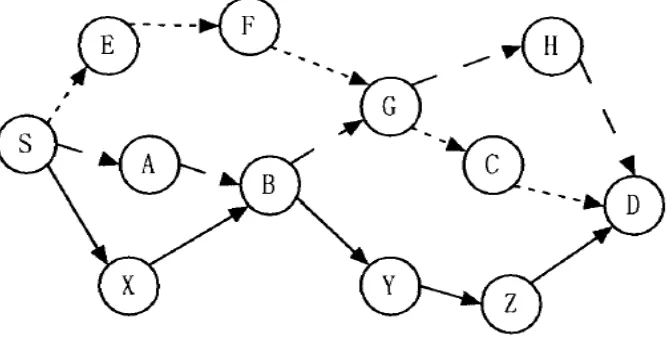
Through an example, we understand the rules of suboptimal path selection. As shown in Figure 1, in the network topology, we use ERMA algorithm. Assume that there are three paths between source node S and destination node D, which are path C (S-E-F-G-C-D), path H (S-A-B-G-H-D), path Z (S-X-B-Y-Z-D), respectively. From the received packets, in the path set of the source node to the destination node, we can know that path C and path H have shared node G, and path H and path Z have shared node B.
1. If the source node chooses path C as the main path, when the path C causes the path to break due to the failure of the node, the source node avoids the path H of the common node, and selects the path C as the secondary path according to the suboptimal path selection rule. Similarly, if the path Z is selected as the primary path, the source node selects path C as the secondary path when the primary path fails.
Fig. 1. Node topology diagram
The selection rule of the suboptimal path ensures that when the primary path fails, the source node can preferentially select the path with the least number of shared nodes as the secondary path. It reduces the probability of path chain failure, and en-hances the network's fault tolerance.
4
Experiment and result analysis
4.1 The selection of parameters
Through its network of effective sensor nodes, wireless sensor networks to perform environmental monitoring and data collection tasks. However, the validity of a sensor node depends on whether the activity of the node can monitor the acquisition data and the connectivity with other nodes in the network, that is, whether it can send and for-ward the monitoring data to the convergence node. With the increase of network run-ning time, the sensor nodes become effective nodes due to energy exhaustion or con-nectivity. When the number of active nodes in the network accounts for less than a certain percentage of all nodes, the lifetime of the sensor network is considered to be ended.
As there is no unified measurement standard for routing protocols in wireless sen-sor networks, according to the sensen-sor network routing protocol performance meas-urement method, we mainly verify the energy efficiency and transmission reliability of the algorithm. From the two aspects of the network survival time and the average packet delivery rate, we conducted a comparative analysis.
Network node survival rate: this criterion is used to compare algorithms to protect nodes with less residual energy from premature depletion. In the simulation process, the node with the residual energy value below the energy needed to receive the data packet is defined as the dead node. The standard reflects the status of nodes in a net-work at a time, and is used to reflect the length of netnet-work lifetime.
The average residual energy value of the node: this standard indicates the average energy consumption of each node in the network, which is used to reflect the average energy of each node in the network, and to reflect the length of the network lifetime from one side.
The average delivery rate of the group: The average delivery rate is defined as the ratio of the number of application layer data packets received by the sink node and the number of packets sent by the application layer of the source node in the network simulation process. It is the main measure to reflect the reliability of data transmis-sion. It can be calculated by using Equation 2. The higher the average delivery rate of the packet, the less the packet lost in the transmission process, and the better the net-work performance.
Group average delivery rate = number of successful packets received / number of packets sent (2)
4.2 Simulation results and performance analysis
The survival time of the network is the effective time of the network, which is the embodiment of the practical value of the network. This measure reflects the direct effect of the network energy consumption problem, that is, it has the same meaning as the whole network energy consumption index of the network.
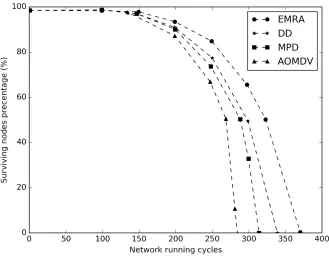
The survival rate of the network node: Network node survival can be defined in three forms: first node died, half node died and last node died. To a certain extent, the node's death time reflects the energy balance in the network. In the comparison pro-cess, if the first node dead time is short, it indicates that the wireless sensor network in the process of collecting data communication too much use of a certain number of sensor nodes for data transmission. If the death time of the first node is relatively long, it indicates that the energy consumption in the data submission process is more evenly distributed on more nodes in the network. To a certain extent, it increases the viability and effectiveness of the network. The network survival time comparison of EMRA algorithm and AOMDV protocol, DD protocol, MDP protocol is shown in Figure 2. In the figure, the ordinate is the number of surviving nodes in the network, and the abscissa is the number of rounds of data transmission. After the network is initialized, the node periodically sends data, and when a node is exhausted, it exits the network and simulates the operation until all nodes die.
and EMRA began node death in 148 cycles. The half of the EMRA node's death time is 1.2 times of the AOMDV node. The half of the EMRA node's death time is 1.08 times of the DD node. The half of the EMRA node's death time is 1.12 times of the MDP node. The death time of all EMRA nodes is 1.31 times of AOMDV. The death time of all EMRA nodes is 1.09 times of DD. The death time of all EMRA nodes is 1.18 times of MDP. From the experimental results, we can see that it significantly extends the network's survival time.
Fig. 2. The comparison curves of the number of surviving nodes
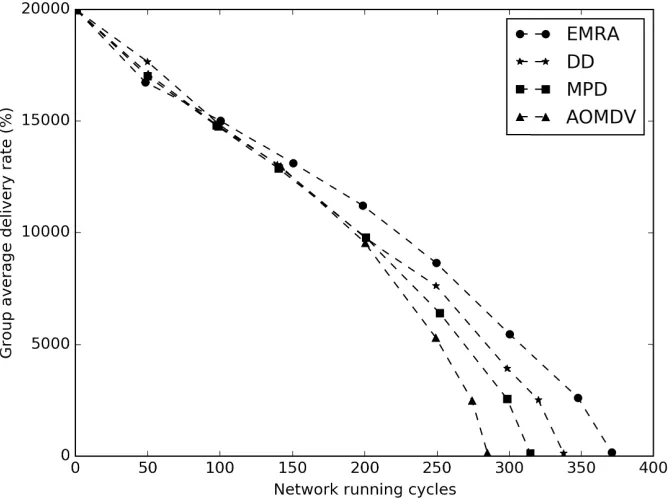
Fig. 3. The comparison curves of the average residual energy of the node
4.3 Group average delivery rate
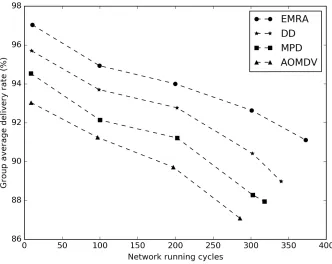
In this simulation, it is mainly to measure the ratio of the number of data packets successfully received by the sink node to the number of packets sent by the source node under different algorithms. This reflects the reliability of data transmission. Figure 4 is the group average delivery rate with time curve. In the figure, the ordinate is the average delivery rate of the group, and the abscissa is the number of cycles to complete the network operation. In the same experimental environment, the average delivery rate of the four algorithms is not the same. In the whole period of the net-work operation, the EMRA algorithm has got a better result, and it shows a high transmission reliability.
Fig. 4. The comparison curves of the group average delivery rate
5
Conclusion
6
References
[1] Anwar, A., Sridharan, D., Anwar, A., & Sridharan, D. (2015). A survey on routing proto-cols for wireless sensor networks in various environments. International Journal of Com-puter Applications, 112(5), 13-29.
[2] Guravaiah, K., & Velusamy, R. L. (2015). Rfdmrp: river formation dynamics based multi-hop routing protocol for data collection in wireless sensor networks. Procedia Computer Science, 54, 31-36. https://doi.org/10.1016/j.procs.2015.06.004
[3] Hao, J., Yao, Z., Huang, K., Zhang, B., & Li, C. (2016). A gradient-based multiple-path routing protocol for low duty-cycled wireless sensor networks. Wireless Communications & Mobile Computing, 16(5), 538-549. https://doi.org/10.1002/wcm.2552
[4] He, D., Mujica, G., Portilla, J., & Riesgo, T. (2015). Modelling and planning reliable wire-less sensor networks based on multi-objective optimization genetic algorithm with change-able length. Journal of Heuristics, 21(2), 257-300. https://doi.org/10.1007/s10732-014-9261-2
[5] Hu, Y. F., Ding, Y. S., Ren, L. H., Hao, K. R., & Han, H. (2015). An endocrine coopera-tive particle swarm optimization algorithm for routing recovery problem of wireless sensor networks with multiple mobile sinks. Information Sciences, 300, 100-113. https://doi.org/10.1016/j.ins.2014.11.052
[6] Karthick, K. ,., & Kumar, R. V. (2015). An energy-saving routing algorithm for wireless body sensor network using data compression technique. International Journal of Computer Applications, 114(15), 26-29. https://doi.org/10.5120/20055-2020
[7] Kumari, N., Gupta, D. K., & Kumar, M. (2015). Improved teen routing protocol with multi hop and multi path in wireless sensor networks. International Journal of Computer Appli-cations, 129(7), 11-16. https://doi.org/10.5120/ijca2015906783
[8] Mann, P. S., & Singh, S. (2017). Energy-Efficient Hierarchical Routing for Wireless Sen-sor Networks: A Swarm Intelligence Approach. Wireless Personal Communications, 92(2), 785-805. https://doi.org/10.1007/s11277-016-3577-1
[9] Naranjo, P. G. V., Shojafar, M., Mostafaei, H., Pooranian, Z., & Baccarelli, E. (2016). P-sep: a prolong stable election routing algorithm for energy-limited heterogeneous fog-supported wireless sensor networks. Journal of Supercomputing, 1-23.
[10] Rajasoundaran, S., Narayanasamy, P., & Riasudheen, H. (2016). A Hybrid Secure Routing and Monitoring Mechanism Using Authorized and Concealed Arbitrary Watchdogs in Wireless Sensor Network. Intelligent Systems And Communication (NCISC-2016), 177. https://doi.org/10.5958/2249-7315.2016.00664.x
[11] Rezaei, E., Baradaran, A. A., & Heydariyan, A. (2016). Multi-hop routing algorithm using steiner points for reducing energy consumption in wireless sensor networks. Wireless Per-sonal Communications, 86(3), 1557-1570. https://doi.org/10.1007/s11277-015-3006-x [12] Yigit, M., Gungor, V. C., Fadel, E., Nassef, L., Akkari, N., & Akyildiz, I. F. (2016).
Chan-nel-aware routing and priority-aware multi-channel scheduling for WSN-based smart grid applications. Journal of Network and Computer Applications, 71, 50-58. https://doi.org/10.1016/j.jnca.2016.05.015